What is Mexican Frida Blue House (Coyoacán 1930)?
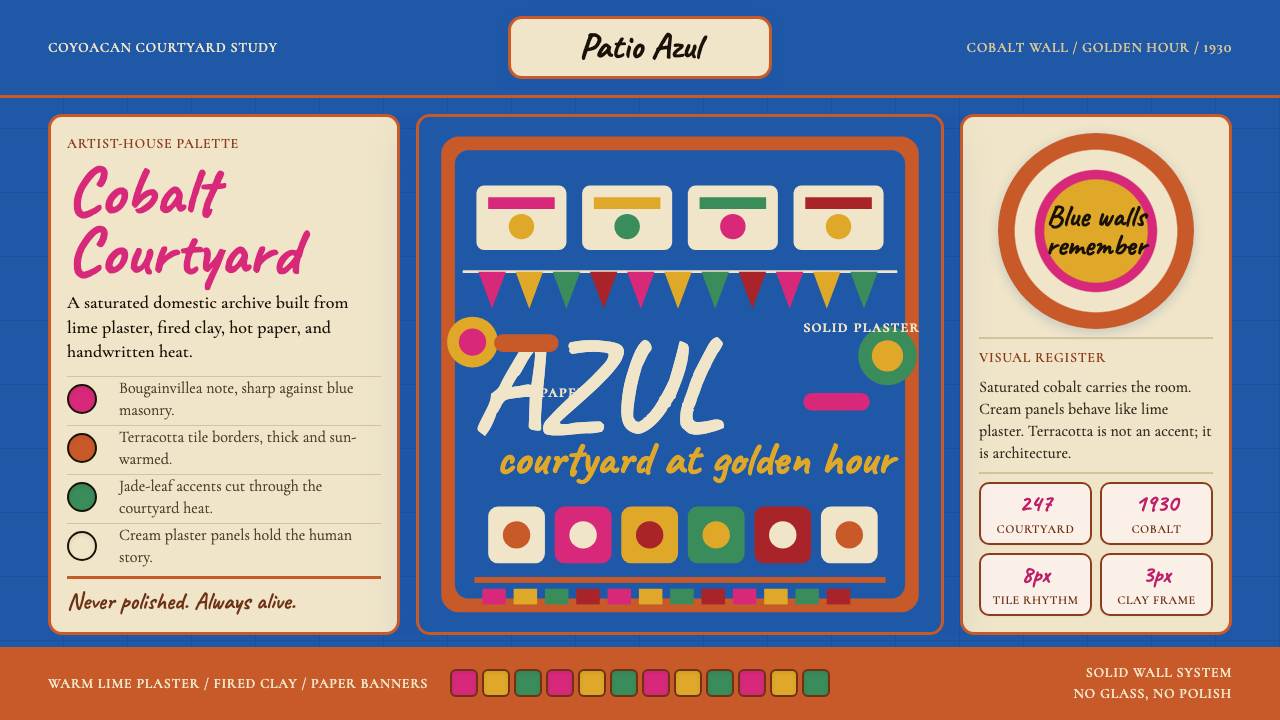
Casa Azul distills a century of Mexican color, folk devotion, and revolutionary pride into a single vibrant courtyard — and every element of its palette speaks before a word is read.
Mexican Frida Blue House (Coyoacán 1930) in brief
Mexican Frida Blue House (Coyoacán 1930) is a design system rooted in the visual world of Casa Azul — the house at Londres 247, Coyoacán, where Frida Kahlo was born, lived, and died. Its palette centers on an assertive cobalt blue that coats the exterior walls like a declaration, set against cream interior panels, terracotta tile rhythms, bougainvillea magenta, and jade-leaf green. The result is a visual language that feels simultaneously ancient and intimate, like a hand-painted altar lit by afternoon sun.
The style belongs to the broader tradition of Mexicanidad — the post-revolutionary cultural project that celebrated indigenous craft, pre-Hispanic material culture, and mestizo identity as the foundations of a new national aesthetic. Kahlo and her partner Diego Rivera were central figures in this movement, living among retablo ex-votos, Tehuana textiles, folk ceramic vessels, and papel-picado banners. Their home was not a museum but a working proof that everyday objects from Mexican craft traditions carried the same formal dignity as any European fine-art object.
Visually, the style is abundant without being chaotic. Color is used at maximum saturation but never randomly — each hue occupies a clear spatial role. The cobalt acts as a structural field, the cream as a breathing ground for text and content, terracotta as a grid accent, and the warmer accent colors — magenta, gold, and green — as points of focus. Typography carries the energy of Kahlo's diary handwriting while remaining legible; ornamental details draw from cut-paper silhouettes, floral motifs, and geometric tile patterns rather than European decorative traditions.
See the Mexican Frida Blue House (Coyoacán 1930) design system
Where does Mexican Frida Blue House (Coyoacán 1930) come from?
Casa Azul was built in 1904 by Frida Kahlo's father, the German-Hungarian photographer Guillermo Kahlo, who settled in Mexico and became one of the country's foremost architectural photographers. Frida was born in the house in 1907. The cobalt-blue color that gives the house its name was applied in the 1930s at Diego Rivera's direction — a choice rooted in pre-Hispanic practice, where indigo and mineral blue pigments were associated with Tlaloc, the rain deity, and with protective spiritual power. The blue was not merely decorative; it was a cultural argument about which tradition the household belonged to.
Rivera and Kahlo returned to Casa Azul definitively in the early 1940s after turbulent years that included their divorce and remarriage. Rivera began systematically filling the rooftop with pre-Hispanic stone sculptures, idols, and ceramic figurines — eventually assembling one of the largest private collections of ancient Mexican objects in the country. Kahlo, meanwhile, layered the interior with Tehuana dress, Catholic retablos, folk toys, dried flowers, and her own paintings. The house became the total artwork of two lives spent arguing, creating, and loving in the same contested space.
The Mexicanidad movement that shaped Casa Azul's aesthetic had its political roots in the aftermath of the Mexican Revolution (1910–1920). The revolutionary government commissioned enormous public murals — Rivera's work at the Ministry of Public Education and the National Palace being the most celebrated — to create a shared visual mythology for a newly unified nation. This indigenista project deliberately elevated folk craft, pre-Hispanic iconography, and regional textile traditions to the level of high art, rejecting the Europeanized bourgeois taste that had dominated Mexican culture under Porfirio Díaz.
Casa Azul became a public museum in 1958, four years after Kahlo's death in 1954 and one year before Rivera's death in 1957. Rivera donated the house and its contents to the Mexican people. Today it is one of the most visited sites in Mexico City, and its chromatic vocabulary — cobalt exterior, terracotta courtyard, cream-painted rooms, marigold plantings — has influenced everything from Mexican restaurant design to contemporary brand identity work seeking warmth, cultural specificity, and unapologetic color.
What defines the Mexican Frida Blue House (Coyoacán 1930) look?
Cobalt Wall Color
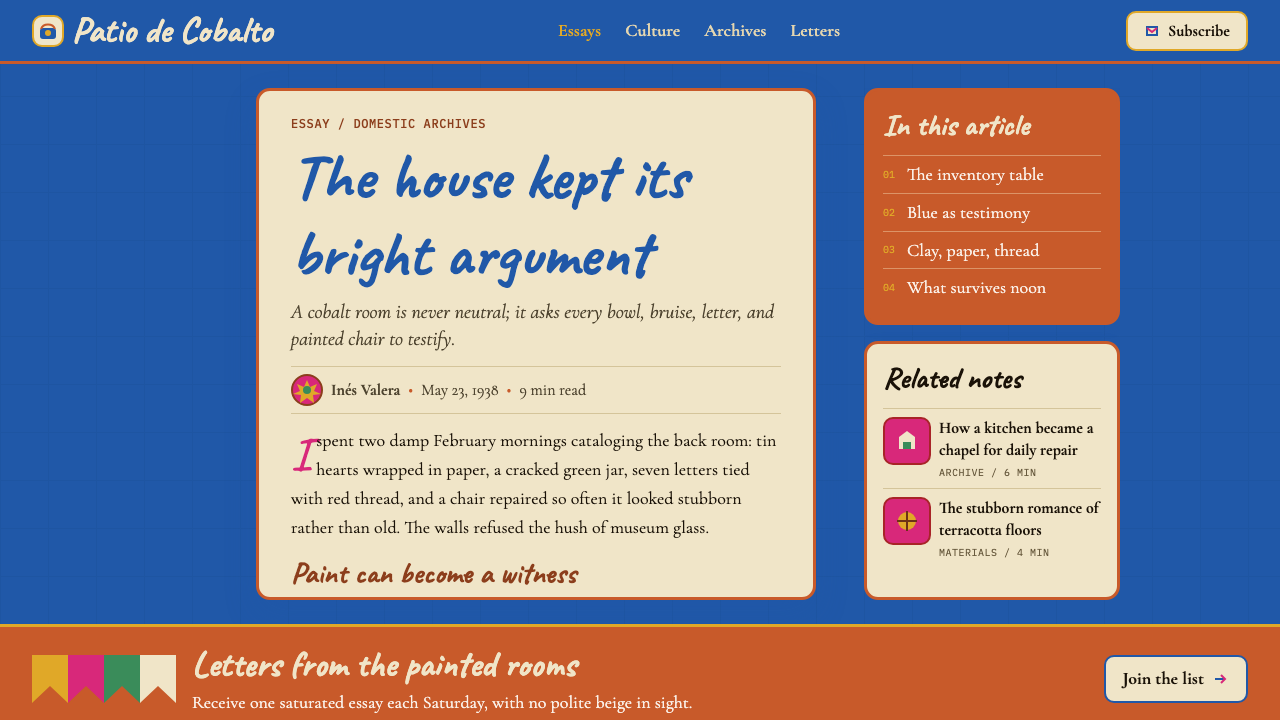
The dominant note of the entire system is a saturated, slightly warm cobalt blue — not the cool distance of cerulean, not the gravity of navy, but a blue that reads as celebratory and grounded at the same time. It is used at full saturation for large structural fields: backgrounds, hero sections, sidebar panels. The color carries an air of protection and declaration, as it did on the original lime-plastered walls that have faced Coyoacán's streets for nearly a century.
Terracotta Grid Accents
Terracotta — the warm, fired-earth tone of Mexican clay pots and Talavera tile — functions as the structural grid accent of the system. It appears as borders, divider lines, card edges, and rhythmic decorative bands. Against cobalt it reads as warmth and contrast; against cream it reads as grounding and craft. This interplay between the cool dominance of blue and the warm punctuation of terracotta is the fundamental tension that gives the style its energy.
Cream Content Panels
Where blue dominates structure, cream provides relief. Content panels, card bodies, and text-heavy areas use a warm off-white that suggests unbleached cotton, aged paper, or the interior walls of a Mexican colonial house — never the clinical sharpness of pure white. This warmth ensures that long-form reading remains comfortable even when surrounded by intensely saturated color. The cream also makes the overall composition feel handmade rather than digital: it has the quality of something lived-in.
Bougainvillea Accent and Folk Warm Tones
Beyond the core triad of cobalt, terracotta, and cream, the system draws on a secondary palette of bougainvillea magenta, marigold gold, and jade green — the colors of Kahlo's courtyard plantings. These appear as highlight colors, call-to-action elements, and celebratory decorative touches. They are used sparingly and never compete with the dominant cobalt; a single magenta button or a marigold icon is sufficient to bring the full warmth of the courtyard into a digital interface.
Papel Picado and Cut-Paper Rhythm
One of the most distinctive decorative signatures of the style is derived from papel picado — the Mexican tradition of cutting intricate geometric and floral patterns into tissue paper banners that are strung across courtyards for festivals. Translated into digital surfaces, this gives rise to border treatments, divider patterns, and decorative frames that feel perforated, layered, and festive. The patterns are geometric in underlying structure but organically rounded at the edges — the opposite of Swiss precision.
Handwritten and Serif Type Mix
Typography in this system lives between two registers: the intimate energy of Kahlo's diary handwriting — expressive, personal, with irregular baseline and flourished terminals — and the composed authority of classical Garamond-style serif body text. Display text leans into the handwritten register, giving headlines and labels a human presence; body text opts for legible elegance. Neither extreme is purely decorative or purely functional — they meet at a point of warm literacy.
Tactile Surface Quality
The style consciously evokes physical materials: sun-warmed lime plaster, fired clay, cut paper, embroidered cotton. In digital use, this manifests as subtle texture overlays on solid color fields, slightly rough-edged decorative elements, and shadows that suggest depth without full skeuomorphism. The goal is not to simulate a photograph of a wall but to evoke the sensory memory of one — a warmth you associate with a place rather than a production technique.
See the Mexican Frida Blue House (Coyoacán 1930) design system
Who shaped Mexican Frida Blue House (Coyoacán 1930)?
Kahlo (1907–1954) was born in Casa Azul, returned to it after her injury and medical struggles, and died there at forty-seven. Her self-portraits — painted largely while bedridden — are inseparable from the visual world of the house: Tehuana headdresses, pre-Hispanic necklaces, tropical foliage, and the bold flat color planes that also characterized her home's interior. She kept a diary in the final decade of her life whose handwritten pages, mixing poetry, illustration, and color, constitute one of the most vivid documents of any artist's inner life. The diary's visual sensibility — intimate, maximalist, and technically unashamed — is the emotional register that this design system aims to honor.
Rivera (1886–1957) was the most celebrated muralist in Mexican history, and it was his hand that painted Casa Azul cobalt blue. His monumental public murals at the Ministry of Public Education and the National Palace established the visual language of the post-revolutionary Mexican state: large flat color planes, indigenous figures treated with heroic dignity, pre-Hispanic symbols woven into scenes of contemporary labor and struggle. Rivera's compositional approach — bold color masses, clear human silhouettes, rhythmic patterning — is one of the structural ancestors of this design system's approach to layout and figure.
Hayden Herrera's 1983 biography of Frida Kahlo is largely responsible for the global canonization of both Kahlo's life and the visual world of Casa Azul. Before Herrera's book, Kahlo was known primarily in Mexican art circles; after it, she became one of the most recognizable artist-figures in the world. Herrera's work catalyzed the broader cultural appetite for Kahlo's aesthetic — the colors, the self-presentation, the house itself — that has continued to grow for four decades and that gives this design system its contemporary cultural resonance.
Modotti (1896–1942) was an Italian-born photographer and political activist who lived in Mexico City during the late 1920s and was close to Kahlo and Rivera's circle. Her photographs of Mexican workers, Tehuana women, and folk objects — shot with formal precision but emotional warmth — helped establish the visual archive that the Mexicanidad movement drew on. Modotti's eye for the dignity of ordinary Mexican material culture, and her technical commitment to strong tonal contrast and geometric composition, prefigure several of the visual instincts that the Blue House style embodies.
Frida's father Guillermo Kahlo (1871–1941) was a German-Hungarian immigrant who settled in Mexico and became one of the country's foremost architectural photographers, commissioned by the Díaz government to document colonial-era buildings. His careful, respectful attention to Mexican vernacular architecture and craftsmanship established a visual sensibility in the Kahlo household that valued Mexican built culture long before it became fashionable. He also suffered from epilepsy and passed periods of fragility to his daughter, which shaped her understanding of the body as both material object and site of meaning — a theme that runs through her painting and, by extension, through the intimate, embodied quality of the Blue House aesthetic.
How do you use Mexican Frida Blue House (Coyoacán 1930) today?
The Blue House palette is one of the most immediately recognizable and emotionally resonant historical design systems available to contemporary practitioners — but its richness demands discipline. The cobalt and terracotta at full saturation will dominate any composition they enter; the system works when these heavy colors are given large, confident fields, not scattered as small accents across a neutral background. Applying it well means committing to the palette's logic: cobalt for structure, cream for content, terracotta for accent rhythm, and the warm secondary colors used sparingly as points of celebration.
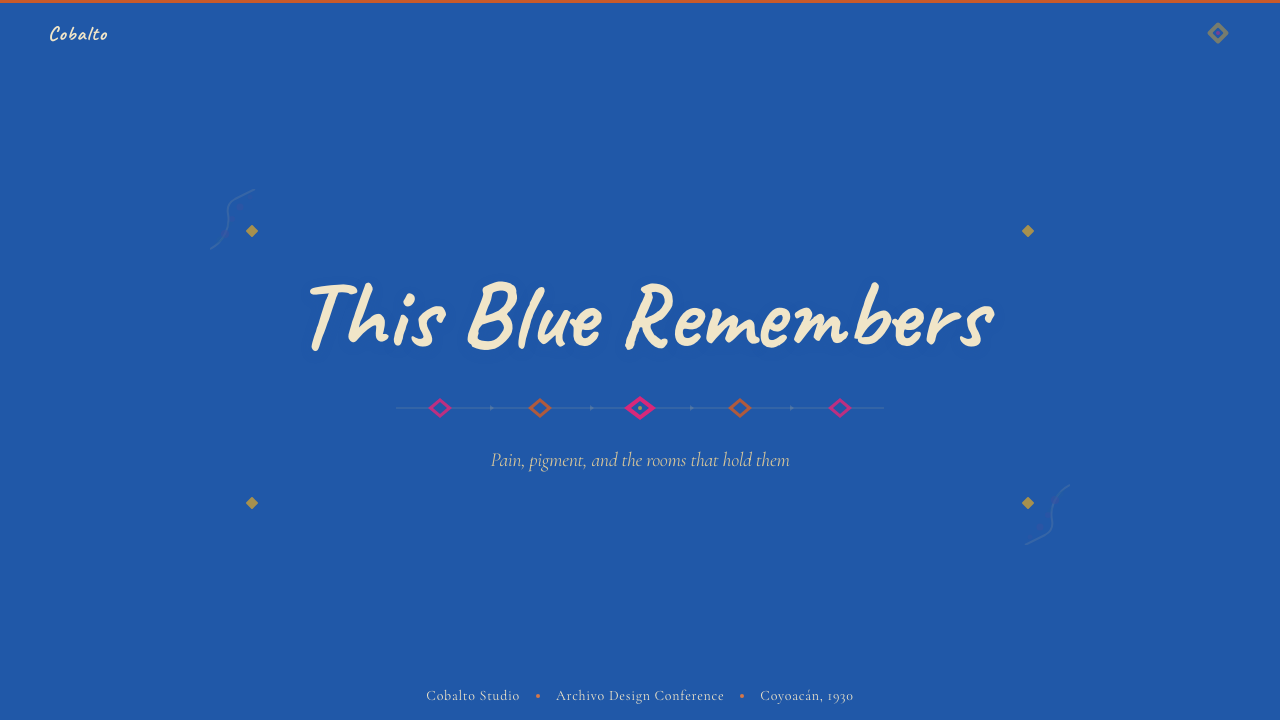
For presentation slides, Casa Azul works powerfully on cover pages where the cobalt blue can fill the entire background, with a cream or white text field positioned asymmetrically and a terracotta decorative band or border grounding the composition. The handwritten or expressive display typeface belongs in headlines only; body text on content slides should shift to the composed serif register for legibility across screen distances. Data slides benefit from the terracotta-and-gold palette applied to charts and diagrams — bars and segments feel like ceramic tile rather than software defaults — while the cobalt field can be reserved for section headers or category labels.
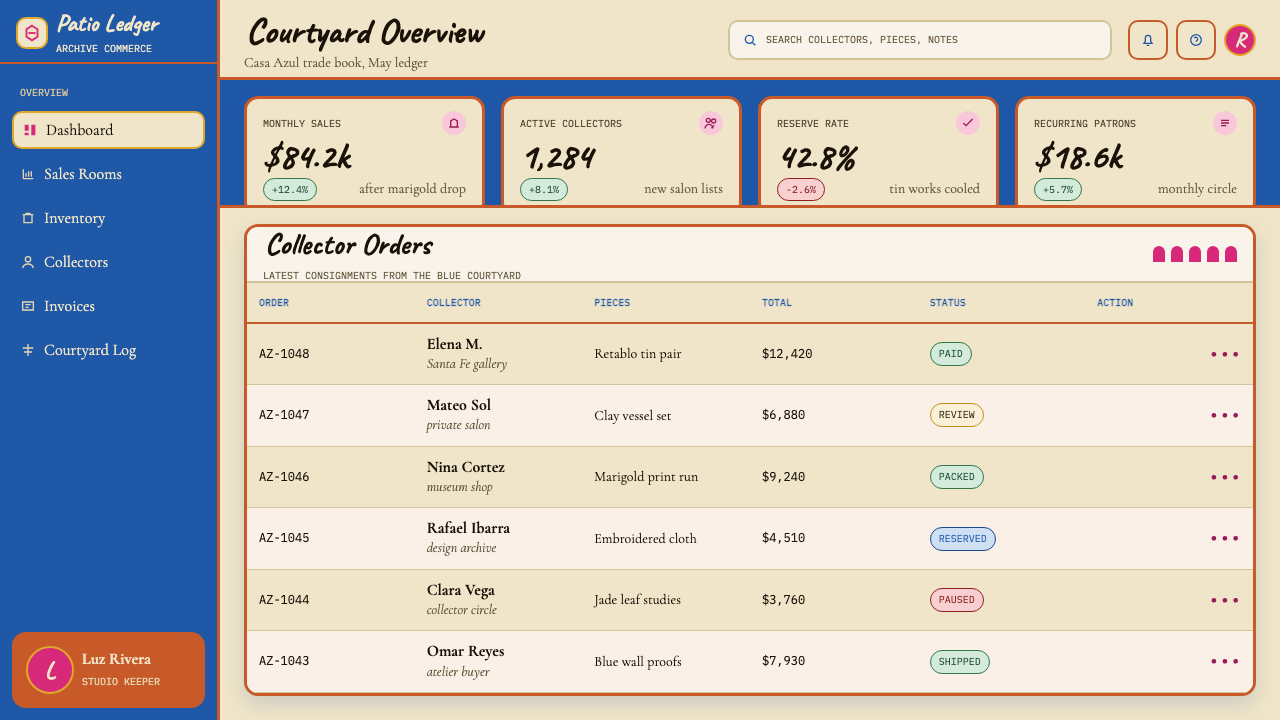
For web UI, the style is best suited to contexts that benefit from warmth, cultural specificity, and confident color: a brand landing page for a Mexican or Latin American product, a cultural institution's public-facing site, a food or hospitality brand, or any project where the goal is to evoke a specific place and time. Dashboard applications are possible but require the cobalt to be used more sparingly — perhaps only in the sidebar and key metric tiles — with cream and warm neutrals carrying the content-heavy areas. Pricing pages can use the bold color contrast effectively for tier differentiation, with the most premium tier rendered in deep cobalt.
For editorial and marketing work, the style excels at magazine-style feature pages where visual rhythm and generous margins allow the palette to breathe. The papel picado-derived border treatments work well as section dividers or pull-quote frames. A marigold or magenta call-to-action element against a cobalt background is one of the most visually arresting combinations in the system. Marketing headers that mix the display handwritten font with a large cobalt color field immediately signal warmth, cultural depth, and specificity — the opposite of generic brand minimalism.
A common mistake is treating this system as license for indiscriminate color maximalism. Casa Azul itself is disciplined: the courtyard has one dominant color (cobalt), a few large secondary presences (terracotta tile, cream wall surfaces, marigold beds), and small punctuations of magenta and green. Digital applications that deploy all five colors at comparable saturation across the same composition quickly become overwhelming. Similarly, mixing the handwritten display face into body text loses the system's typographic contrast — the handwritten register must remain reserved for the short, high-impact moments where Kahlo's diary energy is the point, not a running texture.
See the Mexican Frida Blue House (Coyoacán 1930) design system
Mexican Frida Blue House (Coyoacán 1930) — FAQ
Is this style appropriate for brands with no connection to Mexico?
It can be, but the question deserves honest attention. Casa Azul's visual language carries specific cultural weight — it is rooted in post-revolutionary Mexican identity, indigenista politics, and the particular biography of two artists. Using it superficially, as a source of vibrant color without engaging its cultural meaning, risks reducing a rich tradition to mere decoration. The most defensible approach for brands without a Mexican connection is to engage the style's principles — abundant color, tactile warmth, folk-craft pattern rhythm — while building on the specific cultural iconography lightly and transparently, crediting the tradition in communication where relevant.
How does this style differ from other Latin American or folk-art-influenced palettes?
The key distinctions are structural rather than purely chromatic. Many folk-art-influenced palettes use bright colors but without the underlying spatial logic of Casa Azul's system. The Blue House approach has a clear hierarchy: one dominant structural color (cobalt), a breathing neutral (cream), a grid accent (terracotta), and then sparing warm accents. This hierarchy makes the system readable and scalable rather than merely festive. Additionally, the Blue House style carries specific historical and artistic references — Kahlo's diary handwriting, retablo imagery, papel picado geometry — that are more precisely situated than generic folk-art inspiration.
Can the Blue House style work for professional or institutional contexts, or is it too festive?
The style is more versatile than it might first appear. Frida Kahlo herself was a serious professional artist navigating a largely male art world, and Casa Azul was both a personal sanctuary and a professional workspace. The visual system can carry authority when the cobalt is deployed at large scale and the warmer accent colors are used sparingly — the result reads as confident and culturally grounded rather than frivolous. Cultural institutions, universities with Latin American studies programs, government tourism communications, food and hospitality brands, and health and wellness brands with a place-based identity are all plausible institutional contexts. It struggles in settings that require cold neutrality, such as legal services, financial products, or enterprise software.
How should imagery and photography be handled in this style?
Photography works well in this system when it shares the palette's warmth and tactility — images shot in golden-hour light, with warm tonal casts, in physical spaces that feel lived-in rather than staged. Still-life photography of craft objects, textiles, ceramics, or food fits naturally. Architectural photography of vernacular Mexican buildings and courtyard spaces aligns directly with the style's sources. What to avoid: cold-toned or desaturated photography that fights the cobalt and terracotta; highly processed images with heavy vignettes or artificial bokeh that undermine the style's commitment to surface warmth; and stock photography with generic office or technology settings that the palette will always overwhelm rather than enhance.
What distinguishes an authentic application of this style from a superficial one?
The difference lies in whether the spatial logic and emotional register are honored, not just the colors. A superficial application puts cobalt and terracotta on a layout that is otherwise governed by generic digital minimalism — the colors are present but the system's warmth, hierarchy, and craft sensibility are absent. An authentic application commits to the cream panels as breathing grounds for content, uses the handwritten type register at the right emotional moments rather than as a blanket treatment, deploys terracotta as a structural rhythm rather than a random accent, and allows the composition to be generous and layered rather than minimal and sparse. The question to ask is: does this feel like something made by hand in a specific place, or does it feel like a color filter applied to a template?
Related design styles
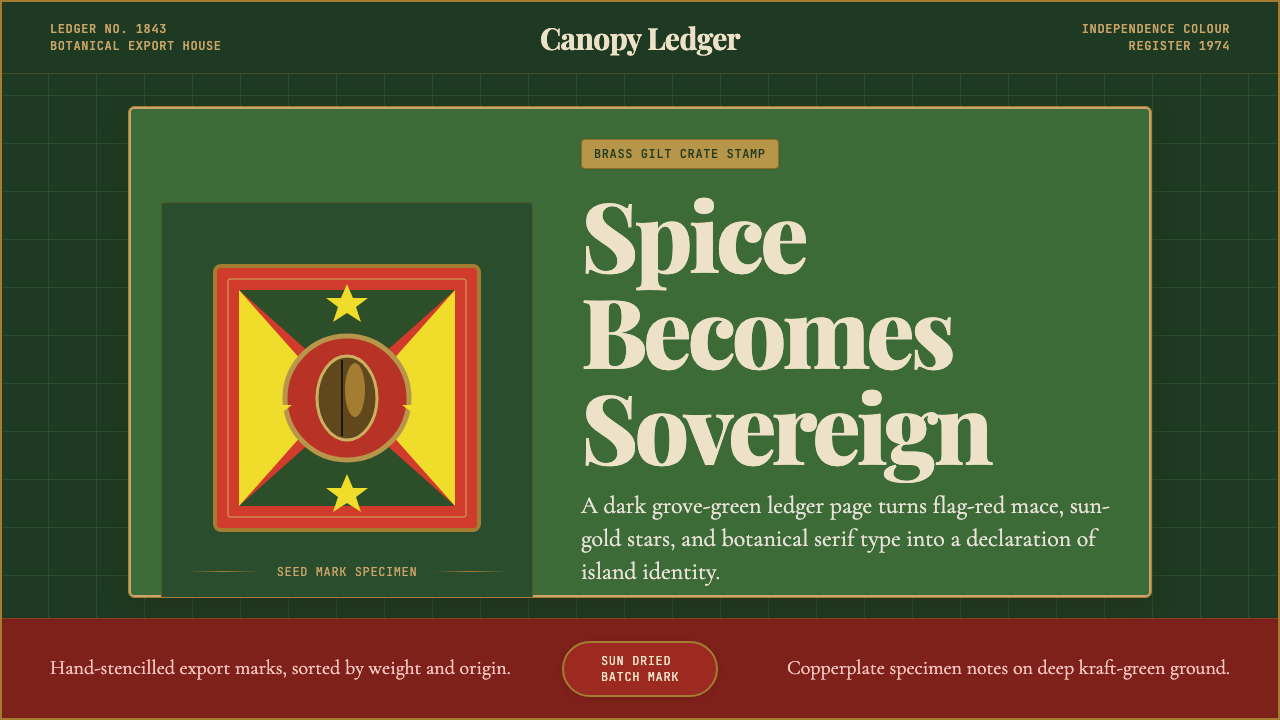 Grenadian Spice & Nutmeg FlagSpice becomes sovereign. Grove green, flag red, brass borders, and serif ledg…
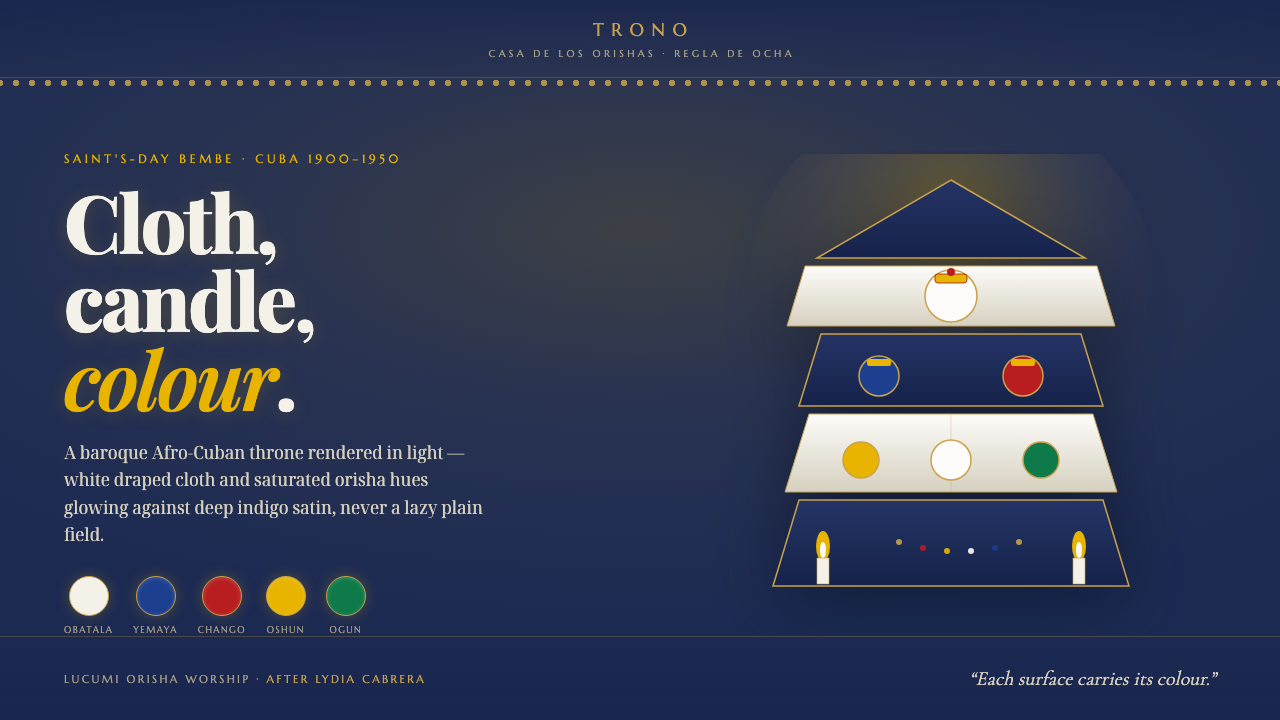 Santeria Altar BembeBaroque Afro-Cuban orisha throne. Saturated hues and white cloth glow on indi…
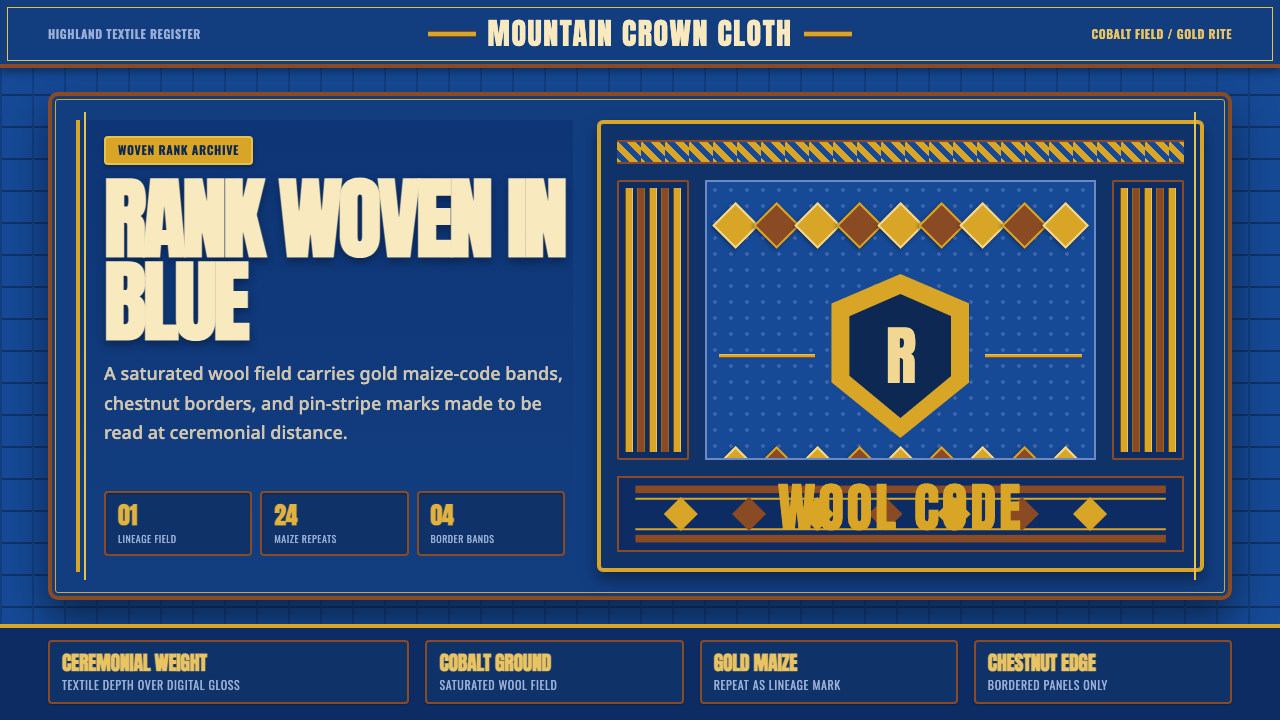 Basotho Seanamarena BlanketRank made visible. Cobalt wool, gold maize diamonds, and chestnut borders rea…
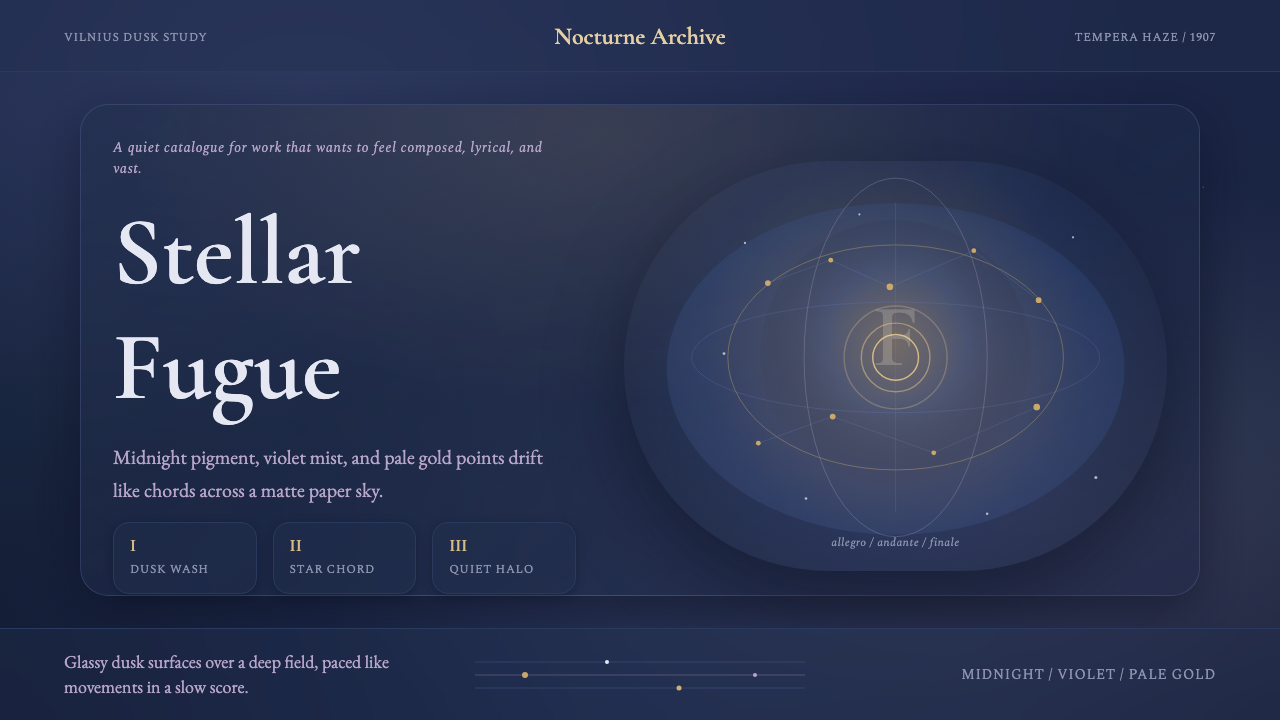 Čiurlionis SymbolismCosmos becomes music. Midnight blue-violet washes and pale gold stars drift i…
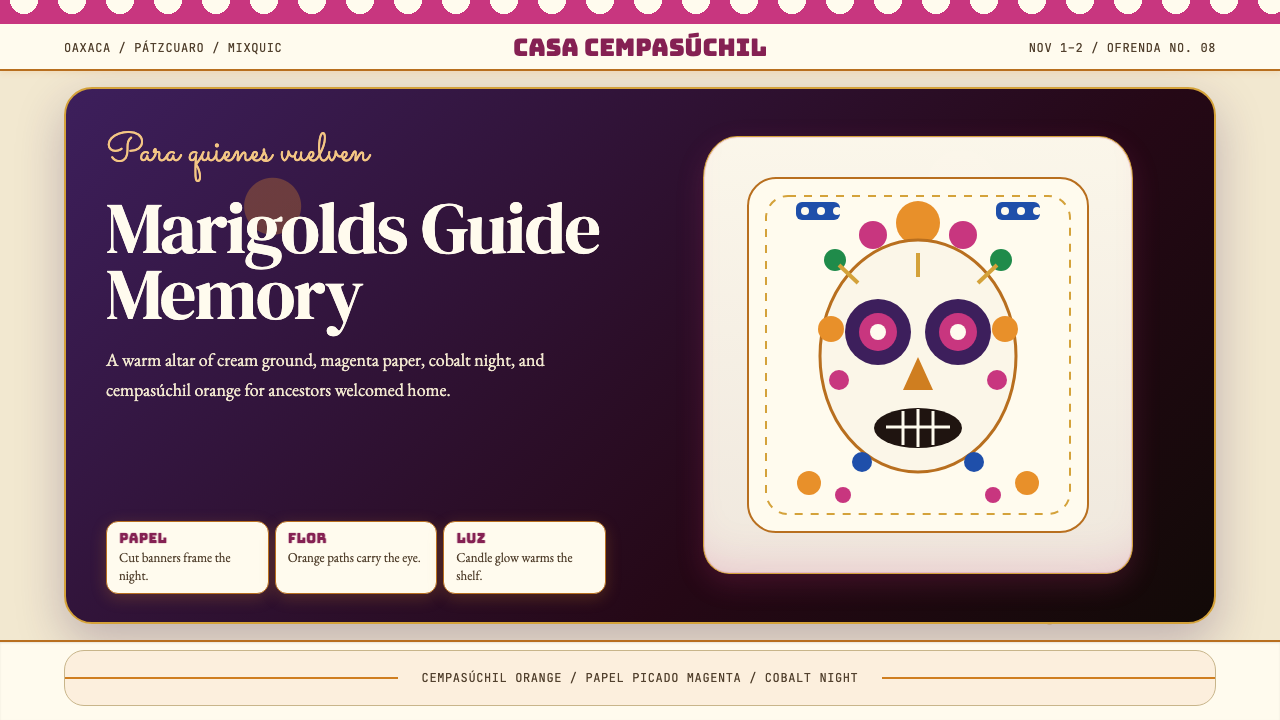 Día de los MuertosRemembrance glows. Marigold orange, magenta papel picado, and cream altar tie…
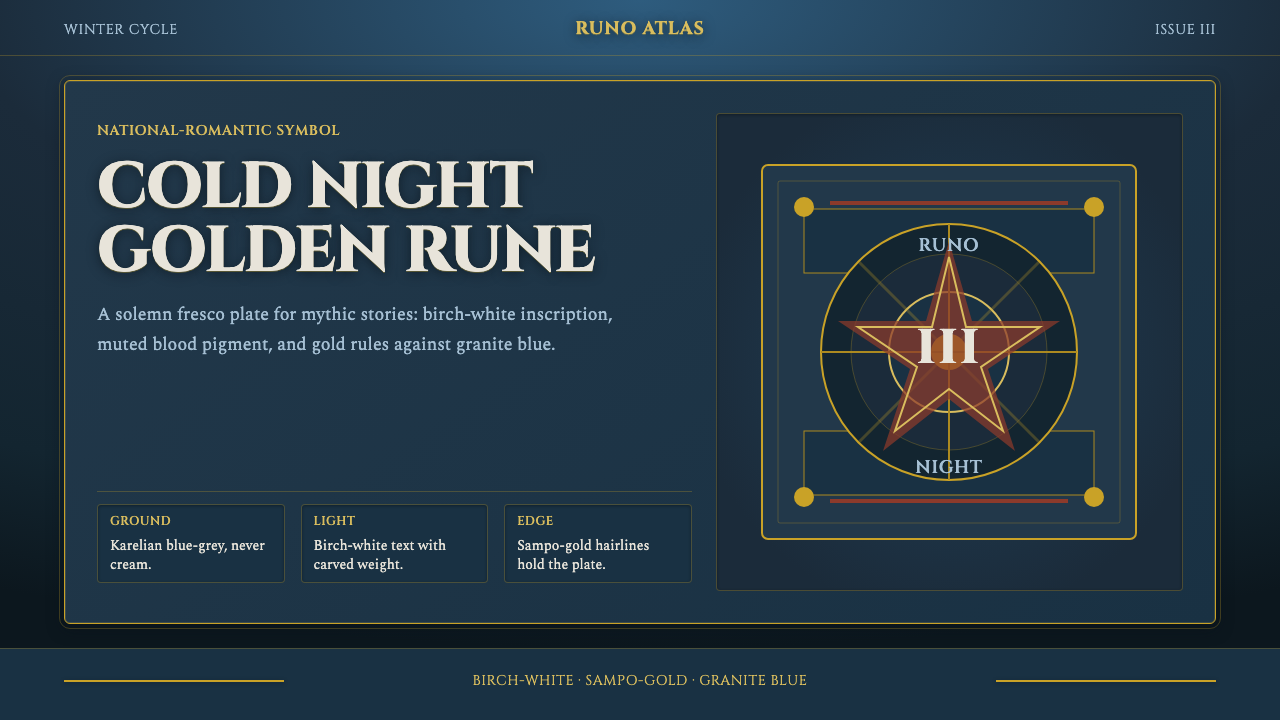 Finnish Kalevala EpicEpic weight in cold night. Birch-white Cinzel, Sampo-gold rules, blue-grey fr…