What is Grenadian Spice & Nutmeg Flag?
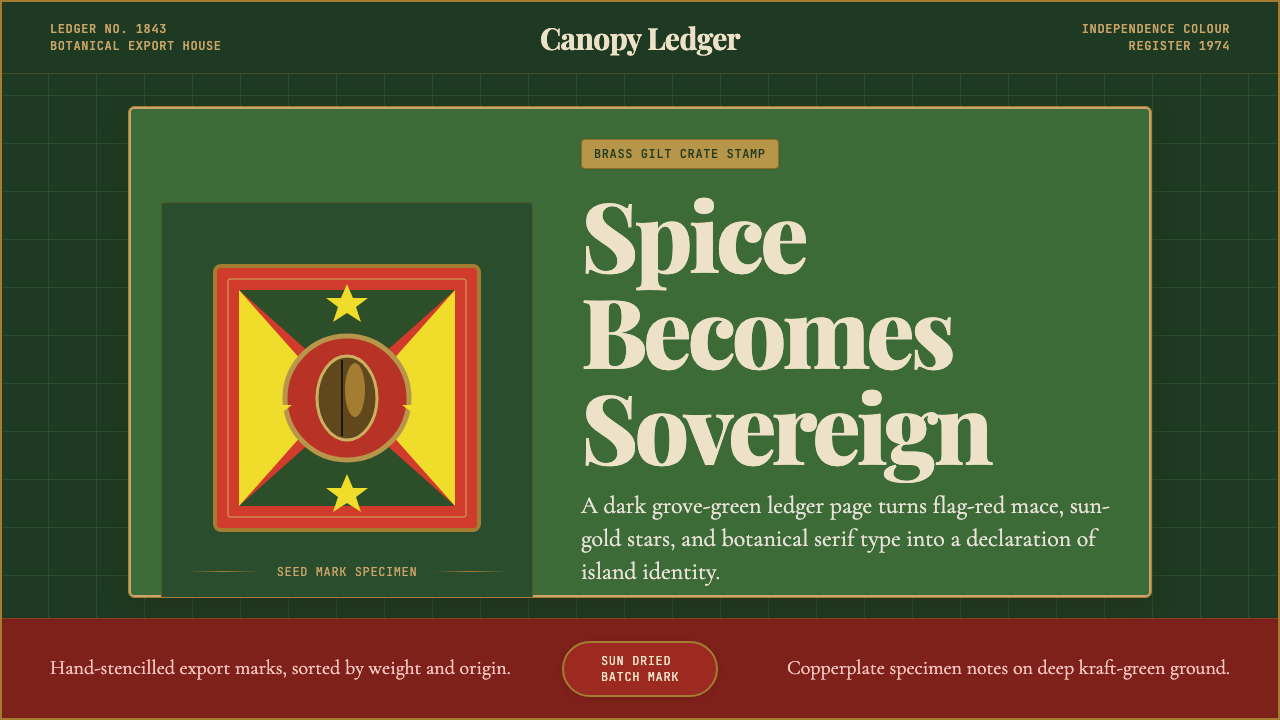
Grenada put a nutmeg on its flag, and this design style turns that audacious act of botanical sovereignty into a complete visual language of spice-grove greens, brick reds, and brass-gilt warmth.
Grenadian Spice & Nutmeg Flag in brief
The Grenadian Spice and Nutmeg Flag style is a design vocabulary rooted in the visual heritage of the Caribbean spice trade — specifically Grenada, the world's most celebrated nutmeg producer and the only nation whose national flag bears the likeness of the spice. The aesthetic draws from three overlapping archival traditions: the hand-stencilled crate stamps used to mark export consignments at the Gouyave and Grenville cooperatives, the copperplate botanical illustration plates produced by European naturalists documenting the island's flora, and the kraft-paper-and-brass-gilt sensibility of nineteenth-century merchant ledgers and spice-house signage.
At its core, the style is a post-colonial reclamation of colonial-era visual forms. The crate stamp, the botanical plate, and the merchant ledger were all instruments of the plantation economy — tools of valuation, classification, and extraction. This design system reappropriates their aesthetic grammar and regrounds it in Grenadian identity, particularly the tricolour of the 1974 independence flag: the deep canopy green of the nutmeg grove, the brick red of the dried nutmeg shell, and the bright gold of the flag's star medallions.
The resulting visual language occupies an unusual register: it is simultaneously archival and contemporary, earthy and ceremonial, humble in its craft references and proud in its cultural assertion. It functions as a design system that carries meaning at multiple levels — a palette that is historically legible, a typographic sensibility drawn from the ledger and the botanical plate, and a textural character derived from the physical materials of the spice trade itself.
Where does Grenadian Spice & Nutmeg Flag come from?
Nutmeg arrived in Grenada in 1843, when a single consignment of seeds was introduced to the island. The crop thrived in Grenada's volcanic soil and humid valleys, and by the early twentieth century the island had become one of the world's two dominant nutmeg producers, alongside Indonesia. The spice cooperative system — centered on the Grenada Cooperative Nutmeg Association, founded in 1947 — brought smallholders together under collective ownership, creating the processing and export infrastructure whose visual identity directly informs this design style. The stamps, crates, and ledgers of the cooperative era are the style's primary archival source.
The national flag adopted at independence on 7 February 1974 was designed with deliberate symbolic density. Its designer, Anthony C. George, arranged a bicolor field of gold and green — the nutmeg grove and its fruit — divided by red borders representing the warmth and vitality of the people. A nutmeg is placed in the hoist-side green triangle: the only vegetable symbol on any sovereign nation's flag. This was not incidental branding. Grenada's economy was, and to a significant degree remains, dependent on nutmeg and mace (the red aril that encases the nutmeg seed). The flag declares that dependency as identity.
The botanical illustration tradition that feeds into the style's decorative register has a longer history. European natural history expeditions of the seventeenth through nineteenth centuries produced detailed copperplate engravings of the Myristica fragrans plant — root, trunk, leaf, flower, fruit, and the split nut revealing the mace-wrapped seed within. These images circulated through botanical journals and were reproduced on spice-company labels, packaging, and promotional materials. Their visual logic — precise linework, labeled diagrams, restrained decorative borders — passed into the commercial idiom of the spice trade and left a traceable mark on how Caribbean botanical products were packaged and presented across several centuries.
The post-independence political history of Grenada also shadows this style's character. The 1979 revolution led by Maurice Bishop and the New Jewel Movement, and the subsequent 1983 US invasion, brought the island unusual global attention and complicated its relationship with colonial and post-colonial visual symbolism. Historian and cultural scholar Beverley Steele documented the richness of Grenadian folk tradition and the particular way the island's communities used decorative and craft objects to assert cultural continuity through political disruption. The style carries that assertion quietly — it is not protest art, but it wears its sovereignty visibly.
What defines the Grenadian Spice & Nutmeg Flag look?
Color Palette
The palette is anchored by three flag-derived hues: a deep, shadowed grove green that reads almost like a dark forest canopy, a brick red that recalls the dried nutmeg shell and the flag's border bands, and a warm amber-gold drawn from the flag's star medallions and brass-gilt label printing. These sit against grounds of aged kraft — the warm off-white of unbleached paper — or near-black inkwash. The cocoa-brown of the seed interior and the crimson of the mace aril appear as secondary accents. The palette is earthy and saturated but never garish; it carries the density of pigment applied to physical material rather than the brightness of backlit color.
Typography
The typographic register draws from two historical sources: the serif ledger typefaces used in nineteenth-century merchant accounting books, and the condensed stencil letterforms of export crate stamps. Display type tends toward tall, slightly compressed serifs with sturdy bracketing — the kind of letterform designed for legibility in copperplate reproduction and bookkeeping at small sizes. Stencil-style headlines introduce a rougher, more manual character, as though cut from craft board and pressed through a screen. The combination creates a layered hierarchy: formal and institutional at the detail level, physical and handmade at the headline level.
Texture and Surface
Texture is central rather than decorative in this style. The visual language actively evokes physical materials: the grain of unbleached kraft paper, the slight bleed of ink into a fibrous surface, the embossed relief of a brass seal, the layered lacquer of a tin spice canister. In digital or print application, this means surface treatments that suggest material depth — subtle paper grain overlays, slight ink irregularity in edges and type, aged or foxed margins — without crossing into nostalgic pastiche. The texture serves to root the design in the physical world of the spice trade rather than the smooth surfaces of contemporary digital production.
Decorative Motifs
The primary decorative vocabulary is botanical: the nutmeg fruit in cross-section revealing the mace-encased seed, the Myristica fragrans leaf in naturalistic or stylized engraving style, and the radiating star form taken from the Grenadian flag's seven-pointed stars. Secondary motifs include compass roses and directional charts referencing trade routes, rope-and-knot borders drawn from maritime tradition, and the concentric ruled lines of the export stamp and customs seal. These motifs appear as structural framing devices — borders, corner ornaments, section dividers — rather than as illustrative fill.
Composition
Layouts in this style tend toward centered or near-centered compositions, in contrast to the asymmetric dynamism of modernist systems. The crate stamp and botanical plate — both primary references — are traditionally centered, formally balanced, and structured around a clear visual hierarchy: a dominant central image or name, surrounded by secondary information arranged in concentric or radial order. This centering reads as ceremonial rather than passive; it places the subject at the heart of the composition as an object of attention and value.
Illustration Register
When figurative imagery appears, it follows the disciplined conventions of scientific botanical illustration: clean controlled linework, cross-hatching for shadow and depth, labeled callouts identifying plant parts, and the characteristic combination of the whole fruit alongside its dissected interior. This illustration register is neither purely decorative nor purely documentary — it carries the prestige of scientific authority while celebrating the beauty of the subject. Digital applications of the style often translate this into high-contrast engraving-style illustration or vector-drawn botanical motifs that echo the copperplate source.
Dark Field and Light Figure
The style is comfortable with dark grounds — the deep grove green and near-black inkwash — against which type, botanical motifs, and gold-gilt ornament appear in warm light tones. This dark-field-light-figure relationship references the printing tradition of the spice label, where dark backgrounds were used to make gold and cream lettering pop with a richness legible at commercial scale. In the flag itself, the green and red fields provide the dark ground against which the gold star medallions assert themselves. This relationship gives the style a ceremonial weight that lighter schemes cannot achieve.
Who shaped Grenadian Spice & Nutmeg Flag?
George designed the Grenadian national flag adopted at independence in 1974, embedding the nutmeg at the center of its hoist-side triangle. The decision to place a food crop on the sovereign flag was a deliberate post-colonial assertion: identity rooted in agricultural labor and cooperative economy rather than colonial heraldry. George's compositional choices — the seven stars, the tricolor field, the botanical center — established the visual vocabulary that this design style directly inherits.
Steele, a Grenadian historian and cultural scholar, documented the folk traditions, material culture, and visual practices of Grenadian communities through decades of research. Her work traced the ways ordinary Grenadians used craft, decoration, and symbolic objects to maintain cultural identity through colonialism and political upheaval. The design style's rooting in cooperative-era material culture — the stamp, the crate, the ledger — draws on the traditions Steele chronicled and preserved.
Bishop led the 1979 New Jewel Movement revolution that briefly transformed Grenada's political and cultural landscape before his assassination in 1983. His government promoted a Grenadian cultural identity that emphasized the island's own agricultural and folk heritage over imported models. The period shaped how Grenadian symbols — including the nutmeg — were mobilized in public life, and the design style's assertion of local botanical identity over European colonial aesthetics carries an echo of the cultural politics of that era.
Founded in 1947, the GCNA became the institutional backbone of the Grenadian spice economy, providing smallholder farmers with collective bargaining power, processing facilities, and export infrastructure. Its visual identity — cooperative stamps, crate markings, ledger accounting — constitutes the primary archival material from which this design style draws its commercial and craft references. The GCNA's post-independence role in asserting Grenadian ownership over a historically colonial export crop makes its visual language an act of economic sovereignty as well as aesthetic tradition.
How do you use Grenadian Spice & Nutmeg Flag today?
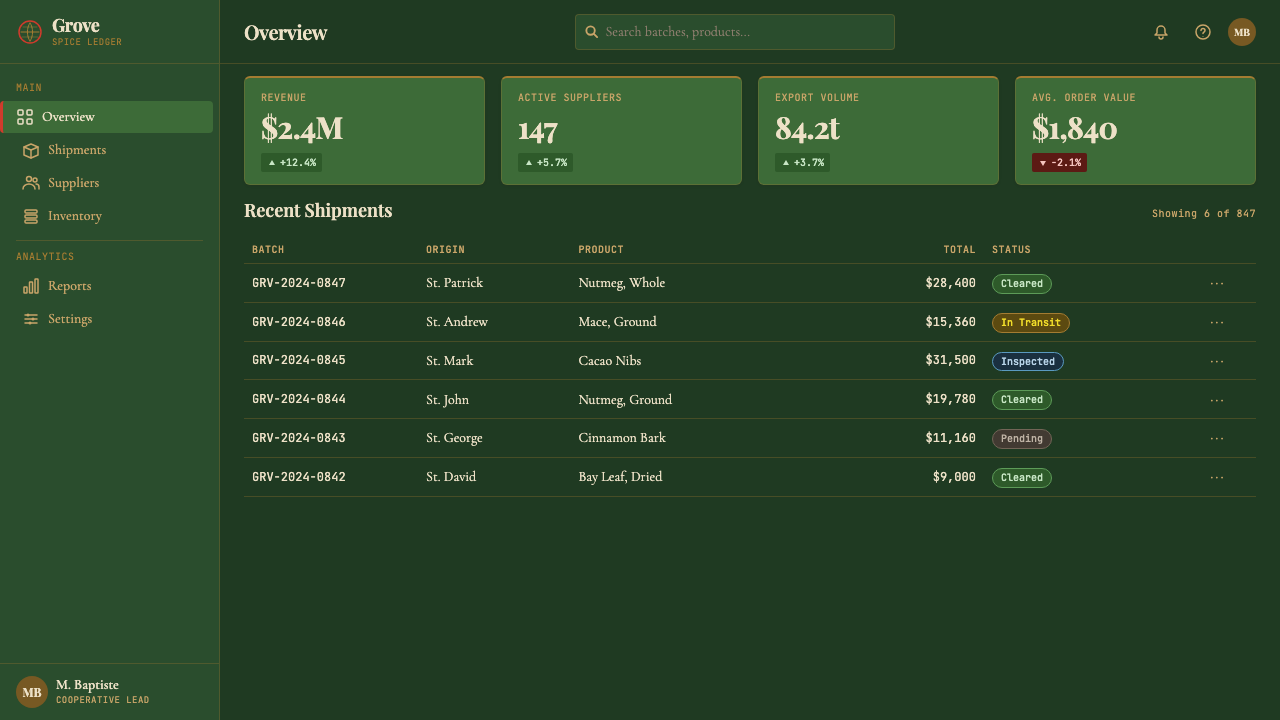
The Grenadian Spice and Nutmeg Flag style translates most naturally into contexts where warmth, cultural specificity, and material richness are desired values — food brands, artisan products, cultural institutions, tourism, and any project whose brand story involves provenance, craft, or place. It is substantially less suited to clinical, technological, or high-abstraction contexts where its density and ceremonial weight would create tonal friction. Understanding this alignment — where the style's values serve the project's values — is more important than any technical application detail.
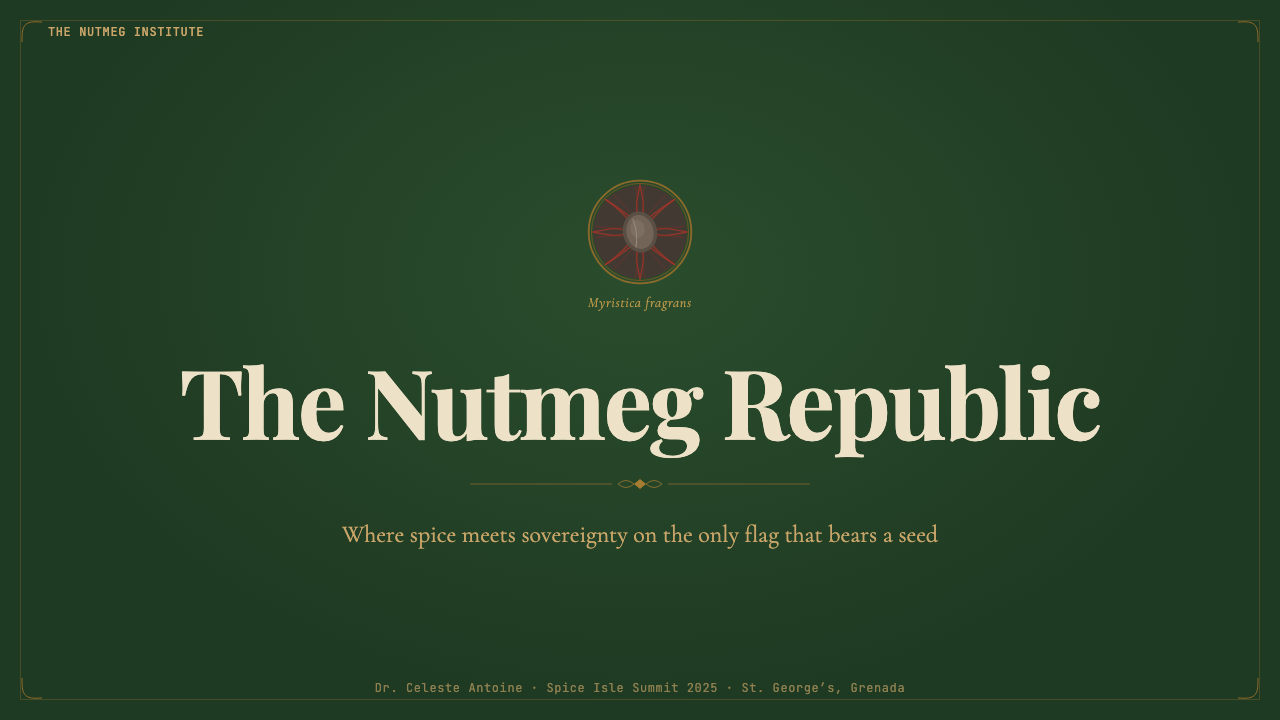
For presentation slides, the style works best on covers and section dividers that need to carry visual authority and cultural presence. A cover built in this register might pair a centered botanical engraving-style illustration with display type set in a tall bracketed serif, on a deep grove-green or aged-kraft ground. Content slides should restrain the texture: use the color palette without the material surface treatments, keeping the body of the presentation legible and uncluttered. Data slides work well with the botanical-illustration logic applied to charts — use the palette's earthy, saturated hues to distinguish data series, and frame charts with the style's ruled-line borders rather than default software gridlines.
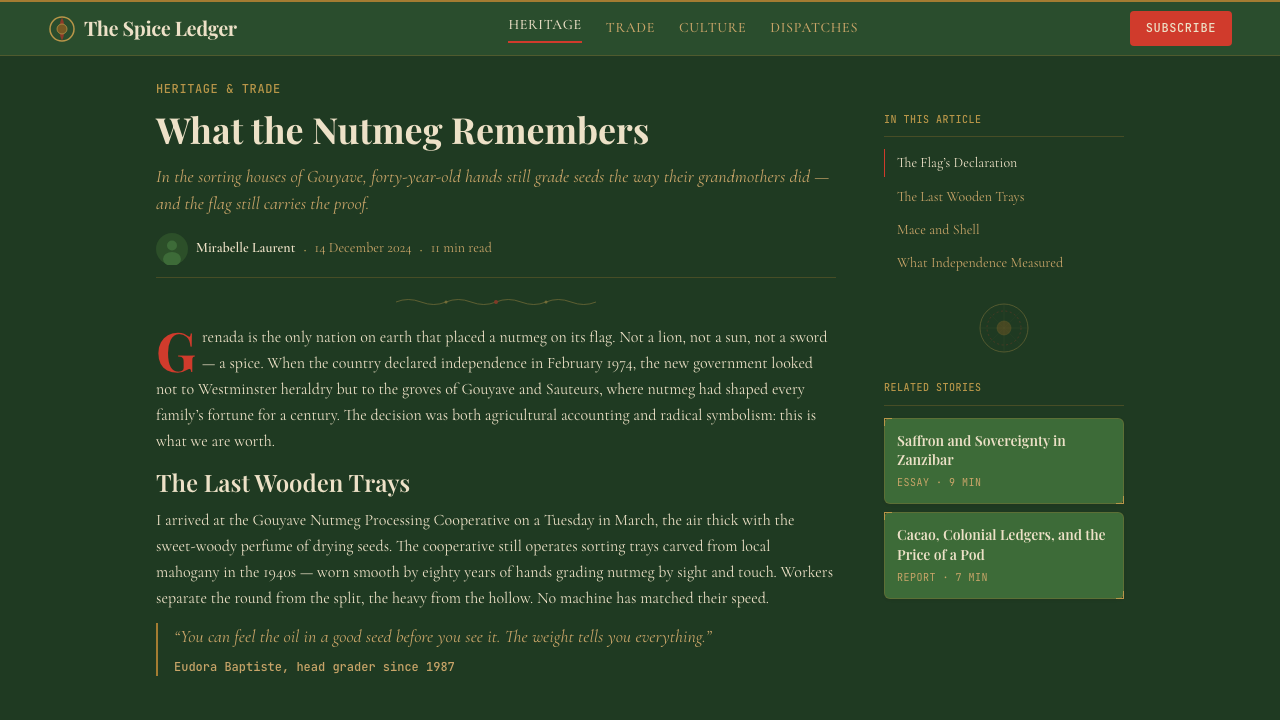
For web interfaces, the style is well-suited to product pages, brand landing pages, and editorial sites for food, craft, or cultural brands. The centering tendency works well in hero sections and product feature blocks. Navigation and body text should use the serif ledger register rather than the stencil headline register — the latter is too rough for extended reading. Keep background textures subtle enough not to interfere with text legibility. Dashboards and data-heavy interfaces are a poor match: the style's ceremonial quality slows down the scannability that functional UIs require.
For editorial and marketing applications, the style excels in packaging design, brand identity, print collateral, and any material that benefits from a strong sense of origin and provenance. A brand identity built in this language might use the botanical motif as a recurring structural element, the flag-derived palette as a consistent color system, and the ledger serif as the primary typographic voice. Marketing pages work well with alternating dark-field and light-field sections — deep green headers followed by kraft-ground body sections — creating rhythm through the style's characteristic tonal contrast.
A common mistake when applying this style is over-saturating the textural elements until the design reads as themed rather than designed. Aged paper effects, rough stamp edges, and engraving crosshatching are powerful in small doses; when applied uniformly across every element, they collapse the hierarchy and make the design feel like a Halloween prop rather than a considered visual system. The discipline is to use texture as accent — on the primary display element, on the section borders, on key motifs — while keeping the body fields clean and the type sharp. Similarly, the three palette anchors (green, red, gold) should not all appear at full weight in every composition; typically one leads, a second accents, and the third appears only in small ornamental details.
Grenadian Spice & Nutmeg Flag — FAQ
Is this style only appropriate for Caribbean or food-related projects?
Its strongest natural fit is with projects that benefit from associations of provenance, craft, warmth, and cultural specificity — which does include food, artisan goods, and travel, but extends to cultural institutions, heritage brands, and any project whose identity is rooted in a specific place or tradition. It is not appropriate for projects requiring neutral, universal, or clinical aesthetics — technology, finance, or healthcare products would typically find the style's ceremonial richness tonally misaligned. The question to ask is whether the project's brand values include the kind of grounded, material warmth that this style carries, not whether it is geographically or categorically adjacent to the Caribbean.
How do you use the botanical motifs without making the design feel like a restaurant menu?
The botanical motifs in this style carry their authority from the scientific illustration tradition, not the decorative tradition. The distinction in application is structural: use botanical imagery as a framing device — a border, a corner ornament, a section anchor — rather than as surface decoration scattered across the layout. A single, precisely rendered nutmeg cross-section placed at the center of a composition, at significant scale, has an entirely different weight than the same image tiled as a background pattern. The engraving register also matters: loose, sketchy botanical illustration reads as casual; precise, labeled, cross-section illustration reads as authoritative. Applying the motifs with architectural discipline — one dominant, sparingly placed — keeps the style in its ceremonial register.
Can this style work in a digital product interface, or is it primarily for print?
Its origins are in print and material culture — the spice label, the botanical plate, the ledger — and it carries those sensibilities most naturally in print, packaging, and editorial contexts. Digital application is possible but requires selective translation: the texture and aged-surface treatments that define the style can feel heavy or slow in interactive interfaces, where users expect responsive, unambiguous visual feedback. A practical approach is to use the color palette and typographic register at full fidelity while treating the textural elements as header or hero-section accents only, keeping functional UI zones (navigation, forms, data tables) in the cleaner end of the palette. The style works better in marketing and editorial digital contexts — brand sites, editorial features, digital publications — than in transactional or dashboard contexts.
What distinguishes this style from generic 'vintage tropical' design?
Generic vintage tropical design tends to draw from a broad, undifferentiated pool of colonial-era tropicalia — pineapples, parrots, palm fronds, Art Deco sun rays — assembled for nostalgic mood rather than cultural specificity. The Grenadian Spice style has a precise cultural address: the nutmeg as a specific botanical and sovereign symbol, the flag's specific tricolor as the palette foundation, the cooperative movement's specific visual vocabulary as the typographic and compositional reference. The precision is the difference. Using this style correctly means being committed to its particular geography, botany, and historical context — not reaching for generically warm, tropical, or aged aesthetics.
How should the flag's tricolor be used without the design looking like a national flag?
The flag's tricolor is the palette foundation, not a literal template. The key is that in the flag, the three colors appear as flat bands and fields of roughly equal visual weight. In applied design work, one color must lead — typically the grove green or the kraft ground — with the red and gold appearing as accent weights rather than as co-equal fields. The botanical and ledger motifs serve as the mediating visual vocabulary that gives the color system its design identity beyond its flag origin. A composition that uses deep green as the dominant ground, brick red for display type or border rules, and gold only for ornamental details and highlight accents will read as a distinct design identity rather than a flag reproduction.
Related design styles
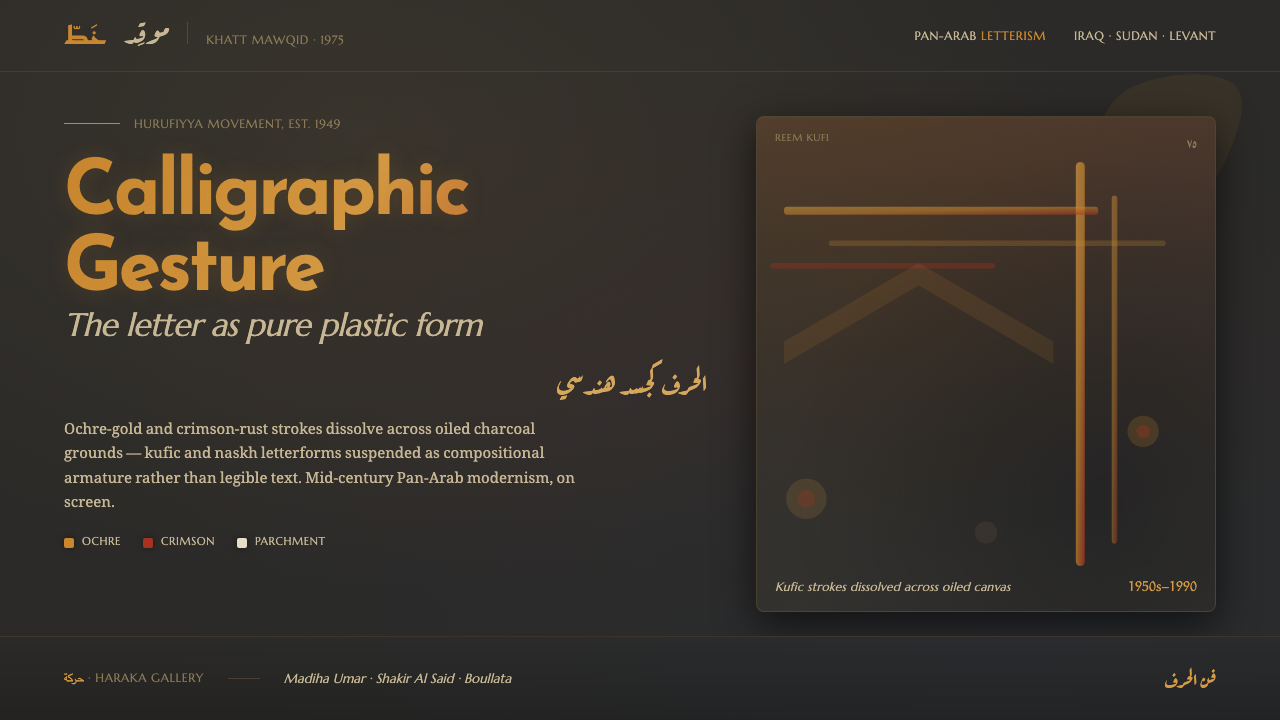 Hurufiyya Letter ArtArabic letters as pure gesture. Ochre and crimson strokes dissolve across oil…
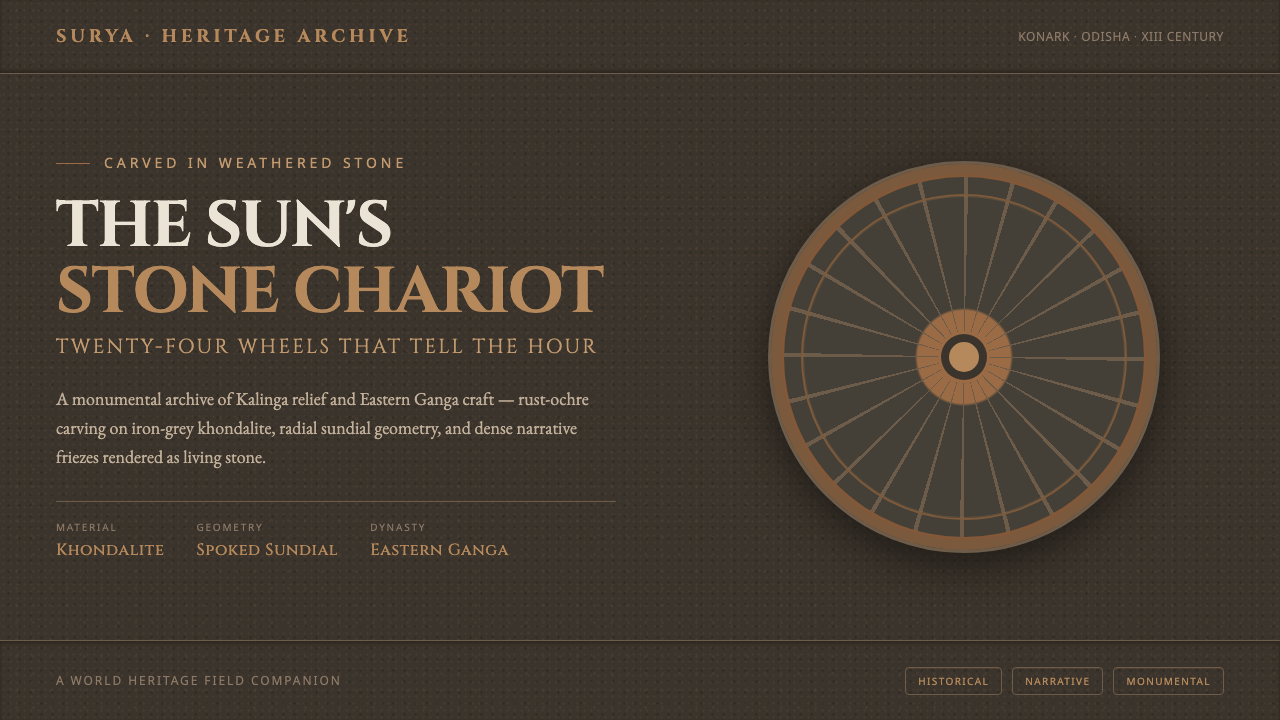 Konark Sun Temple WheelHeavy as carved stone. Rust-ochre sundial wheels and Cinzel inscription on ir…
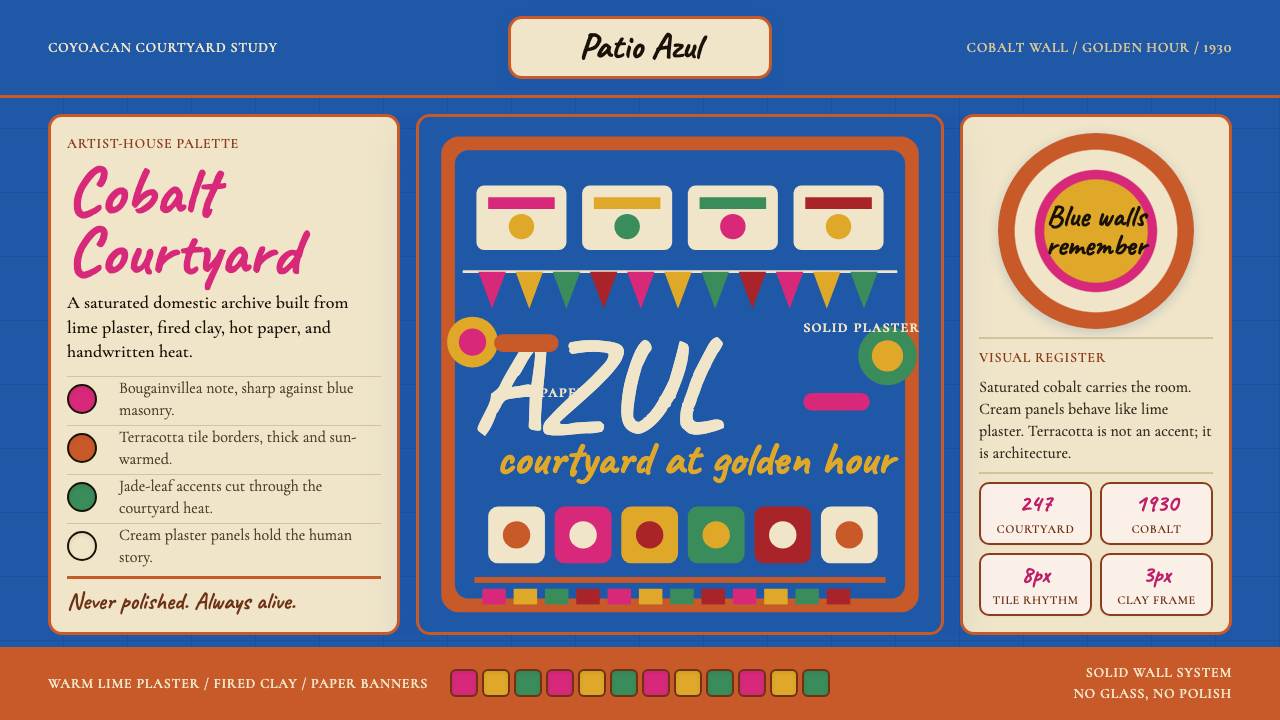 Mexican Frida Blue House (Coyoacán 1930)Maximum color, intimate walls. Cobalt, cream panels, terracotta grid, cut-pap…
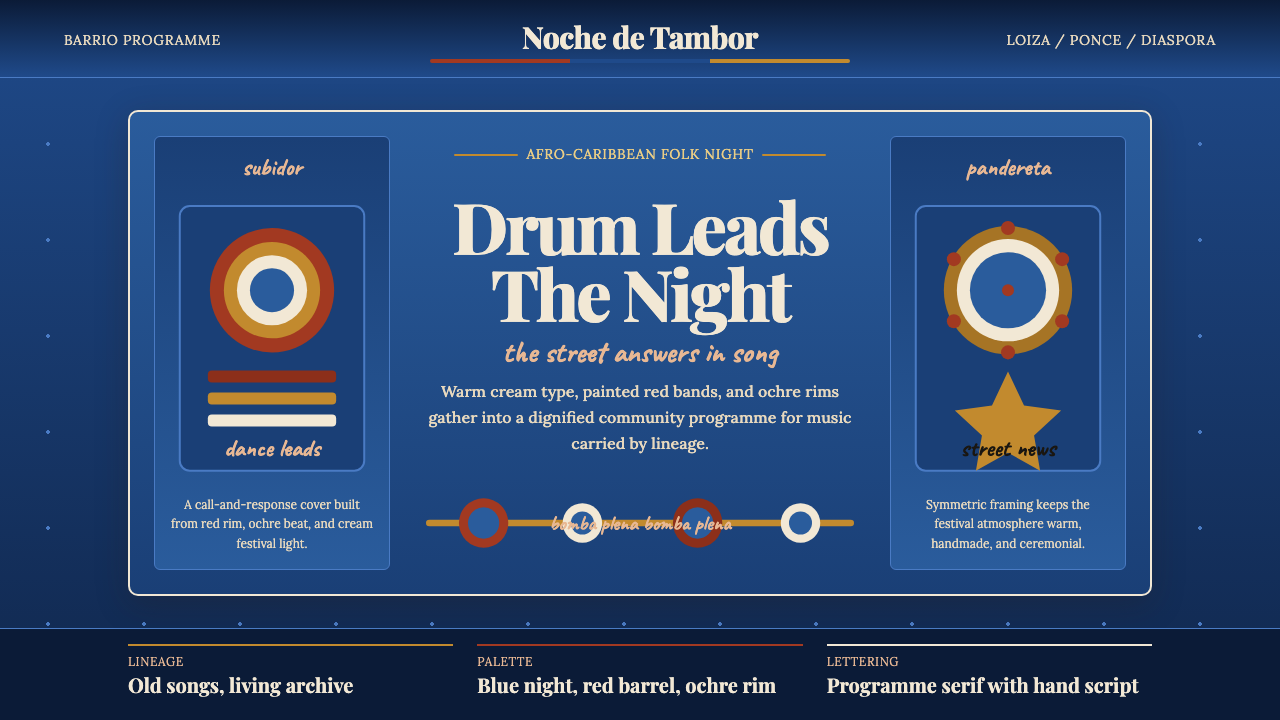 Puerto Rican Bomba & PlenaNight festival dignity. Drum-red stripes and cream Playfair type on deep trop…
 Shinto ToriiSacred red holds the dark. Vermilion gates, Mincho type, and shide white fram…
 Zoroastrian Fire TempleSacred fire in stone darkness. Cinzel capitals, ember orange, and gold relief…