What is Havana Club Cuban Rum?
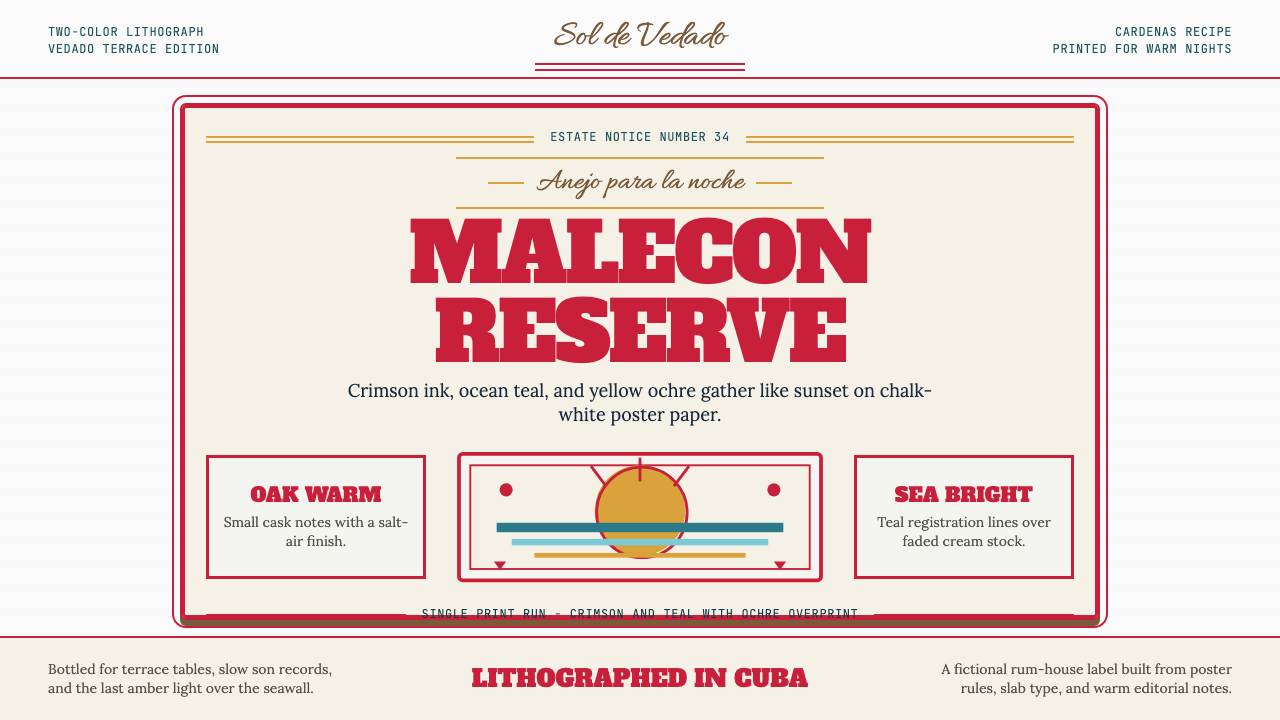
Sunset bottled in print — Havana Club's crimson slab type, ocean-teal rules, and chalk-white stock carry the full weight of Cuba's golden age of lithographic craft.
Havana Club Cuban Rum in brief
Havana Club Cuban Rum Vintage is a design system rooted in the visual traditions of Cuba's mid-twentieth-century lithographic poster school. It is characterized by a commanding crimson slab-serif headline type, ocean-teal accent rules and borders, chalk-white or aged-paper grounds, and ornamental corner cartouches that echo the hand-crafted tobacco and rum label craft of pre-Revolution Havana. The system is not merely retro pastiche — it is a precise reconstruction of a specific printing culture, governed by the material constraints of two-color lithography and the aesthetic ambitions of Cuban commercial artists working at the peak of their tradition.
The visual logic of the system centers on warmth, legibility, and ceremonial weight. Every composition is built to feel like a label or a poster: type is set large and bold, rules are used as structural frames rather than decoration, and the limited palette is deployed with the confidence of a printer who knows that restraint is not poverty but mastery. The ornamental flourishes — cartouches, double-rules, script accents — are not applied arbitrarily but follow the grammar of lithographic label design, where every mark had a practical origin in the registration and hierarchy demands of commercial printing.
At its heart, this design language is a celebration of craft specificity. It communicates provenance, tradition, and the pleasures of a particular place and time. Applied well, it conveys the sensation of holding something genuinely old — not artificially aged, but matured through the real accumulation of cultural meaning. It is a style for brands, publications, and experiences that want to feel earned rather than engineered.

Where does Havana Club Cuban Rum come from?
Havana Club was founded in 1934 in Cárdenas, Cuba, by José Arechabala, a Spanish immigrant entrepreneur who had built a sugar and spirits business on the island. The Arechabala family distillery produced a rum that quickly became associated with the glamour of mid-century Havana — the Vedado bars, the Malecón promenades, the hotel rooftops where American tourists and Cuban society mingled in the years before the Revolution. The brand's visual identity during this founding era drew directly from the lithographic poster culture that was simultaneously flourishing in Havana's commercial printing houses.
The aesthetic context from which Havana Club's visual language emerged was the Cuban lithographic poster school of the 1940s and 1950s — one of the richest commercial art traditions in the Western Hemisphere. Cuban poster artists of this period, including the caricaturist and graphic designer Conrado Massaguer and the painter and illustrator Eduardo Abela, developed a visual vocabulary that fused Spanish colonial decorative traditions, Art Deco geometry, and the bold two-color printing possibilities of the lithographic press. Massaguer, in particular, was known for his magazine covers and advertising work that combined slab-serif display type with ornamental cartouches and vivid tropical color — elements that read directly in the Havana Club visual grammar.
The 1959 Revolution fundamentally disrupted the brand's continuity. The Arechabala family's assets were nationalized, and the family emigrated. The Cuban state continued producing rum under the Havana Club name, while the Arechabala family attempted — ultimately unsuccessfully — to revive the brand in exile. In 1993, Pernod Ricard entered a joint venture with the Cuban state enterprise Cuba Ron S.A., relaunching Havana Club as an international premium rum brand. This relaunch required a visual identity that could carry the weight of the brand's authentic Cuban heritage while functioning in contemporary global markets. The design team returned to the pre-Revolution lithographic tradition, excavating and systematizing the visual codes of the 1950s golden age.
The master rum blender Don Pancho Fernandez became a central figure in the brand's post-1993 identity, serving as the keeper of production knowledge and the human face of Cuba's rum-making tradition. His presence in brand communications reinforced the connection between the visual system and the craft reality it represented — a reminder that the aesthetic choices were not arbitrary heritage cosplay but an attempt to honestly represent a specific artisanal tradition that had survived the discontinuities of Cuban history. The visual language thus functions simultaneously as graphic design and as cultural testimony, carrying information about a place, a practice, and a period that cannot be adequately conveyed through purely contemporary forms.
What defines the Havana Club Cuban Rum look?
Color Palette
The palette is anchored by a deep, saturated crimson that functions as the primary structural and typographic color — it carries the same weight as black in conventional label design but adds the warmth of the tropics. Ocean teal provides the secondary accent, used for horizontal rules, thin border lines, and occasional ornamental fills. The ground is chalk-white or a slightly warm off-white that evokes aged paper stock. This three-value system — crimson, teal, and near-white — is the entire vocabulary; additional colors appear only in very specific heritage contexts and never at high saturation. The restraint is deliberate: two-color lithographic printing made this economy a necessity, and the aesthetic has preserved it as a virtue.
Slab-Serif Typography
Headline type is set in heavy slab-serif letterforms — the kind of bold, block-footed display type that dominated nineteenth and early twentieth century commercial printing and was the default choice of Cuban lithographic poster artists. These letterforms carry the visual weight of woodblock type: wide, confident, built to be read across a bar room. Body and supporting text shifts to a warm editorial serif, softening the overall register without losing legibility. A hand-lettered script accent — used sparingly for product names or decorative sub-headings — introduces the human touch of a skilled letterer and anchors the system in artisanal rather than mechanical production.
Ornamental Cartouches and Rules
Thin double-rules frame the composition in the manner of a formal label, creating a contained, ceremonial reading space. Corner cartouches — small ornamental brackets or flourishes at the intersection of border lines — echo the tobacco and rum label conventions of pre-Revolution Cuba, where such details signaled authenticity and artisanal care. These elements are structural as much as decorative: they establish hierarchy by defining zones, they signal that what is inside the frame deserves careful attention, and they translate the physical experience of holding a bottle label into a flat graphic context. The rules and cartouches are always rendered in crimson or teal, never in black, preserving the warmth of the palette.
Paper and Surface Texture
The ground evokes uncoated, slightly absorbent paper — the kind of stock on which real lithographic inks would feather imperceptibly at the edges and acquire a slight bloom after years in Caribbean humidity. This is not a uniform digital white but a material white, with the warmth and slight unevenness of physical paper. In digital applications, this quality is achieved through a subtly warm off-white ground rather than a pure neutral, and occasionally through restrained use of aged-paper textures that suggest time without performing decay. The texture is always subordinate to typography and color — it provides ground, not visual competition.
Composition and Hierarchy
Compositions are centered and formally symmetrical in the manner of a label, rather than the dynamic asymmetry characteristic of modernist poster design. This symmetry is not static: it is activated by strong vertical and horizontal axes, by deliberate contrast between the heavy slab headline and the lighter supporting text, and by the rhythmic placement of ornamental elements. The hierarchy is clear and immediate: crimson slab headline at the top, teal rule beneath it, editorial body text in the middle zone, and script accent or ornamental cartouche at the base. Reading direction is top-to-bottom and center-outward, following the conventions of a formal label read in hand.
Script Accents and Hand-Lettering
The hand-lettered script element — appearing in product naming, sub-headings, or decorative flourishes — is the system's most emotionally warm component. It signals that a human hand participated in the making: not a generic calligraphic font dropped onto a layout, but a letterform with the personality and slight irregularity of genuine craftsmanship. In the broader Cuban lithographic tradition, hand-lettering was a prestige marker — the finest label work involved artists who could letter consistently at size, creating forms that had both the legibility of type and the expressiveness of drawing. This heritage gives the script element its authority; used sparingly, it elevates the whole composition.
Tropical Warmth and Light
Underlying the entire visual system is an evocation of light — not the cool, northern light of European modernist design, but the rich, sideways light of late afternoon in the Caribbean. This is not achieved through gradients or atmospheric illustration but through color temperature: the warmth of the crimson, the softness of the chalk-white ground, and the slight saltiness of the ocean teal together create a palette that reads as warm without a single warm neutral. The system's emotional register is sunset on the Malecón — the specific quality of light at a specific hour on a specific sea wall — rendered through the economy of two-color commercial printing.

Who shaped Havana Club Cuban Rum?
The Spanish-born entrepreneur who founded Havana Club in Cárdenas in 1934. Arechabala built his distillery on the sugar industry wealth of the Cuban interior, and his brand's early visual identity was shaped by the commercial printing culture of the period — slab-serif display type, ornamental label conventions, and the two-color lithographic vocabulary that Cuban printers had developed to a high art. The family's exile after 1959 created the discontinuity that would later define the brand's complex history and the particular weight of its heritage identity.
One of the defining figures of Cuban commercial art in the first half of the twentieth century, Massaguer was a caricaturist, illustrator, and graphic designer whose magazine covers and advertising work established the visual conventions that the Havana Club system draws upon. His combination of slab-serif display type, ornamental cartouches, and vivid two-color printing captured the energy and sophistication of Havana's golden age social scene. His magazine Social, published from 1916, was the primary venue for Cuban Art Deco commercial illustration and set the aesthetic standard for high-end Cuban graphic design.
A major Cuban painter and caricaturist of the republican era, Abela's work bridged fine art and commercial illustration in ways that typified the richest Cuban graphic tradition. His satirical and celebratory images of Cuban life — characterized by warm color, confident line, and a deep affection for the visual details of everyday Cuban culture — contributed to the visual vocabulary that commercial artists, including those who designed rum and tobacco labels, drew upon throughout the mid-century period. His work represents the high-art dimension of a tradition that the Havana Club aesthetic systematically mines.
The master rum blender who became the human face of Havana Club's post-1993 revival and the embodiment of Cuban rum-making tradition. Don Pancho's presence in brand communications was not merely ambassadorial — he represented the continuity of craft knowledge that had survived the disruptions of Cuban history, and his association with the brand gave its heritage visual language a living referent. The design system's insistence on artisanal authenticity — hand-lettered accents, label conventions rooted in real production culture — draws authority from the fact that the production tradition it references is real and ongoing, not merely historical.
How do you use Havana Club Cuban Rum today?
The Havana Club Cuban Rum Vintage design system is best understood as a label-poster hybrid: it brings the formal structure and ornamental vocabulary of a traditional spirits label into larger compositional contexts. Applying it well requires internalizing that grammar — knowing when a double-rule frames and when it clutters, when a script accent elevates and when it merely decorates. The system rewards restraint and punishes accumulation; adding more crimson ornaments does not intensify the effect, it dilutes it.
For presentation slides, the system works best when cover pages adopt the label-as-poster structure: a centered composition within a thin crimson double-rule border, a dominant slab-serif headline in crimson, a teal horizontal rule as section divider, and the organization name or tagline in the smaller editorial serif at the base. Content slides should simplify: drop the ornamental border, retain the slab-serif for section headers, use the editorial serif for body text, and reserve the teal for data highlights or structural rules. Data slides benefit from the palette's warmth — charts in crimson and teal against a near-white ground feel considered rather than corporate, and the label convention of clear, bold labeling translates directly into legible data visualization.
For web interfaces, the system is particularly well-suited to heritage brand sites, editorial publications, and premium product pages where the user's emotional engagement is as important as information delivery. The approach: use a slightly warm off-white as the page ground, set navigation in the slab-serif or editorial serif (never a geometric sans), and use crimson for primary calls to action and teal for secondary interactive elements. Card components benefit from a thin crimson border rather than a soft shadow — this is a label-derived aesthetic that treats every content unit as a labeled object. Pricing and feature tables gain authority from the formal, centered symmetry of label design; hierarchy is established through type size and weight rather than color.
For editorial and marketing applications, the style's strongest mode is the poster: a single dominant message in large slab-serif type, supported by a teal rule, an ornamental cartouche, and a carefully selected script accent. This poster grammar scales from social media cards to full-page magazine advertisements without losing coherence. Marketing campaigns built on this system gain from consistency: using the double-rule border on every asset, maintaining the crimson-teal color relationship across all touchpoints, and reserving the script accent for the single most important communicative element in each piece creates a visual system that feels both rich and disciplined.
The most common mistake in applying this aesthetic is conflating warmth with busyness. Because the system's emotional register is celebratory and ornamental, designers are often tempted to add more — more rules, more cartouches, more script, more crimson at higher saturation. The authentic lithographic label tradition the system references was disciplined by the economics of printing: every additional color, every additional ornamental element, cost real money. That discipline is part of the aesthetic. A composition with one well-placed cartouche and one script accent is more powerful than one covered in both; a headline in crimson slab-serif reads more boldly against white than against a busy patterned field. The restraint is the message.

Havana Club Cuban Rum — FAQ
How is this different from generic tropical or tiki aesthetics?
Generic tropical aesthetics typically rely on loose, illustrative imagery — palm trees, parrots, waves — rendered in a broadly warm, saturated palette without specific historical grounding. Tiki aesthetics draw from a mid-century American fantasy of Polynesia rather than any specific regional tradition. The Havana Club system is grounded in a specific historical practice: the Cuban lithographic poster school of the 1940s and 1950s, with its particular color conventions, its slab-serif typography tradition, and its ornamental label grammar. The difference is specificity — this system references a real place, a real period, and real practitioners, and that specificity gives it coherence and depth that generic tropical styles lack.
Can this aesthetic work for brands that have nothing to do with rum or Cuba?
Yes, with two important conditions. First, the brand's values should align with what the system communicates: craftsmanship, heritage, warmth, and a certain ceremonial pleasure. It suits premium food and beverage brands, heritage lifestyle companies, travel and hospitality brands, and editorial publications focused on culture, craft, or pleasure. It is poorly suited to technology companies, financial services, or any brand whose core value proposition is speed, efficiency, or clinical precision. Second, the system should be applied for its aesthetic and structural logic, not as Cuban cultural borrowing — the label grammar, the color relationships, and the typographic hierarchy are the transferable elements, not the specific cultural signifiers.
Is the system appropriate for digital screens, or is it fundamentally a print aesthetic?
The system translates well to digital screens, partly because its foundational constraints — a limited palette, flat color, strong typographic hierarchy, absence of gradients — are also good digital design principles. The chalk-white ground reads warmly on screens without requiring adjustment. The crimson and teal hold their character across the color-rendering variations of different devices. The areas requiring the most care in the digital translation are small ornamental details — cartouches and fine rules can lose clarity at small sizes on low-resolution displays — and the script accent, which may require a slightly bolder weight than its print equivalent to remain legible at screen resolutions. Interactive states should use tonal variations within the crimson or teal rather than introducing new colors.
How does the system handle photography and illustration?
Photography is best treated in the manner of the lithographic tradition: high-contrast, with warm toning toward the amber-sepia range, cropped formally and framed within the label-border structure rather than used as a full-bleed background. A portrait or product shot treated as a high-contrast duotone in crimson and cream becomes a compositional object within the system rather than a naturalistic window. Full-bleed photography is generally at odds with the system's enclosed, label-derived grammar and should be avoided. Original illustration, when used, should reflect the flat, confident line quality of the Cuban commercial art tradition — figurative but reduced, warm in color, and subordinate to typography rather than competing with it.
What is the single most important rule for working within this system?
Every element must justify its presence. The lithographic label tradition from which this system descends was defined by the practical discipline of printing economics: you paid for ink, you paid for color separations, you paid for the printer's time setting ornaments. Nothing appeared on a label without reason. Translating that discipline into digital and print contexts means asking, of every rule, every cartouche, every script accent, every crimson headline: does this element earn its place, or is it present because it feels festive? A system that answers this question honestly produces work that reads as genuine heritage. A system that does not produces pastiche — warm in color, hollow in character.
Related design styles
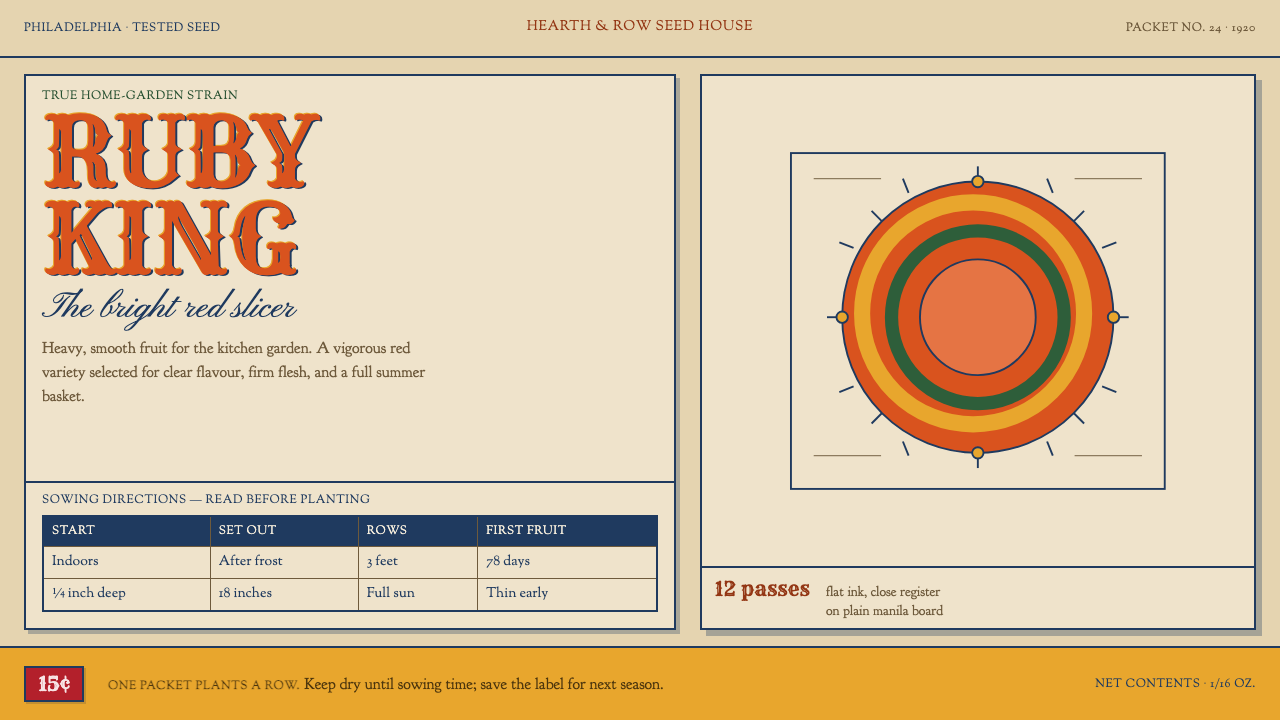 Seed Packet 1920Selling hard, then instructing harder. Loud red overprint meets a dense Goudy…
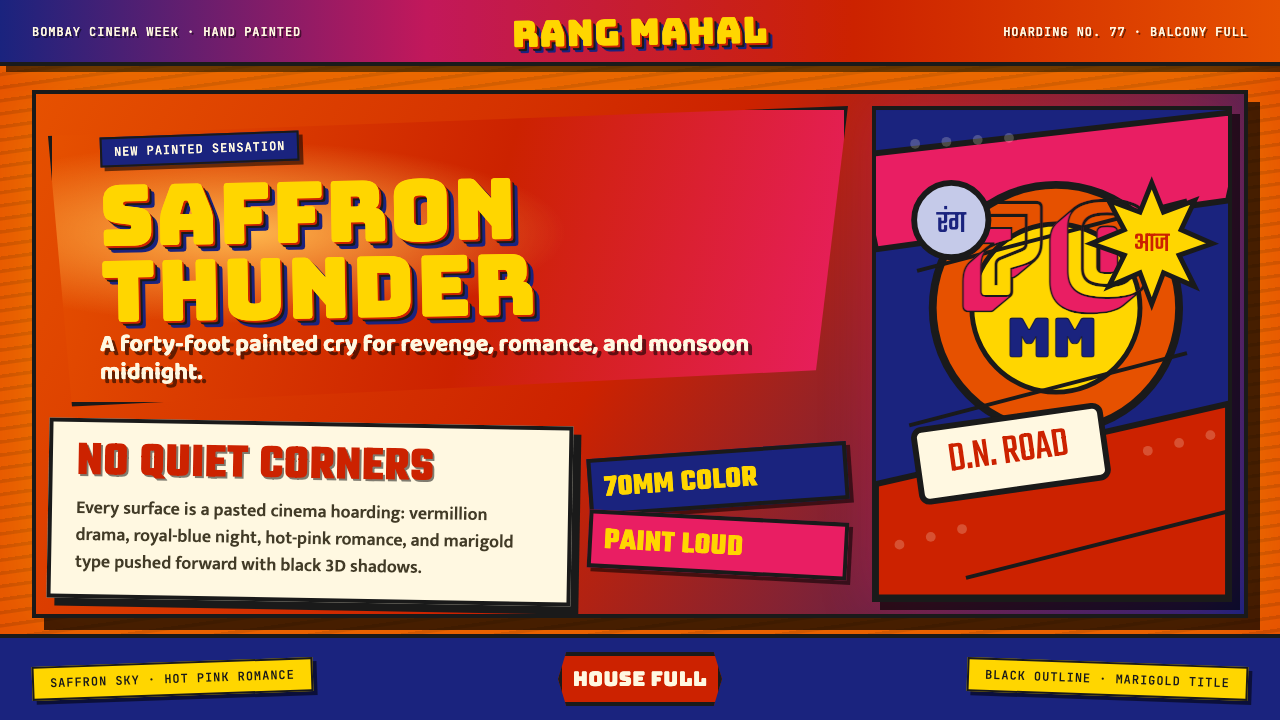 Bollywood Poster Art (1970s)Subtlety is unaffordable. Saffron fields, Bungee shadows, diagonal hoarding d…
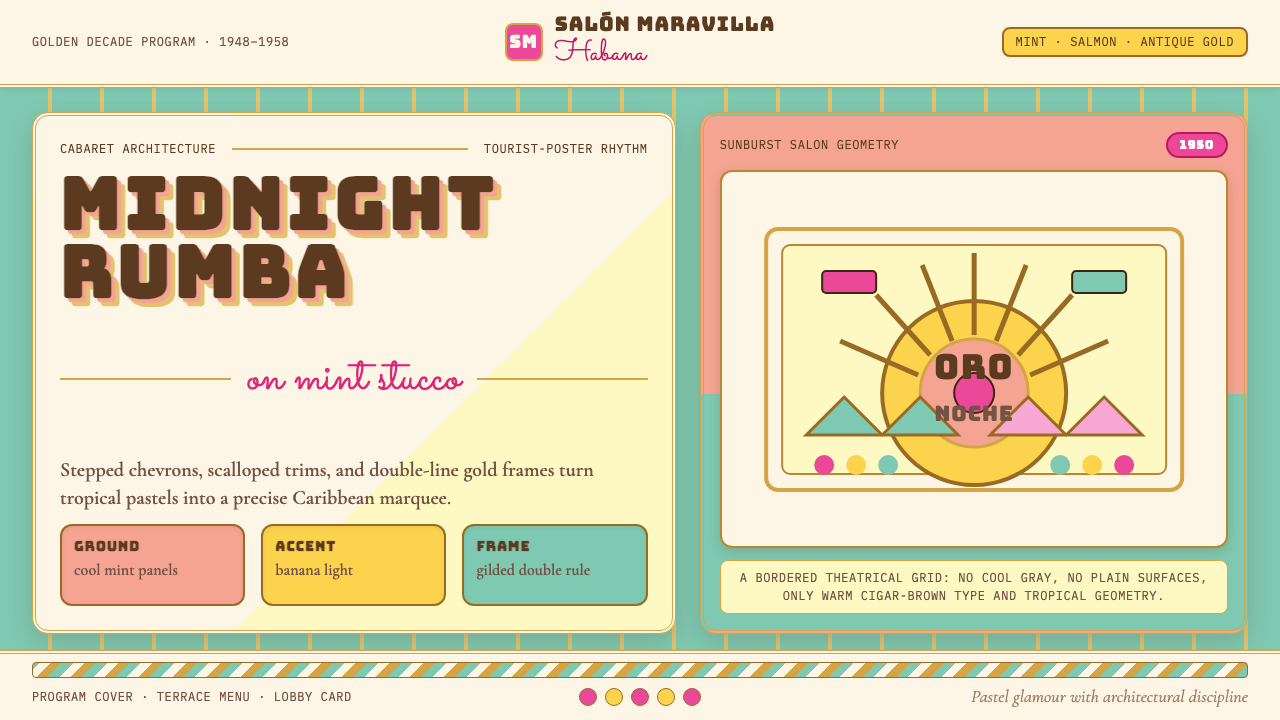 Cuban Art Deco (Havana 1950)Tropical Deco goes theatrical. Mint and salmon panels, gold double rules, Bun…
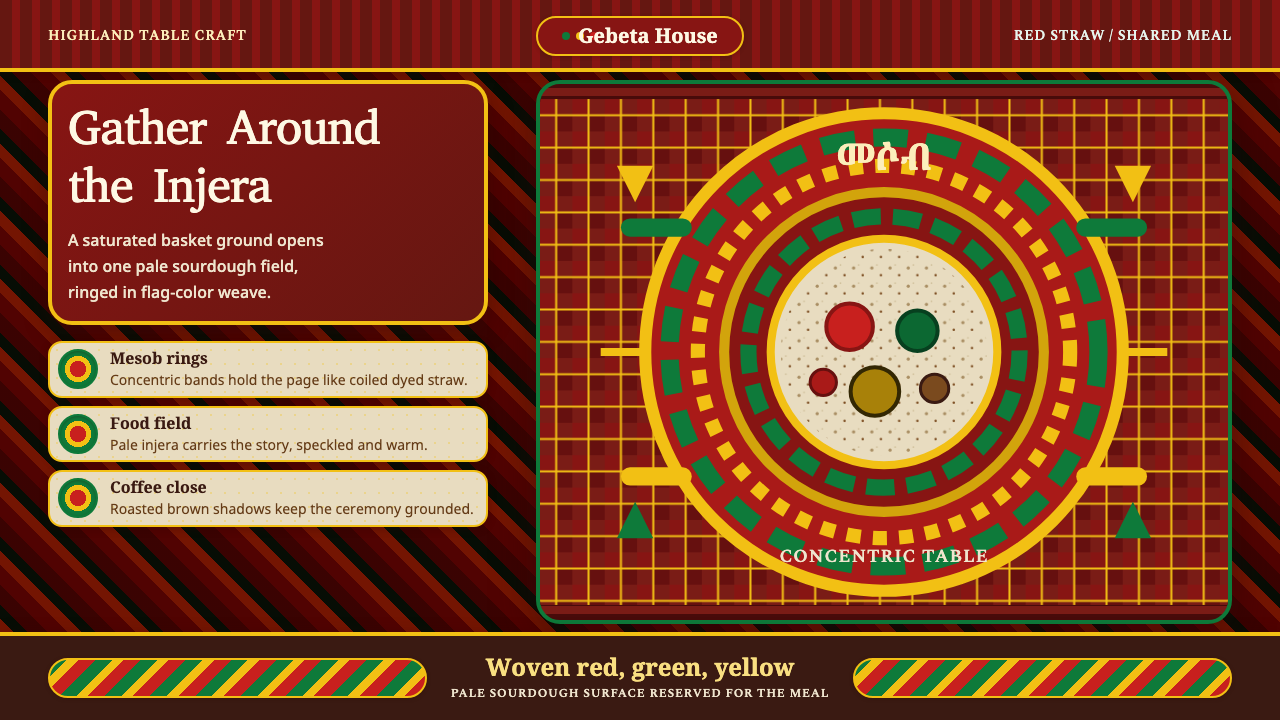 Ethiopian Injera Mesob SpreadHospitality is woven in. Berbere red, flag bands, and an injera field hold th…
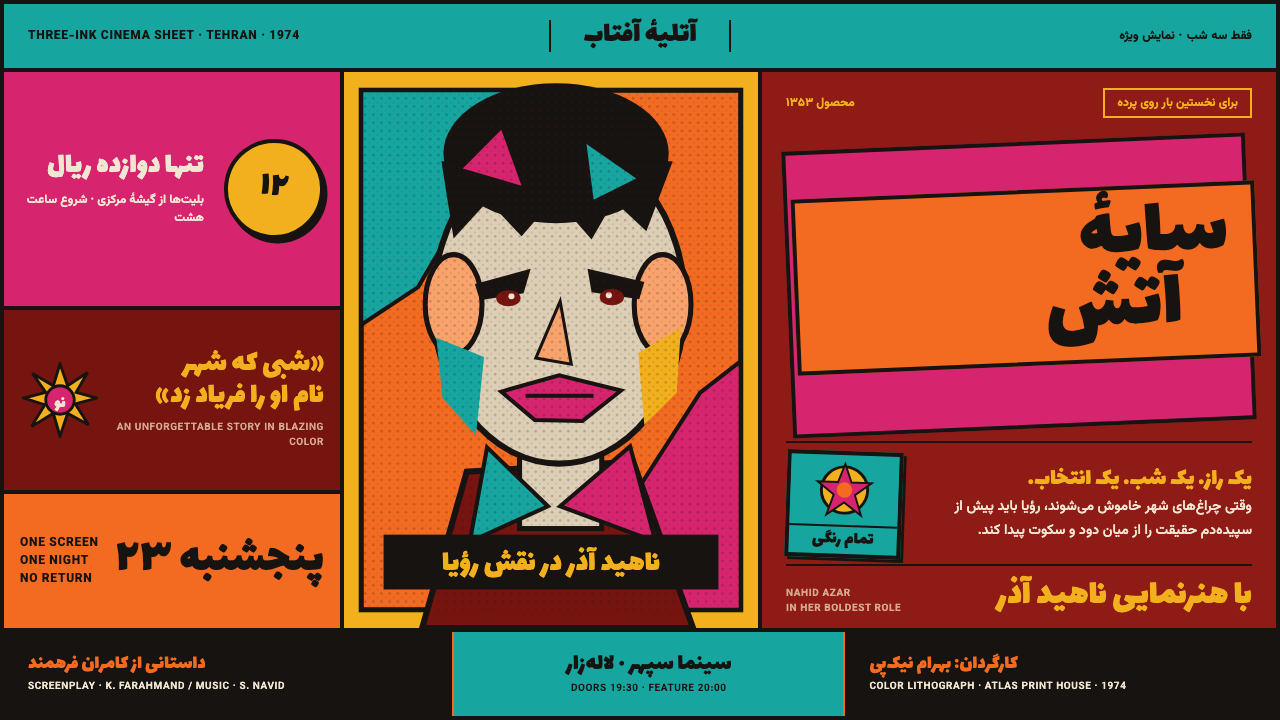 Iranian Film PosterCinema shouts in flat ink. Persian lettering clashes orange, turquoise and ma…
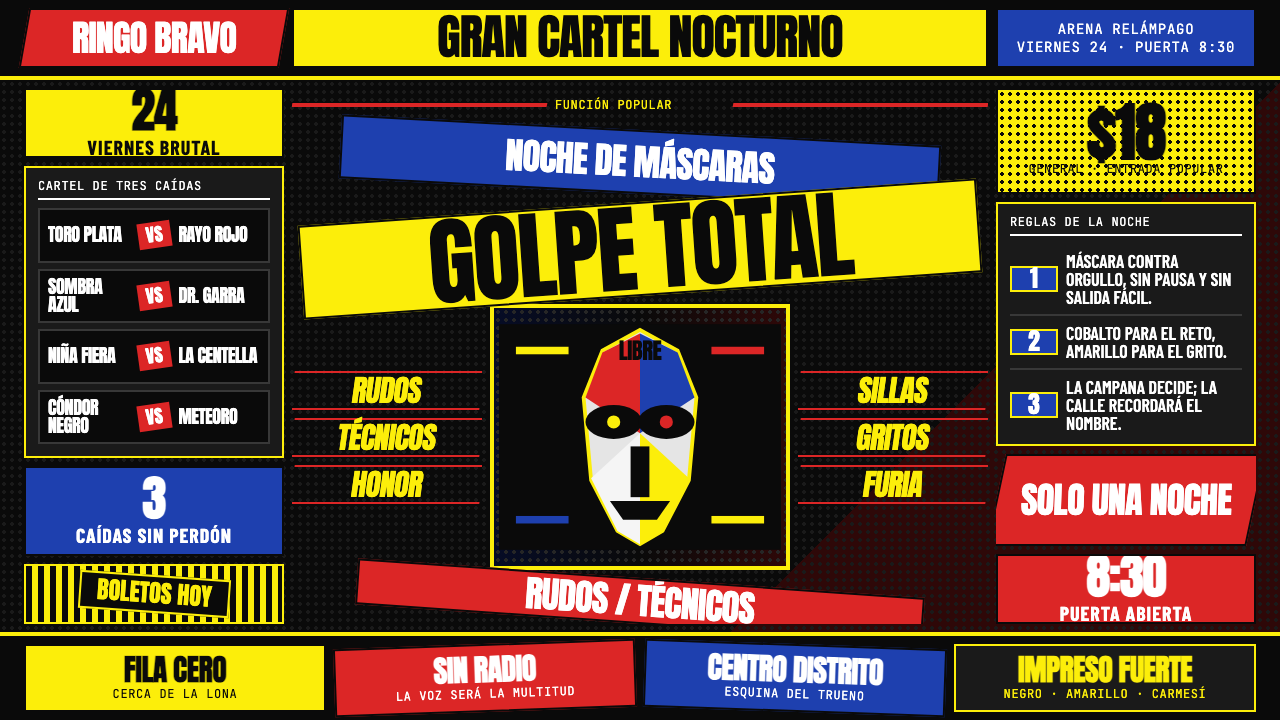 Lucha Libre PosterStreet-poster voltage. Yellow Anton banners, crimson diagonals, cobalt grids…