What is Cuban Art Deco (Havana 1950)?
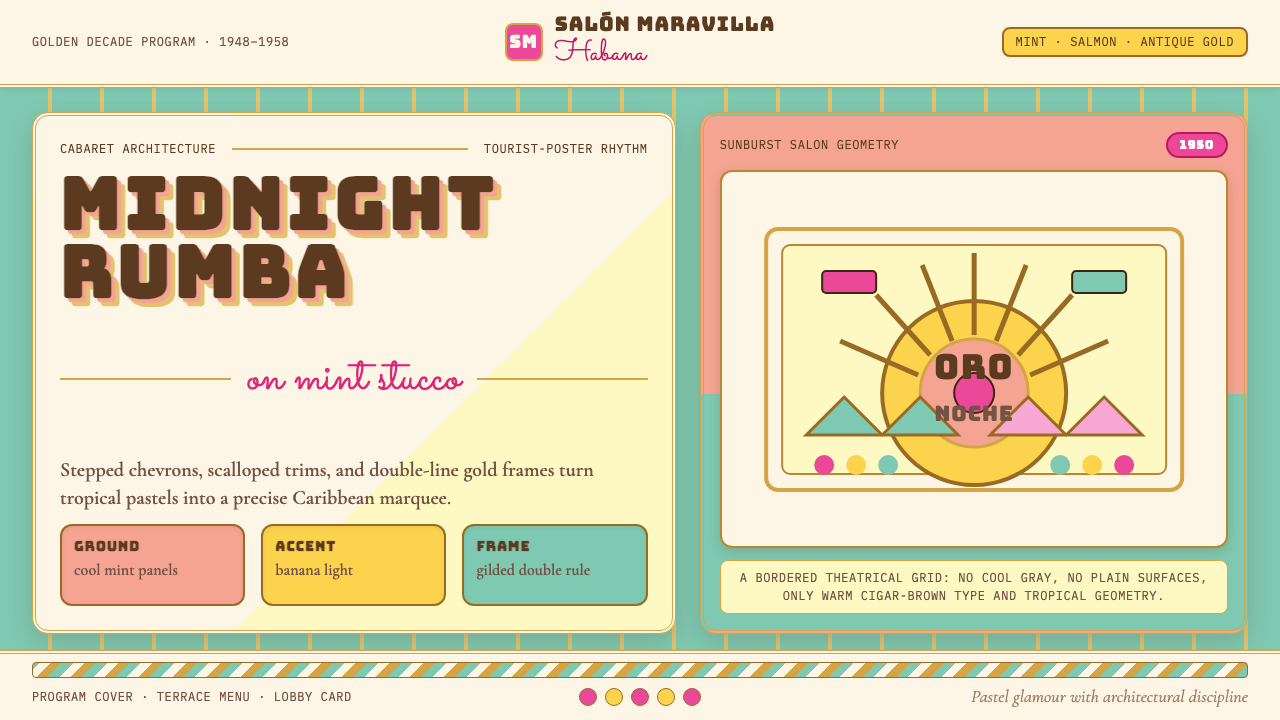
Havana in the 1950s turned Art Deco into a tropical spectacle — pastel panels, gilded double rules, and cabaret marquee lettering that made even a hotel brochure feel like an invitation to dance.
Cuban Art Deco (Havana 1950) in brief
Cuban Art Deco is the most chromatic, palm-touched variant of the global Art Deco language. Where European Deco skewed toward chrome and onyx austerity, and American Deco toward streamlined sobriety, Havana's designers embraced colour with theatrical confidence: mint green, salmon orange, flamingo pink, and banana yellow were layered against one another, outlined in gold double rules, and crowned with stepped chevrons and scalloped edges that gave every surface a festive, almost edible quality.
The style flourished during Havana's golden decade — roughly 1948 to 1958 — when the city was simultaneously a playground for international tourists and a hotbed of Cuban creative ambition. Hotel brochures, nightclub program covers, airline posters, and department store signage all participated in the same visual conversation: geometric precision imported from Paris and New York, radically re-saturated with Caribbean light. The result was a design language that felt simultaneously cosmopolitan and unmistakably local.
At its core, Cuban Art Deco is an architecture of contrasts: the formal grid of European Deco held in productive tension with tropical exuberance. Motifs borrowed from Aztec and Afro-Cuban decorative traditions — sunburst radiations, repeating fan forms, stylised palm fronds — were fitted into the stepped arches and symmetrical facades that characterized the international Deco vocabulary. Typography played a central role too: monumental slab or geometric display faces (the visual equivalent of a neon marquee) sat alongside cursive script flourishes borrowed from the hand-lettered tradition of Cuban carnival posters.

Where does Cuban Art Deco (Havana 1950) come from?
Art Deco arrived in Cuba through multiple channels simultaneously. The 1925 Exposition Internationale des Arts Décoratifs et Industriels Modernes in Paris set the global template, and Cuban architects, designers, and commercial artists working in Havana absorbed it through architectural journals, imported tourist-trade print, and direct study in Europe and the United States. By the late 1920s, Havana's Vedado and Centro Habana neighbourhoods were already acquiring Deco apartment buildings and commercial facades. But Cuba's version did not simply copy the source material — it immediately began absorbing local colour, both literal and cultural.
The key institution was Havana's commercial printing and advertising industry, which by the 1940s was producing some of the hemisphere's most inventive chromolithographed posters, cigar box labels, and tourist brochures. Illustrators like Conrado Massaguer, who founded the influential magazine Social in 1916, had already established a sophisticated graphic culture in Cuba that embraced European modernism while maintaining strong ties to Afro-Cuban visual traditions and the vivid palette of the Caribbean landscape. When Art Deco's geometric grammar arrived, it found a culture already primed for theatrical, colour-saturated design.
The economic and political context of the 1950s intensified the style. Fulgencio Batista's government (1952–1959) actively cultivated international tourism and foreign investment, funding large-scale hotel and entertainment construction in Havana. The Hotel Nacional, the Habana Hilton (now Habana Libre), and the Hotel Capri all opened or expanded during this period, each commissioning visual identity programmes — menus, stationery, signage, brochures — that became showcases for the mature Cuban Deco style. The Tropicana Cabaret, operating under an open sky in the Marianao suburb, became perhaps the most internationally visible expression of the aesthetic: its graphic materials combined geometric Deco structure with the lush, flambouyant spirit of the cabaret stage.
The architects and designers working in this period — Eladio Rivadulla and Esteban Rodríguez-Castells among the most prominent in built form — synthesised the international Deco vocabulary with a specifically Cuban palette and ornamental sensibility. The Bacardí Building, completed in 1930 by Esteban Rodríguez-Castells and his collaborators, had already established the template: its terracotta-coloured upper sections, stylised bat reliefs, and stepped crown demonstrated that European Deco geometry could support tropical ornament rather than suppress it. The visual culture of the 1950s extended this logic into ephemeral media — printed matter, signage, fabric — and amplified the colour until the dial could go no further.
What defines the Cuban Art Deco (Havana 1950) look?
Tropical Pastel Palette
The Cuban Deco palette centres on warm and cool pastels deployed at high saturation against each other: mint green faces salmon orange, flamingo pink answers banana yellow. These are not the muted, powder-washed pastels of later mid-century design — they are vivid and assertive, luminous as tropical fruit in direct sunlight. Gold and warm ivory serve as the unifying neutrals, appearing as border lines, rule work, and ground panels that prevent the coloured fields from overwhelming each other. Black is used sparingly, typically in typography and fine detail lines, never as a dominant ground.
Stepped Chevrons and Geometric Banding
The stepped chevron — a zigzag form that rises in stair-like increments — is perhaps the most distinctive single motif in Cuban Deco, appearing on building cornices, border ornaments, programme covers, and textile patterns alike. It is typically rendered in contrasting colours or outlined in gold, giving it a jewel-like, almost three-dimensional quality despite being a flat mark. Horizontal and vertical banding — alternating strips of colour that divide a composition into zones — is the structural complement to the chevron, creating a sense of orderly rhythm beneath the ornamental surface.
Sunburst and Fan Motifs
Radiating lines — whether emanating from a central point like a sunburst or spreading from a base like a hand fan — permeate Cuban Deco at every scale, from architectural relief panels to letterhead ornaments. The sunburst connects to both Art Deco's global vocabulary and to Afro-Cuban solar symbolism, giving it unusual cultural resonance in the Cuban context. Fan forms echo the physical fans carried by Havana's elegantly dressed patrons and appear most often at corner positions, as compositional anchors, or as transitions between contrasting colour fields.
Double-Line Gold Rules and Ornamental Borders
A hallmark of Cuban Deco print culture is the double rule — two parallel lines of equal or slightly varying weight — rendered in gold or warm metallic tones. These rules function simultaneously as border, separator, and luxury signal. They appear framing title areas on brochure covers, dividing columns in programme layouts, and outlining decorative panels. Unlike the single ruled lines of Swiss or Bauhaus typography, the double rule in Cuban Deco carries an explicit ornamental intent: it is there to be seen, not merely to organise.
Monumental Display Type with Script Accents
Cuban Deco typography operates on bold contrast between two opposing registers: heavy, architecturally solid display faces — often with slab serifs or geometric construction — that evoke neon marquees and building lettering, and flowing cursive scripts that reference the hand-lettered tradition of Cuban carnival posters and cabaret signage. A typical composition places the main title in a thick, uppercase display face, then adds a subtitle or venue name in a loose, forward-leaning script. The contrast is not a collision but a conversation — the formality of one answering the warmth of the other.
Alternating Ground Panels
Rather than committing a single colour to the background and a contrasting colour to foreground elements, Cuban Deco compositions frequently divide the ground itself into alternating coloured panels — mint and salmon, ivory and flamingo pink — each of which hosts its own typographic or ornamental elements. This creates a sense of tiled or panelled space that recalls the decorative tilework of Havana's interiors and the alternating facades of its residential streets. The technique allows more colours to coexist at similar saturation levels without one dominating, because each colour controls its own territory.
Tropical and Architectural Ornament
Cuban Deco does not reject ornament — it curates it, selecting motifs that bridge the geometric vocabulary of international Deco with the natural environment and cultural inheritance of the Caribbean. Stylised palm fronds appear as corner flourishes and border elements; scalloped arch forms echo the vernacular tile rooflines of colonial Havana; repeating flame or wave patterns carry both Deco energy and Afro-Cuban visual resonance. These ornaments are always rendered in the flat, silhouetted manner of the broader Deco language — no modelling, no shading — but their selection is distinctly Cuban.

Who shaped Cuban Art Deco (Havana 1950)?
Massaguer was the most prominent commercial illustrator and graphic impresario of early-to-mid twentieth-century Cuba. His 1916 founding of the magazine Social gave Havana a sophisticated showcase for modernist graphic design, caricature, and chromolithography that became enormously influential on the generation of artists who would go on to define the mature Cuban Deco visual style. Massaguer's own illustration work — covers, portraits, editorial cartoons — moved fluidly between European Art Nouveau influence and the emerging Deco idiom, helping to establish the idea that international design vocabulary could be inhabited and inflected by Cuban artists rather than simply imported.
Rodríguez-Castells was the lead architect of the Bacardí Building (completed 1930), which remains the most celebrated single monument of Cuban Art Deco. Working within the international Deco vocabulary of stepped massing and geometric ornament, he fused it with distinctly tropical and Cuban elements: terracotta-coloured cladding, stylised bat reliefs (the Bacardí corporate symbol), and a crowned lantern top that reads both as skyscraper ambition and as festive confection. The building's success established the model for what Cuban Deco could achieve architecturally and gave later designers a landmark to orient themselves against.
Rivadulla was among the most prolific architects working in the Cuban Art Deco idiom during the 1940s and 1950s, responsible for numerous residential and commercial buildings in Havana that adapted the style to everyday urban contexts rather than prestige institutional commissions. His work demonstrated that the Cuban Deco vocabulary — pastel facades, ornamental cornices, decorative tilework — could function as a vernacular architectural language for the city's middle-class neighbourhoods, not merely as a luxury register for hotels and corporate towers. This democratisation of the style contributed to its visual dominance of Havana's streetscape.
The Tropicana Cabaret, operating in the Marianao suburb under an open sky since 1939, became by the 1950s the most internationally recognised showcase for Cuban entertainment culture. The anonymous team of graphic artists who produced its menus, programme covers, promotional posters, and printed ephemera created what may be the most concentrated body of mature Cuban Deco print design in existence. Their work is notable for the confidence with which it handles multiple colours simultaneously — saturated tropical pastels coexisting without muddiness — and for the fluency with which it moves between formal geometric structure and exuberant ornamental expression.
The Hotel Nacional, completed in 1930 and continuously operated as Havana's most prominent address through the 1950s, sustained a visual identity programme across decades that stands as a touchstone of Cuban Deco print culture. Its brochures, menus, stationery, and matchbook covers — produced by successive generations of Havana's commercial graphic artists — chronicle the evolution of the style from its more restrained early-Deco origins toward the fully saturated, ornamentally confident idiom of the late 1950s. The hotel's materials were widely distributed internationally as part of Cuban tourism promotion, making them among the most exported examples of the style.
How do you use Cuban Art Deco (Havana 1950) today?
Cuban Art Deco is a high-energy, high-intent style. Applying it well requires committing to its core logic — alternating colour panels, gold rule work, stepped ornament, layered typography — rather than cherry-picking individual elements and expecting the mood to follow. The style rewards boldness; timid half-measures produce neither the warmth of mid-century illustration nor the precision of European Deco. Identify which elements are load-bearing for the project at hand and deploy them fully before adding secondary details.
For presentation slides, Cuban Deco works most effectively when the cover page establishes the tonal contract: alternating mint and salmon (or flamingo and ivory) ground panels, a primary title in a heavy display face, a secondary script line beneath, and a double gold rule framing the composition. Content slides should simplify to one or two ground colours per slide and use the colour alternation principle at section transitions rather than slide by slide. Data visualisations can use the palette meaningfully — bar charts whose bars cycle through the tropical pastels, with gold rules as axis lines — but resist the temptation to apply ornamental borders to individual chart elements, which makes data harder to read rather than more festive.
For web interfaces, Cuban Deco translates best into contexts that call for warmth, theatricality, and a sense of curated luxury: event landing pages, boutique hotel booking flows, cultural institution homepages, restaurant or entertainment venue sites. The alternating panel structure maps naturally onto full-width section blocks; the double-rule border logic works well as card outlines and modal frames. Dashboard and analytical tool contexts are more challenging — the style's richness can compete with data density — but carefully limited applications (a branded header in full Deco treatment over a mostly neutral body) can work well. Pricing pages benefit from using colour to tier levels, with each tier panel in a distinct palette colour.
For editorial and marketing work, the style is most naturally at home in contexts with a Latin American, Caribbean, hospitality, or entertainment character, but it travels more broadly too. A magazine feature on 1950s design history, a cocktail brand identity, a cultural festival program, or a travel publication can all use the full vocabulary appropriately. The double-rule border and alternating panel structure are particularly effective in printed matter — brochures, menus, event programmes — where they can be rendered with physical metallic inks rather than simulated gold. For social media and digital marketing, the key is cropping compositions tightly enough that the ornamental richness reads at thumbnail scale: a bold display title over a single saturated panel, with just one ornamental element, performs better than a complex multi-panel layout reduced to icon size.
A common mistake when applying Cuban Art Deco is treating all the tropical pastels as interchangeable and distributing them evenly across a composition. The style's chromatic intelligence lies in pairing: specific colours face each other as complementary contrasts (mint opposite salmon, flamingo opposite ivory) rather than rotating through the full palette randomly. A second frequent error is using the ornamental motifs — chevrons, sunbursts, scalloped edges — as decorative afterthoughts applied to an otherwise complete layout, rather than integrating them into the compositional architecture from the beginning. The ornament in Cuban Deco is structural: it defines zones, marks transitions, and frames hierarchy. Appended ornament reads as costume; integrated ornament reads as style.

Cuban Art Deco (Havana 1950) — FAQ
How does Cuban Art Deco differ from mainstream Art Deco?
Mainstream Art Deco — as expressed in the 1925 Paris Exposition and its immediate aftermath — favoured cool chromatic restraint: silver, black, ivory, and muted jewel tones against dark grounds. Streamlining and machined precision were aspirational values. Cuban Art Deco kept the geometric grammar but inverted the colour logic entirely: warm, saturated pastels at high intensity rather than cool metallic tones at low saturation. Ornament was amplified rather than refined. The style also incorporates local referents — Afro-Cuban solar motifs, Caribbean palm forms, the tile and ironwork traditions of colonial Havana — that give it a cultural specificity absent from the international Deco vocabulary.
Can this style work for digital products, or is it fundamentally a print style?
Cuban Art Deco was developed for print — lithography, letterpress, architectural surface — and its original richness depended on physical ink saturation and metallic finishes that digital screens approximate rather than replicate. That said, the style translates to digital contexts well when its principles are understood rather than its specific material effects mimicked. The alternating panel structure maps naturally to responsive full-width layouts. The typography contrast between display and script is achievable with contemporary web type. Gold rule work can be rendered as fine-weight lines or borders in warm tones without needing actual metallic rendering. The main adjustment for digital is restraint in complexity per viewport: what works on a A4 brochure spread may need to be edited down significantly for a mobile screen.
Is Cuban Art Deco appropriate for brands outside Latin America or hospitality contexts?
Yes, with awareness. The style carries cultural specificity — it emerged from a particular place, period, and social context — and that specificity is part of its power. Deploying it thoughtfully for a cocktail brand, a music festival, a fashion editorial, or a premium food product can work well because the style's associations (warmth, pleasure, elegance, tropical exuberance) align with those product categories. Using it for contexts where those associations would mislead — a financial services firm, a medical device, a serious news publication — would create tonal dissonance. The question to ask is whether the style's emotional and cultural resonances serve the product's core message, not whether the product is geographically or historically connected to Cuba.
What happened to Cuban Art Deco after the 1959 Revolution?
The 1959 Cuban Revolution brought an abrupt end to the social and economic conditions that had sustained the mature Deco style. Tourism from the United States was severed; the hotel industry was nationalised; the advertising industry that had produced much of the style's most exuberant print work was dismantled. Revolutionary Cuba developed its own distinct visual culture — most famously the OSPAAAL poster movement, with its bold silkscreen graphics influenced by Pop Art and Soviet constructivism — that consciously departed from the pre-revolutionary commercial aesthetic. The Deco buildings and their original graphics survived physically, but the style was no longer produced as a living design language. It has since been rediscovered and re-engaged as a historical aesthetic, both by Cuban designers looking to reclaim pre-revolutionary visual heritage and by international designers drawn to its unique chromatic exuberance.
How do I avoid making Cuban Art Deco look like a generic 'retro tropical' cliché?
The difference between authentic Cuban Deco application and generic tropical retro lies in structural commitment. Generic tropical retro borrows surface elements — palm motifs, pastel colours, script fonts — and applies them decoratively to an otherwise conventional layout. Authentic Cuban Deco applies the full structural logic: alternating ground panels as the primary compositional device, double-rule borders as zone markers, the specific pairing of contrasting pastels rather than a freely chosen tropical palette, and the particular tension between architectural display type and script flourish. If the colour and motif choices could be swapped for different tropical references without changing the underlying composition, the structure is not doing enough work. Specificity of reference — the stepped chevron, the gold double rule, the sunburst fan form — is also important: generic retro tends to drift toward coconut-and-hibiscus imagery, while Cuban Deco is resolutely geometric.
Related design styles
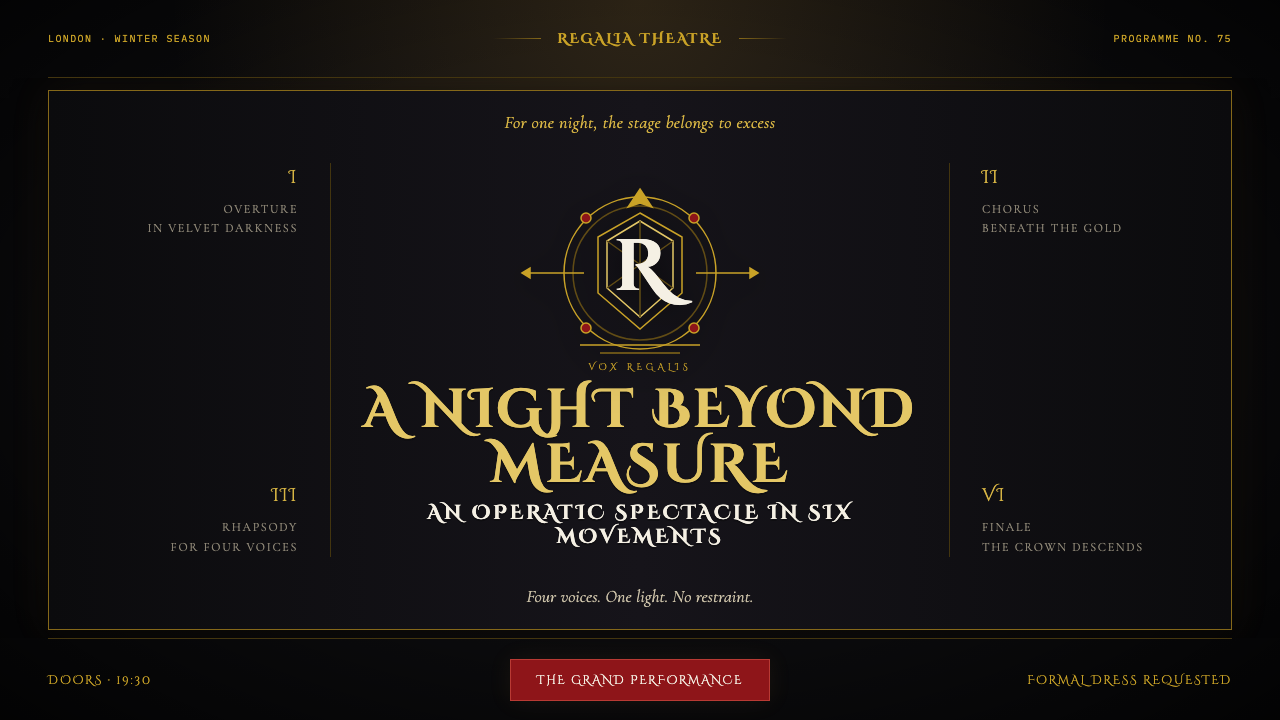 Queen — Bohemian Rhapsody (1975)Rock assumes the crown. Engraved gold, Roman capitals and a lone spotlight ru…
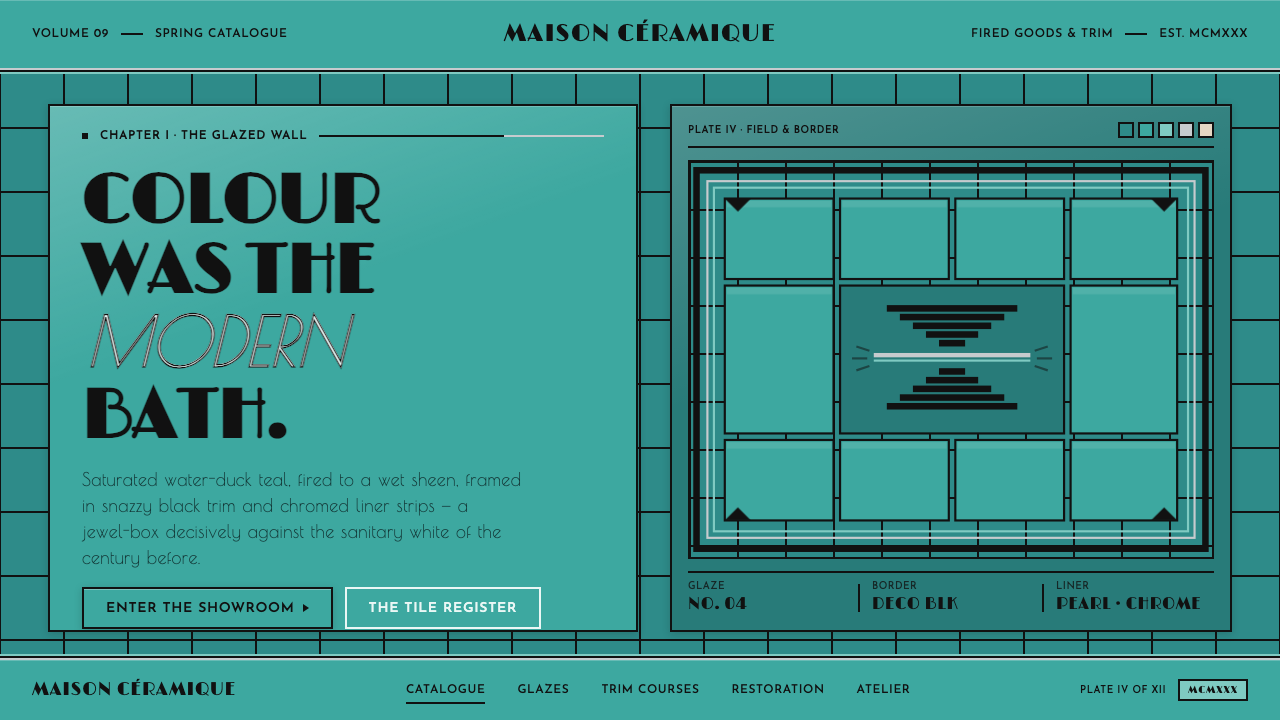 Art Deco Teal BathroomColour was the modern bath. Water-duck teal glaze, snazzy black trim, Limelig…
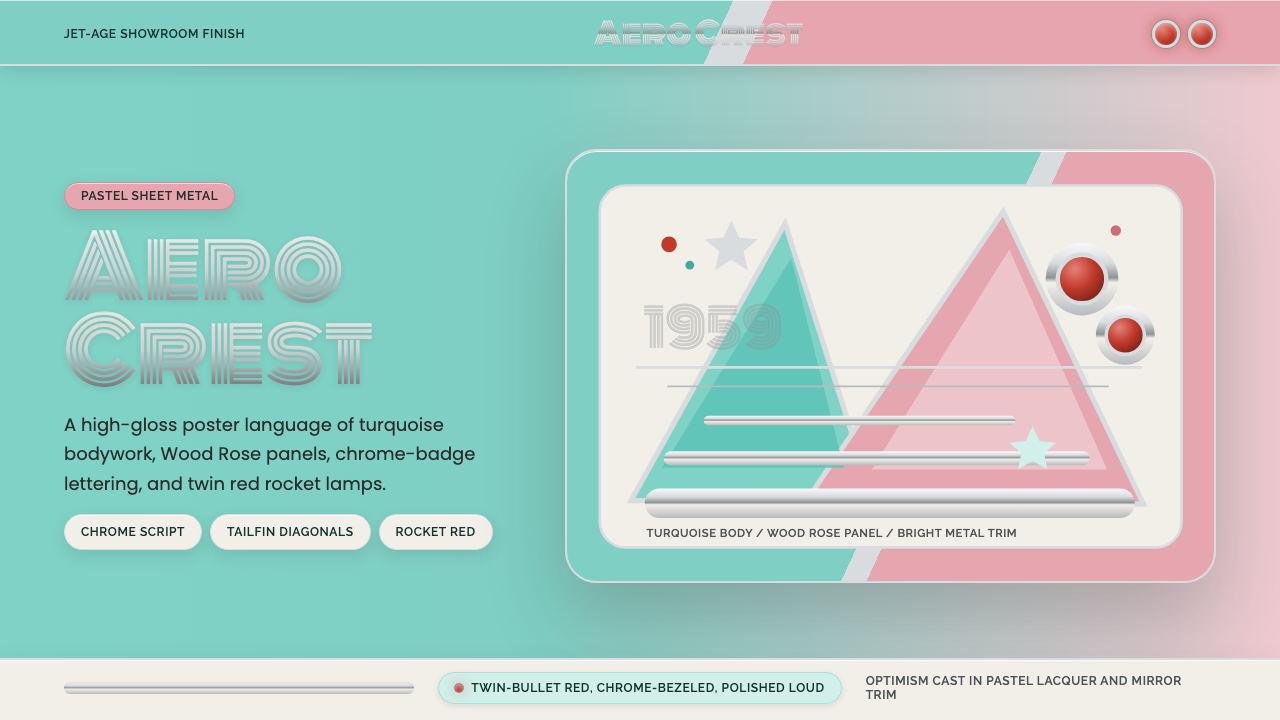 Cadillac TailfinShowroom optimism. Pastel aqua, Wood Rose panels, chrome Monoton, and rocket…
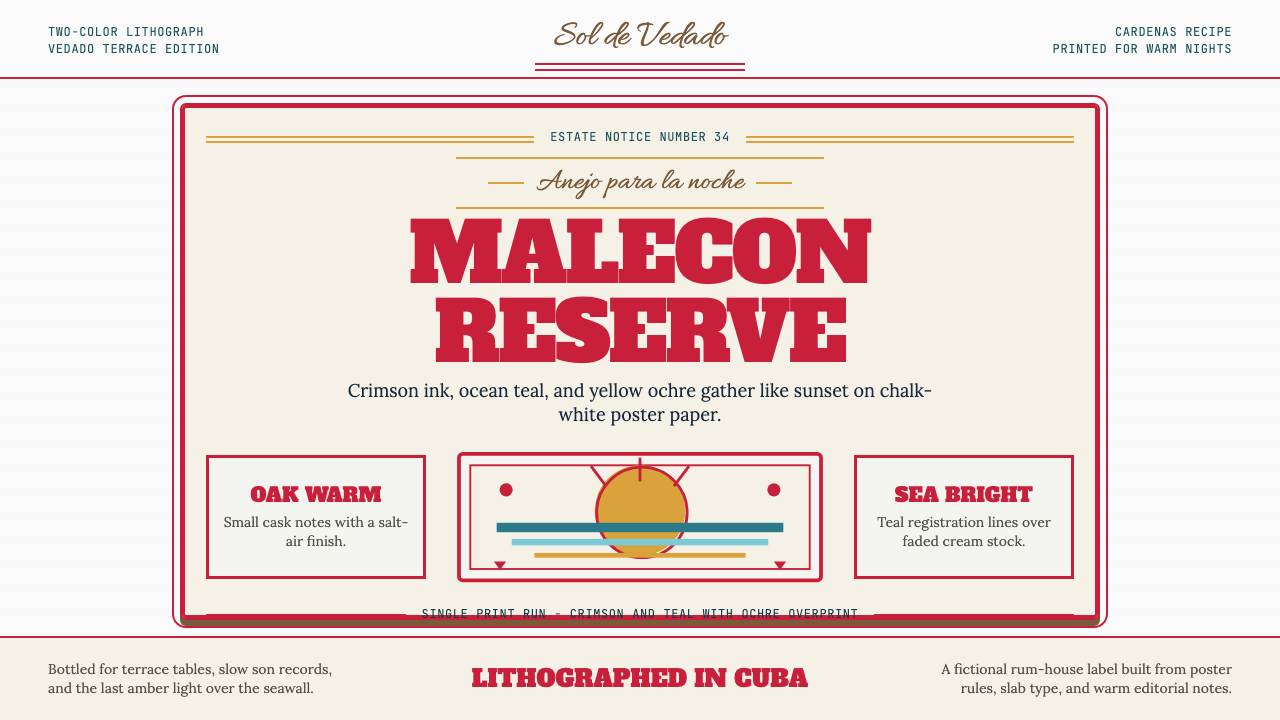 Havana Club Cuban RumSunset in print. Crimson slab type and ocean teal rules age on chalk-white pa…
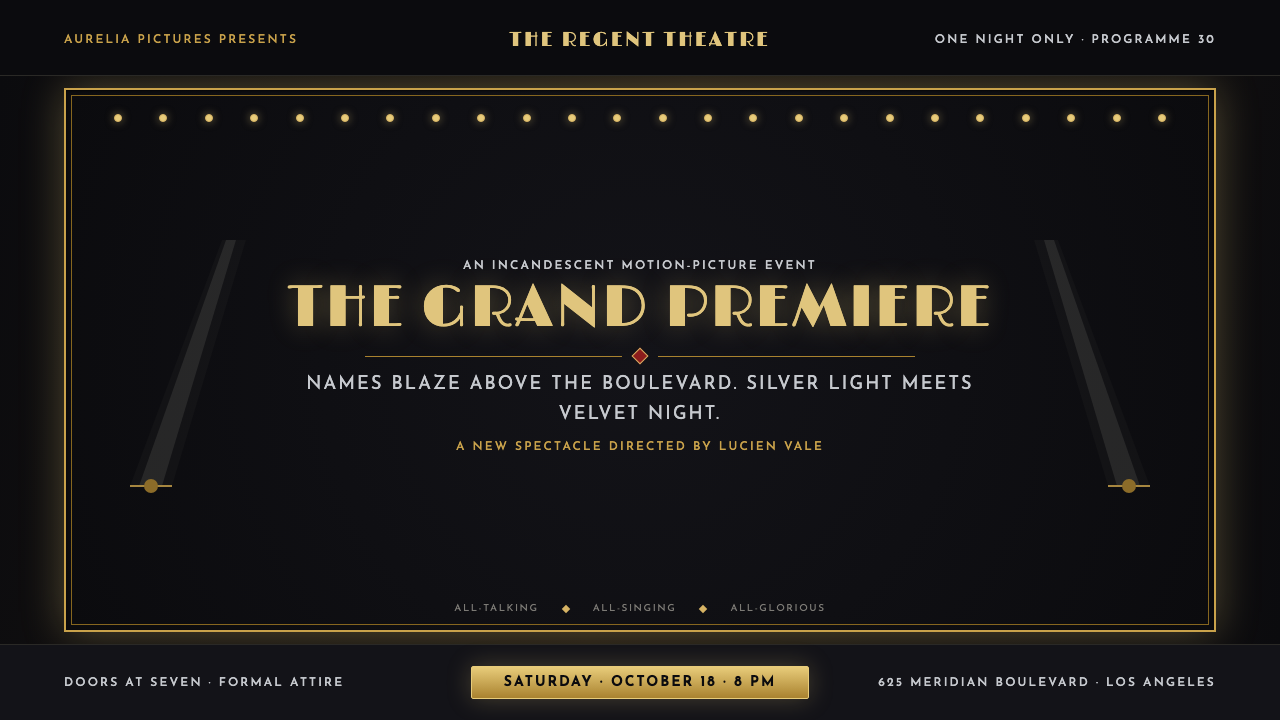 Hollywood Golden Age (1930)Black-and-gold spectacle commands the night. Marquee bulbs frame monumental D…
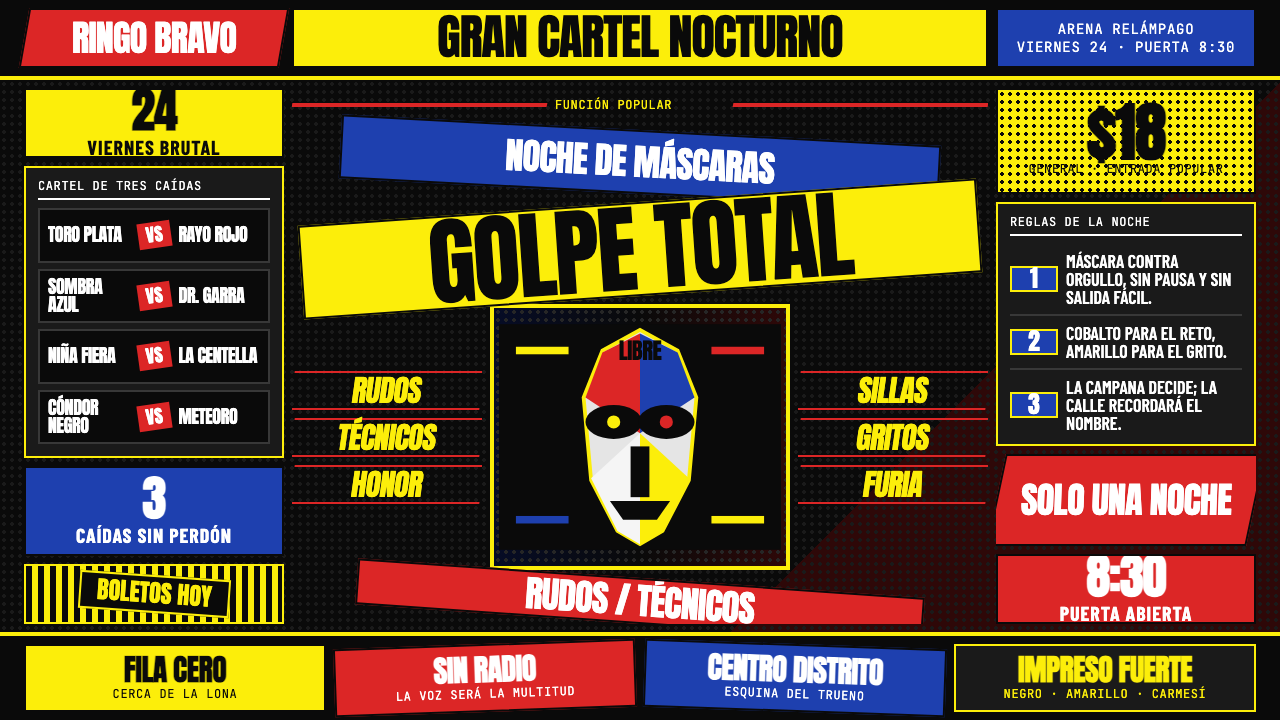 Lucha Libre PosterStreet-poster voltage. Yellow Anton banners, crimson diagonals, cobalt grids…