What is Warhol Pop?
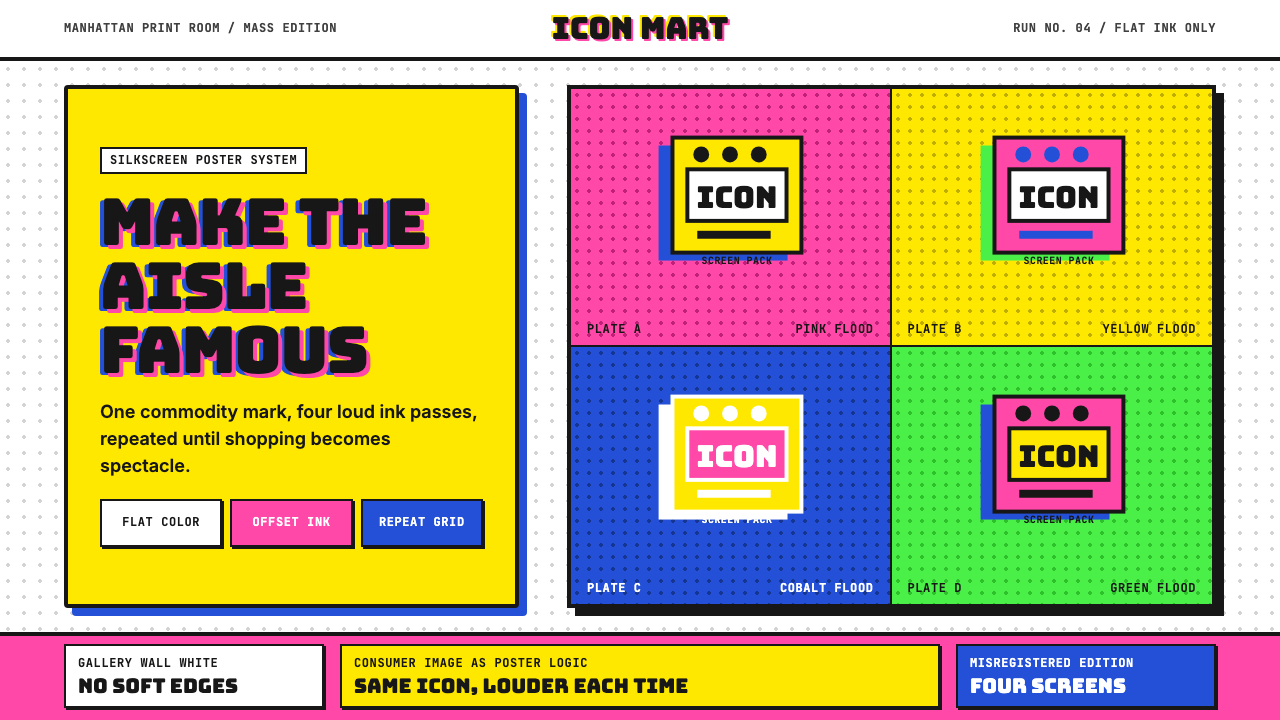
Andy Warhol proved that a soup can, silk-screened thirty-two times, could outlast every manifesto written against it.
Warhol Pop in brief
Warhol Pop is the visual system distilled from Andy Warhol's studio practice at The Factory in 1960s Manhattan: flat silkscreen color pulled across celebrity portraits and consumer-goods packaging, hard-edged repetition that turns a single image into a grid, and a palette of hot pink, electric yellow, cobalt blue, and acid green that makes every surface vibrate with the energy of a roadside billboard. It is the design language of mass production turned reflexive — the supermarket aisle staring back at itself.
Where earlier modernisms sought to purge commerce from art, Warhol Pop absorbs commerce entirely. The soup can is not a critique of the soup can; it is the soup can, faithfully reproduced and then reproduced again, until repetition itself becomes the content. In design terms this means embracing brand logic: high-contrast silhouettes, flat fields of uniform color, and a register of imagery drawn from what was already everywhere — celebrity faces, product labels, newspaper photographs. The style trusts familiarity as a visual force.
Visually, Warhol Pop is defined by a handful of consistent moves: a single high-contrast source image reduced to two or three flat tones, a grid of repeated instances in color variants, deliberate misregistration that lets the ink edge drift slightly outside the silhouette, and type borrowed from commercial signage rather than fine art tradition. The result is simultaneously democratic and iconic — work that announces itself as printable, reproducible, and intended for everyone.

Where does Warhol Pop come from?
The visual grammar of Warhol Pop crystallized in 1962, when Andy Warhol, then a successful commercial illustrator in New York, painted the Campbell's Soup Cans series — thirty-two canvases, one for each variety then offered by the brand. The paintings were shown at the Ferus Gallery in Los Angeles in July of that year, hung in a row along the wall like a supermarket shelf. The gesture was deadpan and radical in equal measure. Warhol had not made the soup cans look like art; he had insisted that they already were. The critical establishment was unsettled; the public understood immediately.
Warhol's method was as important as his subject matter. He had spent the 1950s as a sought-after commercial illustrator, producing shoe advertisements, record covers, and department-store promotions using a blotted-line technique that introduced slight unpredictable variation into each reproduction. By 1962 he was using photo-silkscreen to transfer found photographic images onto canvas — a process that allowed him to work at industrial scale, vary color across a series without repainting, and introduce the mechanical register-drift that became one of the style's signatures. The Factory, the studio he established on East 47th Street and later moved to Union Square, operated as a literal production house: assistants applied color, Warhol directed.
Warhol was not working in isolation. The broader Pop Art movement emerged simultaneously on both sides of the Atlantic in the late 1950s and early 1960s. In Britain, artists including Richard Hamilton and Eduardo Paolozzi were already making collages from American advertising imagery, theorizing the relationship between mass culture and fine art. In New York, Roy Lichtenstein was reproducing comic-strip panels at monumental scale, Robert Indiana was turning the word LOVE into a logotype, and Jasper Johns had been painting targets and flags since the mid-1950s. What distinguished Warhol's contribution was the systematic embrace of mechanical reproduction and commercial color — not ironic distance from it, but full absorption into it.
The cultural context that made Warhol Pop legible was postwar American consumer culture at its peak self-confidence. Television was everywhere; celebrity was industrialized; brands had become a shared visual language. Warhol understood that Marilyn Monroe and a Campbell's soup can occupied the same visual ecosystem — both were images circulated until they detached from their referents and became pure surface. His silk-screened Marilyns, produced shortly after her death in 1962, made this explicit: the same face in hot pink, turquoise, lime yellow, and orange, repeated until it ceased to be a person and became a pattern. The style that emerged from this insight — flat, loud, grid-organized, color-varied — remains one of the most immediately recognizable visual grammars in twentieth-century design.
What defines the Warhol Pop look?
Flat High-Saturation Color
Color in Warhol Pop is applied as solid, uniform fields with no gradation, no shading, and no tonal variation within a single area. The palette leans toward the extreme end of saturation: hot pink that reads almost fluorescent, yellow that competes with neon signage, cobalt and electric blue that feel broadcast-quality. Color is not used to model form — the silhouette carries the form — but to differentiate instances in a series and to create the visual temperature associated with commercial printing at full-bleed.
Silk-Screen Misregistration
One of the style's most distinctive textural notes is the slight slippage between the image layer and the color layer — where the ink extends a few millimeters beyond the edge of the silhouette, or where two color passes fail to align exactly. In Warhol's actual prints this was a product of manual screen registration; in contemporary design work it is a deliberate aesthetic choice, introduced as a visible offset halo around key shapes. The misregistration marks the work as hand-touched and printed rather than digitally perfect, and carries a subtle energy that pure precision would neutralize.
Repetition as Composition
The grid of repeated images is Warhol Pop's most structurally distinctive move. Rather than a single centered composition with supporting elements, the style arranges multiples of the same image across a regular grid, varying only the color assignment. This approach borrowed directly from commercial printing layouts and contact sheets. Compositionally it means the grid itself is the layout decision: all cells are equal, hierarchy is expressed through color temperature rather than position, and the collective impression of the grid reads differently from any single cell examined in isolation.
High-Contrast Silhouette
Source imagery is reduced to high-contrast silhouettes before color is applied — details within the shadow areas collapse to a single flat dark tone, and highlights merge into a single flat light tone. This reduction is not loss but economy: the silhouette extracts the most legible version of the face or object, the version that survives reproduction at any scale and in any color variant. The technique is closely related to the commercial poster and signage tradition where legibility at a distance is paramount.
Commercial Typography
When type appears in Warhol Pop work, it comes from the vernacular of commercial signage, product labeling, and tabloid headlines rather than from typographic refinement. Letter spacing is often tight, weight is often heavy, and the type sits on or near the image rather than in a designated text zone below it. The effect is closer to a product label or a newspaper front page than to art-world convention. This typographic vernacularism is intentional: it closes the aesthetic gap between the artwork and the commercial object it depicts.
Serial Color Variation
A defining characteristic of the style is the production of variations — not a single finished version but a set of instances, each carrying the same compositional structure with a different color assignment. The Marilyn series, the Mao series, the flower prints: all work this way. In design application this translates to a system where a primary visual module can be recolored across a palette without any other change, producing a family of outputs that feel simultaneously unified and varied. The variation is not revision; it is multiplication.
Deadpan Flatness
The emotional register of Warhol Pop is deliberately neutral — not warm, not confrontational, not celebratory. The same mechanical process that makes a portrait of Elvis Presley also makes a portrait of an electric chair; the flatness is morally consistent. In design terms this means avoiding visual hierarchy cues that suggest urgency, warmth, or concern. Everything is presented at the same visual temperature. This neutrality is not blandness — it is a stance that forces the viewer to bring their own emotional reading to the image.

Who shaped Warhol Pop?
Born Andrew Warhola in Pittsburgh in 1928 to Carpatho-Rusyn immigrant parents, Warhol trained at the Carnegie Institute of Technology and moved to New York in 1949, where he built a successful career in commercial illustration before pivoting decisively to fine art around 1960. The Factory studio became a social and creative hub where the silk-screen method was developed into an industrial practice. Warhol managed his own celebrity with the same detached precision he applied to his subjects, producing self-portraits, interview transcripts, and eventually a magazine — Interview — as extensions of his media-analysis project. He died in 1987 following complications from routine surgery, having reshaped the boundary between commercial and fine art more durably than almost any figure of his century.
Lichtenstein's parallel practice illuminates the Pop Art moment by contrast. Where Warhol gravitated toward the photographic image and the celebrity, Lichtenstein mined the comic strip and the romance novel — line-art sources with their own Ben-Day dot printing signature. The two artists approached mechanical reproduction from different directions and arrived at related conclusions: that the imagery of mass culture, enlarged and isolated in a gallery context, acquired a reflective quality it lacked in its original setting. Lichtenstein's typographic approach — dialogue balloons, onomatopoeic sound effects set in bold sans-serif — contributed a specifically comic-derived letterform tradition to the broader Pop design vocabulary.
Sedgwick occupied a structurally important position in the Warhol ecosystem as the Factory's most visible female muse and superstar during the period 1965 to 1966. Her significance to the design legacy of Warhol Pop is less about individual artworks and more about the Factory model itself: the production of celebrity through image circulation, costume repetition, and the deliberate blurring of private person and public surface. Sedgwick's visual presence — raccoon-eye makeup, geometric shift dresses, short bleached hair — embodied the Pop aesthetic applied to personal style, demonstrating that the silkscreen logic of flat planes and high-contrast reduction could operate equally in fashion, film, and social performance.
Indiana's contribution to the Pop Art vocabulary was the reduction of language to logotype. His LOVE image — the word arranged in a two-by-two block with the O tilted — became one of the most reproduced graphic images of the twentieth century after its use as a United States Postal Service stamp in 1973. Indiana's approach differed from Warhol's in that it began with words rather than photographs, treating language itself as a flat graphic element subject to the same color-field treatment as any other shape. His stencil-derived letterforms and his insistence on primary and secondary colors deployed in hard-edged blocks contributed a linguistic dimension to the Pop graphic system that remains influential in logo and identity design.
Hamilton, working in Britain, produced in 1956 what is often cited as the first Pop artwork: the small collage 'Just what is it that makes today's homes so different, so appealing?' — a composite of American advertising clippings that catalogued the aspirational consumer interior. Hamilton's analytical stance toward mass-culture imagery — treating it as worthy of close formal attention rather than as background noise — provided the theoretical framework within which Warhol's more intuitive practice would later be understood. His influence on British graphic design, particularly the interplay of photography, type, and flat color in editorial and poster contexts, runs in parallel to the American strand of Pop without being identical to it.
How do you use Warhol Pop today?
Warhol Pop is one of the few historical styles that transfers directly and legibly into contemporary digital design contexts, because its underlying logic — flat color, high contrast, repetition, grid — is native to both screen and print. Applying it well requires understanding what the style is actually doing structurally, not merely copying its surface markers. The misregistration halo, the hot-pink field, the grid of repeated portraits: each of these does specific compositional work, and dropping them into a layout without that understanding produces decoration rather than system.
For presentation slides, Warhol Pop is particularly effective on cover pages and section dividers. A cover built on the style's logic takes a single high-contrast image — a product photograph, a portrait, an icon — reduces it to two flat tones, and tiles it in a grid of three or four, each cell in a different color from the palette. The deck title sits over this grid in bold commercial-style type. Content slides should use the palette sparingly: one accent color per slide for key data labels or callout boxes, black on white or near-white for body text, and generous white space so the color reads as signal rather than wallpaper. Data visualization slides work especially well with this approach — bar charts become color-coded grid elements that feel designed rather than defaulted.
For web interfaces, Warhol Pop suits marketing landing pages, event pages, and product launch contexts more than it suits transactional or utility interfaces. The palette's intensity is a feature in contexts where the goal is to command attention and communicate cultural confidence, but it can overwhelm in interfaces where users need to concentrate or complete tasks. A Warhol Pop-inflected pricing page works when each pricing tier gets its own flat color field from the palette, making tier comparison a color-reading exercise. A dashboard built on this logic should restrict the full palette to status indicators and alerts, keeping the primary information architecture in a quieter register.
For editorial and marketing work, the style offers strong tools for high-impact hero sections and campaign materials. A Warhol-inflected editorial spread uses a full-bleed repeated-image grid as a background layer, with the headline dropped over it in a contrasting flat color. Campaign posters work well with the four-up or nine-up grid of color variants — the viewer gets multiple readings of the same visual in a single glance, which is itself the communicative point. The style is particularly effective for cultural events, music releases, fashion editorials, and brand campaigns that want to signal irreverence and cultural literacy simultaneously.
A common mistake when applying Warhol Pop is reaching for the full palette at once. The style's most successful contemporary applications typically commit to two or three colors from the palette — one dominant, one accent, one structural — and use the remainder for variation within a series rather than mixing them all on a single surface. A second frequent error is using naturalistic photography without the necessary reduction step: an unprocessed photograph in a Warhol Pop layout looks like a stock-image intrusion, not a Pop statement. The image must be reduced to high-contrast flat tones before it functions correctly within the visual system. Finally, do not confuse the decorative surface of misregistration with its purpose — it should appear at edges and as a subtle halo, not as a pervasive texture that muddies legibility across the entire composition.

Warhol Pop — FAQ
Is Warhol Pop the same as Pop Art?
Pop Art is the broader movement; Warhol Pop is one specific visual system within it. Pop Art included a wide range of artists — Lichtenstein's comic-strip enlargements, Indiana's word-as-logotype work, Hamilton's British collage practice, Hockney's California imagery — each with distinct visual vocabularies. What Curio calls Warhol Pop specifically refers to the silkscreen aesthetic: the flat high-saturation color, the serial repetition grid, the misregistration halo, and the celebrity-or-consumer-product subject matter. Applying a Lichtenstein-derived style — Ben-Day dots, comic-strip outlines, dialogue balloons — would be a different system within the Pop Art family.
Does the style work in monochrome or limited color?
Yes, with adjustments. The serial color variation is what gives Warhol Pop its most recognizable quality, but the underlying structure — high-contrast silhouette, grid repetition, flat fields — functions in monochrome. A single-color screen print is entirely within Warhol's practice; his 1960s shadow prints and later work explored this. In contemporary application, a two-color version using one saturated hue and black on white can read as Warhol-adjacent while feeling more restrained. The key is maintaining the other structural elements — the repetition, the flat tones, the high contrast — so the restriction reads as a deliberate choice rather than a budget constraint.
How do I introduce misregistration without it looking like a rendering error?
The difference between deliberate misregistration and an accidental rendering artifact lies in consistency and placement. Authentic misregistration is consistent in direction — the offset drifts the same way across the composition — and it appears at the edges of silhouetted shapes, not as a general blur or as color fringing on typography. Apply the offset as a separate color layer, slightly larger than the primary image layer, visible as a halo or shadow of a second hue. The offset should be noticeable but not dominant — it should read as a printing characteristic when you know to look for it, not as a mistake visible to everyone at a glance. Typography should generally remain crisp even when the image layers carry the offset.
Can Warhol Pop suit a professional or corporate context, or is it inherently counter-cultural?
The style is flexible enough to read as sophisticated rather than transgressive in corporate contexts, provided the application is controlled. What makes Warhol Pop feel counter-cultural in careless use is typically the combination of maximum palette saturation, dense repetition, and misregistration all applied simultaneously at full intensity. Pulling back on any of these axes — choosing two colors rather than four, spacing the grid generously, keeping the misregistration subtle — shifts the register from agitprop toward editorial confidence. The style has been used effectively by cultural institutions, fashion brands, and technology companies precisely because its visual authority is distinct from both corporate conservatism and blank minimalism. The key is intentionality: every element must feel chosen, not defaulted.
What is the right way to handle photography in a Warhol Pop layout?
Photography must be processed before it enters a Warhol Pop layout — the style does not accommodate naturalistic photographs with full tonal range. The correct process is to reduce the photograph to high-contrast flat tones: collapse the shadows to a single dark field, collapse the highlights to a single light field, and eliminate the midtone gradient entirely. The result should read as a silkscreen print rather than a photograph. In practice this means applying a high-threshold posterization that leaves two or three tones maximum. Once reduced, the image can be colored as a flat element — the dark areas taking one hue, the light areas taking another — and repeated in the grid with color variants. Portrait and product photography suit this treatment well; landscape and atmospheric photography, which depend on tonal subtlety, resist it.
Related design styles
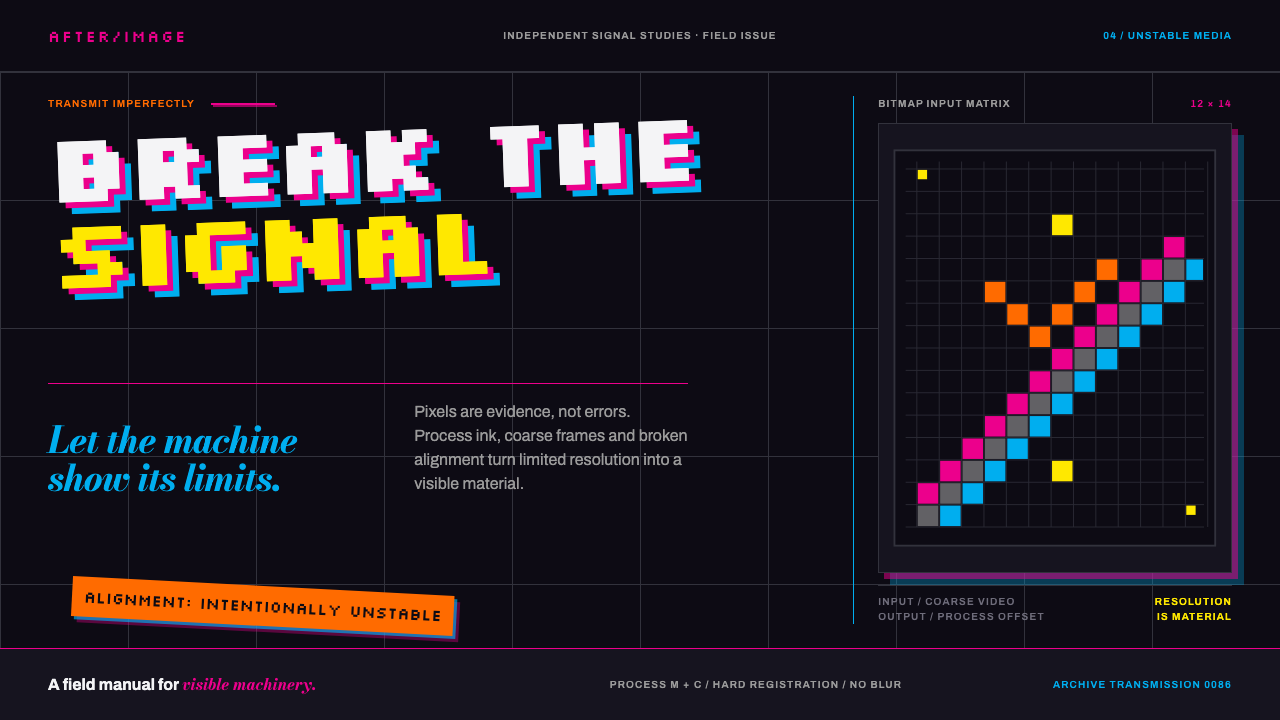 April Greiman HybridResolution becomes material. Bitmap type and process magenta collide on a bro…
 Psychedelic Fillmore (Mouse, 1968)Legibility becomes ritual. Magenta-cyan vibration and bulbous mandalas melt t…
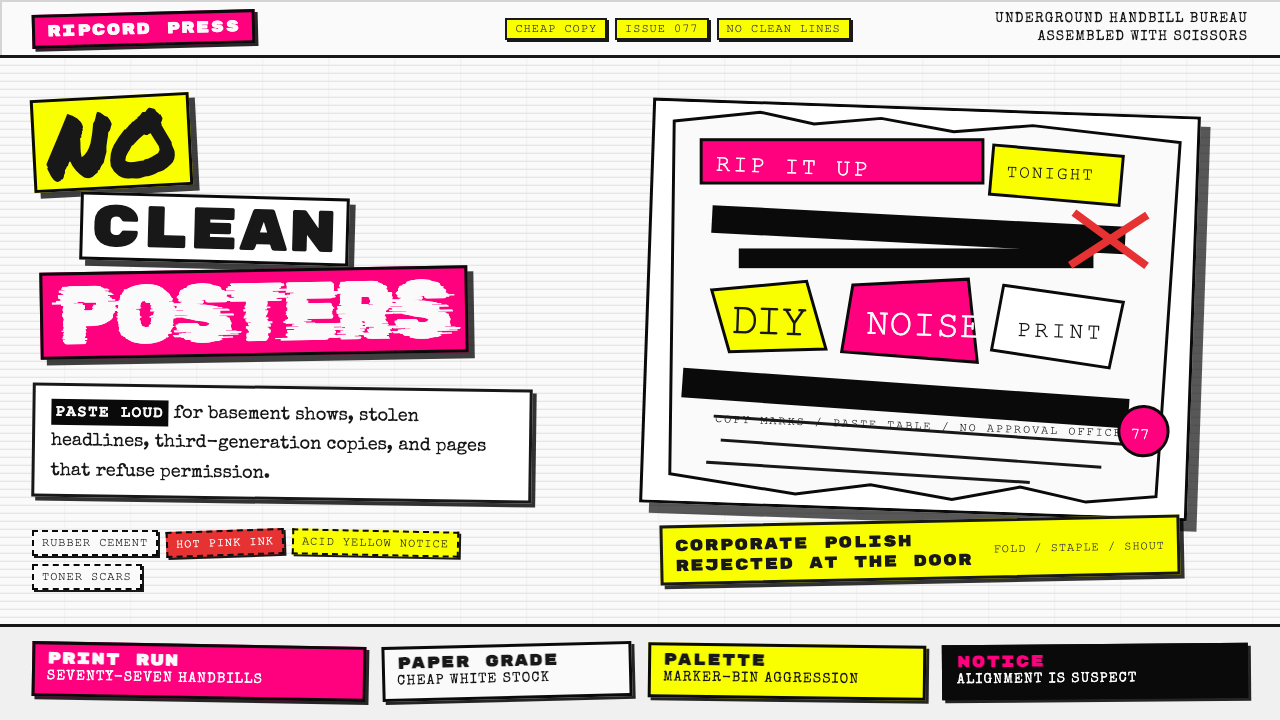 Punk Xerox 1977Anti-design shouts. Hot pink and acid yellow collide with ransom type on Xero…
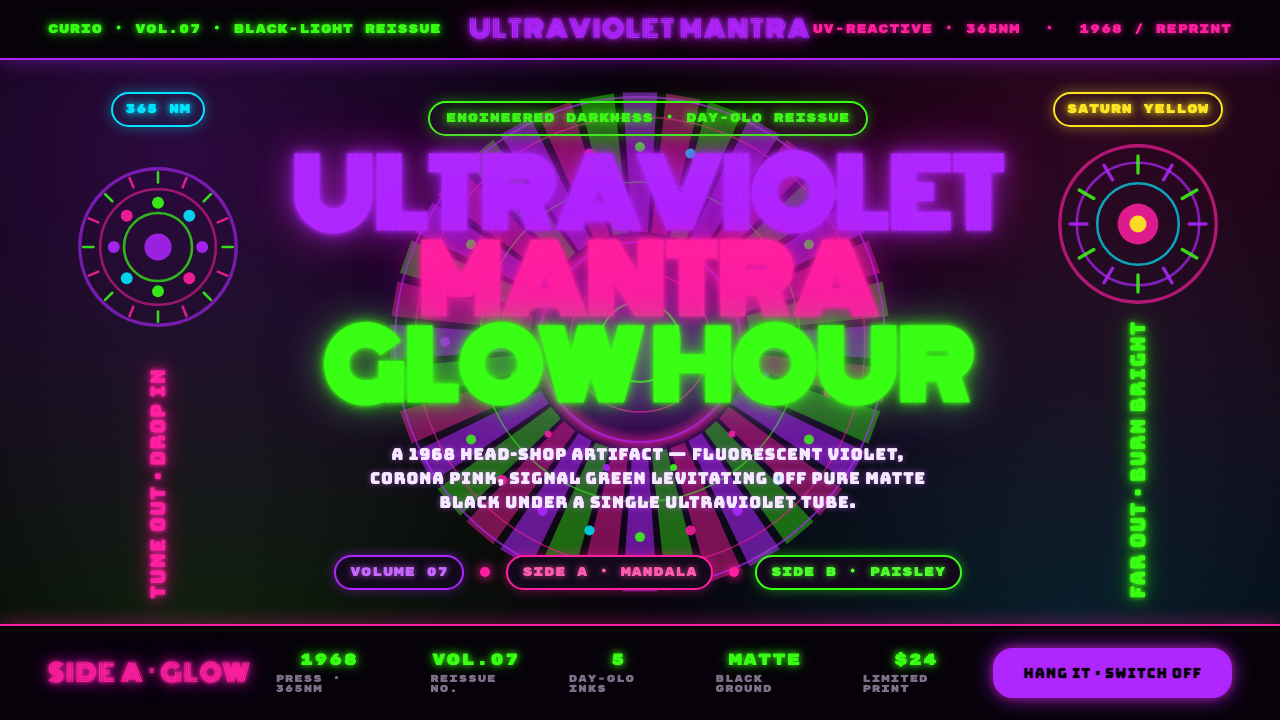 UV Blacklight PosterEngineered darkness. Day-Glo violet, Corona pink, and signal green levitating…
 Bollywood Poster Art (1970s)Subtlety is unaffordable. Saffron fields, Bungee shadows, diagonal hoarding d…
 Brazilian Tropicália (1968)Art must be loud. Jungle green, banana yellow Anton type, and hard-shadow col…