What is Punk Xerox 1977?
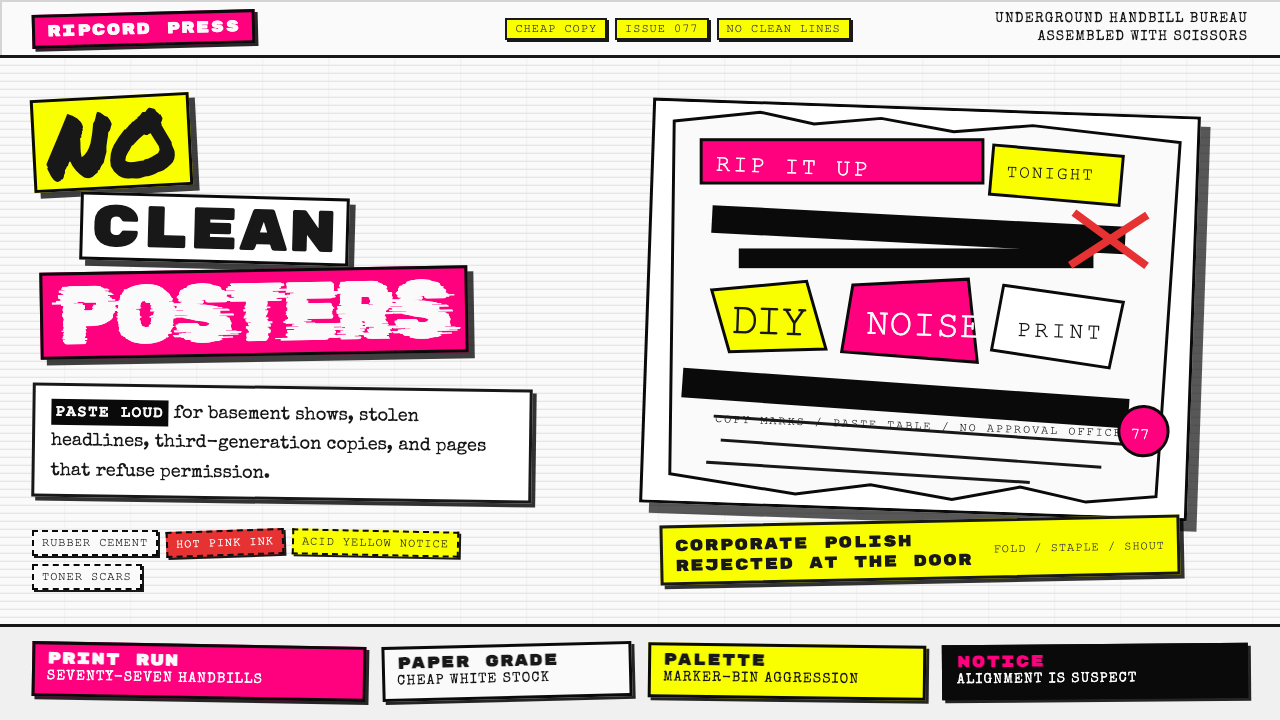
Punk Xerox 1977 is the aesthetic of deliberate degradation — ransom-note letters, torn edges, and screaming color photocopied until every surface becomes an act of refusal.
Punk Xerox 1977 in brief
Punk Xerox 1977 is the visual language born in London's underground music scene between 1976 and 1980, assembled from photocopier output, cut magazines, rubber cement, and the confrontational energy of a youth culture explicitly rejecting polished commercial aesthetics. Every letter is a different size. Every edge is torn or cut unevenly. Every surface carries the visible grain of reproduction — the streaks, the skewed angles, the black halos of a Xerox machine pushed past its intended purpose.
The core visual logic is the inverse of professional design: quality is not the goal, rawness is. Where corporate graphics of the era sought smooth gradients, aligned grids, and consistent typography, Punk Xerox assembled mismatched clippings from newspapers and magazines into ransom-note compositions where the act of cutting and pasting was itself made visible. Hot pink and acid yellow — the cheapest, loudest inks available — collided against stark white or off-white paper. Black was used heavily for photocopied newsprint clippings, crude hand-lettering, and confrontational imagery.
This is anti-design made deliberate and coherent. The aesthetic communicates urgency and authenticity precisely because it refuses the conventions that signal expertise. It says: this was made by someone with scissors and a coin-operated photocopier, and that is the point. The roughness is the message.

Where does Punk Xerox 1977 come from?
The aesthetic has a precise historical origin. In 1976, graphic artist Jamie Reid began creating artwork for the Sex Pistols, a London punk band managed by Malcolm McLaren. Reid drew on the Situationist International — a French political art movement — particularly their practice of détournement: taking existing imagery from consumer culture and subverting it to produce a critical message. His most iconic work defaced official portraits of Queen Elizabeth II with ransom-note lettering, transforming a symbol of institutional authority into a vehicle for confrontation. These images, reproduced cheaply and distributed as flyers, posters, and record sleeves, established the visual grammar of punk.
The Xerox machine was not incidental to the movement — it was its infrastructure. In an era before desktop publishing, the photocopier offered instant, cheap, infinitely reproducible output. Punk musicians, artists, and fans used it to produce fanzines (self-published fan magazines), gig flyers, and political manifestos. Each generation of photocopying degraded the image slightly: contrast increased, halftones collapsed into solid black, thin lines disappeared. Rather than treating this degradation as a defect, punk aesthetics embraced it as a quality — proof of circulation, of hands passing the object along, of information spreading outside official channels.
Parallel scenes developed simultaneously in New York City and Los Angeles. New York punk, centered on CBGB and associated with bands like Television, Talking Heads, and the Ramones, produced its own graphic culture — slightly cleaner than London punk but sharing the cut-and-paste immediacy and the rejection of commercial finish. The Los Angeles hardcore scene in the late 1970s and early 1980s produced some of the most aggressive graphic work of the period, with bands and labels pushing the degraded aesthetic toward maximum visual compression and illegibility.
The movement also drew from design history in ways its practitioners often did not consciously acknowledge. The cut-up technique had precedents in Dada collage of the 1910s and 1920s — Hannah Höch's photomontages, Raoul Hausmann's typographic experiments — and in Beat generation cut-up writing methods. What punk added was mass distribution via photocopy, an explicitly anti-commercial ethic, and a specific sonic and subcultural context that gave the visual language its meaning. By 1980, the aesthetic had been extensively documented and was beginning its long second life as a reference style for designers who came after.
What defines the Punk Xerox 1977 look?
Color
The palette is deliberately aggressive and limited: hot pink and acid yellow are the signature hues, chosen because they were the cheapest and most attention-demanding colors available for offset printing and screen printing on a budget. Black appears heavily — not as an elegant neutral but as the raw output of photocopied newsprint and crude hand-lettering. White or off-white paper provides the ground. These colors do not harmonize; they clash, and the clash is the point. Secondary or muted tones are conspicuously absent — every color choice reads as a shout rather than a suggestion.
Typography
The ransom-note approach to type is the movement's most recognizable characteristic: letters sourced from different publications, at different sizes, in different typefaces, cut individually and pasted together to form words and sentences. No two letters share the same baseline. No two words share the same weight or style. This typographic cacophony is both the aesthetic and the communicative strategy — it signals that the message was assembled urgently, with whatever materials were at hand, and that the content matters more than its presentation. Hand-lettering appears alongside clipped letterforms, sometimes in the same word.
Surface Degradation
Photocopying introduces visible artifacts: grain, streaks, halo effects around dark areas, contrast compression, and the slight skewing that results from paper fed imprecisely. Punk Xerox aesthetics treat all of these as features rather than failures. Multiple generations of copying — photocopying a photocopy — produce progressively more distorted, higher-contrast, more grainy images. This deliberate degradation signals authenticity and circulation: the rougher the surface, the more hands it has passed through, the more real it is. Clean, smooth reproduction is associated with corporate production and therefore rejected.
Collage and Cut-and-Paste
Composition is assembled rather than designed. Images, headlines, and blocks of text are cut from existing sources — newspapers, magazines, official documents, advertising materials — and repositioned to create new meanings through juxtaposition. The cut edges are left visible; the seams between elements are not concealed. Torn paper edges appear alongside straight cuts, creating irregular silhouettes. This process makes the act of production visible and legible as a physical, manual act, which is inseparable from the movement's anti-corporate, DIY ethic.
Confrontational Imagery
Subject matter is deliberately provocative: defaced portraits of authority figures, consumer imagery stripped of its original context and reframed as critique, symbols of institutional power subjected to graphic violence — overprinted, slashed, obscured. Images are not used to illustrate or decorate; they are used to create cognitive friction. The viewer is meant to be unsettled, not comforted. This confrontational relationship with imagery distinguishes Punk Xerox from later styles that borrow its surface texture while stripping away the critical content.
Illegibility as Intent
Punk Xerox does not optimize for readability. Text is sometimes overprinted on busy backgrounds, rotated to unexpected angles, sized so small as to require effort, or set in such extreme contrast that it becomes difficult to parse. This is not carelessness but strategy: illegibility demands active engagement from the reader, filters out passive audiences, and signals that the work exists outside mainstream communication conventions. The degree of illegibility varies — some pieces prioritize a single legible slogan against chaotic background noise, others make even the central message effortful to extract.
DIY Material Evidence
The materials of production are never concealed — they are displayed. Rubber cement bleed-through, fingerprints transferred onto the original before copying, tape residue, the shadows cast by layers of pasted paper — all remain in the final image. This material evidence is proof of process and of the absence of professional mediation. A piece that looks too clean, too precisely cut, or too evenly reproduced loses authenticity within this aesthetic system. The visible trace of human hands making the object is, paradoxically, what gives it authority.

Who shaped Punk Xerox 1977?
Reid is the defining visual architect of punk graphics. His work for the Sex Pistols — including the safety-pin-and-ransom-type treatment of the Queen's portrait for the 'God Save the Queen' single, and the collaged sleeve for 'Never Mind the Bollocks' — established the visual template that defined the movement internationally. Reid's approach was rooted in Situationist politics: he saw visual art not as a commercial service but as a tool for ideological disruption. His practice of defacing existing imagery rather than creating original illustration was both politically motivated and economically practical — it required no specialist equipment, only scissors and a photocopier.
Garrett was the graphic designer for Manchester post-punk bands Buzzcocks and Magazine, and his work represents a more formally sophisticated strain of punk graphic design that operated alongside and after the raw Xerox moment. Working from the late 1970s, Garrett absorbed the collage aesthetics and typographic disorder of punk and began formalizing them — introducing more systematic grid structures beneath the surface chaos, and treating found imagery and layered type as design elements to be composed rather than simply assembled. His work documents the transition from first-generation punk graphics to the post-punk design language that influenced British graphic design through the 1980s.
Sterling — who worked under the name Linder — was a visual artist and musician closely associated with the Manchester punk scene and the band Buzzcocks. Her photomontage work, which juxtaposed domestic consumer imagery (food, household objects) with fragmented female bodies from soft-focus advertising, represented punk's most direct engagement with feminist critique through collage. Her covers for Buzzcocks singles extended the cut-and-paste vocabulary into territory that was simultaneously more formally composed and more conceptually layered than straight Xerox punk. Sterling's work is a reminder that the aesthetic had multiple intellectual strands, not all of them reducible to raw aggression.
Bubbles — the working name of designer Colin Fulcher — was one of the most formally inventive designers working in the punk and post-punk orbit, producing work for Stiff Records, Elvis Costello, and Ian Dury and the Blockheads. His practice was distinctive in its range: he absorbed punk's collage energy and typographic anarchism but applied it with a knowledge of design history — Constructivism, Dadaism, Art Deco — that produced work of unusual sophistication. His record sleeve designs often operated as sequential works, with back and inner sleeves extending the typographic and visual system established on the front cover. Bubbles demonstrates that punk graphic design could be simultaneously anti-establishment and deeply historically literate.
Perry was the creator of Sniffin' Glue, widely regarded as the first British punk fanzine, launched in July 1976 and produced for roughly a year before he folded it. Sniffin' Glue was produced entirely by hand — handwritten text, cut-and-paste images, run off on a photocopier — and distributed through record shops and at gigs. Its graphic quality was emphatically amateur: crooked columns, uneven margins, text running into images, pages assembled without any pretense of professional layout. But this amateur quality was the point: Perry demonstrated that anyone with a photocopier and something to say could produce a publication, democratizing media production in a way that anticipated desktop publishing by nearly a decade.
How do you use Punk Xerox 1977 today?
Punk Xerox 1977 is a high-signal aesthetic: applied correctly, it communicates urgency, authenticity, and a deliberate rejection of corporate polish. Applied carelessly, it reads as mere chaos or unfinished work. The key is understanding that the original aesthetic was purposeful in its disorder — every torn edge, every mismatched letter, every overexposed image was the result of choices made under constraints, not the absence of choices. Contemporary use must replicate that purposefulness, even when the constraints themselves are artificial.
For presentation slides, Punk Xerox works most effectively on cover and section-break pages where a strong tonal statement is needed. A cover built on this aesthetic uses a dramatically cropped or degraded image — high contrast, stripped of midtones, given visible grain — combined with ransom-note title lettering where each word is set in a different weight and scale. The background should be raw white or near-white; color appears in isolated, flat bursts of hot pink or acid yellow rather than as wash. Content slides, if they must follow this cover system, should be treated as deliberate reductions — one concept per page, large text, minimal elements, with roughness preserved through intentional asymmetry and uneven spacing rather than through literal photocopier artifacts.
For web interfaces, the style is best suited to landing pages and editorial contexts rather than functional dashboards. A Punk Xerox landing page works when the brand proposition is specifically about independence, anti-establishment positioning, authenticity, or disruption. The implementation uses raw white backgrounds, typographic hierarchy built from extreme scale contrast (a massive headline alongside very small body text), flat hot-pink or acid-yellow accent elements used sparingly, and border or outline treatments that appear hand-drawn or rough-edged rather than precisely rendered. Navigation should be sparse and typographic; interactive states can use color as a sudden, jarring switch rather than a smooth transition.
For editorial and marketing work, the style supports strong opinionated voices and content that explicitly positions itself against convention. An editorial layout in this mode uses intentional column misalignment, pull quotes set in ransom-note style, and section dividers that are crude rules or torn-edge devices rather than refined ornament. Marketing materials for brands in music, fashion, youth culture, or independent media can use the aesthetic to signal subcultural literacy — but only if the underlying brand positioning actually supports that signal. Applying Punk Xerox to a generic enterprise SaaS product or a financial services brand reads as costume rather than identity.
A common mistake when applying this aesthetic is treating visual disorder as the primary goal and losing all compositional logic in the process. Authentic Punk Xerox — even in its most chaotic examples — maintains a basic hierarchy: there is usually one dominant element (a single large image or a single dominant word) around which the chaos is organized. Without that anchor, the result is not punk but merely illegible. A second common mistake is using too many colors: the historical palette was constrained to one or two colors beyond black and white by the economics of printing. Introducing a full-spectrum color palette dissolves the aesthetic's urgency and makes it look decorative rather than confrontational.

Punk Xerox 1977 — FAQ
Is Punk Xerox just about making things look dirty and broken?
No — and this is the most important distinction to make before applying the style. Punk Xerox is not a texture applied to design; it is a stance communicated through design choices that happen to produce a particular texture. The roughness, the mismatched type, the degraded surfaces all exist to communicate something specific: urgency, independence, opposition to institutional polish. When contemporary designers apply the surface without the stance — using grunge filters on corporate content, or adding ransom-note type to a luxury brand campaign — the result reads as hollow appropriation. The aesthetic only functions when the visual language aligns with an actual communicative position that the roughness is meant to express.
How does Punk Xerox relate to Dada and Constructivism?
Punk Xerox shares techniques with both movements but differs fundamentally in context and intent. Dada collage — particularly the Berlin Dada photomontages of John Heartfield and Hannah Höch — used cut-and-paste assembly and typographic disruption to produce political critique, which is the closest historical parallel to punk's approach. Soviet Constructivism contributed the diagonal composition and bold typographic scale that appear in some punk graphic work, though usually filtered through Situationist posters rather than direct engagement. The difference is that Dada and Constructivism were produced by trained artists working within avant-garde art institutions, while Punk Xerox was deliberately non-institutional — it was produced outside art schools, without professional equipment, by people who often had no formal design training. That distinction is part of its ideology.
Can the style work for digital-native products, or is it inherently tied to print?
The style originated in print production but its principles translate to digital contexts — with some important adaptations. The original degradation effects came from physical reproduction processes: photocopier artifacts, ink bleed, paper texture. In digital contexts, these must be simulated or approximated, which risks tipping into nostalgic pastiche if handled poorly. The most effective digital translations focus on the compositional and typographic principles — extreme scale contrast, collage-based layouts, unapologetically asymmetric compositions — rather than attempting to perfectly simulate Xerox artifacts. The color system — hot pink, acid yellow, black, raw white — translates directly. Motion design can reference the aesthetic through sudden cuts, high-contrast transitions, and type that appears to have been stamped or slammed onto the screen rather than smoothly animated in.
How do I avoid the look reading as dated rather than referential?
The line between 'referencing a historical aesthetic' and 'looking like it was made in that period' depends almost entirely on the quality and purposefulness of the selection. A design that borrows every element of the 1977 idiom simultaneously — the specific color combination, the ransom-note type, the Xerox grain, the torn edges, the safety-pin imagery — will read as costume. A design that selects two or three elements and applies them with contemporary compositional thinking — clear hierarchy within the chaos, deliberate use of negative space, a single conceptual anchor — reads as reference. The most successful contemporary applications of Punk Xerox tend to be formally rigorous underneath their surface disorder: they know exactly which rule they are breaking and why, and they break only that rule.
What kinds of brands and projects are genuinely suited to this style?
Punk Xerox is well-suited to independent music labels and artists, fashion brands with genuine subcultural positioning, activist organizations and political campaigns, arts institutions presenting provocative or boundary-testing work, youth-facing media brands that want to signal insider cultural knowledge, and any project where the communication of independence and non-corporate authenticity is a core brand value. It is poorly suited to healthcare, financial services, enterprise software, hospitality, food and beverage (with the exception of specific beverage brands that have built their identity around counterculture), children's products, and luxury goods. The honest test is whether the roughness communicates something true about the organization using it — or whether it is borrowed texture in service of a brand that would be better served by a different aesthetic.
Related design styles
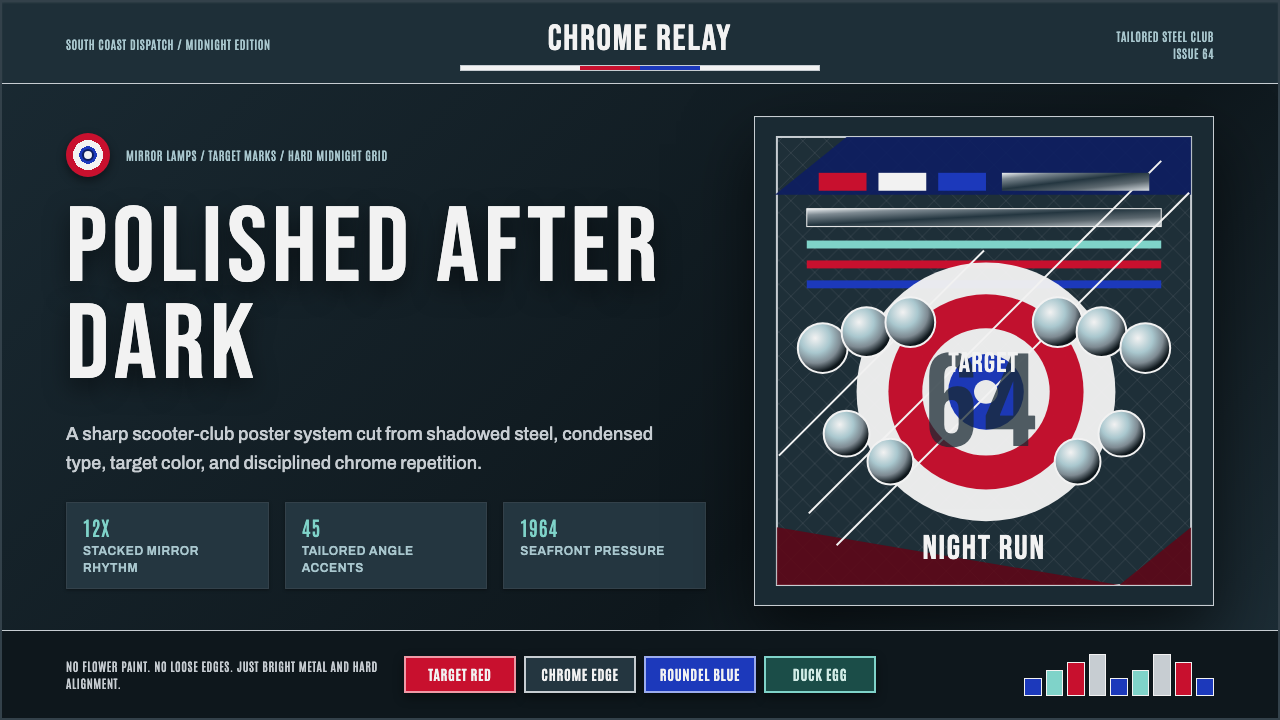 Mod Scooter ChromeSharp chrome discipline. Steel ground, roundel targets, condensed type, mirro…
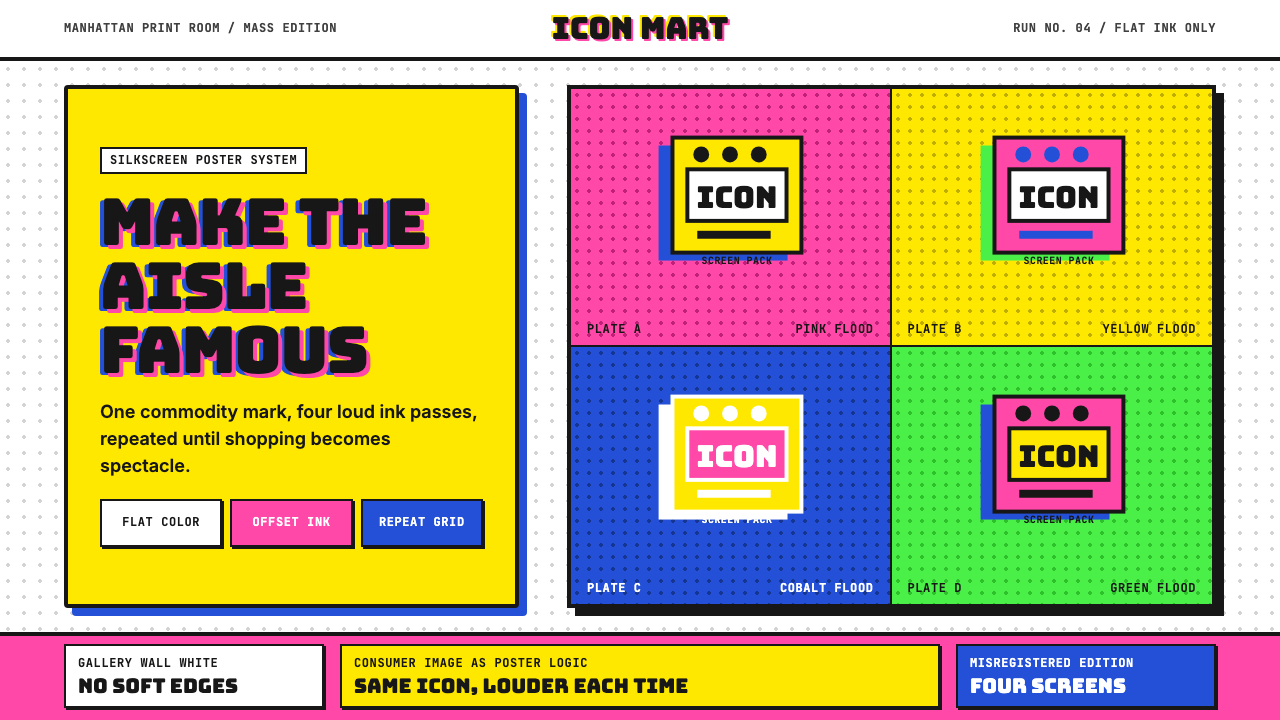 Warhol PopMass culture turns iconic. Hot pink, yellow, cobalt grids repeat flat silkscr…
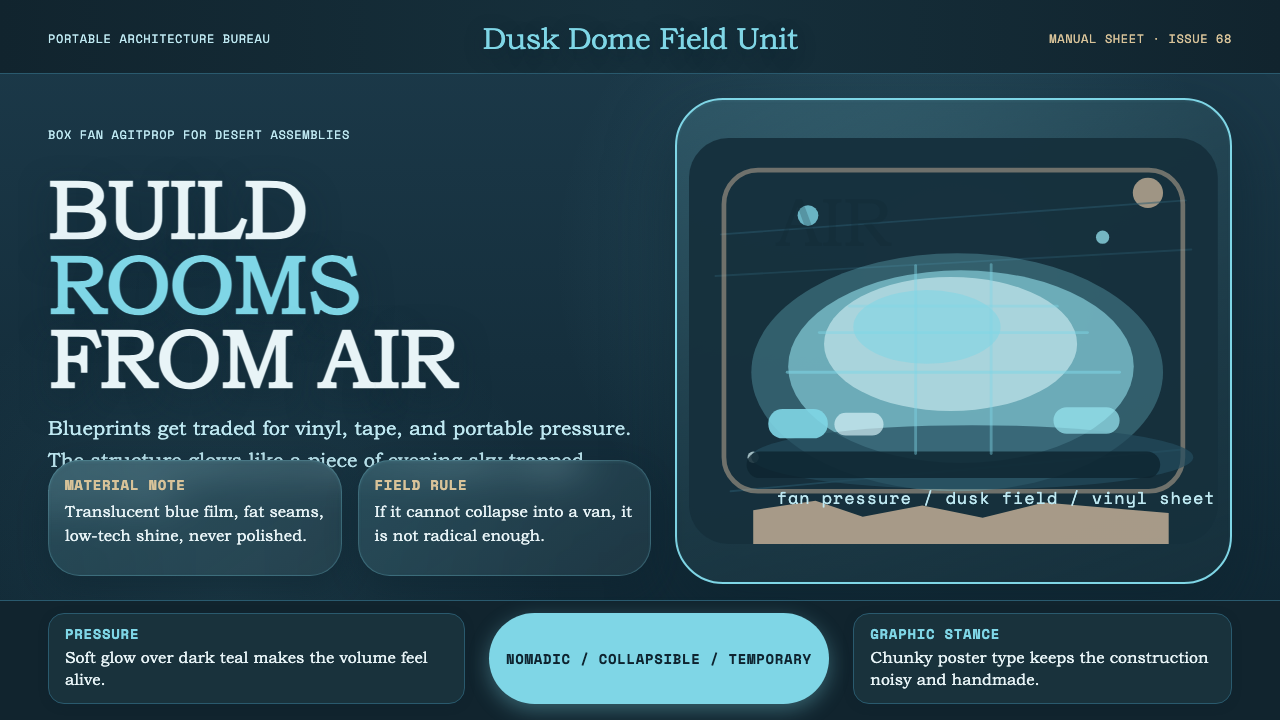 Ant Farm InflatablesTemporary architecture glows. Vinyl-blue domes swell over dark desert teal.
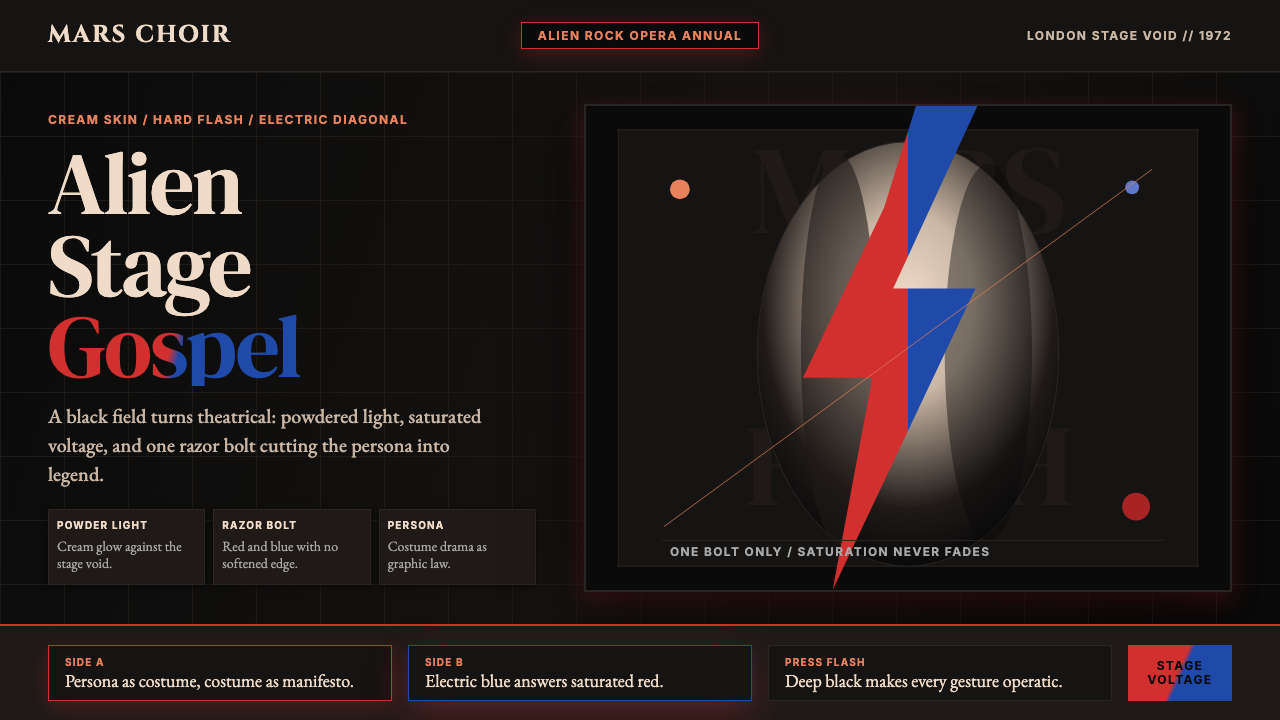 Bowie — Ziggy StardustTheater at full voltage. Cream-on-black portrait cut by one red and electric-…
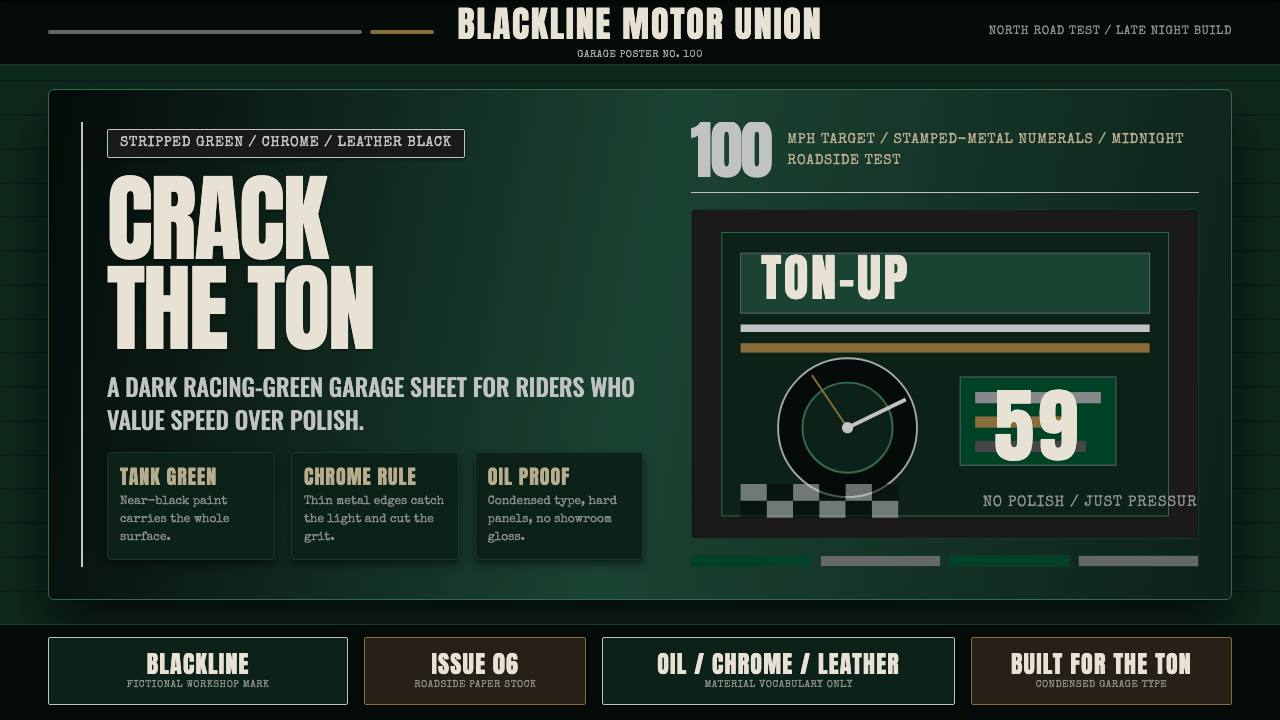 Café Racer Ton-UpGarage grit at speed. Near-black racing green, chrome rules, condensed sign t…
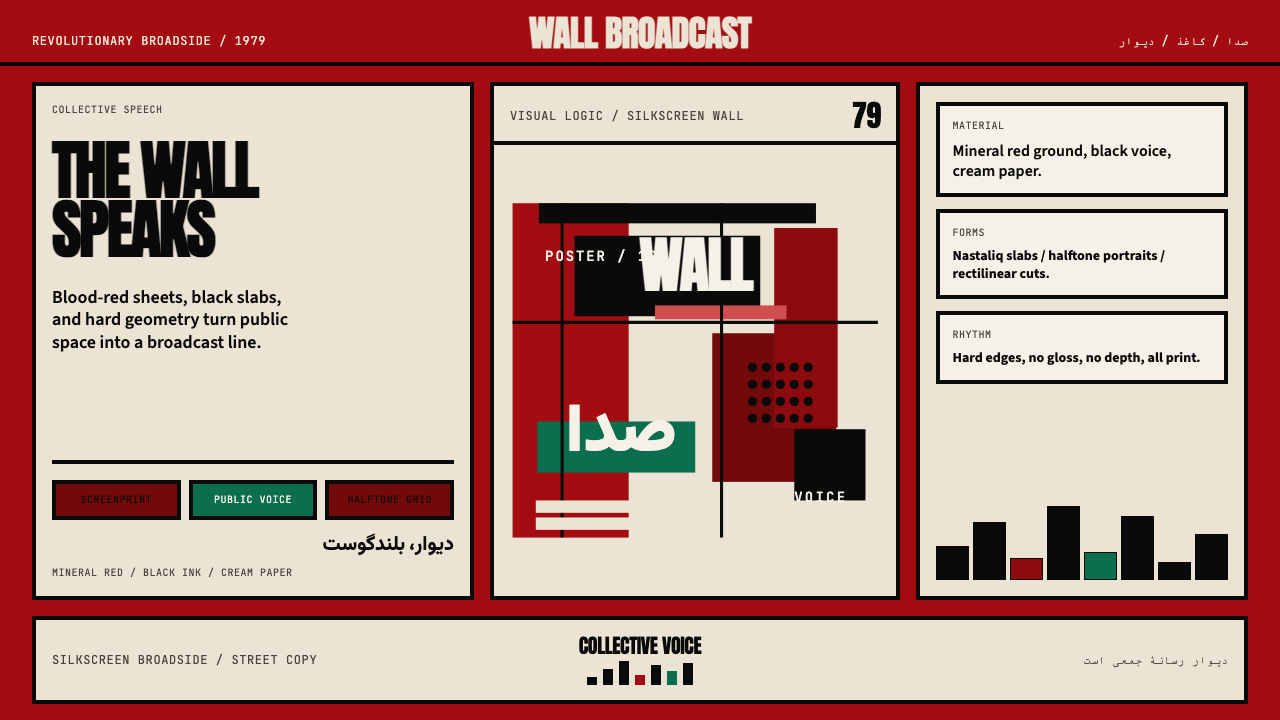 Iranian Revolution Poster (1979)Collective voice in ink. Blood red, black slabs, and hard screenprint geometr…