What is Lucha Libre Poster?
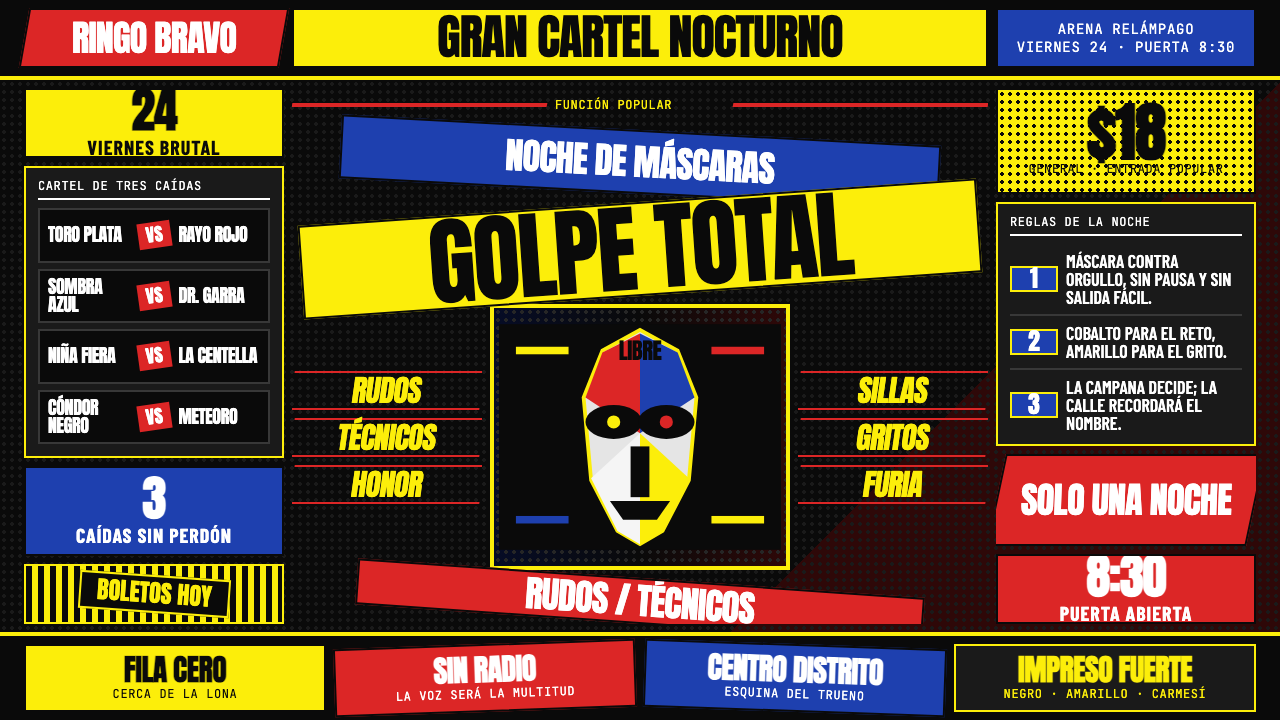
Lucha Libre posters are the loudest broadsheets in Latin American graphic history — pure black grounds, screaming diagonal type, and a palette so saturated it reads from across a dusty street.
Lucha Libre Poster in brief
Lucha Libre poster design is a graphic system born from the promotional culture of Mexican professional wrestling. Every element of these broadsheets — the diagonal axis layouts, the hand-lettered display type in screaming scale, the masked-fighter silhouettes, and the saturated palette of red, yellow, blue, and silver — was engineered for a single purpose: to be unmissable on a telephone pole or arena wall at thirty paces.
As a design vocabulary, the style is maximalist by conviction rather than by accident. Where quieter traditions treat empty space as a virtue, Lucha Libre posters treat it as waste. Every square centimeter of the sheet is occupied. Type crashes into illustration, color blocks collide at hard diagonal edges, and multiple competing hierarchies are held together not by restraint but by sheer chromatic force. The result is a visual experience closer to a shout than a statement.
The underlying structure, however, is more disciplined than it first appears. Diagonal axes replace the horizontal baseline grid, giving the whole composition a sense of kinetic energy — as if the layout itself is mid-motion. Weight and contrast do the work that whitespace would do in a calmer system, separating the fighter's name from the venue details from the ticket price without ever introducing silence.

Where does Lucha Libre Poster come from?
Lucha Libre wrestling arrived in Mexico in the early twentieth century, drawing on American, European, and Japanese wrestling traditions. The sport found its definitive home in Mexico City, where the Arena México — inaugurated in 1956 — became the cathedral of the form. The theatrical elements that made Lucha Libre distinctively Mexican — the elaborate masks, the dramatic personas, the aerial acrobatics — were matched by an equally theatrical promotional apparatus. Posters were the primary advertising medium in an era before television saturation, and the printers who produced them developed a visual language as bold and performative as the wrestlers themselves.
The golden era of the poster style ran roughly from the 1960s through the 1980s, concentrated in Mexico City and Guadalajara but spreading across the republic wherever arenas hosted events. Printing was typically done by silkscreen — a medium that rewards flat areas of intense color and punishes fine detail. The technical constraints of screenprinting shaped the aesthetic: limited color separations meant each hue had to carry maximum weight, hairline registration meant shapes needed hard edges, and the urgency of weekly event promotion meant layouts had to be readable at a glance. The style was not designed in any studio; it accumulated organically across dozens of anonymous workshops.
The figures who defined the era were the wrestlers themselves, whose visual identities became the subject matter of the posters. El Santo — whose silver mask made him one of the most recognizable figures in Mexican popular culture — became a recurring protagonist on thousands of broadsheets from the 1950s through the 1980s. Blue Demon and Mil Máscaras each brought their own chromatic identities (cobalt and a kaleidoscopic multicolor respectively) to the poster tradition, giving printers specific color cues to work with. The wrestlers' masked faces, printed as bold graphic silhouettes, became the emblematic image of the genre.
The broader cultural context matters. Lucha Libre poster design did not emerge in isolation — it was part of a vivid street-print culture that included event flyers, boxing promotion, circus announcements, and the illustrated broadsheets known as corridos. This tradition drew on the graphic urgency of earlier Mexican popular print, including the deeply influential woodcut work associated with the Taller de Gráfica Popular (People's Graphic Workshop), founded in 1937. The diagonal compositions and saturated palettes of the wrestling posters share visual DNA with this longer Mexican tradition of print made for public walls rather than gallery walls.
By the 1990s, offset printing and digital production gradually displaced the screenprinted broadsheet, and the specific vernacular of the hand-lettered wrestling poster began to thin. But the visual vocabulary had already been absorbed into Mexican graphic culture broadly, and from the 2000s onward, designers internationally began studying and reviving the aesthetic — finding in its maximalism, its chromatic confidence, and its structural use of the diagonal a set of tools that translated unexpectedly well into digital environments.
What defines the Lucha Libre Poster look?
Palette
The canonical palette is built on four anchors: pure black as the ground, fluorescent yellow for the dominant headline banner, crimson red for price chips and diagonal accent bars, and cobalt blue for secondary headings and structural accents. Silver appears as a fifth element — referencing the metallic sheen of the wrestlers' masks — typically applied to key names or borders. The palette is always deployed at full saturation with no tinting, no pastels, and no gradients. Each color is a declaration, not a suggestion.
Diagonal Axis
The organizing spine of a Lucha Libre poster is rarely horizontal or vertical — it runs diagonally across the sheet, typically from lower-left to upper-right or upper-left to lower-right. This axis manifests as angled type baselines, raked color bands, and tilted silhouettes. The effect is kinetic: the composition appears to be in motion, matching the explosive athleticism of the sport it promotes. No other structural choice defines the genre as immediately as this diagonal grammar.
Hand-Lettered Display Type
In the original posters, display type was often hand-lettered directly onto the printing plate — each headline drawn rather than set. The resulting letterforms are thick-stroked, compressed in width, and frequently outlined or shadowed in a contrasting color to separate them from the background. The type communicates at the scale of signage: individual letters may be taller than a hand's span. Contemporary applications that capture this quality use bold condensed display faces with visible structure — letterforms that feel drawn rather than generated — and maintain the tradition of outlining or banding the type in a second color.
Masked Silhouette
The central image of most Lucha Libre posters is the wrestler's portrait, reduced to a bold graphic silhouette that emphasizes the mask over the face. Masks in the tradition carry encoded color identities — a silver mask, a cobalt mask, a tiger-striped mask — and these translate directly into the chromatic choices of the surrounding layout. The silhouette treatment is flat and hard-edged: no gradients, no skin tones, no photographic texture. The figure reads as an icon rather than a portrait, which makes it legible at distance and reproducible across printing conditions.
Maximum Density
Where modernist design traditions treat negative space as an active compositional element, the Lucha Libre poster fills it. Multiple text hierarchies — fighter name, event name, venue, date, ticket price, sponsor callouts — coexist in a single sheet without breathing room. Density is managed through contrast rather than spacing: a name in fluorescent yellow sits against black, a price chip in crimson cuts across a cobalt band, and the collision itself creates separation. This is a maximalism with internal logic, not chaos.
Hard-Cut Geometry
Every shape in a Lucha Libre poster has a hard, straight edge — corners are sharp, color transitions are abrupt, and no element softens its boundary with a rounded corner or a feathered edge. This hard-cut geometry derives directly from the silkscreen process: ink either covers or does not cover. In digital translation, it means zero corner radius, zero blur, and color bands separated by sharp diagonal lines rather than gradients. The hard cut is not a stylistic affectation; it is a document of how the originals were made.
Silver Accent
Silver functions as the style's prestige register — reserved for the most important name on the sheet, for border treatments on the primary event box, or for outline strokes on the central silhouette. In print, this was achieved with metallic ink, which under arena lighting produced a genuine gleam. In digital work, silver is approximated through high-contrast light grey or near-white tones applied against the black ground. It is never used as a background or as a dominant color — always as a signal that something here is worth special attention.

Who shaped Lucha Libre Poster?
El Santo — born Rodolfo Guzmán Huerta in 1917 — was the defining figure of Lucha Libre and its most consequential visual subject. His silver mask, worn across a career spanning five decades, became one of the most recognizable icons in Mexican popular culture, transcending wrestling into film, comic books, and eventually mythology. On posters, his name and mask dominated the composition regardless of the actual billing — his presence alone was the primary advertising argument. He died in 1984 without ever publicly revealing his face, and the decision to keep the mask on was itself a graphic act: it preserved the icon over the individual.
Blue Demon — Alejandro Muñoz Morales — was El Santo's great rival and professional partner across hundreds of bouts from the 1940s onward. His cobalt-and-silver mask made him an equally vivid poster subject, and his name reliably appeared alongside Santo's in the billing. The chromatic contrast between the two — silver Santo versus cobalt Blue Demon — gave poster designers a ready-made color opposition to organize their layouts. Blue Demon's career similarly extended into film, where he and Santo appeared together in a series of wrestling horror films that became cult objects of Mexican cinema.
Mil Máscaras — the name translates as Thousand Masks — debuted in 1965 and brought a new dimension to the poster tradition. Where El Santo and Blue Demon each carried a single fixed chromatic identity, Mil Máscaras changed his mask for every appearance, introducing a kaleidoscopic visual unpredictability to the promotional material. Poster designers faced the challenge of representing a wrestler whose identity was deliberately unstable, and the solutions they developed — collages of multiple mask silhouettes, rainbow-band treatments, typography that carried the chromatic load — enriched the genre's visual vocabulary. His international career, spanning Japan, the United States, and Europe, helped export the aesthetic beyond Mexico.
The visual style was not the creation of any single named designer — it was the accumulated practice of dozens of anonymous print shop workers across Mexico City, Guadalajara, and other arena cities. These craftsmen developed the diagonal layout conventions, the color hierarchies, and the hand-lettering techniques that define the genre, working under the constraints of weekly deadlines and limited color separations. Their anonymity is itself historically significant: the style is a vernacular, not an authored work, and its authority comes from collective practice rather than individual genius. Contemporary designers who engage with the tradition are in dialogue with a workshop culture rather than a singular artistic vision.
The Taller de Gráfica Popular — People's Graphic Workshop, founded in Mexico City in 1937 — was a collective of politically committed printmakers who used woodcut and linocut to produce socially engaged broadsheets, posters, and illustrations. While the Taller's subject matter was political rather than sporting, its graphic vocabulary — bold outlines, flat areas of strong color, diagonal compositions, and type integrated directly into the image — fed directly into the broader street-print culture from which the Lucha Libre poster emerged. The Taller demonstrated that print made for public walls could be both visually sophisticated and viscerally immediate, establishing a template that wrestling promoters and their printers adapted with great effectiveness.
How do you use Lucha Libre Poster today?
Lucha Libre poster design translates into digital work most effectively when applied with structural commitment rather than surface decoration. The temptation is to borrow only the palette — dropping fluorescent yellow and crimson onto an otherwise conventional layout — and call it done. That approach produces a tinted version of something ordinary. The style's power comes from its compositional logic: the diagonal axis, the maximum density, the hard-cut edges, and the use of color as pure hierarchy signal rather than mood. All of these must be present for the result to carry authentic voltage.
For presentation slides, the style is exceptional for cover pages and section dividers. A cover works by assigning the dominant diagonal axis to the title — angled type in fluorescent yellow or crimson across a pure black ground — with the speaker name or event name treated as a secondary band running parallel at a different scale. Section dividers use full-bleed color blocks with angled cuts between them, using the color shift itself as the transition. Content slides require more discipline: the diagonal energy should be used for accent elements only — a tilted label, an angled price chip on a data comparison — while the body text remains on a legible grid. Data visualizations gain a great deal from this system: bar charts become bold flat color blocks, legends use the chromatic hierarchy naturally, and the overall slide reads as a designed object rather than a software default.
For web interfaces, the style is best suited to contexts where bold hierarchy and immediate scannability are the priority: pricing pages, event landing pages, promotional announcements, and dashboards that need to communicate status at a glance. The approach is to treat the page as a vertical sequence of full-width color bands, each with a hard diagonal cut at its lower edge, alternating between black-ground and color-ground sections. Navigation bars should be pure black with type in fluorescent yellow or white — no rounded corners, no subtle gradients, no ghost buttons. Interactive states use the crimson accent: hover turns a yellow button crimson, not lighter yellow. The silhouette treatment from the poster tradition translates directly into hero imagery: subjects cut out against a solid color ground, edges hard.
For editorial and marketing work, the style supports both long-form content and short-burst promotional materials. A marketing page built on this system uses alternating full-width sections in the primary palette, with feature headlines set at poster scale — large enough that individual letters command attention. Pull quotes work especially well when treated as color band interruptions: a crimson band cuts across the page at a slight diagonal, carrying a short quote in black or white type. For social media cards and event promotions, the style is already native: the single-image format is essentially a constrained broadsheet, and the principles of maximum density, diagonal axis, and chromatic hierarchy apply directly without translation.
A common mistake is treating the palette as a license for undifferentiated saturation — applying fluorescent yellow, crimson, and cobalt simultaneously across every element at full intensity. Authentic posters are saturated, but they are also hierarchical: one color dominates, one accents, one signals a specific element type. Yellow headlines, crimson price chips, cobalt secondary labels — the system works because each color has a role. When all three compete equally, the hierarchy collapses and the composition becomes noise rather than signal. Similarly, introducing soft shadows, rounded corners, or gradient fills immediately neutralizes the style's defining quality — the hard-cut, flat, abrupt geometry that makes it legible at distance. Every softening is a step away from the source.

Lucha Libre Poster — FAQ
Is this style appropriate only for sports or entertainment contexts?
Not at all — the style's power is independent of its subject matter. The original posters were sports promotion, but the visual system they developed is fundamentally about hierarchy, urgency, and legibility at distance. These qualities transfer well to any context where you need information to land immediately and confidently: product launches, limited-time offers, event announcements, pricing pages, and status dashboards all benefit from the same compositional principles. The style does carry an energy — it is never quiet — and it is not suited to contexts where the brand voice is delicate, minimalist, or luxury-restrained. But within its natural register, which is anywhere boldness is appropriate, the subject matter is secondary.
How does this style differ from other bold Latin American graphic traditions?
The most important distinction is structural. Other Latin American poster traditions — Brazilian carnival design, Cuban revolutionary posters, Peruvian chicha graphics — share high saturation and expressive energy, but each has its own compositional logic. Brazilian carnival work tends toward symmetry and figurative exuberance. Cuban political posters use flat areas of color with strong silhouettes but often a more measured scale relationship between elements. Chicha graphics are dense and psychedelic, often centered on portraiture with a characteristic rainbow gradient approach. Lucha Libre's defining traits are the hard diagonal axis, the complete absence of gradients, the silver accent, and the collision of flat color bands — a vocabulary drawn specifically from the silkscreen process and the arena environment. The shared quality is loudness; the grammar is distinct.
Can a light-background version of this style work, or does it require black grounds?
The black ground is not a technical requirement but a structural one — it is the surface against which fluorescent yellow and crimson read at their maximum contrast and energy. A light-background variant is possible but requires significant rethinking. On cream or white, the yellow loses its fluorescent quality and reads more as a muted mustard; the red remains strong but the overall energy drops considerably. If a light variant is needed, the most successful approach is to treat the background as a reserved zone and concentrate the palette into bold color-band elements — the white functions like negative space that the diagonal bands cut across, rather than as the dominant ground. The result is a version of the style that has more in common with its street-print cousins than with the classic black-ground poster.
How should imagery and photography be handled in this style?
Photography, when used, should be treated the way the original posters treated their subjects: reduced to high-contrast silhouettes or bold graphic extractions rather than presented as naturalistic windows into a scene. The practical approach is to isolate the subject against a transparent or solid-color ground, increase the contrast until the midtones collapse, and treat the result as a flat shape rather than a photograph. Facial detail, skin texture, and ambient light are the enemies of this style — they introduce the softness and naturalism the system explicitly rejects. A portrait processed this way — reduced to a high-contrast silhouette with a strong mask or costume detail — becomes native to the style. Full photographic naturalism, used without treatment, will always fight with the flat-color geometry of the surrounding design.
Does applying this style mean every design element must be aggressive and loud?
The style is inherently high-energy, but internal contrast is what makes it work — and internal contrast requires some elements to be relatively quieter. In a well-constructed Lucha Libre layout, the fighter name screams in fluorescent yellow at maximum scale; the venue and date are set much smaller in a secondary color; the body copy (ticket information, sponsor text) recedes further still. The loudness is relative: the loudest element is loud because everything else makes room for it. A design where every element competes at maximum volume is not authentic to the tradition — it is a failure to apply the system's hierarchical logic. The correct question is not 'how loud should everything be?' but 'what is the single most important thing, and how loud does everything else need to be to make that one thing unmissable?'
Related design styles
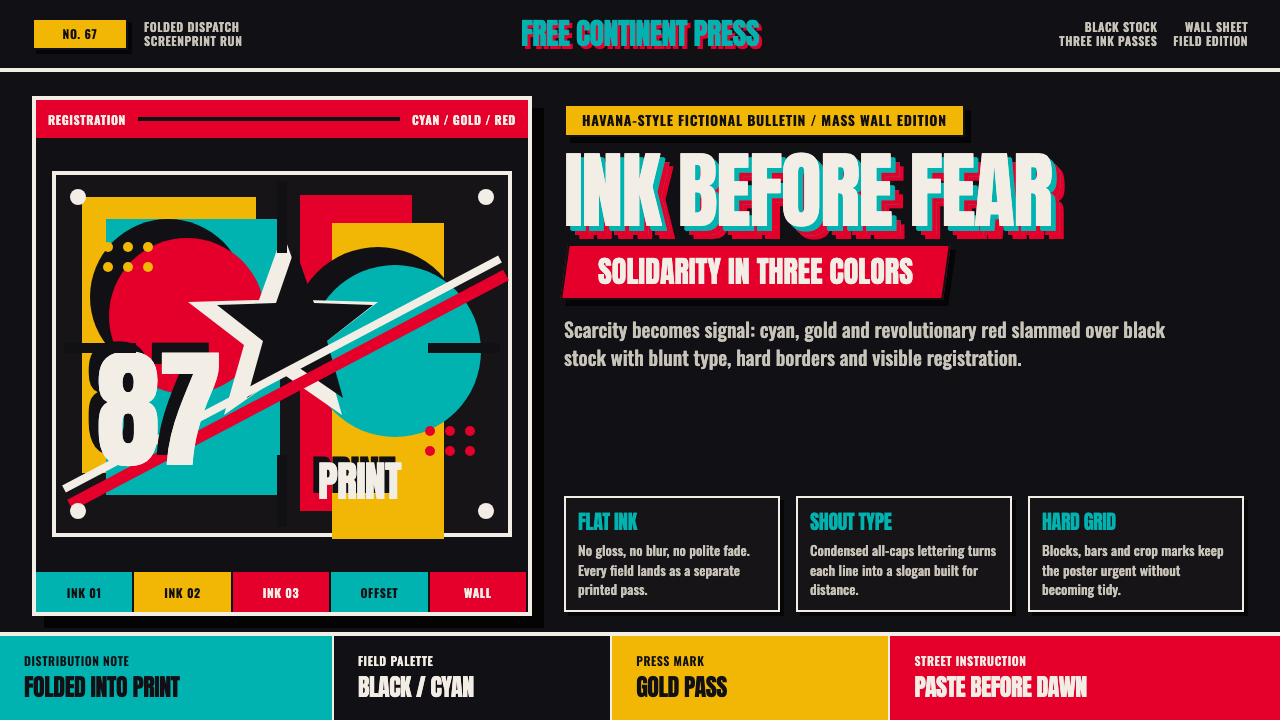 Cuban OSPAAAL Tricontinental PosterUrgency from scarcity. Cyan, gold and red slam over black in blunt silkscreen…
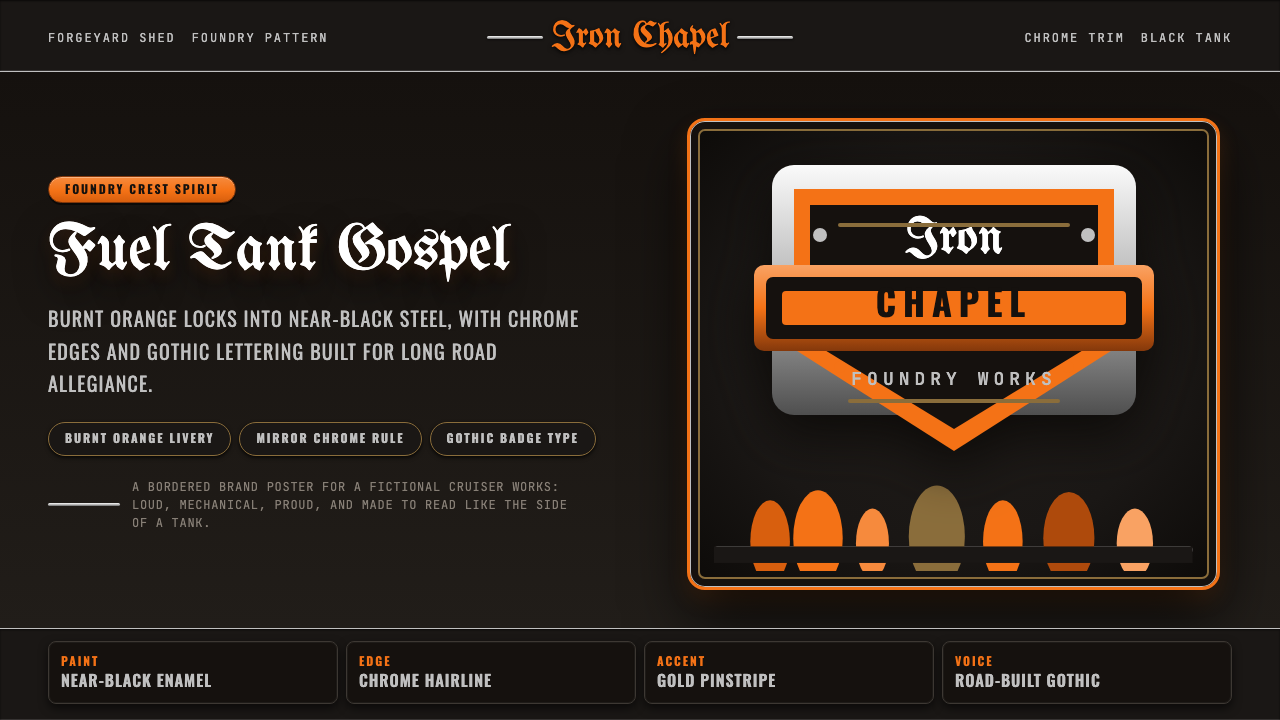 Harley Orange & BlackBuilt like a tank badge. Burnt orange, chrome hairlines, gothic type on near…
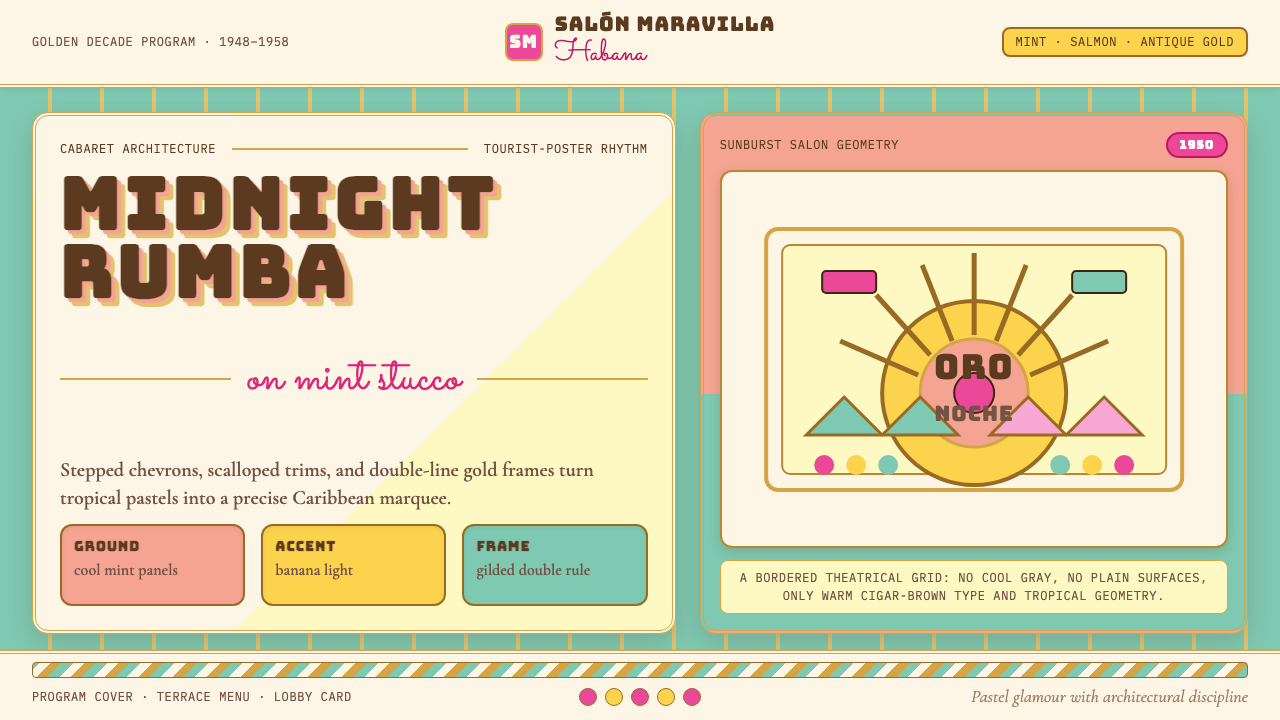 Cuban Art Deco (Havana 1950)Tropical Deco goes theatrical. Mint and salmon panels, gold double rules, Bun…
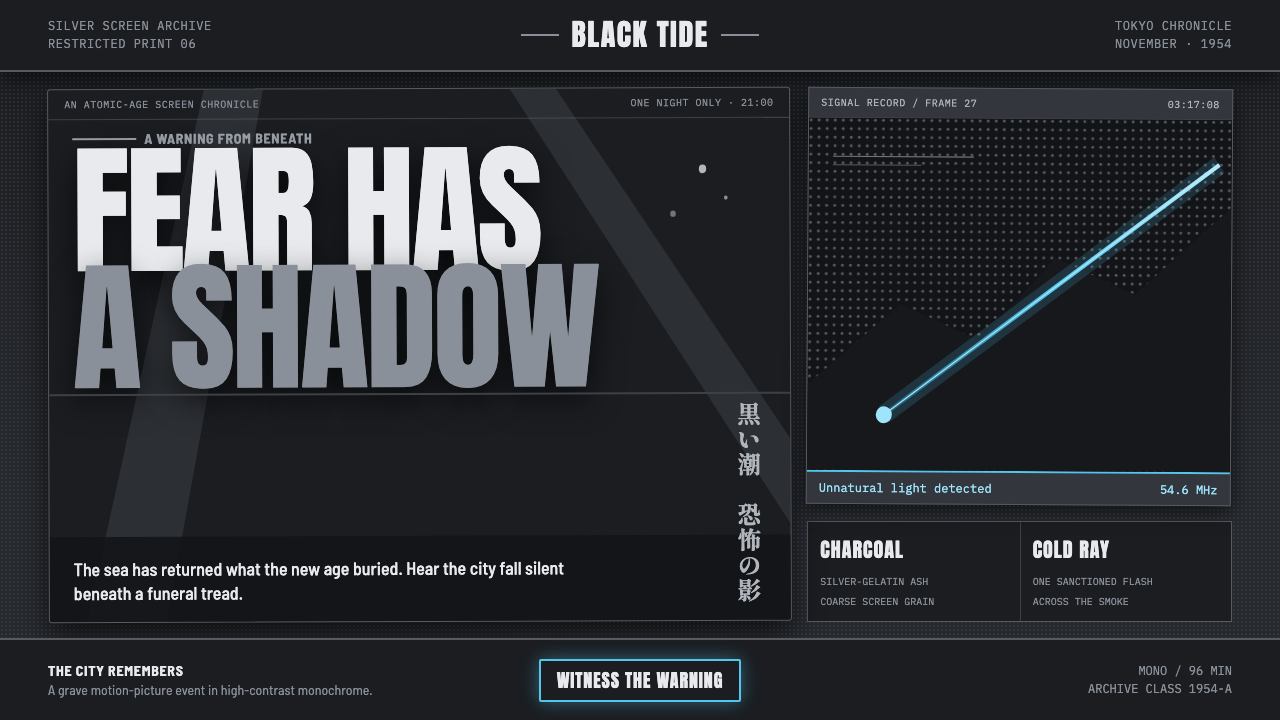 Godzilla (1954 Showa)Fear takes monumental form. Charcoal halftones split under one atomic-blue ra…
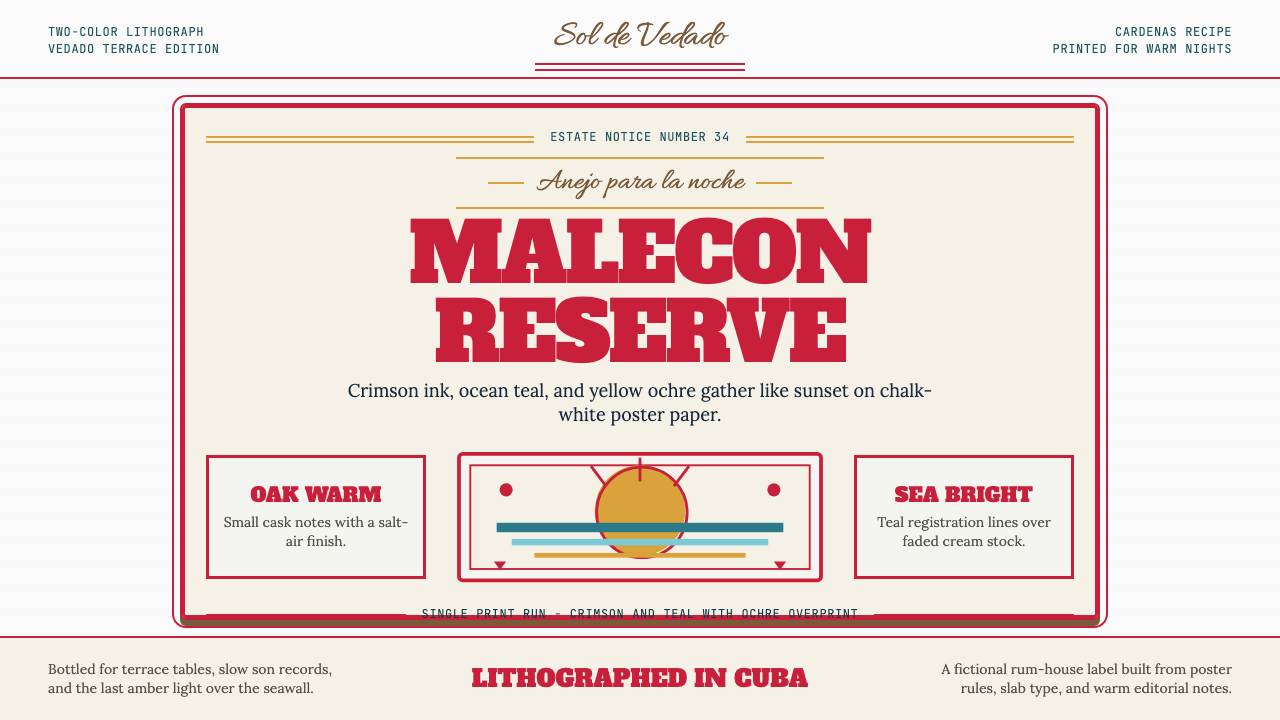 Havana Club Cuban RumSunset in print. Crimson slab type and ocean teal rules age on chalk-white pa…
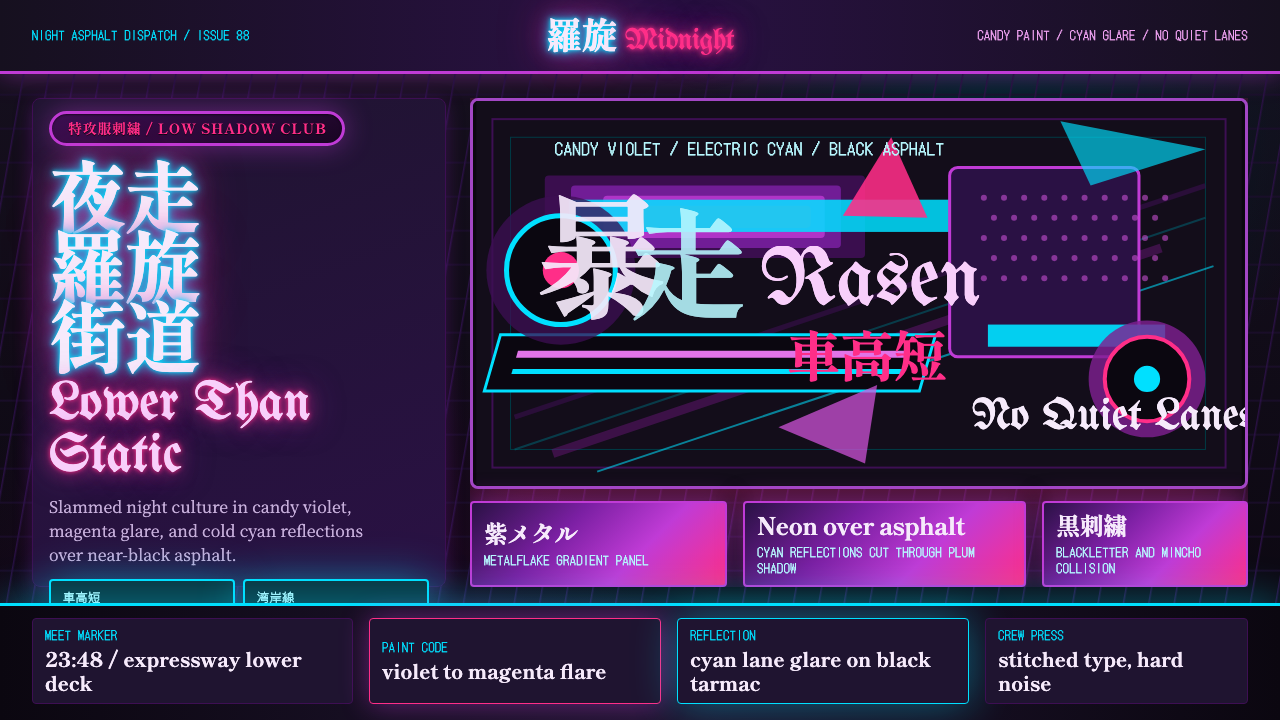 JDM BosozokuNight culture shouts. Candy violet, cyan neon, and stacked Mincho-blackletter…