What is Brazilian Tropicália (1968)?
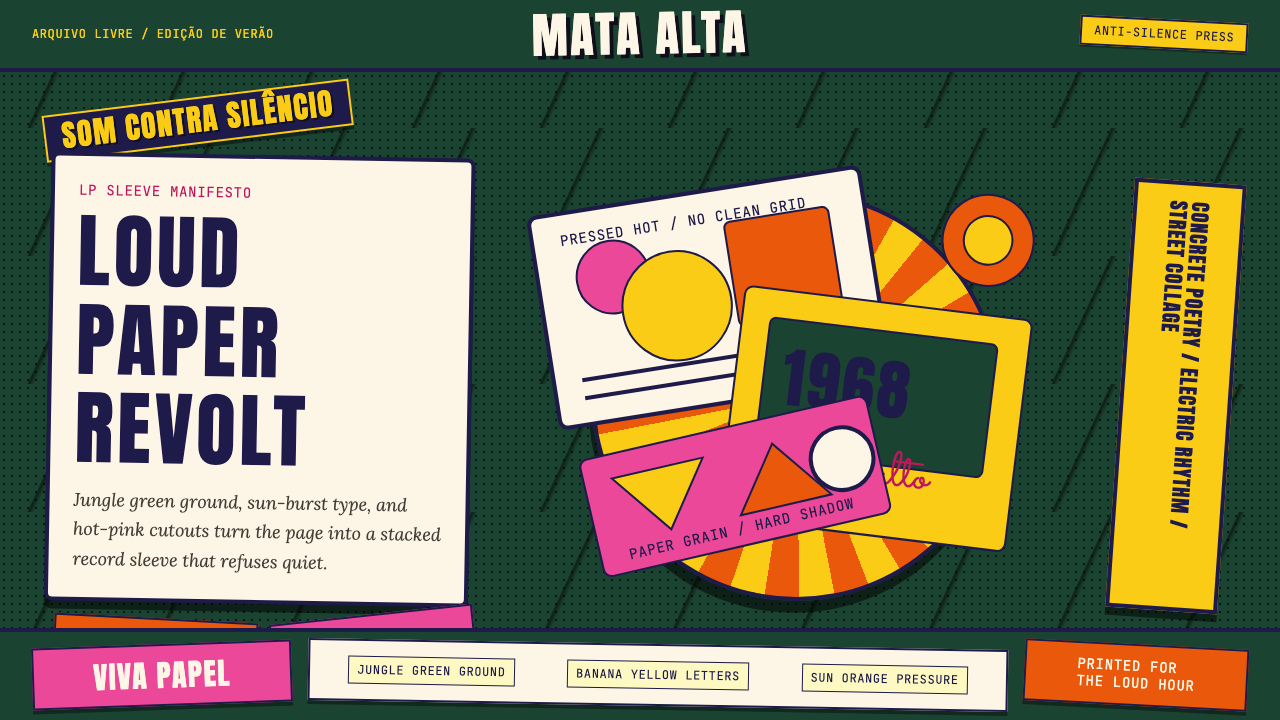
Tropicália turned the LP sleeve into a protest weapon — saturated jungle greens, banana-yellow lettering, and photographic collage erupting against Brazil's military dictatorship.
Brazilian Tropicália (1968) in brief
Brazilian Tropicália is a maximalist cultural movement whose visual language fuses bossa nova's lyrical warmth with Afro-Brazilian rhythm, concrete poetry, and psychedelic protest art. Emerging at its peak in 1967 and 1968, it produced one of the most immediately recognizable design aesthetics of the twentieth century: saturated tropical color, hand-painted lettering, photographic collage layered over raw paper grain, and compositions that refuse every principle of restraint.
The aesthetic is deliberately, philosophically anti-minimalist. Where European modernism was pruning design down to its functional skeleton, Tropicália was piling on — overlapping images, clashing saturations, typefaces that vibrate against their backgrounds, and a visual density that matches the layered sonic texture of the music it accompanied. The LP sleeve was its primary canvas, and the physicality of the printed record — heavy paper stock, visible grain, ink that pools at edges — is central to the style's identity.
To apply Tropicália correctly is to understand that excess is not a failure of discipline but a statement of it. Every collision of color and texture is intentional. The chaos is curated. The style encodes a specific political stance: that culture must be loud, alive, and impossible to ignore, because silence is complicity.

Where does Brazilian Tropicália (1968) come from?
Tropicália emerged from a Brazil under military dictatorship. The coup of 1964 had installed a government that grew steadily more repressive through the late 1960s, culminating in Institutional Act No. 5 in December 1968, which suspended civil liberties and authorized direct censorship of art and media. The cultural response was not silence but ferocious creative output. Musicians, visual artists, poets, and filmmakers understood that their work was political by the simple fact of existing — and they made that fact explicit.
The movement crystallized around musicians Caetano Veloso and Gilberto Gil, who had both emerged from the Bahian popular music scene and arrived in São Paulo carrying the influence of bossa nova, northeastern folk rhythms, and an awareness of international psychedelia and rock. At the 1967 Brazilian Popular Music Festival, Veloso performed with electric guitar — a transgression for a tradition that prized acoustic purity — and was booed by the audience and lionized by critics simultaneously. This confrontational gesture became the movement's founding myth. The visual arts parallel was provided by Hélio Oiticica, whose 1967 installation at the Rio Museum of Modern Art — a tropical shantytown constructed inside a gallery, complete with live parrots and banana plants — gave the movement its name and its spatial vocabulary.
The visual design of Tropicália crystallized primarily through LP cover art. The 1968 album simply titled Tropicália: ou Panis et Circencis — featuring Veloso, Gil, Os Mutantes, Gal Costa, Nara Leão, and Tom Zé — was the movement's collective manifesto in both sound and image. Its sleeve, a collage of tropical plants, band members in quasi-ceremonial dress, and clashing photographic elements, established the template: organized disorder, democratic image-making that refused the hierarchy of fine art presentation, and color pushed to the edge of legibility.
Cinema Novo, the parallel movement in Brazilian film directed by figures such as Glauber Rocha, reinforced the aesthetic from another direction. Cinema Novo's visual language — handheld cameras, harsh tropical light, unresolved narratives — shared Tropicália's commitment to rawness as an aesthetic and political position. The movements were not formally coordinated but drew from the same cultural moment: an urgency to document and transform a society under authoritarian pressure. By 1969, Veloso and Gil had been arrested by the military government and ultimately exiled to London, an event that paradoxically spread the movement's influence internationally while closing its most intense Brazilian phase.
What defines the Brazilian Tropicália (1968) look?
Tropical Color Saturation
The palette draws from the Brazilian landscape at its most intense: the deep green of jungle canopy, sun-burst orange and yellow, the vivid red of tropical flowers, and electric sky blues. No color is toned down or harmonized into pastels. Colors collide rather than coordinate — adjacent hues may clash deliberately, creating visual vibration. The effect reads less like a palette decision and more like a natural environment pushed to the edge of artificiality, which is precisely the movement's point.
Hand-Painted and Vernacular Lettering
Typography in Tropicália resists refinement. Lettering borrows from Brazilian street signage, carnival banner painters, and market stall hand-lettering traditions — forms that are bold, imprecise, and human in a way that typeset fonts refuse to be. Letters may be outlined, shadowed, or filled with a contrasting color. Scale is exaggerated: a single word may occupy an entire composition. The goal is presence and energy, not legibility optimization.
Photographic Collage and Layering
Collage is the structural method of Tropicália, not an embellishment. Photographs — cropped aggressively, scaled inconsistently, oriented at angles — are layered with drawn elements, flat color fields, and text. The cut-and-paste logic does not attempt seamlessness; the edges, overlaps, and mismatches are visible and intentional. This approach democratizes image sources: a press photograph, a botanical illustration, a performer's portrait, and a geometric abstraction can coexist on equal terms.
Paper Grain and Material Texture
Tropicália's original medium was the printed record sleeve, and its visual system carries the memory of that physicality. Visible paper grain, ink texture, and the slight imprecision of offset printing are not flaws to be eliminated but qualities to be amplified. In contemporary applications, this translates to simulated grain overlays, deliberately rough image treatments, and a general preference for surfaces that look touched and handled rather than digitally pristine.
Organized Compositional Density
Tropicália compositions are full — borders are rarely left empty, and negative space is treated as territory to be filled rather than breathing room to be protected. But the density is not random. There is a compositional logic that assigns different visual weights to different zones, typically anchoring a strong focal element — a face, a bold typographic word, a dominant color field — and building outward from it. The result is maximalist but not disorienting: you can always find where to look first.
Political and Surreal Imagery
Tropicália imagery draws from two wells simultaneously: the hyperreal tropical environment (jungle plants, animals, landscapes intensified to near-abstraction) and the surrealist juxtaposition of incongruous objects. A banana plant may share space with a television set; a military uniform may appear alongside carnival costume. These juxtapositions are not decorative but argumentative — they stage contradictions that the viewer is invited to interpret.
Hard Shadow as Structural Accent
Shadow in Tropicália is hard-edged, solid, and frequently colored rather than black. A letter or shape may cast a shadow in a contrasting tropical hue — orange shadows behind green letterforms, pink behind yellow. This treatment heightens the sense of depth in an otherwise flat collage surface and amplifies the visual noise that the style courts. Shadows behave more like duplicate shapes shifted slightly off-register than like lighting simulations.

Who shaped Brazilian Tropicália (1968)?
Veloso is the central figure of Tropicália both musically and conceptually. His decision to perform with electric guitar at the 1967 Brazilian Popular Music Festival, and the confrontational energy of the movement's 1968 collective album, established the aesthetic and political template for everything that followed. After his arrest and exile to London in 1969, his influence spread internationally. His essay-length liner notes and lyrics doubled as concrete poetry, making him as important to the movement's literary and visual sensibility as to its music.
Oiticica was the visual artist who gave Tropicália its name and its most radical spatial dimension. His 1967 installation at the Rio Museum of Modern Art — a shantytown labyrinth inside a gallery, complete with live birds and tropical plants underfoot — proposed that art should be inhabited, not observed. His earlier Parangolé series, wearable cape-artworks meant to be danced in, collapsed the boundary between visual art and bodily experience. These ideas directly shaped the movement's rejection of the passive viewer and its insistence on sensory totality.
Gil brought the Afro-Brazilian rhythmic depth and the northeastern folk music tradition to Tropicália, ensuring that the movement's sonic and visual eclecticism was grounded in specifically Brazilian cultural roots rather than simply importing international psychedelia. His engagement with Black Brazilian identity and Candomblé aesthetics — ceremonies, colors, and ceremonial objects of the Afro-Brazilian religious tradition — gave the movement's visual language much of its ritual density and saturated color energy. Like Veloso, he was arrested and exiled in 1969.
The band Os Mutantes — Rita Lee, Sérgio Dias, and Arnaldo Baptista — represented Tropicália's most overtly psychedelic and surrealist dimension. Their LP sleeve imagery extended the collage aesthetic into absurdist territory, mixing sci-fi imagery with tropical motifs and self-consciously campy visual humor. Their willingness to court kitsch and celebrate bad taste as a position was central to the movement's anti-elitist stance, and their work demonstrated that Tropicália's visual language could accommodate irony and playfulness alongside its political urgency.
Rocha directed the Cinema Novo films that provided Tropicália's visual aesthetic with its cinematic parallel. His 1964 film Black God, White Devil and 1969's Antonio das Mortes established a visual language for Brazilian counter-cultural expression — brutal sunlight, handheld immediacy, landscapes that function as social argument — that directly informed the movement's photographic sensibility. His theoretical manifesto for Cinema Novo, the 1965 essay An Aesthetic of Hunger, articulated the same anti-refinement politics that Tropicália embodied visually.
How do you use Brazilian Tropicália (1968) today?
Tropicália is one of the more demanding historical styles to apply well in contemporary design because its energy is easier to replicate than its discipline. The visual system rewards knowledge of its source material: every formal decision — the collage composition, the hard-edged colored shadow, the vernacular lettering scale — carries a specific cultural weight. Applying it means applying that logic, not just borrowing the surface appearance.
For presentation slides, Tropicália works with particular force on cover pages and section dividers, where the full saturated palette and collage density can be deployed without overwhelming information. A cover slide benefits from a dominant tropical color field — rich green or deep orange — with a title in bold, slightly imprecise lettering that evokes hand-painting rather than digital precision. Section dividers can incorporate photographic collage fragments with overlapping color shapes. Content slides should pull back: a clean typographic hierarchy on a warm off-white ground, with a single tropical accent color used for headline emphasis or data highlights. Data visualizations — bar charts, line graphs — become compositionally interesting when treated as flat geometric elements colored from the tropical palette, with hard-edged labels in a contrasting hue.
For web user interfaces, Tropicália is most effective in contexts where cultural energy and distinctiveness are as important as usability — landing pages, promotional microsites, portfolio presentations, and editorial platforms. A dashboard in pure Tropicália aesthetic would overwhelm most users; the approach here is selective application. A pricing page might use a deep jungle-green hero section with cream type, offsetting it with bright accent cards in sun-orange or banana-yellow. Interactive states can use the colored hard-shadow treatment — a button that casts a solid shadow in a contrasting tropical hue — to give interaction a visceral, physical quality. Navigation and body text should be cleaner, using the tropical palette only at the structural level.
For editorial and marketing work, the style's poster heritage makes it naturally suited to full-bleed hero images, large-format print, and social media assets where bold visual presence is the primary objective. A marketing campaign in this aesthetic would use collage layouts where photography is treated as a flat element — cropped tightly, overlaid with color blocks or hand-lettered text, combined with botanical or tropical graphic motifs. The key structural decision is the handling of hierarchy: a clear focal point (usually one dominant color field or photographic element) surrounded by supporting layers of increasing visual complexity, so the eye has a route through the density.
The most common mistake when applying Tropicália is treating it as a permission structure for visual noise without attending to the underlying compositional logic. Randomly layering tropical colors and collage elements produces confusion, not energy. Authentic Tropicália work always has a clear center of gravity — one element that earns the most visual weight — and builds complexity outward from there. A second common mistake is using the style's saturation as decoration on otherwise restrained layouts: the tropical palette clashes with Swiss-style grids and clean sans-serif typography because the aesthetic assumptions are incompatible. Commit to the system or step outside it; hybridization at the surface level produces incoherence.

Brazilian Tropicália (1968) — FAQ
Is Tropicália the same as general tropical or beach aesthetics?
No, and the difference is crucial. Generic tropical aesthetics draw on leisure, escapism, and postcard imagery — palm trees, beach scenes, soft pastels. Tropicália is a specific Brazilian counter-cultural movement defined by its political urgency, its collage methodology, its Afro-Brazilian cultural roots, and its anti-refinement stance. Where tropical aesthetics are soothing, Tropicália is confrontational. Where tropical aesthetics invite relaxation, Tropicália demands engagement. The color saturation may look similar at a glance, but the compositional logic, the treatment of imagery, and the underlying values are entirely different.
How do you use photographic collage in digital design without it looking dated?
The key is intentionality in the cut. Tropicália collage works because the edges, overlaps, and juxtapositions are argumentative — they are making a point about the relationship between the combined elements. When digital collage fails, it is usually because the layers are assembled for visual interest rather than conceptual logic. In contemporary applications, this means choosing photographs with clear geometric qualities, cropping to isolate specific formal elements rather than preserving narrative context, and ensuring that each collage layer contributes something distinct to the composition rather than adding ambient visual complexity. The grain and texture overlays should amplify this sense of physical making, not simply add noise.
Can Tropicália work in a professional or corporate context?
In limited application, yes. The style's cultural weight — anti-authoritarian, exuberant, Afro-Brazilian in its roots — makes it unsuitable as a complete identity system for conservative corporate clients. However, selective use of Tropicália principles — tropical color energy, collage composition, vernacular lettering — can give brands in creative industries, entertainment, food and beverage, fashion, and travel a powerful sense of cultural specificity and visual confidence. The approach is to use the style's most transferable qualities (color saturation, compositional density, typographic boldness) while moderating the elements most loaded with the movement's specific historical meaning (the anti-government imagery, the deliberately rough political register).
How does Tropicália relate to other Latin American design movements?
Tropicália shares ancestry with Mexican muralism — both use large-scale visual art as a vehicle for political argument and both draw on indigenous and folk traditions to resist European aesthetic authority. It also has parallels with Cuban revolutionary poster art of the same era, which similarly combined psychedelic color, collage methodology, and political urgency into a distinctive visual identity. The key distinction is that Tropicália was a counter-cultural movement produced under — and against — a right-wing military dictatorship, while Cuban poster art was state-sponsored. This difference in political position produces a fundamental difference in tone: Cuban revolutionary posters have a didactic clarity, while Tropicália has a carnivalesque ambiguity.
What is the right context for using the vernacular lettering quality of Tropicália?
Vernacular lettering works best when it carries a specific cultural or emotional argument that refined typography cannot make. In Tropicália's original context, the choice of hand-painted, market-stall lettering over refined typographic forms was a deliberate rejection of European design authority and a claim for the legitimacy of Brazilian popular culture. In contemporary applications, the same logic applies: use vernacular-quality lettering when the work needs to feel human-made, specific to a place or community, and resistant to corporate polish. It is inappropriate in contexts requiring institutional trust or precision readability — financial communications, medical applications, legal documents. It is powerful in music, food, cultural events, and any context where the message benefits from the sense that a human hand was involved.
Related design styles
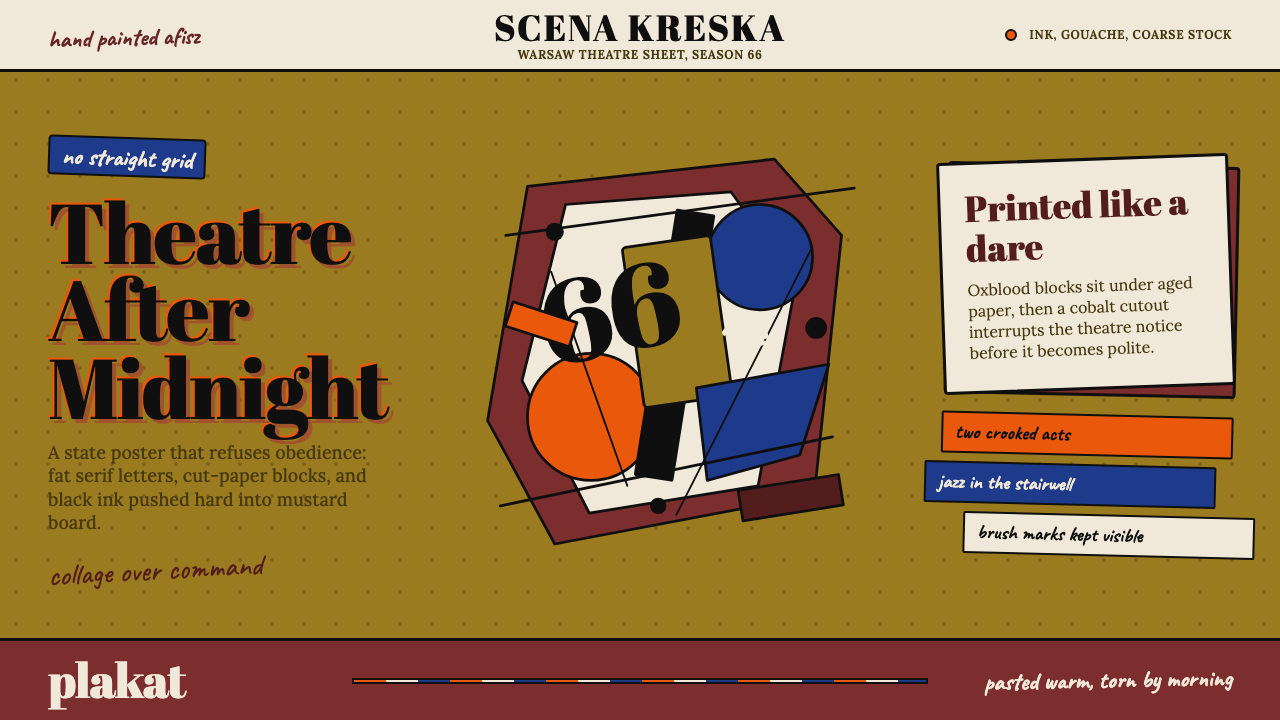 Polish Poster School (1960s)Painterly rebellion. Mustard board, oxblood collage, and fat serif letters re…
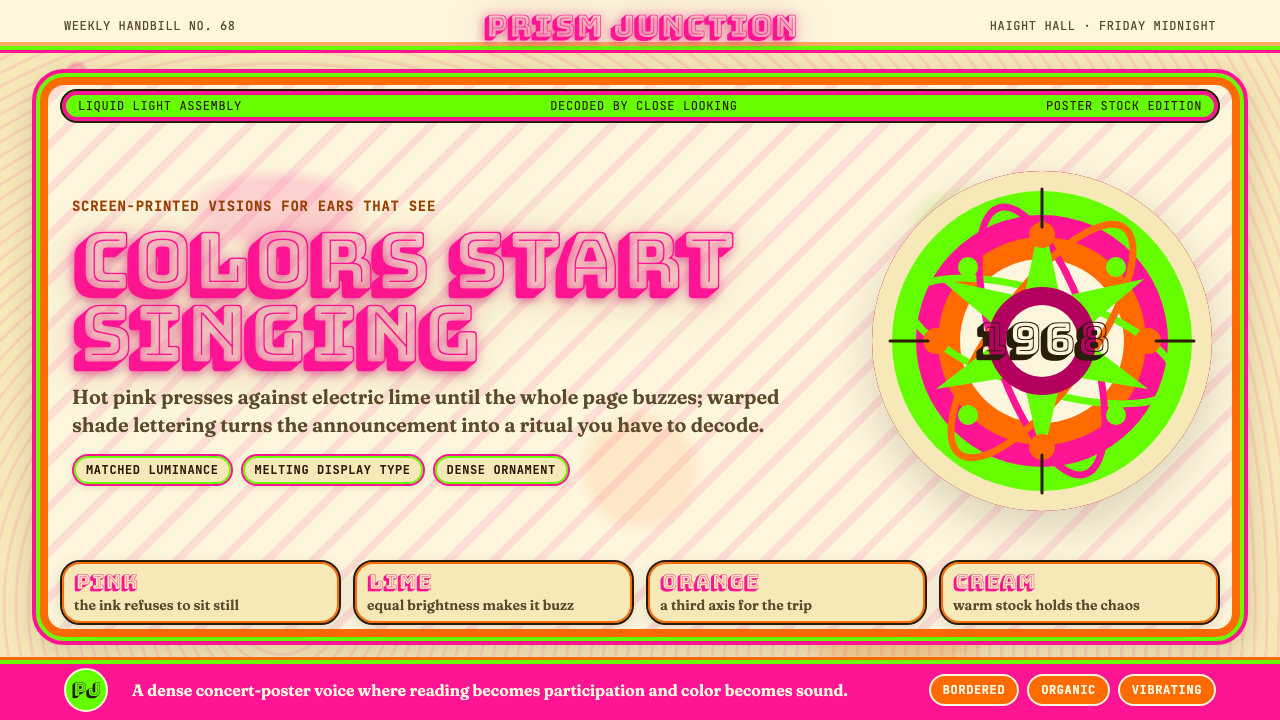 Psychedelic Haight-Ashbury 1968Color becomes sound. Hot pink and electric lime vibrate around melting Bungee…
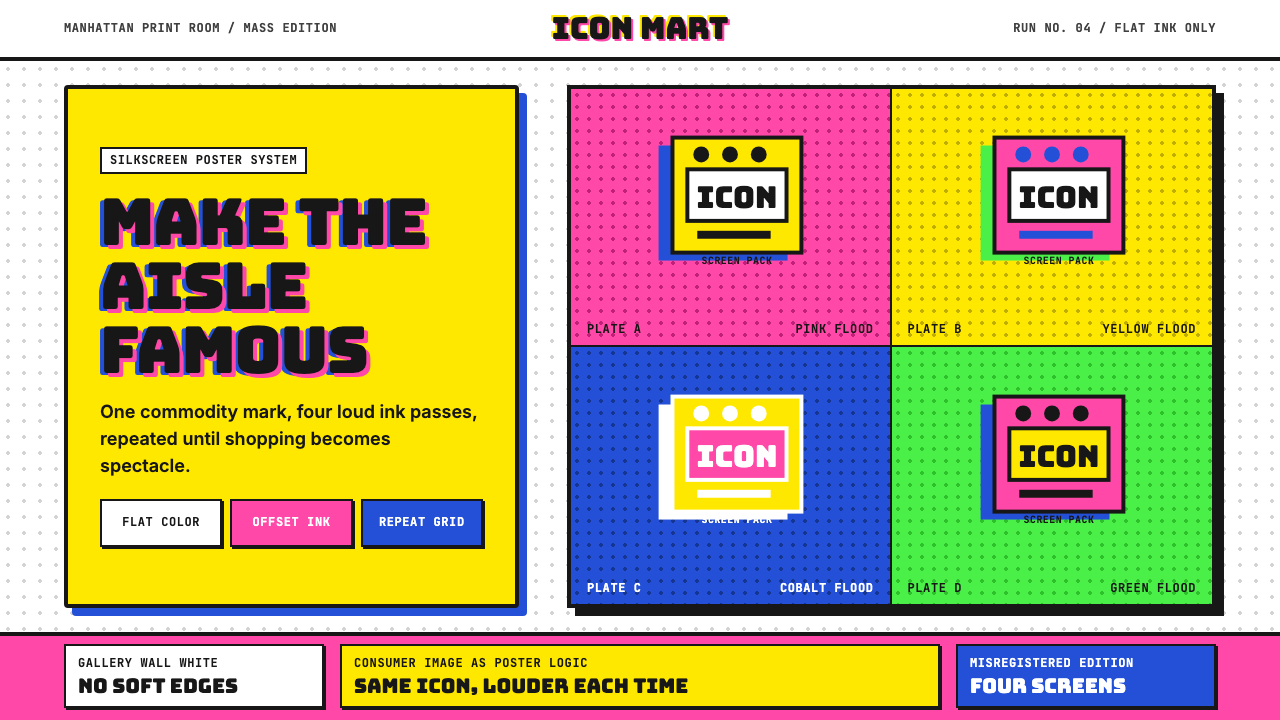 Warhol PopMass culture turns iconic. Hot pink, yellow, cobalt grids repeat flat silkscr…
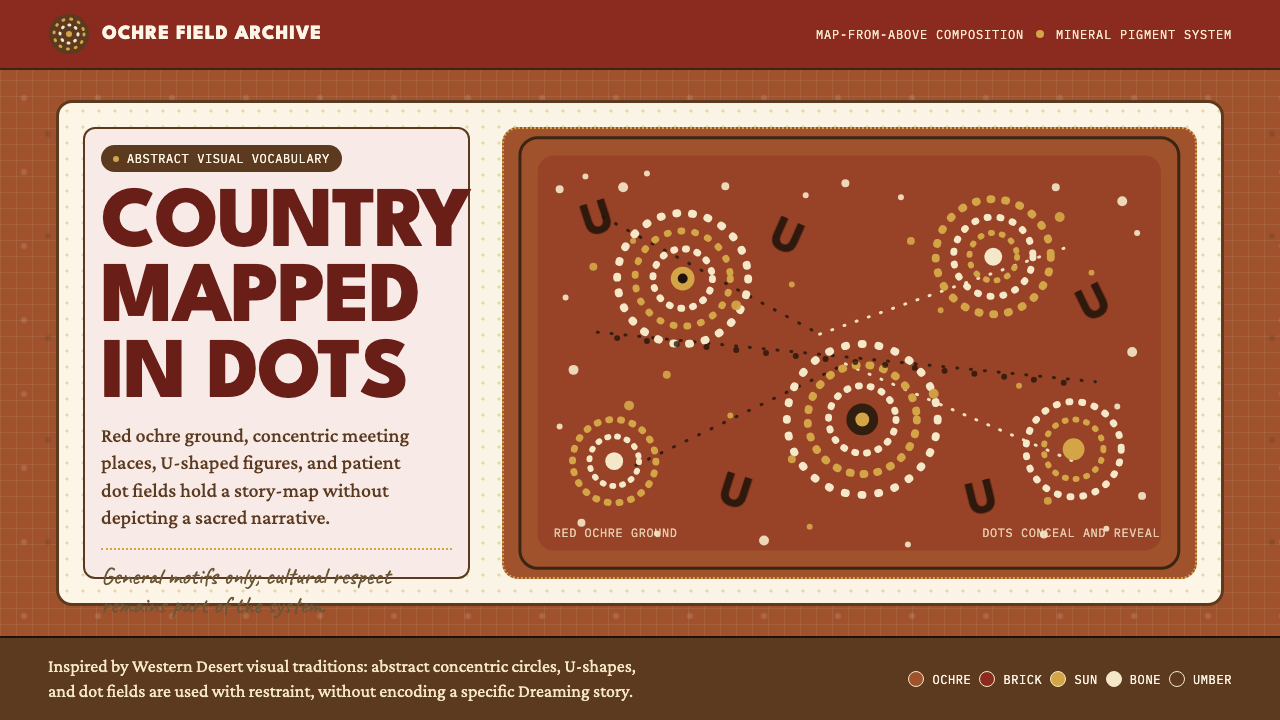 Aboriginal Dot PaintingAncient story-map energy. Red ochre, bone dots, concentric circles, and U-mar…
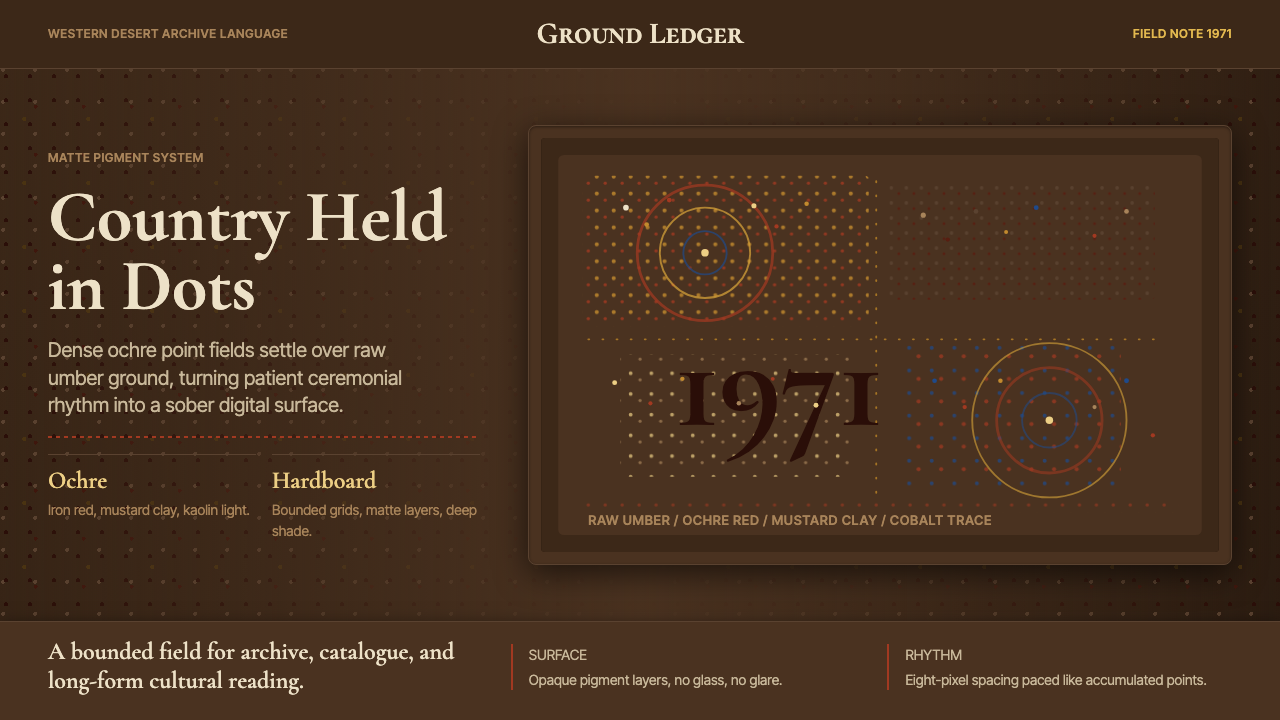 Aboriginal Dot Painting (Papunya 1971)Ochre memory, held steady. Raw umber ground, Cormorant type, disciplined dot-…
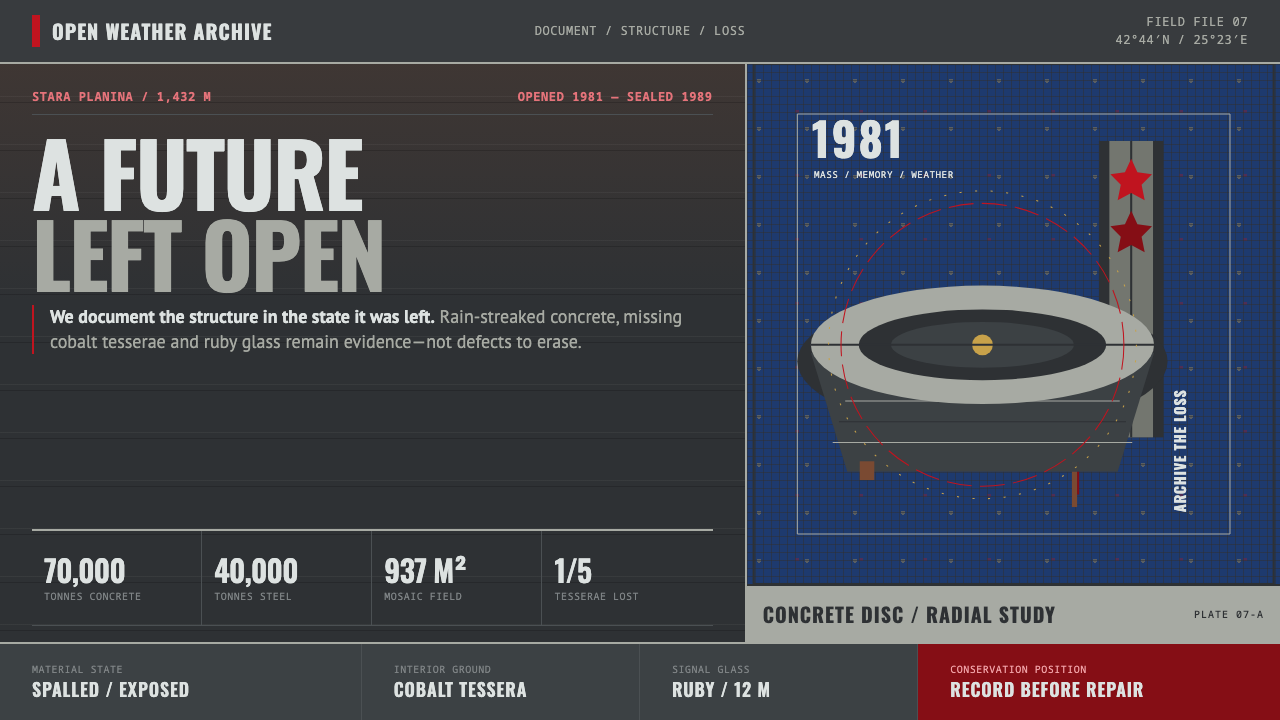 Buzludzha MonumentMonumentality without repair. Stained concrete frames cobalt tesserae, ruby g…