What is Polish Poster School (1960s)?
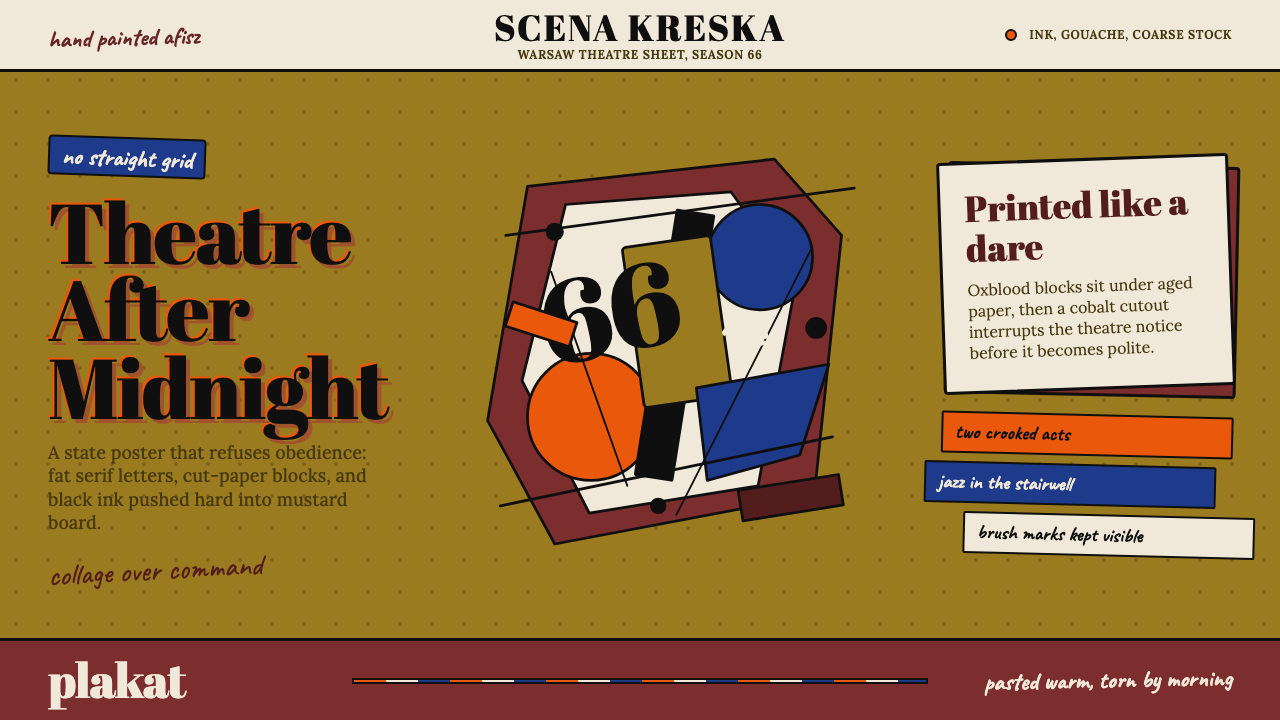
Warsaw's state-funded designers weaponized paint, collage, and surrealist wit to produce the most visually arresting posters the Cold War ever saw.
Polish Poster School (1960s) in brief
The Polish Poster School (Polska Szkoła Plakatu) was a movement of graphic artists working primarily in Warsaw and Kraków from the late 1940s through the 1980s, reaching its creative peak in the 1960s. Its practitioners produced hand-painted, collage-driven posters for theatre, film, opera, jazz festivals, and circuses that bore little resemblance to the mechanically printed propaganda of the Soviet bloc. The visual language they invented — saturated earthy grounds, fragmented hand-lettered type, distorted figurative imagery, and a painterly texture that recalled gouache on toned paper — became one of the most recognizable national design identities of the twentieth century.
What distinguished the Polish school from its Western contemporaries was its insistence on the poster as an autonomous artwork rather than a commercial communication tool. Where Swiss International Style subordinated expression to a rational grid, and American mid-century commercial art answered to the brief, Polish designers treated the poster surface as a canvas. Composition was governed by visual drama rather than readability hierarchy: a single distorted eye might occupy the full field, with the event title inscribed in brush lettering at an oblique angle along one edge. The image was the argument, and the text was almost an afterthought.
The style is immediately recognizable by its palette and its texture. Grounds tend toward deep, warm tones — the ochre of aged paper, the dark red of dried pigment, the warm black of India ink on rough stock — offset by bursts of brilliant contrast. Letterforms are drawn rather than set: thick brush strokes, hand-cut stencil shapes, or roughly torn paper edges replace the mechanically even letterpress or phototypesetting that dominated commercial print elsewhere in Europe. The deliberate imperfection, the visible grain of the surface, and the evidence of the maker's hand are not flaws but essential carriers of meaning.

Where does Polish Poster School (1960s) come from?
The Polish Poster School emerged from a precise historical conjunction: the devastation of World War II, the imposition of communist governance, and an institutional paradox that transformed state patronage into unexpected creative freedom. Poland lost approximately six million citizens and saw Warsaw almost entirely razed between 1939 and 1945. The country that emerged from the war was physically and culturally shattered, absorbed into the Soviet sphere, and theoretically committed to Socialist Realism — the officially mandated aesthetic of heroic labor, optimistic faces, and legible didactic imagery. Yet within a decade, Polish graphic designers had carved out a space for something almost opposite.
The mechanism of this inversion was institutional. The Polish state needed posters — for theatre, for cinema, for cultural festivals that demonstrated the vitality of socialist culture — and it needed them in volume. It established dedicated poster studios attached to cultural institutions and gave designers considerable autonomy over how they solved the creative brief. Critically, the films, plays, and operas being advertised were often foreign or experimental works that Socialist Realism had no ready vocabulary for: an Orson Welles film, a Beckett play, an American jazz ensemble. Polish designers, trained in fine arts traditions and philosophically acquainted with Surrealism and the European avant-garde, found that the brief itself demanded invention.
Henryk Tomaszewski, widely acknowledged as the father of the Polish school, had already established the painterly, metaphor-driven approach by the early 1950s. His posters operated through visual association rather than literal illustration — a film about grief might yield a single tear rendered as a vast landscape, rather than a weeping face. Tomaszewski trained a generation of students at the Warsaw Academy of Fine Arts who absorbed this method: Jan Lenica, Roman Cieslewicz, Waldemar Świerzy, and Franciszek Starowieyski each extended the vocabulary in distinct directions, from Lenica's intricate organic line-work to Starowieyski's darkly erotic neo-Baroque imagery.
By the early 1960s, the school had attracted international attention. Polish posters won prizes at international biennales and entered the permanent collections of the Museum of Modern Art in New York and design institutions across Europe. The irony — state-subsidized art from behind the Iron Curtain winning acclaim in Western capitals — was not lost on observers on either side. The 1966 Warsaw International Poster Biennial, inaugurated in that decade, became a permanent institution and formalized Poland's position as the world center of poster art. The school's influence extended outward through emigration: Cieslewicz moved to Paris in 1963, where his work informed French graphic design for decades, while the Lenica–Borowczyk animation collaborations brought the visual language into film.
What defines the Polish Poster School (1960s) look?
Earthy, Saturated Ground Colors
The Polish school grounds its compositions in deep, warm, non-neutral tones that read less like paper and more like pigment: ochre yellows recalling raw mustard or aged parchment, dark reds in the range of oxblood or dried lacquer, warm blacks that hold visible texture. These are not background colors in the passive sense — they carry the weight of gouache or casein paint applied to toned stock, and they set the emotional register of the piece before any figure or letterform appears. Against these grounds, accent colors arrive with shocking force: a pure cerulean, a vivid vermillion, a near-white that vibrates at the edge of the composition.
Surrealist and Metaphoric Imagery
Where commercial poster design elsewhere in Europe used literal illustration — a film still, an actor's portrait, a product rendering — the Polish school substituted visual metaphor. A poster for a play about memory might show a human figure dissolving into fragments of paper; a circus advertisement might replace the performers with menacing anatomical hybrids. The imagery draws on Surrealist precedents — the dislocated body parts of Max Ernst, the dreamlike spatial compression of de Chirico — but filters them through Polish folk tradition and post-war existential weight. Nothing is depicted that could be photographed; everything is transformed through the act of drawing and cutting.
Hand-Drawn and Collage Typography
Letterforms in Polish school posters are almost never typeset from a standard face. Instead they are drawn, painted, stenciled, or assembled from cut paper — each character slightly irregular, each word carrying the pressure and personality of the hand that made it. The lettering might be thick and gestural, like brushwork in a hurry; or it might be deliberately crude, like a child's cut-out letters; or it might be so abstracted that it hovers between legible text and pure visual form. This approach treats the title not as information to be efficiently conveyed but as a visual element with the same pictorial weight as the central image. The words belong to the picture.
Collage Composition Over Grid
The organizing principle of Polish school composition is layering rather than alignment. Elements — painted shapes, torn paper, photographic fragments, drawn figures — overlap and interrupt each other without deference to a rational grid. Scale relationships are driven by expressive priority rather than information hierarchy: the thing that matters most emotionally is largest, regardless of whether it is the headline, the central figure, or an atmospheric detail in a corner. Negative space, when it appears, is itself treated as a shaped form — a deliberate cut in the composition rather than empty margin.
Painterly Texture and Surface Evidence
Perhaps the most immediately recognizable quality of Polish school work is its insistence on visible surface. Paint strokes are not smoothed; paper grain reads through areas of flat color; torn edges reveal the substrate beneath. This is the opposite of the seamless commercial print finish that characterized most contemporary European poster production. The texture is not incidental — it carries temporal and emotional information, suggesting that the work was made by hand, over time, with physical effort. The visible labor is part of the meaning: these are not reproductions of designs but artifacts of making.
Figurative Distortion and Dark Wit
Human figures in Polish school imagery are rarely intact. They may be fragmented, combined with animal or mechanical parts, inverted, repeated in unsettling series, or reduced to a single expressive feature — an eye, a hand, a mouth — detached from any body. This distortion is not random but purposeful: it reflects the existential concerns of a post-war culture that had witnessed the literal disintegration of the human body, and the surrealist inheritance that treated the body as a site of psychic as much as physical reality. Alongside the darkness runs a thread of absurdist wit — incongruous juxtapositions, visual puns, and moments of unexpected comedy that prevent the work from becoming merely grim.
Cultural Specificity and Folkloric Reference
Despite its engagement with European avant-garde movements, the Polish school retained distinctly local visual references. Polish folk art, with its bold cut-paper silhouettes (wycinanki), vivid painted decorations, and flattened figurative imagery, provided a parallel vocabulary to Surrealism — one that was simultaneously modern and rooted. Certain recurring motifs — the rooster, the folk mask, stylized plant forms — appear across many designers' work as shared cultural shorthand. This folkloric layer gives the style a grounded specificity that distinguishes it from the internationalism of Swiss design or the consumerism of American commercial art.

Who shaped Polish Poster School (1960s)?
Tomaszewski is the acknowledged patriarch of the Polish school. Teaching at the Warsaw Academy of Fine Arts from the late 1940s onward, he developed the foundational approach that defined the movement: image as metaphor, paint as primary medium, and the poster as autonomous artwork rather than functional announcement. His work ranged across theatre, film, and political subjects, always prioritizing visual intelligence over legibility. He trained virtually every major designer of the subsequent generation, making his influence structural as well as stylistic. His own work retained a lightness and wit even as it engaged difficult subjects — a balance that prevented the school from collapsing into academic gravity.
Lenica brought the school's visual language into animated film as well as poster design, collaborating with Walerian Borowczyk on films that exported the Polish aesthetic to international art cinema. His poster work is characterized by intricate, organic line-work — figures that seem to grow from biological process rather than geometric decision, letterforms that curl and branch like living matter. Where Tomaszewski's influence was broadly humanist, Lenica's was more unsettling, closer to the anxious imagery of Kafka — not coincidentally, he produced a celebrated animated adaptation of Kafka's The Trial. His emigration to West Germany and later France in the 1960s spread the school's methods into European animation and graphic design.
Cieslewicz was the member of the Polish school most directly engaged with the visual language of mass media and photography. Where his contemporaries worked primarily with paint and drawn line, Cieslewicz incorporated photographic imagery — cropped, high-contrast, often distorted — into collage compositions that prefigured much of what the 1980s would call postmodern graphic design. After emigrating to Paris in 1963, he worked for Elle magazine and the Opus International art journal, introducing Polish poster sensibility into French editorial design and influencing designers across Europe who had no direct connection to Warsaw.
Świerzy was the school's most prolific personality portraitist, producing a vast body of work for jazz and rock music subjects that brought a painterly, almost Expressionist approach to the portrait poster format. His depictions of musicians — Jimi Hendrix, Louis Armstrong, and others — used loose, gestural mark-making and vivid non-naturalistic color to capture energy rather than likeness. Within Poland, his work extended the school's reach beyond the theatre and art-film context into popular music and mass entertainment, demonstrating that the painterly poster could carry contemporary cultural subjects without sacrificing pictorial intensity.
Starowieyski occupied the furthest extreme of the school's range, producing imagery of baroque complexity and erotic darkness that tested the limits of what state cultural institutions would commission and display. His posters — often for theatre festivals or experimental cinema — drew on the anatomical illustration tradition, medieval memento mori imagery, and central European grotesque, combining them in densely detailed compositions that rewarded extended looking. He referred to himself as a painter who happened to work in the poster format, and his canvases and prints extended the same obsessions into fine art contexts. His work remains the most difficult to apply as a design reference precisely because its power derives from irreducible personal obsession.
How do you use Polish Poster School (1960s) today?
The Polish Poster School transfers into contemporary design work through texture, metaphor, and a willingness to treat the image as primary. Applying it correctly means resisting the instinct to center information and instead asking what emotional or conceptual experience the composition should produce. This is not a style driven by grid logic or typographic hierarchy — it is driven by pictorial argument. The designer working in this mode functions more like a painter composing a scene than a typographer arranging a brief.
For presentation slides, the Polish school works most powerfully on cover and section-break pages where a single strong image can carry the full communicative weight. A cover should feel like a poster: one bold ground color, a central image that has been drawn, collaged, or heavily treated rather than photographed cleanly, and a title in hand-drawn or rough brush lettering placed off-center, at an angle, or along an edge rather than centered in the traditional slide position. Content slides should use the same warm ground but simplify radically — a textured background, one large pull-quote in heavy letterforms, minimal body text. Data slides can adopt the school's palette without its complexity: earthy grounds, hand-drawn-style chart elements, axes and labels in a single contrasting color.
For web interfaces and dashboards, the style is best used selectively rather than as a total system. It suits editorial headers, landing page hero sections, and any context where the goal is arrest-then-read rather than efficient scanning. A dashboard built entirely in Polish school aesthetics would be illegible — the texture and irregularity that give the style its power conflict with the scannable, data-dense requirements of analytics interfaces. The productive middle ground is using the palette and a degree of textural richness for hero areas and empty states, then stepping back to cleaner, more neutral components for data-heavy sections. Pricing pages and marketing splash pages are the strongest fit: the poster-like boldness of a single strong ground color with a contrasting feature image and typographically heavy call-to-action works in the same way a street poster demands attention from a passing eye.
For editorial and marketing print, the school's methods apply most directly. A magazine spread inspired by Polish school aesthetics might use a heavily textured full-bleed image on one page — not a clean photograph but something painted over, collaged, or printed with visible halftone grain — with the facing page using a warm earthy ground for the text block, body type in a face with some personality and warmth, and pull-quotes set in large irregular letterforms. Marketing posters and event announcements are the most natural home for the style: the brief aligns with the original context, the single-image single-message format matches the school's compositional logic, and the large print format accommodates the textural richness that screens compress.
The most common mistake when applying this style is aestheticizing the surface while abandoning the underlying logic. Designers sometimes add painterly texture, earth tones, and hand-lettered type but arrange them within a conventional centered grid — the result is a costume, not a translation. The Polish school is fundamentally asymmetric, fundamentally image-led, and fundamentally willing to sacrifice legibility for visual impact. If a composition looks polished and orderly, it is not yet Polish school. The other common error is treating the palette as somber throughout: the historic work always contains moments of brilliant, almost jarring contrast — a vivid orange cutting across a dark ground, a white letterform bursting from deep ochre — and without those moments of optical shock, the earthy tones read as merely dull rather than rich.

Polish Poster School (1960s) — FAQ
How is the Polish Poster School different from Surrealism?
The Polish school draws on Surrealist imagery — dreamlike spatial logic, the distorted body, the uncanny juxtaposition — but it operates in a fundamentally different cultural and functional context. Surrealism was a Paris-based art movement with no commercial brief and a manifesto of pure psychic automatism. The Polish school was producing posters for specific cultural events, working within (and often against) a state commissioning structure, and drawing simultaneously on local folk traditions that Surrealism had no connection to. Polish poster imagery is more anchored in narrative — even when abstract, it refers to a specific play or film — and more physically rooted in the evidence of making: the brushstroke, the torn edge, the grain of the paper. Surrealism aimed to bypass conscious thought; Polish poster art aims to focus and intensify it.
Can this style work for digital products and screens, or is it only suited to print?
The style can work on screen, but it requires deliberate translation rather than direct application. The qualities that define it in print — visible paper grain, physical brushstroke texture, the weight of gouache on toned stock — need to be evoked through treated imagery and textured background assets rather than literally reproduced, since screens have no physical substrate. The palette translates well: the warm ochres, dark reds, and near-blacks that define the school's ground colors are effective on screen and carry the same emotional register. The more challenging translation is typography: screens reward legibility, and the hand-lettered irregular letterforms that work at large poster scale can become fatiguing or unreadable at body text sizes on screen. The practical answer is to use the painterly imagery and palette at large scale — hero sections, splash pages, editorial headers — while keeping smaller text in a cleaner, more regular face that harmonizes with the overall color system.
Is it possible to use this style without hand-drawn elements, using only digital tools?
It is possible, but it requires care to avoid producing work that feels like a superficial quotation rather than a genuine application of the style's logic. The Polish school's power comes not from the hand-drawn technique per se, but from the qualities that hand-drawing produces: irregularity, texture, evidence of process. These qualities can be approximated digitally through high-resolution scanned textures used as overlays, deliberately imperfect brushstroke assets, image treatments that introduce grain and visual noise, and typography choices that favor faces with optical irregularity or calligraphic heritage over mechanically precise grotesques. The risk in a purely digital approach is that everything becomes too clean, too consistent, too controllable — the opposite of what gives the school its emotional charge. Building in deliberate imperfection at every layer of the composition, rather than adding it as a final filter, produces more convincing results.
What kinds of brands or products fit this style, and which should avoid it?
The Polish Poster School suits contexts where cultural seriousness, artistic credibility, and a degree of deliberate difficulty are assets rather than liabilities. Performing arts organizations, independent film festivals, literary publishers, cultural institutions, and brands in the premium creative sector — architecture, fine craft, independent music labels — can carry the style's intensity without alienating their audiences. It also works for brands that want to signal handmade, artisanal, or anti-corporate values, since the visible evidence of making is central to the aesthetic. It is poorly suited to contexts requiring immediate legibility at small sizes, clinical clarity, or warmth and approachability: healthcare products, children's brands, enterprise software, consumer packaged goods, and any product where the user relationship is built on ease and reassurance rather than aesthetic challenge. The style requires an audience that is willing to spend time with an image — a condition that applies in some commercial contexts and not at all in others.
How does the Polish school relate to contemporary risograph and letterpress print culture?
The connection is genuine and mutual. Contemporary risograph and letterpress printing culture shares the Polish school's central values: visible process, ink on paper, deliberate color limitation, and the productive accident that comes from physical printing. Risograph's characteristic ink bleed, slight misregistration, and limited but vivid color range produce results that rhyme with the Polish school's gouache-and-collage surfaces, even though the technical process is entirely different. Many contemporary designers working in risograph consciously reference the Polish school, and the Polish poster tradition is frequently cited in the risograph design community as a historical precedent for embracing print's physical imperfection. The key difference is intentionality: Polish school designers were working against the smooth commercial finish of their era, making a choice to hand-paint when photomechanical reproduction was available. Risograph practitioners make a similar choice today, selecting a slow, limited process when digital printing offers speed and precision.
Related design styles
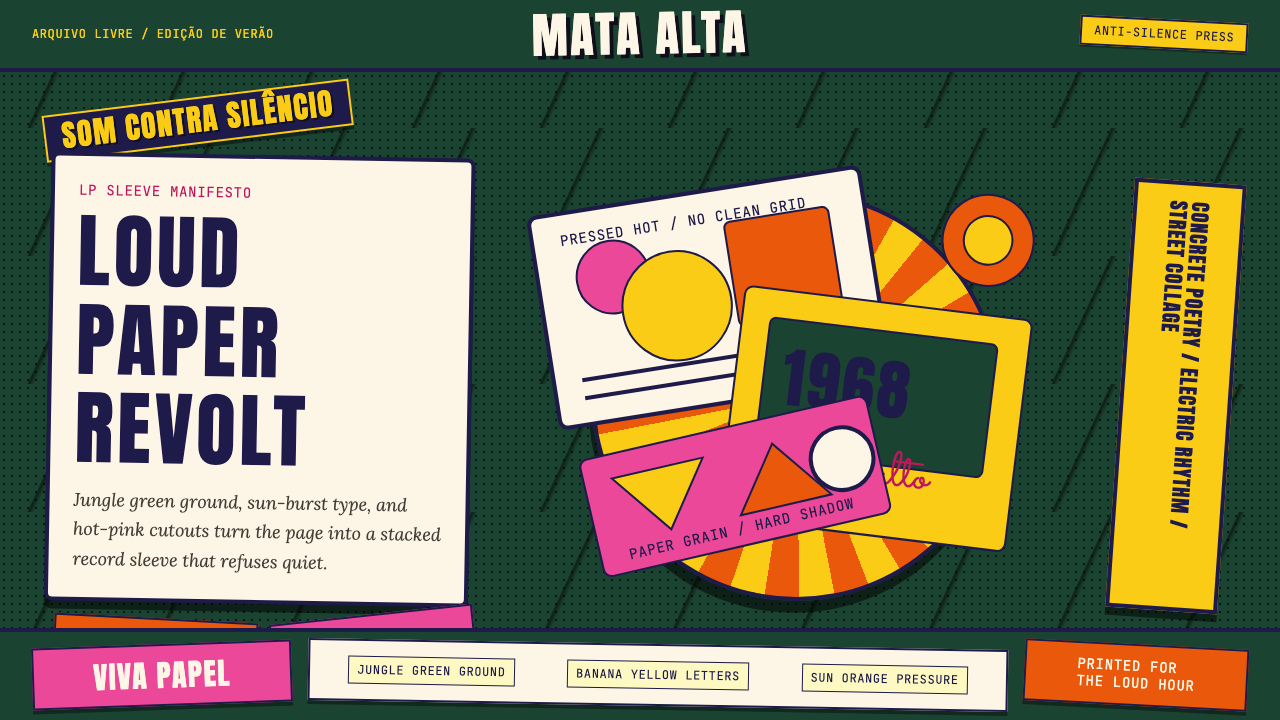 Brazilian Tropicália (1968)Art must be loud. Jungle green, banana yellow Anton type, and hard-shadow col…
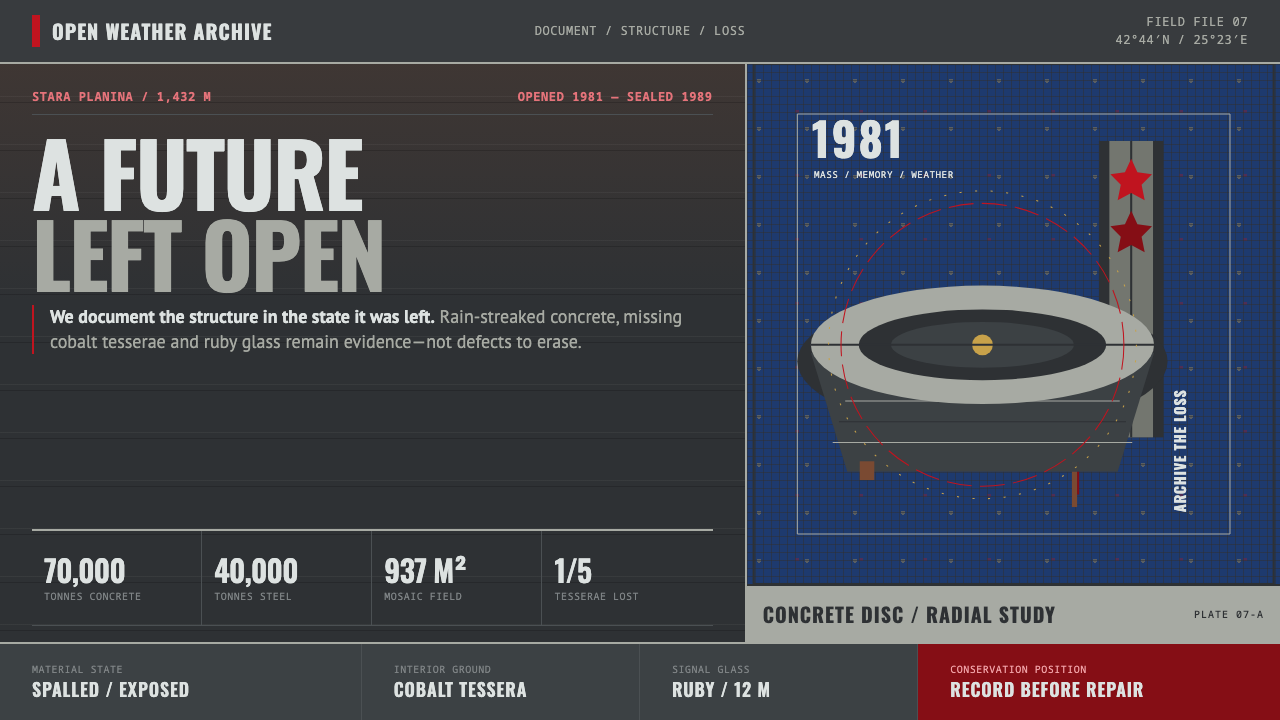 Buzludzha MonumentMonumentality without repair. Stained concrete frames cobalt tesserae, ruby g…
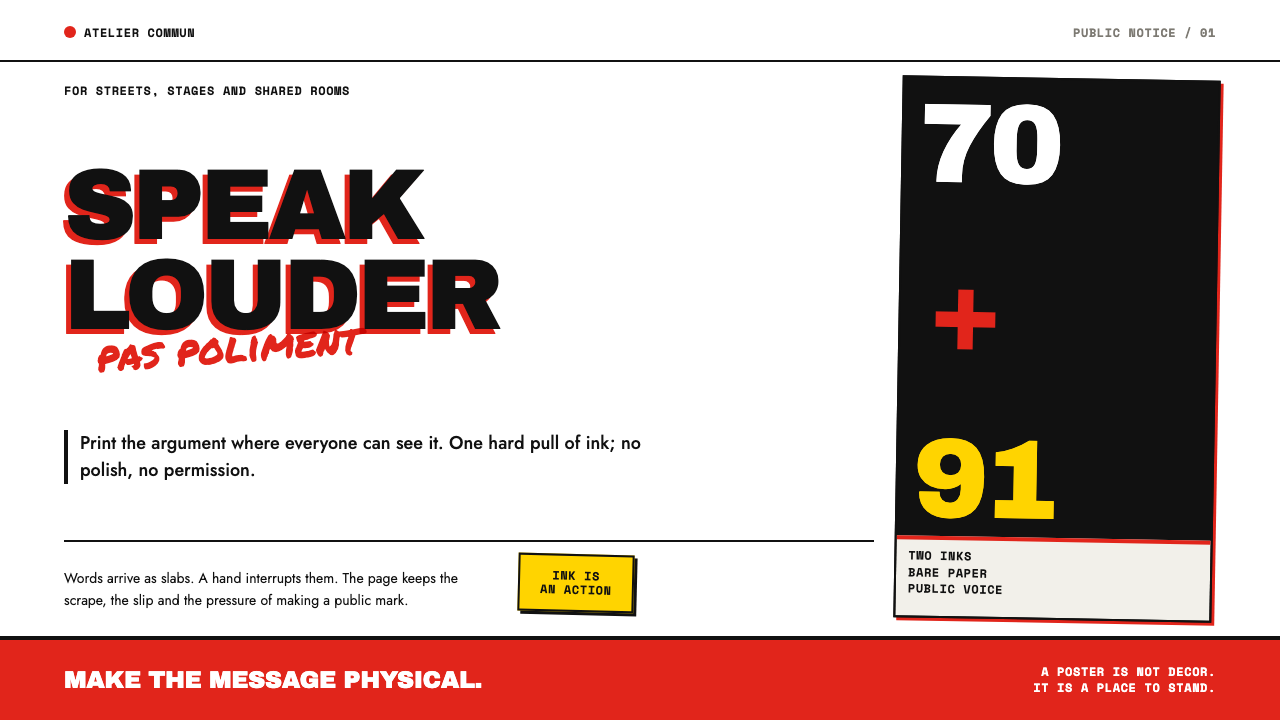 Grapus CollectivePrints dissent without polish. Red-black type slabs are disrupted by blunt ma…
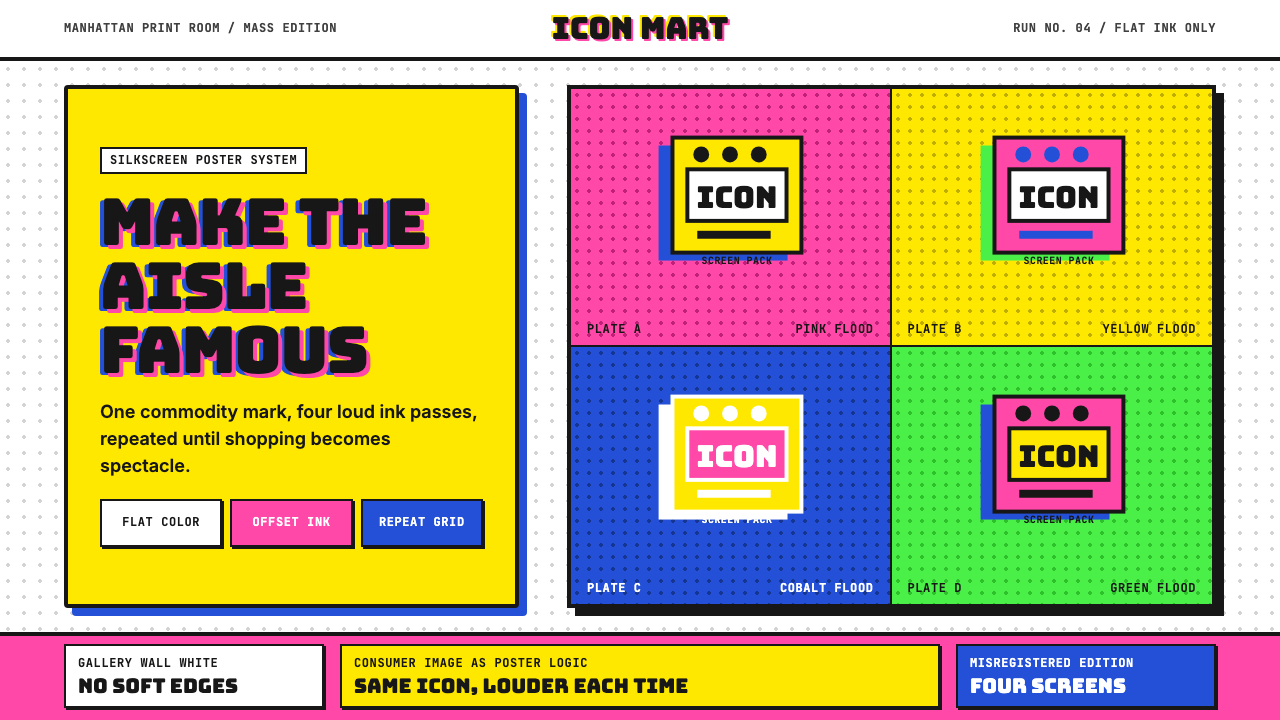 Warhol PopMass culture turns iconic. Hot pink, yellow, cobalt grids repeat flat silkscr…
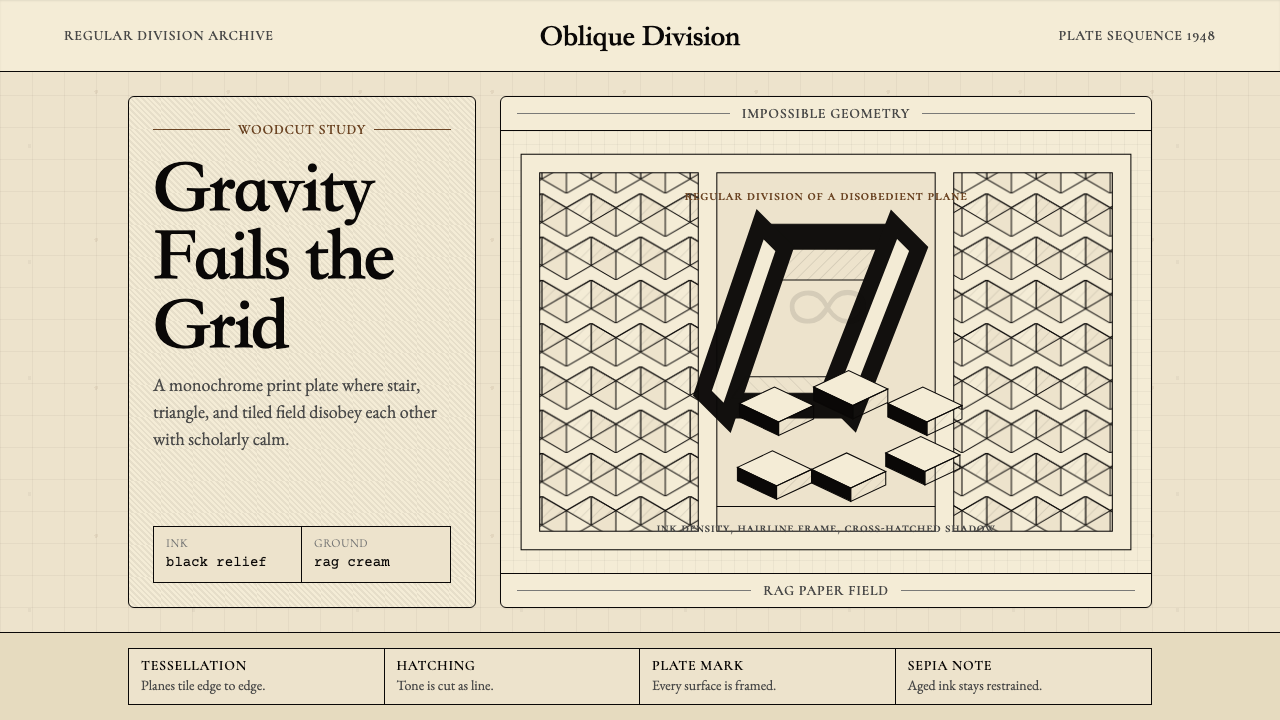 M.C. Escher ImpossibleImpossible calm. Ink-black tessellations and hatching fold cream paper into p…
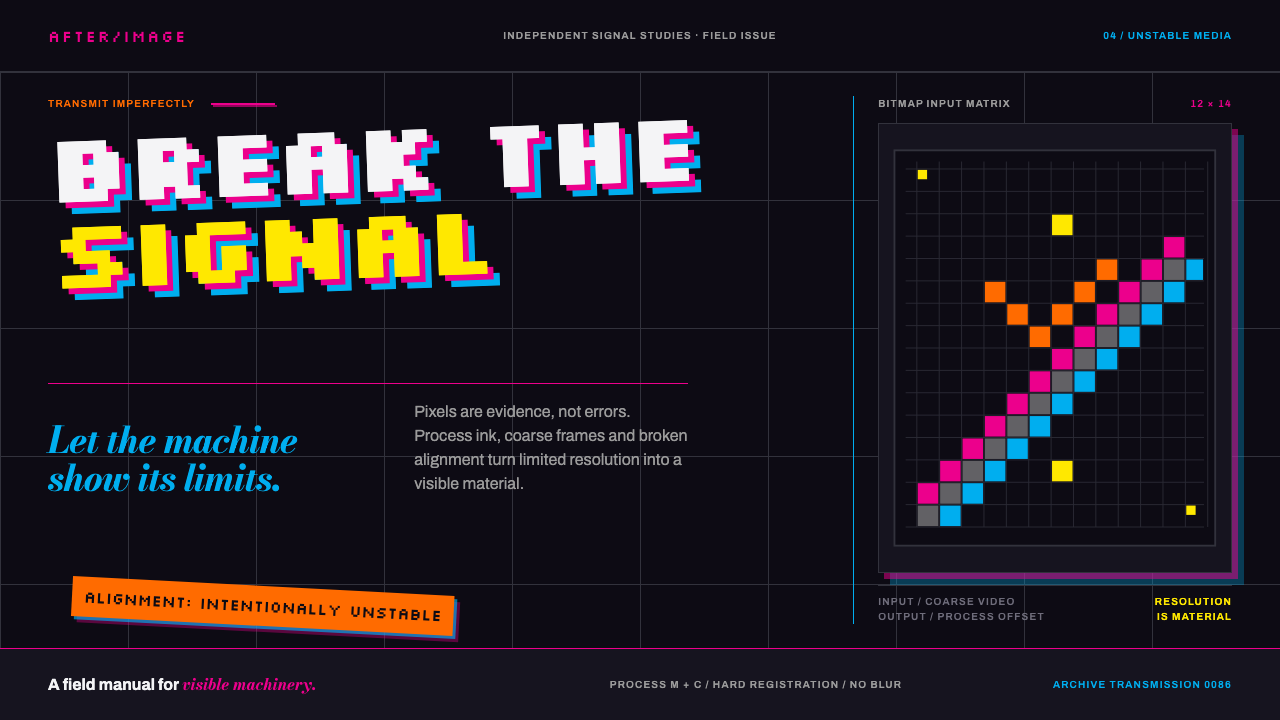 April Greiman HybridResolution becomes material. Bitmap type and process magenta collide on a bro…