What is M.C. Escher Impossible?
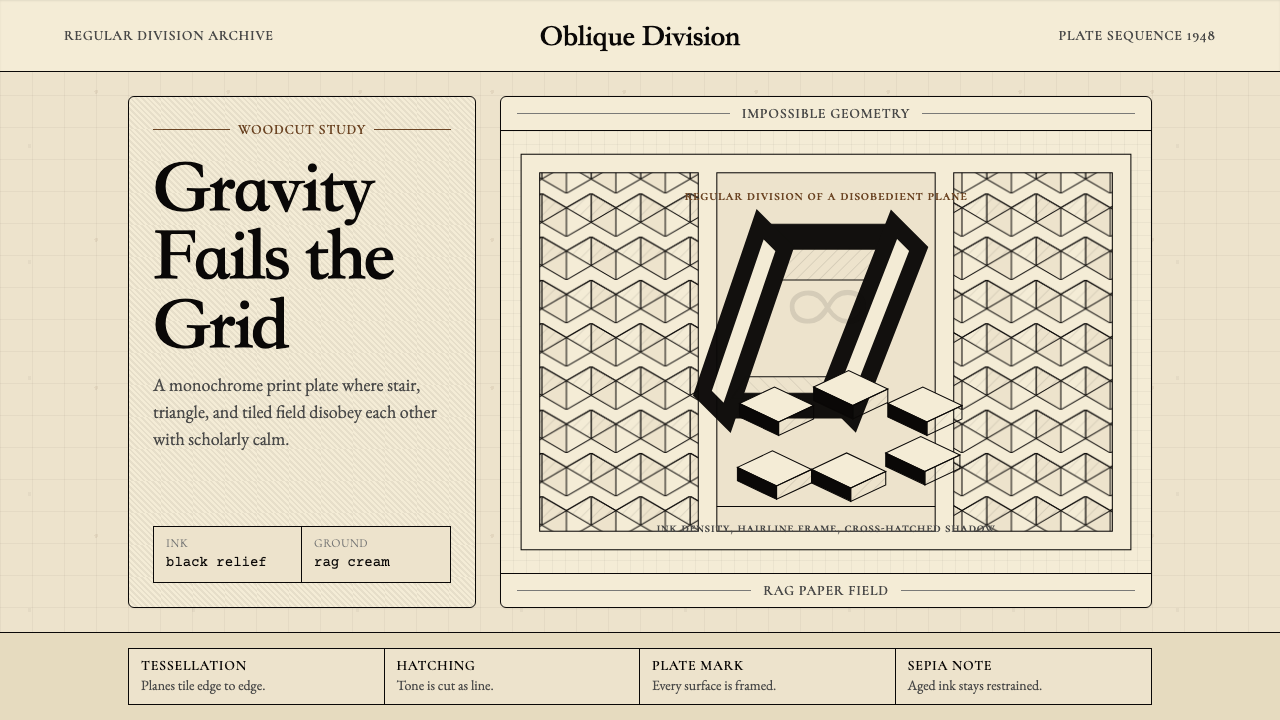
Escher turned ink and paper into paradox — tessellating creatures, infinite staircases, and architectures that fold space into knots no hand can untie.
M.C. Escher Impossible in brief
M.C. Escher Impossible is a design aesthetic rooted in the monochrome printmaking discipline of Maurits Cornelis Escher, whose woodcuts, mezzotints, and lithographs from the late 1930s through the early 1970s produced the most recognizable geometric optical illusions of the twentieth century. The visual system is built on a warm cream ground — the color of aged rag paper — against which dense ink-black geometry performs impossible feats: fish become birds mid-flight, a waterfall perpetually falls upward, staircases ascend and descend simultaneously.
The aesthetic is not primarily about surrealism or fantasy. It is about the disciplined exploitation of perceptual rules. Escher studied the mathematics of tessellation, hyperbolic geometry, and crystallographic symmetry groups not as an academician but as a craftsman seeking to understand what the eye will accept as consistent. Every impossible image in his oeuvre is built on a foundation of strict internal logic — the paradox only works because the surrounding geometry is scrupulously correct.
Translated into a design system, this sensibility produces something austere and precise: cross-hatched shadow gradients rendered in parallel lines rather than tonal wash, geometric tiling patterns that lock without gap or overlap, hairline borders that echo the pressure of a burin on a woodblock, and the persistent warmth of cream paper as a ground that is never pure white and never cold. The palette is essentially binary — ink against paper — but within that constraint the system achieves remarkable tonal and spatial complexity.

Where does M.C. Escher Impossible come from?
Maurits Cornelis Escher was born in Leeuwarden, in the Netherlands, in 1898. He trained initially as an architect at the Haarlem School of Architecture and Decorative Arts before abandoning that path in favor of printmaking under the tutelage of Samuel Jessurun de Mesquita. His early work consisted largely of Italian landscape prints made during extended stays in Rome and across the Italian south, and they display the precision of observation and the technical command of the woodcut medium that would later serve his impossible architectures.
The decisive turning point came in 1936, when Escher made his second visit to the Alhambra palace in Granada, Spain. The Moorish tilework there — intricate geometric tessellations covering every surface — arrested him completely. He spent days making careful sketches of the symmetry systems, filling notebooks with observations about how interlocking shapes could cover a plane without gap or remainder. Where the Islamic craftsmen had restricted themselves to geometric abstraction out of religious principle, Escher saw the possibility of biological metamorphosis: his tessellating units would be fish, birds, lizards, and horsemen, recognizable figures that would dissolve into one another across the picture plane.
His engagement with mathematics deepened through correspondence and collaboration with academic mathematicians. The geometer H.S.M. Coxeter sent Escher a diagram illustrating hyperbolic geometry in 1954, and Escher — who had no formal mathematical training beyond secondary school — studied it until he understood how to use it, producing his celebrated Circle Limit series in which identical figures diminish toward an infinite boundary. Roger Penrose independently invented the impossible tribar figure in 1958 and sent a paper on impossible objects to Escher; Escher incorporated the Penrose staircase into his 1960 lithograph Ascending and Descending, one of the most reproduced images of the twentieth century. These collaborations were unusual — a craftsman corresponding with mathematicians as an equal, each side finding in the other confirmation of intuitions they had pursued by different means.
Escher worked in relative obscurity through most of his career; his work was appreciated in the Netherlands but was not widely known internationally until the late 1950s and early 1960s, when it was reproduced in Scientific American and discovered by mathematicians, psychologists, and the emerging counterculture. The psychedelic movement of the 1960s and 1970s adopted his impossible architectures as emblems of expanded consciousness, and his work was widely distributed on posters and album covers, reaching audiences far beyond the gallery world. He died in 1972 in the Netherlands, by which point his imagery had become genuinely iconic — reproduced so often that the visual language had, to some degree, separated from his name and entered the general vocabulary of Western visual culture.
What defines the M.C. Escher Impossible look?
Palette
The palette is essentially binary: dense ink-black against the warm cream of aged rag paper. This is not a neutral white and a neutral black — the warmth of the ground is deliberate, referencing the specific cream of handmade printing papers, and the black carries the slight density variation of actual ink pressed into fiber. Where tonal variation appears, it is achieved through the spacing and weight of hatching lines rather than through intermediate hues. Color, where it occasionally appears in design applications derived from this system, is used sparingly and almost always as a single accent against the monochrome field.
Tessellation
Interlocking geometric or figurative units that tile a plane without gap or overlap are the most distinctive structural device in this aesthetic. A tessellation is not simply a repeating pattern — each unit must be the negative space of its neighbor, so that the boundary between one figure and the next is shared and indivisible. In design applications, tessellation logic governs background fields, border treatments, and any decorative fill. The eye should be able to switch between reading the dark shapes and the light shapes as figure and ground, a deliberate exploitation of perceptual ambiguity.
Impossible Geometry
Architectural or structural forms that are locally consistent but globally contradictory define the most conceptually distinctive aspect of this style. The Penrose staircase, the impossible tribar, the Necker cube inversion — each exploits the eye's tendency to infer three-dimensional structure from two-dimensional cues. When used in design, impossible geometry is most powerful as a focal element rather than a background texture: a single impossible object in a composition commands attention precisely because the mind cannot resolve it and keeps returning to try.
Cross-hatching and Line Weight
Shadow, volume, and tonal depth are built not through washes or gradients but through systems of parallel and crossing lines. The density of hatching controls perceived darkness; the angle and regularity of the lines signal whether a surface is receding or advancing. This approach references the specific constraints of woodcut and engraving — media in which tone must be constructed from line because the tool cannot blend. In design applications, hatching patterns replace flat shadows and gradient fills wherever tonal variation is needed, maintaining the handcraft quality of the original medium.
Metamorphosis
The gradual transformation of one figure into another — a geometric grid dissolving into recognizable creatures, fish morphing into birds at the edge of a composition — is the most narrative element in this aesthetic vocabulary. Metamorphosis creates visual momentum: the eye is pulled across the picture plane by the process of change rather than by conventional compositional diagonals or focal points. In design applications, this principle can be translated into transitional elements between sections, progressive figure-ground inversions within a single decorative band, or diagrammatic sequences that show transformation over time.
Spatial Depth Without Color
Escher's prints achieve a convincing sense of architectural depth and three-dimensional space using only line weight, hatching density, and the geometry of perspective — without any color differentiation to separate foreground from background. This discipline produces a particular kind of visual tension in which the spatial relationships are simultaneously clear and destabilizing. In design work, this means that hierarchy and depth can be established entirely through line quality and geometric structure, without recourse to the color contrasts that normally separate layers in a composition.
Geometric Precision
Everything in this system is governed by strict geometric logic. Curves are derived from mathematical constructions rather than gestural freehand drawing; angles are consistent and deliberate; repeating units are genuinely identical rather than approximately so. The visual effect is not cold or mechanical, because the warmth of the paper ground and the slight imprecision inherent in handcut printing preserve a human quality — but the geometric framework beneath is rigorously correct. This combination of mathematical precision and craft warmth is the system's most characteristic quality.

Who shaped M.C. Escher Impossible?
Escher (1898–1972) was a Dutch graphic artist who worked primarily in woodcut, mezzotint, and lithography. Self-taught in mathematics beyond the secondary level, he developed an intimate understanding of tessellation, symmetry, and non-Euclidean geometry through direct observation and correspondence with mathematicians. His mature work from the late 1930s onward systematically explored the perceptual paradoxes that would define this aesthetic: impossible architectures, infinite recursions, and biological metamorphoses built on interlocking geometric units. He worked with extraordinary technical precision and was prolific by the standards of the labor-intensive printmaking media he favored.
Penrose is a British mathematical physicist who, with his father Lionel, developed the concept of impossible objects as formal geometric constructions in the late 1950s. Their 1958 paper introduced the impossible tribar and the impossible staircase — figures that are locally consistent in three dimensions but globally contradictory. Penrose sent this paper to Escher, who incorporated the staircase into Ascending and Descending (1960). This exchange exemplifies the unusual relationship between this aesthetic and formal mathematics: the visual paradoxes are not tricks but rigorous demonstrations of specific perceptual and geometric principles.
Harold Scott MacDonald Coxeter was a British-Canadian geometer whose work on hyperbolic geometry and regular polytopes provided Escher with the mathematical framework for his Circle Limit series. When Coxeter published a diagram illustrating the Poincaré disk model of hyperbolic geometry in a 1954 paper, Escher recognized in it a structure he had been intuitively pursuing — a way of filling a bounded circle with infinitely diminishing identical figures. Their subsequent correspondence, in which Escher described his geometric discoveries and Coxeter confirmed or corrected them, is one of the most documented examples of artist-mathematician collaboration in the twentieth century.
Bruno Ernst — the pen name of Hans de Rijk — was a Dutch mathematics teacher and writer who became the most authoritative interpreter of Escher's work during the artist's lifetime. His book The Magic Mirror of M.C. Escher, published in 1976, provided the first systematic analysis of the geometric and perceptual structures underlying Escher's prints, and it remains the standard reference for understanding the mathematical content of the work. Ernst's access to Escher's studio and notebooks allowed him to document the working methods that produced these images, making visible the laborious construction processes behind apparently spontaneous paradoxes.
De Mesquita was a Dutch Jewish graphic artist and the teacher who recognized and cultivated Escher's printmaking talent at the Haarlem School. He taught Escher the technical foundations of woodcut and introduced him to the tradition of the Dutch graphic arts. De Mesquita's own work combined decorative pattern-making with figuration in ways that anticipated Escher's later tessellations. He was murdered at Auschwitz in 1944, and Escher spent the rest of his life honoring his memory and preserving examples of his work — a connection that grounds this apparently abstract aesthetic in human tragedy and artistic debt.
How do you use M.C. Escher Impossible today?
The Escher Impossible aesthetic transfers most effectively to design contexts where intellectual engagement, geometric precision, and a sense of depth-without-ornamentation are desired values. Unlike decorative historicist styles that can be applied as a surface layer, this system asks you to construct compositions according to the same principles that govern the original prints: geometry must be internally consistent, tonal variation must be earned through line work rather than color, and any impossible element must be placed with an understanding of why it produces the perceptual effect it does.
For presentation slides, the style works exceptionally well as a cover treatment and for section dividers. A cover composition built on a central impossible object — a Penrose triangle rendered in careful line work against a cream ground — commands attention and signals conceptual seriousness without resort to photography or decorative illustration. Content slides should be treated with restraint: the full tessellation and hatching vocabulary is too dense for text-heavy layouts. Instead, reserve the geometric patterning for framing elements and section backgrounds, and use the ink-on-cream palette consistently for all typographic and structural elements. Data visualizations gain distinction from this style when chart forms are treated as geometric objects in their own right — bars, segments, and nodes rendered in the system's line-weight vocabulary rather than as filled solid shapes.
For web interfaces and dashboards, the key is selectivity. The monochrome ink-on-cream palette translates well to pricing pages, documentation sites, and portfolio presentations where the content itself is complex and the visual system should not compete. Use tessellation geometry in hero backgrounds or empty-state illustrations; use cross-hatching as a texture for card backgrounds or section fills where a flat color would feel lifeless; use hairline borders and precise geometric containers throughout. For interactive states, a single warm accent color used sparingly against the monochrome field will feel coherent rather than intrusive. Marketing pages built on this aesthetic tend to work best when they commit to a single hero impossible object and build all visual hierarchy through typography and geometric structure rather than color.
For editorial and print applications, the aesthetic is a natural fit for publications dealing with mathematics, architecture, science, philosophy, or any subject that rewards patient close reading. A layout derived from this system uses a narrow justified measure, generous margins that accommodate marginal annotations or geometric ornament, and section breaks marked by tessellating border patterns rather than decorative flourishes. Pull quotes and callouts are framed by geometric containers — precise rectangles or interlocking shapes — rather than typographic flourishes. Cover designs built on a full tessellation field achieve visual impact through density and intricacy rather than through the bold color contrasts of more conventional poster-derived styles.
A common mistake when applying this aesthetic is reaching for the most dramatic impossible geometry immediately — filling a composition with staircases and infinite loops — without the supporting structure of consistent line work and geometric discipline that makes the impossible element legible. The paradox only works when the surrounding space is scrupulously ordered; an impossible figure placed in a chaotic or decoratively inconsistent composition simply looks like an error. Similarly, applying digital gradients or soft shadows to elements within this system destroys its internal logic, because the system's depth is built from line density rather than from lighting simulation. Every tonal transition should be achievable in a two-color print.

M.C. Escher Impossible — FAQ
Is this aesthetic purely black and white, or can color be introduced?
Escher's own prints were almost entirely monochrome, and the core logic of the system is built on the binary relationship between ink and paper. Color can be introduced, but it must be handled with the same discipline that governs the rest of the system. A single warm accent color — used for a specific figure type in a tessellation, or to highlight a single impossible element in a composition — can extend the vocabulary without breaking it. What tends to break the system is using multiple colors simultaneously at full saturation, which undermines the monochrome tonal logic and makes the geometric structure harder to read. When color appears, it should feel like an analytical distinction rather than a decorative one.
How do I use impossible geometry without it looking like a novelty or a gimmick?
The key is that impossible geometry only works as a serious visual device when the surrounding composition is scrupulously ordered. The paradox depends on the viewer first trusting the spatial logic, then experiencing its contradiction. If the broader layout is chaotic or decoratively inconsistent, there is no established spatial logic to contradict, and the impossible figure simply looks like an error or an affectation. Practically: place impossible geometry at the compositional center or primary focal point, surround it with precise and consistent geometric structure, and resist the temptation to add more than one such element per composition. One impossible object, placed correctly, creates sustained fascination. Several impossible objects compete and cancel each other out.
Can this style work for digital interfaces, or is it too print-derived?
It transfers to digital contexts, but with some translation required. The key values of the style — geometric precision, monochrome depth built from line work, and perceptual complexity that rewards close attention — are all achievable on screen. The challenge is that screen rendering tends toward smoothness and anti-aliasing, which can soften the sharp hairline geometry that gives the style its character. SVG-rendered geometric elements, rendered at precise vector fidelity, handle this better than rasterized assets. The cream ground, which is central to the warmth of the print aesthetic, works well on screen when treated as a warm off-white rather than a pure white or a grey. Animation should be used extremely sparingly, if at all — a slowly rotating tessellation can be hypnotic, but motion generally competes with the perceptual complexity of the static geometry.
What kinds of projects or brands are a poor fit for this style?
The style is poorly suited to contexts that require emotional warmth, approachability, or sensory richness. Consumer products in the food, wellness, children's, or lifestyle categories depend on organic texture, human imagery, and color associations that the Escher Impossible system does not provide. The monochrome severity and intellectual complexity of the aesthetic can read as cold, exclusive, or intimidating in contexts where the user experience depends on immediate comfort and trust. Similarly, brands that rely on photographic lifestyle imagery as their primary communication mode will find the style difficult to integrate, since the system's logic is built on geometry and line rather than photography. The style is at its strongest where precision, intellectual engagement, and a certain deliberate difficulty are features rather than obstacles.
How does this style relate to Op Art, and are they interchangeable?
Escher's work is frequently cited as part of the Op Art lineage, and there are real connections: both exploit perceptual ambiguity, both use geometric precision as a primary tool, and both emerged in the mid-twentieth century context of interest in visual psychology. But they are not interchangeable. Op Art — as represented by Bridget Riley, Victor Vasarely, and their contemporaries — typically uses color contrast and moiré effects to produce retinal vibration and perceptual instability in the viewer's visual field. Escher's work produces spatial paradox and conceptual impossibility rather than retinal vibration; its effect is intellectual as much as perceptual. Op Art tends to be non-figurative and purely abstract; Escher's most distinctive work is figurative and narrative. The two aesthetics can be confused at a glance but serve very different experiential purposes.
Related design styles
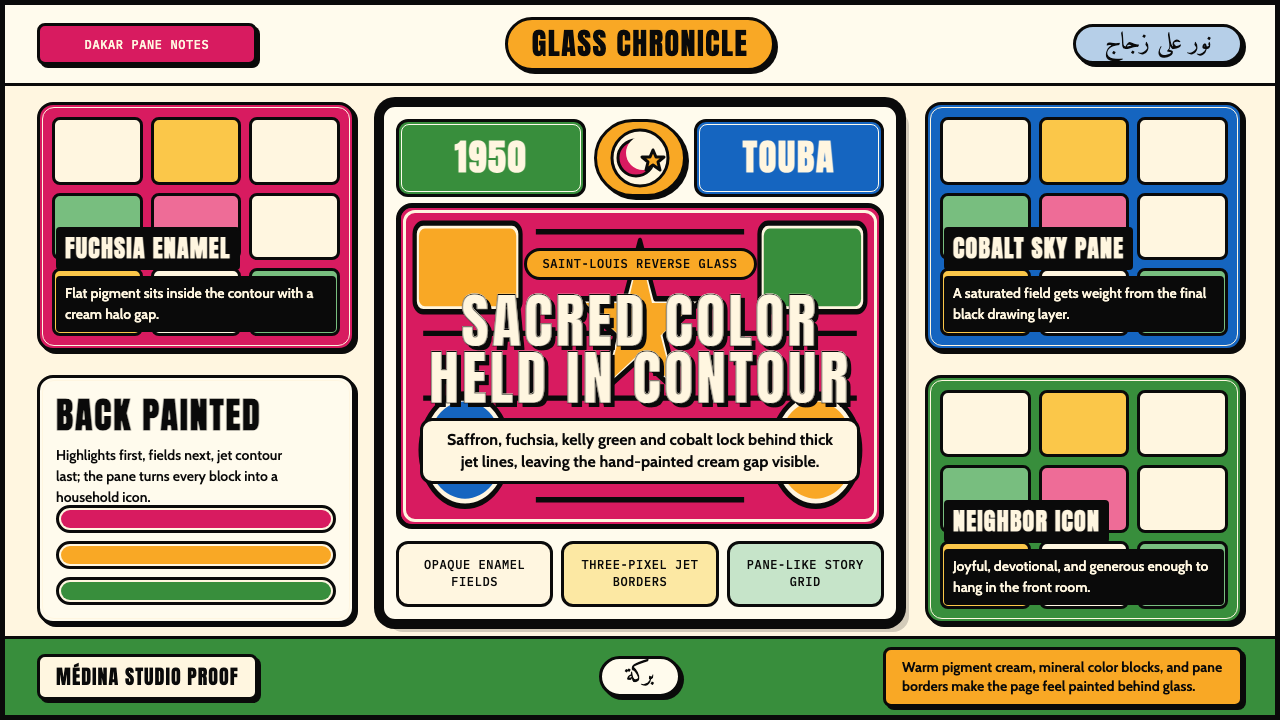 Senegalese Sous-VerreSacred joy in enamel. Fuchsia and saffron panes lock behind thick jet contour…
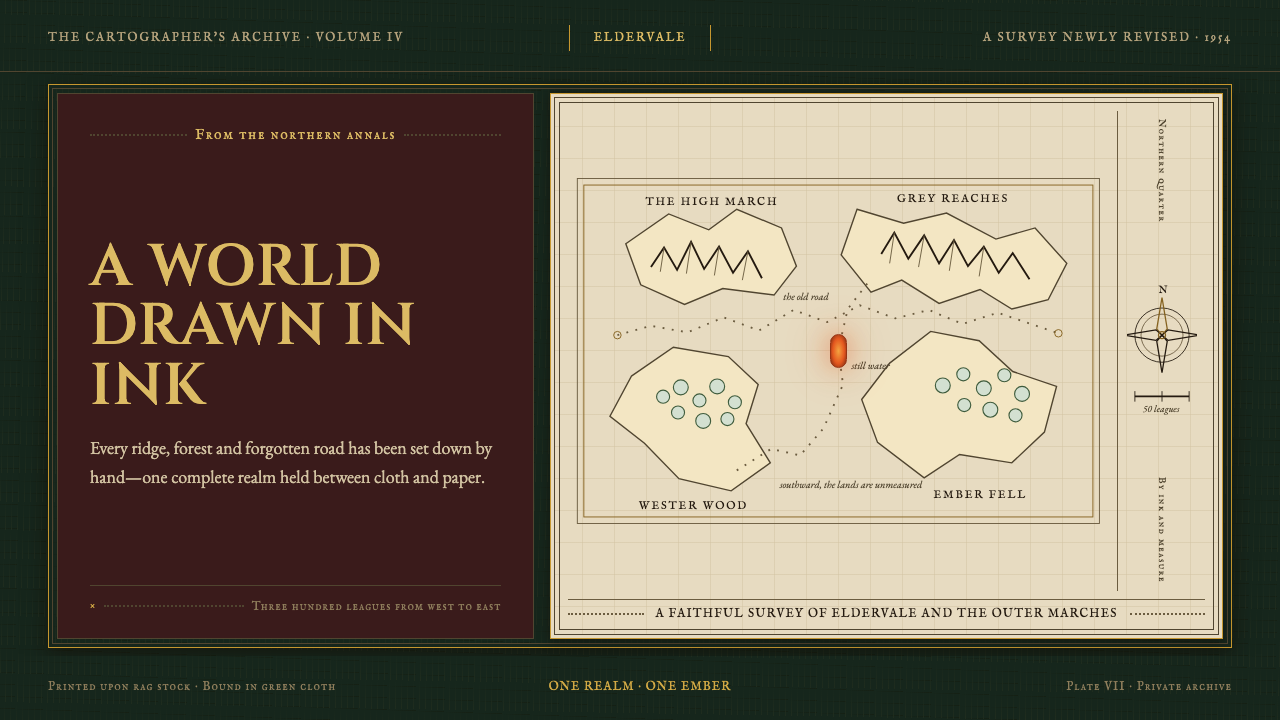 Tolkien Middle-earth (1954)A whole world held in ink. Gilt type and vellum cartography glow against bott…
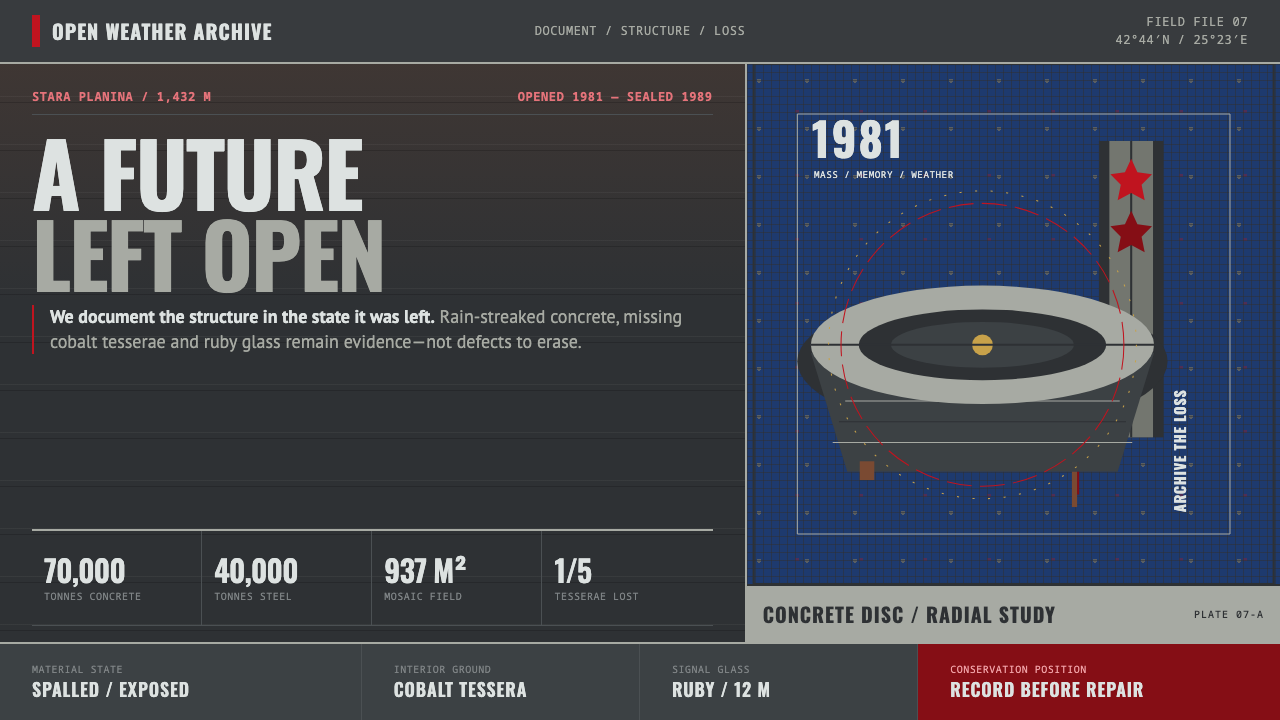 Buzludzha MonumentMonumentality without repair. Stained concrete frames cobalt tesserae, ruby g…
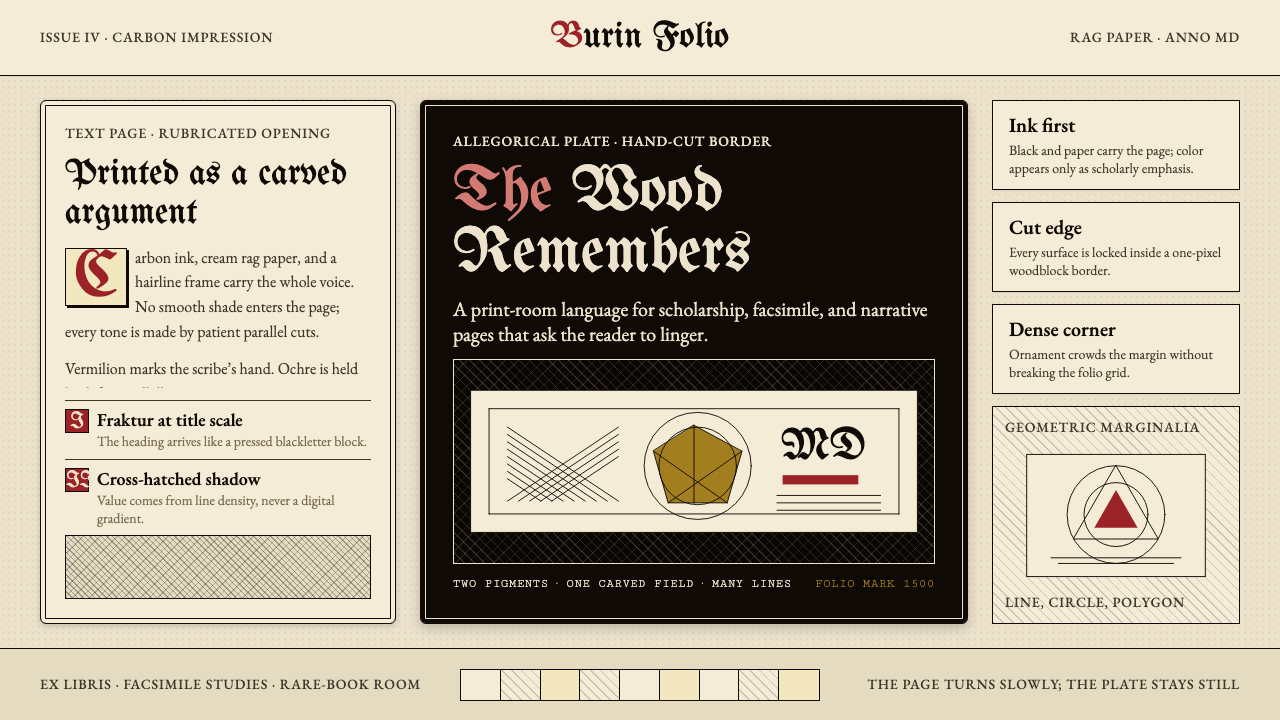 Dürer WoodcutInk remembers everything. Fraktur titles, rag-paper cream, and cross-hatched…
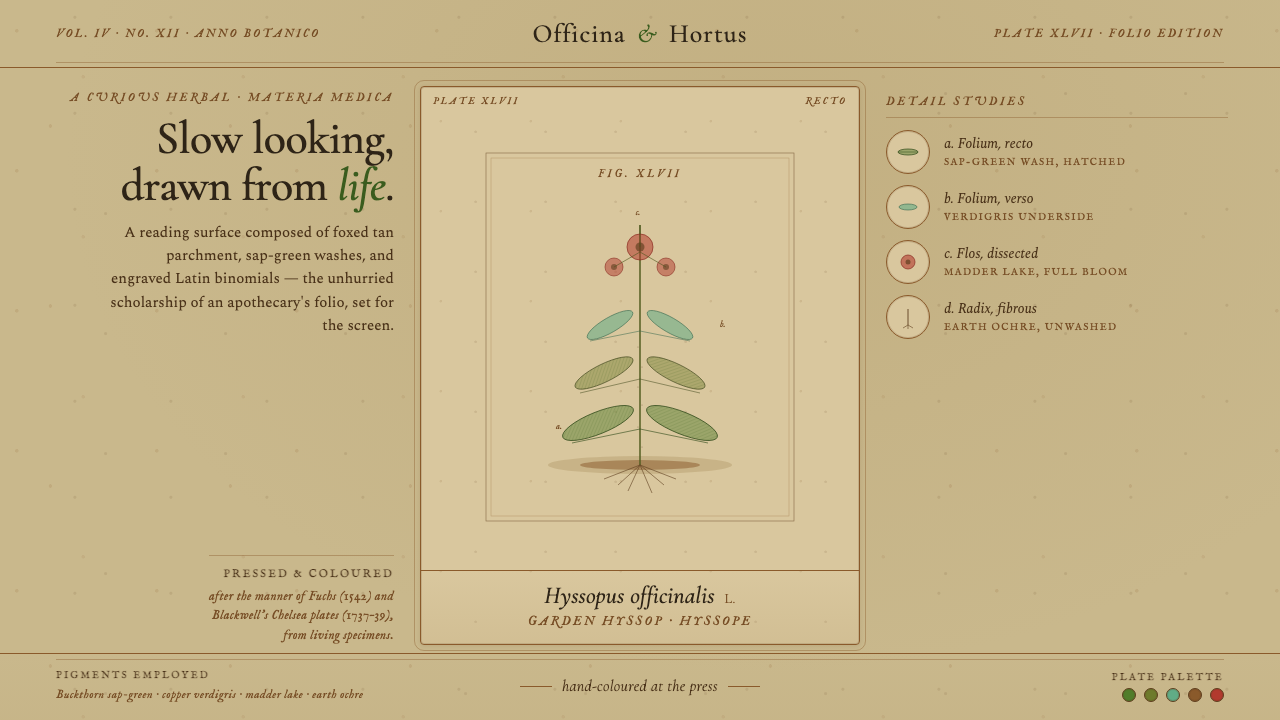 Herbal PharmacopoeiaSlow scholarship of the apothecary folio. Foxed tan parchment, sap-green wash…
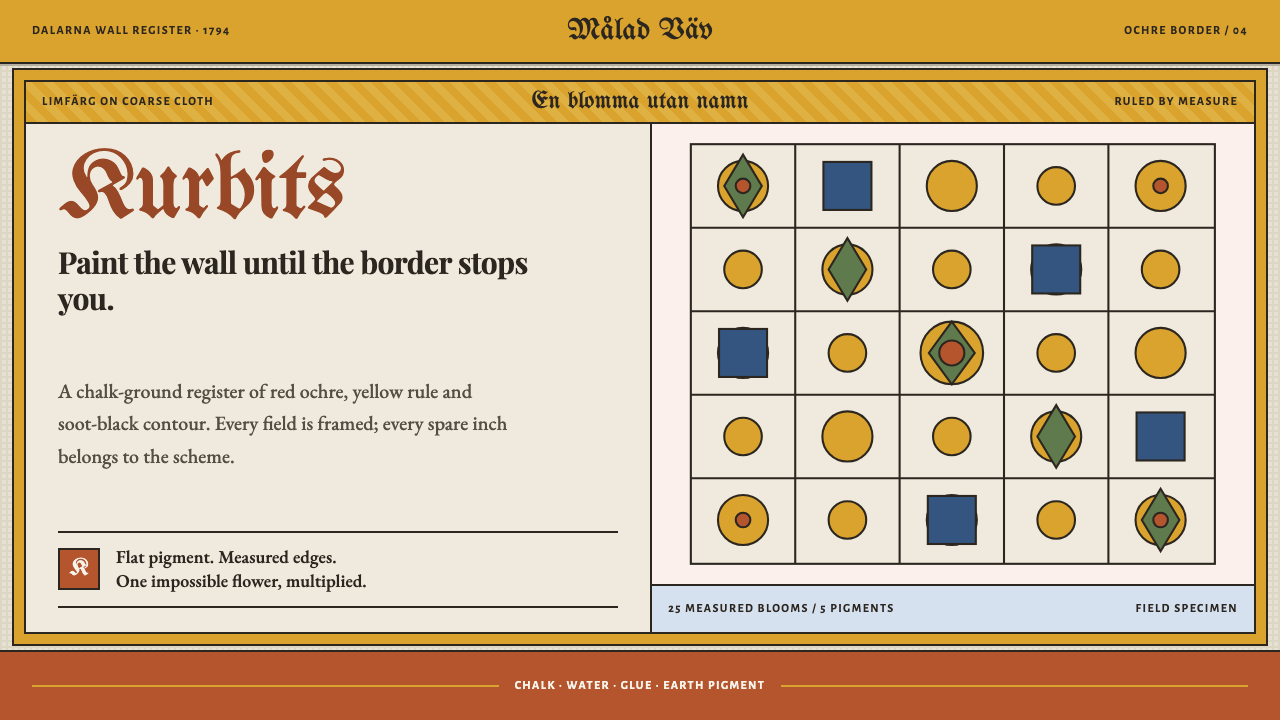 Kurbits Dalarna PaintingNo blank wall survives. Red ochre blooms crowd a chalk ground inside measured…