What is William Blake Illuminated?
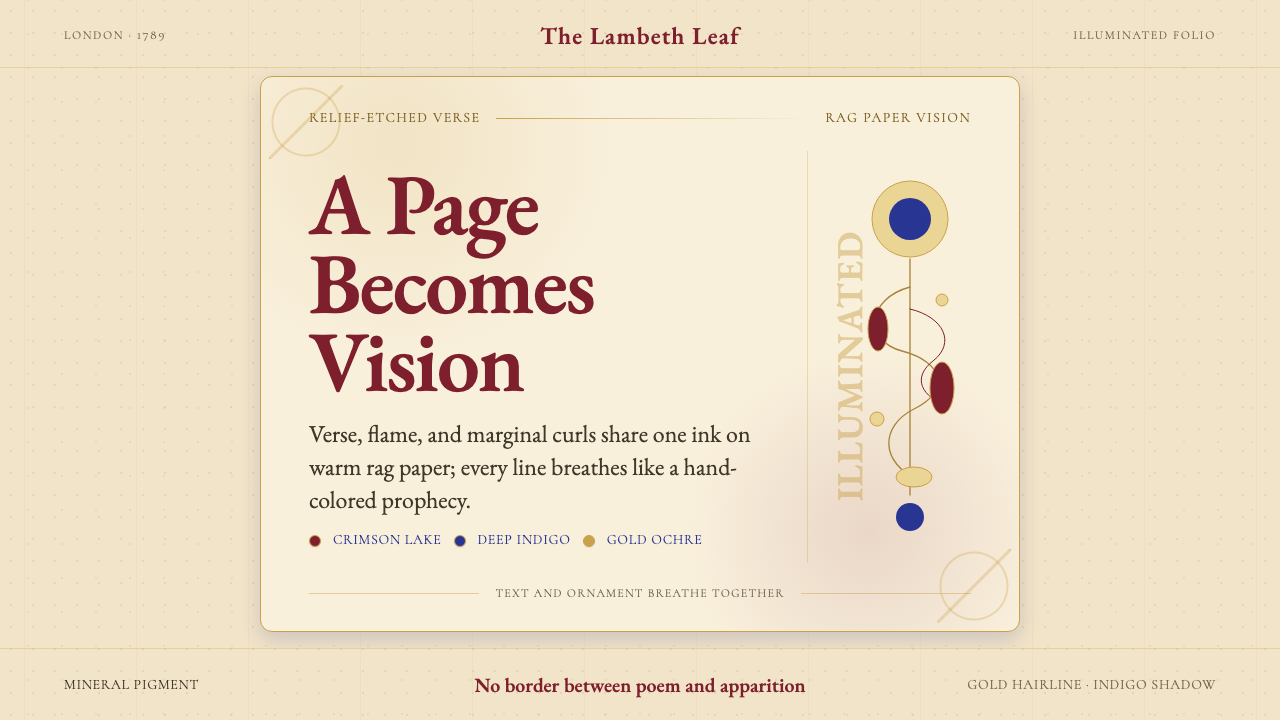
Blake turned the printed page into a living prophecy — hand-etched, hand-painted, every poem inseparable from its vines and flames.
William Blake Illuminated in brief
William Blake Illuminated describes the visual and literary aesthetic originating in the hand-produced illuminated books William Blake created in London beginning in 1788. Unlike any printed tradition before or since, each page fuses verse, prophecy, and image into a single organism: text flows around naked angelic figures, marginal vines curl between stanzas, and tongues of flame rise from the bottom of lines as naturally as punctuation. There is no hierarchy between word and image — both are drawn by the same hand, on the same plate, inked in the same session.
The palette is warm and mineral: deep indigo, crimson, and gold ochre spread across cream-toned rag paper whose texture shows through the pigment. Blake and his wife Catherine mixed their own watercolors from pigment and gum arabic, which gives each copy a slightly different warmth and opacity. No two copies of any Blake book are identical — the coloring of Songs of Innocence and of Experience, for instance, varies dramatically between the surviving copies, making each one a unique object rather than a reproduced edition.
As a design sensibility — applied to contemporary visual work — the Blake Illuminated aesthetic means: treat every surface as an integrated field, let type and ornament breathe together, choose colors that feel hand-mixed and luminous rather than flat and digital, and allow the composition to feel visionary and slightly asymmetric rather than mechanically balanced. It is the opposite of minimalism: density is a virtue, but the density must feel alive rather than cluttered.

Where does William Blake Illuminated come from?
William Blake was born in London in 1757 and trained as an engraver from the age of fourteen, apprenticed to the commercial engraver James Basire. His technical mastery of the copper plate was therefore not an artistic affectation but a lifelong professional skill. By his late twenties, dissatisfied with commercial commissions and convinced that conventional publishing would never accommodate his prophetic poetry, he invented a new method he called relief etching. Instead of incising lines into copper (intaglio), he wrote his text and drew his designs directly onto the plate in acid-resistant varnish. Acid ate away the unprotected background, leaving the writing and drawing raised — printable like woodcut, but as fine as engraving.
The first completed illuminated book, All Religions Are One, dates to around 1788, followed quickly by There Is No Natural Religion. The celebrated Songs of Innocence appeared in 1789, the same year as the French Revolution — whose political energies Blake watched with ambivalent intensity. The Marriage of Heaven and Hell (c. 1790–1793) pushed the illuminated format toward its most visually complex form, with interleaved prose, aphorism, and grotesque imagery. The later prophetic books — America (1793), Europe (1794), Jerusalem (1804–1820) — grew larger, more labyrinthine, and more overtly apocalyptic in their imagery. Jerusalem, the longest and most ambitious, took sixteen years to complete and was finished when Blake was in his early sixties.
Blake and Catherine printed each copy themselves on a rolling press in their home, using oil-based ink. After printing, Catherine — whose role is often underacknowledged — helped apply the watercolor washes that gave each page its characteristic glow. Blake sometimes re-colored copies years after the original printing run, meaning that the same plate could produce very different-looking pages depending on the decade and his evolving vision. The entire enterprise was hand-made from start to finish: from the poem's composition to the acid bath to the press to the brushwork, no external craftsman or printer was involved.
During his lifetime, Blake sold few copies. His work was noticed by a small circle of admirers including the collector Thomas Butts, who commissioned many drawings, and the young painter John Linnell, who introduced Blake to the group of disciples known as the Ancients in the last years of his life. After Blake's death in 1827, his reputation remained marginal until the Pre-Raphaelite Brotherhood, and particularly Dante Gabriel Rossetti, rediscovered his visual work in the 1840s and 1860s. Rossetti's championing transformed Blake from a neglected eccentric into a founding figure of British Romanticism and visionary art. By the late nineteenth century, the illuminated books were recognized as unique objects — neither purely literary nor purely pictorial, but a synthesis that had no precedent and no direct successor.
What defines the William Blake Illuminated look?
Integrated Text and Image
In Blake's pages, the division between text and illustration does not exist. Letters are drawn as part of the composition; figures emerge from the ascenders and descenders of words; vines and roots grow between stanzas. No element is purely decorative and none is purely typographic. Contemporary applications of this aesthetic strive for the same integration: type should feel placed within the visual field rather than laid over it, and ornamental elements should touch or surround the text rather than float separately.
Warm Mineral Palette
Blake's characteristic colors are deep indigo, warm crimson, and gold ochre, applied over cream rag paper that contributes its own warm undertone. These are not bright primary colors — they are the muted, slightly variable hues of hand-ground pigment, closer to fresco and manuscript than to commercial printing. Authentically Blake-influenced work avoids pure digital saturations; instead it favors colors with a perceptible warmth, slight earthiness, and a sense that they might have been mixed by hand.
Flowing Organic Line
Where Bauhaus privileges the ruled straight line and geometric form, Blake privileges the sinuous, undulating line of the natural world — the curve of a vine, the arc of a human back, the spiral of a flame. Blake was influenced by Gothic illuminated manuscripts and by his reading of Michelangelo's figure drawing, and his line has a muscular, expressive quality that is never mechanical. In contemporary applications, this characteristic translates to decorative borders that curve and branch, letterforms with slight calligraphic life, and figurative or botanical elements that are drawn rather than constructed.
Visionary Figuration
Blake's figures are idealized human bodies in extreme postures — stretching, falling, ascending, reaching across the full height of a page. They are rarely clothed; nudity for Blake signifies the eternal, spiritual condition of the soul as opposed to the temporal, social condition of the dressed body. The figures coexist with text without caption or explanation, as if naturally inhabiting the same space as the words. This prophetic, symbol-laden figuration is one of the style's most recognizable qualities and its most demanding: figures must be drawn with conviction to avoid pastiche.
Layered Density Without Claustrophobia
Blake's pages are full — full of text, full of vine work, full of figures — but they do not feel oppressive. The key is luminosity: the warm paper shows through the washes, figures and plants share the same light source, and the overall composition has a vertical rhythm that creates breathing room between zones of density. This balance of richness and air is the central discipline of the style. Applied to contemporary design, it means that the goal is not to fill every square unit of space but to arrange layered elements so that the eye finds rest between them.
Hand-Made Individuality
Because every copy of a Blake book was produced by hand, no two are alike. Slight variations in inking, coloring, and page placement are not defects but the signature of the process. Contemporary application of this aesthetic actively embraces slight irregularity — hand-lettered or calligraphic type elements, subtle variation in border thickness, textures that recall paper and pigment. The goal is to produce work that feels crafted and particular rather than algorithmically generated.
Symbolic Color Temperature
Blake used color expressively and symbolically rather than descriptively. Gold and warm yellows signify spiritual energy and divine presence; deep blues and indigos evoke night, experience, and the fallen world; crimson and rose suggest both beauty and sacrifice. The coloring choices in his later hand-painted copies often departed entirely from naturalistic expectation — trees might be indigo, skies gold, figures crimson. This symbolic rather than descriptive use of color is central to the style and distinguishes it from mere decorative historicism.

Who shaped William Blake Illuminated?
Blake (1757–1827) was a poet, painter, and printmaker who invented the relief-etching method in 1788 and used it for the rest of his life to produce his illuminated books. He was also a commercial engraver by trade, working on book illustrations and reproductive prints throughout his career. His prophetic poems — including The Marriage of Heaven and Hell, Milton, and Jerusalem — contain an elaborate private mythology of cosmic forces called Zoas, which appear in visual form throughout the illuminated pages. Despite chronic poverty and public neglect during his lifetime, he produced a body of work — roughly twenty-five illuminated books — that is now recognized as one of the most singular achievements in the history of English literature and art.
Catherine Boucher (1762–1831) married William Blake in 1782 and became his indispensable collaborator in the production of the illuminated books. She helped operate the press, applied watercolor washes to the printed pages, and managed the practical household economy that allowed Blake to work. Art historians have increasingly recognized that the distinction between William's and Catherine's hands in the coloring process is nearly impossible to establish with certainty, meaning that the visual character of many surviving copies reflects her contribution as much as his. After Blake's death, she continued selling his works and reportedly saw visions of him.
Thomas Butts (1757–1845) was a civil servant in the British War Office and the most important patron of Blake's visual work during his lifetime. Over a period of roughly two decades beginning around 1799, Butts commissioned hundreds of works from Blake — watercolors illustrating the Bible, Milton's Paradise Lost, and other literary subjects — providing the steady income that allowed Blake to continue producing his illuminated books without commercial success. Butts's collection, assembled largely out of personal loyalty and genuine admiration rather than investment calculation, preserved a significant body of Blake's work that might otherwise have been lost.
Rossetti (1828–1882) was the central figure of the Pre-Raphaelite Brotherhood and the artist most responsible for rescuing Blake's reputation after his death. In 1847, Rossetti purchased a notebook of Blake's drawings and poems (now known as the Rossetti Manuscript or Blake's Notebook) from Blake's friend William Palmer, which gave him direct access to Blake's working process. Rossetti's subsequent championing of Blake — in essays, lectures, and his own artistic practice — established the critical framework through which Victorian and Edwardian audiences encountered Blake's visual legacy and transformed him from a neglected eccentric into a canonical Romantic visionary.
John Linnell (1792–1882) was a landscape painter who befriended Blake in 1818, when Blake was in his early sixties and in relative obscurity. Linnell introduced Blake to a circle of younger admirers known as the Ancients — including Samuel Palmer and George Richmond — who treated the elderly Blake with near-devotional reverence and were profoundly influenced by his visionary approach to landscape and figure drawing. Linnell also commissioned Blake's final major work, the one hundred engravings illustrating Dante's Divine Comedy, left unfinished at Blake's death. His practical support in Blake's final decade ensured that the late visionary works were completed and preserved.
How do you use William Blake Illuminated today?
Applying the Blake Illuminated aesthetic requires understanding its fundamental premise: the page is a unified vision, not a container for separately designed elements. This is the deepest difference from grid-based contemporary design. Rather than placing type, then placing imagery, then adding decoration, the Blake approach asks you to conceive the entire surface as an integrated field where all elements grow from and into each other. Starting from this principle produces different decisions at every step.
For presentation slides, the style works powerfully on cover and section-divider pages where a full-bleed composition can do its work. A Blake-influenced cover might use a deep indigo or warm cream ground, with a central or asymmetrically placed figure rendered in flowing outline, and a title set in a letterform that has some calligraphic quality — even a slight irregularity — rather than a mechanically perfect sans-serif. Vine or flame ornament can grow from the corners or margins, framing rather than competing with the text. Content slides are harder: the density of the source aesthetic can quickly overwhelm practical information. The solution is to import only one Blake characteristic per slide — the warm palette, a single marginal ornament, a decorative initial letter — and let that single element carry the visual identity while the information remains clear and scannable.
For web interfaces, Blake Illuminated is best suited to editorial, cultural, and luxury contexts: a poetry or literary journal, a museum or gallery site, a high-end craft or artisan brand. Dashboard and data-heavy interfaces generally resist this aesthetic because the ornamental density competes with the need for instant readability of numerical or relational information. In suitable contexts, the approach means choosing backgrounds with warm off-white or parchment tones, using borders and dividers that have some curve or leaf-like terminal rather than hard right angles, and selecting type with a perceptible human quality. Pricing pages can work in this style if tier differentiation is handled through color warmth — one tier in indigo, another in crimson, a third in gold — rather than generic blue-gray neutrals.
For editorial and marketing materials, the aesthetic translates especially well to book covers, event posters, album artwork, and luxury packaging. A Blake-influenced poster layout might place a central figure or botanical motif that extends to all four edges, with the title integrated into the composition rather than floating above it. Marketing pages can use a two-color or three-color palette drawn from the Blake range — cream background with indigo headline and crimson accent — combined with ornamental section breaks and pull-quotes set inside decorative borders. The key discipline in marketing contexts is restraint: the palette and the organic line quality carry the style; attempting to add photographic realism, hard drop shadows, or modern sans-serif UI elements will break the coherence immediately.
A common mistake when applying Blake Illuminated is mistaking historical detail for the style itself. Adding Gothic letterforms, a few vine flourishes, and some aged-paper texture does not produce a Blake-influenced design — it produces a Renaissance Faire aesthetic. The real Blake sensibility is about integration and luminosity, not period decoration. Another common error is using the palette without the density: a cream-and-indigo color scheme on a clean, widely spaced layout will read as Scandinavian or Arts-and-Crafts rather than Blakean. The style needs layering, ornamental intricacy, and figures or botanical elements that genuinely interpenetrate with the type to achieve its characteristic visionary quality.

William Blake Illuminated — FAQ
How is Blake Illuminated different from other ornate or maximalist historical styles?
The key difference is integration versus application. Art Nouveau, for instance, applies organic ornament to the surface of objects — the ornament is decorative layer on top of a functional substrate. In Blake's work, there is no substrate and no overlay: the text is drawn, the ornament is drawn, the figure is drawn, and all three exist in the same visual plane as parts of the same composition. The distinction matters when applying the style: Blake Illuminated done well has no background layer onto which elements are placed — it has a unified surface where everything is composed together from the beginning.
Can the Blake Illuminated aesthetic work in dark-mode or dark-background designs?
Blake himself produced some copies of his books with very dark, saturated grounds — deep blue-black or near-black — and the coloring in these copies is among the most visually dramatic. So a dark-ground variant is historically supported. The challenge is luminosity: the warm cream paper is what makes the standard Blake palette glow, and on a dark ground the same pigment colors can look muddy or heavy unless the values are actively adjusted upward. A workable dark-ground Blake approach uses deep indigo as the ground, applies gold and warm rose as primary accent colors (rather than the muted ochre of the light-ground originals), and ensures that figure and ornament are rendered in lighter, more saturated tones so that they seem to emit rather than absorb light.
Is hand-lettering or calligraphy required to achieve this style, or can digital type work?
Hand-lettering is ideal but not strictly necessary. Blake's own inscribed text has an irregular, drawn quality that is essentially impossible to replicate with standard digital type. However, the goal is to approximate the spirit — type that feels like it has been written rather than set — and this can be approached with typefaces that have genuine calligraphic ancestry: those drawn from historical chancery or humanist models that preserve some of the variation in stroke weight and terminal form that handwriting produces. The more critical requirement is that the type be integrated into the composition spatially, not simply placed on top of it: allowing ornament to touch the type, running type within a bordered field, or slightly rotating blocks of text within a larger figured composition all move closer to the Blakean ideal than choosing the most calligraphic typeface available and setting it on a clean background.
What kinds of brands or projects are best suited to this aesthetic, and which should avoid it?
Blake Illuminated works best for projects where the values of vision, craft, depth, and individual authorship are central to the brand identity: literary publishing, independent music, artisan food and beverage with genuine craft credentials, luxury goods with a handmade emphasis, cultural institutions, and spiritual or philosophical wellness brands (not the generic wellness market, but genuinely contemplative contexts). It is genuinely difficult to execute well, and a poor execution reads as generic 'medieval fantasy' rather than Blakean vision. Projects that should avoid it include anything requiring fast visual scanning, any product where clarity and neutrality signal professionalism (SaaS, fintech, enterprise software), and contexts where the ornamental density would be interpreted as chaotic or untrustworthy by the target audience.
How does Blake Illuminated relate to Arts and Crafts, Art Nouveau, and Pre-Raphaelite styles that it resembles?
The relationship is one of ancestry and influence rather than family membership. Blake's illuminated books, produced 1788–1820, predate all three movements and were a significant source for each of them. The Pre-Raphaelites — particularly Rossetti — explicitly championed Blake and absorbed his approach to integrated figure and ornament. William Morris, who founded the Arts and Crafts movement, admired Blake's book-as-total-object philosophy and shared his commitment to hand production. Art Nouveau took the organic line quality and the fusion of text and botanical ornament directly from the tradition Blake established. The key distinguishing factor is that Blake's work retains a prophetic intensity and compositional unpredictability that the later movements generally tempered in favor of decorative consistency. Blake Illuminated as a style is rawer, more asymmetric, and more visually confrontational than any of its aesthetic descendants.
Related design styles
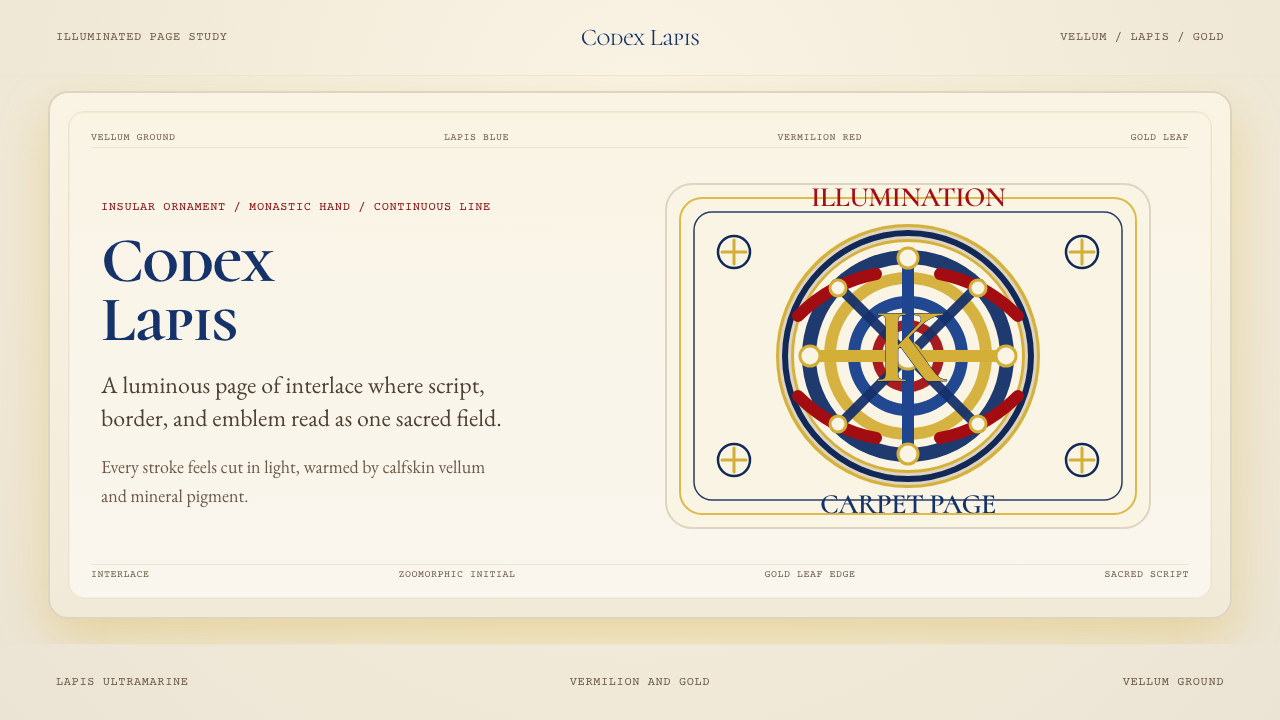 Book of Kells Celtic (800)Sacred and precise. Vellum cream, lapis, vermilion, and gold knotwork.
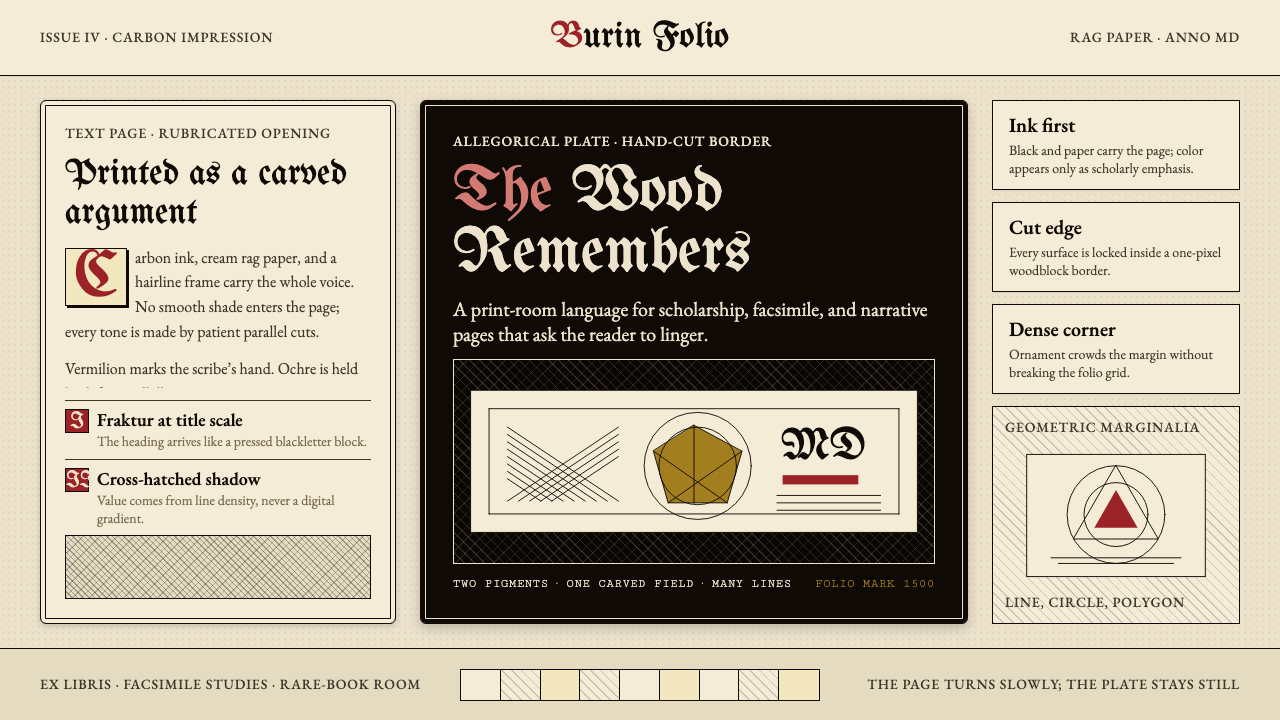 Dürer WoodcutInk remembers everything. Fraktur titles, rag-paper cream, and cross-hatched…
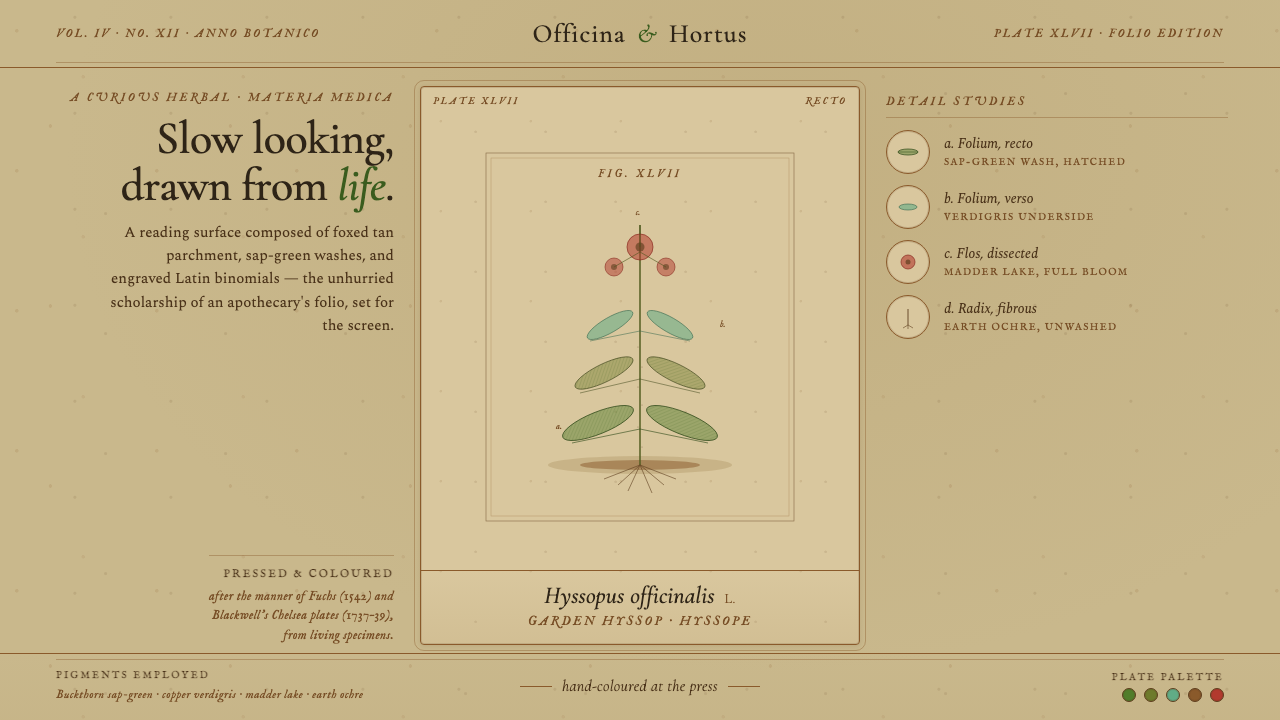 Herbal PharmacopoeiaSlow scholarship of the apothecary folio. Foxed tan parchment, sap-green wash…
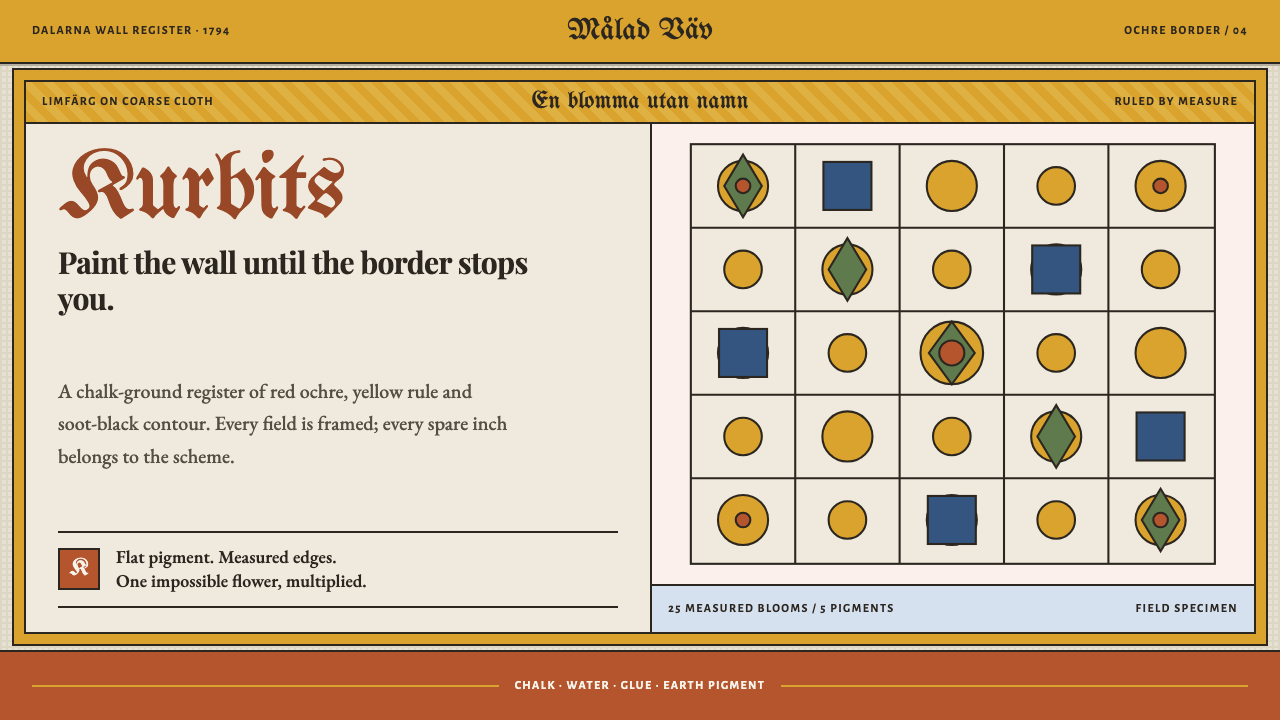 Kurbits Dalarna PaintingNo blank wall survives. Red ochre blooms crowd a chalk ground inside measured…
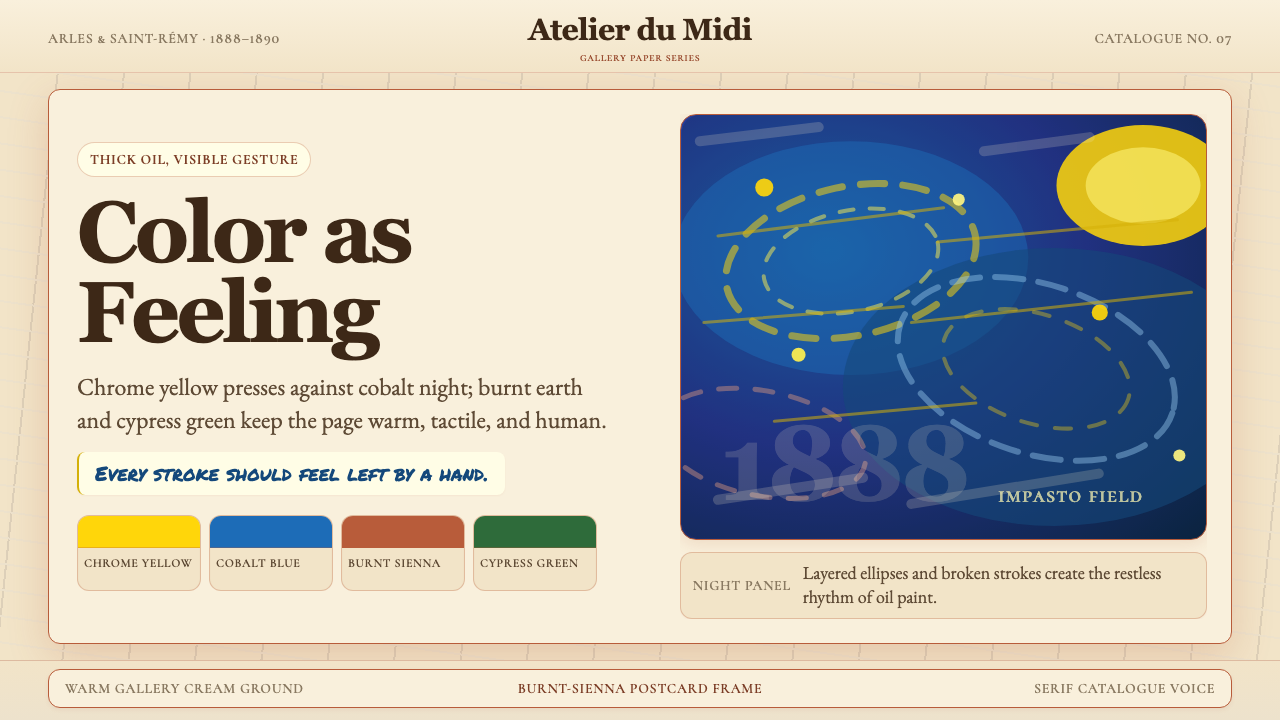 Van Gogh Post-ImpressionistFeeling made visible. Chrome yellow meets cobalt swirls on warm gallery cream.
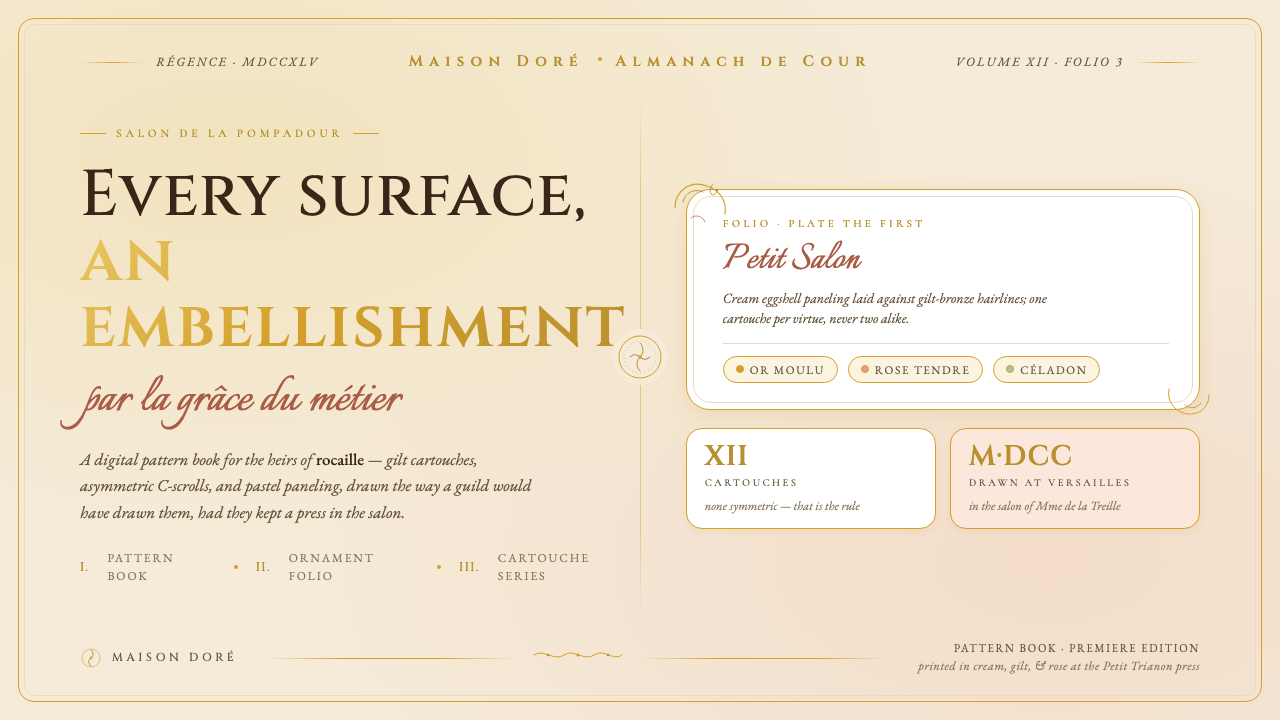 Versailles Rococo OrnamentEvery surface earns an embellishment. Cream paneling, ormolu gilt hairlines,…