What is Dürer Woodcut?
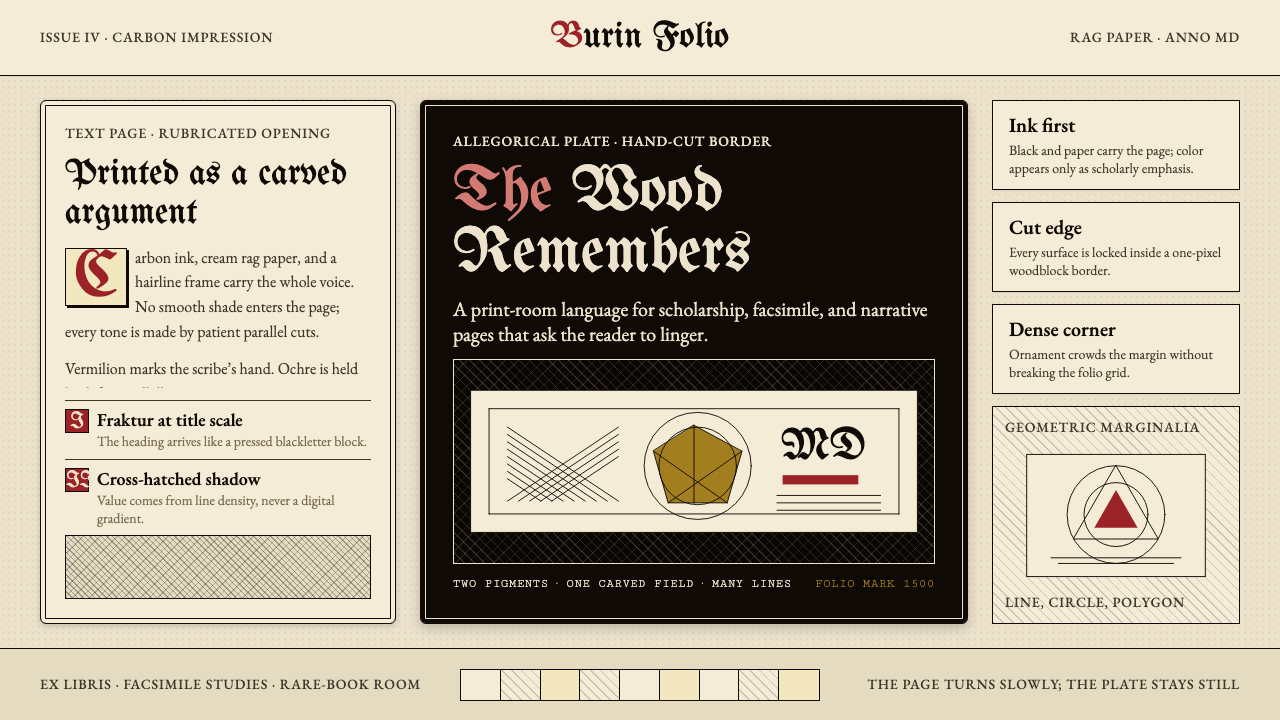
Dürer proved that two pigments — carbon black and cream rag paper — could hold more tonal complexity than an entire painter's palette, one cross-hatched line at a time.
Dürer Woodcut in brief
The Dürer Woodcut design system draws on the visual grammar Albrecht Dürer perfected in Nuremberg between roughly 1498 and 1514 — a body of work that includes the Apocalypse series, the Meisterstiche triptych of Knight, Death and the Devil, Melencolia I, and Saint Jerome in His Study. Its defining feature is not a colour palette in the conventional sense but a tonal architecture built entirely from ruled parallel lines and their intersections. Where lines run close together and cross at steep angles, the surface reads as near-black; where they thin and diverge, the paper itself becomes the light.
At its core, this is a two-pigment system: carbon-black ink and the warm cream of unsized rag paper do virtually all the tonal work. A third pigment — a warm vermilion — enters as rubrication, the tradition of marking chapter headings or opening initials in red inherited from medieval manuscript practice. A fourth, a rich gold-ochre, was used in illuminated editions for halos and decorative borders. The discipline of those four is absolute: no intermediate mixing, no gradient wash, no atmospheric blending. Every tone is constructed, not painted.
Typography in Dürer's printed books follows the same principle of absolute fidelity to craft tradition. Headings are set in Schwabacher Fraktur, the dominant German blackletter of the late fifteenth century, with its angular compressed forms and distinctive branching strokes. Running text may use a rounder Textura or Roman depending on the print shop, but the hierarchy is always clear: blackletter marks the sacred or authoritative, lighter roman marks the explanatory or supplemental. Borders, decorative initials, and allegorical marginalia crowd every available corner — not as ornament for its own sake but as a dense symbolic apparatus in which compass, polyhedron, hourglass, and skull each carry precise iconographic meaning.

Where does Dürer Woodcut come from?
Albrecht Dürer was born in Nuremberg in 1471, the son of a goldsmith — a background that gave him early fluency in the close observation of materials and the production of fine objects by hand. His initial apprenticeship under the painter Michael Wolgemut (1486–1489) exposed him to the commercial woodcut workshops of late-medieval Germany, where images were conceived as flat, schematic, and adapted to the technical limits of a knife on end-grain wood. What Dürer recognized — and then systematically dismantled — was that those limits were conventional, not physical. A knife guided with sufficient patience and skill could produce lines as fine as any engraver's burin.
His two journeys to Venice were decisive. The first, in 1494–1495, brought him into contact with the work of Andrea Mantegna and Giovanni Bellini, who were demonstrating how the Italian Renaissance's interest in classical proportion, perspective, and naturalistic anatomy could be deployed in print. The second sojourn, 1505–1507, deepened his understanding of the Venetian colorists and further refined his sense of tonal modulation — how light falls across a surface, how a curved plane recedes. He returned to Nuremberg each time not to imitate Italian models but to synthesize them with the northern Gothic tradition, producing a visual language that was rigorously mathematical in its spatial construction and deeply symbolic in its iconographic content.
The 1498 Apocalypse — fifteen large woodcuts illustrating the Book of Revelation, published by Dürer himself at the age of twenty-six — announced his mature ambitions to all of Europe. The Four Horsemen alone demonstrated a density of cross-hatching, a dynamism of composition, and a control of scale and foreshortening that had never been achieved in the woodcut medium. European printmakers, collectors, and humanist scholars immediately recognized that something categorically different had occurred. The series made Dürer famous across the continent and was pirated within a year.
The Meisterstiche of 1513–1514 — Knight, Death and the Devil; Melencolia I; and Saint Jerome in His Study — represent the summit of his engraved and woodcut work, though they are technically copper engravings, not woodcuts. The distinction matters for understanding Dürer's design vocabulary: by this point his cross-hatching technique had become so refined that the visual language of woodcut and engraving had converged. Both media shared the same commitment to line, the same construction of tone from density and direction, and the same allegorical density. The printer and publisher Anton Koberger, Dürer's godfather and one of the most significant figures in the early European printed-book trade, shaped the commercial and typographic context in which Dürer's images circulated.
What defines the Dürer Woodcut look?
Tonal Architecture via Line
No gradient, no wash, no airbrush: every tone in the Dürer system is produced by the direction, density, and crossing angle of ruled lines. Where lines are widely spaced and parallel, the surface is near-white — paper showing through. Where they converge and cross repeatedly at oblique angles, the surface reads as near-black. Midtones are built by carefully varying both the spacing and the degree of intersection. This means every shadow, every modeled surface, every passage of depth is a deliberate act of construction rather than an atmospheric effect.
Two-Pigment Palette with Reserved Accents
The operative palette is carbon-black ink against cream rag paper — two pigments doing the full tonal range. Vermilion red appears only as rubrication: a tradition borrowed from illuminated manuscripts in which a contrasting pigment marks the opening of a new section, a dedication, or a significant proper name. Gold-ochre is even more restricted, appearing in illuminated or deluxe editions for halos, decorative initials, and border embellishments. These accent colors are structural signals, not decorative choices. Using them freely dilutes their meaning.
Blackletter Typography
Headings and titling text adopt the Fraktur or Schwabacher blackletter tradition — angular compressed letterforms with high stroke contrast, characteristic branching ascenders, and diamond-shaped terminals. This is not stylistic nostalgia but historical accuracy: Fraktur was the dominant text face in German-speaking print culture from the late fifteenth century through the early twentieth. The visual weight of blackletter headings anchors the page in the same way a bold ruled border does, providing a firm chromatic mass against which lighter roman or italic body text can be read with ease.
Allegorical Density
Dürer's images are never decoratively empty. Every corner is occupied, every object present for a reason: the compass and polyhedron in Melencolia I connote mathematical inquiry and creative frustration; the skull in Saint Jerome's study connotes memento mori; the hourglass marks the passage of finite time. In design terms, this principle translates to a refusal of arbitrary decorative fill and a preference for elements that carry genuine semantic weight — icons that mean something specific, borders that frame a specific argument, marginalia that extend a specific idea.
Hard Edges and Woodcut Line Quality
Every contour in a Dürer woodcut is a decisive cut — the knife either removed the wood or it did not, producing edges with no intermediate state. In contemporary applications, this translates to borders, dividers, and frames that are sharp, ruled, and unambiguous. Soft-edged glows, drop shadows with heavy blur, and anti-aliased feathering are all inconsistent with this visual logic. Where a shadow exists, it is defined by a second hard-edged shape offset from the first. The aesthetic comfort of softness is explicitly refused.
Structured Symmetry with Dense Marginalia
Unlike the dynamic asymmetry of Bauhaus or the radical diagonal compositions of the Russian avant-garde, Dürer's page architecture tends toward a formal, near-bilateral symmetry — a centered composition with the principal figure or text block as axis. This symmetry is, however, never simple: it is layered with dense marginalia, decorative borders, and subsidiary figures that complicate and enrich the central axis without undermining it. In design terms, this suggests a strong central hierarchy with permission for rich peripheral annotation — footnotes, captions, call-out boxes, and decorative rules that frame the primary content.
Historical Texture without Gimmickry
The most important discipline of this system is distinguishing genuine structural principles from surface historicism. The cream paper tone, the cross-hatch shading, the Fraktur heading, and the hard rule border are not vintage filters or rough-texture overlays applied to otherwise modern design. They are the load-bearing elements of a coherent visual language. Applied superficially — as a patina over an unrelated contemporary layout — they read as costume. Applied structurally — as the organizing principle of spacing, hierarchy, and emphasis — they produce work of genuine authority.

Who shaped Dürer Woodcut?
Dürer (1471–1528) is the central figure and originating intelligence of the entire system. Born in Nuremberg to a goldsmith father, trained by the painter Michael Wolgemut, and transformed by two journeys to Venice, he synthesized the Italian Renaissance's command of space and proportion with the northern Gothic tradition's symbolic density and craft precision. His most celebrated works — the 1498 Apocalypse, the 1513–1514 Meisterstiche — set new technical and conceptual standards for European printmaking and were immediately recognized as such by contemporaries across the continent. He also wrote the first theoretical treatises on geometry and proportion published in Germany, grounding his practice in mathematics as rigorously as in craft.
Koberger (c. 1445–1513) was Dürer's godfather and the most powerful printer-publisher in late-fifteenth-century Germany. His Nuremberg printing house at its peak operated twenty-four presses and employed over one hundred workers, distributing books across Europe through a network of agents that prefigured modern publishing distribution. He was the publisher of Dürer's 1498 Apocalypse and shaped the material and typographic context in which Dürer's woodcuts reached their first audiences — the layout of the page, the choice of typeface, the quality of paper, and the binding. Understanding Koberger is understanding that Dürer's visual system was from its origin a designed communication object, not merely a fine-art print.
Baldung (c. 1484–1545) was Dürer's most gifted and longest-serving workshop apprentice, and the figure who most directly carried the Dürer woodcut vocabulary into the next generation of German printmaking. He worked in Dürer's Nuremberg studio from around 1503 to 1507 before establishing his own workshop in Strasbourg. His independent woodcuts — particularly his nocturnal witch scenes and his series on death — are immediately recognizable as Dürerian in their cross-hatch density and allegorical apparatus, while pushing toward a more expressive, psychologically intense register. Baldung demonstrates how a design system can be transmitted faithfully and then stretched to new emotional territory without losing structural coherence.
Holbein (c. 1497–1543) represents the broader diffusion of the German woodcut tradition into humanist book production across Northern Europe. His woodcut series for the Dance of Death — designed in Basel in the early 1520s — demonstrates how the Dürerian visual vocabulary could be adapted to smaller formats, tighter narrative sequence, and a more ironic, socially critical register. As court painter to Henry VIII and a prolific designer of title pages, decorated borders, and printer's marks, Holbein also extended the system into a recognizably modern context of branded publishing identity — the consistent visual framing that made a publisher's output recognizable across many titles.
How do you use Dürer Woodcut today?
The Dürer Woodcut system is most naturally suited to contexts where authority, historical depth, and textual seriousness are the desired registers: scholarly publishing, museum and archival identity, long-form editorial layouts, premium book design, and any digital product that positions itself as a considered, deliberate, intellectually serious artifact. It is emphatically not a neutral or friendly style — it carries the weight of five centuries of European learned culture and announces that weight immediately.
For presentation slides, the system works best when the content itself has density and argumentative structure. A cover page in this mode should be treated as a title page from a Nuremberg printed book: a central title in weighted blackletter against a cream field, with a decorative ruled border framing the entire composition, and a secondary line of roman text below carrying the subtitle or author attribution. Content slides should resist the temptation to lighten or modernize: one strong vertical or horizontal axis, text in a single well-spaced typeface at two or three sizes, and any data visualization treated as a diagram rather than a chart — ruled axes, hatched fills, no color graduation.
For web interfaces and dashboards, the system pairs well with content-heavy reading environments: long-form articles, research portals, archival databases, and documentation sites. Navigation should be typographic and hierarchical, using scale and weight rather than color to signal structure. Cards and content blocks benefit from explicit ruled borders rather than soft shadows. Background color should remain in the warm cream register; interactive states can introduce a restrained vermilion accent for links and primary calls to action. Dashboard data displays work well when chart elements — bars, areas, lines — are rendered with a hatched or cross-hatched fill rather than a solid color, preserving the constructed-from-line quality that defines the system.
For editorial and marketing work, this system rewards patience with its emphasis. A long-form article layout is where it is most fully itself: a centered text column, generous margins populated with call-out quotes set in a slightly larger size and weight, section breaks marked by a short horizontal rule, and footnotes or endnotes occupying a clearly delineated zone at the bottom of the page. Pull quotes can carry a rubricated initial — the first letter rendered in vermilion — to signal importance without disrupting the tonal architecture. Marketing materials work best when they commit to the poster-like qualities of the system: one dominant image rendered in high contrast with strong hatching, a title in blackletter, and a minimum of supporting text.
The most common mistake when applying this system is to use it as a texture overlay — adding a paper-grain filter, a distressed border, or a vintage color grade to an otherwise unrelated contemporary design and calling the result Dürer-inflected. This produces costume, not design. The second common mistake is treating the blackletter heading as the entirety of the system and pairing it with modern flat colors, soft UI conventions, and gradient backgrounds. Blackletter in isolation is a stylistic quotation; to function as a design system, it must be accompanied by the full structural logic — the hard edges, the constructed shadows, the restrained two-pigment palette, the allegorical density of the imagery. Applied as a complete system rather than a surface effect, the Dürer Woodcut vocabulary is among the most legible and authoritative historical styles available to contemporary designers.

Dürer Woodcut — FAQ
Is this style only appropriate for historical or academic subjects?
Not at all, though the style does carry inherent historical gravity and should be chosen deliberately. It works for any subject where intellectual seriousness, craft precision, and a sense of considered depth are desirable attributes. Technology companies with strong research identities, independent publishers, luxury goods with artisanal positioning, financial institutions emphasizing stability and tradition — these all represent contexts where the Dürer vocabulary can be applied without irony and without requiring the subject matter to be historical. The key question is whether the brand or product wants to signal the values the style encodes: patience, precision, and density.
How do I handle color in a digital interface when the palette is essentially two pigments?
The two-pigment constraint is more generative than it first appears. The cream-and-black relationship produces a full tonal range through the constructed shading system, meaning you have more tonal variation available than a typical flat-color interface. Vermilion red enters as an interaction color — links, primary buttons, active states — and must be used with the same discipline as manuscript rubrication: only for things genuinely important enough to mark in red. Gold-ochre can serve for secondary accents, icon fills, or decorative border elements where a warm metallic quality is appropriate. Beyond these four, the palette should not expand. Adding a fifth or sixth color breaks the logic of the system.
Can the system work in a dark mode or dark-background variant?
A dark inversion is possible but requires structural rethinking rather than simple color reversal. Swapping black to white and cream to dark does not produce a Dürerian dark mode — it produces a negative image. In the historic source material, the dark passages were always constructed from dense line on a light ground; inverting this makes the light passages the constructed elements, which is the opposite of the system's logic. A more faithful dark variant treats the dark ground as an uncut wood surface and renders all light passages as the constructed, active element — which in practice means lighter lines on a dark ground rather than the usual convention of dark text on light. This is technically and aesthetically demanding, and for most projects a light-ground variant is strongly preferable.
What is the difference between applying this system and simply using a vintage or medieval aesthetic?
The difference is structural versus cosmetic. A vintage aesthetic typically works by applying visual markers of age — rough textures, distressed type, sepia tones, irregular borders — as surface effects on an otherwise contemporary design. The Dürer system, by contrast, is a set of compositional and tonal principles: construct tone from line, restrict the palette to two pigments plus two reserved accents, use typographic hierarchy to signal authority, frame content with explicit borders, populate every significant space with semantically loaded elements. These principles can be applied to entirely contemporary content and produce work that reads as authoritative and precise rather than nostalgic. The test is whether removing the 'vintage' textures would expose a generic layout underneath — if so, it is costume, not system.
How should imagery and illustration be handled in this system?
Photographic imagery should be converted to high-contrast treatments — not merely desaturated, but genuinely restructured so that tonal gradients are replaced by zones of near-black and near-white, as though the photograph were being re-rendered as a woodcut. This is distinct from a simple duotone or halftone treatment, which preserves the photographic gradient logic. Illustration, if used, should be built from visible linework: hatching, cross-hatching, stippling — the same vocabulary of constructed tone that defines the typographic and decorative elements. Vector illustrations with flat color fills are inconsistent with the system. The goal is that imagery and type feel as though they came from the same hand, the same tool, the same commitment to line as the primary means of meaning-making.
Related design styles
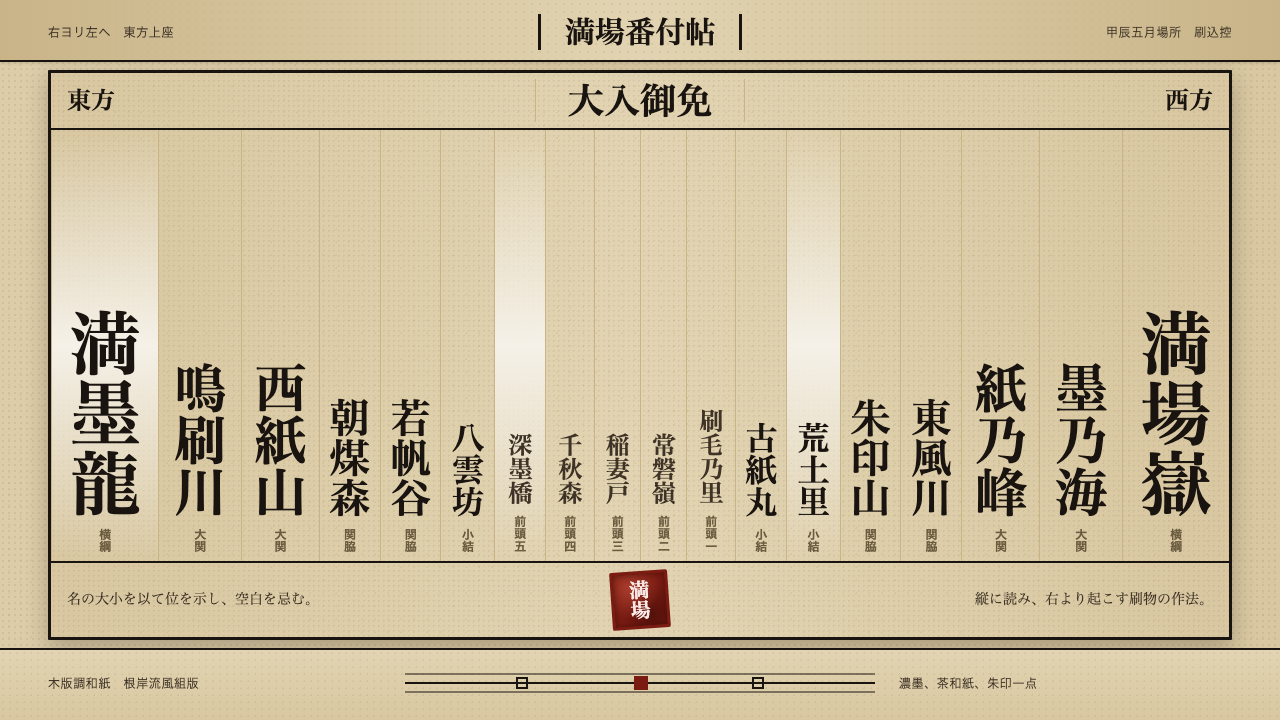 Sumo BanzukeCeremonial density. Sumi columns crowd tan washi; rank-scaled type meets one…
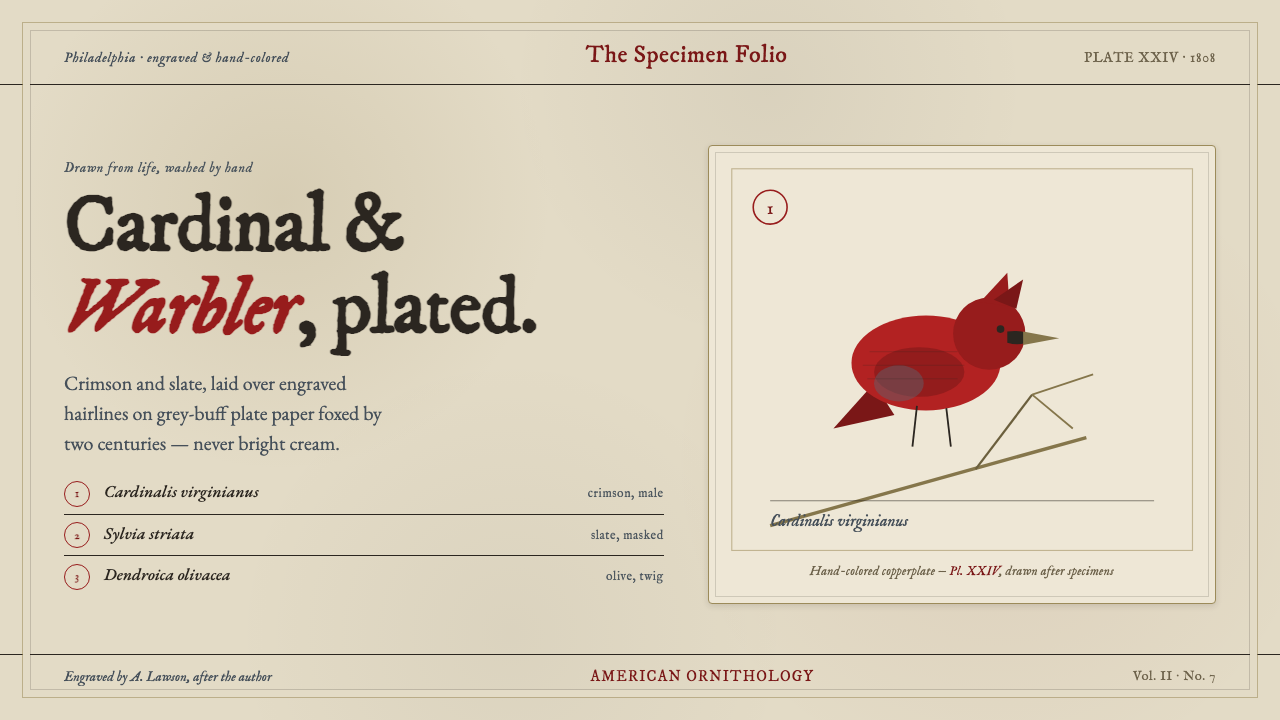 Wilson Ornithology PlateAn 1808 ornithology plate reborn. Cardinal crimson and slate, washed over eng…
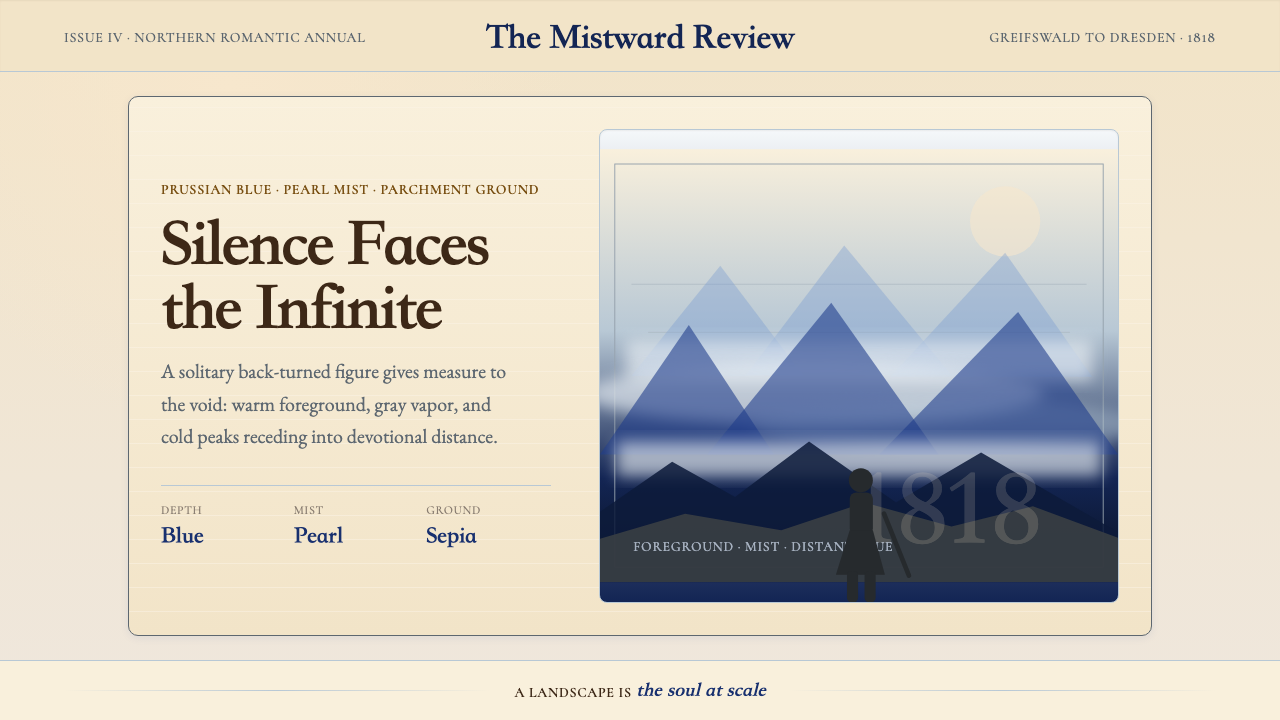 Caspar David FriedrichSilence becomes vast. Prussian blue depth, pearl mist, and parchment framing…
 Charcoal & Conté DrawingAtelier calm, in middle value. Gray-taupe tooth, smoky charcoal, and chalk-wh…
 Claude Monet ImpressionistLight becomes the subject. Buttercream, pastel dapples, and Cormorant serif s…
 Degas Ballet PastelsBackstage glamour is labor. Jade walls, rose footlights, cropped serifs on cr…