What is Van Gogh Post-Impressionist?
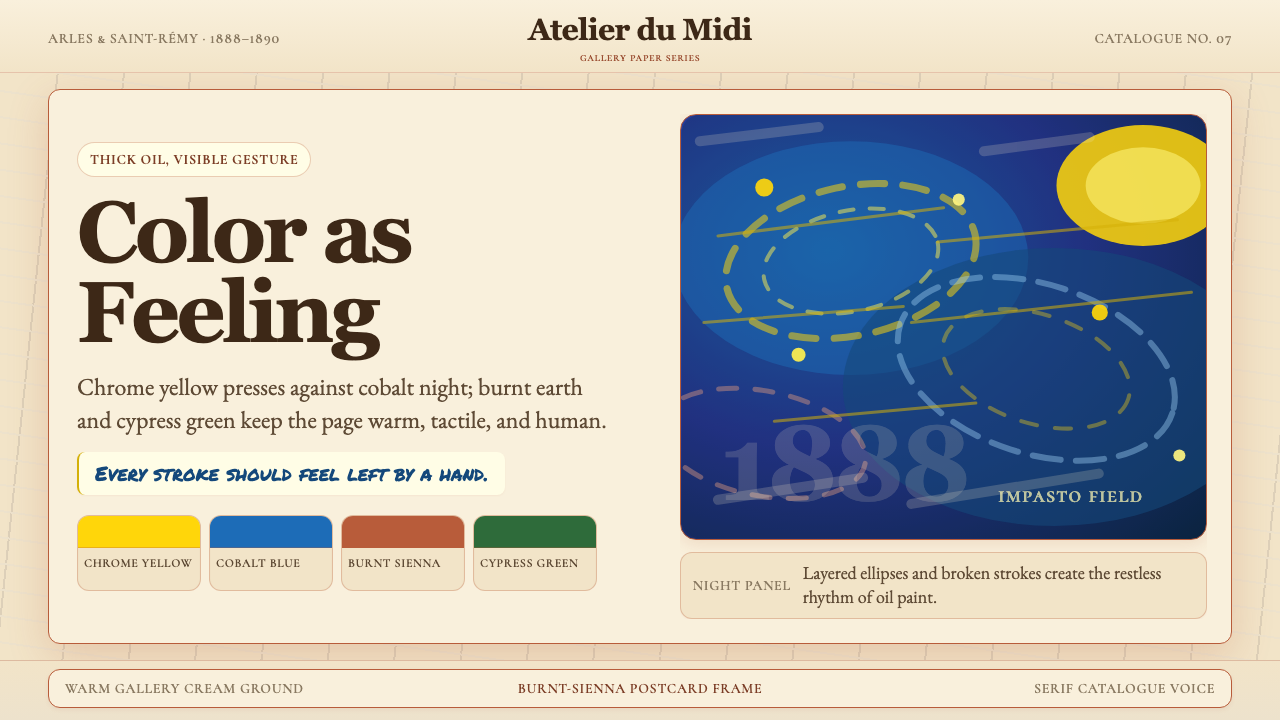
Van Gogh turned visible brushwork into emotional language — swirling impasto, sun-scorched yellow, and cobalt blue that vibrates with feeling rather than merely describing a scene.
Van Gogh Post-Impressionist in brief
Van Gogh Post-Impressionist design is a visual system rooted in the paintings Vincent van Gogh produced during his most intensive period in southern France, from 1888 through 1890. The aesthetic is built on three inseparable elements: directional impasto brushwork rendered as swirling, energetic marks rather than smooth fills; a palette drawn from the earth pigments and mineral colors available to a nineteenth-century painter in Provence — chrome yellow, cobalt blue, burnt sienna, Prussian green, and warm gallery cream; and an emotional directness that treats every color and every stroke as a carrier of feeling rather than a neutral description of form.
The style belongs to Post-Impressionism, a broad current that moved beyond Impressionism's concern with light and momentary perception toward something more subjective and structural. Where Impressionism dissolved edges in atmosphere, Van Gogh reinforced them with contour lines borrowed from Japanese woodblock prints — a practice known as Japonisme that was fashionable among Paris avant-garde circles in the 1880s. The result is a world in which objects are simultaneously described and interpreted: a cypress tree is not just recorded but felt, its shape torqued into a flame-like upward spiral, its green deepened almost to black to express a kind of brooding vitality.
As a contemporary design language, Van Gogh Post-Impressionism offers warmth, tactility, and expressive richness that cool, geometric modernist styles cannot provide. Surfaces carry the quality of gallery-paper grain and hand-applied pigment. Compositions favor organic movement over rigid grid alignment. Typography draws from the serif traditions of nineteenth-century French printing — letterforms with a classical weight and warmth rather than the neutral efficiency of sans-serif geometry. Applied with fidelity to its source, this aesthetic reads as both historically grounded and viscerally alive.

Where does Van Gogh Post-Impressionist come from?
Vincent van Gogh arrived in Arles in February 1888, having left the grey skies of Paris for what he hoped would be a revelatory encounter with southern light. He was thirty-four years old, had been painting seriously for only about seven years, and was in the grip of an ambition so intense it alarmed even his closest friends. In Arles he rented a portion of the Yellow House on the Place Lamartine and began painting at a rate that was, by any measure, extraordinary: in the fifteen months before his voluntary admission to the Saint-Paul-de-Mausole asylum in Saint-Rémy in May 1889, he produced approximately two hundred paintings and as many drawings.
The Arles period was shaped by two converging influences. The first was Japonisme — Van Gogh had spent years collecting and studying Japanese ukiyo-e woodblock prints in Paris, absorbing their use of bold, flat color areas, thick contour lines, asymmetric composition, and the treatment of natural motifs such as blossoms, water, and horizon lines as abstract decorative elements. These principles gave him a structural logic to organize the intensely saturated color he was experiencing under the Provençal sun. The second influence was Paul Gauguin, whom Van Gogh persuaded to join him in Arles in October 1888 for what he envisioned as an artists' commune. Gauguin pushed toward more memory-based, symbolic composition rather than direct observation; the creative friction between them — which ended catastrophically in December 1888 — deepened Van Gogh's engagement with expressive distortion as a deliberate technique.
The move to the Saint-Paul-de-Mausole asylum at Saint-Rémy in May 1889 did not diminish Van Gogh's output; if anything, it intensified and focused it. The asylum's walled garden, the surrounding wheat fields, olive groves, and the view of the Alpilles mountains visible from his window became obsessive subjects. The Starry Night — now the most recognized painting in the world — was produced here in June 1889. The spiraling, turbulent sky is often read as a projection of Van Gogh's psychological state, but it also represents a fully realized formal solution: the sky becomes a field of directional brushwork that models movement and energy as confidently as any academic painter modeled solid form. His brother Theo's wife, Jo van Gogh-Bonger, who inherited the bulk of the paintings and letters after both men died in 1890 and 1891 respectively, was instrumental in the posthumous construction of Van Gogh's reputation, arranging exhibitions across Europe that established his canonical status by the early twentieth century.
Post-Impressionism as a movement was named retrospectively by the British art critic Roger Fry in 1910, when he organized the landmark exhibition 'Manet and the Post-Impressionists' in London. Fry used the term to group painters who had begun from Impressionism but moved toward more structured, symbolic, or expressive ends — including Van Gogh, Paul Gauguin, Paul Cézanne, and Georges Seurat. The movements and practices that fed Van Gogh's specific approach included: Impressionism, which gave him the liberation to work from direct observation and use color freely; Japonisme, which gave him compositional structure; Provençal plein-air painting, which kept him tethered to observed landscape even as he distorted it; and a deeply personal theology of labor and empathy rooted in his years as a lay preacher in the Borinage coal district of Belgium during the early 1880s. The earthen, raw quality of his earliest Dutch work — The Potato Eaters of 1885, with its dark, almost monochromatic palette — can be read as the foundation from which the Arles explosion of color becomes all the more dramatic.
What defines the Van Gogh Post-Impressionist look?
Impasto Brushwork
The defining mark of Van Gogh's mature style is paint applied in thick, directional ridges that remain visible on the surface — never smoothed into a seamless finish. Each stroke has a purpose and a direction: parallel marks follow the contour of a form, concentric swirls animate a sky or a field, short staccato dabs describe a flower's petals or a blade of grass. In a design context, this translates to textures and surface treatments that suggest hand-applied materiality — grain, directionality, and the deliberate imperfection of a mark made by a human hand rather than a mechanical process.
Earth-Pigment and Mineral Color
Van Gogh's palette was constrained by what was available — and affordable — to a nineteenth-century painter working in southern France. Chrome yellow (brilliant, almost acidic, slightly warm), cobalt blue (deep, cool, luminous), burnt sienna (a reddish-brown earth), Prussian green (dark, almost resinous), and the warm cream of unpainted linen: these are the foundational colors. The palette is not subtle in the contemporary muted-tone sense — it is bold and saturated — but it is also grounded, because each color has an earthen or mineral quality that prevents it from reading as synthetic or flat.
Contour and Japanese Outline
One of Van Gogh's most distinctive structural moves — absorbed from his study of Japanese ukiyo-e prints — is the use of a dark, definitive contour line to bound forms and separate color areas. This line is not the academic outline of Western drawing tradition, which describes the edge of a three-dimensional form viewed in perspective; it is more like a calligraphic boundary that gives each element its own visual territory. In design, this translates to the use of expressive border strokes, outlined type, or illustrated elements where the edge itself is as communicative as the filled area it encloses.
Warm Ground and Gallery Texture
Van Gogh often began on an unprepared or minimally primed linen canvas, and the warm, slightly textured ground shows through his paint layers, contributing to the overall warmth and organic quality of the finished work. In design, this translates to backgrounds that are not cold white or neutral grey but rather a warm, slightly off-white or creamy tone with a subtle papery or fibrous grain. This quality of surface distinguishes the Van Gogh aesthetic from both the clinical white of contemporary minimalism and the stark black of maximalist dark-mode design.
Emotional Color Correspondence
Van Gogh wrote extensively about the emotional and symbolic meanings he assigned to specific colors — a practice described in his letters to Theo with unusual precision. Yellow signified the sun, warmth, life, and divine energy; blue represented infinity, depth, and spiritual calm; green carried the vitality and sometimes the melancholy of growing things. These are not arbitrary assignments but a consistent symbolic system that gives Van Gogh's color choices a legibility beyond pure aesthetics. A design rooted in this palette can use these color correspondences intentionally: warm yellows for energy and welcome, deep blues for contemplation and trust, earthy greens for nature and growth.
Organic Dynamism over Geometric Order
Where Bauhaus and Swiss International Style impose the logic of the ruled grid, Van Gogh's visual language follows the logic of observed nature — spirals, undulations, radial patterns, and the irregular rhythms of living forms. Compositions tilt and lean; horizons are rarely centered; foregrounds push forward with exaggerated foreshortening. In design, this means layouts that use diagonal emphasis, curved text paths, asymmetric cropping, and illustrated or textured elements that resist alignment to a strict mathematical grid. The goal is visual energy and aliveness rather than rational clarity.
Nineteenth-Century Serif Warmth
Van Gogh worked in a world shaped by nineteenth-century French printing — the era of classical transitional and old-style serif typefaces, of letterpress printing with its slight impression into the paper, of handwritten correspondence in ink on cream stock. Typography in the Van Gogh style draws from this tradition: letterforms with visible contrast between thick and thin strokes, bracketed serifs, and a warmth that recalls hand-set metal type. The effect is intimate and literary rather than technological or corporate, and pairs naturally with the handmade quality of the surrounding visual elements.

Who shaped Van Gogh Post-Impressionist?
Van Gogh (1853–1890) was a Dutch painter who spent his formative years as a lay preacher and art dealer before turning to painting seriously in 1881. His transformation from the dark, empathic realism of his Dutch period to the incandescent color and expressive brushwork of his Arles and Saint-Rémy years is one of the most dramatic in art history. In the last two years of his life he produced the works — Sunflowers, The Night Café, Bedroom in Arles, The Starry Night, Wheat Field with Crows — that now define the entire aesthetic. He died in July 1890, largely unrecognized commercially, having sold only one painting during his lifetime.
Theo van Gogh (1857–1891), Vincent's younger brother and a successful art dealer at the Paris gallery Boussod, Valadon & Cie, was the financial and emotional foundation of Vincent's entire career. He sent a monthly stipend that allowed Vincent to work without commercial pressure, corresponded with him almost daily, and championed Impressionist and Post-Impressionist painters at a time when the Paris market was only beginning to accept them. The 820 surviving letters between the brothers constitute an extraordinary document of artistic thought and brotherly love, and they remain the primary textual source for understanding Van Gogh's intentions and methods.
Jo van Gogh-Bonger (1862–1925) married Theo van Gogh in 1889 and, after his death in January 1891 — just six months after Vincent's — found herself in possession of an enormous collection of paintings, drawings, and letters that the art world had not yet recognized. Over the following decades, she systematically arranged loans and exhibitions across Europe, published a selection of the letters (first in Dutch, then in German translation, then in English), and negotiated sales and gifts to major museums. Without her sustained effort, the Van Gogh canon as we know it — the specific body of works that defines the aesthetic — might never have been assembled into the coherent public legacy it became.
Paul Gauguin (1848–1903) spent nine turbulent weeks in Arles with Van Gogh from October to December 1888, a collaboration that produced some of the most closely analyzed works in either artist's career. Gauguin's approach — working from memory and imagination, using flat color areas bounded by heavy outlines in a style he called Synthetism — pushed Van Gogh toward greater compositional boldness and symbolic use of color, even as their temperamental differences created constant friction. The episode ended with Van Gogh's famous breakdown in late December 1888. Despite the personal catastrophe, the encounter marks a genuine artistic watershed: after Gauguin's departure, Van Gogh's style became decisively more expressive and less observationally constrained.
Roger Fry (1866–1934) was the British art critic and painter who coined the term Post-Impressionism in 1910 for his landmark exhibition in London. He was not himself a painter in the Van Gogh tradition, but his critical framework — which argued that these painters were engaged in a formal and emotional investigation of painting's own means rather than a representation of the external world — gave the movement an intellectual legitimacy that accelerated its acceptance by collectors and institutions. Fry's grouping of Van Gogh with Cézanne, Gauguin, and Seurat under one rubric created the critical vocabulary through which Van Gogh's specific contribution — the emotive use of brushwork and color — could be discussed, compared, and eventually systematized into the design language we work with today.
How do you use Van Gogh Post-Impressionist today?
Van Gogh Post-Impressionist design is best understood as an expressive warmth system — it performs most effectively when the goal is to communicate vitality, emotional authenticity, or artistic prestige, and when the context allows for visual richness rather than demanding neutral austerity. Applying it correctly requires understanding that the style's power comes from specific tensions: saturated color held in check by earthy grounding, organic dynamism balanced against legible hierarchy, and tactile warmth coexisting with intentional compositional structure.
For presentation slides, the style works on both cover and content pages but in different registers. A cover page benefits from the full force of the palette: a warm cream ground, a boldly painted illustration or typographic element in chrome yellow or cobalt blue, and a title set in a warm serif with generous weight. The composition should be asymmetric and slightly tilted toward the organic — a brushwork texture field behind the title, a painted border that thickens and thins like a hand-drawn mark. Content slides should pull back from this richness and use it as a structural accent: a warm ground color, clean serif body text, and color reserved for callout blocks, section markers, or data emphasis. Data visualization slides benefit from treating chart elements as painted objects — bars with a slightly brushed edge, color fills that correspond to the warm earth palette rather than clinical primaries.
For web interfaces, the style is best suited to brand-forward contexts where emotional resonance matters more than information density: a portfolio landing page, an artist collective's homepage, a cultural institution's event site, a premium editorial publication, or a product that positions itself as handcrafted or artisanal. Dashboard and productivity applications generally do not suit the style — the expressivity that makes a landing page memorable becomes visual noise when a user needs to scan data quickly. On the web, use the warm cream as the background, limit the palette to one dominant earth tone plus the cobalt or yellow as a single accent, and apply brushwork textures as subtle surface treatments rather than aggressive foreground elements. Navigation and interactive components should retain sufficient contrast and clarity to remain fully usable.
For editorial and marketing work, the Van Gogh style excels at cover design, poster work, and feature article headers where a single image or typographic moment carries the full weight of the communication. A Bauhaus-derived layout organizes through geometry; a Van Gogh-derived layout organizes through composition and color flow — the reader's eye is guided by warm-to-cool color transitions and the directional energy of brushwork rather than by ruled lines and grid anchors. Marketing pages work well when the style's inherent warmth is aligned with the product's values: artisanal food, luxury travel, cultural subscriptions, or premium creative tools. A section that alternates between cream-on-deep-cobalt and warm-yellow-on-cream can carry the full expressive range of the palette without becoming visually unstable.
A common mistake when applying this style is over-texturing — adding grain, brushwork, and impasto effects to every element simultaneously, producing a visual field so busy that hierarchy collapses and reading becomes laborious. Van Gogh's own paintings are not uniformly textured: some areas are smoothly laid in, others built up with thick ridges, and the contrast between these is part of what makes the densely worked areas read as expressive emphasis rather than overall noise. Apply the same principle in design: choose which surfaces carry texture and which are comparatively quiet, and let the contrast do the compositional work. Similarly, resist the temptation to use the full palette simultaneously — one dominant color, one accent, and the warm ground will almost always produce a more coherent result than attempting to deploy chrome yellow, cobalt blue, and burnt sienna at equal weight.

Van Gogh Post-Impressionist — FAQ
Is Van Gogh style appropriate for professional or corporate design, or is it too artistic?
The style is well suited to professional contexts where artistic credibility, cultural prestige, or emotional warmth are genuine values — a museum's digital presence, a creative agency's brand identity, a luxury product's marketing materials, or a publishing platform positioning itself as editorially serious. It is poorly suited to contexts that require the appearance of neutral rationality: financial services dashboards, medical information systems, legal documents, or enterprise SaaS products where user trust depends on calm clarity rather than expressive warmth. The question to ask is not whether the style is 'too artistic' in the abstract, but whether expressivity serves or undermines the specific trust relationship between the product and its users.
How do I prevent a Van Gogh-inspired design from looking like a greeting card?
The greeting-card trap comes from reducing the style to its most superficial elements: sunflower motifs, cheerful yellow, and swirly backgrounds without compositional discipline. To avoid it, anchor the design in the aspects of Van Gogh's work that are less frequently popularized — the dark cobalt and resinous green, the intense psychological weight of his compressed compositions, the hard contour lines borrowed from Japanese printmaking, the earthy ground color rather than bright white. Treat the brushwork as structural rather than decorative: it should define the direction of the eye and the emotional register of the communication, not simply add a 'handmade' feel to an otherwise generic layout. When in doubt, push toward the dramatic and even somber aspects of the palette rather than the sunny ones.
Can this style work for dark-mode interfaces?
A dark-mode inversion of the Van Gogh palette is possible but requires significant restraint. The canonical warm cream ground is the style's emotional center; removing it shifts the mood from gallery warmth to something more nocturnal and dramatic — which can work deliberately for certain products (a nighttime reading app, a film platform, a late-night cultural publication) but will feel incongruous for others. On a dark ground, chrome yellow becomes the dominant visual force and must be used with care, as it will overpower cobalt and sienna at any comparable saturation. A successful dark-mode Van Gogh design tends to lean into the night-sky and cypress quality of the palette — the darker, more brooding colors that appear in works like The Starry Night and Café Terrace at Night — rather than transposing the full sunflower-yellow warmth of the Arles daytime paintings.
What is the difference between Post-Impressionism and Impressionism as design aesthetics?
Impressionism as a design aesthetic emphasizes soft edges, light-infused color fields, atmospheric diffusion, and the dissolution of hard boundaries — it tends toward the gentle, the luminous, and the momentary. Post-Impressionism in the Van Gogh mode does the opposite: edges are reinforced, colors are intensified and made more saturated, brushwork is made visible and directional rather than blended, and the emotional register is heightened rather than tranquil. Impressionist-inspired design feels like watercolor or soft light; Van Gogh Post-Impressionist design feels like oil paint applied by a forceful hand. In practice, Impressionist aesthetics suit delicate, atmospheric products — perfume, floristry, high-end hospitality — while the Van Gogh aesthetic suits products that want to communicate passion, artistic authenticity, and expressive force.
How much historical accuracy is required when applying this style, and when does it become pastiche?
Historical accuracy is not a requirement — the goal is to derive a living design language from the source, not to simulate the nineteenth century. The risk of pastiche arises not from deviation from historical accuracy but from superficiality: using the most recognizable surface elements (swirls, sunflowers, the specific impasto look) without engaging with the underlying structural and emotional logic. A design can use contemporary typefaces, digital production methods, and modern layout conventions and still be genuinely rooted in the Van Gogh aesthetic, provided it is operating from the same set of values — emotional directness, color as feeling, texture as materiality, organic composition over geometric order. Conversely, a design can use period-accurate visual references and still feel like a costume if those references are applied decoratively rather than structurally. The test is whether the style is doing real communicative work or merely adding atmosphere.
Related design styles
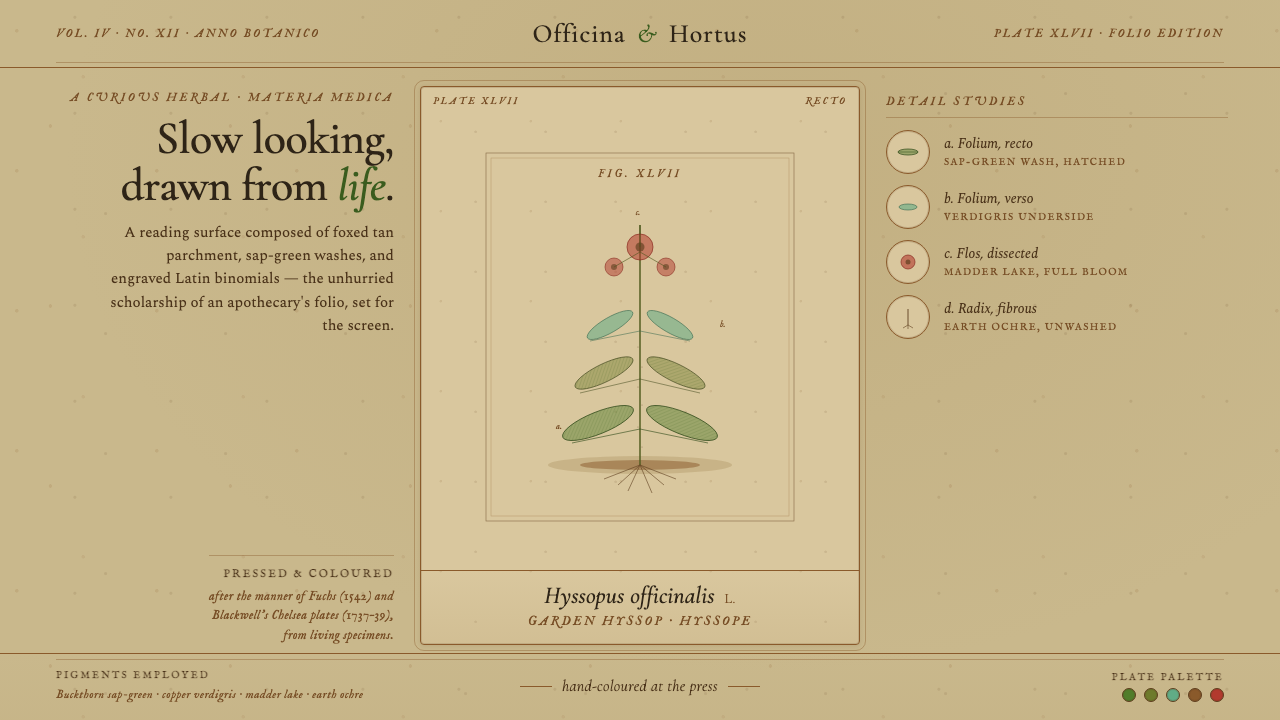 Herbal PharmacopoeiaSlow scholarship of the apothecary folio. Foxed tan parchment, sap-green wash…
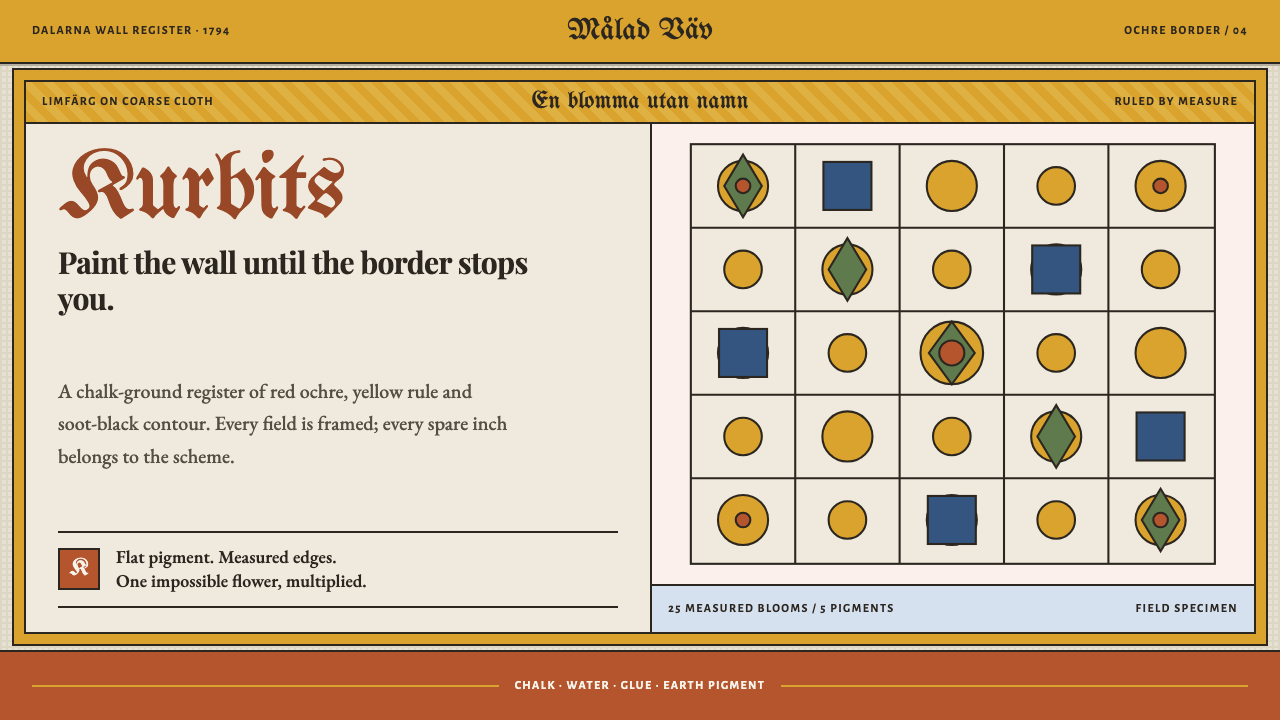 Kurbits Dalarna PaintingNo blank wall survives. Red ochre blooms crowd a chalk ground inside measured…
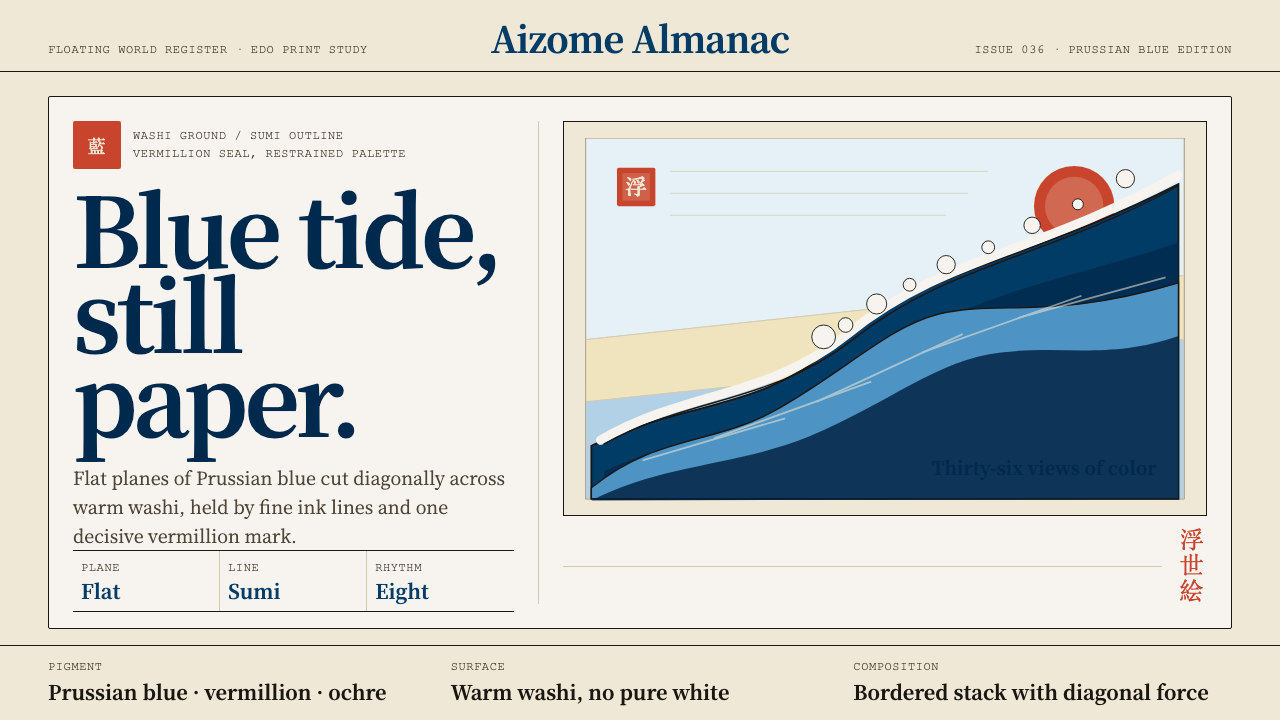 Edo Ukiyo-e (Hokusai)Flat power on paper. Prussian blue diagonals and vermillion seals cut across…
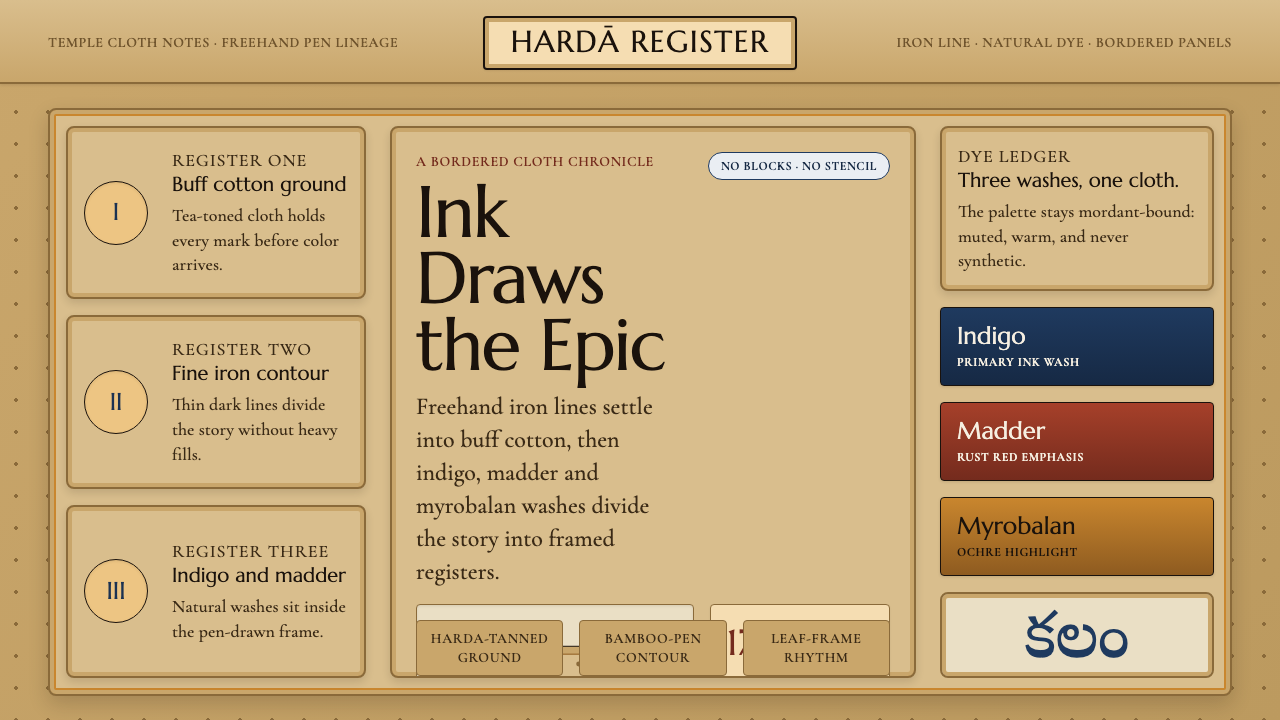 Srikalahasti Kalamkari Pen-WorkHand-drawn cloth storytelling. Buff tan ground, iron lines and indigo-rust pa…
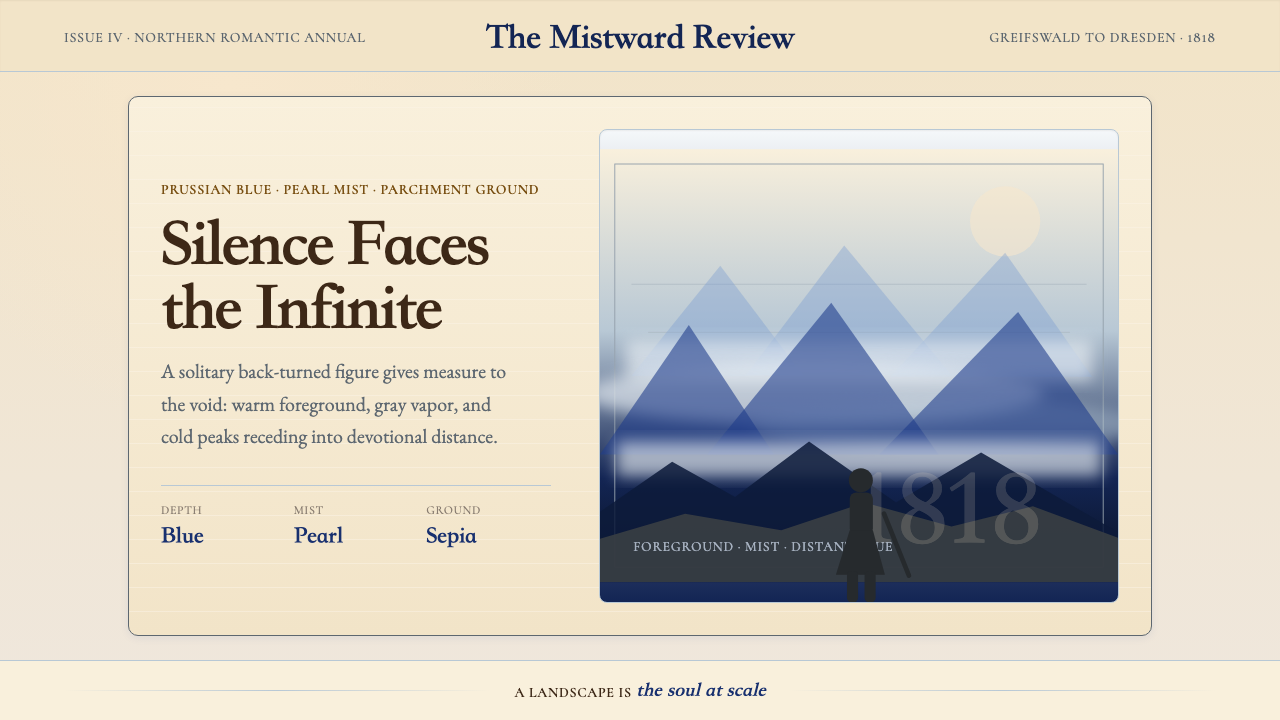 Caspar David FriedrichSilence becomes vast. Prussian blue depth, pearl mist, and parchment framing…
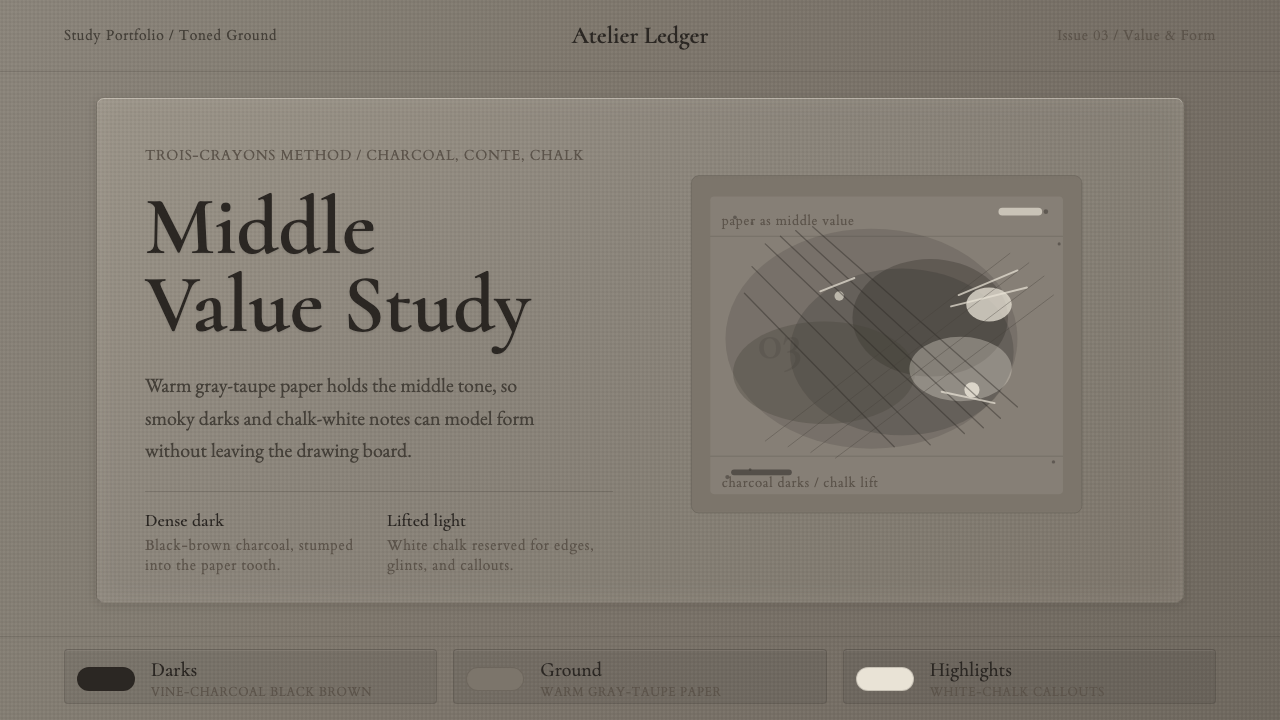 Charcoal & Conté DrawingAtelier calm, in middle value. Gray-taupe tooth, smoky charcoal, and chalk-wh…