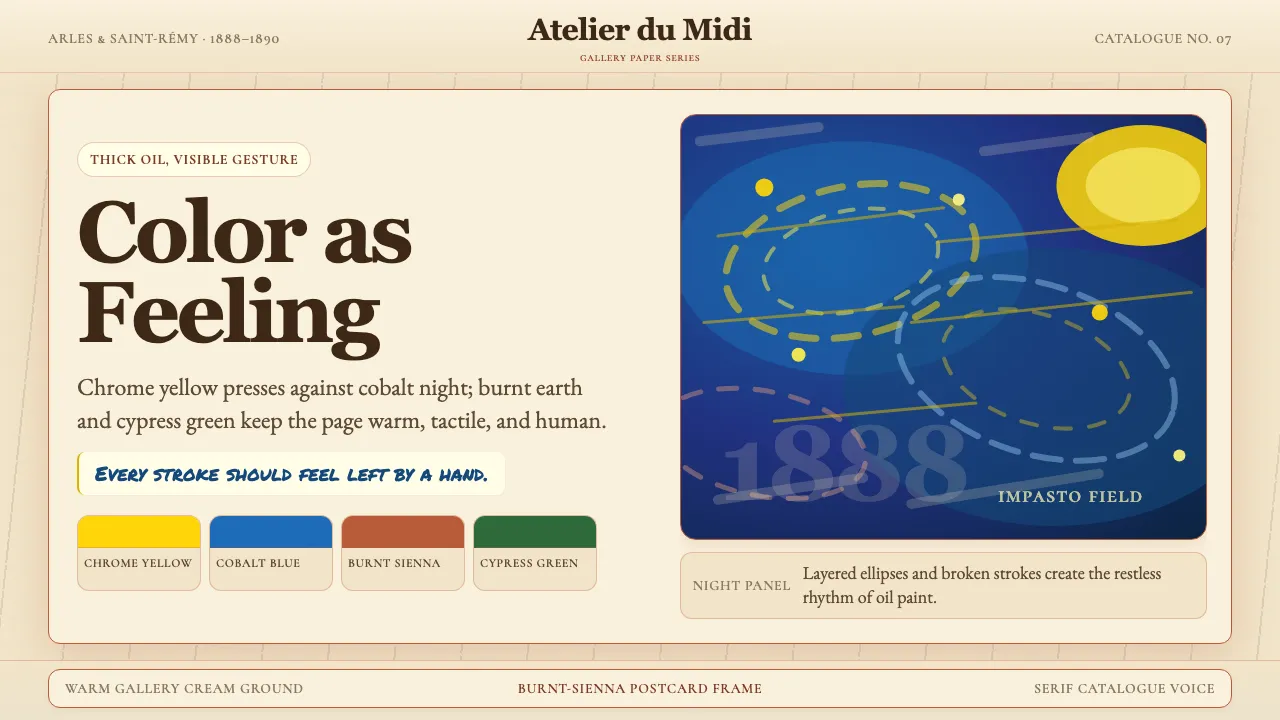
About Van Gogh Post-Impressionist
Vincent van Gogh's Arles period (1888–1890) produced the most reproduced fine-art images in history — Sunflowers, Starry Night, The Yellow House. His technique of thick impasto oil paint applied in visible directional swirls created an aesthetic where every brushstroke is a gesture and every color is a feeling.
This system translates Van Gogh's earth-pigment palette — chrome yellow, cobalt blue, burnt sienna, cypress green — into a warm, tactile design language. Typography draws from 19th-century French serif tradition, surfaces carry gallery-paper grain, and every edge has the soft imperfection of hand-painted brushwork.
- Origin
- Arles & Saint-Rémy-de-Provence, France
- Era
- 1888–1890 (Arles + Saint-Rémy peak production)
- Key figures
- Vincent van Gogh · Theo van Gogh · Jo van Gogh-Bonger · Paul Gauguin
- Movements
- Post-Impressionism · Japonisme · Provençal plein-air painting
Van Gogh Post-Impressionist design spec
Colors
Typography
The other 11 sections — buttons, cards, spacing, motion, techniques and more — open once you unlock. Download the DESIGN.md or send it to your AI in one click. Unlock once, yours forever.
Sign up nowStyles similar to Van Gogh Post-Impressionist
Also inspired by art & artists, with a close feel.
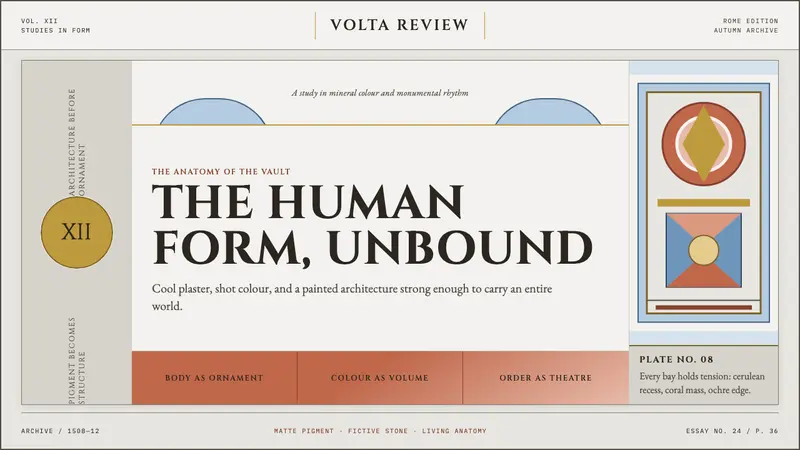 Michelangelo Sistine Ceiling (1512)Paint becomes monumental. Coral, cerulean and ochre figures strain against a plaster grid.
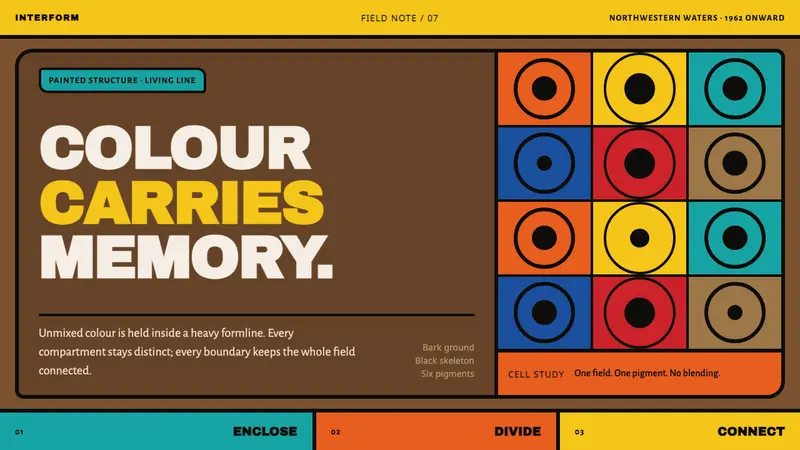 Woodland School — MorrisseauColour carries memory. Unmixed orange, yellow and turquoise lock into heavy black cells.
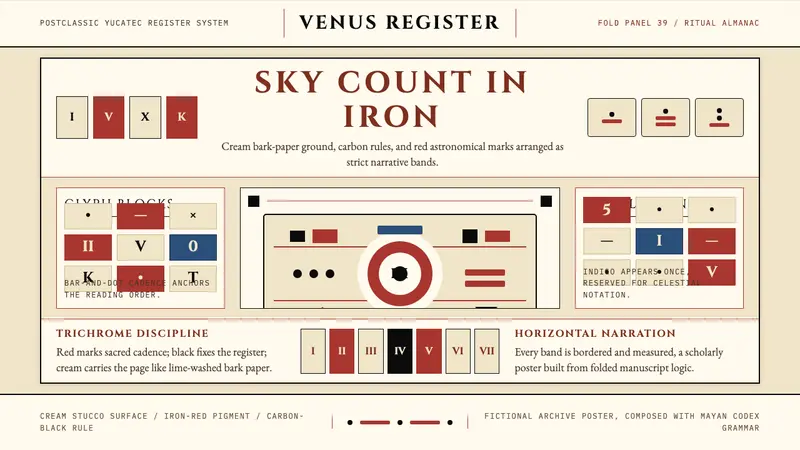 Mayan Dresden CodexSacred astronomy, measured. Cream registers, iron-red glyphs, carbon rules.
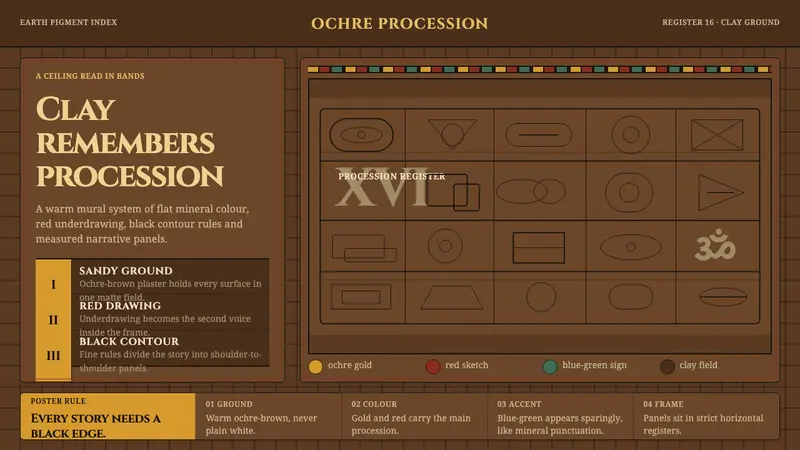 Lepakshi Vijayanagara CeilingEarth remembers in registers. Ochre gold, red underdrawing and black rules march on clay.