What is Edo Ukiyo-e (Hokusai)?
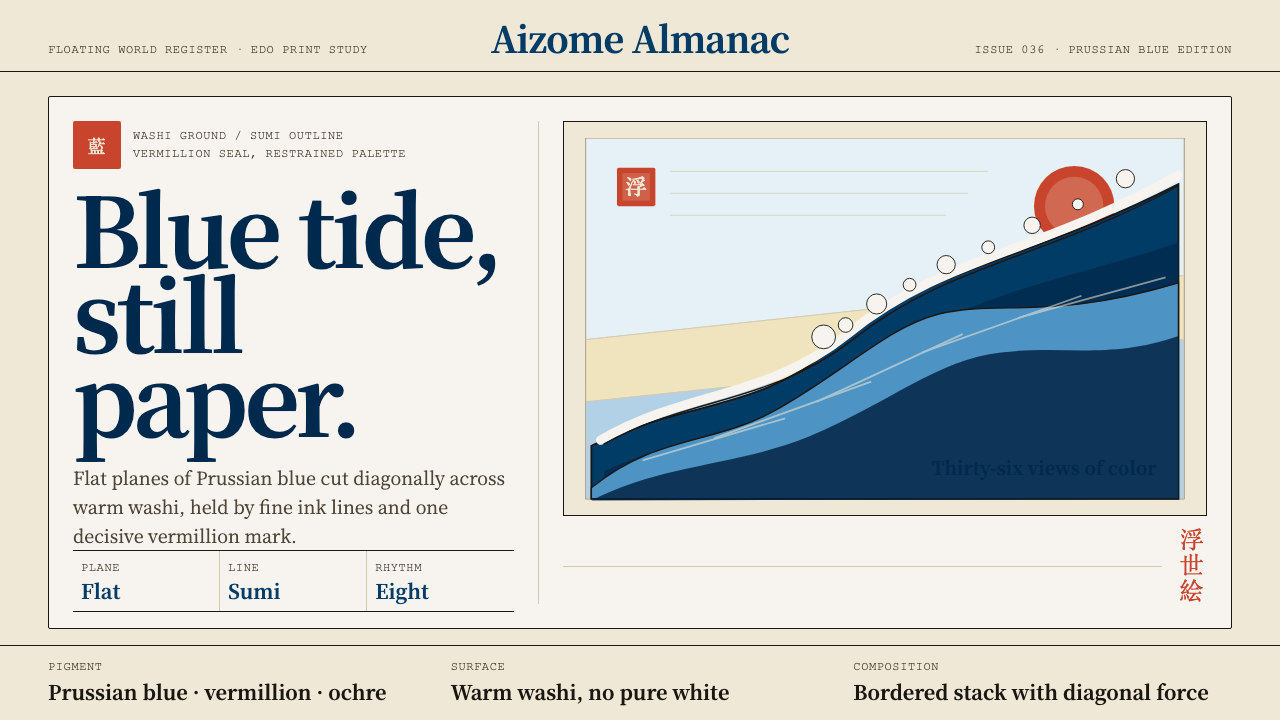
Ukiyo-e — 'pictures of the floating world' — distilled Edo Japan's entire visual imagination into flat color planes, delicate ink outlines, and compositions of such diagonal force that they rewired how Western artists understood space.
Edo Ukiyo-e (Hokusai) in brief
Ukiyo-e is the Japanese woodblock printing tradition that flourished during the Edo period (1603–1868). The word ukiyo originally carried a Buddhist connotation of impermanence — the sorrowful transience of earthly life — but by the seventeenth century it had been repurposed with ironic pleasure to mean the fashionable, hedonistic 'floating world' of Edo's merchant class: kabuki theater, sumo wrestling, tea houses, and the licensed pleasure districts. Prints depicted these subjects with an aesthetic that was simultaneously popular and refined.
Visually, ukiyo-e is defined by a small number of absolute commitments: flat color planes with no modelling or gradients; contour lines drawn in sumi ink that describe form without simulating volume; and compositions organized through overlapping horizontal bands — foreground, middle ground, sky — rather than through Western linear perspective. Backgrounds are often left as unprinted paper or washed in a single atmospheric color. The result is images that feel simultaneously immediate and timeless, bold yet unhurried.
Katsushika Hokusai (1760–1849) pushed the tradition to a new level of compositional ambition with his series 'Thirty-Six Views of Mount Fuji' (1830–1832). Where earlier ukiyo-e had focused on people — actors, beauties, wrestlers — Hokusai made landscape the dominant subject and brought to it an almost architectural sense of scale and geometry. The arrival of imported Prussian blue pigment around 1820 gave him a deep, stable, luminous hue that no Japanese pigment had provided before, and his use of it in gradated washes and flat planes became the visual signature of the entire tradition.

Where does Edo Ukiyo-e (Hokusai) come from?
The Edo period (1603–1868) was defined by the Tokugawa shogunate's policy of national isolation (sakoku), which kept foreign influence minimal and concentrated cultural life within Japan's own cities. Edo — the shogunal capital, today's Tokyo — grew into one of the world's largest cities by 1700, with a prosperous merchant class that was economically powerful but socially ranked below samurai, scholars, and farmers in the Confucian hierarchy. Denied access to high culture by social convention, merchants and artisans built their own parallel culture centered on entertainment, fashion, and vernacular art. Ukiyo-e was the visual expression of this parallel world.
Woodblock printing itself was not new — it had been used for centuries to reproduce Buddhist texts and illustrations. What changed in the seventeenth century was the application of this reproductive technology to secular, commercial image-making. Publishers in Edo commissioned artists, who would draw the designs in ink on thin paper; professional block-cutters would then transfer these outlines to woodblocks; printers would press successive blocks — one per color — onto sheets of handmade washi paper. At its height, a single edition might run to several hundred prints, making images affordable to urban commoners for the first time. The mass-produced print was Edo's equivalent of the poster and the magazine.
The tradition moved through several distinctive phases. Early ukiyo-e (late seventeenth century) was dominated by figure subjects: Hishikawa Moronobu's bold line prints of women and genre scenes established the format. Multi-color printing (nishiki-e, 'brocade pictures') emerged around 1765 under Suzuki Harunobu, whose delicate palette and idealized feminine figures set the template for bijinga (beauty pictures). Tōshūsai Sharaku's intensely psychological actor portraits appeared in a single concentrated burst in 1794–1795. Kitagawa Utamaro refined the close-up female portrait into an art of extraordinary psychological subtlety. Hokusai and his younger contemporary Utagawa Hiroshige elevated landscape — fūkeiga — to the dominant genre, and it was this final phase that most directly reached and transformed Western art.
The opening of Japan to Western trade after Commodore Perry's mission in 1853 led, within a generation, to ukiyo-e prints traveling to Europe as wrapping paper for exported ceramics. Édouard Manet, Edgar Degas, Claude Monet, and Vincent van Gogh each collected prints and openly absorbed their compositional lessons: the flattening of space, the bold cropping, the use of outline, the asymmetric placement of subject against empty ground. This influence — christened Japonisme — transformed Impressionism and Post-Impressionism, and through those movements, shaped the entire trajectory of Western modernism. The influence was not one-directional: Prussian blue itself was a European invention that Hokusai adopted, and woodblock artists of the late Edo period were already incorporating some Western perspective conventions into their landscape work.
What defines the Edo Ukiyo-e (Hokusai) look?
Flat Color Planes
Ukiyo-e applies color in unmodulated, even planes with no gradients, no highlights, and no cast shadows — a direct consequence of the woodblock printing process, where each block deposits a single layer of water-based pigment. This flatness is not a limitation but a discipline: it forces compositional decisions to be made through shape, outline, and placement rather than through tonal modelling. Modern applications should honor this by using solid fills rather than gradients, and reserving any wash effect for intentional atmospheric zones only.
Sumi Ink Contour
A thin, precise outline in deep sumi ink defines every form in ukiyo-e. The line is the primary carrier of information — it describes volume without simulating it, separates color planes without hard shadows, and gives the image its characteristic drawn quality. Line weight varies subtly to suggest pressure and emphasis: slightly heavier at the base of figures, lighter and more calligraphic in hair or fabric folds. In digital interfaces, this translates to hairline borders in a near-black tone rather than drop shadows or ambient glow.
Constrained Palette
The multi-block printing process imposed an inherent limit on color — early prints used two or three blocks; elaborate late Edo prints might use seven or eight. This constraint produced a distinctive economy: every color is present because it is necessary, and the combinations carry maximum visual weight from minimum hue variety. Prussian blue anchors the system as its deepest, most saturated note; vermillion provides warmth and visual tension; ochre bridges the warm paper ground to both. The background is washi paper itself — a warm off-white that reads as light rather than neutral.
Asymmetric Diagonal Composition
Ukiyo-e compositions are governed by diagonal energy rather than bilateral symmetry. In 'The Great Wave,' the wave's claw-like crest arcs from lower-left to upper-right; Fuji sits small and stable in the far distance as a geometric counterweight. This diagonal dynamism — often reinforced by a cropped foreground element that pushes into the frame from one edge — creates tension and movement without symmetry. The convention of placing the horizon high and leaving the lower register open is equally characteristic, giving a sense of vast space without traditional Western receding perspective.
Layered Planes
Space in ukiyo-e is organized as a series of overlapping horizontal bands stacked vertically on the picture plane — the visual equivalent of theater stage flats receding into the wings. Sky occupies the upper register; a middle band holds the primary subject; foreground elements anchor the bottom. Rather than diminishing in size with distance, objects are often drawn at consistent scale with depth implied purely through overlap and vertical position. This planar stratification, borrowed in part from Chinese Song and Ming dynasty landscape traditions, is the formal grammar that Western Japonisme enthusiasts found most exotic and most influential.
Washi Ground
The physical substrate of ukiyo-e — handmade washi paper produced from kozo (paper mulberry) fibers — contributes a warm, slightly absorbent surface whose fibrous texture gives printed inks a subtly matte, organic quality entirely different from the hard-edged reproduction of Western engraving. Colors appear to glow from within rather than sit on top. In digital application, this quality is approximated through warm off-white backgrounds (rather than pure white), and optionally through very subtle noise overlays at low opacity that recall the irregular fiber pattern of handmade paper.
Vermillion Seal
Every ukiyo-e print bears at least one red seal — the artist's hanko (personal seal) stamped in cinnabar or vermillion ink, identifying authorship and authenticating the print. This small rectangular or oval mark functions as a focal anchor: a burst of warm red in an otherwise blue-and-neutral composition that the eye is drawn to first. In design applications, the hanko principle translates into a small, square vermillion accent mark — a badge, a label, a call-to-action button — that provides warmth and specificity within an otherwise restrained palette.

Who shaped Edo Ukiyo-e (Hokusai)?
Hokusai (1760–1849) was active as an artist for seven decades and is estimated to have produced over thirty thousand works. He changed his artist name at least thirty times, viewing each change as a spiritual renewal and fresh beginning. His series 'Thirty-Six Views of Mount Fuji' (the final print count was actually forty-six) transformed landscape printmaking by imposing a rigorous geometric logic onto natural scenery — Mount Fuji appears in each print as a stable triangle, the compositions structured around its presence or absence in unexpected corners of the frame. He is said to have written at age seventy that nothing he produced before the age of seventy was worth attention, and that he expected to reach true mastery at one hundred and ten.
Hiroshige (1797–1858) was Hokusai's most significant contemporary rival in the landscape genre, and in some respects his temperamental opposite. Where Hokusai's compositions are dramatic and geometric, Hiroshige's are lyrical and atmospheric: rain depicted as diagonal ruled lines, snow as white negative space against darkened sky, mist as dissolving layers of pale wash. His series 'One Hundred Famous Views of Edo' and 'The Fifty-Three Stations of the Tōkaidō' documented urban and road-journey scenes with a poetic melancholy that proved enormously influential. Van Gogh copied two of Hiroshige's prints directly in oil paint, and Monet's garden at Giverny — with its Japanese bridge and reflective pond — was conceived in explicit dialogue with Hiroshige's vision.
Utamaro (1753–1806) specialized in bijinga — pictures of beautiful women — and brought to the genre an unprecedented psychological intimacy. His signature innovation was the ōkubi-e, the large-head or bust-portrait format, which cropped away the full figure and concentrated attention on facial expression, the line of a neck, the arrangement of hair ornaments. His images are not portraits of individuals but idealizations of feminine types — the romantic, the coquette, the distracted — read through precise observation of posture, gesture, and physiognomy. Utamaro's work defined the bijinga genre for a generation and influenced the representation of women in Western art through Japonisme.
Sharaku is one of the great mysteries of art history: he produced approximately one hundred and forty-five actor portraits in a period of roughly ten months in 1794–1795, then vanished entirely from the record. His prints departed sharply from the idealized actor images that his contemporaries produced, depicting kabuki performers with exaggerated, almost caricatural intensity — bulging eyes, twisted mouths, extreme tension in the hands. His identity has never been established with certainty. The prints were not commercially successful in his own time, dismissed as too realistic and unflattering, but they are now regarded as among the greatest portraits in the history of printmaking.
Harunobu (1725–1770) is credited with introducing full polychrome woodblock printing — nishiki-e, or 'brocade pictures' — around 1765, transforming ukiyo-e from a primarily monochrome tradition into the rich, multi-color medium it is known as today. Before Harunobu, most prints were produced in two or three colors; his technical advance allowed the delicate layering of six or more blocks, enabling the subtle tonal gradations and patterned textiles that became central to the aesthetic. His own subjects were typically young, slight figures of androgynous beauty in intimate indoor settings, rendered with a porcelain delicacy that influenced every bijinga artist who followed.
How do you use Edo Ukiyo-e (Hokusai) today?
Applying ukiyo-e as a design system requires understanding that its power comes from constraint and structural decision-making rather than from surface decoration. The instinct to add a 'Japanese feel' through cherry blossoms, red torii gate silhouettes, or cursive script is exactly wrong — those are cultural symbols, not design principles. The actual ukiyo-e principles are spatial (flat planes, diagonal diagonals, cropped foreground), chromatic (Prussian blue as structural anchor, vermillion as counterpoint, washi ground), and linear (precise sumi-ink outlines replacing shadows and gradients). Work from those three axes and the cultural authenticity will follow.
For presentation slides, the style produces a distinctive and memorable result with relatively few moves. A cover slide works best with a strong diagonal element — a wave, a horizon band, an angled color field — that cuts across a washi-warm background. The title sits in high-contrast serif type (preferably a Garamond or similar cut with fine hairlines) against the flattest possible surface. Content slides should be treated as woodblock compositions: a strong color band as a section header, body text in a clear serif at generous leading, and data visualizations rendered as flat filled shapes without gradients or three-dimensional effects. Bar charts become color planes; pie charts become flat discs.
For web UI, ukiyo-e works particularly well in editorial, cultural, or portfolio contexts where the atmosphere of refined restraint reinforces content. A pricing or dashboard layout built on this system should use the warm off-white washi ground as the page background, card surfaces slightly cooler at a light neutral tone, and borders as thin sumi-ink-like lines rather than shadows. Prussian blue handles primary interactive states — links, focus rings, primary buttons — while vermillion is reserved for the highest-priority calls to action or error states. The horizontal banding principle translates naturally to alternating section backgrounds on marketing pages: washi warm alternating with a slightly deeper neutral creates depth without breaking the flat-color discipline.
For editorial and marketing work, the style has a natural affinity for long-form storytelling and cultural content. Article layouts benefit from generous vertical white space between sections — the Edo woodblock's unprinted margin — and from section markers that are typographic (a bold number or rule) rather than decorative. Pull quotes work well in Prussian blue against a vermillion horizontal rule. Marketing pages that need emotional warmth can lean on the ochre-gold accent for background washes behind feature sections, with the main palette providing contrast and structure. The hanko-stamp badge — a small square vermillion label — is useful across contexts wherever a tier indicator, status tag, or emphasis marker is needed.
The most common mistake is using the ukiyo-e palette while retaining Western spatial conventions: gradients, soft drop shadows, modelled illustration, or perspective-based hero images. Each of these imports volumetric space that flatness excludes by definition. A second common error is over-saturating the blue to a cobalt or navy that loses the particular luminous depth of Prussian blue. A third is treating the vermillion as a danger or error color exclusively — it is an accent and a counterpoint, warm and lively, not a warning signal. Reserve it for moments of energy and invitation, not only for alerts.

Edo Ukiyo-e (Hokusai) — FAQ
What makes ukiyo-e different from other Japanese art traditions?
Ukiyo-e was fundamentally a commercial, mass-production medium aimed at an urban merchant audience, which distinguishes it sharply from earlier aristocratic Japanese art traditions. Court painting (yamato-e), ink wash painting (sumi-e), and the decorative Rinpa school were all produced in small quantities for elite patronage — hanging scrolls, folding screens, painted sliding doors. Ukiyo-e prints were made in editions of hundreds and sold at markets and bookstalls for prices equivalent to a bowl of noodles. This accessibility drove both its popular subject matter (entertainment, fashion, travel) and its visual directness: images designed to communicate quickly to a broad audience rather than reward contemplative study.
Why is Prussian blue so central to the Hokusai look?
Before the import of Prussian blue (Berlin blue) around 1820, Japanese artists had access to blue pigments derived from indigo and azurite, neither of which could achieve the deep, luminous, and stable saturation that Prussian blue provided. Indigo faded; azurite was expensive and granular. Prussian blue was cheaper, more stable, and capable of producing both intense solid fills and delicate graduated washes from a single pigment — qualities that aligned perfectly with the woodblock printing process. Hokusai seized on it immediately and used it in ways that created the iconic contrast between deep blue sea and cream-white wave foam that 'The Great Wave' is now famous for. Without Prussian blue, the visual signature of mature Hokusai would simply not exist.
How did ukiyo-e influence Western modern art?
The influence, known as Japonisme, was rapid and pervasive once Japanese prints reached Europe in the 1860s and 1870s. At the most immediate level, Western artists copied specific ukiyo-e compositional devices: the high horizon, the cropped figure at the edge of the frame, the use of flat outline over modelled form, and the placement of subjects against unmodulated color fields rather than atmospheric backgrounds. Monet restructured his garden around a Japanese bridge and used the reflective surface of water as flat color planes in his late lily pond series. Degas borrowed the unusual cropping and overhead viewpoints. Van Gogh was so explicit about the influence that he painted oil copies of Hiroshige prints and wrote about ukiyo-e in his letters as a model of how to express emotions through simplified form and pure color. At a deeper structural level, ukiyo-e demonstrated to Western artists that the elimination of perspective depth and tonal modelling was not a deficiency but a legitimate and powerful spatial alternative.
Can the ukiyo-e style work in dark-mode interfaces?
The historical palette is fundamentally a light-ground system — the warm washi off-white is not just a background color but a structural element that gives Prussian blue and vermillion their particular luminous quality. A dark inversion is possible but requires significant reinterpretation. On a dark ground, the Prussian blue loses its contrast advantage (it reads dark against dark) and vermillion becomes the dominant visual signal rather than an accent. A workable dark variant would treat a deep navy or charcoal as the base, use a lighter, desaturated blue-grey for surfaces, bring in vermillion and ochre as the primary accent colors, and deploy fine cream or washi-toned lines where the original used sumi-ink outlines on light ground. The result would be inspired by ukiyo-e rather than derived from it — and honesty about that distinction matters.
What kinds of products are a natural fit for this design style?
Ukiyo-e works best where editorial richness, cultural depth, and contemplative pace are aligned with user expectations. Digital magazines, cultural institution websites (museums, galleries, performance venues), travel and hospitality platforms, portfolio sites for designers and photographers, and long-form reading applications all benefit from the style's combination of warm restraint and compositional boldness. It is also a strong choice for brands that position themselves at the intersection of Japanese and Western sensibility — furniture, clothing, food, beauty. It is less suited to fast-moving consumer products, entertainment platforms requiring high visual energy, or SaaS tools where functional density must compete with ambient aesthetic warmth. The style rewards slow attention; interfaces that need to communicate quickly at a glance should look elsewhere.
Related design styles
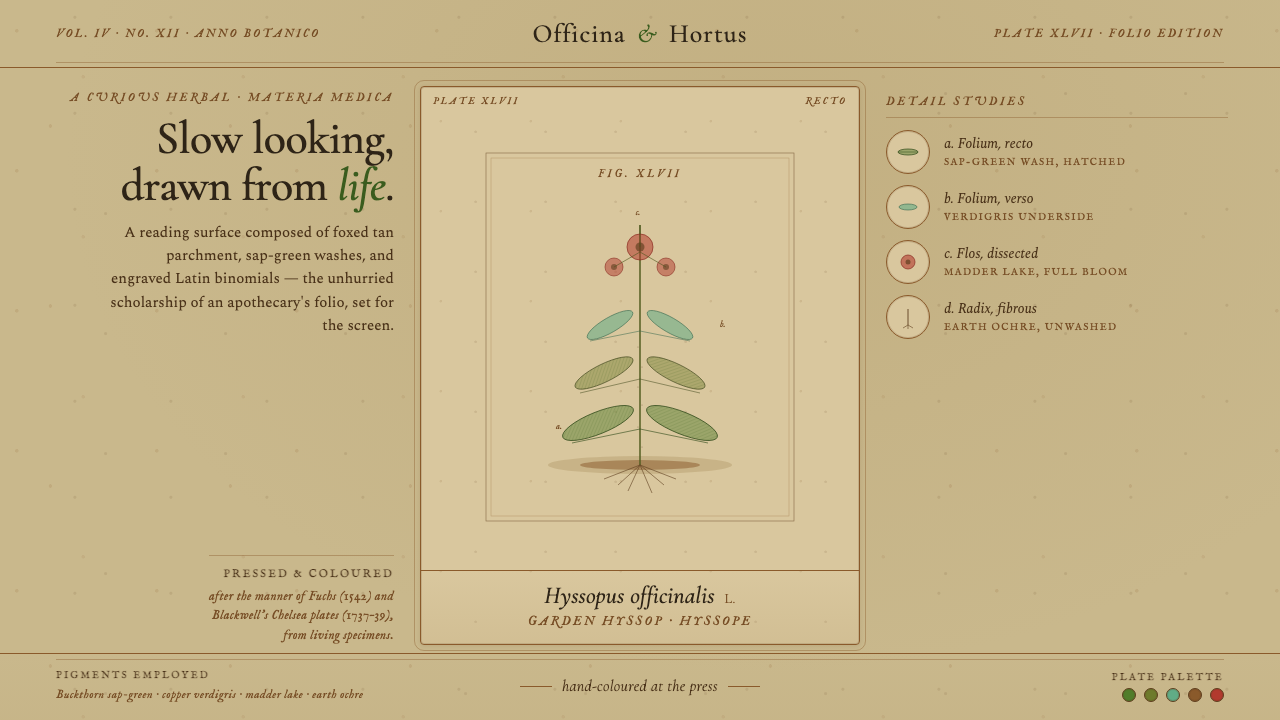 Herbal PharmacopoeiaSlow scholarship of the apothecary folio. Foxed tan parchment, sap-green wash…
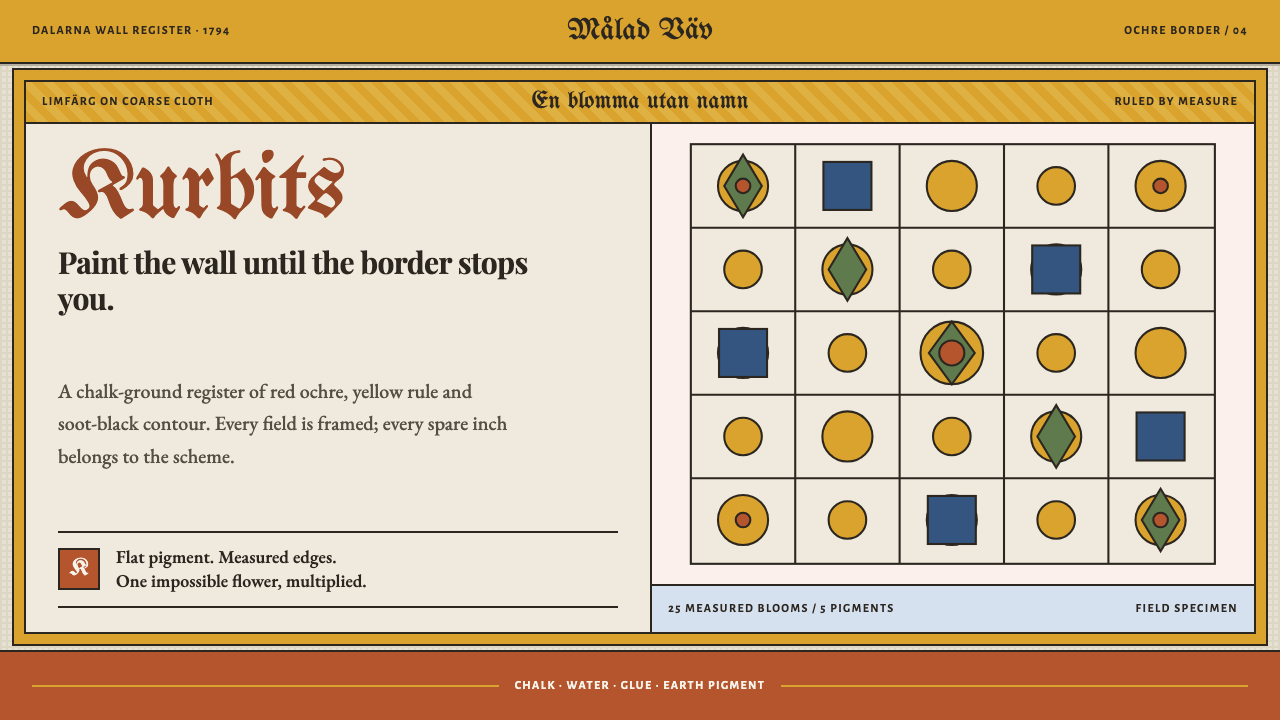 Kurbits Dalarna PaintingNo blank wall survives. Red ochre blooms crowd a chalk ground inside measured…
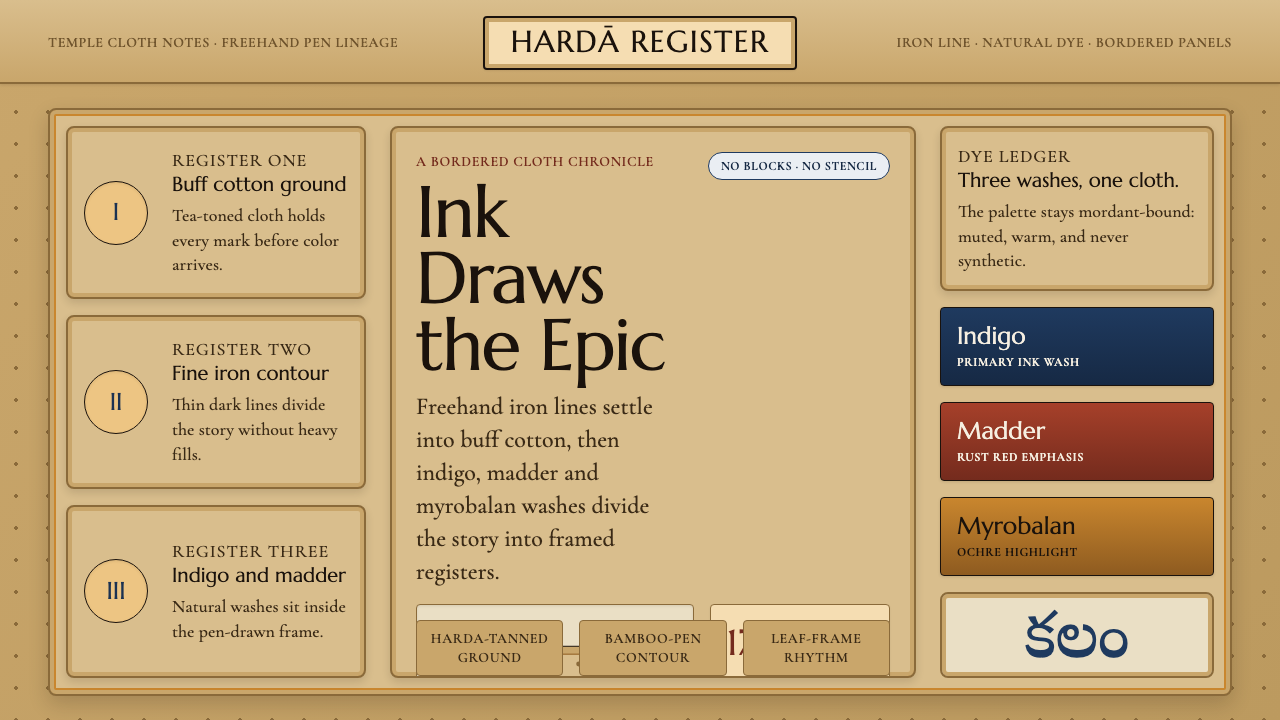 Srikalahasti Kalamkari Pen-WorkHand-drawn cloth storytelling. Buff tan ground, iron lines and indigo-rust pa…
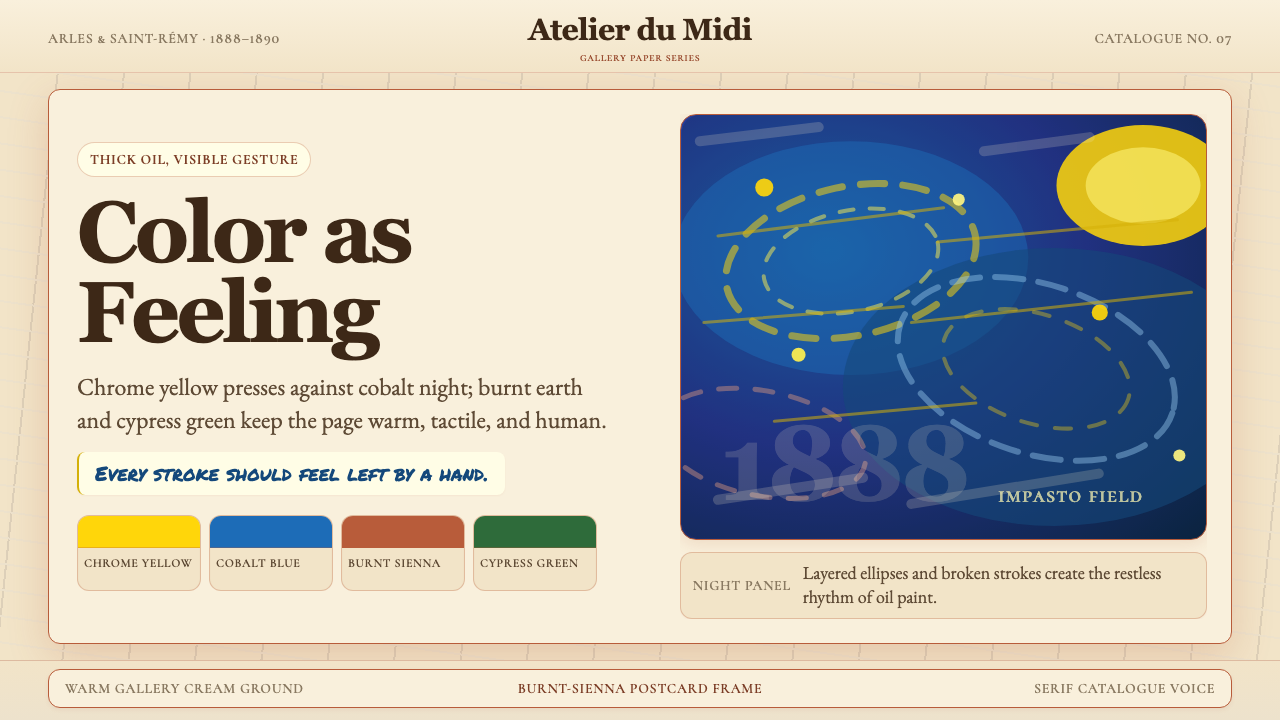 Van Gogh Post-ImpressionistFeeling made visible. Chrome yellow meets cobalt swirls on warm gallery cream.
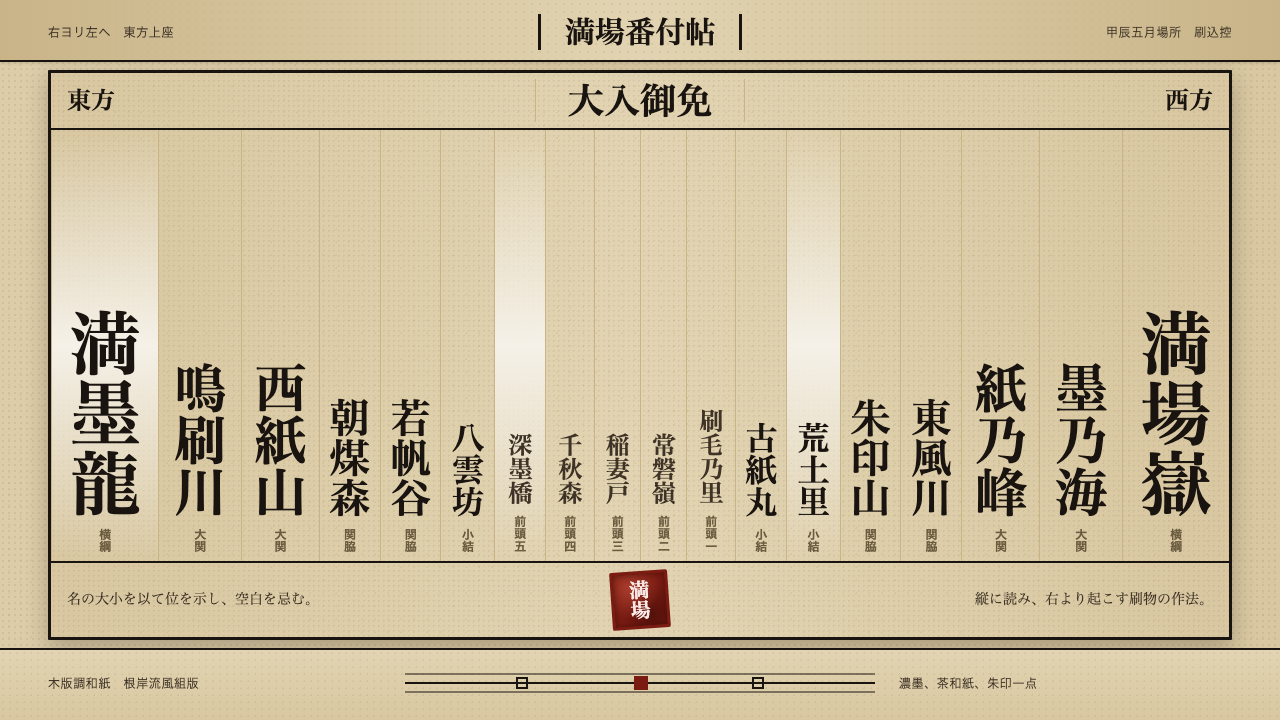 Sumo BanzukeCeremonial density. Sumi columns crowd tan washi; rank-scaled type meets one…
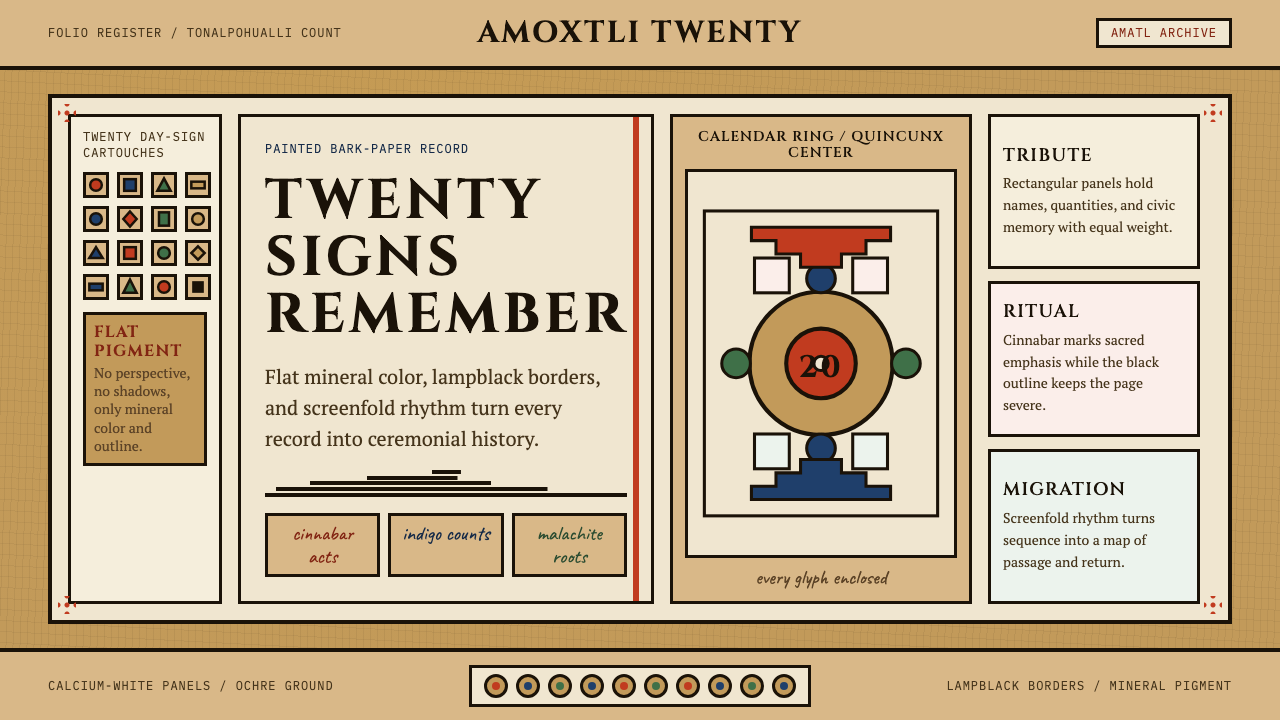 Aztec CodexSacred records stay severe. Ochre amatl ground, Cinzel capitals, black cartou…