What is Art Brut (Dubuffet)?
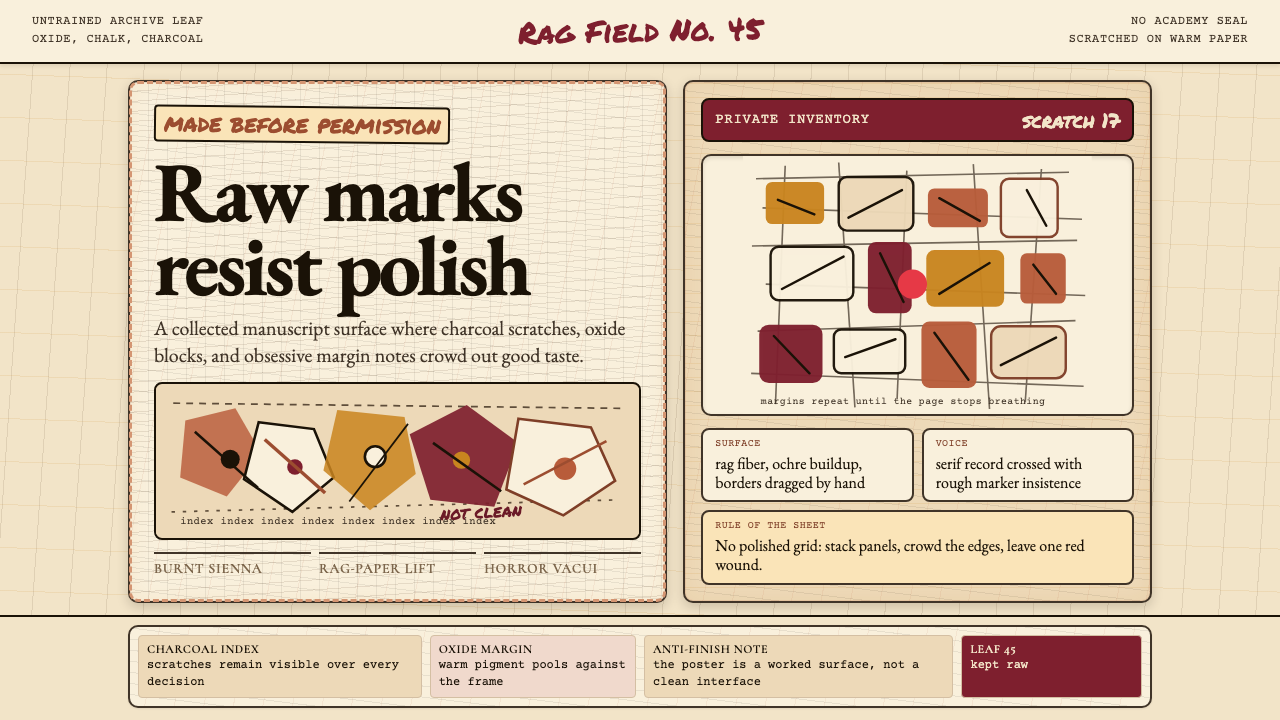
Art Brut tears away every polish — bone-cream surfaces, earth pigments, obsessive scratched marks, and figures that crowd every margin with ungovernable urgency.
Art Brut (Dubuffet) in brief
Art Brut — French for 'raw art' — is the name Jean Dubuffet coined in 1945 for work made outside the cultural mainstream: drawings, paintings, and sculptures by psychiatric patients, prisoners, mediums, and self-taught isolates who never sought gallery validation and were never shaped by academic tradition. Dubuffet argued that this work, precisely because it was free from received convention, represented a more authentic creative impulse than anything produced by trained artists operating within institutional art systems.
As a design aesthetic, Art Brut channels that radical anti-refinement through a specific visual vocabulary: warm bone-cream or aged-paper grounds, palettes drawn from earth pigments — ochre, raw umber, charcoal, rust, and muted terracotta — hand-worked surfaces that preserve the evidence of their own making, and a dense, horror-vacui composition that fills every available space with marks, figures, or texture. Nothing aspires to smoothness; everything insists on its own materiality.
The style is immediately distinguishable from deliberate primitivism or folk art pastiche because it is systematic in its rawness. The scratched borders are intentional, the crude figure silhouettes are compositionally considered, and the obsessive mark-making follows a logic — even if that logic is closer to compulsion than to classical proportion. In contemporary design, Art Brut works as a counter-signal to digital slickness: it communicates authenticity, urgency, and the irreducible presence of the hand.

Where does Art Brut (Dubuffet) come from?
The story of Art Brut begins not in a gallery but in a psychiatric institution. In 1945, Jean Dubuffet — a Paris-based painter who had already rejected academic training and spent years running his family's wine business before returning to art — traveled to Switzerland to visit asylums and collect drawings made by patients. What he found in institutions in Geneva, Bern, and Lausanne radicalized his thinking: he encountered work of staggering internal consistency, invented symbolic systems, obsessive spatial organization, and imagery that bore no relationship to any art-historical tradition because its makers had never encountered one.
Dubuffet returned to Paris with a collection and a manifesto. He called the work 'Art Brut' — raw, uncooked, unprocessed — and began arguing in lectures, writings, and his own painting practice that the Western art establishment had systematically mistaken sophistication for value. The training that produced skilled painters, he contended, also produced artists who could only recombine what they had already absorbed. The untrained maker, working without reference to tradition, was free to discover form independently — and that independence was not a limitation but a liberation.
In 1948, Dubuffet founded the Compagnie de l'Art Brut in Paris with a group that included the Surrealist André Breton and the writer Jean Paulhan. The collection he had been building — which would eventually grow to thousands of works — was housed in various locations over the following decades, including a period in the United States when it was stored at the home of the Surrealist collector Alfonso Ossorio. In 1971, Dubuffet donated the entire collection to the City of Lausanne, where it became the foundation of the Collection de l'Art Brut, still the world's primary institution dedicated to the genre.
Dubuffet's own painting practice, which ran from his decisive return to art in 1942 until his death in 1985, constituted a sustained demonstration of Art Brut principles applied by a trained, self-aware artist. His 'Hautes Pâtes' series of the late 1940s built surfaces from plaster, tar, sand, gravel, and industrial pigments to produce canvases that looked excavated rather than painted. His 'Corps de Dames' series deliberately deformed the female figure, flattening, fracturing, and spreading it across the picture surface in ways that recalled both children's drawings and cave painting simultaneously. His late 'Hourloupe' series introduced a different register — interlocking jigsaw cell-forms in flat red, white, and blue — that influenced subsequent generations of graphic designers looking for a systematic visual language rooted in hand-drawn irregularity.
What defines the Art Brut (Dubuffet) look?
Color
The Art Brut palette is rooted in earth and mineral pigments rather than mixed or synthetic colors. Ochre, raw umber, burnt sienna, charcoal black, chalky off-white, rust, and muted terracotta are the primary tones; they read as excavated or aged rather than chosen from a swatch book. Accent moments — if they appear at all — come from unexpected pops of crude primary pigment: an unmodulated red, a chalky sky blue, a raw cadmium yellow applied as if squeezed directly from a tube. The overall palette is warm and earthen, never cool or clinical, and the tones feel as though they have absorbed the time of their making.
Surface and Texture
Every surface in an Art Brut composition reads as worked, not rendered. Scratches, gouges, layered buildup, visible brushstrokes, embedded grit, and smear marks are not accidents to be corrected but evidence to be preserved. The ground itself — often simulating the warm tooth of aged rag paper, plaster, or untreated canvas — participates actively in the image: its texture shows through thin applications of pigment and resists overly smooth passages. In digital applications, this quality is achieved through layered noise, grain, and deliberately imperfect edge treatments rather than clean vector shapes.
Figure and Form
The human figure in Art Brut is consistently present and consistently deformed. Heads are oversized or reduced to oval blobs; limbs radiate at improbable angles; bodies flatten against the picture plane without foreshortening or spatial logic. These figures are not failed attempts at academic anatomy — they are systematic alternatives to it, encoding presence and energy rather than physical proportion. In design applications, figurative elements derived from Art Brut carry this same quality: silhouetted shapes, crude outlines filled with scratched marks, and repeated figure motifs that accumulate like obsessive inventory.
Horror Vacui Density
Where Bauhaus or Swiss International Style treats negative space as a structural resource, Art Brut treats it as a problem to be solved. Margins are invaded by figures, decorative borders leak inward, text and image compete for the same territory without clear hierarchy, and secondary marks fill any passage that might otherwise read as empty. This horror vacui — the compulsion to fill every void — is not compositional carelessness but a distinct aesthetic position: it communicates obsessive intensity and the refusal of editorial restraint.
Typography
Art Brut typography resists the clean authority of typeset letterforms. Hand-lettering — whether scratchy and angular or densely repeated — is preferred over precision typesetting. When set type is used, it is typically a period serif or slab serif that carries the weight of the printed page rather than the precision of the screen, and it is often set in dense masses with irregular spacing or alongside hand-drawn annotations. Letter-spacing tightens to the point of collision; word spacing becomes unpredictable. The typographic effect is of language under pressure — words crowded into available space rather than given room to breathe.
Border and Frame
Borders in Art Brut compositions are characteristically hand-drawn — irregular, scratched, or constructed from repeated marks rather than ruled lines. They are active visual elements rather than passive containers: the border scratches back, bleeds, or is partially obliterated by the content it supposedly encloses. Multiple nested frames, decorative border registers filled with repeated small marks, and the deliberate violation of frame edges by figures or text all belong to the Art Brut typology. In contemporary design, these qualities translate to rough-edge masks, layered frame treatments, and borders made from repeated illustrative marks rather than geometric rules.
Expressive Mark-Making
The individual mark — scratch, smear, dot, repeated incised line — is the fundamental unit of Art Brut visual language rather than the geometric form (as in Bauhaus) or the clean edge (as in Swiss Style). These marks accumulate into textures, become stand-in backgrounds, and build the visual field from the ground up in a way that preserves the evidence of duration and repetition. In some Art Brut works, individual marks are so dense and uniform that they create optical vibration; in others they are sparse enough to feel like isolated gestures. Either way, they declare the presence of a body at work — not a program, not a system, not a machine.

Who shaped Art Brut (Dubuffet)?
Dubuffet (1901–1985) is the originating figure of Art Brut — its theorist, collector, and most prominent practitioner. Born in Le Havre to a wine merchant family, he enrolled at the École des Beaux-Arts in Paris before abandoning formal training in 1924, convinced that academic art education produced only competent imitators. He spent nearly two decades in his family's wine trade before returning decisively to painting in 1942 at the age of forty-one. His 1945 Switzerland journey to collect asylum art was the founding act of the movement; his subsequent writings, particularly the 1949 lecture 'Art Brut Preferred to the Cultural Arts,' became the movement's intellectual charter. His own paintings — layered, scratched, dense with crude figures — demonstrated that Art Brut principles could be applied consciously by a sophisticated thinker without losing their essential rawness.
Wölfli (1864–1930) is among the most celebrated of the artists Dubuffet came to categorize as Art Brut, though he died fifteen years before the term was coined. A Swiss laborer who was committed to the Waldau psychiatric clinic near Bern in 1895, Wölfli began drawing and writing in 1899 and over the following three decades produced a monumental autobiographical fantasy — 'From the Cradle to the Grave' — comprising thousands of pages of dense, obsessively detailed drawings, musical notations, and invented text, all embedded within elaborate decorative borders. His work exemplifies the horror vacui density and invented symbolic system that Dubuffet identified as characteristic of authentic Art Brut production.
Aloïse Corbaz (1886–1964) was a Swiss-born woman who worked as a governess in the German court of Kaiser Wilhelm II before experiencing a psychotic break and being committed to psychiatric institutions in Switzerland in 1918, where she remained for the rest of her life. She began making secret drawings and paintings on salvaged paper using toothpaste, plant juices, and colored pencils. Her work — large-scale, vibrantly colored, depicting operatic scenes and royal figures crowded into every inch of the surface — represents one of the purest examples of the Art Brut impulse: a completely self-contained visual world built without any reference to or awareness of contemporary art.
Henry Darger (1892–1973) was a Chicago hospital janitor who, upon his death, was discovered to have produced one of the most extraordinary private artistic works in the twentieth century: 'The Story of the Vivian Girls, in What Is Known as the Realms of the Unreal,' a fifteen-thousand-page illustrated manuscript accompanied by hundreds of large-format watercolor and collage paintings. Darger worked in total isolation over decades, tracing figures from coloring books and newspaper photographs and assembling them into epic battle scenes. He was unaware of the Art Brut movement and had no contact with the art world; his work was recognized posthumously and became central to international discussions of Outsider Art.
While not Art Brut practitioners in Dubuffet's strict sense, the CoBrA artists — a collective active from 1948 to 1951, drawing its name from the initials of Copenhagen, Brussels, and Amsterdam — developed a parallel approach to raw, childlike imagery and crude figuration that shared significant aesthetic territory with Art Brut. Artists including Asger Jorn, Karel Appel, and Constant produced paintings with deliberately unschooled mark-making, bold unmixed pigment, and crude figurative forms that challenged the dominance of abstract geometric painting in post-war Europe. Their influence on the visual vocabulary available to contemporary designers applying Art Brut principles is substantial.
How do you use Art Brut (Dubuffet) today?
Art Brut is one of the most demanding historical styles to apply in contemporary design because its visual authority depends entirely on internal consistency. The temptation, when borrowing from this style, is to add 'roughness' as a surface treatment — a few scratchy textures, a slightly irregular border — while leaving the underlying layout logic smooth and digital. This produces pastiche rather than conviction. Authentic application requires committing to the aesthetic at every level: ground, color, type treatment, figure handling, density, and border logic all must speak the same language.
For presentation slides, Art Brut works most powerfully as a cover and section-break system. A cover built in this aesthetic should feel excavated: warm bone-cream or aged-paper ground, earth-tone title treatment in dense hand-lettered or heavy serif type, crude figurative marks or obsessive textures filling the margins. Content slides require more restraint but should maintain the visual character: a single textured ground, text set in a dense serif with tight leading, data visualizations treated as hand-drawn diagrams rather than clean infographic elements. Data slides in this style — bar charts built from irregular mark accumulation, pie charts rendered as hand-divided circles — communicate craft and care rather than computational precision.
For web interfaces and dashboards, Art Brut suits platforms where authenticity, craft, and independence from mainstream digital aesthetics are part of the brand value proposition. An Art Brut dashboard uses a warm off-white or parchment-toned background rather than a pure white or neutral grey canvas; interactive elements carry rough-edge borders and hard, offset shadows rather than soft drop-shadows or rounded corners; data visualizations are given textured fills and irregular edges. Pricing pages and feature callouts work well with the style's poster-like directness: large crude numerals, dense descriptive text, and figurative marks used as category indicators.
For editorial and marketing applications, Art Brut is particularly effective for brands and publishers whose positioning involves authenticity, craft production, independence, or counter-cultural stance. An Art Brut editorial layout treats the full page as a territory to be occupied: body text runs in dense columns with minimal leading, pull quotes are handwritten or set in a scratchy typeface and surrounded by border marks, images are reproduced with visible grain and aged paper simulation. Marketing pages derive their impact from density and accumulation rather than the white-space clarity of modernist layouts — the composition feels urgent, almost overwhelmed, which communicates abundance and intensity.
The most common mistake when applying Art Brut is confusing crude with careless. Every element in a well-executed Art Brut composition is deliberately placed — the scratched borders, the dense figure fills, the irregular type treatment — even if the result looks uncontrolled. A second common error is applying Art Brut textures only to decorative elements while keeping structural elements (grid, type hierarchy, spacing) clean and digital. The third, and most undermining, mistake is using the style's warmth and earthiness while stripping its density and horror vacui compulsion — this produces a 'rustic' aesthetic that borrows Art Brut's color palette but abandons its fundamental character. If the composition has comfortable breathing room and generous margins, it is not Art Brut.

Art Brut (Dubuffet) — FAQ
How does Art Brut differ from other 'raw' or expressive styles like Expressionism or Grunge?
Expressionism is a trained artist's emotional amplification of the visible world, using distortion and intensified color to convey subjective states. Grunge typography (1990s David Carson era) is a trained graphic designer's formal deconstruction of readability conventions. Art Brut is neither: it originates from makers who were never trained and are not commenting on conventions they know, but rather inventing visual systems from scratch. In practice, this means Art Brut design avoids the deliberate legibility-breaking moves of Grunge and the gestural bravado of Expressionism. It is slower, denser, and more obsessive — the mark-making feels compelled rather than chosen.
Can Art Brut work in digital-first products like apps and websites, or is it too tactile?
Art Brut can work well in digital products, but it requires deliberate adaptation. The key is to simulate materiality rather than deny the digital medium: layered grain and noise textures applied to backgrounds and surfaces, rough-edge SVG shapes in place of clean vector forms, system fonts given irregular tracking and alignment, and interaction states (hover, active, focus) expressed through physical metaphors — a deepened shadow, a texture shift — rather than smooth transitions. The style is less suited to interfaces requiring precision at small sizes, such as dense data tables or highly compact mobile navigation, where its characteristic density becomes illegibility.
Is it appropriate to use Art Brut for serious or professional contexts like finance or healthcare?
Art Brut is rarely appropriate for contexts where the primary design requirement is institutional authority and trust-signaling. Financial services, medical platforms, legal products, and government interfaces generally depend on visual conventions — clean type, ordered hierarchy, spatial generosity — that Art Brut directly contradicts. The style's associations with psychiatric institutions, outsider status, and radical anti-establishment positions make it a significant brand risk in contexts where users need to feel safe, regulated, and professionally handled. There are exceptions — an independent arts foundation, a psychiatric care organization communicating empathy and humanity rather than clinical authority, or a mental health platform deliberately rejecting the cold aesthetic of mainstream health tech — but these require explicit strategic justification rather than stylistic preference.
How do I handle color in Art Brut without it looking muddy or unintentional?
The perceived muddiness of earth palettes is actually a feature of Art Brut, but it needs to be controlled to read as intention rather than accident. The key is contrast management: within the warm earth range, maintain clear value contrast — light ochre against dark charcoal, bone-cream against deep umber — so that the composition has legible structure even without clean hue separation. Reserve the occasional crude primary pop (an unmodulated rust red, a flat raw yellow) for single moments of emphasis, never distributed throughout the composition. Avoid mixing earth tones with cool grays or blues, which creates a visual conflict that reads as unresolved rather than deliberate. Test the palette at reduced size: if the composition loses all differentiation, the value contrast is insufficient.
What makes Art Brut feel contemporary rather than nostalgic or historical?
Art Brut feels contemporary when its rawness functions as a counter-signal to the specific visual conventions of the present moment — not as an evocation of any particular historical period. In the current context, dominated by ultra-smooth gradients, AI-generated imagery, and perfectly kerned geometric sans-serif type, Art Brut's earthy surfaces and hand-made marks communicate authenticity and human presence with genuine force. The risk of nostalgia arises when the style is applied too literally — simulating sepia-toned photographs, mimicking specific mid-century printing techniques, or using visual clichés like distressed type effects that have themselves become aesthetic conventions. Contemporary Art Brut should feel as if it was made today, by a hand, under urgency — not as if it was lovingly reproduced from a historical archive.
Related design styles
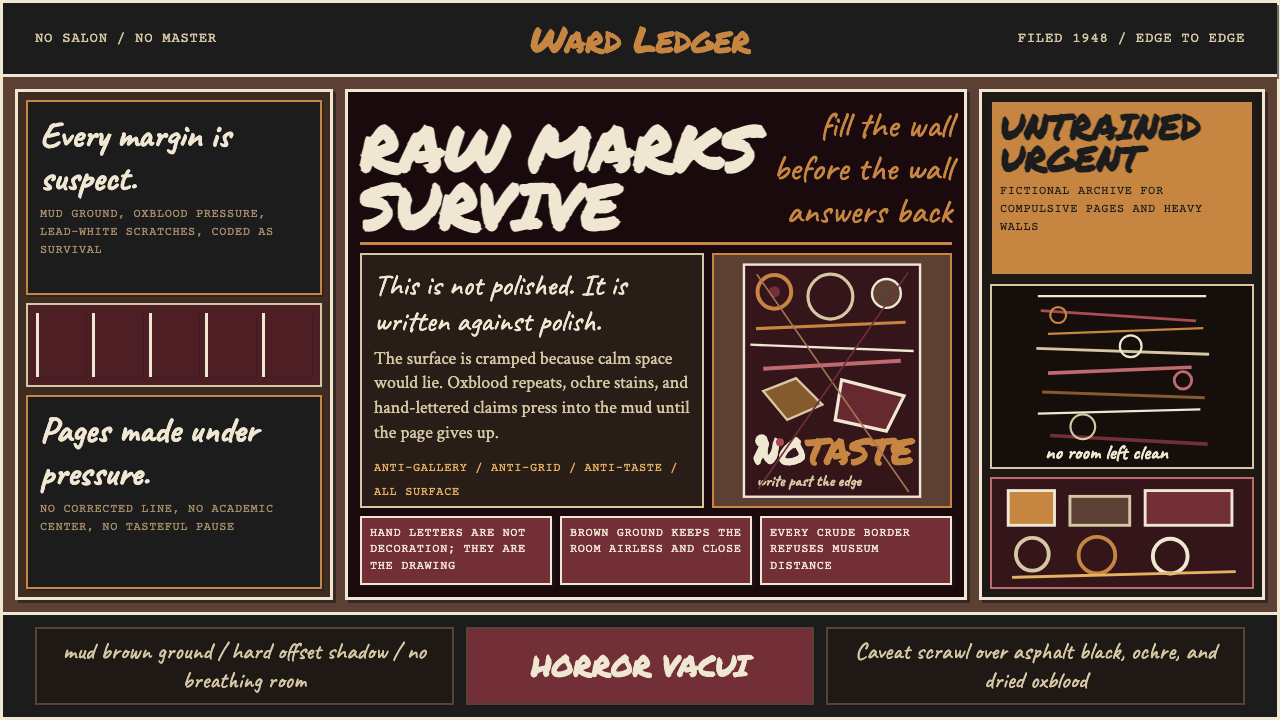 Art Brut (Dubuffet, 1948)Rawness crowds the frame. Mud brown, oxblood marks, and hand scrawl erase the…
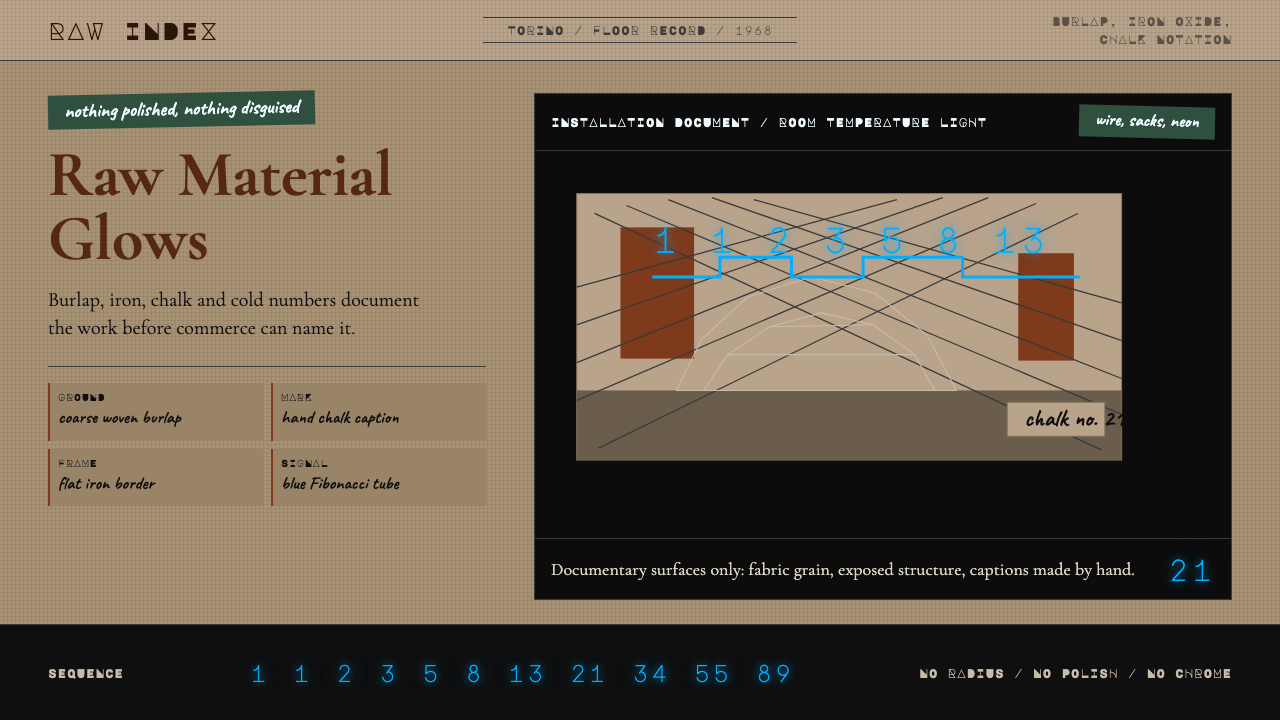 Arte Povera (Merz, 1968)Material refuses polish. Burlap ground, rust serif, chalk marks, neon Fibonac…
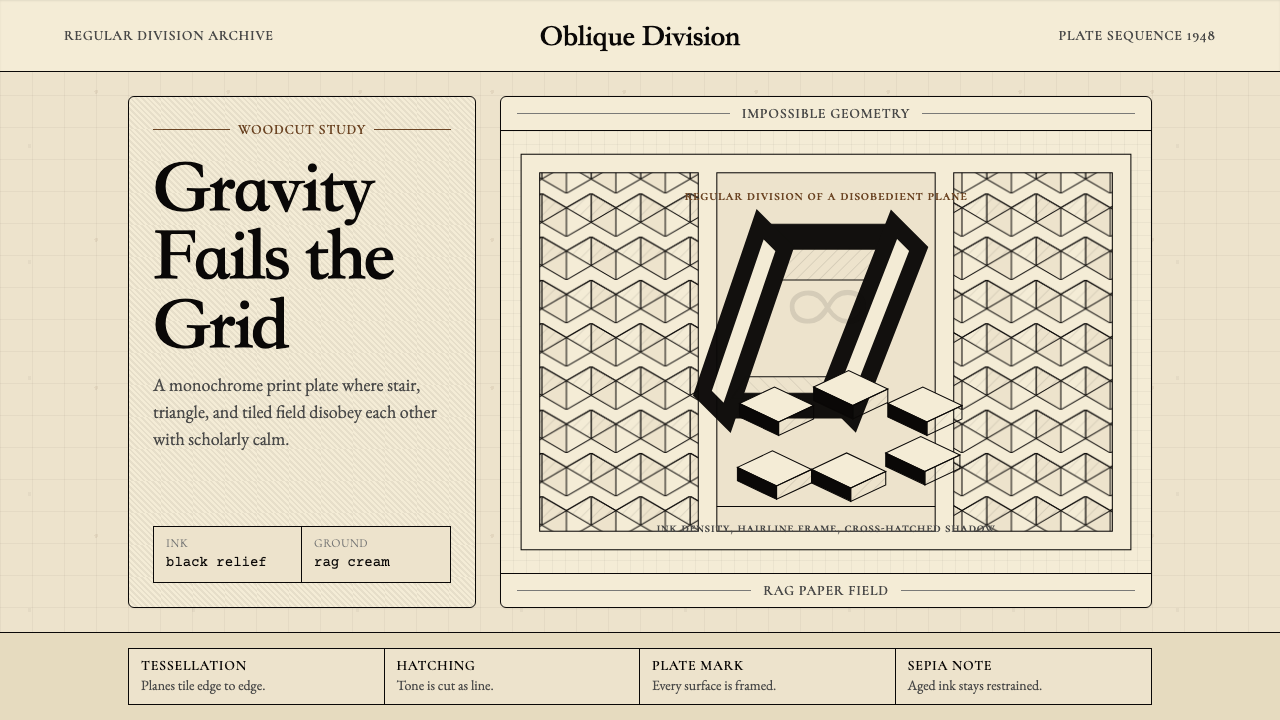 M.C. Escher ImpossibleImpossible calm. Ink-black tessellations and hatching fold cream paper into p…
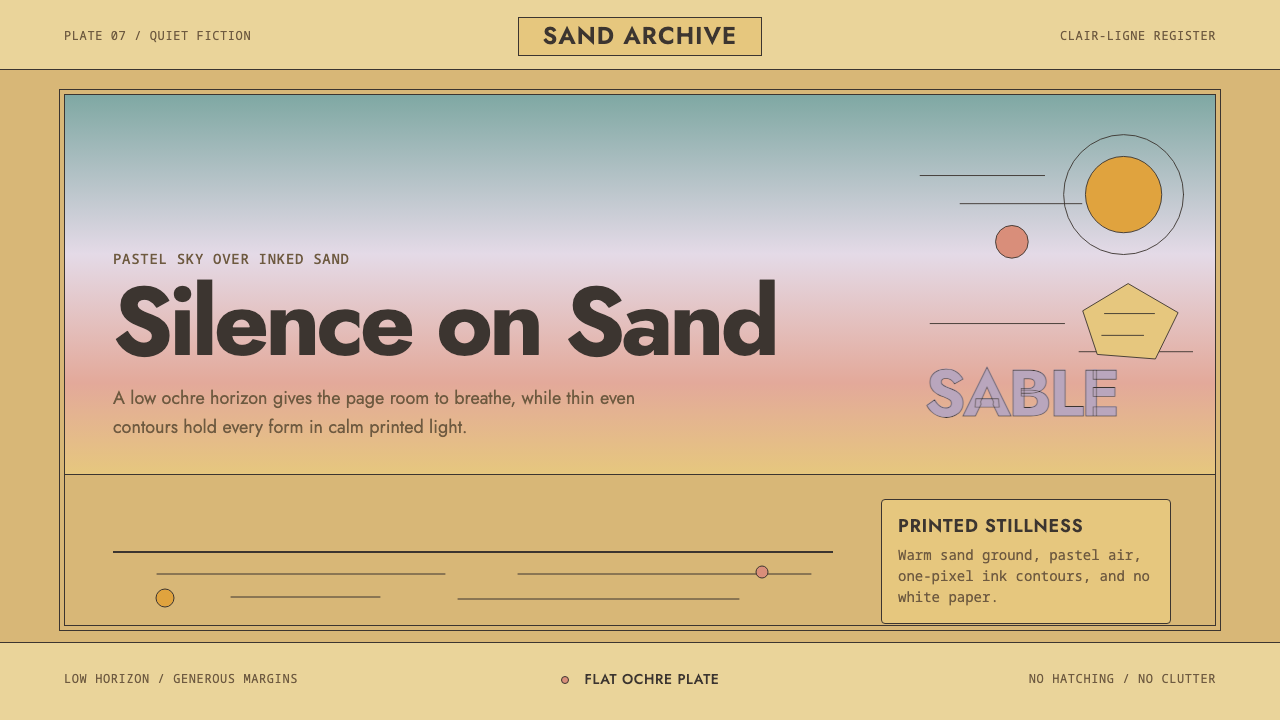 Sable (Mœbius)Still desert science fiction. Ochre ground, pastel sky, and thin ink contours…
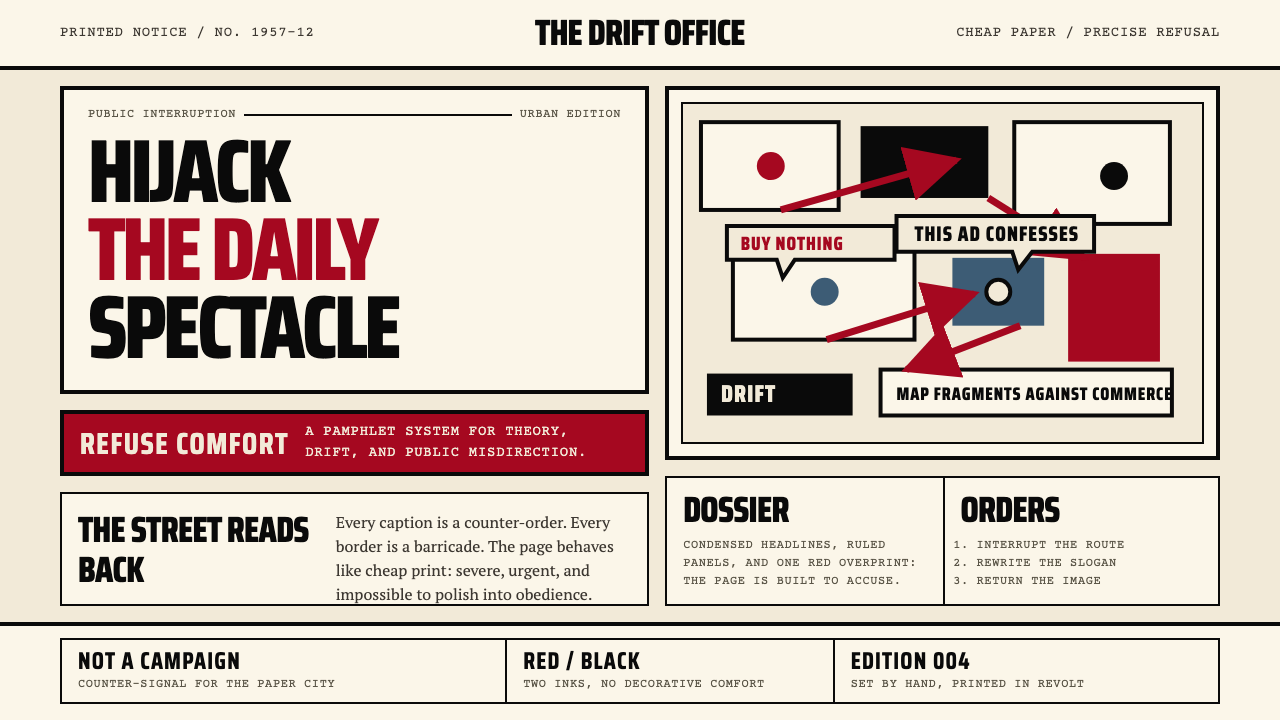 Situationist International (Debord, 1957)Agitation becomes structure. Red-black blocks and condensed type weaponize ne…
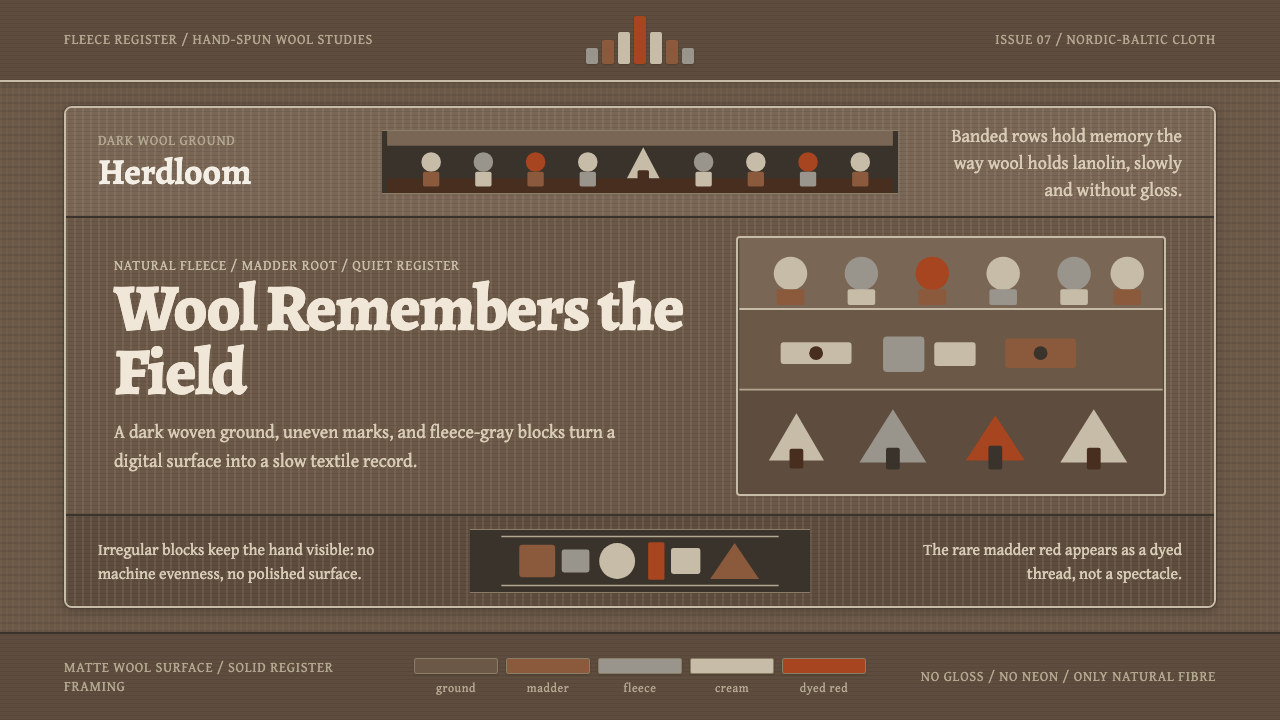 Estonian Folk Tapestry (Anu Raud)Quiet wool carries memory. Banded fleece browns and Alegreya type move like a…