What is Persepolis (Marjane Satrapi, 2000)?
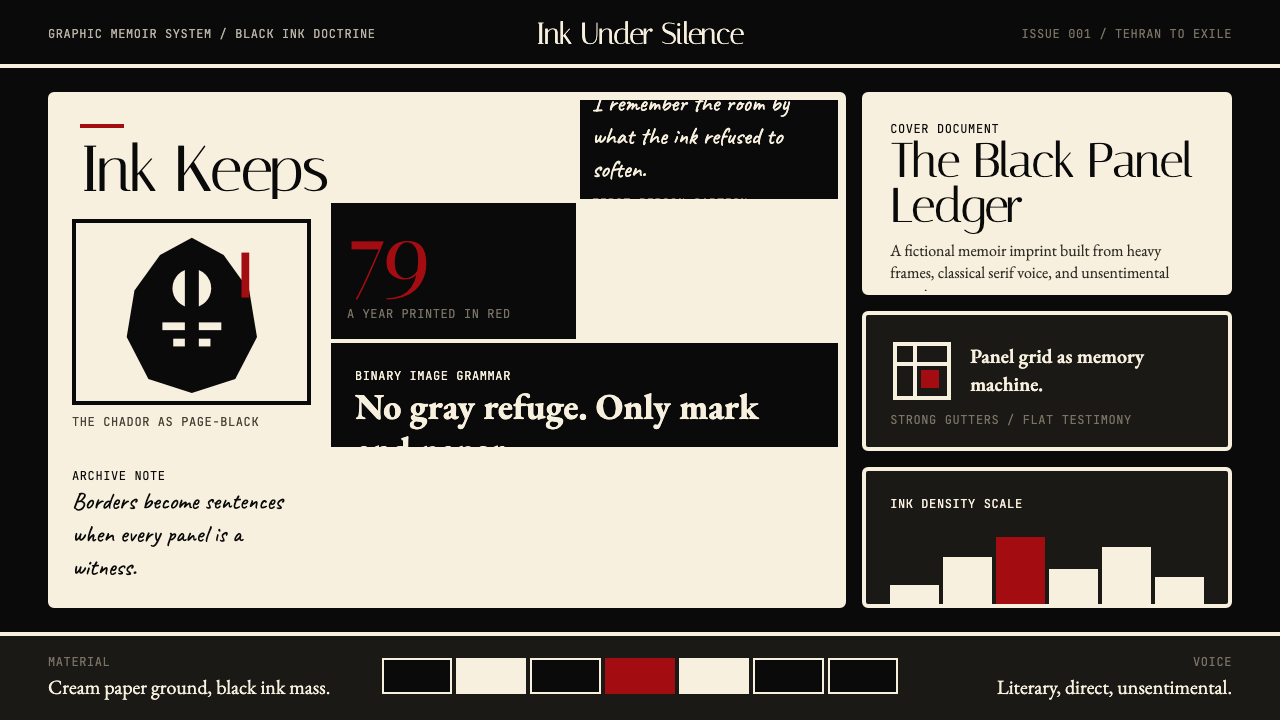
Persepolis translates the stark black-and-white ink language of Marjane Satrapi's Iranian-revolution memoir into a design vocabulary of cream grounds, heavy borders, and a single revolution-red accent that hits only when it must.
Persepolis (Marjane Satrapi, 2000) in brief
Persepolis is a graphic memoir published in four volumes by L'Association in Paris between 2000 and 2003, collected in English by Pantheon Books in 2003 and 2004, and adapted into an animated film in 2007. Its author and illustrator, Marjane Satrapi, depicts her childhood and adolescence in Tehran during and after the 1979 Islamic Revolution, her years as a teenager in Vienna, and her eventual return to Iran. The book's visual language — uncompromising black and white, dense ink, flat cut-out silhouettes, and the chador rendered as a pure page-black shape — became one of the most recognizable and studied aesthetic signatures of twenty-first-century literary comics.
As a design system, Persepolis translates that memoir vocabulary into a precise set of visual decisions: cream paper grounds that evoke archival print rather than digital white; bold black ink borders that frame every panel and component with the same weight a woodblock printer would apply; a revolution-red accent deployed with deliberate scarcity, so that its appearance carries emotional and structural significance; and warm classical serif typefaces that honor the literary-comics lineage of L'Association, whose editions were themselves objects of typographic care. The result is an aesthetic of controlled severity that reads simultaneously as personal, political, and authoritative.
The design system's central tension — between the intimacy of a handmade ink mark and the rigorous flatness of a cut-paper silhouette — mirrors Satrapi's own narrative tension between private memory and public history. This makes Persepolis particularly powerful for interfaces and editorial work that need to carry both intellectual weight and human directness: the visual language is stark enough to command attention but warm enough, through its cream grounds and serif letterforms, to sustain sustained reading.

Where does Persepolis (Marjane Satrapi, 2000) come from?
Marjane Satrapi was born in Rasht, Iran, in 1969 and grew up in Tehran in a secular, politically progressive family. Her great-grandfather had been a Qajar prince; her grandfather was a communist. This family history of navigating between privilege and dissent, between Iranian tradition and European intellectual life, gave Satrapi a particular vantage point on the Islamic Revolution of 1979 and the Iran-Iraq War that followed. At fourteen she was sent to Vienna by her parents to protect her from the worsening political climate, and it was the experience of cultural displacement — the foreigner in Europe, the Westernized girl in Iran — that would eventually become the emotional core of the book.
Satrapi studied illustration in Strasbourg and settled in Paris in the late 1990s, where she joined the orbit of L'Association, the French independent comics publisher founded in 1990 by a collective including David B., Jean-Christophe Menu, and Lewis Trondheim. L'Association was a decisive influence. The collective had established an aesthetic and ethical framework for the graphic novel as literary form: black-and-white printing as a commitment rather than a budget constraint, books as designed objects, and autobiographical and documentary subjects treated with the same formal rigor as fiction. David B.'s own memoir Epileptic — also black-and-white, also concerned with family, illness, and the surreal intrusions of history on private life — was a direct model for Satrapi's formal approach.
The visual language of Persepolis draws from three distinct genealogies. The first is Persian miniature painting, with its flat grounds, bold outlining, and figures arranged to convey narrative status rather than perspectival depth — Satrapi absorbed this tradition through Iranian culture and schooling, and its economy of line and symbolic use of scale are visible throughout the memoir. The second is German Expressionist woodcut printmaking, whose high-contrast black-and-white and emotional intensity Satrapi encountered through European art history and which gave her the formal permission to make heavy ink and sharp silhouette carry psychological weight. The third is the French alt-comics lineage of L'Association itself, with its insistence on the page as a designed surface rather than a transparent window onto story.
The four volumes were published as Persepolis (2000), Persepolis 2 (2001), Persepolis 3 (2002), and Persepolis 4 (2003). The Pantheon English translation, published in two volumes in 2003 and 2004, brought the work to international audiences and sparked a broad critical reassessment of graphic memoir as a literary form. The 2007 animated film, co-directed by Satrapi and Vincent Paronnaud, translated the flat black-and-white ink aesthetic into motion with exceptional fidelity — using animation not to add depth or color but to honor the original's commitment to silhouette, bold outline, and the chador as a graphic form. The film won the Jury Prize at Cannes and an Academy Award nomination for Best Animated Feature.
What defines the Persepolis (Marjane Satrapi, 2000) look?
Palette
The core palette is a strict three-way system: cream — an aged-paper warmth rather than a clinical white — serves as the ground for all panels and surfaces; dense, absolute black carries every border, silhouette, letterform, and shadow; and a single revolution red, used with exceptional restraint, marks the moments of maximum emotional or structural emphasis. This red does not appear as a gradient or ambient wash — it strikes as a flat, solid shape, the way a stamp or a censored passage might. The effect is that each red element reads as a deliberate event rather than a decorative choice.
Ink Border and Framing
Every panel, card, and content region is bounded by a heavy black border whose weight is consistent throughout — a direct translation of the comic-panel grid into interface design. The border is not a drop shadow or a subtle outline; it is an ink mark, opaque and intentional. This framing device gives every element the quality of a hand-composed page: contained, legible, and self-sufficient. When borders vary in weight — a thicker frame around a feature or a primary call to action — the variation reads as editorial emphasis, not decoration.
Flat Silhouette and Shape Language
Persepolis has no halftone, no gradient, and no rendered shading. Every figure, object, and illustration is reduced to its silhouette: a flat black shape on a cream ground, or a cream shape cut from black. This binary quality comes directly from Satrapi's woodcut-influenced line work and from the Persian miniature convention of arranging symbolic shapes rather than simulating three-dimensional space. In interface design this translates to icon systems and illustration styles that favor bold outlines over photographic realism, and to the avoidance of any texture or gradient overlay that would introduce the illusion of depth.
Typography and Serif Voice
Where most ink-heavy comic aesthetics pair with sans-serif or distressed display type, Persepolis draws on the L'Association tradition of treating the book as a literary object. Typography here is warm and classical: serif letterforms that read as authoritative and literary rather than utilitarian. Headline type is set at a large scale for immediate legibility and hierarchy; body text is generous in line spacing and narrow in measure, mimicking the column width of a well-set journal or small-press literary edition. Emphasis within text is achieved through bold weight or italic cut of the same face, never through decorative flourishes or competing type families.
Negative Space and Breathing Room
Despite the visual density of Satrapi's black ink panels, the page of Persepolis breathes through deliberate emptiness: cream gutters between panels, margins that allow the eye to rest before the next image, and the stark clarity of a white face against an all-black ground. In interface design, this translates to generous white or cream space around components, with content grouped in bordered panels rather than sprawled across an open canvas. The space between elements is not wasted — it is structural, giving the borders and type the room they need to read cleanly.
The Chador as Graphic Form
One of Persepolis's most distinctive visual inventions is the chador rendered as a flat black shape — an abstract form that reads simultaneously as clothing, censorship, and cultural imposition. In the design system this principle generalizes into a broader approach: dense, solid black shapes are used not as decorative fills but as meaningful presences, areas of high visual weight that demand the eye acknowledge them before moving on. A full-width black header band, a solid black sidebar, or a black framing element all carry this quality — they are not backgrounds but foreground statements.
Emotional Economy
Persepolis achieves its emotional power not through visual richness but through withholding. A single red splash in an otherwise entirely black-and-white spread becomes devastating precisely because the entire visual grammar has taught the reader not to expect it. The design system applies the same logic: decorative elements, gradients, and additional accent colors are not merely discouraged — they actively undermine the system's logic by diluting the semantic weight of the elements that do appear. Every element that exists must justify its presence; every element that is withheld creates the conditions for the next meaningful element to land with force.

Who shaped Persepolis (Marjane Satrapi, 2000)?
Satrapi is the author and illustrator of Persepolis and its primary creative intelligence. Born in Iran and educated in part in Vienna and Strasbourg, she brought to the graphic memoir a perspective shaped equally by Persian cultural memory, European art history, and the experience of political exile. Her decision to work exclusively in black and white was not a technical limitation but a formal argument: the absence of color imposed a discipline on the work that matched the austerity of the subject matter. After Persepolis, she continued as an author and filmmaker in Paris, and co-directed the 2007 animated adaptation. Her work is widely taught in university literature and visual culture programs as a canonical example of the graphic memoir as a serious literary and historical form.
Born Pierre-François Beauchard, David B. is one of the founding members of L'Association and the author of Epileptic (L'Ascension du haut mal), a graphic memoir about his family's experience with his brother's epilepsy. David B.'s visual language — dense black ink, surreal imagery drawn from dreams and historical fantasy, flat silhouettes arranged to communicate emotional rather than literal reality — was a direct predecessor and acknowledged influence on Satrapi's approach in Persepolis. He also served as an editorial mentor to Satrapi at L'Association, and his insistence on the graphic novel as a formally serious medium gave her the critical framework within which she developed her own visual voice.
Paronnaud, known in French comics under the pseudonym Winshluss, co-directed the 2007 animated film adaptation of Persepolis with Satrapi. His contribution was central to solving the formal problem of animating a work whose power derived from static ink marks: how to introduce movement without sacrificing the flatness, the silhouette quality, and the binary black-and-white logic of the original. The film's solution — preserving the hand-drawn line quality, using animation to extend rather than supplement the ink aesthetic, and avoiding the temptation of photorealistic rendering — demonstrated that the Persepolis visual grammar was robust enough to survive the transition to a time-based medium.
L'Association is the Paris-based independent comics publishing collective founded in 1990, whose influence on literary graphic novels in France — and eventually internationally — is comparable to the influence of literary small presses on prose fiction. By insisting on black-and-white printing, high production standards for binding and paper, and an authors-first editorial philosophy, L'Association established the conditions within which works like Persepolis could be conceived, produced, and taken seriously as literature. The collective's aesthetic stance — that the book is itself a designed object, that printing choices are artistic choices — is legible throughout Persepolis's visual grammar and the design system derived from it.
Satrapi has cited Persian miniature painting — the tradition of highly detailed, flat, jewel-colored manuscript illustration practiced in Iran, Central Asia, and the Mughal empire from the thirteenth through the seventeenth centuries — as a foundational visual influence. Persian miniatures organize figures and architecture across a flat picture plane without perspectival recession; status and narrative importance are communicated through scale and placement rather than spatial position. This convention is directly present in Persepolis's treatment of large-scale symbolic figures — the Shah, God, the Islamic Republic's officials — rendered as massive silhouettes against which small human figures are arranged to express power relationships without the mediation of pictorial depth.
How do you use Persepolis (Marjane Satrapi, 2000) today?
The Persepolis design system is most effective in contexts where moral seriousness, intellectual authority, and human directness are the desired communicative qualities — and where those qualities need to be achieved without the visual noise of photographic imagery, decorative gradients, or saturated multi-color palettes. The system's central challenge is restraint: because its power depends on the scarcity of the revolution-red accent and the stark authority of the black border, any tendency to accumulate decorative elements, introduce additional colors, or soften edges with transparency will progressively erode its effectiveness.
For presentation slides, the system yields a strong and distinctive visual identity at both cover and content levels. A cover slide works best with a large black framing element — a full-bleed black band at the top or a heavy bordered panel occupying most of the slide — with the title set in a large classical serif against cream, and the red accent appearing only for a single critical word or phrase. Content slides should be structured as bordered panels on a cream ground: each section of information is its own framed unit, headlines are set at high contrast against the cream background, and data visualizations use the three-system palette exclusively — cream for background, black for axes and labels, and red only for the single most important data series or threshold. This restraint makes red elements on data slides visually unmissable without any additional annotation.
For web interfaces, Persepolis works particularly well on dashboards, editorial platforms, documentation sites, and any application that positions itself as a serious intellectual tool rather than a consumer entertainment product. The approach: cream or very warm near-white for the page ground, heavy black borders for all card and panel components replacing any box-shadow or subtle border approach, classical serif for body text and headings, and revolution-red reserved exclusively for primary call-to-action elements, critical alerts, or the single most important interactive affordance per screen. Navigation should be typographic and weighted rather than icon-led; sidebar and header bands can use full black as a ground color with cream or white text, applying the same chador-as-foreground-presence principle of the source material.
For editorial and marketing contexts, the system's poster-like boldness supports strong information hierarchy across long-form articles, marketing landing pages, and printed collateral. An article layout benefits from a narrow measure for body text — mimicking the column discipline of literary journal design — with wide margins reserved for pull-quotes, footnotes, or section labels set in a smaller weight of the same serif family. Marketing pages work best with alternating full-width bands: cream ground with black type and a single red call-to-action button, followed by a full black band with cream type. The transition between bands should be a hard edge — the ink-border principle applied at page scale — with no soft gradient transitions or decorative separators.
A common and fatal mistake when applying Persepolis is treating it as simply a dark, edgy aesthetic and importing conventions from unrelated moody design systems — adding texture overlays, distressed paper effects, multiple accent colors, or soft ambient shadows. These additions violate the system's structural logic at a foundational level. The cream ground is not aged-paper texture; it is a flat, uniform color. The black borders are not vintage or distressed; they are precise, consistent, and intentional. The red is not a brand color used regularly throughout the interface; it is a sparingly deployed signal. Any element that introduces naturalistic simulation — texture that pretends to be paper, a shadow that pretends to be light — contradicts the entire formal argument of the source material and reduces a rigorous visual system to a mood board.

Persepolis (Marjane Satrapi, 2000) — FAQ
Can Persepolis work as a light-mode interface, or is it inherently dark?
The canonical form of the system is light: cream grounds, black borders, and the red accent on a pale surface. This is how the source material itself is printed — the page is light, the ink is dark. A dark inversion is possible — using a full black ground with cream typography and borders — but it should be applied to specific sections or panels rather than to the entire interface. A full dark-mode application of Persepolis risks losing one of its most important qualities: the chador-as-black-shape principle, where dense black areas read as meaningful presences against a lighter ground. On a full black background, those black areas disappear into the page and the visual grammar collapses.
How do I use the revolution red without it feeling arbitrary?
The red works because it is governed by an implicit rule: it appears only once, or at most twice, in any given view. Before placing a red element, ask whether it is the single most important thing the viewer needs to notice in this composition. If the answer is yes, place it. If there are two or more candidates for the red, that is a signal to reconsider the information hierarchy — either one of those elements is truly primary and the others are secondary, or the design is attempting to communicate too many priorities simultaneously. Treat the red as a scarcity resource. Its power is entirely a function of its rarity; every additional red element diminishes all the others.
Is this style appropriate for products aimed at general consumers, or is it too severe?
Persepolis is better suited to products where the user relationship is based on trust, knowledge, and seriousness rather than delight, playfulness, or sensory comfort. It fits well for financial tools, documentary platforms, literary publishing, serious journalism, research interfaces, and any product that wants to signal that it is treating its users as intelligent adults with important things to do. It is less well suited to food and beverage brands, children's products, lifestyle and wellness applications, social entertainment, and any context where the primary emotional register is warmth, ease, or fun. The style can work in consumer contexts if the product itself has an intellectual or political edge — a nonfiction book platform, a serious news application — but it should not be applied simply because black and white feels modern or minimal.
How does this design system differ from other black-and-white minimal aesthetics?
Most contemporary black-and-white minimal aesthetics — Swiss International Style derivatives, Scandinavian minimalism, brutalist web design — achieve their effect through subtraction: removing color, reducing type, eliminating ornament until the design approaches a kind of pure structural abstraction. Persepolis is different in that its black-and-white language is not abstract or neutral; it is specific, emotionally weighted, and narratively charged. The heavy border is not a structural grid element — it is an ink mark. The cream ground is not a neutral white — it is a material surface with warmth and age. The silhouette figures are not icons — they are characters with political and emotional context. This specificity is both the system's strength and its constraint: it communicates with great force in contexts where that emotional charge is an asset, and it can feel oppressively specific in contexts that call for neutrality.
What typography mistakes should I avoid?
The most common typographic mistake is switching to a sans-serif typeface on the grounds that it feels more modern or clean. A sans-serif face applied to the Persepolis system immediately severs the connection to the L'Association literary tradition and shifts the aesthetic toward a generic technical minimalism that competes with dozens of other design systems rather than occupying its own distinct territory. A second common mistake is using the system's boldness as permission for chaotic typographic variety — mixing multiple serif families, applying color to type beyond the three-system palette, or using display type that is more decorative than authoritative. The system works through typographic discipline: one family, clear hierarchy through size and weight, black or cream for all text, and the red used at most for a single typographic accent such as a pull-quote attribution or a critical data label.
Related design styles
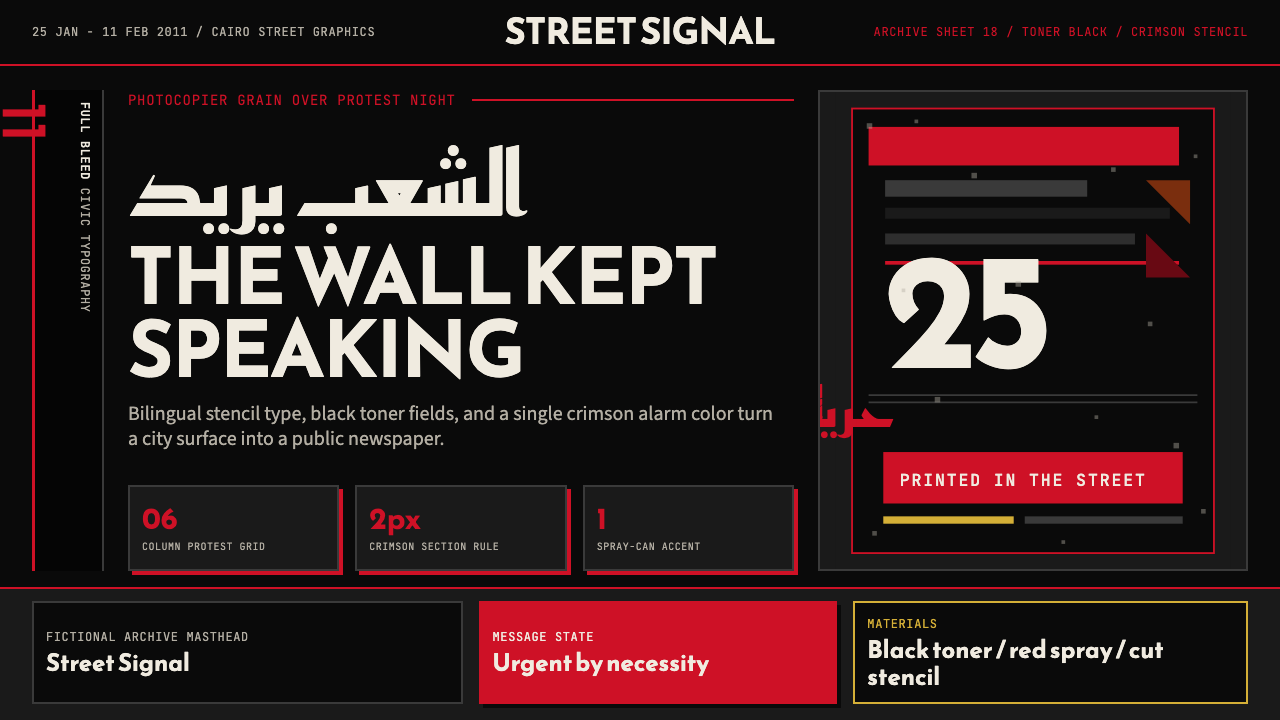 Tahrir Square 2011Civic signal, not polish. Photocopier black and crimson stencils on a hard gr…
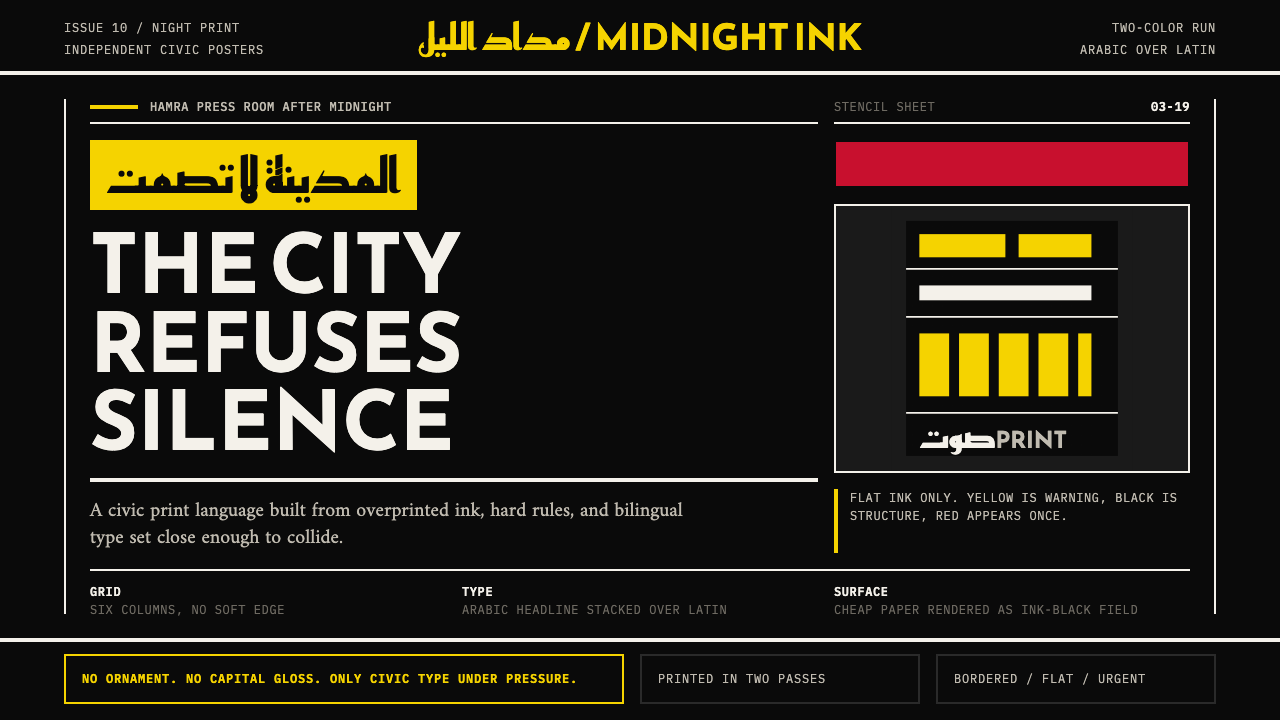 Beirut Indie Graphic DesignCivic type as protest. Sulfur yellow Arabic blocks collide with ink-black pos…
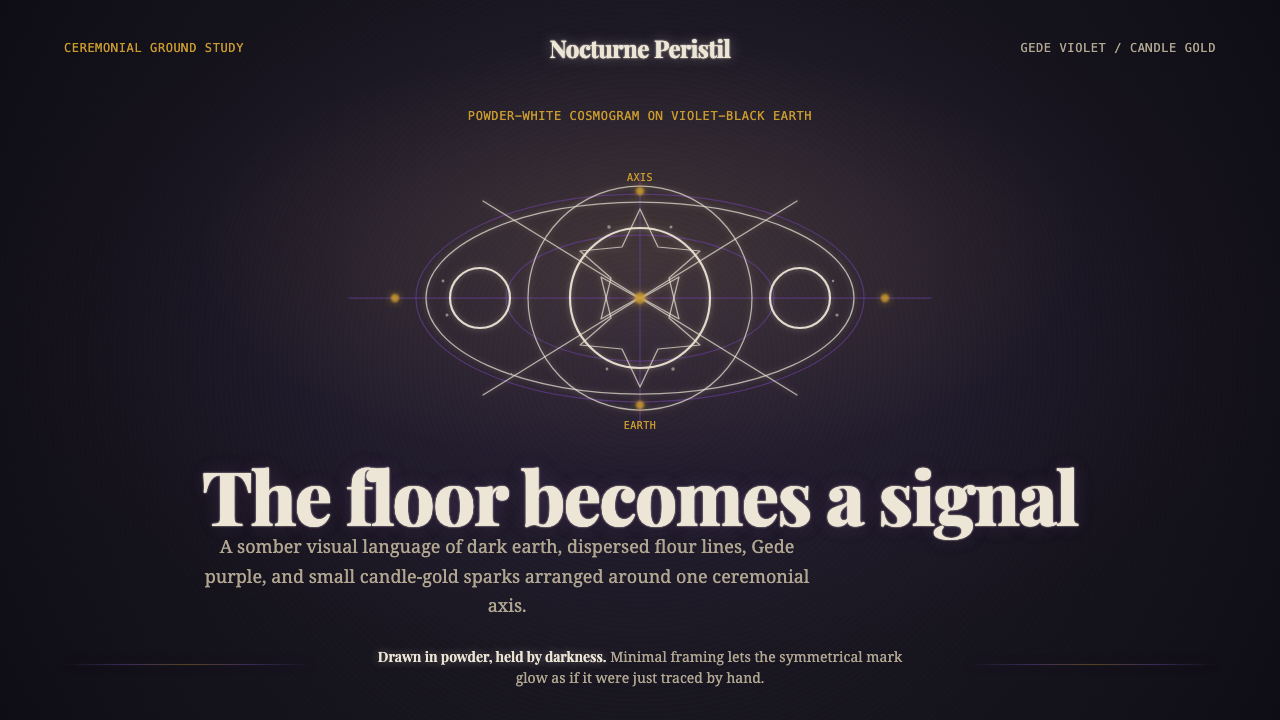 Haitian Vodou VèvèSomber ritual glow. Powder-white lines on violet-black earth, touched by cand…
 Tunisian Jasmine Revolution (2010)Raw urgency wins. Red browser grids and mono hashtags compress 3am protest in…
 Art Brut (Dubuffet)Polish is refused. Bone-cream paper, earth pigments, scratched borders, dense…
 Data Humanism (Lupi)Data feels authored. Near-black fields carry serif notes and categorical hand…