What is Fluxus Event Score (1962)?
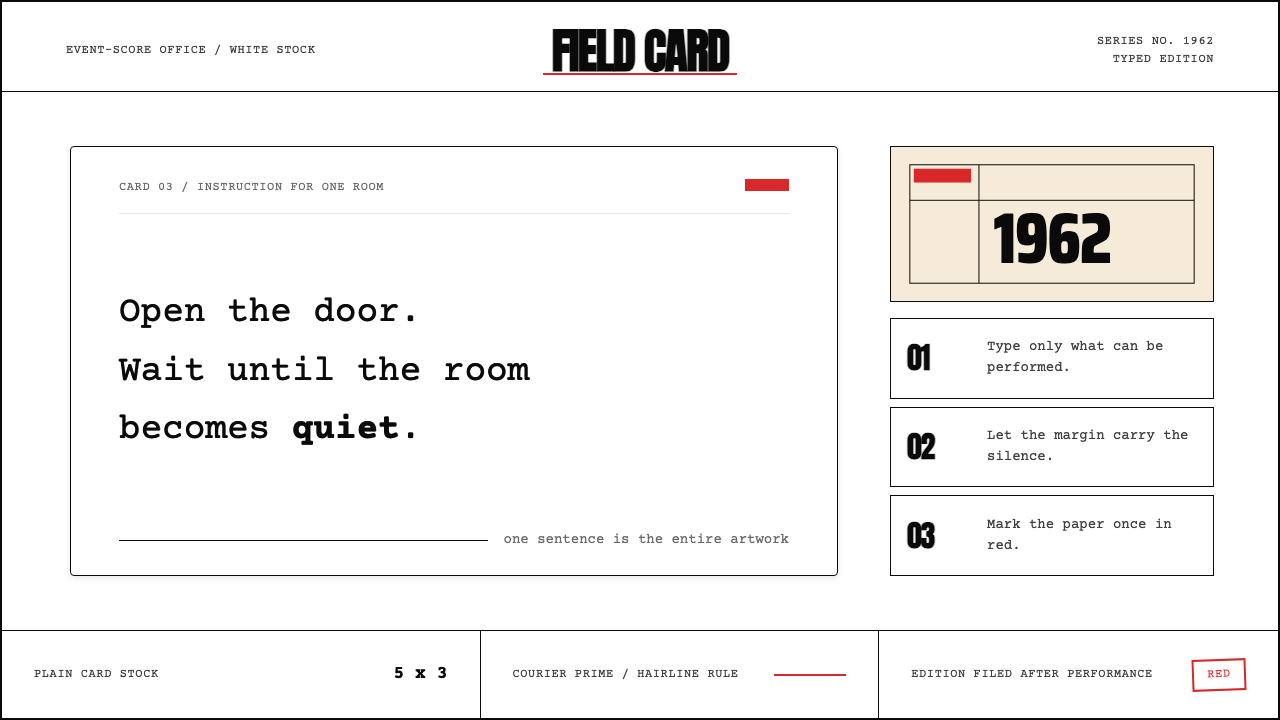
Fluxus reduced art to a single typewritten instruction — proof that a sentence on a white card could carry the full weight of an artwork.
Fluxus Event Score (1962) in brief
Fluxus Event Score is both a movement and a visual system born from the radical conviction that art needs no object, no gallery, no trained eye — only an instruction. An event score is typically a single sentence or short sequence of sentences typed in a monospaced typeface on a white index card or sheet of paper: 'Light a match. Watch it until it goes out.' The card is the work. The reading is the performance. The design system takes this irreducible format and transforms it into a transferable visual language.
The aesthetic vocabulary is deliberately minimal: monospaced type on white card stock, hairline rules to separate sections, generous margins on all sides, and an almost total restriction of color to black ink with rare, emphatic marks in a sharp, saturated red. There are no illustrations, no decorative borders, no gradation of tone. Every element on the page is functional — it is either language or structure, instruction or division. Anything that cannot justify its presence as one of these things does not appear.
What makes the Fluxus Event Score system distinctive is the weight it places on white space and the authority it gives to plainness. The monospaced typeface carries the deliberate impersonality of bureaucratic or scientific documents — yet in this context that impersonality becomes a form of radical democracy. No element asserts status above another. The instruction addresses anyone equally. The page withholds beauty in order to insist that the action described is itself the beautiful thing.

Where does Fluxus Event Score (1962) come from?
The Fluxus network was coined as a term in 1961 by Lithuanian-American artist and designer George Maciunas, who was living in New York and working as a graphic designer. He envisioned Fluxus not as a style but as a strategy: a collective of international artists, composers, and poets who would dissolve the boundaries between art forms and between art and everyday life. The word itself — from the Latin for flow, flux, and change — captured the movement's resistance to fixed categories. Maciunas's first major act was organizing the International Fluxus Festival in Wiesbaden, Germany, in September 1962, which is conventionally taken as the movement's public birth.
The event score as a format emerged directly from the influence of American composer John Cage, whose class at the New School for Social Research in New York between 1957 and 1959 became a crucible for what would become Fluxus. Cage's students — among them George Brecht, Allan Kaprow, and Dick Higgins — were taught to think of sound events as open instructions rather than fixed compositions. George Brecht began publishing his 'event scores' on small cards in the early 1960s: concise poetic instructions like 'Two signs. / Smell / No Smell.' Yoko Ono's 1964 book Grapefruit, composed entirely of instruction pieces, became perhaps the most famous product of this approach and helped introduce it to mass audiences.
Maciunas himself was the movement's primary typographer and graphic designer. His approach to layout was shaped by his commercial design training and by his interest in Soviet Constructivism and Dadaist typography. He designed the visual format — the Fluxus 'house style' — for the event score cards, publications, and multiples that the network produced throughout the 1960s and 1970s: Courier or another monospaced typeface, horizontal rules, white grounds, occasional red marks. This was not an arbitrary style choice but a philosophical one: the impersonal, clerical appearance of the typewriter was itself a statement against the precious, hand-crafted object of traditional art.
The movement's centers shifted between New York, Wiesbaden, and Tokyo, and its participants included figures working in music, performance, film, and visual art across Europe, North America, and Japan. Alison Knowles contributed domestic event scores — instructions involving beans, sandwiches, and everyday household acts — that grounded the form in material life. Nam June Paik, later famous as a video artist, was present at the first Wiesbaden festival and contributed to the blurring of music, performance, and object. The movement remained active through the 1970s, and Maciunas continued producing Fluxus publications and editions until his death in 1978, after which the format passed into the broader history of conceptual art and intermedia practice.
What defines the Fluxus Event Score (1962) look?
Monospaced Typography
The defining typographic choice of the event score is the monospaced face — Courier being the canonical example — which carries the deliberate impersonality of the typewriter. Each character occupies the same horizontal width, producing an even, grid-like rhythm that resists expressiveness and signals that the text is instruction rather than authorial voice. Type size is modest and consistent; there is no headline hierarchy in the conventional sense, only the instruction itself, set at a single measured weight.
White Ground and Generous Margins
The page or card is white — not off-white or cream, but a clean, uncoated white that recalls clerical paper and index cards. Margins are deliberately wide relative to the text block, giving the instruction a quality of isolation that amplifies its weight. The white space is not empty but active: it is the silence before and after the instruction, the equivalent of the pause in a musical score. This use of space prevents the eye from treating the page as dense content and instead focuses attention on the single directive.
Hairline Rules as Structural Division
Where division between sections is needed, the event score uses a hairline rule — the thinnest printed line possible — rather than any decorative separator. The rule is structural, not ornamental: it marks a boundary without adding visual weight. In multi-part scores, hairline rules separate individual instructions from titles, dates, or labels. Their fineness reinforces the economy of the entire system: every mark on the page is the minimum necessary mark.
Fluxus Red as the Single Accent
The palette is almost entirely achromatic — black type on white ground — with one exception: a sharp, saturated red that appears sparingly and with deliberate purpose. This red is not decorative but emphatic; it might mark a title, a number, a critical word, or a section divider. Its scarcity is what gives it force. Against the austerity of the black-and-white field, a single red mark reads as urgent, as an alarm, as the one moment when the instruction raises its voice. No other color appears.
Instruction as the Sole Content
No illustration, no photograph, no decorative device accompanies the text. The instruction is the entire content of the piece. This formal decision is also a philosophical statement: representation is unnecessary when the language is precise enough. The absence of imagery forces the reader to supply the scene mentally, transforming the score into a collaborative act. Any design application drawing on this system inherits that discipline — if an element does not contribute to the instructional function of the page, it does not belong.
Democratic Impersonality
The event score's format is deliberately impersonal: it looks like a memo, a label, a form. This impersonality is a political choice. Traditional fine art was marked by the artist's hand — brushwork, gesture, signature style — which conferred uniqueness and market value. The Fluxus score removes all of this. Any typewriter could have produced it; any person can perform it. The design system carries this democratic quality: no flourish signals the designer's presence, no craft element asserts specialness. The work belongs to whoever reads and enacts it.
Economy and Compression
The event score achieves its power through radical compression: a complete artwork contained in one to three sentences, an entire visual system expressed in fewer than five design decisions. This economy is not a limitation but a demonstration — proof that the smallest unit of language, presented with sufficient clarity and intention, can activate the imagination fully. In design terms, this means every decision is load-bearing. There is no background noise, no supporting cast, no ambient texture. What remains after compression is what matters.

Who shaped Fluxus Event Score (1962)?
Maciunas was the organizer, publisher, and graphic designer of Fluxus — the figure who gave the movement its name, its house style, and its institutional infrastructure. A trained architect and graphic designer, he developed the visual vocabulary of event score cards, Fluxus editions, and collective publications from 1961 until his death in 1978. His design decisions — monospaced type, white grounds, hairline rules, the occasional red mark — were not decorative preferences but philosophical positions about the relationship between art, labor, and everyday objects. He also organized or co-organized the major early Fluxus festivals in Wiesbaden, New York, and elsewhere, securing the network's international reach.
Brecht is credited with crystallizing the event score as a form. A former chemist turned artist, he attended John Cage's legendary New School class and began publishing his 'Water Yam' card scores in the early 1960s — concise printed cards containing minimal instructions for events, actions, and observations. His scores are models of compression: often a single word or phrase, a list of two or three items, or a simple binary ('on / off'). Brecht's approach established that the event score did not need to describe complex actions — the simplest possible instruction, presented with formal precision, was sufficient.
Ono's 1964 book Grapefruit, a collection of instruction pieces spanning music, painting, event, and film, became the most widely read artifact of the event score tradition and helped translate Fluxus sensibilities to a global audience. Her instructions range from the intimate ('Touch me somewhere' instructions for audience interaction) to the durational ('Carry a bag of peas. Leave a pea wherever you go.') to the cosmic ('Draw a map to get lost.'). Ono's work demonstrates the breadth of the form and its capacity to carry humor, tenderness, and political charge within the same minimal typographic container.
Knowles was a founding member of Fluxus and one of the few women central to its early history. Her event scores focus on the domestic, the sensory, and the participatory — most famously her 'Make a Salad' (1962), which has been performed in concert halls, art spaces, and public squares worldwide for over six decades. Knowles grounds the event score in material reality, emphasizing texture, smell, and physical action as legitimate artistic content. Her work demonstrates that the Fluxus system is not cold or conceptually remote but capable of warmth, community, and shared experience.
Though not formally a Fluxus member, Cage is the intellectual godfather of the event score. His classes at the New School for Social Research (1957–1959) and his theoretical writings — particularly 'Silence' (1961) — established the conceptual framework within which event scores became possible: that music is organized sound and silence, that chance operations are valid compositional tools, and that the boundary between art and life is arbitrary. His 4'33'' (1952), a silent composition consisting entirely of the instruction to not play for four minutes and thirty-three seconds, is the originating event score, predating Fluxus by nearly a decade.
How do you use Fluxus Event Score (1962) today?
The Fluxus Event Score system is exceptionally well-suited to contexts where authority, precision, and conceptual clarity are the desired signals — and where conventional design 'richness' would undermine rather than support the message. Applying it correctly requires internalizing its core discipline: every element must justify its presence as either language or structure. If it is neither, it does not belong on the page.
For presentation slides, the system works best when the content itself is instruction-like: step-by-step processes, principles, frameworks, or rules. A cover slide in this style uses a large monospaced title on a white ground, optionally with a single hairline rule below it and a minimal date or category label. Content slides present one to three items per page, typeset in a monospaced or near-monospaced face, with generous surrounding white space. A single red mark — a number, a bullet, a line — can anchor the hierarchy without competing with the text. Data slides take on the quality of lab reports or research printouts: tabular, ruled, and achromatic except for one accent element that draws the eye to the key figure.
For web interfaces, this visual language is particularly powerful for products that want to communicate precision, methodology, or intellectual rigor — developer tools, research platforms, legal or compliance interfaces, and documentation systems. The approach: near-white or pure white background, a single monospaced or geometric typeface throughout, black for all body text, hairline borders on cards and input fields rather than soft shadows, and the saturated red reserved for alerts, required fields, or critical-path interactions. Navigation is typographic; icons, if any, are geometric and minimal. The absence of decorative imagery is a feature, not a gap.
For editorial and marketing work, the event score system excels when the message itself is the product — manifestos, principles pages, open letters, or any content where the words need to carry full weight without visual support. A Fluxus-derived editorial layout treats the page as a card: one instruction or argument per section, section breaks marked by a hairline rule, no pull-quote ornamentation, no sidebars filled with imagery. Marketing applications work when the brand is willing to let plainness be the provocation — a product page that offers a numbered list of commitments on white, with one red accent on the most important line, communicates a different kind of confidence than a richly visual brand page.
A common mistake when applying this system is mistaking austerity for emptiness and filling the page with additional elements to compensate for the absence of decoration. The white space in event score design is not a problem to be solved — it is the solution. A second frequent error is using the monospaced typeface as a stylistic affectation while retaining conventional visual hierarchy signals: soft shadows, multiple colors, gradient fills. These undermine the system's logic entirely. The Fluxus aesthetic works only when the restraint is total: one typeface, one accent color, no gradients, no decoration. Half-measures produce pastiche.

Fluxus Event Score (1962) — FAQ
Is Fluxus Event Score the same as minimalism?
They share a commitment to reduction but differ fundamentally in purpose. Minimalism as a visual style — in contemporary design or in the fine art movement of the 1960s — is concerned with the aesthetic experience of reduction itself: the satisfaction of the spare, the elegant, the carefully composed absence. Fluxus austerity is not aesthetic but ideological. The page is stripped because decoration is a lie — because the appearance of craft and luxury in art is a form of social gatekeeping. The minimal Fluxus page is not beautiful on purpose; it is impersonal on purpose. When applying the style, this distinction matters: a Fluxus-derived design that is too polished or too considered starts to look like minimalism, losing the democratic roughness that gives the original its charge.
Can this system work in a color-forward brand context?
The event score system depends on the near-total absence of color for its impact. Introducing a second or third accent color does not merely dilute the effect — it dismantles the logic entirely. The red mark reads as urgent precisely because nothing else on the page is red. If you add a blue and a green for secondary meanings, the red becomes just another color and the urgency disappears. A brand that requires a full color system should look elsewhere. However, the structural principles — monospaced type, white ground, hairline rules, generous margins, no decoration — can be applied as a typographic framework even if the accent color is drawn from the brand palette rather than Fluxus red. The key constraint is that there must be only one.
How do you handle imagery in this system?
The canonical answer is: you do not. The event score is a text-only medium by design, and its power depends on that restriction. In practical design applications — where some imagery may be unavoidable — the closest equivalent is a high-contrast reproduction: a black-and-white photograph or diagram treated as a flat geometric element, cropped tightly, without soft vignettes or naturalistic gradients. The image should feel like a document scan or a technical illustration rather than an editorial photograph. What the system cannot accommodate is warm, atmospheric, or stylistically rich imagery — lifestyle photography, illustrated figures, or any image that competes with the text for emotional weight.
What kinds of products or contexts is this system poorly suited to?
The Fluxus Event Score aesthetic is a poor fit for any context where warmth, sensory pleasure, or visual accessibility are primary values. Consumer products aimed at broad audiences — food, wellness, fashion, entertainment, children's products — depend on imagery, color warmth, and the kinds of visual richness that this system explicitly refuses. The style can also read as cold, clinical, or exclusionary to audiences unfamiliar with conceptual art contexts, making it risky for consumer-facing emotional touchpoints. Additionally, the system's reliance on monospaced type creates legibility considerations at small sizes and on lower-resolution screens — it is a deliberate typographic constraint that rewards careful attention, which is an asset in some contexts and a liability in others.
How does Fluxus Event Score relate to conceptual art more broadly?
The Fluxus event score is one of the earliest and most direct expressions of the conceptual art proposition that the idea is the work — that physical execution is secondary or optional. Sol LeWitt's wall drawings, Lawrence Weiner's language pieces, and the entire tradition of instruction-based art that followed in the 1960s and 1970s are all in dialogue with the event score format. What distinguishes the Fluxus contribution is its emphasis on performance, participation, and humor — the instruction is meant to be enacted, often in public, often by non-specialists. Where later conceptual art often maintained the institutional frame of the gallery and the critical apparatus of the art world, Fluxus specifically worked to dismantle both. The visual system reflects this: the index card is available anywhere, printable by anyone, readable without training.
Related design styles
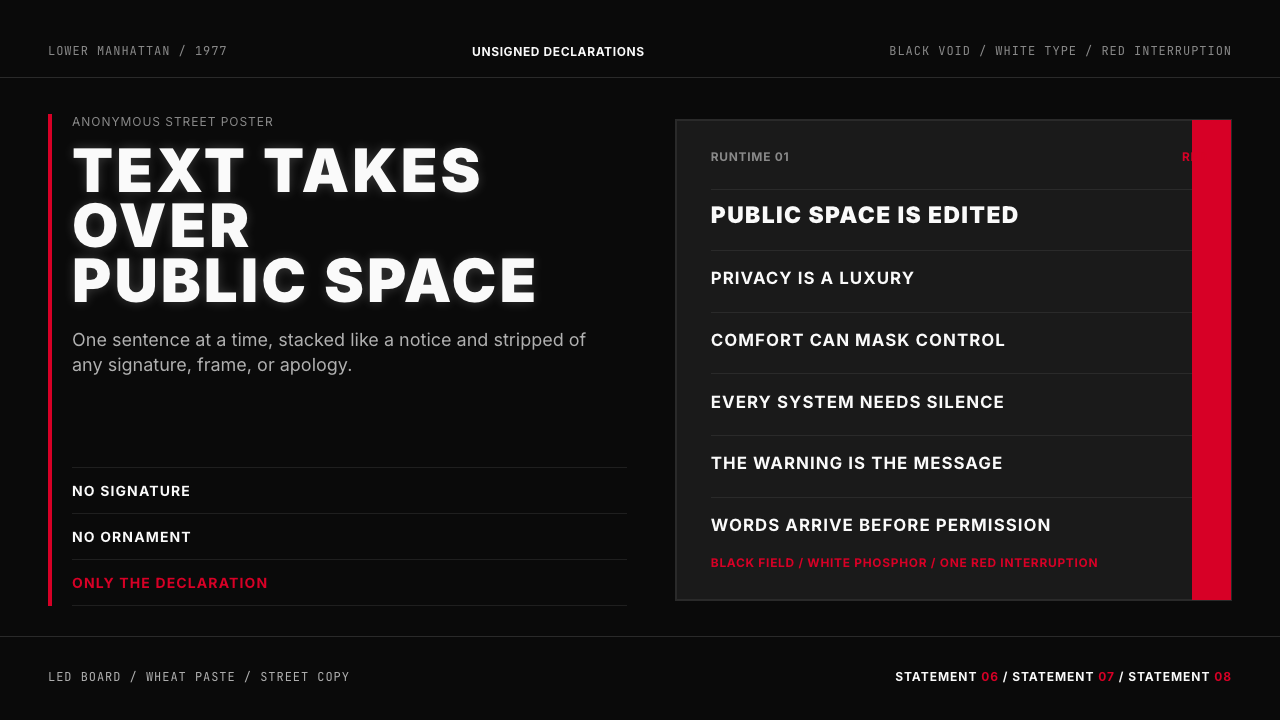 Jenny Holzer Truisms (1977)Austere declarations. White all-caps on black, cut by a single red warning.
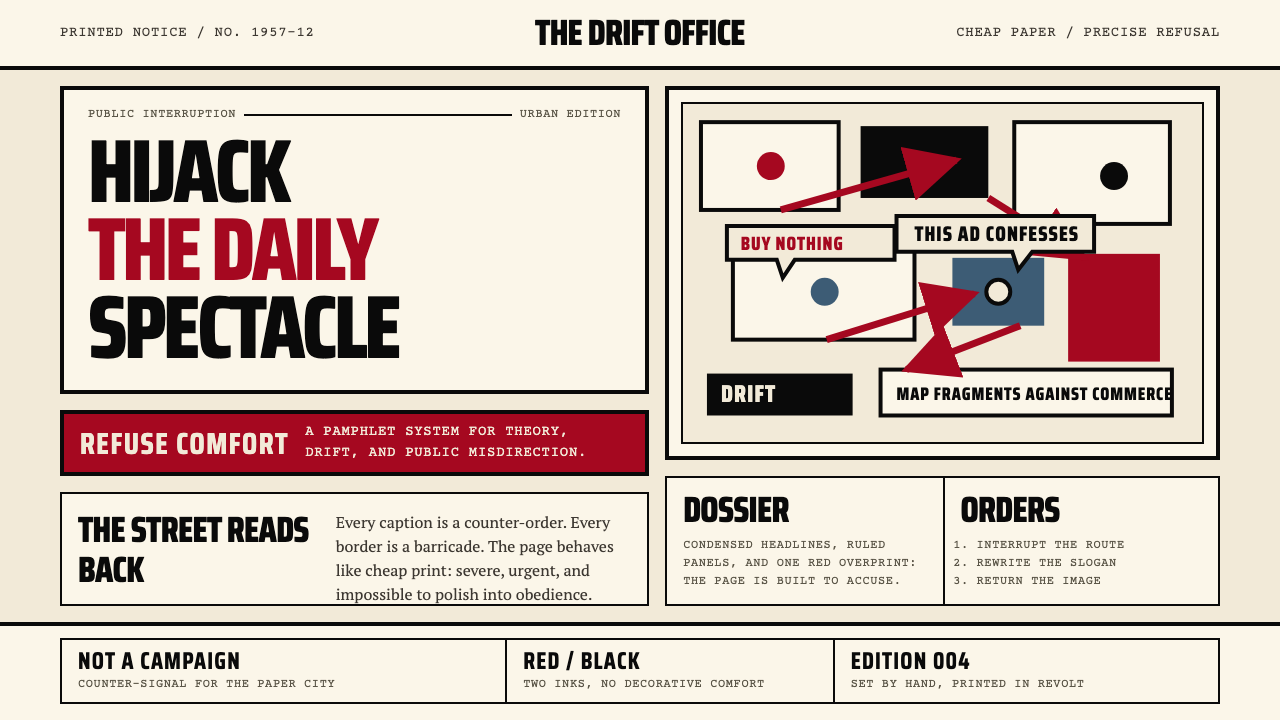 Situationist International (Debord, 1957)Agitation becomes structure. Red-black blocks and condensed type weaponize ne…
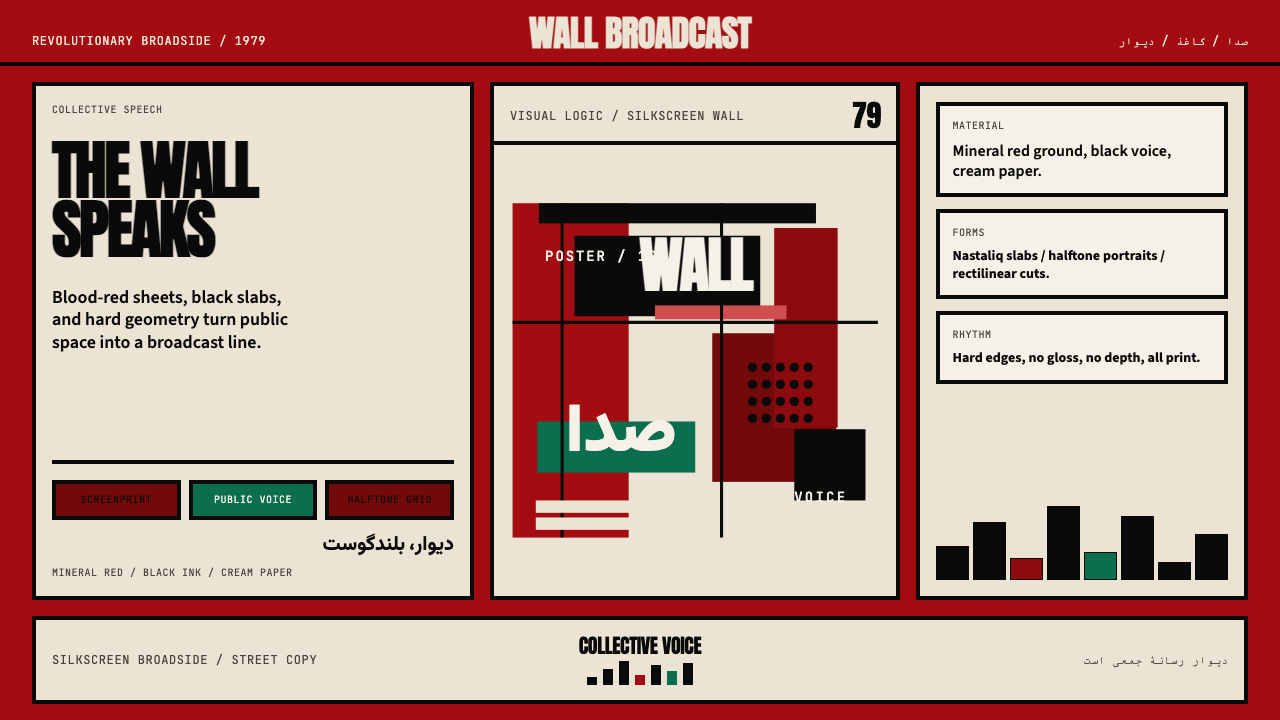 Iranian Revolution Poster (1979)Collective voice in ink. Blood red, black slabs, and hard screenprint geometr…
 Kanye — 808s & HeartbreakGrief in restraint. Cream paper, one red heart, yellow heat, and a black hair…
 Sol LeWitt ConceptualInstruction becomes art. Mono certificates face wavering graphite grids in fo…
 Brazilian Concrete PoetryWords become objects. Monospace cells, black-white paper, one cadmium red rup…