What is Kanye — 808s & Heartbreak?
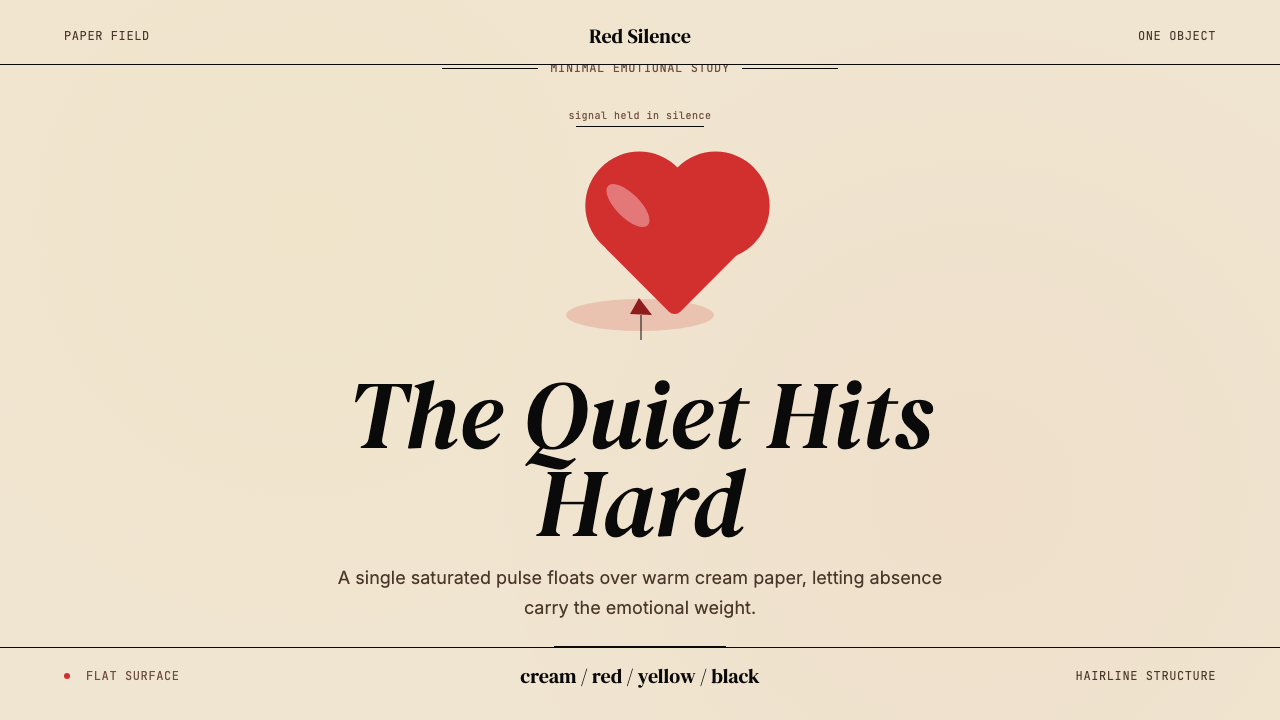
One deflated heart on cream paper — grief reduced to a single object, a single color, and an immensity of silence.
Kanye — 808s & Heartbreak in brief
808s & Heartbreak is the visual and sonic identity Kanye West constructed around his 2008 album of the same name — a record that replaced hip-hop bravado with Auto-Tune vulnerability and conceptual-art restraint. The aesthetic takes its name and logic from the album cover: a single deflated red heart-balloon painted by New York artist KAWS (Brian Donnelly), floating against an expansive warm cream ground, bordered by a thin black hairline and punctuated by a stripe of hot yellow. Nothing else competes for attention. The composition is so bare that every element carries outsize emotional weight.
The design language that emerges from this cover — and that has since been absorbed into a wide current of post-2008 rap, streetwear, and graphic design — is defined by monastic restraint. One saturated focal object. Vast negative space in a warm neutral tone. Generous letter-spacing applied to sparse type. An accent color so electric it reads as alarm rather than decoration. The result is an aesthetic of contained grief: the emotion is not performed through ornament or complexity but held at a distance inside enormous quiet.
What separates the 808s aesthetic from generic minimalism is its specific emotional register. This is not the cool neutrality of Swiss rationalism or the confident austerity of Bauhaus functionalism. The palette is warm rather than cold; the single object is figurative and universally legible rather than geometric and abstract; the emptiness is melancholic rather than efficient. It belongs to a tradition of conceptual album art — Warhol's Velvet Underground banana, Peter Saville's Joy Division topographies — but inflected through hip-hop's scale and mainstream reach.

Where does Kanye — 808s & Heartbreak come from?
Kanye West entered the studio for 808s & Heartbreak in the autumn of 2008 under the compressive weight of two simultaneous losses: the death of his mother, Donda West, in November 2007 from post-operative complications, and the end of his engagement to fashion designer Alexis Phifer in early 2008. The album — recorded in Honolulu in a concentrated burst of weeks — discarded the maximalist production that had defined his previous three records in favor of an almost architectural sparseness. The Roland TR-808 drum machine, whose booming synthetic kick had defined a generation of southern hip-hop, was used not for energy but for melancholy: steady, mechanical, emotionally flat. Auto-Tune was applied to his vocals throughout, not as a corrective but as an aesthetic choice — distance, artificiality, and vulnerability at once.
The cover commission went to KAWS, who by 2008 had already built a practice at the intersection of street art, fine art, and commercial product design. KAWS is best known for his subversive reworkings of cartoon imagery — replacing eyes with crossed-out X's, disrupting familiar characters with his own visual signatures. For 808s, he contributed a more restrained image: a single heart-balloon rendered with the simplified graphic clarity of illustration rather than the gestural energy of street painting. The balloon is deflated, its form collapsing, its surface retaining the shine and curve of an object that was once full of air. The KAWS attribution anchored the album's visual identity within the crossover zone between contemporary art collecting and streetwear — a cultural position Kanye had been building deliberately since at least 2007.
The hot-yellow accent color that frames the cover — and that recurs across the album's visual rollout, merchandise, and stage design — connects the work to a broader visual language Kanye had been developing in collaboration with Virgil Abloh and other creative collaborators from his Chicago circle. This color, occupying a register between caution signage and neon warmth, functions as a kind of emotional alarm: it signals urgency without decoration, energy without celebration. It would recur across much of the subsequent creative output from this circle, eventually becoming a signature of the Abloh-era aesthetic that shaped streetwear and luxury fashion through the 2010s.
808s & Heartbreak arrived at a specific cultural inflection point in hip-hop. The dominant aesthetic in 2008 was still oriented around maximalism — dense production, conspicuous display, layered signification. West's deliberate retreat from that visual and sonic grammar was widely read at the time as commercial risk; it subsequently proved enormously influential. The album gave aesthetic permission for vulnerability in mainstream rap and demonstrated that conceptual-art logic — including the logic of the deliberately empty, deliberately plain — could operate at pop scale. Artists including Drake, Kid Cudi, Frank Ocean, and later a generation of SoundCloud rap producers drew directly on the emotional and visual vocabulary 808s established.
What defines the Kanye — 808s & Heartbreak look?
Color: Cream Ground
The foundational color is not white but warm cream — the tone of aged paper or uncoated stock. This warmth prevents the palette from reading as clinical or sterile. It gives the negative space an organic quality, as if the surface itself has been through something. Against this ground, the single saturated focal object reads with the quiet force of a specimen on a slide: isolated, legible, complete.
Color: Single Saturated Accent
The primary saturated color — a deep, slightly cool red — is used on exactly one object, the heart. It does not recur as decoration, text color, or background fill. This extreme restraint in application gives the red an almost physical weight. The yellow accent, equally saturated, appears as a stripe or border element — not a competing focal point but a frame that heightens the tension the heart already generates.
The Central Object
The defining compositional move is the placement of a single figurative object at the center of enormous negative space. The object must be universally legible — a heart, not an abstraction — and must carry an immediate emotional charge. It is also specifically depicted in a state of diminishment: deflated, partially collapsed, past its fullness. The emotional content is encoded in the object's condition, not in surrounding context or text.
Negative Space as Emotional Register
The most technically distinctive element of the aesthetic is the scale of the empty field relative to the focal object. The cream ground is not a neutral backdrop — it is an active presence. Grief, in this visual logic, is not depicted through expressionistic marks but through the absence of marks: silence rendered as space. The larger the empty field, the greater the felt weight of the lone object within it.
Typography: Editorial Restraint
Type in this aesthetic is sparse, widely spaced, and set at a scale that does not compete with the image. Letter-spacing is generous to the point of near-dissolve — titles and credits breathe across the field rather than clustering. Typeface selection leans toward clean, unornamented letterforms. The typographic approach matches the visual system's core principle: the message is in what is absent, not in what is elaborated.
The Thin Black Hairline
A defining structural detail is the use of a hairline-thin black border or rule — appearing on the album cover as a framing device. This element performs two functions: it provides a precise geometric container that makes the warmth of the cream interior feel intentional and curated rather than undefined, and it introduces a note of editorial precision into what might otherwise read as purely emotional image-making. The hairline is a reminder that this restraint is controlled, not absent.
Flatness and Gloss
The 808s aesthetic does not commit to total flatness in the way Bauhaus or Swiss design does. The single focal object — the heart balloon — is rendered with surface gloss and volume, referencing KAWS's practice of translating cartoon-adjacent characters into sculptural or dimensional forms. This controlled introduction of depth, limited to the one object, intensifies its isolation against the flat cream field. The tension between the object's dimensionality and the ground's flatness is part of the aesthetic's emotional charge.

Who shaped Kanye — 808s & Heartbreak?
West conceived and directed the overall visual and sonic identity of 808s & Heartbreak, making the fundamental decisions — the sparse production palette, the use of Auto-Tune as aesthetic rather than corrective tool, the choice of KAWS as visual collaborator — that gave the project its specific emotional logic. His willingness to expose grief and artistic uncertainty at the height of his commercial power changed the terms on which emotional vulnerability was legible in mainstream hip-hop. The album's visual restraint reflects his deepening engagement with conceptual art and his ongoing relationships with figures from contemporary art and fashion.
KAWS is a New York-based artist whose practice spans painting, sculpture, and product design. Beginning in the late 1990s with unauthorized interventions into public advertising — replacing the faces of billboard characters with his signature crossed-out X eyes — he built a reputation straddling street culture and fine art collecting. His contribution to 808s is characteristically precise: the deflated heart retains the graphic simplicity of illustration while carrying the emotional specificity of sculpture. KAWS's crossover status — simultaneously collected by museums and sold in streetwear drops — perfectly matched the cultural position West was building for the album.
Abloh, a close creative collaborator of West's from their shared Chicago roots, was involved in the broader visual direction and merchandise design that extended the 808s aesthetic beyond the album cover itself. His contribution to defining the hot-yellow accent color as a recurring signature — and his subsequent use of that color logic across his own fashion practice, most visibly in Off-White — demonstrates how the 808s visual vocabulary propagated through the creative network surrounding West. Abloh's later career as creative director at Louis Vuitton menswear amplified many of the same principles: bold graphic restraint, conceptual-art reference, and the legibility of a single strong visual statement.
Kanye West's mother and most steadfast creative supporter, Donda West was a professor of English and chair of the English department at Chicago State University before devoting herself to managing her son's career. Her death in November 2007 at the age of 58 was the primary biographical catalyst for 808s & Heartbreak. Her presence — and its sudden removal — is the emotional substrate from which the album's aesthetic of contained grief is inseparable. The deflated heart on the cover has been widely understood as a direct visual encoding of this loss.
How do you use Kanye — 808s & Heartbreak today?
The 808s aesthetic translates effectively into contemporary design because its principles are emotional and compositional rather than period-specific. Applying it correctly requires internalizing its core logic: one dominant object, enormous breathing room, a warm neutral ground that is never pure white, a single saturated color used sparingly and always on the focal element, and a secondary accent color used as a structural or framing device rather than a mood fill. Understanding these rules before reaching for the palette is what separates a successful application from a superficial imitation.
For presentation slides, the style is particularly powerful in contexts where emotional weight or personal narrative is part of the message — keynotes, brand story decks, memorial or commemorative materials, or any presentation that needs to communicate vulnerability alongside authority. A cover slide in this aesthetic places a single image or icon at generous scale against a warm cream field, with the title set in widely spaced, unornamented type at a scale that does not compete with the image. Content slides carry the same logic: one organizing idea per slide, type set sparsely, data visualizations treated as lone objects in open space rather than dense information panels. The yellow accent, when used, marks emphasis points or section transitions — never background fills.
For web interfaces and dashboards, the aesthetic suits editorial and content-forward contexts better than utility-dense products. A homepage or landing page in this mode commits to a single above-the-fold visual statement — one image, one headline, one call to action — with subsequent sections scrolling into generous white or cream space. The thin black hairline appears as a section divider or typographic rule rather than a decorative motif. Pricing pages work if the tiers are presented with extreme economy: number, label, and the most essential feature list, separated by open space rather than card containers. Navigation should be purely typographic with wide tracking.
For editorial and marketing work — social cards, campaign posters, album or event artwork — the style's poster-logic is directly applicable. The key constraint is the commitment to one primary image: a photograph cropped to isolate a single subject against open space, an icon rendered at large scale, or a typographic word treated as the object itself. The warm cream ground distinguishes this approach from generic minimalism; it should feel hand-touched rather than digital-blank. Yellow accent elements — a stripe, a rule, a thin border — provide the structural frame without becoming decorative.
The most common mistake when working in this aesthetic is filling the negative space. The emotional power of the 808s approach depends entirely on the scale of the empty field relative to the object within it. Designers trained in conventional layout logic often feel compelled to add a secondary image, a texture, a background pattern, or additional type to make a composition feel complete. In this system, the opposite is true: every element added reduces the felt weight of the central object. A second common error is using the yellow accent as a mood color — a warm highlight or background wash — rather than as a structural signal. When yellow occupies large areas of the composition, it loses its alarm quality and becomes decoration. It should be used in narrow bands, thin rules, or small indicators only.

Kanye — 808s & Heartbreak — FAQ
How does the 808s aesthetic differ from generic minimalism?
Generic minimalism typically commits to cold neutrality — pure white grounds, no emotional signaling through color temperature, geometric abstraction over figurative imagery. The 808s aesthetic is warm and figurative: the cream ground has an organic, aged quality; the central object is a heart, not a circle; the saturated red carries grief rather than structural meaning; the yellow accent signals urgency rather than hierarchy. The emptiness is melancholic rather than efficient. It is minimalism in service of a specific emotional state, not minimalism as a universally applicable design philosophy.
Can this aesthetic be applied to commercial products without feeling inappropriately sorrowful?
Yes, with selective application. The emotional register of the 808s aesthetic comes specifically from the combination of a visibly diminished or vulnerable central object and the scale of the surrounding silence. Commercial applications can use the compositional logic — single object, warm neutral ground, extreme negative space, hot-yellow structural accent — without necessarily encoding grief. A product shot against cream with generous space reads as considered and premium; the sorrow is not inherent to the palette or the composition, but to the subject matter. Beauty, luxury, and commemorative contexts adapt most naturally. Fast-moving consumer goods and playful or youth-oriented products fit less well.
How should the yellow accent be used without it becoming distracting?
The yellow in the 808s aesthetic functions as a structural signal, not a mood color — think of it as a warning stripe or a caution band rather than a warm wash. It should appear in narrow, linear applications: a thin border around the entire composition, a horizontal rule marking a section break, a small typographic indicator. The moment yellow fills a large area — a panel, a background block, a shape — it converts from accent to dominant color and the alarm quality dissolves into atmosphere. In practice, the yellow area should be small enough that the cream ground remains the dominant warm tone.
Does this aesthetic work in a dark-mode or dark-background context?
The 808s aesthetic is fundamentally a light-ground system — the warmth of the cream background is load-bearing, not incidental. A dark inversion strips out that warmth and with it much of the aesthetic's emotional specificity. That said, a dark variant is possible if the logic is maintained: a very dark warm ground (not pure black, but a deep, slightly warm near-black), a single luminous focal object retaining its saturation, and the yellow accent converted to its most electric register. The result will read differently — more nocturnal, more urban — but can preserve the core dynamic of one object in silence. The danger is that on a truly dark ground, yellow quickly becomes aggressive and the composition loses its quality of quiet.
What kinds of projects or brands are poor fits for the 808s aesthetic?
The 808s aesthetic is a poor fit for contexts that require energy, density, or social warmth. Products that rely on visual abundance — food, travel, family-oriented services, celebration contexts — conflict with the system's fundamental logic of emptiness and diminishment. Information-dense products like financial dashboards or complex data tools need more visual grammar than the aesthetic provides. Brands that compete on playfulness, community, or sensory pleasure find the style too grave. The aesthetic is also poorly suited to contexts where diversity and inclusivity of visual representation are important, since its figurative vocabulary is narrow by design — one object, not many. Knowing this honestly is part of applying it well.
Related design styles
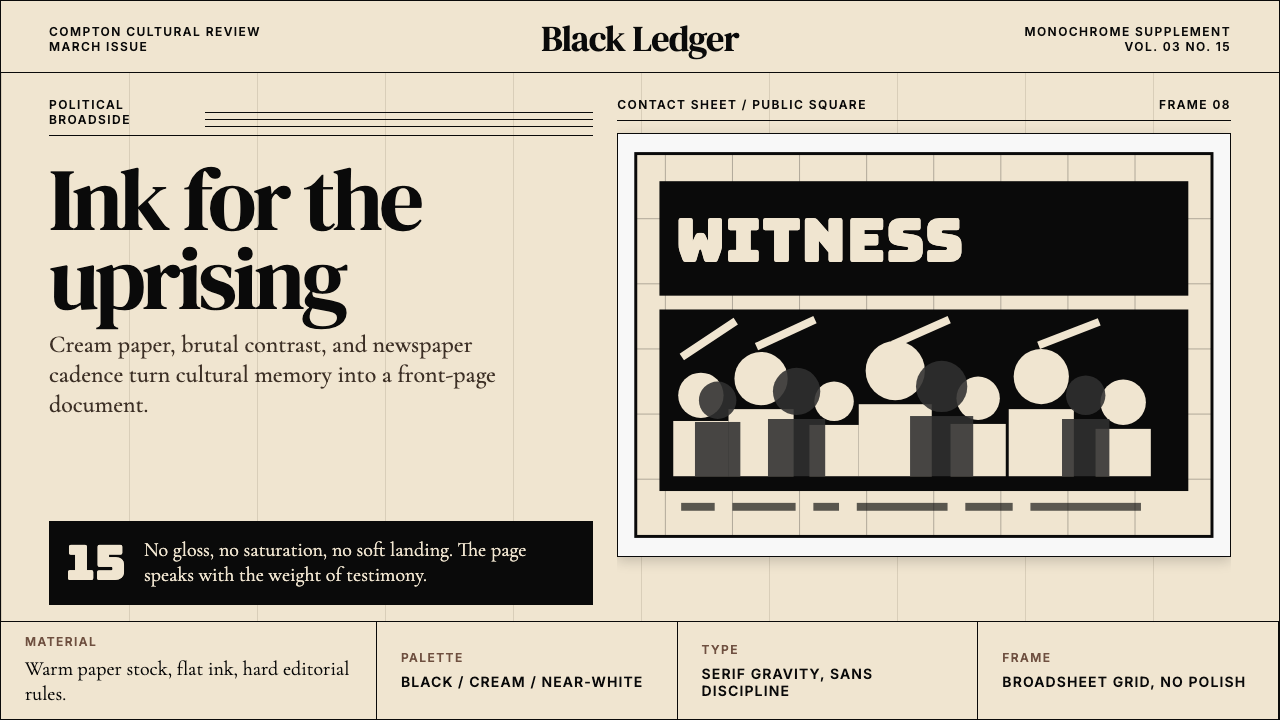 Kendrick — To Pimp a ButterflyPolitical weight, printed cold. Cream paper, hard serif type, monochrome crow…
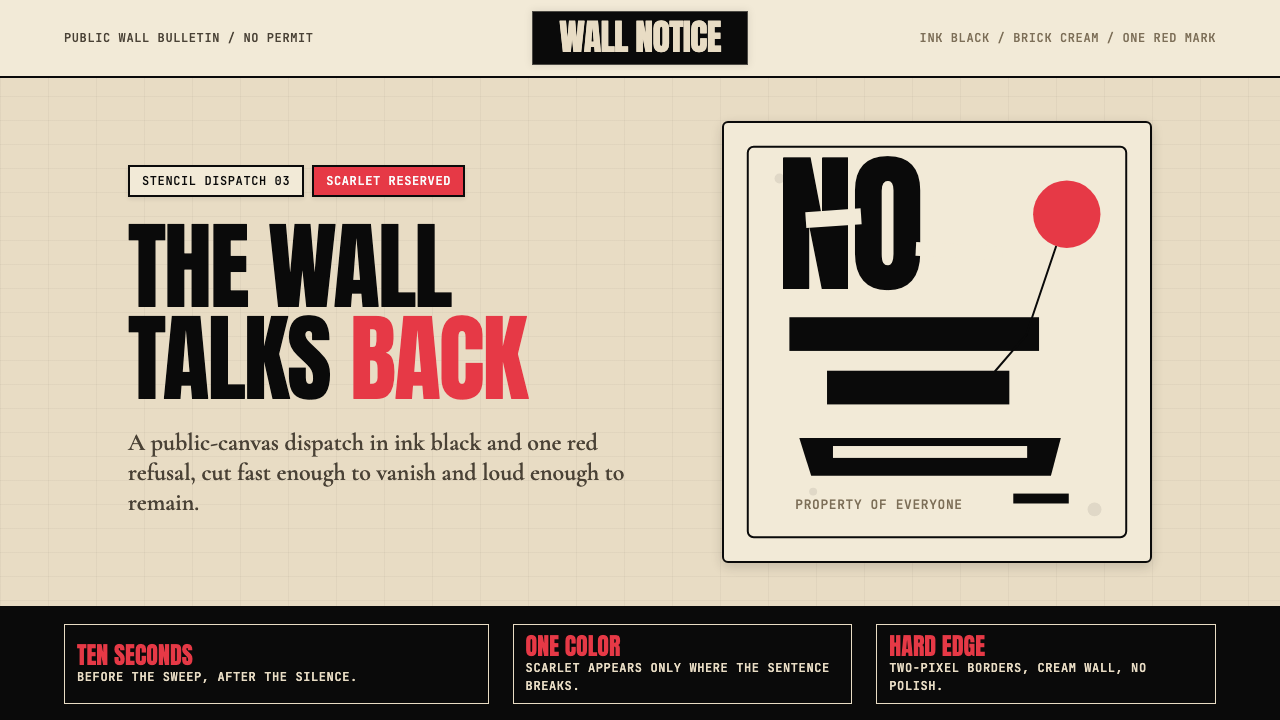 Banksy Stencil GraffitiProtest is reduced to a cut mark. Anton black on brick cream, one scarlet red…
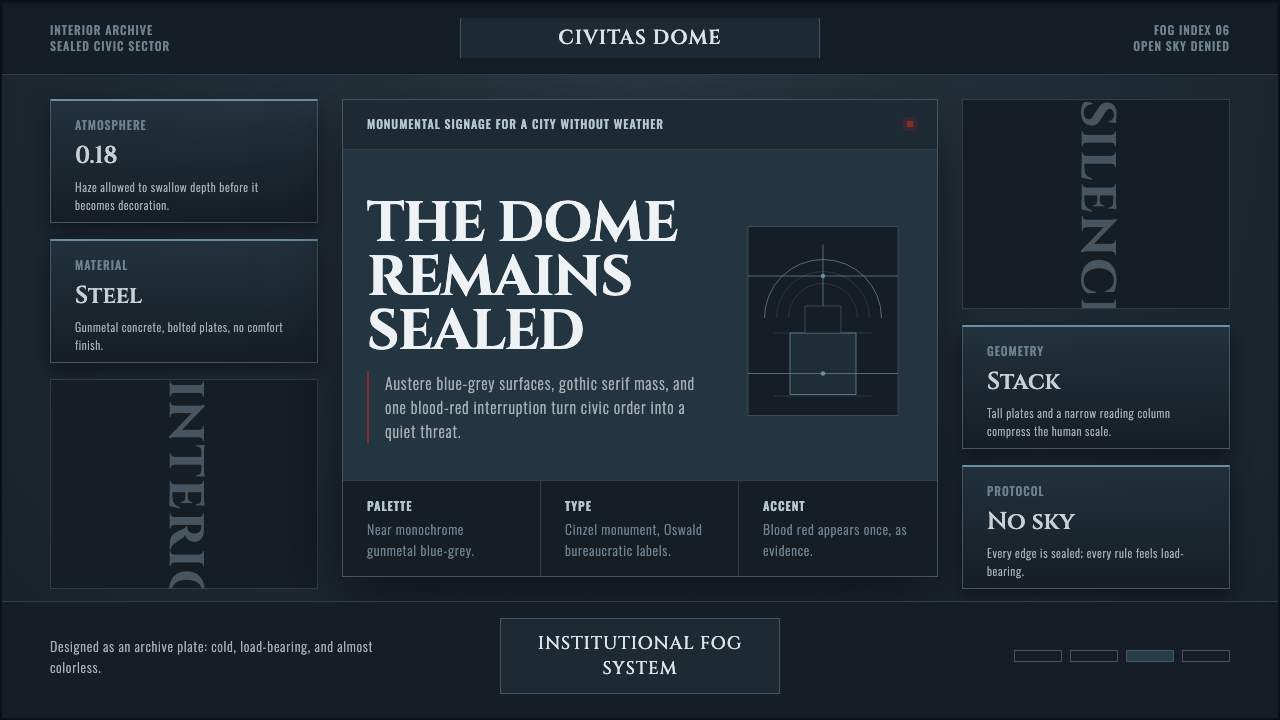 Ergo Proxy Romdo DomesCold order becomes dread. Gunmetal fog, gothic serif mass, one blood-red mark.
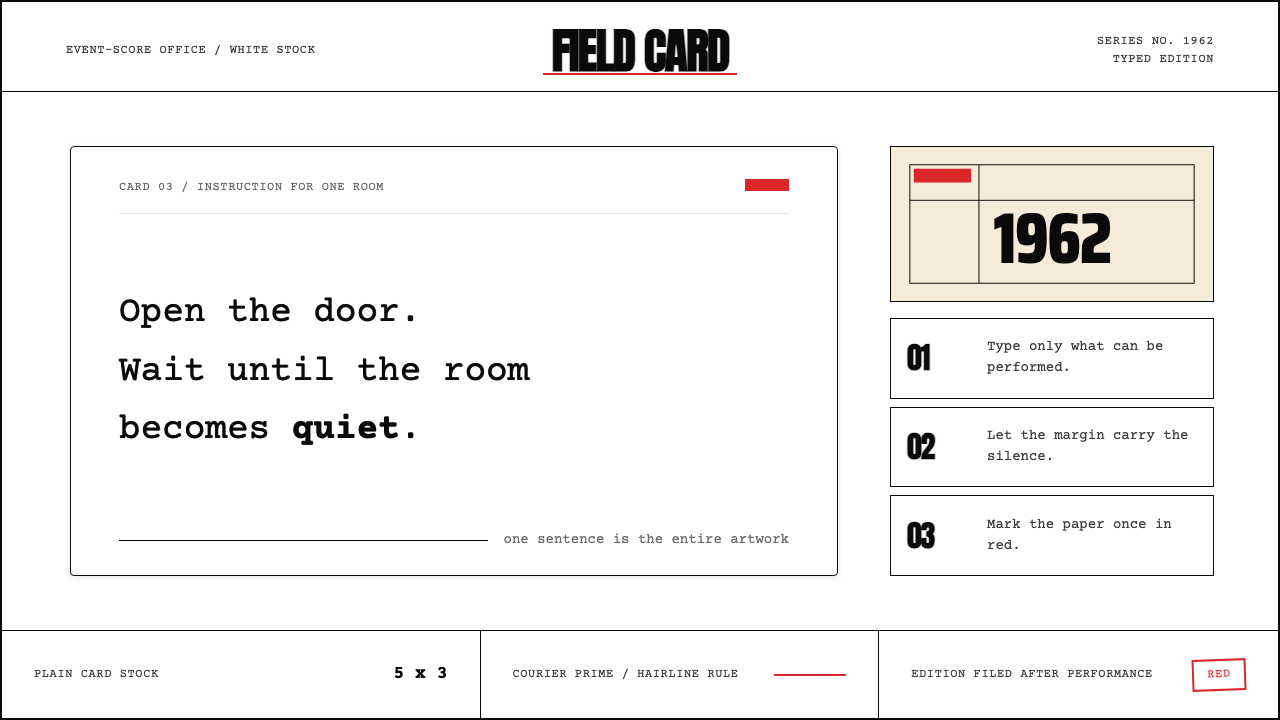 Fluxus Event Score (1962)Instruction becomes art. Courier on white card, hairline rules, one sharp red…
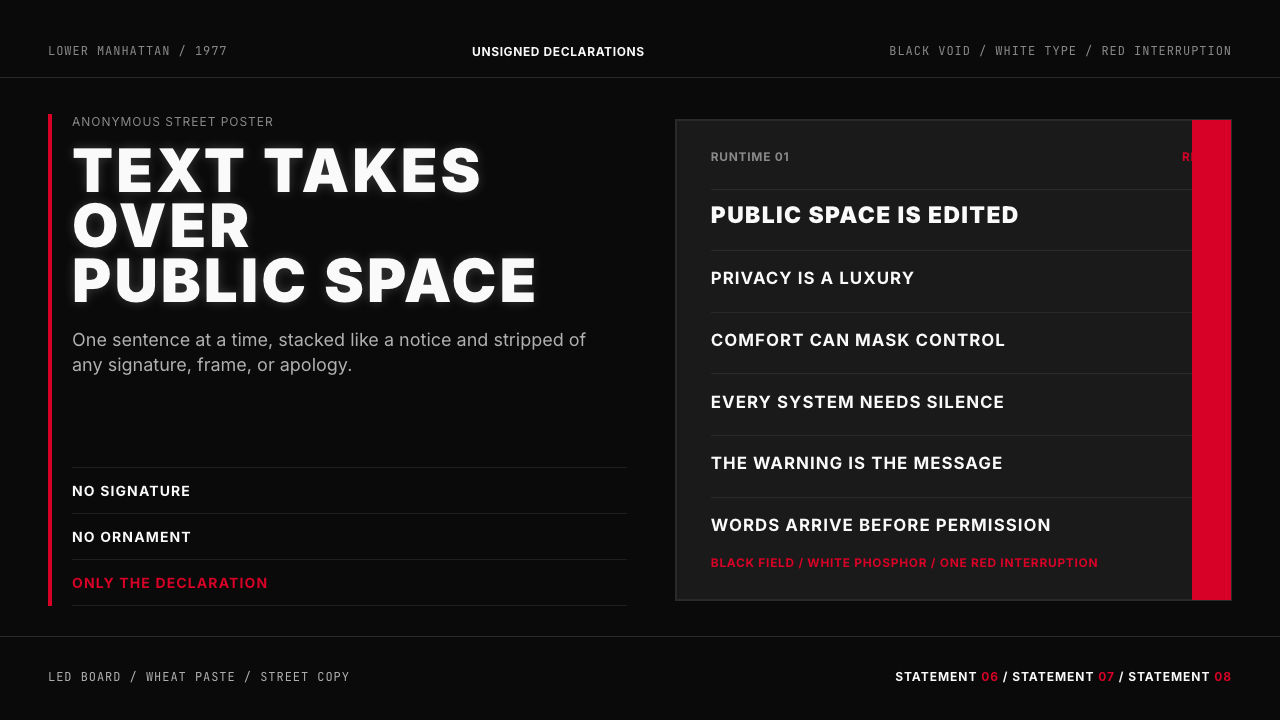 Jenny Holzer Truisms (1977)Austere declarations. White all-caps on black, cut by a single red warning.
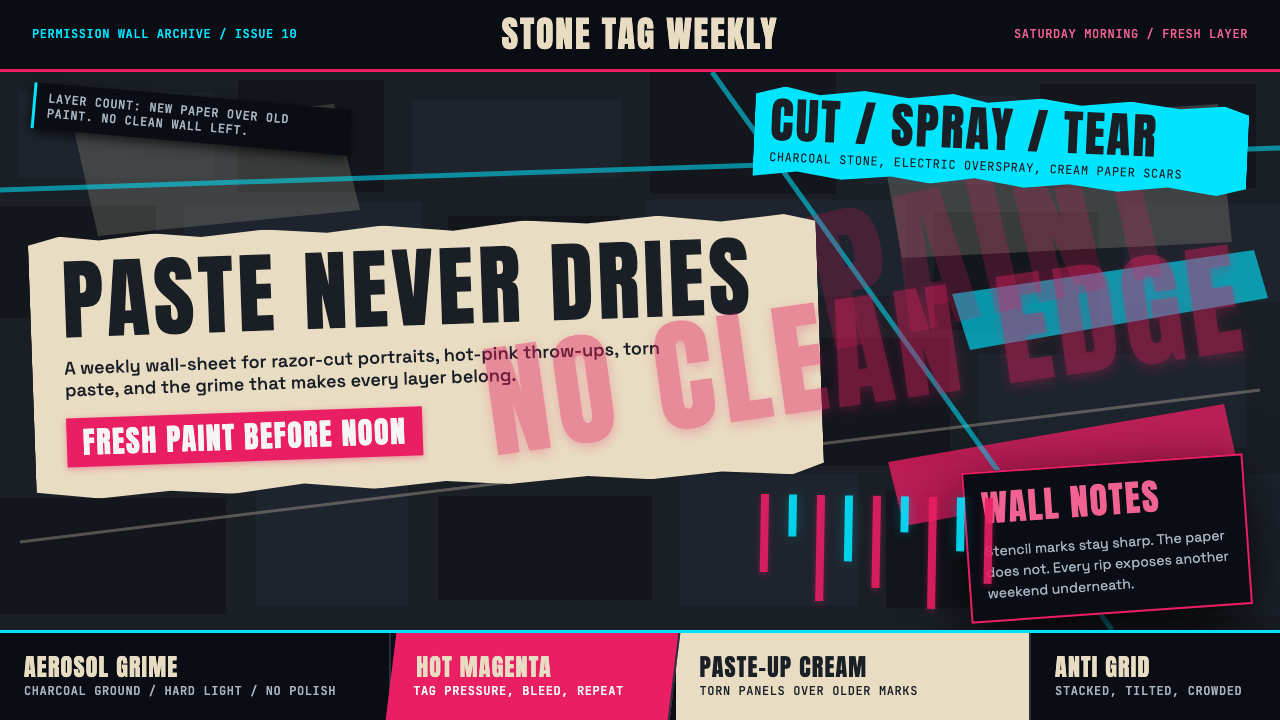 Melbourne Laneway Stencil (Hosier Lane)Permission-wall maximalism. Magenta tags slash charcoal bluestone and cream p…