What is Criterion Collection?
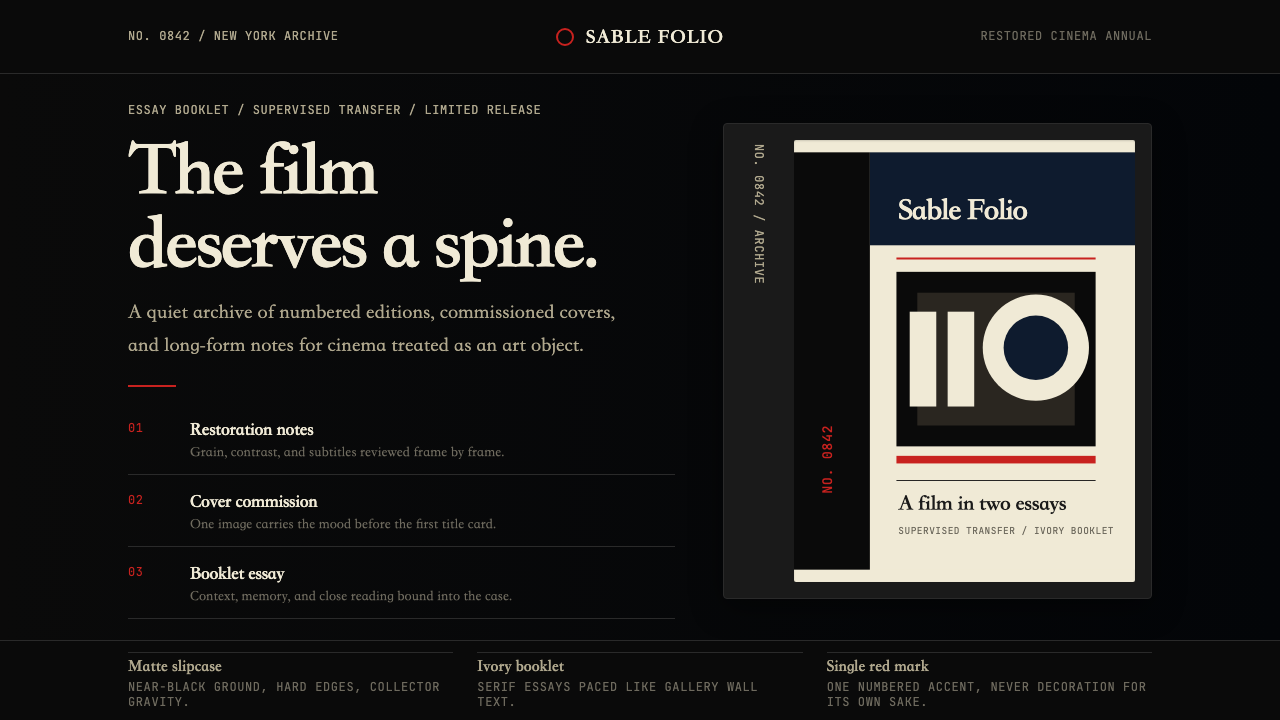
The Criterion Collection turned the home video sleeve into a gallery object — matte black, ivory serif, and a single red accent that have defined prestige cinema culture since 1984.
Criterion Collection in brief
The Criterion Cinema Folio design style is a visual language rooted in the editorial identity of the Criterion Collection, the New York–based home video publisher that has since 1984 treated cinema as a museum-worthy art form. Its hallmarks are a near-black field that functions like a gallery wall, ivory cream serif typography that reads with the authority of a scholarly monograph, commissioned cover illustration that positions each film as a unique art object, and a single reserved-red accent used almost exclusively for the spine number that identifies every release in the catalogue. The result is an aesthetic that communicates seriousness, care, and collector-grade permanence.
What makes this style distinctive is not any single element but the discipline with which a small set of constraints is maintained across hundreds of objects. The dark ground suppresses visual noise and foregrounds whatever illustration or title appears on it. The serif type signals editorial judgment — this is not entertainment packaging but a critical and curatorial act. The illustration-first approach treats the cover as a commissioned artwork rather than a marketing surface, which means each release in the collection reads as visually individual even while belonging unmistakably to the same family. The numbered red accent is the system's most economical gesture: a single device that simultaneously identifies, sequences, and lends prestige.
In contemporary design practice, the style has expanded beyond physical packaging into a recognizable vocabulary for any context where cinephile seriousness, archival authority, or collector prestige is the intended register. It is a dark, editorial, type-led aesthetic — the visual equivalent of a museum catalogue or a limited-edition artist monograph — adapted for slides, web interfaces, printed materials, and brand identities that need to project cultural depth without resorting to nostalgia or pastiche.

Where does Criterion Collection come from?
The Criterion Collection was founded in 1984 by Robert Stein in New York City, initially as a laserdisc label dedicated to presenting important films with supplements — essays, interviews, and production materials — that contextualized them as works of art rather than consumer entertainment. The founding premise was archival and editorial: every release would be supervised, numbered, and treated as a definitive version of the film for the home viewer. This approach to cinema as an object of serious study rather than casual consumption shaped the visual identity from the outset.
The visual system that the Collection is now recognized by — the matte-black slipcase, the commissioned illustrated cover, the Mrs. Eaves serif typeface, the Criterion-red spine number — was not fully codified in 1984 but emerged and consolidated over decades of production. Eric Skillman, who served as the Collection's primary designer for many years, and art director Sarah Habibi were instrumental in refining and systematizing the look into the coherent family it represents today. The current identity, firmly established in its mature form around 2010 and sustained since, draws from a tradition of prestige publishing — specifically the visual language of limited-edition art books, museum catalogues, and the Penguin Modern Classics series — rather than from cinema marketing conventions.
The choice of a near-black ground rather than a white one was both aesthetic and functional. Against white, film stills and photographic covers tend toward the promotional; against near-black, even a color photograph takes on a different register — more contemplative, more archival, closer to the experience of viewing a framed print in a darkened gallery. The dark ground also ensures that the ivory serif typography and red spine numeral read with absolute clarity regardless of what cover art appears alongside them, maintaining visual coherence across a catalogue that spans hundreds of wildly different films and artistic styles.
The numbered spine is perhaps the single most consequential design decision in the Collection's history. By assigning every release a permanent catalogue number — visible on the spine of the physical package and reproduced in all associated materials — Criterion transformed its releases into collectible series entries rather than individual commercial products. The number printed in the Collection's characteristic red against the matte-black spine creates a quiet but unmistakable signal: this object belongs to a considered sequence, not a marketing campaign. That gesture, borrowed from the traditions of numbered fine-art print editions and scholarly journal volumes, anchored the Collection's identity in archive culture and gave its design system one of its most recognizable and oft-imitated features.
What defines the Criterion Collection look?
Dark Editorial Ground
The foundation of the style is a near-black field — not pure black but a very deep, slightly warm dark tone — that functions like the wall of a darkened gallery. Against this ground, all other elements are elevated: type reads with heightened contrast, illustration colors appear more saturated and deliberate, and even the smallest typographic details register with clarity. The dark ground is not a mood gesture but a structural decision that unifies the entire catalogue regardless of what appears on each individual cover.
Ivory Serif Typography
Type in this system is rendered in a warm off-white — ivory or cream rather than pure white — which softens the contrast against the dark ground without sacrificing legibility. The typeface of choice is a classical serif with pronounced contrast between thick and thin strokes, lending the text a scholarly and editorial weight. Title typography is set with deliberate restraint: large enough to anchor the composition, but never aggressive. The typographic hierarchy is simple — title, director, and catalogue designation — and each level is distinguished by size and weight alone, with no decorative intervention.
Commissioned Cover Illustration
Perhaps the most culturally significant characteristic of the style is its insistence on commissioned original artwork for every release cover rather than photographic stills or promotional materials from the film. Artists ranging from established fine-art painters to graphic novel illustrators have contributed covers, meaning that each release is simultaneously a record of a film and an original artwork in its own right. The illustration is always the visual center of the composition; all typographic and structural elements are arranged around it. This approach signals that the film is being treated as a subject worthy of artistic interpretation, not merely reproduction.
The Criterion Red
A single, specific red — warm and saturated without being aggressive, closer to a deep vermilion than a primary signal red — functions as the system's sole permitted accent. Its use is extremely restricted: primarily the spine number, occasionally a typographic detail or layout rule. This economy of application means that wherever the red appears, it carries immediate visual authority. In a layout derived from this style, the red should feel earned rather than decorative — a signal that punctuates rather than enlivens. The discipline of limiting oneself to a single accent color, used in a single way, is the gesture that separates this system from generic dark editorial design.
Archival Numbering System
Every release carries a catalogue number that appears on the spine, spine label, and associated materials. This device — borrowed from the traditions of numbered fine-art print editions and encyclopedic reference series — transforms each release from a product into an entry in a considered archive. In design terms, the number functions as a typographic element that completes the composition and, crucially, signals membership in a larger sequence. Applying this principle to slide decks, data reports, or branded collateral means treating each document as part of a numbered series rather than a standalone artifact.
Minimal Structural Framing
The composition of each cover is organized by a very small set of structural rules: the illustration occupies the primary field, a narrow band at top or bottom holds the title and director credit, and the spine carries the number and spine title. There are no decorative borders, no gradient overlays, no badge graphics, no starburst promotions. The discipline extends to white space — or in this case, dark space — which is treated as a compositional element in its own right rather than empty area waiting to be filled. This structural restraint is what gives individual covers room to be visually unique while the overall catalogue remains visually unified.
Editorial Supplement Culture
The style is inseparable from the editorial apparatus that surrounds it: printed booklets with essays by critics and filmmakers, spine credits, careful typographic treatment of supplementary text. In applied design, this translates to a system where the written word is treated with the same seriousness as the image — generous leading, unhurried reading measure, footnote or sidebar conventions borrowed from academic publishing. Layouts that invoke this style should never treat text as filler. Every block of copy is assumed to matter.

Who shaped Criterion Collection?
Robert Stein founded the Criterion Collection in 1984 as one of the first laserdisc labels to treat home video as a serious archival and editorial endeavor. His founding premise — that films of artistic importance deserved definitive editions with scholarly supplementary material — established the cultural positioning that the visual identity has since served. Stein's model of numbered, supervised releases borrowed from the conventions of fine-art print editions and rare-book publishing, directly informing the design logic of the spine numbering system.
Peter Becker, long-serving president of the Criterion Collection, has overseen the editorial and curatorial direction of the Collection through its most prolific decades. Under his stewardship, the visual identity matured from an evolving set of conventions into a fully codified design system — one recognized internationally as the benchmark for prestige home video publishing. His commitment to maintaining the integrity of the numbered spine and commissioned-cover traditions even as formats shifted from laserdisc to DVD to Blu-ray and digital exemplifies the system-thinking that gives the style its authority.
Eric Skillman served as the primary graphic designer for the Criterion Collection for over a decade, responsible for systematizing the visual conventions that now define the style. His work codified the typographic rules, the compositional logic of cover layouts, and the discipline of color restriction into a coherent, reproducible system. Skillman has also written extensively about design and cinema, which reflects the dual editorial-and-aesthetic sensibility that characterizes the Collection's visual voice — it is the work of someone who thinks about design and about cinema with equal seriousness.
Sarah Habibi has served as art director of the Criterion Collection, overseeing the commissioning and art direction of cover illustrations across a broad range of titles. Her role sits at the intersection of curatorial judgment and design direction: selecting artists whose visual sensibility can translate the essence of a specific film into a cover image, while ensuring that the result remains legible within the overall family. The breadth of artistic styles represented in Criterion covers — from painterly realism to graphic abstraction — without ever destabilizing the system's coherence is a testament to this sustained art direction.
One of the defining features of the Criterion design system is that the covers are not made by an in-house illustration team but by a rotating cast of independent artists — painters, printmakers, graphic novelists, photographers — each brought in to interpret a specific film. Artists including Adrian Tomine, Tomer Hanuka, and dozens of others have contributed covers that are collected and discussed as artworks independent of the films they represent. This commissioned-artist model means the style is never a single visual handwriting but a curatorial framework: what unifies the covers is structural and typographic consistency, not illustrative style.
How do you use Criterion Collection today?
The Criterion Cinema Folio style is among the most directly transferable prestige aesthetics in contemporary design precisely because its authority comes from structure rather than decoration. The core vocabulary — dark ground, ivory serif type, one reserved accent color, illustration as subject rather than backdrop — can be adapted to slides, web interfaces, editorial layouts, and branded collateral without losing its distinctiveness. Applying it correctly requires internalizing the underlying editorial logic: every element must appear because it is necessary, not because it fills space.
For presentation slides, the style excels both on cover and content pages. A cover slide benefits from the dark ground with a single strong illustration or graphic element positioned as the visual center, the presentation title set in a classical serif in ivory or cream, and no other decorative intervention. If the series is numbered — a deck within a larger report set or season — a small red number in a corner or spine position signals the sequence exactly as Criterion's spine number does. Content slides should treat the dark background as a gallery wall: one organizing idea per slide, generous typographic breathing room, data charts rendered in near-monochrome with a single accent-color highlight for the relevant figure. Avoid white backgrounds on individual slides within a dark-ground presentation — the contrast breaks the editorial unity.
For web interfaces and digital dashboards, this style is well suited to contexts where credibility, depth, and deliberate curation are the desired values — portfolio sites, editorial platforms, streaming interfaces for prestige content, and data dashboards for research or analytics products. The approach: a very dark background throughout, ivory or near-white for all primary text, strict typographic hierarchy using a classical serif for headings and a clean complementary face for body text, and the accent color reserved exclusively for interactive states and the most important single data point per view. Navigation should be typographic and horizontal, with minimal iconography. Cards and panels should have defined borders rather than soft shadows, giving the interface an object-like quality consistent with the physical packaging ethos.
For editorial and marketing materials — printed lookbooks, digital editorial spreads, campaign identities, annual reports — the style provides a framework for information that feels considered and museum-caliber. An editorial layout in this mode gives illustration or photography the majority of the page, treats captions and body text with the same discipline as Criterion's booklet typography, and uses the accent color for a single typographic element per spread — a page number, a pull-quote rule, a section identifier. Marketing applications should resist the temptation to brighten the palette or add secondary colors; the authority of the style depends entirely on the restraint of its color system. A campaign that introduces two or three accent colors immediately shifts from prestige archive to generic dark luxury, a much less specific and less distinctive register.
The most common mistake when applying this style is misunderstanding what the dark ground actually requires. A dark background does not automatically produce a Criterion-like effect — it requires that every element placed on it earn its place through contrast and precision. Vague or low-contrast typographic elements, illustrations that lack sufficient tonal range to read against the dark field, accent colors used across many elements rather than one, and decorative details like gradients or texture overlays all undermine the system. The style works through discipline, not atmosphere. A layout that feels like a gallery wall succeeds; a layout that merely feels dark fails.
A second common error is treating the illustrated cover as the whole system. The Criterion style is not primarily an illustration style — it is an editorial system in which illustration plays a specific role. Applying it correctly means building the typographic and structural scaffolding first: the ground color, the serif typeface, the hierarchy, the accent restriction. The illustration then inhabits that framework. Reversing this sequence — finding an evocative illustration and building a layout around its mood — typically produces something that looks cinematic or moody but not specifically like this system, because the underlying editorial logic is absent.

Criterion Collection — FAQ
Does this style require original commissioned illustration, or can it work with photography or existing imagery?
Commissioned illustration is central to the Criterion Collection's identity but is not a mandatory requirement for applying the style to other contexts. What the style does require is that imagery be treated as a subject rather than a backdrop — placed with intention, given compositional primacy, and selected or created to interpret the content rather than merely illustrate it. Photography can work within this framework if it is treated editorially: high-contrast, deliberately cropped, and presented as an art object rather than a documentary image. Stock photography used decoratively will undermine the system regardless of how the typography is handled.
Can the style work on a light or white background?
The dark ground is not merely aesthetic — it is structurally what allows the ivory type, the accent red, and the cover illustration to function as they do. Transposing the style to a light background is possible but requires careful recalibration. On a cream or off-white ground, the ivory type must shift to near-black, the illustration still functions as the visual center, and the red accent retains its restricted role. What tends to be lost in a light-ground version is the gallery-wall quality — the sense that elements float against an absorptive dark field — and what replaces it is closer to fine-art publishing or a high-end museum catalogue. This is not a failure, but it is a different visual register.
How is this different from generic 'dark luxury' or 'premium dark mode' design?
Dark luxury design typically relies on gold or metallic accents, gradients, texture overlays, and a sense of surface richness to communicate premium status. Criterion Cinema Folio style is the opposite: it communicates prestige through restraint, editorial intelligence, and archival seriousness rather than through visual richness. The single reserved red accent, the scholarly serif type, the commissioned illustration treated as an art object, and the numbered cataloguing system are all signals of a different kind of authority — cultural and intellectual rather than material and sensory. If a dark layout includes more than one accent color, uses gradients or textures, or relies on surface sheen to signal quality, it has moved away from this style and toward generic dark luxury.
How do you handle color when adapting this style for data visualization?
Data visualization is one of the more challenging adaptations because charts and graphs conventionally use multiple colors to distinguish categories. Within this style, the approach is to treat the visualization as a near-monochrome object by default: all data series rendered in graduated tones of ivory or warm grey against the dark ground, with the single accent red reserved exclusively for the most important figure, the highlighted category, or the call-to-action data point. Secondary categories can be distinguished through opacity or tonal variation within the warm neutral range rather than through hue variation. The chart itself should be designed with the same typographic discipline as the rest of the layout — axis labels and legends in the same serif face, generous spacing, no decorative grid lines.
Is this style appropriate for brands outside culture and media?
The style is best suited to contexts where editorial authority, archival seriousness, and collector-grade care are genuine values of the product or organization — not just aesthetic aspirations. It works well for publishers, research institutions, high-end product lines with a genuine heritage dimension, platforms for serious creative work, and any context where the audience is expected to approach the content with attention rather than impulse. It struggles in contexts that depend on warmth, accessibility, or immediate emotional approachability — consumer goods for mass markets, children's products, wellness brands, or anything where a sense of welcome and openness is more important than authority and depth. Applying it to contexts where its editorial severity is a mismatch with the product's actual values produces a result that reads as affected or pretentious rather than authoritative.
Related design styles
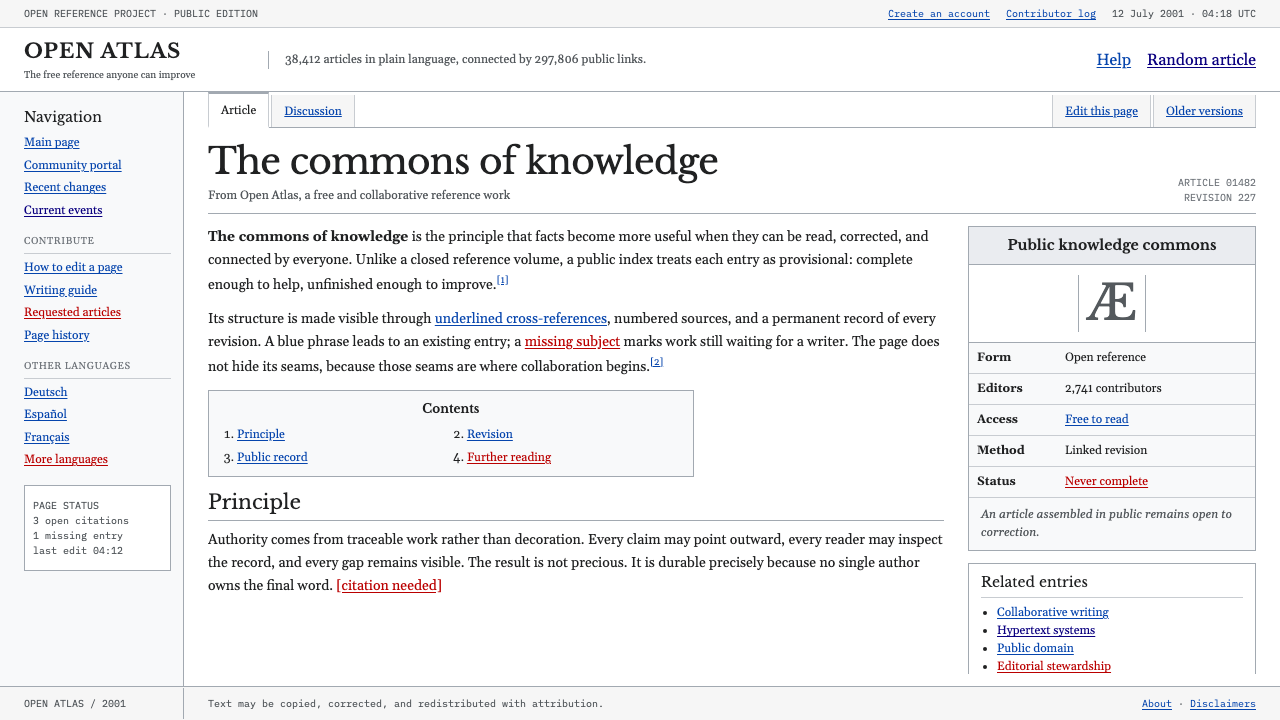 Wikipedia (2001)Content needs no ornament. Black serif text, gray hairlines, and blue links e…
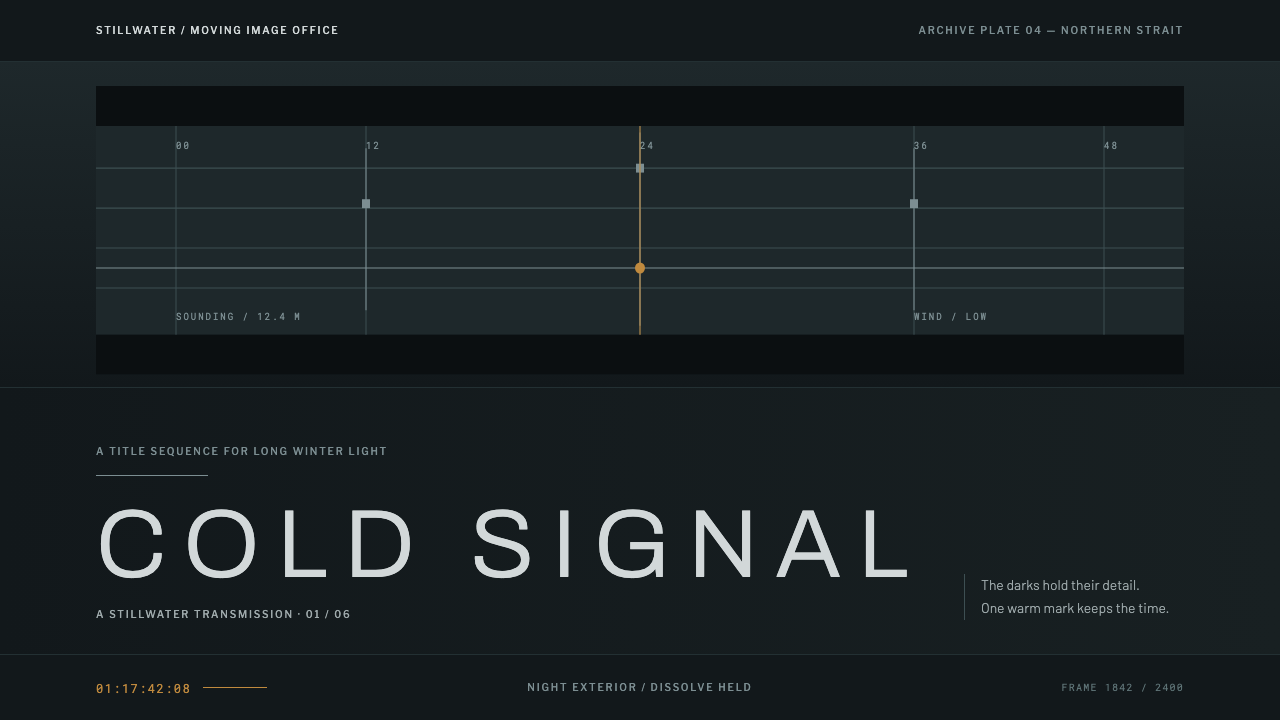 Nordic Noir TitlesThe grade carries the drama. Cold blue-green plates and low tracked caps hold…
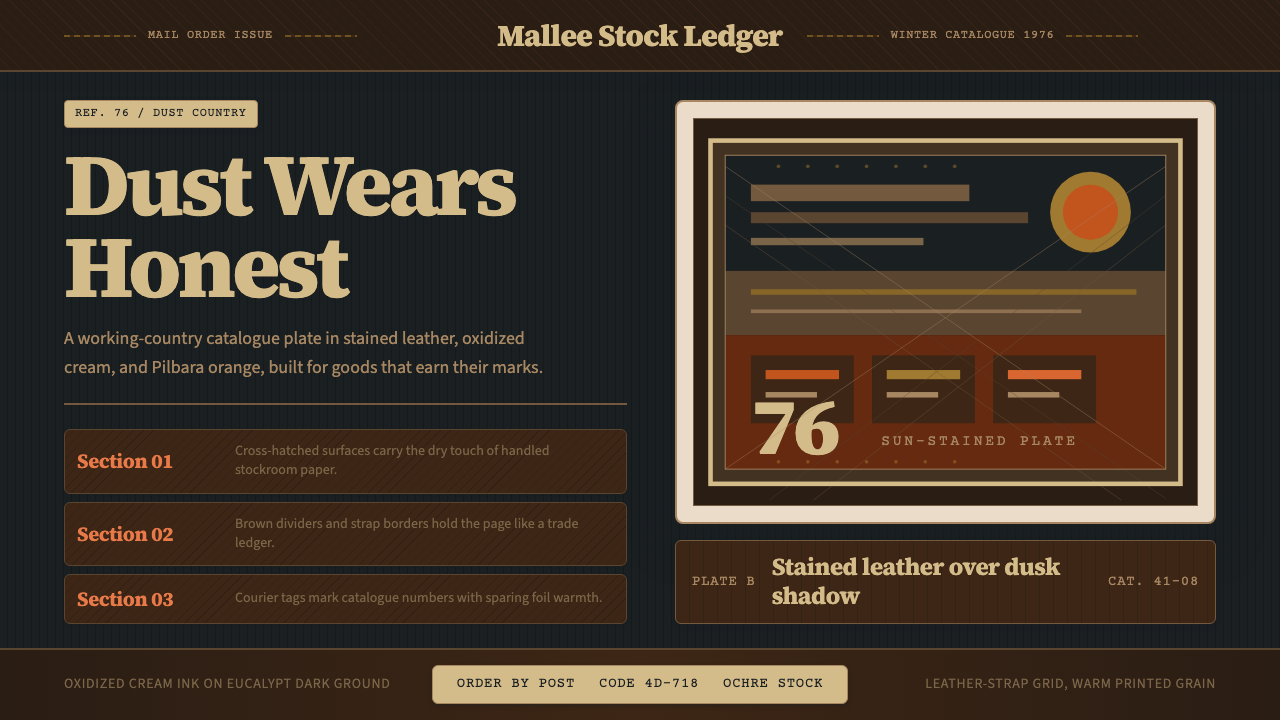 Akubra Outback (1970s Stockman)Worn honesty. Leather brown, Pilbara orange, and cream catalogue frames carry…
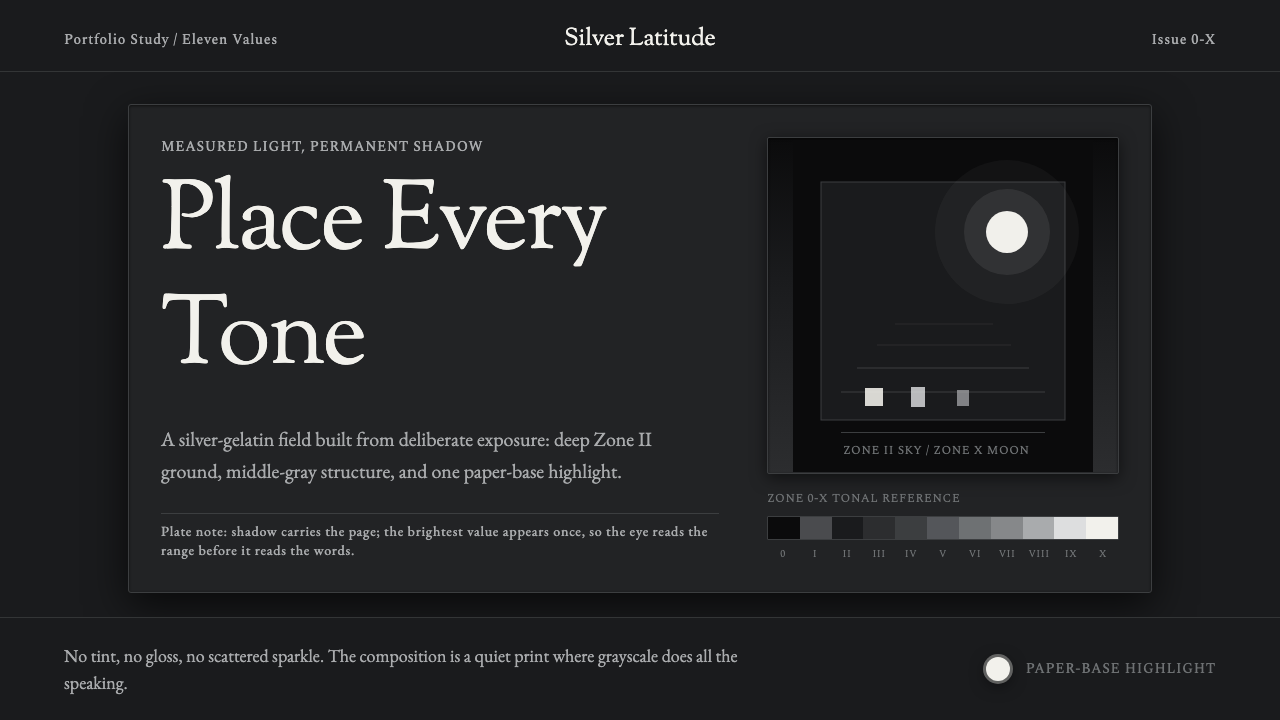 Ansel Adams Zone SystemOnly light remains. Deep shadow, serif captions, and one white moon mark the…
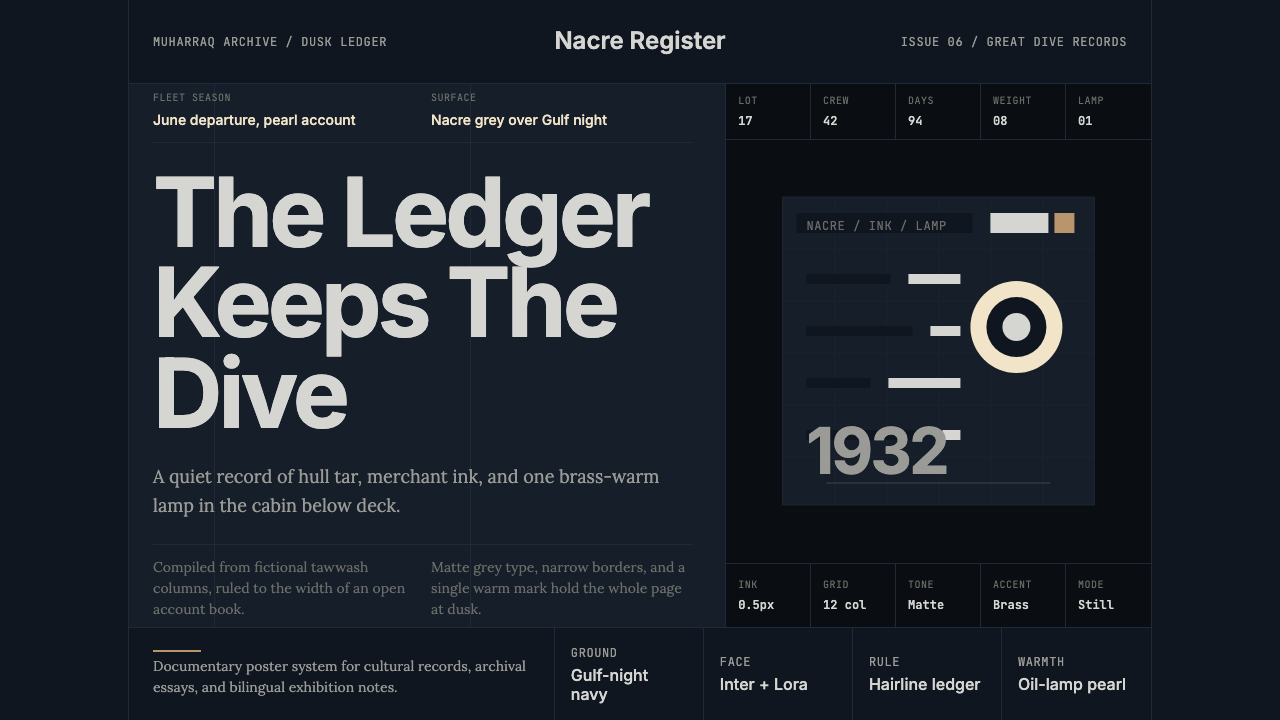 Bahraini Pearl Diving GreyQuiet authority at dusk. Nacre grey type and hairline grids hold one brass-wa…
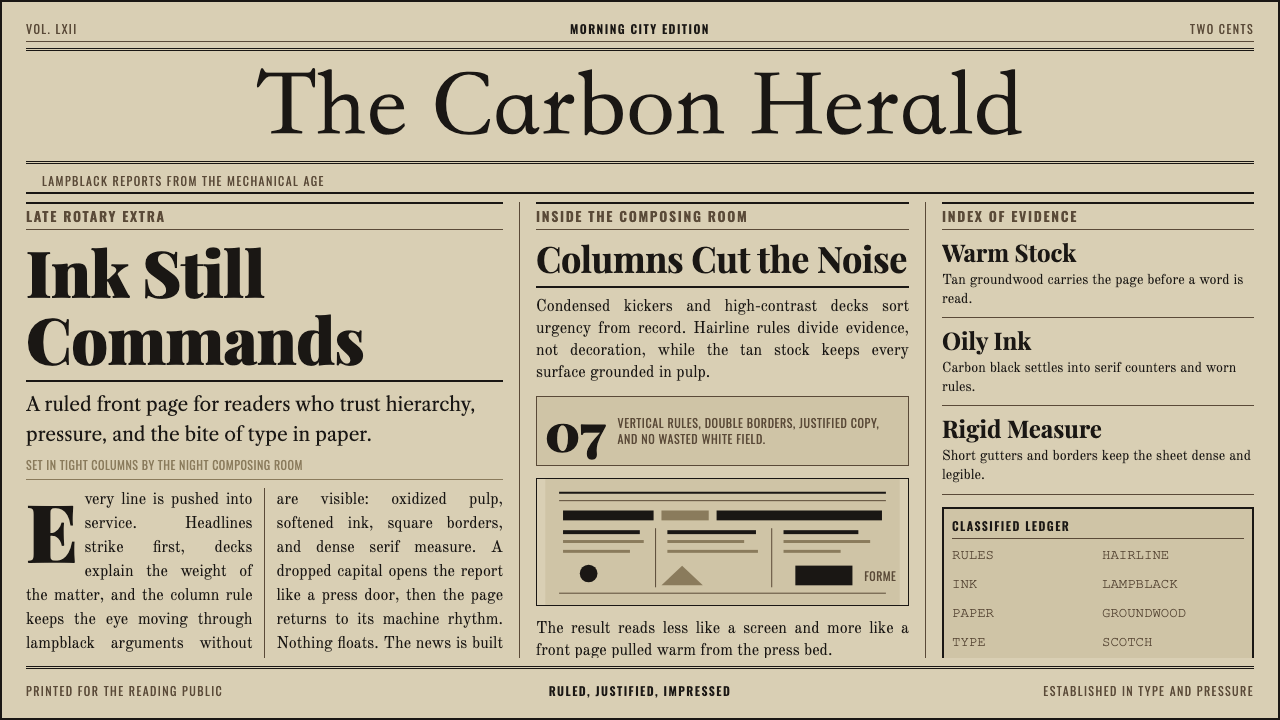 Broadsheet LetterpressAuthority in ink. Lampblack serif decks lock into tan paper with strict ruled…