What is Akubra Outback (1970s Stockman)?
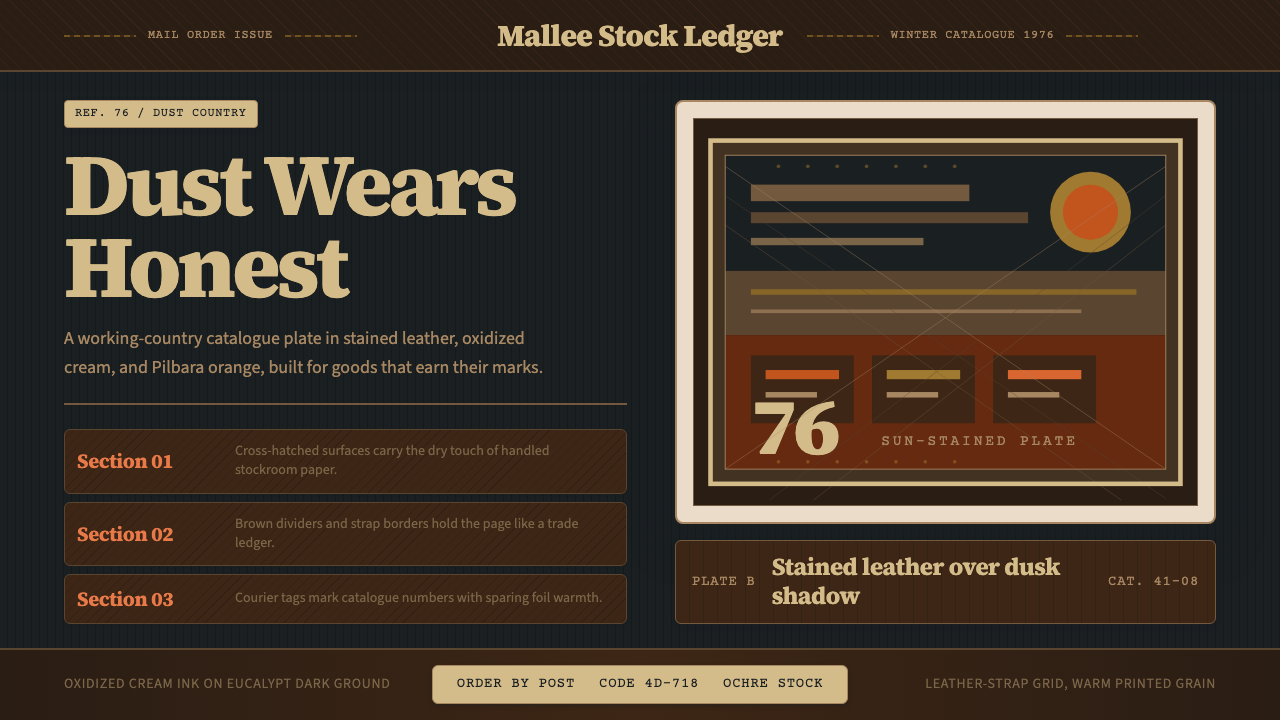
The Akubra Outback design system is a love letter to the 1970s Australian cattle country — rabbit-fur felt, stained leather, and the honest grit of a mail-order catalogue page.
Akubra Outback (1970s Stockman) in brief
The Akubra Outback design system distils the visual language of Australia's pastoral golden age — the 1970s and early 1980s — when working-stockman culture became the country's most powerful brand of self-identity. It is rooted in three interlocking sources: the handmade Akubra felt hat that had been manufactured in Kempsey since 1874; the RM Williams mail-order catalogue that dressed drovers, jackaroos, and city romantics alike; and the vast heat-scorched landscapes of the Pilbara, Kimberley, and Channel Country that formed the backdrop of drover photography across that era.
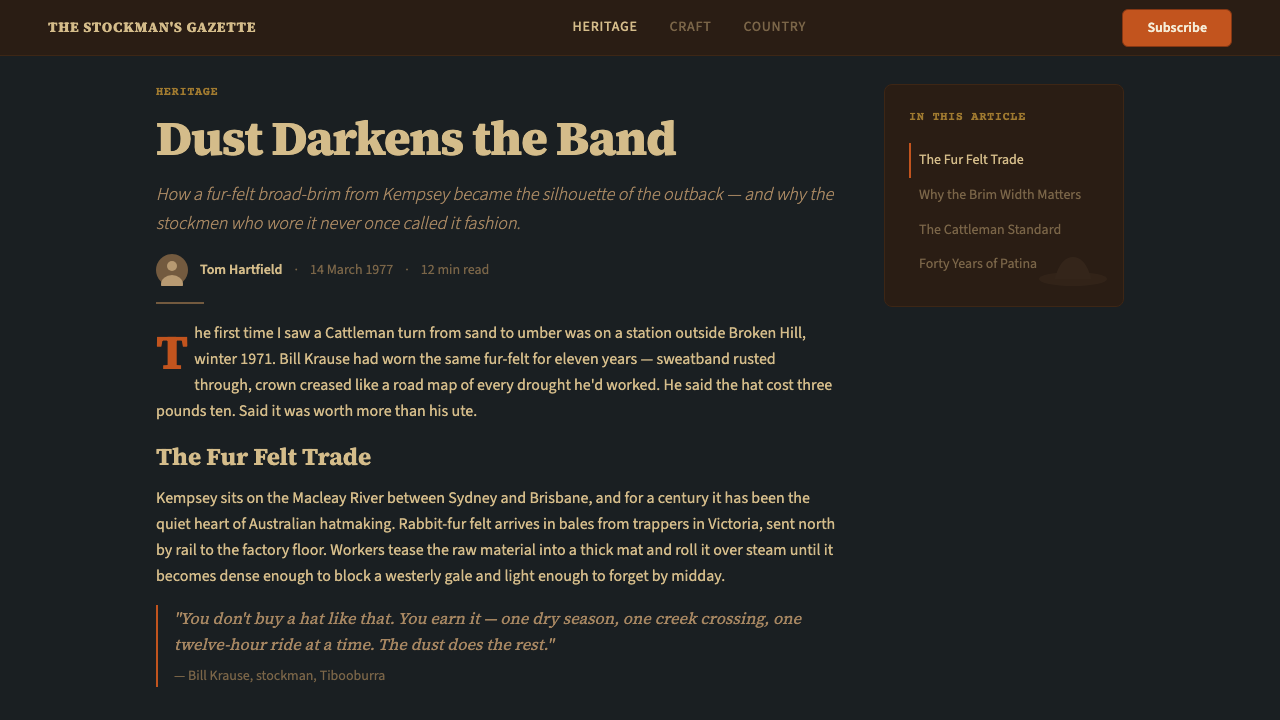
Visually, the system is built around a palette of deep stained-leather brown, Pilbara dust-orange, cream, and the cool blue-black of eucalypt shadow at dusk. Every surface reads as though it has been touched by sun, sweat, and decades of honest use. Components carry leather-strap borders, photography sits in cream-edged frames with printed-grain warmth, and typography pairs sturdy slab serif with clean, legible sans-serif — the combination of a stock-station ledger and a country newspaper. The overall register is warm, worn, and unashamedly authentic.
This is a heritage system in the truest sense: it does not romanticise a fictional past but traces a specific documented aesthetic — one that circulated through catalogues, station noticeboards, country fair programs, and livestock auction posters across a decade. It draws its authority from the real objects of that world: pressed rabbit-fur felt, hand-stitched kangaroo leather, and the yellowed newsprint of a 1976 catalogue page.
Where does Akubra Outback (1970s Stockman) come from?
The hat itself is the oldest thread in this story. The Akubra brand traces to 1874, when a Hobart tanner named Benjamin Dunkerley began producing rabbit-fur felt hats for working men in rural Tasmania. The rabbit — an introduced pest that had colonised the Australian continent at catastrophic scale — provided an unexpected raw material of remarkable quality: soft, tightly matted, and highly resistant to rain, dust, and radiant heat. In 1912, Dunkerley relocated production to Kempsey on the New South Wales mid-north coast, and the factory remains there today. The word 'Akubra' is derived from an Aboriginal term for 'head covering', though the precise linguistic attribution has been debated by scholars.
Throughout the first half of the twentieth century, the Akubra was workwear, not icon — as unremarkable and functional as a pair of moleskin trousers or a stockwhip. The visual transformation happened in the 1960s and reached its height in the 1970s, driven by two forces working in tandem. The first was the rise of outback photography as a genre: photographers commissioned by pastoral companies, government tourism bodies, and newspapers began producing large-format images of drovers and jackaroos at work — mending fences, mustering cattle from horseback, watering livestock at remote bores. These images circulated widely in calendars, newspaper supplements, and exhibition prints. The Akubra, worn low over the eyes against the sun, became the central symbol: not just a hat but a stance toward the land.
The second force was commercial. Stephen Keir III, who took over the company in the mid-twentieth century, invested in the Akubra's identity at a moment when pastoral Australia was being positioned as a romantic and authentically national image. The brand aligned naturally with RM Williams — the saddler and bush outfitter founded by Reginald Murray Williams in Adelaide in 1932 — whose mail-order catalogues became definitive documents of outback aesthetic during the 1970s. The RM Williams catalogue was a visual system in its own right: warm-tinted photographic portraits, slab-serif headings, cream newsprint backgrounds, and leather-textured product borders. Clothing and equipment were photographed on real working stockmen, not models, anchoring the catalogue's authority in documented authenticity rather than aspiration.
Country music provided a third cultural amplifier. Slim Dusty, who had recorded 'A Pub with No Beer' in 1957 and became Australia's most beloved bush balladeer, was photographed wearing the Akubra throughout his career. His image — wide-brimmed hat tilted against the light, sun-weathered face, easy authority — became inseparable from the hat itself. Dusty's commercial success through the 1970s turned the Akubra from regional workwear into a national emblem recognised across the continent. The visual system this design style draws on is precisely that convergence: catalogue typography, drover photography, country music imagery, and the physical texture of the hat and the land it was made for.
What defines the Akubra Outback (1970s Stockman) look?
Palette
The color world is built around stained leather brown — a deep, warm, slightly reddened brown that reads as the surface of a well-used saddle — and Pilbara dust-orange, the scorched orange of iron-rich earth under afternoon sun. Against these two anchor tones, cream provides relief: the color of unbleached paper, of a catalogue page printed on newsprint, of the inside of a hat band. Blue-black appears in shadows, in the cool dark of eucalypt canopy at dusk, and as a structural contrast to the warm tones. No color in this system is fresh or artificially vivid; every hue has been aged, warmed, or dried by imaginary exposure to sun and use.
Texture
Texture is the signature quality that separates this system from other heritage styles. Every surface is read as having been touched: felt has a pressed-grain quality, leather has stitching and grain marks, paper has the slight tooth of newsprint, photography carries a halftone grain that implies offset printing rather than digital reproduction. Even flat color fields suggest the imperfect, slightly fibrous surface of a dyed cloth rather than the smooth uniformity of a screen fill. This textural register is not decoration — it is the primary carrier of authenticity, the visual equivalent of a product that has been broken in by use.
Typography
Type in this system pairs two contrasting voices: a sturdy slab serif for headings and labels, and a clean, upright sans-serif for body content and captions. The slab serif carries the authority of a stock station ledger or a country newspaper masthead — squared serifs, regular stroke contrast, and enough weight to hold its own against the textured backgrounds. The sans-serif brings legibility and order, the functional voice of a catalogue specification. The combination reads as a page that was set with care and competence but no decorative aspiration — the typography of a place that trusted content over style.
Photography and Framing
Photographs in this system are treated as objects with physical edges. Images sit in cream or bone-white frames with a slight inner border that suggests the white edge of a photographic print, or the inked border of a catalogue illustration. The printing-grain quality of the image surface — warm-tinted, slightly soft in the shadows, with slightly blown-out sky tones — implies a photograph taken on film and reproduced in ink rather than on a backlit screen. Subjects are real, unposed-feeling, and contextual: people at work, landscapes without human figures, close details of tools or materials. Nothing looks cast or styled.
Borders and Structural Ornament
Where ornament exists in this system, it is structural and material-derived rather than decorative. Borders reference leather strap edges: they are thick, warm-toned, and occasionally carry a stitching detail or blind emboss. Section dividers are horizontal rules that read as the printed line of a catalogue — straightforward, unpretentious, legible. Corner brackets, where they appear, suggest the metal reinforcement corners of a stockman's leather wallet or the pressed-tin border of a station notice. Nothing is ornamental for its own sake; every decorative element has a referent in the real material world of the pastoral station.
Warmth and Aging
Unlike heritage systems that treat aging as distress (deliberately worn, cracked, or faded surfaces), this system treats aging as honest testimony. Colors are warm-shifted rather than desaturated or faded. Surfaces are worn but not damaged. The overall effect is of something that has been used properly and cared for — a hat that has been re-blocked, a saddle that has been oiled, a catalogue that has been read multiple times and kept. The system avoids both the pristine quality of the new and the aggressive decay of deliberate distress; it occupies the dignified middle ground of honest wear.
Restraint and Specificity
The system achieves its authority through specificity, not breadth. It does not attempt to represent all of Australia or all heritage aesthetics — it is precisely the aesthetic of a particular object, a particular region, and a particular decade. This narrowness is a strength: every element decision refers back to the source world, and nothing is generic. The restraint extends to the palette (no turquoise, no deep forest green, no Australian-flag blue), to the typography (no scripts, no novelty display faces), and to the photographic treatment (no dramatic color grading, no golden-hour warmth pushed to orange). The more faithfully the system is applied within its own logic, the more distinctive it becomes.

Who shaped Akubra Outback (1970s Stockman)?
The founder of the hat-making tradition that would become Akubra. Dunkerley was a Hobart tanner who recognised in the 1870s that rabbit-fur felt — made from the skins of the continent's devastating rabbit plague — could be pressed and shaped into hats of exceptional durability and weather resistance. His decision to relocate production to Kempsey in 1912 planted the brand in the mid-north coast of New South Wales, where it remains. Dunkerley's commercial insight was essentially material: he found a high-quality product in an environmental nuisance, and built a manufacturing tradition around it that has outlasted the era in which it was founded by more than a century.
Reginald Murray Williams founded his saddlery and outfitting business in Adelaide in 1932, initially making hand-tooled leather boots and stockwhips for drovers in the South Australian outback. Over the following decades, the RM Williams mail-order catalogue became the primary document of outback aesthetic for a national audience. Williams — himself a man who had worked as a drover and boundary rider — insisted that equipment be photographed on real working stockmen and that the copy be written without inflated claims. The catalogue's authority derived from this discipline: it was read as evidence of real use, not as advertising. The visual conventions of the RM Williams catalogue — cream stock, slab-serif headings, leather-toned product borders, warm-shifted photography — are the direct visual ancestors of this design system.
David Gordon Kirkpatrick, known professionally as Slim Dusty, was Australia's most commercially successful country music artist and — through his lifelong association with the Akubra — one of the most powerful image-makers of the outback identity. His recording of 'A Pub with No Beer' in 1957 gave him a platform that he sustained through the 1970s and 1980s with albums and concert tours that covered the continent. Dusty was photographed wearing the Akubra across decades of publicity materials, album covers, and live performances, and his image — wide-brimmed hat, weathered face, easy geniality — became the popular face of stockman culture for an audience that had never set foot on a cattle station. The visual conventions of his promotional material overlapped precisely with the catalogue aesthetic this system captures.
The member of the Keir family who stewarded the Akubra company through the critical decades of the mid-to-late twentieth century, during which the hat transitioned from regional workwear to national symbol. Under the family's management, the company maintained its production in Kempsey and resisted the pressure to industrialise the felt-making process fully — a decision that preserved the handmade quality that became central to the brand's heritage identity. The Keir family's investment in the Akubra identity during the 1970s, when drover photography and country music were converging to create a powerful outback aesthetic, was decisive in establishing the hat as an enduring national icon rather than a fading piece of occupational dress.
Not a single individual but a broad cultural current that gathered momentum through the 1970s — the working-stockman heritage movement — which sought to document, preserve, and celebrate the practical material culture of Australia's pastoral industry before it was transformed by mechanisation, aerial mustering, and the decline of long-distance droving. Photographers, writers, and museum curators who participated in this movement created the visual archive that is this design system's primary source: large-format photographs of men at work, inventories of hand-made equipment, oral histories of droving routes. The movement's documentation instinct is partly why the aesthetic of that era feels so complete and retrievable today — it was being consciously recorded even as it was being lived.
How do you use Akubra Outback (1970s Stockman) today?
The Akubra Outback system is most powerful when applied with the discipline of its source world: restraint in color, specificity in material reference, and a consistent commitment to the warm, worn, honest register that defines the 1970s pastoral aesthetic. Applying it correctly means understanding what each element is doing — not layering brown and orange over a generic layout, but building surfaces that feel as though they have been made from, or at least touched by, the materials of that world.
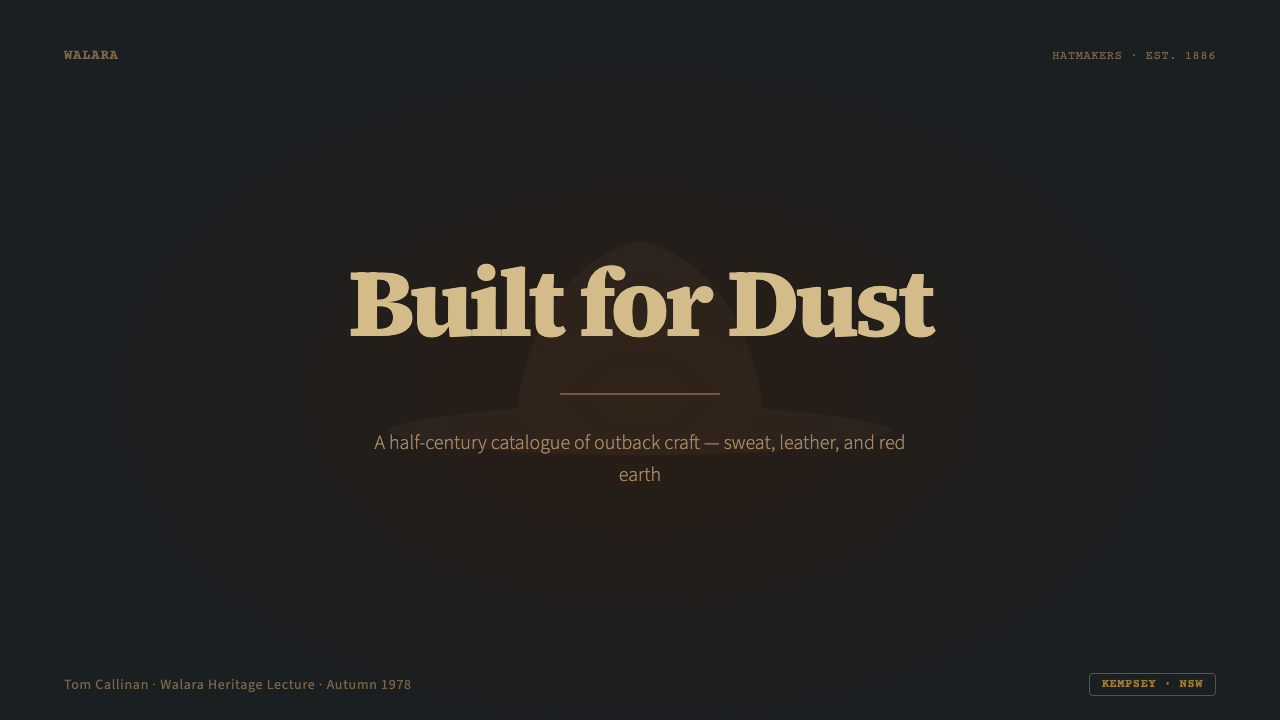
For presentation slides, the system works exceptionally well on covers that establish a strong editorial tone. A cover built in this style uses a large warm-toned photographic image in a cream-bordered frame as the anchoring element, with the title set in slab-serif at generous scale against the natural leather-brown ground. Content slides should be treated as catalogue pages: a clean grid, two type sizes, slab-serif labels above the content, and ruled lines separating sections. Data slides benefit from the system's material honesty — charts and diagrams should read as drawn or printed rather than rendered, using the palette's warm tones for category differentiation. Avoid any visual effect that implies digital precision or high-gloss rendering; this system reads as handmade and grounded, not screen-optimised.
For web and digital interfaces, this aesthetic is well-suited to product pages, editorial sites, and brand identity platforms for goods and services with a genuine heritage story. The approach: use a warm cream or very light bone tone as the base background, reserve leather brown for navigation bars and structural elements, and use the dust-orange as the primary interactive accent. Card components should feel like catalogue entries — cream ground, slab-serif label at the top, photographic image in a bordered frame, plain descriptive text below. Avoid hover effects that feel digital and clean; instead, use subtle texture shift or shadow deepening that references the weight of physical materials. Navigation should be typographic and unadorned.
For editorial and marketing work, the system excels at the kind of long-form, deeply contextual content that benefits from an aesthetic that implies time, patience, and authenticity. An article or campaign built in this style uses wide margins for pull-quotes or contextual annotations, section breaks marked with a thick ruled line rather than decorative ornaments, and photography treated as documentary evidence rather than styled imagery. Marketing campaigns that use this system work best when the copy commits to the same register — plain, specific, free of hyperbole — because the visual language is so strongly associated with honest craft that inflated language reads as a contradiction.
A common failure mode when working with heritage and pastoral aesthetics is to push the warmth too far toward sepia and nostalgia, producing an image that reads as theatrical vintage rather than lived heritage. The Akubra system is not sepia: its leather brown is deep and genuine, its orange is scorched and direct, and its cream is warm but not yellow. A second error is to mix this aesthetic with unrelated heritage cues — linen textures from a different tradition, serif letterforms that reference European editorial rather than Australian print culture, or photographic treatments that imply Americana rather than the Southern Hemisphere. The specificity of this system is its strength; generic heritage dilutes it.
Akubra Outback (1970s Stockman) — FAQ
Is this system appropriate only for Australian brands, or can it be applied more broadly?
The system is rooted in a very specific cultural and geographic context, but its applicability is broader than that origin suggests. Any brand whose core values include honest craftsmanship, material quality, heritage authenticity, and practical durability can draw on this aesthetic — regardless of geographic origin. Leather goods, workwear, outdoor equipment, agricultural products, and long-established family businesses in any region may find that the system's visual language aligns well with their positioning. The caution is that the more the specific Australian referents (the landscape palette, the catalogued pastoral imagery) are used literally, the more the system reads as Australian rather than universally heritage. Applied at a higher level of abstraction — prioritising the texture register, the typographic voice, and the honest aging — it becomes more transferable.
How does this system relate to other heritage Australian design aesthetics?
Australia has several distinct design heritage traditions that should not be conflated. The Akubra Outback system is specifically pastoral and working-class — it belongs to the tradition of the drover, the jackaroo, and the mail-order catalogue, not to the mid-century modernism of Sydney Opera House architecture, the Indigenous visual traditions of different Aboriginal nations, or the coastal beach culture that defines a different strand of Australian identity. Mixing these traditions produces incoherence. A designer choosing this system is choosing the cattle-country interior, not the coastal city or the First Nations tradition, and that choice should be made deliberately and with respect for the distinctions between these distinct cultures.
Can this system work in digital-first products that have no physical dimension?
Yes, but with one important adjustment in intent. The system's power in its original context came from the fact that the materials were real — the felt, the leather, the newsprint — and the visual language was a direct record of those materials. In a purely digital product, the texture references become intentional artifice rather than documentation. This is not a contradiction of the system, but it does mean that the designer must be thoughtful about which elements to carry over and which to leave behind. Texture patterns should suggest rather than simulate; the photographic treatment can be achieved through warm color grading and border conventions without requiring the grain to look literally printed. The key is to maintain the honesty of the system — no element should feel decorative or arbitrary — while accepting that the digital medium cannot fully replicate the tactility of the original.
What is the biggest mistake designers make when working with this style?
The most common mistake is treating the palette as interchangeable with other warm, earthy heritage palettes — reaching for terracotta, mustard, sage green, or barn red alongside the Akubra tones, producing a generic 'rustic heritage' look rather than the specific pastoral Australian one. The Akubra palette is precise: stained leather, scorched earth-orange, cool eucalypt shadow, and catalogue cream. A second frequent error is softening the typography — replacing the slab serif with a rounded or humanist sans-serif that reads as approachable and contemporary rather than authoritative and documentary. The slab serif is load-bearing in this system; replacing it undermines the system's foundational reference to printed matter. A third error is adding decorative elements that feel crafted and artisanal — hand-drawn borders, brush-stroke textures, ink-bleed effects — which import the visual vocabulary of a different tradition (Americana, letterpress revival) and conflict with the system's clean catalogue logic.
How should this system handle dark backgrounds if the original aesthetic was light-ground?
The canonical ground for this system is warm cream or light bone — the colour of catalogue newsprint and unbleached paper. A dark-mode or night variant is possible but requires deliberate adaptation rather than simple inversion. The leather brown, when placed on a near-black ground, becomes a mid-tone structural element rather than a dominant field. The dust-orange, which is aggressive and warm, needs to be used sparingly as an accent rather than as a large-field tone, because it generates too much visual tension against a dark background. The cream, rather than being a background, becomes a foreground type colour — which is appropriate, because catalogue type was always dark on light. The eucalypt blue-black, which was a shadow accent in the light-ground version, effectively disappears into the background in a dark variant; a cooler dark-teal or near-black with a slight warm cast replaces it as the primary ground. The most important rule: do not simply invert the palette. Rethink each element's role in the new ground condition.
Related design styles
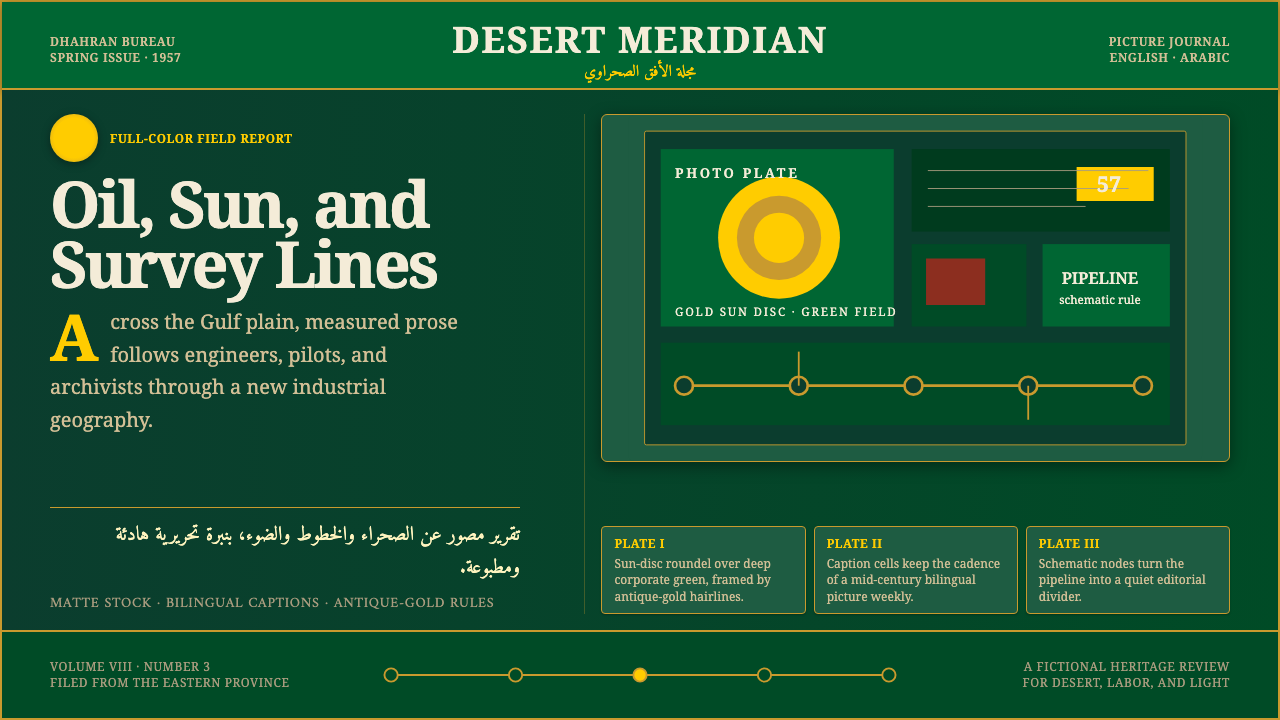 Aramco World MagazineMatte Gulf modernism. Desert green, gold sun-discs, classic serif, and naskh…
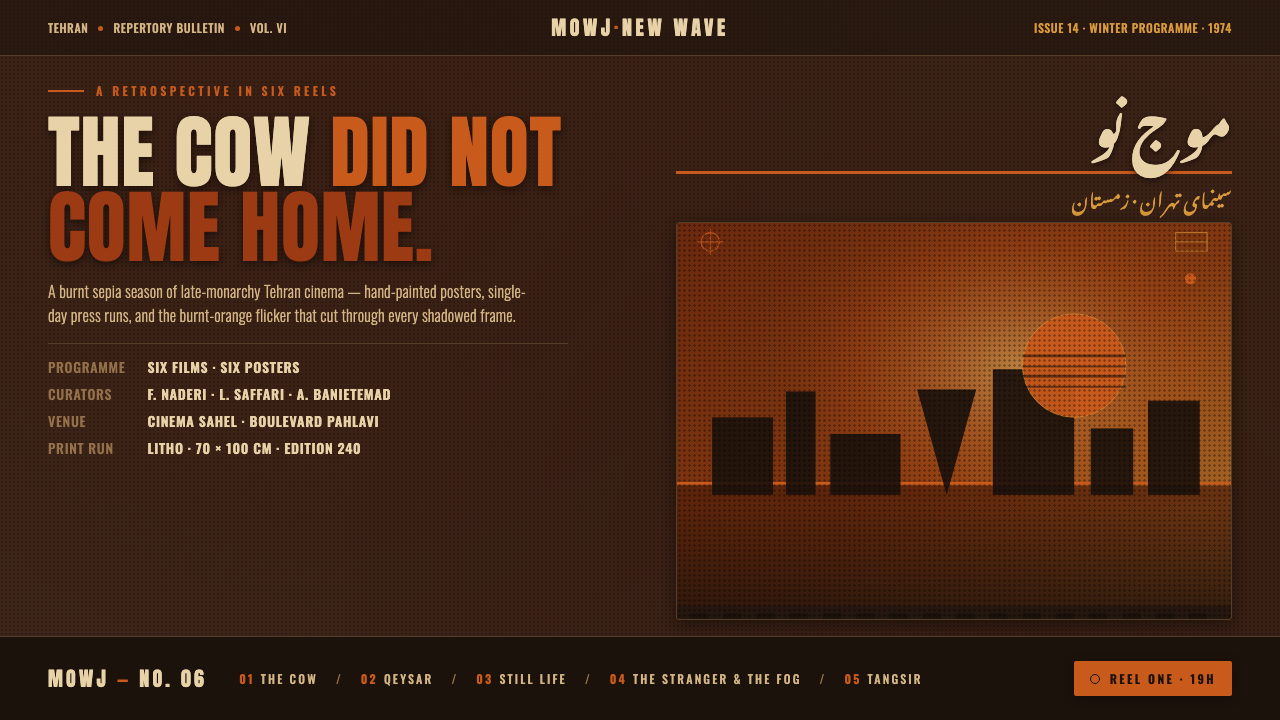 Iranian New Wave PosterPre-revolution Tehran cinema, burnt. Grainy ochre duotone over dark sepia, st…
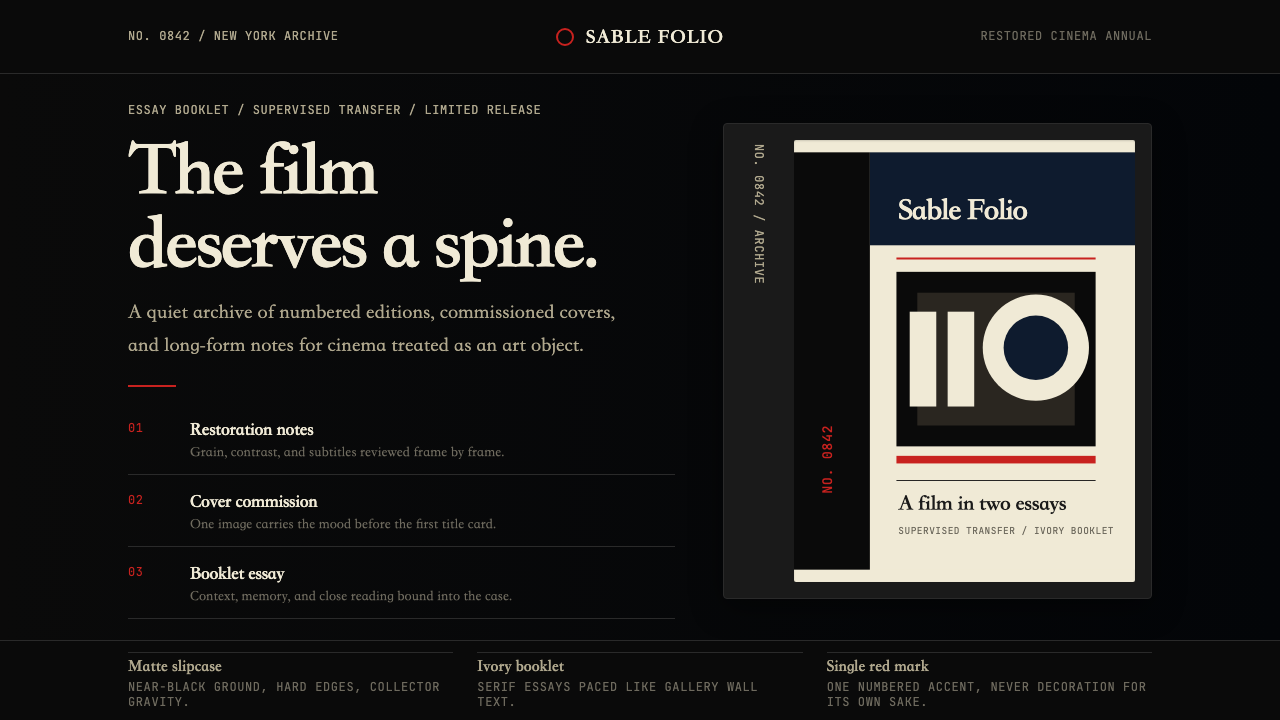 Criterion CollectionMuseum-grade cinema. Matte black, ivory serif, and one red numbered spine set…
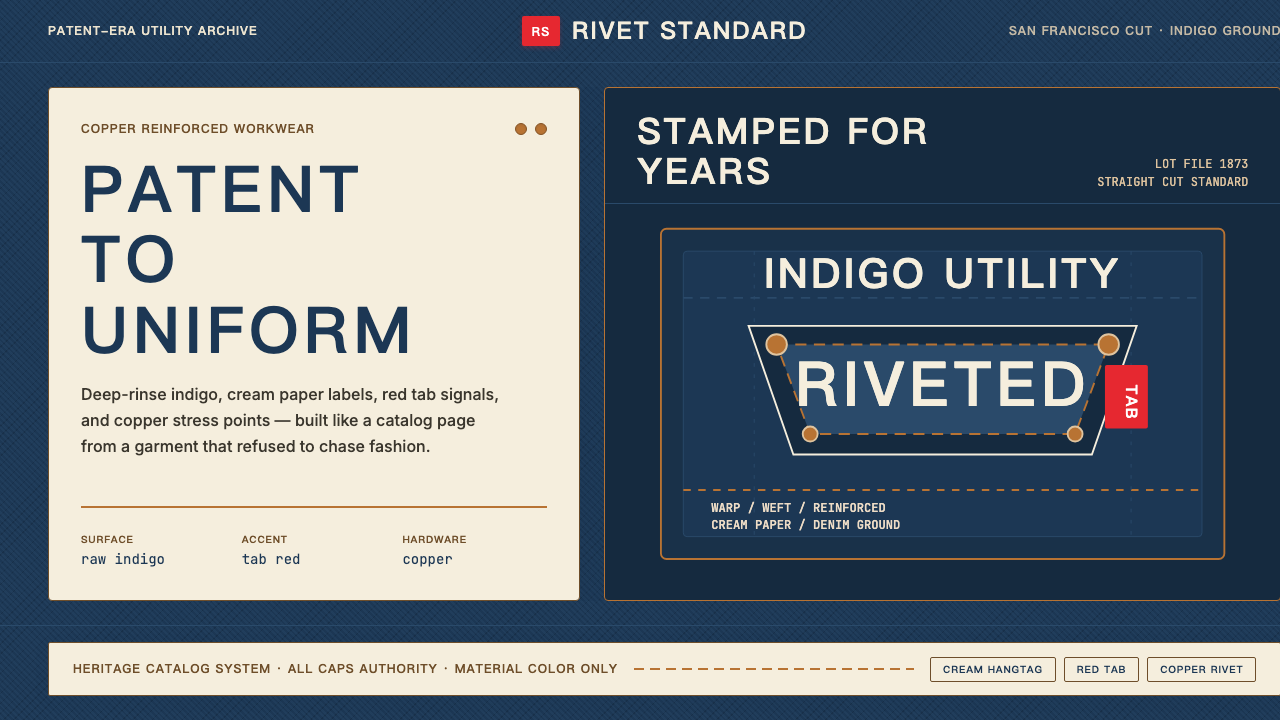 Levi's 501Utility becomes permanent. Indigo ground, cream hangtag panels, red tab and c…
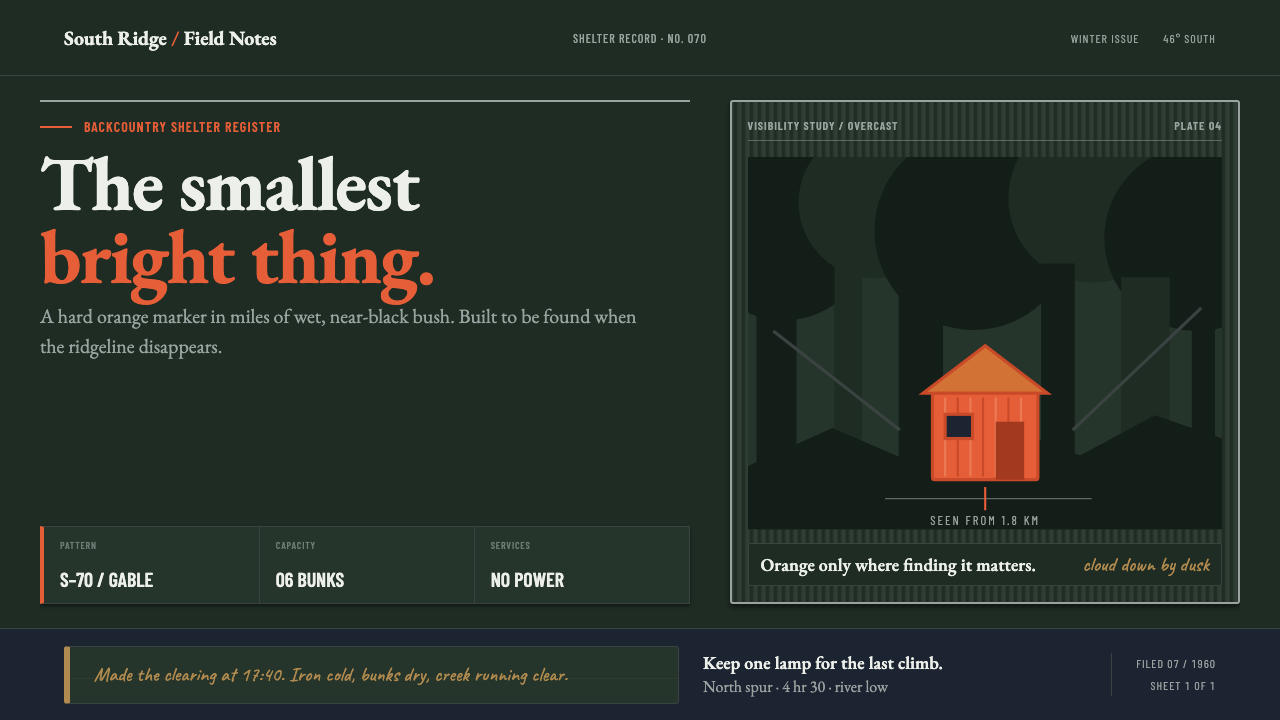 NZ Backcountry HutBuilt to be found. Survival orange cuts through a near-black beech field.
 Pepto-Bismol Pink (1901)Color is the cure. Bubblegum pink floods the field; white label cards and pil…