What is Levi's 501?
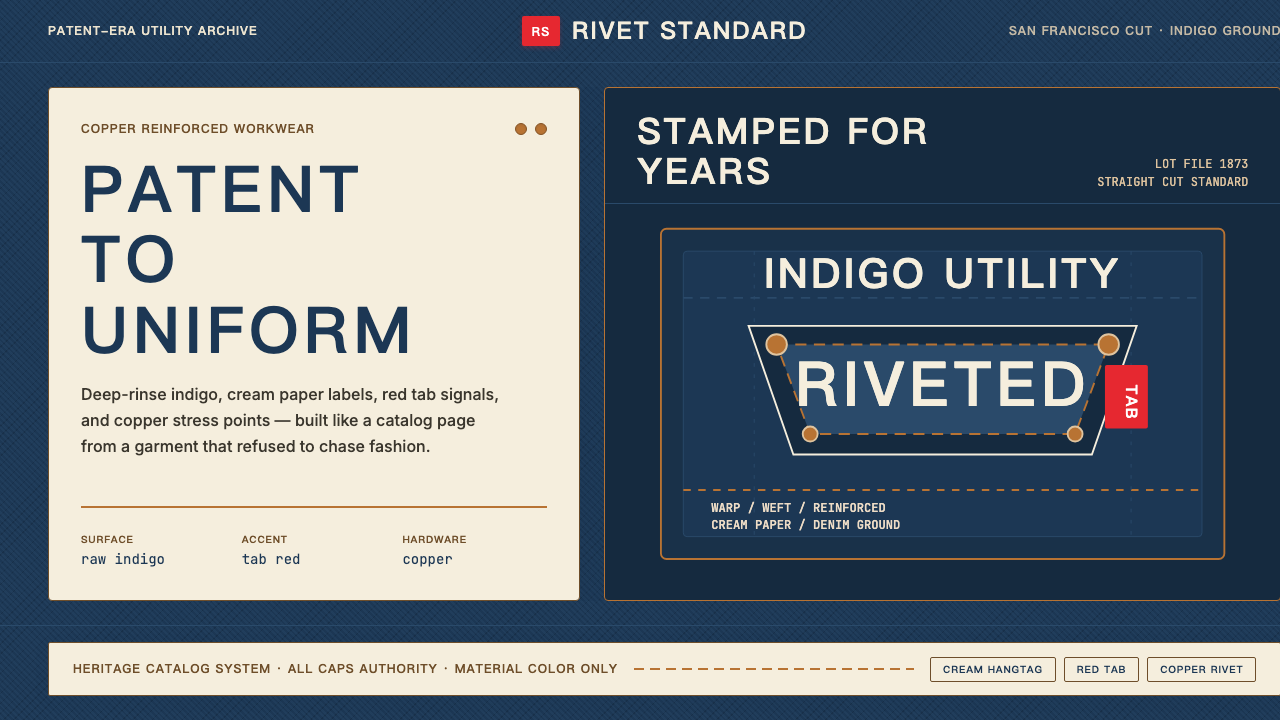
Since 1873, one pair of copper-riveted work pants has remained unchanged in cut while clothing gold miners, rebels, and rock stars alike — the 501 is not fashion, it is infrastructure.
Levi's 501 in brief
The Levi's 501 design system is built on a small number of irreducible visual decisions that have not fundamentally changed in over a century: a deep, saturated indigo ground that reads as both workwear and authority; a cream or off-white panel used wherever information must be legible against that dark field; a precisely sized red accent — the iconic pocket tab — that functions purely as a signature and navigation mark; and copper hardware whose warm, oxidized tone prevents the composition from reading as cold or industrial.
These four elements — indigo, cream, red tab, copper — operate as a system rather than a palette. Each carries a specific role. The indigo is the ground and mood: permanence, labour, authenticity. The cream panel is the content surface: receipts, hangtags, care labels, warranty cards — everything that must communicate clearly is printed on this field. The red tab is the action marker: it identifies ownership and brand at the smallest legible scale. The copper is the structural accent: rivets, buttons, and clasps that hold the object together and signal quality through material weight.
Typography in the 501 system is condensed, all-capitals, and blunt. It descends from the commercial lettering traditions of late-nineteenth-century American trade printing — bold compressed letterforms that ensure legibility under dust, distance, and poor light. The sensibility is label, not logotype: authoritative, neutral, and almost bureaucratic. Nothing about the type style invites reading so much as it insists on being read.

Where does Levi's 501 come from?
The 501's origin is a practical document: United States Patent No. 139,121, granted on May 20, 1873, to Levi Strauss and Jacob Davis for the Improvement in Fastening Pocket-Openings. Davis, a Latvian immigrant tailor working in Reno, Nevada, had discovered that copper rivets placed at pocket corners and the base of the button fly could prevent the tearing that hard physical labour caused in ordinary cotton trousers. He wrote to Strauss — his fabric supplier in San Francisco — proposing to patent the idea jointly, since he could not afford the fourteen-dollar filing fee alone. Strauss agreed. The patent transformed workwear from a disposable consumable into a durable engineered object.
The model number 501 came later, assigned in 1890 as Levi Strauss & Co. began organizing its product line with lot numbers. The precise reason 501 was assigned to this particular cut is not documented, but the number became inseparable from the garment's identity as the company's core straight-leg, button-fly jean. For the first several decades, the 501 was sold almost exclusively to working men in the American West — miners, ranchers, and railroad workers who needed trousers that would survive the work rather than the wearer. The design changed only in response to material constraints: copper rivets were removed from the back pockets during World War II to preserve metal for the war effort, an absence that was made permanent after the war when it was discovered that the rivets scratched saddles and school furniture.
The garment's cultural meaning shifted decisively after World War II, when returning veterans and their teenage children adopted denim as a rejection of formal postwar conformity. Marlon Brando wore 501s in The Wild One (1953); James Dean wore them in Rebel Without a Cause (1955). These appearances transformed the 501 from workwear to iconography. The jeans were subsequently banned from many American schools and public buildings as a symbol of juvenile delinquency — which only accelerated their adoption. By the 1960s they had been absorbed into the aesthetics of folk music, student movements, and counterculture, and by the 1970s they were a genuine global phenomenon, commanding premium prices in European markets where denim was scarce.
The visual identity of the 501 system as it is recognized today was shaped primarily in the mid-twentieth century and refined in a major brand refresh around 2014. The red tab — introduced in 1936 to distinguish authentic Levi's product from imitations on retail shelves — became one of the most recognizable small brand marks in commercial history, recognizable at the scale of a thumbnail. The two-horse logo, depicting two horses pulling in opposite directions on a pair of jeans and failing to tear them, was first registered in 1886 and has appeared continuously on the leather patch at the back waistband ever since. Walter Landor, the San Francisco brand strategist whose firm worked with Levi's from the 1960s onward, helped systematize the brand's visual language for an era of global retail, establishing the proportional relationships and print standards that govern how the identity reproduces across packaging, retail environments, and advertising at scale. Chip Bergh, CEO from 2011, oversaw the contemporary repositioning that reaffirmed heritage authenticity as the brand's primary value in a competitive fast-fashion environment.
What defines the Levi's 501 look?
Indigo Ground
The dominant surface is a deep, rinse-faded indigo — not navy, not black, not a decorative blue, but the specific blue of selvedge denim that has been dyed in natural indigo and worn in. This tone carries associations of labour and age that a clean, flat blue does not. In the design system it functions as both background and mood-setter: it makes everything placed on or against it — cream, red, copper — appear earned rather than applied.
Cream Content Panel
Wherever legible information must appear — hangtag, care label, waistband patch, receipt — the 501 system shifts to a cream or warm off-white ground. This is not a neutral white; it carries the warmth of unbleached cotton and aged paper, reinforcing the heritage character. The contrast between the deep indigo field and the cream panel is high enough for clear reading while remaining within the system's warm, earthy temperature. This panel is the document surface of the design language.
Red Tab Accent
The red tab — a small folded cloth label sewn into the right rear pocket seam since 1936 — is the most concentrated point of brand identity in the system. It introduces the only vivid warm accent into an otherwise subdued palette, and it does so at the smallest scale: a mark no larger than a fingernail that nonetheless reads unmistakably at a distance. In the broader design system, red is used with the same discipline: reserved for a single identifiable action, call-to-action, or brand mark per composition, never as a general accent throughout.
Copper Hardware Warmth
The copper rivets and buttons are structural elements — they hold the garment together — but they also serve an important tonal function in the visual system. Their warm, slightly oxidized metallic quality prevents the deep indigo from reading as cold or severe, and they bridge the palette between the blue-black ground and the warm cream panels. In digital and print applications of the system, copper-toned metallic accents or warm amber tones perform the same thermal balancing function.
Condensed All-Capitals Typography
Text in the 501 system is set tight, narrow, and entirely in capitals. This follows the visual logic of late-nineteenth-century American label printing, where information needed to be dense and legible on small surfaces under poor conditions. The all-caps format removes hierarchy within words and creates a uniform texture — every line reads as a declaration rather than a sentence. Line spacing is tight; letter spacing is optically adjusted but never airy. The overall effect is of text as stamp rather than text as prose.
Heritage Label Composition
Layouts in the 501 system are organized around the logic of the physical label: a bordered rectangle containing stacked lines of condensed type, possibly a logo or mark at top, and the essential information below in descending size. This is not grid-based composition in the contemporary sense — it is closer to the certificate or the typographic broadside. Borders are functional, not decorative; they define the edge of the content field. The composition is symmetrical within its rectangle but the rectangle itself may be asymmetrically placed against the ground.
Material Authenticity
The 501 system resists simulation. Textures referenced are real textures — denim weave, unbleached paper, oxidized metal — rather than digitally generated surfaces approximating these materials. In application, this means avoiding surface treatments that mimic materials without the material logic: a photographic denim texture used as a decorative pattern is a pastiche; a solid indigo field that refers to denim in tone and weight is authentic. The system's authority comes from restraint and directness, not from decorative reference.

Who shaped Levi's 501?
Levi Strauss emigrated from Bavaria to New York in 1847 and arrived in San Francisco in 1853, where he established a dry-goods wholesale business supplying merchants throughout the American West. When Jacob Davis proposed the copper-rivet patent in 1872, Strauss provided both the financial backing and the manufacturing infrastructure. His company's San Francisco base — far from the Eastern textile establishment — meant that the product's identity was rooted in frontier utility from the start. Strauss never married; his company passed to his nephews, who maintained the family control that kept the Levi Strauss & Co. identity stable and commercially consistent through periods of fashion pressure that destroyed comparable brands.
Jacob Davis was the actual inventor of the copper-rivet reinforcement. A tailor by trade, he had been buying denim cloth from Levi Strauss's wholesale business and sewing work garments for labourers in Reno. After a customer — reportedly the wife of a woodcutter — repeatedly returned with torn trousers, Davis experimented with placing copper rivets at stress points. He produced his first riveted trousers in 1870 or 1871 and had sold around two hundred pairs before contacting Strauss. After the patent was granted, Davis moved to San Francisco to oversee production as Strauss's factory superintendent, a role he held until his death in 1908. His contribution was practical engineering applied to a garment problem; the design insight was entirely functional.
Walter Landor founded his brand design firm in San Francisco in 1941, making it a near neighbour — both geographically and culturally — to Levi Strauss & Co. Landor's work with Levi's, spanning decades from the 1960s onward, focused on translating the brand's heritage visual language into systems that could operate consistently across mass retail, international markets, and advertising at scale. His contribution was not to invent the 501's iconography — the rivets, the red tab, the two-horse patch were all pre-existing — but to codify the proportional relationships, the typographic standards, and the color hierarchies that make the system reproducible and defensible. Landor's broader influence on American corporate identity design also shaped how heritage brands across industries learned to systematize authenticity.
Chip Bergh became CEO of Levi Strauss & Co. in 2011, inheriting a brand whose heritage was widely recognized but whose commercial position had eroded in the face of fast fashion and premium denim competitors. His tenure prioritized returning to the 501's core identity: authentic, durable, and direct. The brand refresh overseen during his leadership — including tightened visual standards, a renewed emphasis on the made-in-USA heritage narrative, and the relaunch of the 501 as a cultural rather than purely commercial object — helped position the company for its 2019 IPO. Bergh's strategic contribution was demonstrating that a heritage brand's visual restraint and historical consistency were competitive assets rather than liabilities in an era of brand proliferation.
How do you use Levi's 501 today?
The 501 design system is highly transferable to contemporary design work precisely because its logic is material rather than fashionable. Applying it correctly requires understanding the roles of each element — indigo as ground and mood, cream as content field, red as singular accent, copper as thermal counterweight — and maintaining those role boundaries rigorously rather than using the palette as a general color scheme. The most common failure mode is treating the four elements as interchangeable decorative options rather than a system with internal grammar.
For presentation slides, the 501 system works exceptionally well on cover pages and section dividers where a strong visual statement is needed. A cover might be built around a near-full-bleed indigo field with the title set in condensed all-caps cream type, a single red accent mark positioned as a tab or badge at one edge, and copper-toned metallic treatment on a logo or numbering element. Content slides are best treated differently: move to a cream or near-white ground for the body, use the indigo as a heavy header band or a strong left-margin accent bar, and reserve red for a single call-out or live data figure per slide. Data visualizations — bar charts, progress indicators, comparison tables — should use indigo as the primary fill, cream as the background field, and red only for the single most critical value or threshold line.
For web interfaces and dashboards, the system translates well to utility-forward products: analytics tools, inventory management, logistics platforms, and financial applications where the user needs to extract information quickly under pressure. The approach is to build the primary navigation and header in deep indigo, use cream or near-white for the main content area, and apply the red accent to a single interactive state — primary action button, active tab indicator, critical alert — per screen. Typography should be condensed and authoritative throughout the UI, with hierarchy established through weight and capitalization rather than multiple typeface families. Hard-edged card separators and bordered table cells read more authentically in this system than soft shadows and rounded corners.
For editorial and marketing work, the 501 system supports a strong heritage-brand narrative. Feature pages can alternate between indigo-ground sections with cream type and cream-ground sections with indigo type, using the inversion to create visual rhythm without introducing new colors. Pull quotes and callout statistics benefit from the red-tab treatment: a small red rectangle beside or beneath a large-scale figure functions exactly as the pocket tab does on the garment — a small, confident mark that identifies the most important element on the page. Marketing pages directed at establishing authenticity and durability as brand values are well served by this system; pages that need to communicate warmth, softness, or playfulness are not.
A common mistake when applying the 501 system is introducing visual noise in the name of richness: additional accent colors pulled from the indigo-denim color family, distressed or worn texture overlays applied decoratively, or multiple weight variants of condensed type competing on a single surface. The system's authority comes from restraint. Each element appears because it has a specific job; when an element has no job, it should not appear. Similarly, using a washed or desaturated indigo in place of the deep, saturated ground compromises the system's gravity — the indigo must read as material and permanent, not faded or provisional.

Levi's 501 — FAQ
Is the 501 system the same as a general denim or Americana aesthetic?
No. The 501 system is more specific and more restrained than a general denim or Americana aesthetic. Denim as a decorative theme often incorporates distressed textures, patchwork motifs, vintage photography, and a wide warm-brown earth palette that references the American West broadly. The 501 system uses none of these: it is an indigo field, a cream panel, a red tab, and condensed capitals. Its references are industrial and documentary rather than folkloric. A page designed in a general denim aesthetic might feel rustic and warm; a page designed in the 501 system should feel authoritative and permanent, closer in spirit to a utility patent or a government stamp than to a vintage poster.
Can the 501 system work on a light background, or does it require the dark indigo ground?
The system works on a cream or warm off-white ground — this is, in fact, the authentic surface for much of the 501's physical communication: hangtags, care labels, and the two-horse patch are all cream or paper-toned. On a light ground, indigo becomes the heavy structural accent rather than the field: wide header bands, thick ruled lines, heavy typographic elements. The red tab accent remains a single small mark. The copper warmth may need to be replaced with a warm dark brown or amber if full metallic treatment is not appropriate. What the system cannot accommodate gracefully is a cool, clinical white ground — that temperature belongs to a different design sensibility entirely.
How should the 501 system handle imagery and photography?
Photography in the 501 system should be treated the way garment photography has historically been treated by the brand: direct, unapologetic, documentary in character rather than styled or conceptual. Images are best reproduced with high contrast against the indigo or cream ground — silhouetted, edge-cropped, or treated with a duotone approach that limits the image palette to the system's warm tones. Lifestyle imagery with soft natural light, warm glows, and ambient atmosphere works against the system's directness. The preferred photographic register is closer to a product specification sheet or an archival trade photograph than to an editorial fashion story. When in doubt, removing the image and using type alone will produce a more authentic result.
Does the 501 system suit consumer-facing products, or is it primarily a B2B or utilitarian register?
The 501 system is unusual in that it operates successfully in both registers — but for a specific reason: the Levi's brand itself has historically occupied both the utilitarian and the aspirational simultaneously. The system works for consumer-facing products when the product wants to communicate permanence, authenticity, and anti-trend positioning. It works well for heritage goods, quality-over-quantity retail, professional tools, and any product whose value proposition is durability rather than novelty. It struggles in categories that depend on novelty, luxury warmth, or sensory softness: high-end beauty, artisan food, wellness, and children's products are typically mismatched. The question to ask is whether the product values the 501's specific associations — labour, permanence, no-nonsense utility — or whether it needs a different emotional register entirely.
What is the most important single principle to preserve when adapting the 501 system to a new medium?
Role clarity. Each of the four primary elements — indigo ground, cream panel, red tab, copper accent — has a specific job, and that job should not be transferred to a different element or performed by two elements simultaneously. If the indigo is the ground, it should not also be used as a typographic accent on a cream page; if the red is the singular identifier, it should appear once per composition, not as a general highlight color. The system's strength comes from the fact that each element is unrepeatable in its role: you always know what you are looking at and why it is there. Breaking role clarity — even in service of variety or visual interest — collapses the system into a palette, and a palette without grammar is just decoration.
Related design styles
 Aeronautical ChartReads like cockpit data. Magenta-blue airspace rings cut through dense dark-c…
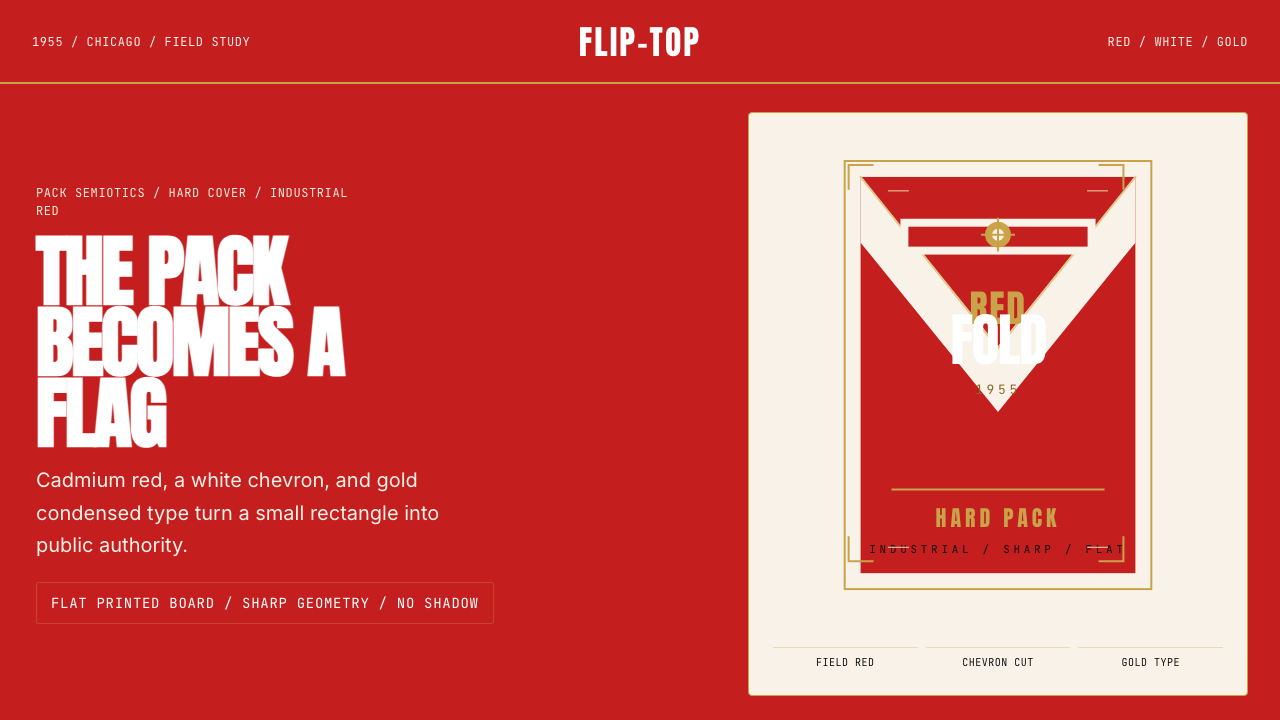 Marlboro Red Flip-Top (1955)Authority in one fold. Cadmium red, white chevron, and gold type read like a…
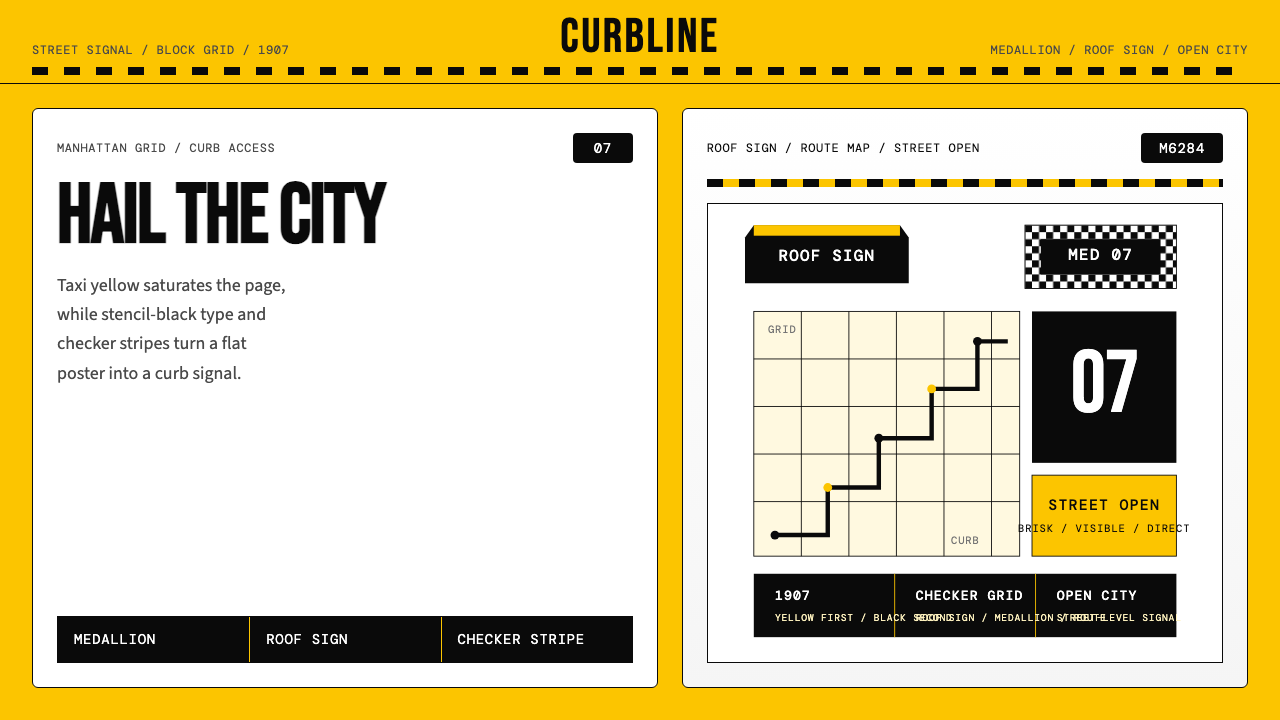 New York Yellow Cab (1907)Visibility is the brand. Taxi yellow, stencil type, checker stripes.
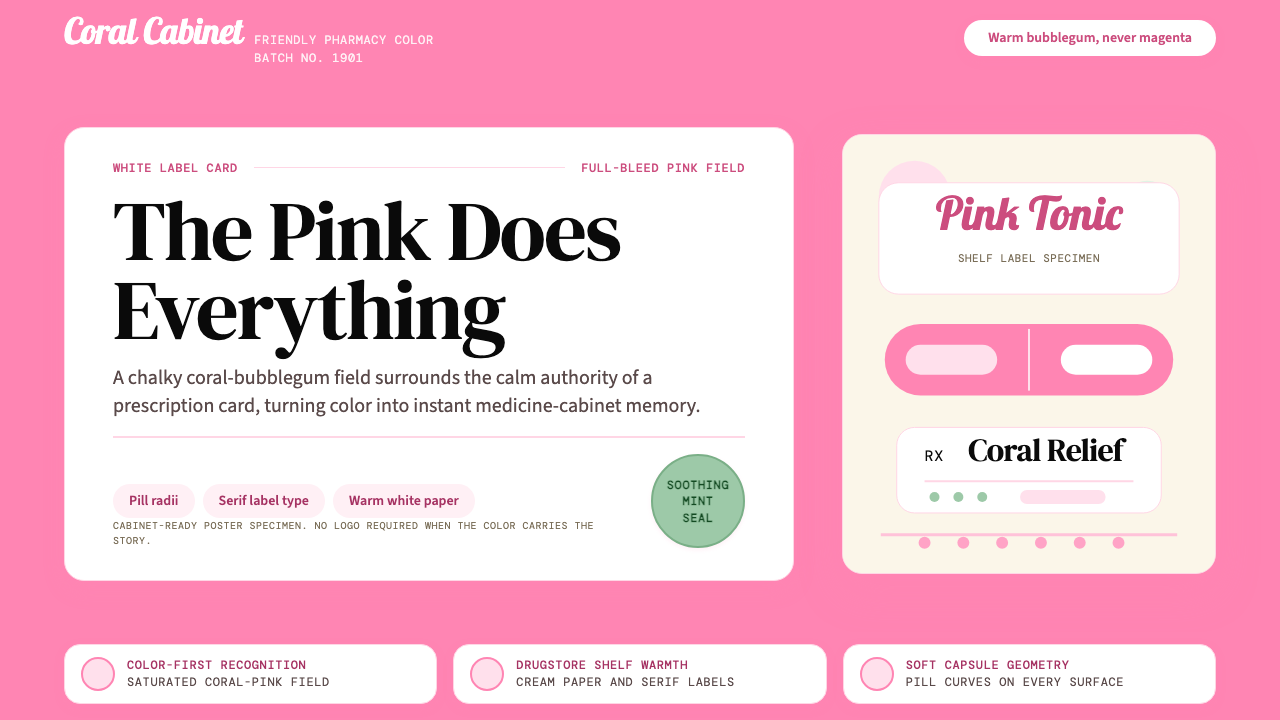 Pepto-Bismol Pink (1901)Color is the cure. Bubblegum pink floods the field; white label cards and pil…
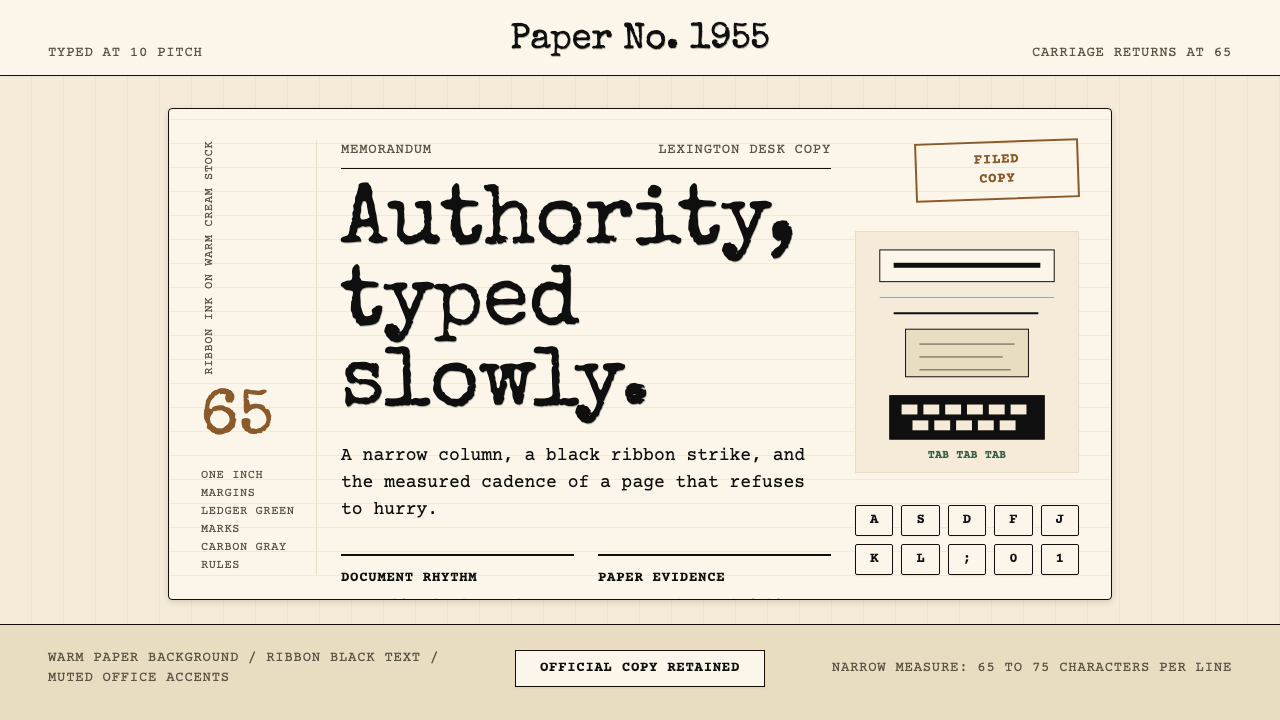 Typewriter Courier (1955)Unhurried authority. Cream paper, ribbon-black monospace, and bordered 65-cha…
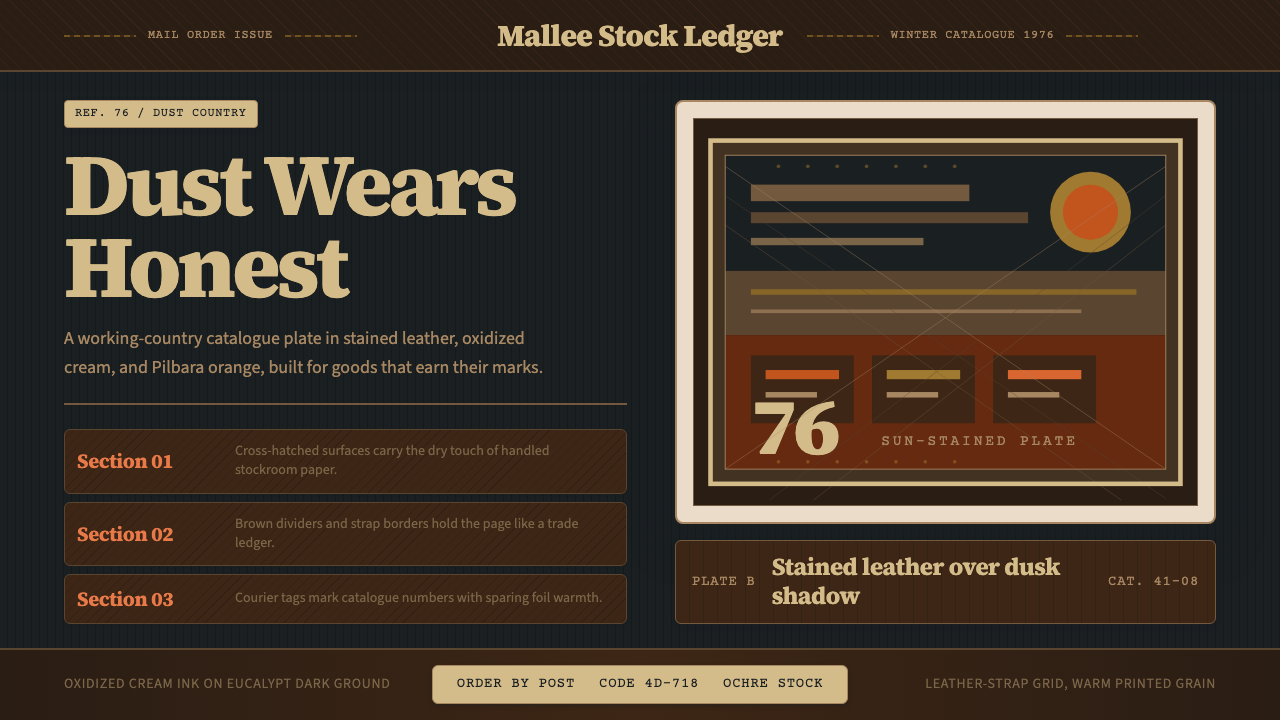 Akubra Outback (1970s Stockman)Worn honesty. Leather brown, Pilbara orange, and cream catalogue frames carry…