What is Typewriter Courier (1955)?
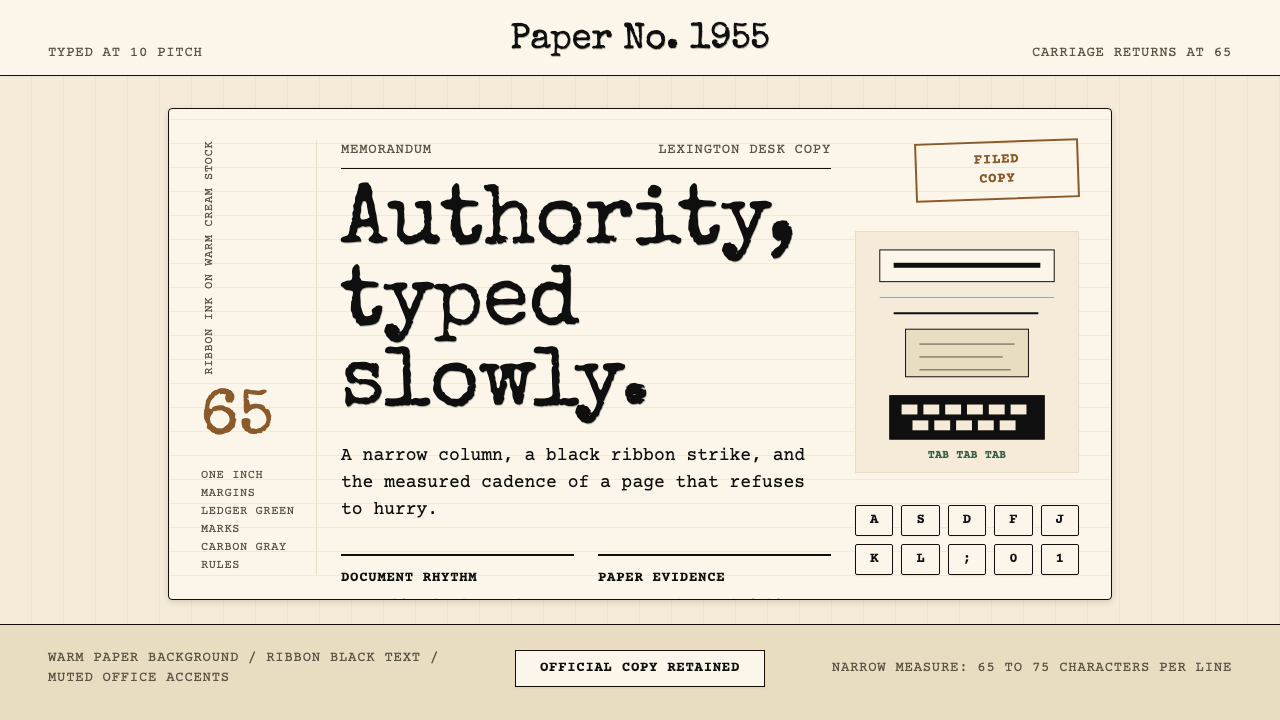
Courier's fixed-width rhythm and ribbon-black authority turned the blank page into an institution — every character equal, every margin deliberate, every line a memo that meant business.
Typewriter Courier (1955) in brief
Typewriter Courier (1955) is a design system built around the visual logic of the mid-century American typewriter: monospaced letterforms, warm cream paper stock, ribbon-ink black, and the measured cadence of a sixty-five-character line. Every element in the system observes the same rule that governed the original machine — no character may claim more horizontal space than any other. The result is a grid so absolute it doubles as both structure and ornament.
The system does not attempt to evoke nostalgia or period costume. Instead, it distills the typewriter's functional properties — equal-width columns, high legibility at long measures, a tonal warmth that sits between white and yellow — into a coherent visual language applicable to contemporary work. What looks like retro is in fact a rigorous set of spacing, tonal, and weight decisions rooted in the mechanical constraints of the IBM typehead.
Visually, the style is defined by restraint and confidence rather than decoration. The palette is narrow: warm off-white grounds, dense near-black ink, and occasional use of a faded red or aged blue that recalls a second typewriter ribbon. Borders appear as single ruled lines rather than elaborate frames. White space is generous and structural — the one-inch margin of a typed page translated into digital breathing room.

Where does Typewriter Courier (1955) come from?
In 1955, IBM commissioned typeface designer Howard 'Bud' Kettler to design a new monospaced font for its line of typewriters. The engineering brief was unambiguous: every character — from the narrow letter i to the wide capital M — must occupy identical horizontal space, because the typewriter's mechanical carriage advanced a fixed increment with each keystroke. Kettler's response was Courier: a slab-serif design whose proportions were carefully balanced so that no character looked starved or crowded within its fixed cell. The name was chosen to suggest a professional messenger — reliable, neutral, carrying dispatches without editorial comment.
Courier remained an IBM proprietary design until 1955, when the company took the unusual step of releasing it into the public domain without reserving trademark rights. IBM's stated rationale was that a standard typewriter typeface should be universally available — a stance that reflected the postwar American corporate culture of standardization and interoperability. This decision had consequences far beyond the typewriter industry. When the IBM Selectric arrived in 1961 with its revolutionary typeball mechanism — replacing individual hammers with a single interchangeable sphere — Courier became the de facto standard for American business correspondence, government documents, and legal filings.
The screenplay industry adopted Courier as its binding standard in the 1970s and codified it further through the decades that followed. The conventions are precise: a properly formatted film script in Courier occupies roughly one page per minute of screen time, a rule of thumb that has governed the industry's working rhythm for over fifty years. The Writers Guild of America and major studios enforced Courier as the only acceptable typeface for submitted scripts — not out of aesthetic preference, but because a standardized format made timing estimates reliable and page counts meaningful. Courier thus acquired the authority of a legal instrument: its monospace rhythm was simultaneously a design choice and a contractual specification.
When personal computing arrived, Courier followed. It shipped as a default typeface with countless word processors, terminals, and operating systems, becoming the universal face of the command line, the code editor, and the plain-text document. Adrian Frutiger redesigned it as Courier New for inclusion in the core font sets distributed with early Microsoft and Apple systems, extending its reach to hundreds of millions of screens. The typeface that began as a mechanical solution to a mechanical constraint became the visual signature of the digital age's plainest, most trusted outputs: source code, legal transcripts, screenplay drafts, and government correspondence.
What defines the Typewriter Courier (1955) look?
Monospaced Grid
Every character — letter, numeral, punctuation mark, or space — occupies an identical horizontal unit. This mechanical constraint, inherited directly from the typewriter carriage, creates a grid so rigid that columns align without any deliberate tabulation. The visual effect is one of absolute orderliness: text blocks read as dense, textured rectangles rather than rivers of varying-width letters. In design application, this grid serves as the underlying structure for tables, lists, and data displays without requiring any additional alignment logic.
Warm Paper Ground
The background is not white but a warm off-white — the color of aged bond paper or unbleached typing stock — that reads as cream or ivory under most lighting conditions. This warmth is structural: it softens the harshness of high-contrast black text, reduces eye fatigue at long reading distances, and gives the overall composition an authority that pure white grounds lack. The tone sits closer to candlelight than to the blue-white of a backlit screen, grounding the system in the physical world of the printed document.
Ribbon Black
The primary ink tone is a dense, slightly warm black — not a neutral or blue-tinted print black, but the color of a fresh typewriter ribbon pressed onto textured paper. This tone has a subtle inkiness, a weight that feels deposited rather than projected. In digital application, it implies the full, saturated depth of ink-on-paper without resorting to simulated texture. Against the cream ground, ribbon black delivers contrast that is authoritative without being harsh — the contrast of a government document rather than a warning sign.
Ruled-Line Borders
Structural divisions in the system are marked by single, consistent ruled lines — thin horizontal or vertical strokes that recall the underlines of typed headings and the borders of printed form fields. These lines never double, ornament, or vary in weight for decorative effect. They are purely positional: they mark where one section ends and another begins. The ruled line is the system's only decorative concession, and even then it is borrowed from the typewriter's most functional gesture — the underline key.
Sixty-Five Character Rhythm
The canonical typewriter line — sixty-five characters across with one-inch margins on a standard letter page — establishes a reading measure that has been tested by decades of heavy document use. This line length sits at the upper boundary of comfortable single-column reading for adult readers processing dense information. In design application, the sixty-five-character measure serves as a guide for body text columns: wide enough to convey authority, narrow enough to prevent the eye from losing its return path across the column.
Faded Accent Colors
The system admits a narrow range of secondary tones: a muted brick red suggesting a second typewriter ribbon, a faded navy or slate blue that recalls carbon-copy forms and government stamp ink, and an aged manila or buff that recalls the envelopes of official correspondence. These accents are never vivid or saturated — they carry the patina of age, as if the color has been absorbed by the paper rather than applied to it. They appear sparingly, for hierarchy or emphasis only, and never compete with the dominant cream-and-black axis.
Formal Cadence
The system's spacing and layout decisions produce a cadence that feels deliberate and unhurried — the rhythm of a document that expects to be read in full rather than scanned. Generous leading between lines of body text, consistent paragraph breaks, and the absence of call-out boxes or pull-quotes force a linear reading path. This formality is not a limitation but a feature: it signals seriousness of purpose and invites the reader to slow down and give the content the attention that official correspondence has always demanded.

Who shaped Typewriter Courier (1955)?
Kettler designed Courier for IBM in 1955, solving the formidable challenge of creating a typeface in which every character — from the hairline-thin letter i to the broad capital W — reads as visually balanced within an identical fixed-width cell. His solution drew on the slab-serif tradition, using consistent stroke weights and bracketed serifs to give each character enough visual mass to fill its allotted space without crowding. IBM's decision to release Kettler's design into the public domain, an unusual act of corporate generosity, ensured that Courier became the common property of an entire era of typed communication.
Frutiger, best known for the typeface that bears his name and for Univers, was commissioned to redesign Courier for the digital era. His revision — released as Courier New — adjusted the letterforms to render more cleanly at the lower resolutions of early personal computer screens and laser printers. Frutiger's intervention preserved the essential character of Kettler's original while adapting its proportions for on-screen legibility, ensuring that the typeface's authority survived the transition from mechanical impression to digital pixel.
Riley is the author of one of the most widely consulted practical guides to screenplay formatting, which codified the conventions — twelve-inch page, one-inch margins, Courier as the only permissible typeface — that have governed Hollywood script submission since the 1980s. His work transformed the informal industry practice of typing scripts in Courier into a documented standard, cementing the typeface's status as not merely a design choice but a contractual and professional requirement. The screenplay industry's insistence on Courier is one of the most durable examples of a design decision preserved unchanged for reasons of institutional inertia and functional reliability.
The IBM Selectric typewriter was not a person but an artifact whose influence on design history rivals any individual designer's contribution. Its interchangeable typeball mechanism — a golfball-sized sphere bearing the complete character set — replaced the jamming-prone individual hammer system and allowed a single machine to switch typefaces by swapping the ball. The Selectric made Courier the default face of American office culture by shipping with a Courier typeball as standard, and its global commercial success — over thirteen million units sold — ensured that the visual conventions of Courier-typed documents became the universal template for authoritative written communication.
How do you use Typewriter Courier (1955) today?
Typewriter Courier's greatest strength in contemporary design is the authority it confers without requiring elaborate visual language. The system works because it has been pre-loaded with institutional credibility by a century of legal contracts, government reports, and screenplay drafts. Applying it correctly means understanding which design contexts benefit from that borrowed authority — and which contexts will be undermined by its formality.
For presentation slides, the system divides naturally between cover and content pages. A cover benefits from the contrast of a centered, weighted title in the monospaced face against an expanse of warm cream — with a single thin ruled line separating the title from a subtitle or date, and no additional graphic elements. Content slides should treat text as document pages rather than designed graphics: one level of body text, a clearly subordinated caption layer, and section labels set as typed headings rather than styled callouts. Data slides work well in this system precisely because the monospaced grid aligns numerical columns without design intervention — a table of figures in Courier is already formatted by its own typeface logic. Resist the temptation to color-code rows; instead, use the ruled-line border to group data and let the cream-and-black contrast carry the hierarchy.
For web interfaces, the system is best deployed in contexts where deliberate, sustained reading is expected — documentation pages, legal disclosures, pricing tables, and editorial platforms. Dashboard interfaces benefit from the monospaced grid for numerical data: figures displayed in a fixed-width face align on the decimal without explicit layout rules, giving a table of metrics the precision of a spreadsheet without the coldness of a spreadsheet aesthetic. Navigation and interface labels should respect the system's document logic — sentence case, minimal iconography, no gradient fills on interactive elements. Accent colors in the faded brick-red or aged-blue range can mark interactive states or tier differentiation without breaking the paper-and-ink axis.
In editorial and marketing contexts, the style's authority translates into a distinctive voice for long-form content and institutional communication. A landing page built on this system should lead with a full-width hero treated as a typed memo — center-weighted or left-aligned title, a thin horizontal rule, and a brief identifying line in a smaller weight. Body sections work as document columns: narrow measure, generous leading, pull-quotes set as indented typed paragraphs rather than enlarged display type. Marketing applications that lean into the system's contractual associations — legal tech, financial services, policy platforms — benefit especially from its matter-of-fact tone. The absence of illustration and decorative imagery is intentional: the system's credibility depends on looking like it has no interest in selling you something.
The most common mistake when applying this system is treating the monospaced typeface as a stylistic texture while ignoring the spacing and tonal logic that gives it meaning. Using a monospaced face inside a brightly colored, rounded-corner card component produces pastiche rather than system coherence — the face signals one set of values while the surrounding design signals another. The second common error is introducing too much variety into the accent palette: a faded red, an aged blue, and a manila yellow used simultaneously lose the system's austere authority and begin to look merely vintage. Choose one accent tone per application and use it sparingly, consistently, and only for structural — never decorative — purposes.

Typewriter Courier (1955) — FAQ
Is this style appropriate only for text-heavy content, or can it support visual and data-driven work?
The monospaced grid makes this system surprisingly well-suited to data-heavy work. Numerical tables, code listings, and structured data displays align naturally in a fixed-width environment — the typeface's mechanical origin as a precision instrument means that data formatted in it inherits an air of exactitude. Charts and graphs work in the system when treated as typed diagrams rather than designed infographics: axis labels in the monospaced face, bars or lines in the primary ink tone, minimal gridlines. The system struggles with layouts that depend on photography, rich color, or freeform illustration — it is fundamentally a text-and-structure system, and any imagery introduced should be treated as a formal document element rather than an emotional visual.
Can the Typewriter Courier system work in a dark or night-mode layout?
A dark inversion is possible but requires care. The system's warmth depends on the relationship between cream ground and ribbon black — invert this to dark charcoal or near-black ground with a cream or aged-white foreground type, and the warmth largely survives. What does not survive well is the literal black-ink color: in a dark layout, the primary text tone should shift to the warm cream used as background in the light version. The faded accent colors — brick red and aged blue — function adequately on dark grounds. What breaks the system entirely is a cold, saturated dark background such as pure navy or deep green, which imports the wrong tonal associations.
How should illustration and imagery be used within this system?
The system has no native place for photography or representational illustration, and forcing either in tends to undermine the document authority the style depends on. When imagery is unavoidable — a product screenshot, a portrait, a diagram — it should be treated as a formal document inclusion rather than a designed graphic: housed within a ruled-line border, captioned in a subordinate monospaced size, and left without drop shadows or rounded corners. High-contrast, desaturated, or duotone image treatments in the cream-and-ink palette preserve tonal coherence. Diagrams and charts drawn as monospaced-grid constructions — using horizontal and vertical lines only, no decorative fills — integrate most naturally.
What distinguishes this system from generic retro or nostalgia design?
The distinction is between mining a historical aesthetic for atmosphere and applying the functional logic that created that aesthetic. Retro typewriter design typically imports visual signals — worn textures, smudged ink effects, distressed letterforms — to generate a nostalgic emotional response. The Typewriter Courier system does the opposite: it abstracts the functional principles of the typewriter — equal-width spacing, warm stock, ribbon ink, sixty-five-character measure — into a design language that is contemporary in execution while carrying the institutional authority those functional origins produced. There are no worn textures, no distress effects, no simulation of age. The warmth is tonal, not simulated. The authority is structural, not atmospheric.
Which design contexts are genuinely unsuitable for this system?
The system is poorly matched to any context where warmth, playfulness, sensory richness, or cultural proximity is a primary value. Consumer food brands, children's educational products, wellness and self-care applications, entertainment platforms, and fashion or lifestyle editorial all depend on visual warmth and variety that the typewriter system structurally refuses. The system is also a poor fit for products targeting audiences who associate the typewriter aesthetic with obsolescence or bureaucratic friction — younger users with no direct experience of typed documents may read the style as dated rather than authoritative. Finally, any design requiring strong photographic imagery or colorful illustration will fight against the system's formal constraints rather than working within them.
Related design styles
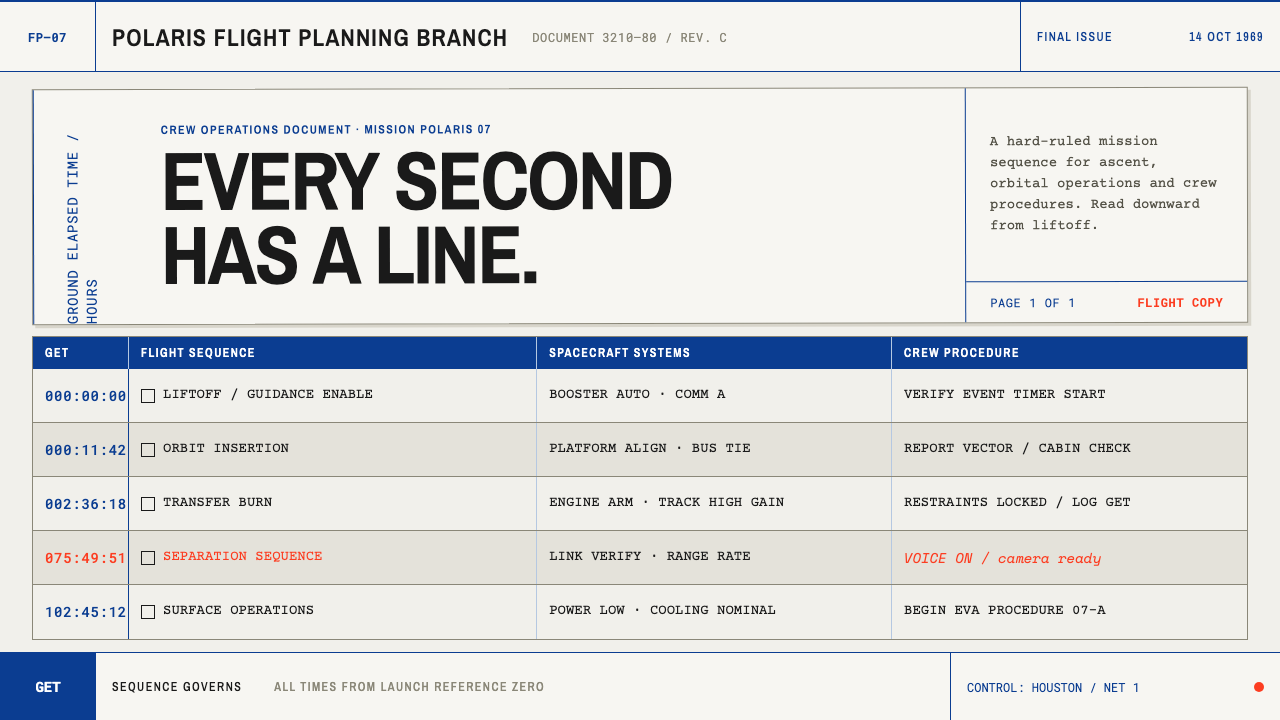 Apollo Flight PlanEvery second has a line. NASA blue rules and monospaced GET stamps discipline…
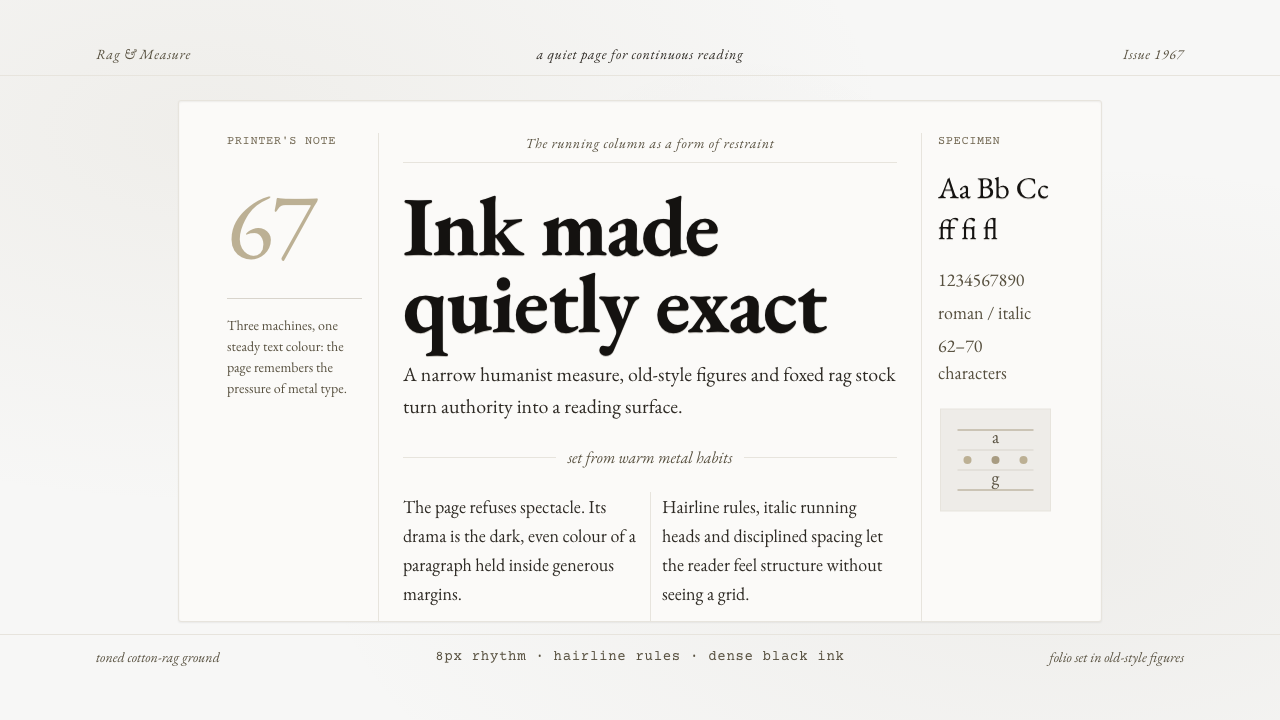 Sabon by Jan TschicholdQuiet authority in print. Dense black Garamond rests on foxed grey-tan rag pa…
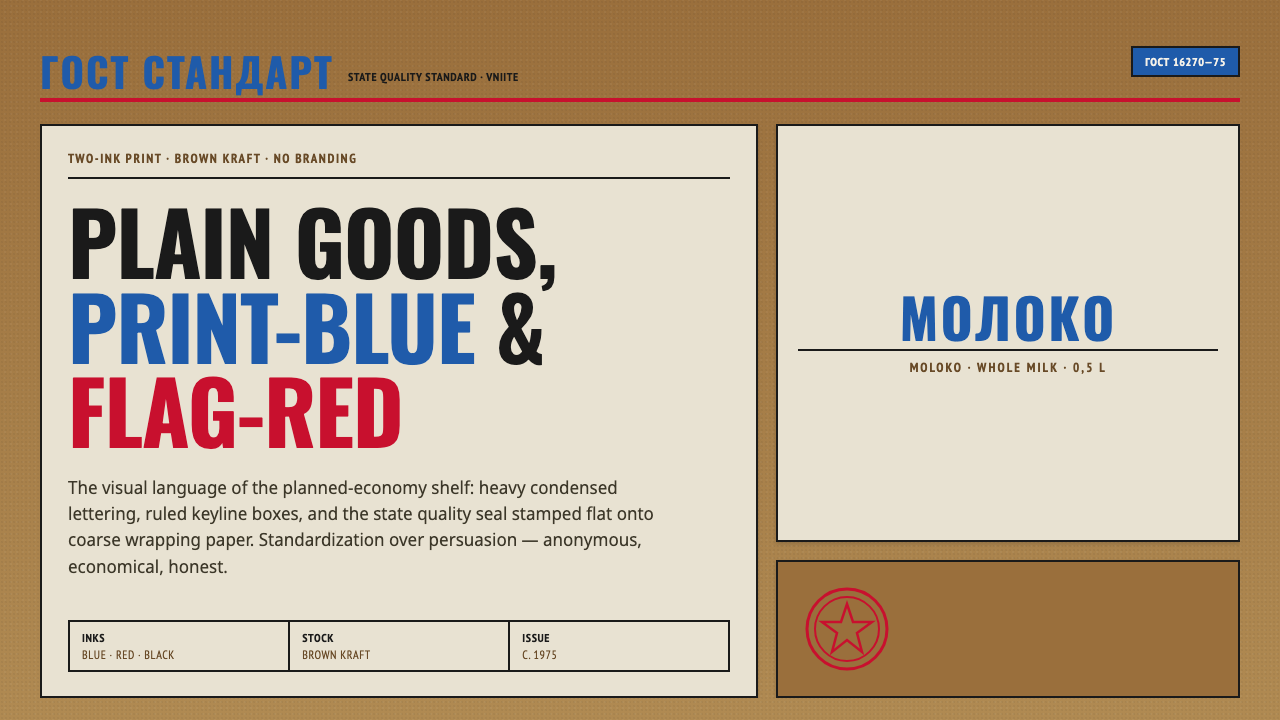 Soviet GOST PackagingAnonymous and strict. Kraft ground, red-blue ink, ruled boxes, condensed type.
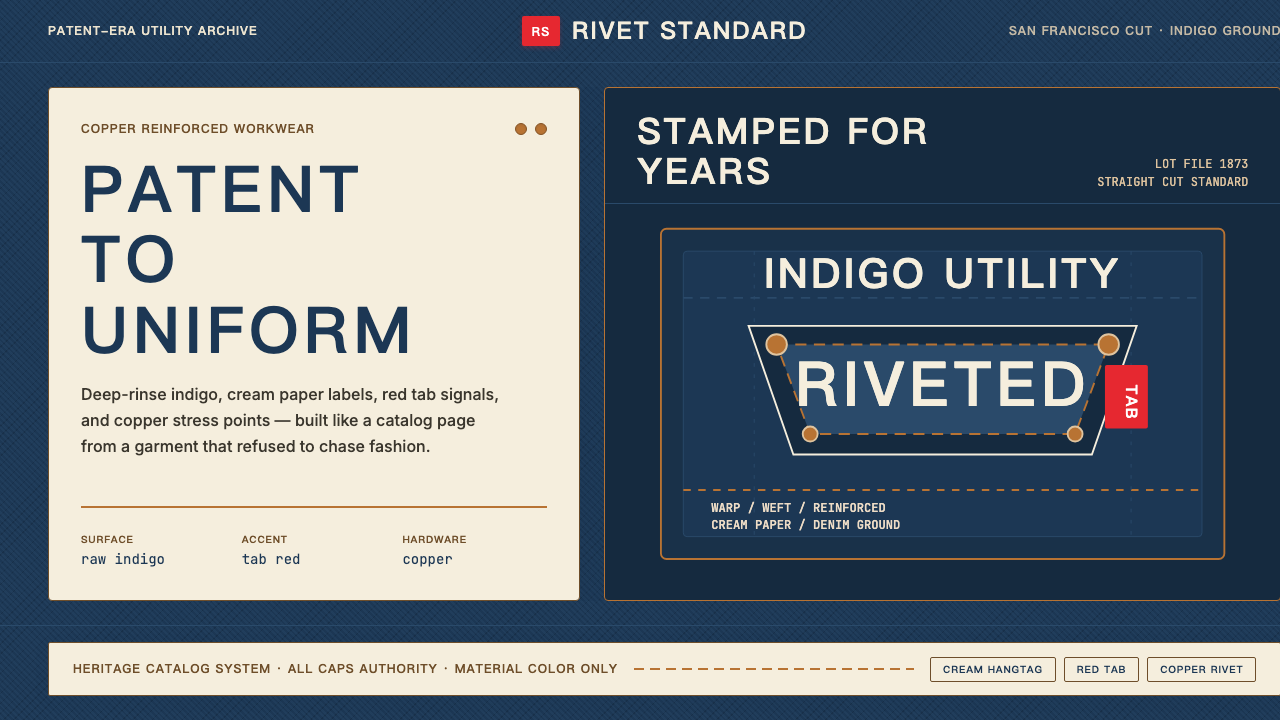 Levi's 501Utility becomes permanent. Indigo ground, cream hangtag panels, red tab and c…
 Microfiche ArchiveRecords as lit frames in a matrix. Cyan-blue back-lit panel, glowing mono typ…
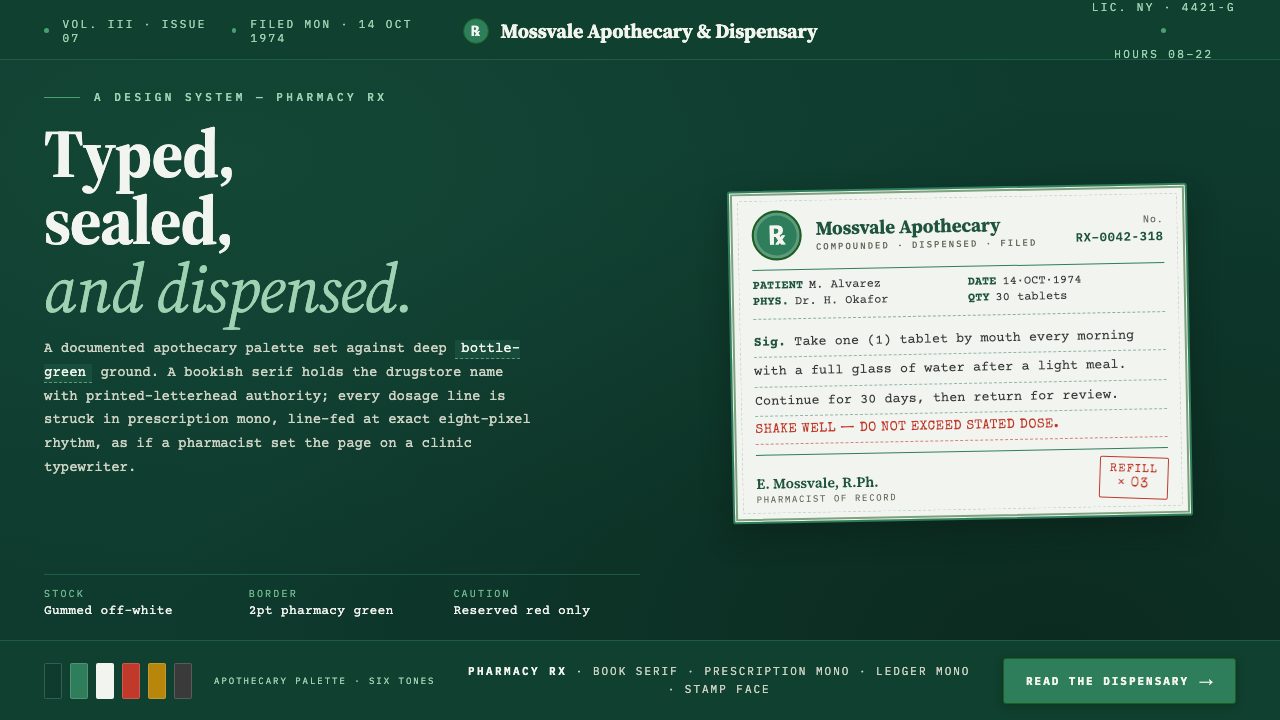 Pharmacy RxThe drugstore label, documented. Pharmacy-green border, Rx seal, typewriter d…