What is Facebook 2004?
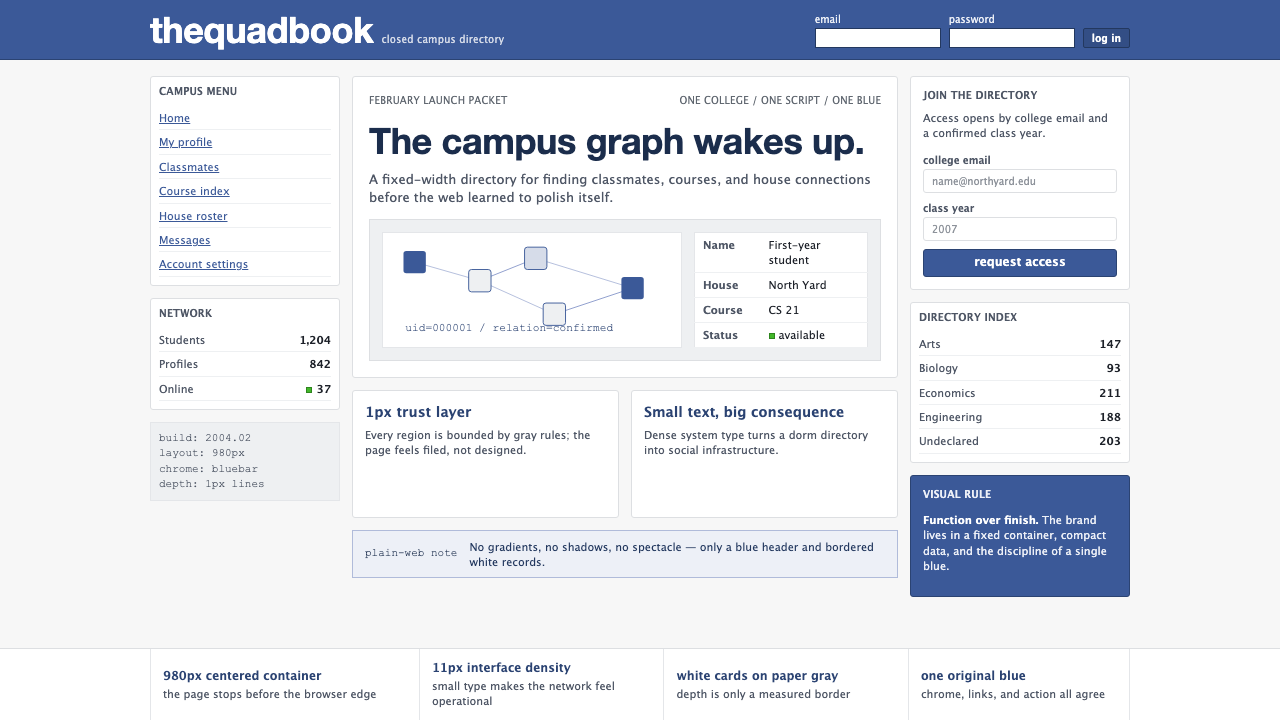
Before social media had a look, thefacebook.com defined one: a blue bar, a gray page, white bordered cards, and system type so small it felt like it was whispering.
Facebook 2004 in brief
Facebook 2004 is the visual language of the original thefacebook.com — launched from a Harvard dormitory in February 2004 — before the site acquired polish, rounded corners, or any of the softening conventions that would define consumer social media in the decade to follow. It is a fixed-width page built on a disciplined columnar grid, a stark blue header bar, a light gray background, and white content cards outlined with hairline borders. There are no gradients, no drop shadows, no decorative illustration. The aesthetic is almost bureaucratic: a university directory that happened to become the most visited site on earth.
The style belongs to a precise and unrepeatable moment in web history — what designers sometimes call pre-Web 2.0 sobriety. Before Ajax made pages feel alive, before CSS3 made rounded corners effortless, before broadband made imagery cheap, sites were built around system fonts, table-based grids, and a color palette limited to whatever browsers rendered reliably. Facebook 2004 did not transcend these constraints; it made them into an identity. The blue that anchored every page became one of the most recognized colors in the history of digital media.
As a design reference, Facebook 2004 is valuable precisely because of its constraint. It demonstrates what a coherent visual system can achieve with almost no decorative resources: consistent grid, deliberate typographic hierarchy, and a single strong hue used structurally rather than expressively. Applied today — to slides, dashboards, editorial layouts, or brand identities positioning themselves as direct and functional — it reads not as nostalgia but as principled restraint.

Where does Facebook 2004 come from?
In the early hours of February 4, 2004, Mark Zuckerberg launched thefacebook.com from his room in Kirkland House at Harvard University. The site was built in roughly two weeks, in PHP, on a shared hosting plan. Its original purpose was narrow: a directory of Harvard students with profile photos, basic biographical information, and — crucially — the ability to declare social relationships. Within twenty-four hours, twelve hundred students had registered. Within a month, it had spread to Yale, Columbia, and Stanford.
The visual language was not designed so much as assembled. Zuckerberg and Andrew McCollum, who handled early graphic work, made choices that were partly aesthetic and partly practical. The fixed-width grid was a standard technique for controlling layout across the inconsistent browsers of the era. The blue header reflected a known personal preference of Zuckerberg's — he has been reported to have a degree of red-green color blindness that made blue the color he could perceive most vividly and reliably. The Klavika typeface, used for the wordmark, was a contemporary geometric sans designed by Eric Olson and released by Process Type Foundry in 2004, chosen for its clean, neutral authority. The system-font body text — primarily Lucida Grande on Mac and its Windows equivalents — was simply the most readable option available without requiring custom font loading.
The site's aesthetic was shaped by the conventions of the mid-2000s campus web. University intranets, student government pages, and academic department sites all shared a similar visual grammar: light gray backgrounds, bordered white content regions, small body text, and navigation bars in institutional colors. Facebook did not subvert this grammar — it executed it more crisply than anyone else. The resulting look was simultaneously familiar and authoritative, which contributed to the trust and adoption speed among the college demographic it targeted.
The visual identity crystallized over the period from the February 2004 launch through roughly 2006, when the platform began expanding beyond colleges and started accumulating the additional UI surface area that would gradually alter its appearance. The 2004 to 2006 window represents the frozen form of the style: the proportions, the column structure, the typographic scale, and the blue-and-gray palette had all settled into a consistent system before the scale of the platform demanded the more elaborate interface conventions that followed.
What defines the Facebook 2004 look?
The Structural Blue
A single cool, medium-value blue serves as the entire brand and structural signal. It appears on the header bar, on primary navigation links, on interactive text elements, and on the wordmark — and nowhere else. The blue is not expressive or atmospheric; it is organizational, functioning like a heading rule in a printed document. Against the light gray and white of the page body, it creates an immediate sense of orientation: wherever the blue is, the frame of the interface is.
Gray-Ground Neutrality
The page background is a flat, cool light gray — not white, not off-white, but a distinctly institutional gray that the browser could render without inconsistency. This ground color performs an important function: it makes the white content cards read as raised and distinct without the use of shadows. The contrast between background gray and card white is subtle enough to remain quiet, but clear enough to define content boundaries. The entire depth vocabulary of the site is accomplished through this single tonal step.
Hairline Borders
Content cards, table rows, form fields, and navigational divisions are all defined by single-pixel borders in a medium gray. The borders are not decorative — they are structural, functioning as the primary means of separating information regions. Because they are so fine, they recede visually and allow the content itself to dominate. The convention requires that content regions be substantial enough to hold their own weight; hairline borders around empty or sparse content feel anxious rather than clean.
System-Font Sobriety
Body text is set in the system sans-serif of the user's operating system — a convention that, in 2004, was both a technical necessity and an invisible aesthetic choice. The result is text that feels native to the device rather than branded or styled. Point size is small by contemporary standards, set tight, with limited line spacing — a density that signals seriousness and information priority over comfort. The typographic hierarchy is achieved entirely through size and color shift rather than through distinctive typefaces at each level.
Fixed-Width Column Grid
The page is constructed on a fixed total width, divided into a narrow left navigation rail and a dominant main content column, with a thinner right sidebar. This columnar structure was the standard layout grammar of mid-2000s web design, but Facebook applied it with unusual consistency. Every page in the site maps to this same underlying grid regardless of content type, which creates a visual uniformity that reinforces the sense of a coherent system rather than a collection of ad-hoc pages.
Geometric Wordmark Clarity
The facebook wordmark, set in a geometric sans-serif, sits in the upper left corner of the blue header bar in white — the most structurally inevitable position on the page. The letterforms are clean and reductive, with no custom ligatures, no illustrative marks, and no supporting icon. The identity is purely typographic. This convention, which later became an expectation in startup branding, was in 2004 notable for its self-confidence: the name alone, in a reliable sans-serif, against the blue.
No Decoration, No Imagery
Outside of user-uploaded profile photographs — which are constrained to small, fixed-proportion containers — the interface contains no imagery. No background textures, no icon illustrations, no marketing photography, no gradient fills. The visual field is composed entirely of text, borders, and the structural blue. This absence is not poverty but discipline: every pixel that is not content is overhead, and in 2004, bandwidth was still a constraint that design had to respect.

Who shaped Facebook 2004?
Zuckerberg coded and effectively art-directed the original thefacebook.com while a nineteen-year-old sophomore at Harvard. His reported color perception characteristics influenced the blue that would become the site's primary brand signal. His preference for clear, direct information presentation — rooted in his background in competitive programming and his stated admiration for well-structured data displays — shaped the spare, function-first visual character of the original interface. The decision to keep the design unadorned while competitors were adding skeuomorphic flourishes was, in retrospect, a significant aesthetic judgment.
McCollum, one of the original co-founders and Zuckerberg's roommate at Harvard, handled much of the early graphic design work on thefacebook.com, including the original profile interface and the visual layout of the first feature pages. His contributions established the structural conventions — the column grid, the card-based content layout, the use of bordered containers — that would persist as recognizable Facebook DNA through multiple subsequent redesigns. McCollum later moved into product leadership roles at the company.
Saverin co-founded and initially financed thefacebook.com, providing the capital that covered early server costs and allowed the site to expand beyond Harvard. His business role was distinct from the design and engineering work, but his financial contribution made the 2004 visual identity possible to sustain and scale — without his funding, the platform would have been unable to support the server load that came with rapid early growth. His later legal dispute with Zuckerberg over equity became the subject of significant public attention.
Moskovitz, Zuckerberg's roommate and another of the original co-founders, joined as an engineer in the first weeks of the site and was instrumental in the technical expansion that allowed the Facebook visual system to scale from a single-school site to a multi-campus network in the spring and summer of 2004. The consistency of the visual identity across this rapid geographic expansion — the same grid, the same blue, the same card conventions appearing at Yale and Stanford — was a product of the tight engineering constraints Moskovitz and Zuckerberg maintained as the codebase grew.
How do you use Facebook 2004 today?
Facebook 2004 is a surprisingly versatile reference for contemporary work because its constraints are universal rather than period-specific. The underlying principles — a single structural color, a neutral ground, hairline borders as the primary division mechanism, system-native typography, and a columnar grid — are transferable to any medium where clarity and directness are the priority values. Applying it correctly requires accepting the austerity: the moment you add a gradient fill, a soft drop shadow, or a decorative icon set, you have left the style.
For presentation slides, the style works on both cover and content pages with distinctly different treatments. A cover benefits from the full structural impact: the wordmark or title set in a clean geometric sans, the blue occupying the full top band or a large anchoring block, the rest of the field in light gray or white with no imagery. Content slides should be treated as information grids — left-aligned type hierarchy using only size and weight to distinguish heading from body, data presented in bordered tables or simple column charts with the blue reserved for the single most important value or column. Avoid decorative separators; a hairline rule in medium gray is the only necessary division element.
For web interfaces and dashboards, Facebook 2004 is particularly well-suited to data-dense screens where the user needs to scan and orient quickly. The approach: establish a fixed-width or constrained-width main column, set the page background to a flat cool light gray, use white for content card surfaces with a thin border rather than a shadow, and reserve the structural blue exclusively for the primary navigation bar, active states, and links. Pricing pages benefit from the style's directness — tier columns in bordered cards, feature rows in alternating light-gray and white, with the blue appearing only on the recommended tier or the call-to-action button.
For editorial and marketing contexts, the style's effectiveness comes from its information hierarchy rather than its visual warmth. An editorial layout in this mode uses a narrow body column, a distinct blue or bold-type headline, and a conservative gray system for subheadings and metadata. Marketing pages work best when they commit to the poster-like directness of the blue header convention: full-width top section in the structural blue with white type, followed by white-background content sections with bordered feature callouts. The style does not support hero photography, illustrated icons, or testimonial carousels — these should be replaced with structured text, data tables, or simple bordered feature grids.
A common mistake when applying Facebook 2004 is misidentifying what made the style functional and treating it as an exercise in deliberate ugliness. The original interface was not ugly — it was efficient. The small type, the tight spacing, the gray ground: these were decisions that made the most of 2004 technical constraints, and they read as intentional discipline rather than aesthetic poverty when applied with consistency. The error to avoid is applying these elements inconsistently — mixing tight small type on one page with loosely set large type on the next, or using bordered cards in some contexts and shadow cards in others. The style's authority comes from its uniformity.

Facebook 2004 — FAQ
Is Facebook 2004 just bad design that became famous?
No — it is constrained design that was highly effective for its context. The small type, the hairline borders, the information density: these were responses to real conditions in 2004, including bandwidth costs, browser inconsistency, and the need to display substantial amounts of profile and network data in a compact space. The design did not age badly because it was bad; some elements — particularly the information density and the gray-ground card convention — aged badly only relative to the higher visual expectations that broadband, retina screens, and CSS3 made possible. As a reference extracted from its era and applied deliberately, it reads as principled economy rather than naivety.
How is Facebook 2004 different from generic Web 2.0 design?
Web 2.0 design, as it emerged from roughly 2005 onward, is characterized by reflections, rounded corners, gradient fills, shiny button treatments, and illustrated icons — a visual language of softness and approachability that was heavily influenced by Apple's Aqua interface and the design language of early social platforms like MySpace. Facebook 2004 predates this wave and pointedly lacks all of it. There are no gradients, no rounded corners, no reflections, no illustrated elements. The style is closer to a well-maintained institutional website than to the glossy consumer-web aesthetic that Web 2.0 canonized. This distinction is part of what makes it a useful reference: it is a pre-candy-coating moment.
Can this style work in dark mode?
The original Facebook 2004 visual system was entirely light-ground — dark mode did not exist as a user expectation in 2004. A dark inversion is possible, but requires reinterpreting several conventions. The gray background becomes a dark charcoal or near-black; the white card surfaces become a slightly lighter dark tone; the hairline borders shift to a low-contrast light-on-dark gray. The structural blue must be recalibrated, as the original value reads poorly on dark grounds — a lighter, brighter variant of the same hue maintains the structural role. The most important discipline: keep the same information density and typographic restraint. A dark variant that loosens the type or softens the borders has abandoned the reference.
What is the right way to use blue in this system?
Blue in the Facebook 2004 system is structural, not expressive. It appears in exactly three contexts: the primary navigation header, interactive text links, and the wordmark. It does not appear as a background fill for feature sections, as a hover state color on non-interactive elements, or as an accent on data visualizations. When applying the style, treat the blue as a system color that signals 'navigation or action' and nothing else. Using it on decorative elements — a border accent, a pull-quote background, an illustration fill — breaks the structural logic and makes the overall composition feel unanchored.
Is this style appropriate for consumer products, or is it too institutional?
Facebook 2004 succeeded with a consumer audience precisely because the college demographic it targeted was comfortable with institutional visual grammar — university systems, library catalogs, academic portals. For a contemporary consumer product targeting a general audience, the style's austerity can read as cold, bureaucratic, or dated without careful application. It works best for productivity tools, developer platforms, financial applications, or any product where the user's primary relationship to the interface is functional rather than emotional. For products where warmth, play, or sensory appeal are core values — food, wellness, entertainment, fashion — the style is a poor fit and will require significant modification that risks abandoning the reference entirely.
Related design styles
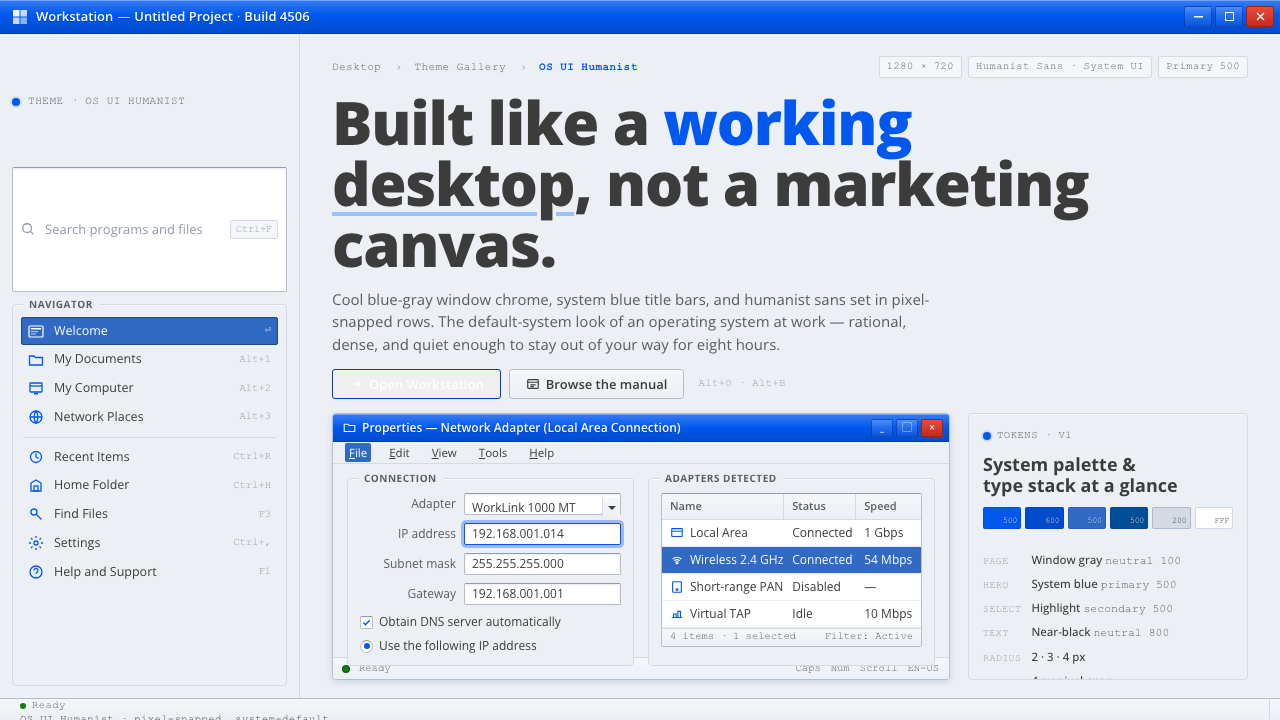 OS UI HumanistBuilt like a working desktop, not a brand. Window-gray ground, system-blue ch…
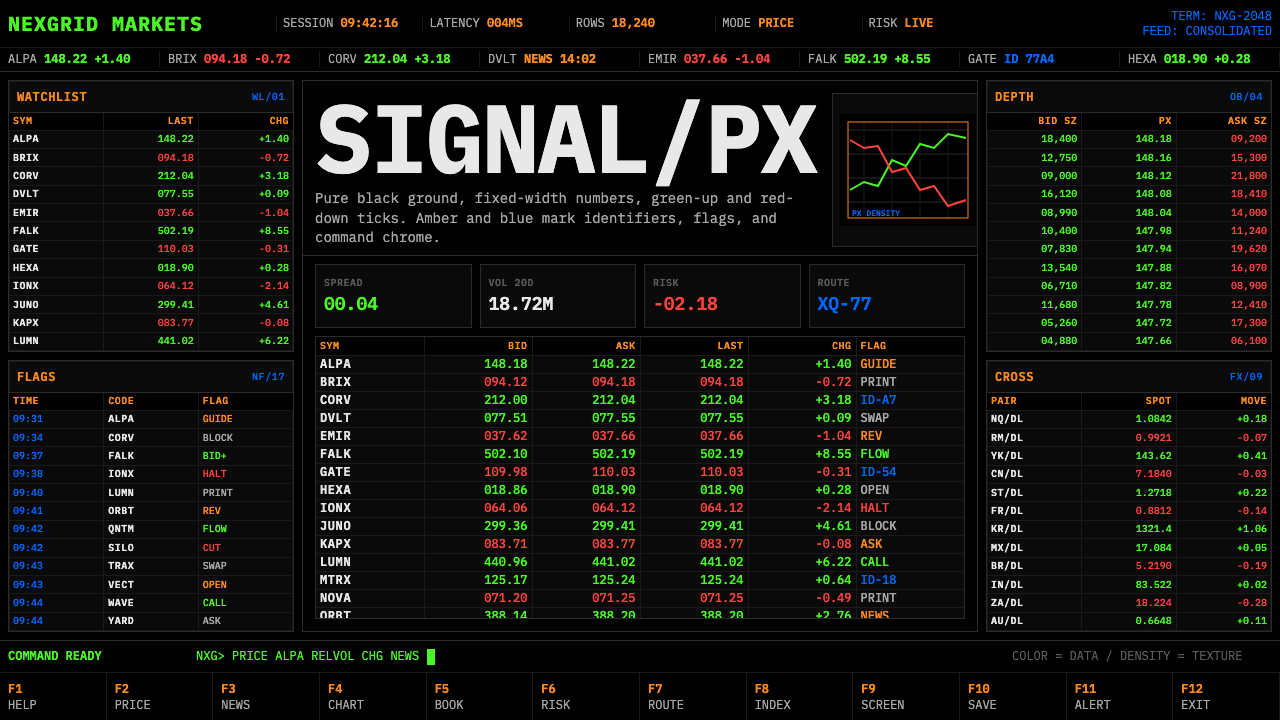 Financial Terminal MonoMaximum signal per pixel. Pure black, IBM Plex Mono, green-red ticks, amber-b…
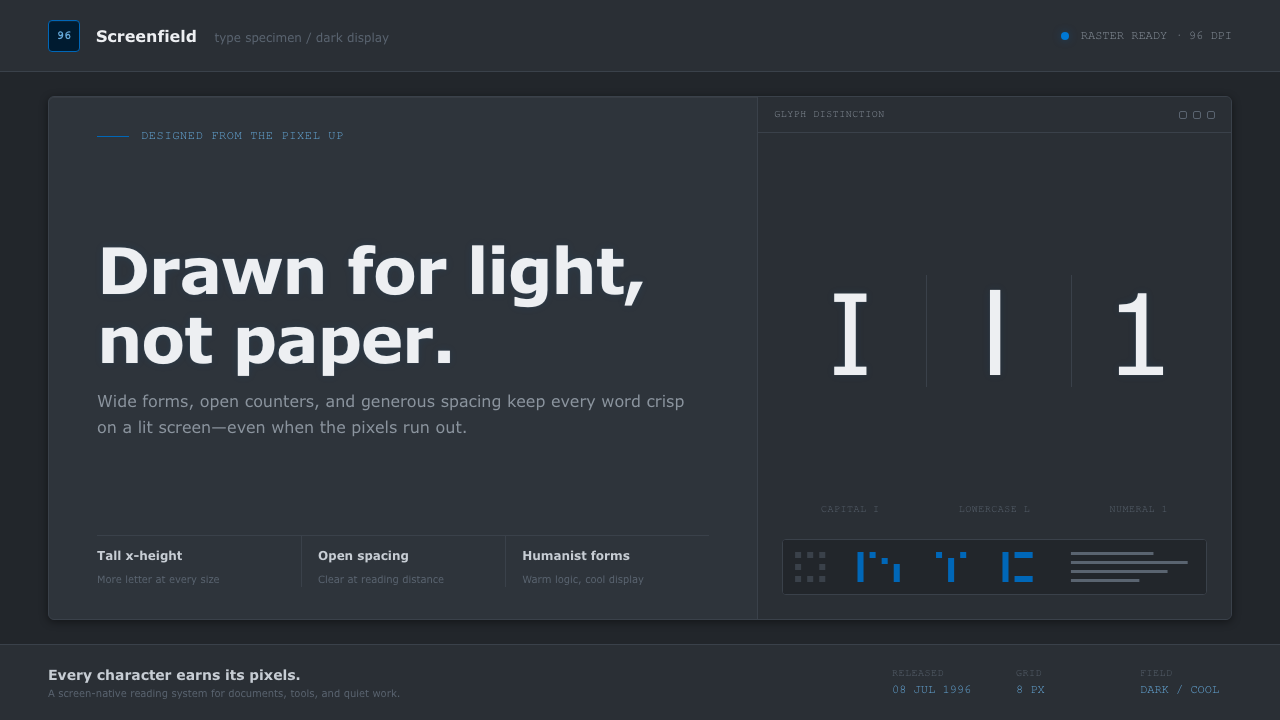 Verdana Screen SansBorn digital, built for clarity. Wide humanist letters glow in cool grey on a…
 Microfiche ArchiveRecords as lit frames in a matrix. Cyan-blue back-lit panel, glowing mono typ…
 Pan Am Jet AgeJet-age confidence. Globe-blue field, steel type, meridian circle on a strict…
 PayPalTrust without coldness. Deep navy, sky cyan, white cards, and pill checkout c…