What is PayPal?
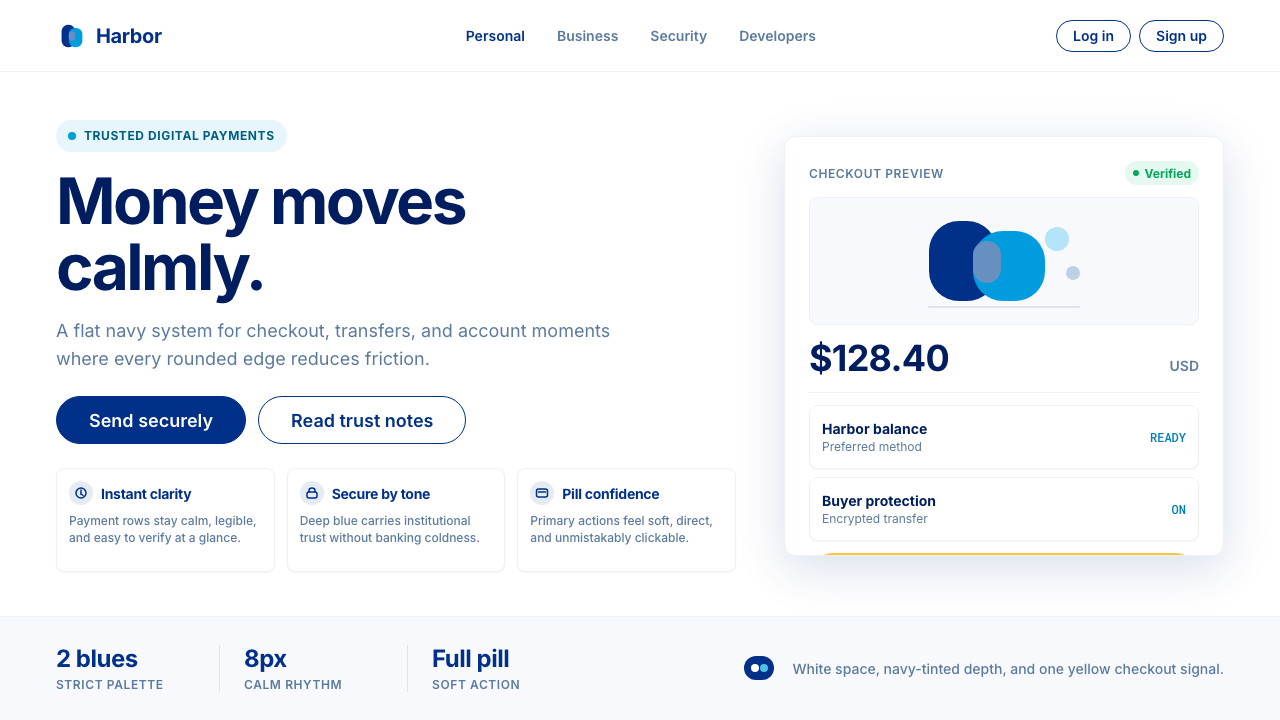
PayPal's visual identity turns the deepest navy in fintech into a signal of trust so complete it made the internet feel safe enough to spend.
PayPal in brief
PayPal's design system is built on a two-tone blue palette — a deep, almost ink-dark navy anchored by a brighter sky-facing cyan — deployed across a geometry of rounded rectangles, pill-shaped buttons, and white card surfaces that together communicate safety, simplicity, and momentum. Where most financial brands choose severity or coldness to project authority, PayPal chooses depth and warmth: the navy is rich enough to feel trustworthy, and the cyan is light enough to feel approachable.
The system's signature interactive elements are pill-shaped — checkout buttons, input fields, and call-to-action units all share the same soft terminus, a rounded edge that implies forward movement rather than containment. This formally distinct choice, combined with generous whitespace and a limited accent palette that reserves yellow exclusively for high-stakes conversion moments, creates a visual rhythm that users have come to associate globally with the act of completing a transaction.
Flat surfaces, minimal use of shadow, and a single primary typeface give the system its discipline. Nothing about the visual language asks you to stop and admire it; every element is directed at one goal: reducing the cognitive friction between intention and payment. The result is a design language that is simultaneously institutional — it holds the aesthetic weight of a major financial brand — and consumer-grade friendly, capable of appearing on a market stall's checkout page and on a multinational e-commerce platform with equal credibility.

Where does PayPal come from?
PayPal was founded in 1998 in San Jose, California, by a group that included Max Levchin and Peter Thiel, initially as a cryptography-based security company before pivoting to digital payments. Its early visual identity was a product of late-1990s web aesthetics: beveled buttons, gradient fills, a palette that borrowed the corporate blue conventions of traditional banking. The brand looked like trust because it mimicked the things that had historically looked trustworthy — the visual vocabulary of established financial institutions translated into the browser.
The real transformation came in 2014, when PayPal commissioned Fuseproject, the San Francisco design firm led by Yves Béhar, to carry out a comprehensive brand overhaul. By that year the company had been independent from eBay for two years — the corporate parent whose own visual conventions had constrained the brand — and was competing aggressively with a new wave of consumer fintech challengers. Fuseproject's brief was to create a visual identity that felt modern, approachable, and digitally native without sacrificing the institutional weight that kept consumers comfortable handing over payment credentials.
The Fuseproject rebrand produced three decisive changes. First, the logotype: the overlapping dual-P monogram, in which two blue Ps of slightly different weights nest together, became the primary marque — a mark that is geometrically simple, memorable at any scale, and subtly alludes to the concept of two parties in a transaction. Second, the palette was distilled from a broad legacy blue into the specific two-tone system: the deep navy as the primary anchor and a brighter, more saturated blue-cyan as the secondary. Third, the pill shape was codified as the system's interactive grammar, distinguishing every clickable or tappable element from static content.
Dan Schulman, who became CEO in 2014, championed the accompanying strategic repositioning that the visual identity was designed to support: PayPal as the payments platform for everyone, not just eBay shoppers or early-adopter technologists. The design system therefore had to perform across a vast range of surfaces — mobile apps, merchant checkout flows, physical card terminals, advertising campaigns — while remaining instantly recognizable. The decision to build the entire system around two highly specific blues and a single accent yellow gave it the legibility and distinctiveness needed to anchor that breadth. What began as a Silicon Valley startup's logo evolved into one of the most recognized financial marks on Earth.
What defines the PayPal look?
Dual-Blue Palette
The PayPal system lives inside two blues: a deep navy that functions as the brand's primary anchor — carrying the weight of institutional trust — and a brighter, more saturated blue-cyan that signals interactivity and lightness. The two blues are never equivalent in hierarchy; the navy dominates backgrounds and headers while the cyan activates buttons, links, and highlights. Together they cover the emotional spectrum from gravitas to approachability without leaving the brand's chromatic world.
Pill-Shaped Interactive Grammar
Every primary interactive element — checkout buttons, primary calls-to-action, certain input containers — is terminated with a fully rounded end, producing the characteristic pill shape that has become synonymous with PayPal's presence in a merchant checkout flow. This is not merely decorative: the pill edge creates a visual signal that is immediately distinguishable from static content, reduces the perceived weight and formality of the action being requested, and implies forward motion. At scale, across billions of checkout sessions, the pill has become a global symbol of safe, imminent payment.
White-Card Surface Architecture
Information is organized into white-background cards that float against slightly cooler off-white or light-gray ground planes. The cards carry a very subtle, low-contrast shadow — almost a suggestion of lift rather than a dramatic depth cue — that separates content from background without introducing the visual noise of hard borders. This layered surface architecture allows complex transaction information (amounts, merchant names, account balances) to be chunked and scanned rapidly, mirroring the cognitive rhythm of reviewing a physical wallet's contents.
Yellow as Conversion Signal
PayPal's yellow appears sparingly and always at moments of decisive action: the 'Buy Now' or 'Pay' button in a merchant's checkout, the final confirmation that money is about to move. Its warm contrast against the predominantly blue and white system creates an immediate focal point that is distinct from any blue-toned interactive element. The restraint with which yellow is deployed is central to its power — because it appears so rarely, it reads unmistakably as a signal of urgency and confidence rather than decoration.
Geometric Humanist Typography
The brand's proprietary typeface sits at the intersection of geometric construction and humanist warmth — letterforms built on precise circular and rectangular underlying geometry, but with enough optical adjustment and stroke variation to read as approachable rather than mechanical. Headlines are set large and with considerable weight to anchor hierarchy; body text drops to a lighter, more open setting that prioritizes legibility in transaction-dense interfaces. The typeface family avoids both the coldness of purely geometric grotesks and the nostalgia of traditional financial serifs.
Flat Surfaces with Restrained Depth
PayPal's interfaces are fundamentally flat — no gradients on primary surfaces, no simulated three-dimensionality, no textures that imply physical material. The single exception is the card shadow described above, which is used structurally rather than decoratively. This flatness is not austere: generous whitespace, large type, and the consistent pill-and-card vocabulary fill the visual field with enough rhythm that the absence of decorative depth goes unnoticed. The flatness also ensures cross-platform consistency: the same components render identically across dark-mode, light-mode, mobile, and web.
Trust Through Constraint
PayPal's design system earns trust not through the complexity of its signals but through the consistency and restriction of them. The palette is narrow, the shapes are few, the type hierarchy is strict, and the accent colors are rationed. This constraint creates predictability, and predictability in a payment context is itself a form of reassurance. Users who have completed hundreds of PayPal checkouts can detect an authentic PayPal interface instantly — and, by extension, detect when something is off. The visual system is so tightly defined that counterfeit interfaces struggle to replicate its specific feel, which has practical security implications beyond aesthetics.

Who shaped PayPal?
Béhar is the founder of Fuseproject, the San Francisco industrial and brand design studio commissioned to lead PayPal's 2014 rebrand. His practice is known for fusing product design with brand identity — a sensibility that shaped the PayPal project, where the visual system was designed to behave as coherently on a physical card terminal as on a mobile screen. Béhar's contribution to PayPal was the distillation of a complex legacy brand into a minimal, scalable system whose geometry and palette could be trusted at global scale.
Levchin co-founded PayPal in 1998 and served as its first CTO, responsible for the cryptographic security infrastructure that made digital payments safe enough to trust. His technical conviction — that security could be built into the system at a foundational level rather than bolted on as a warning layer — directly influenced the brand's eventual visual philosophy: the absence of anxiety-inducing security iconography in the interface reflects the confidence that security is embedded, not displayed.
Thiel co-founded PayPal and served as its first CEO, guiding the company through its early growth and its eventual acquisition by eBay in 2002. His conviction that PayPal could become a new global currency — a payment layer independent of governments and banks — informed the boldness of the brand's ambition. Though the company's visual identity evolved significantly after his tenure, the institutional scale that the design system must communicate traces directly to the ambition Thiel articulated in the early years.
Schulman became PayPal's CEO in 2014, the same year as the Fuseproject rebrand, and championed the repositioning of PayPal as a democratizing payments platform serving the underbanked and all consumers rather than primarily serving eBay's ecosystem. The visual identity he endorsed was built to support that mission: warm enough to welcome first-time users, authoritative enough to satisfy enterprise merchants, and legible enough to function in every market globally. Schulman's tenure saw PayPal's brand achieve near-universal recognition across the digital economy.
Hoffman was an early executive at PayPal and part of the founding leadership group that established the company's culture of bold, systems-level thinking about payments infrastructure. He later became a prolific investor and the co-founder of LinkedIn, but his time at PayPal contributed to the intellectual environment that produced the brand's core conviction: that trust, at internet scale, is a design problem as much as a security problem. PayPal's visual restraint and consistency are a direct answer to that conviction.
How do you use PayPal today?
PayPal's design language is built for contexts where the user must make a consequential decision quickly and with confidence. Applying it correctly means understanding that the system's power comes from its restraint: the narrow palette, the controlled shapes, and the strict typographic hierarchy all work together to reduce visual noise so that the action you need the user to take is the only thing that clearly stands out. Adding decorative complexity undermines the entire logic.
For presentation slides, the PayPal system translates well to both cover and content pages. A cover works best with a deep navy background, a large, weight-forward headline in light type, and the cyan reserved for a single accented word or supporting label. The pill motif can be echoed in section markers or callout boxes — rounded containers that frame key figures or short statements. Content slides should treat the white card as the primary unit: each major point lives in its own card container against an off-white ground, with generous internal padding and a strict two-level type hierarchy. Data visualizations take on a clean, high-contrast quality when bars, segments, and lines are restricted to the two blues plus the yellow accent for the most important value.
For web and product interfaces, the system is particularly effective on payment flows, pricing pages, onboarding sequences, and trust-sensitive dashboards. The approach: a white or near-white base ground, card components with barely-there shadows, pill-shaped primary buttons in the brighter blue or in yellow for the highest-stakes action, and the deep navy for headers, navigation bars, and key brand anchors. Body text in near-black, secondary information in a medium gray, and all interactive affordances clearly distinguished from static content through color and shape. Avoid introducing new shapes or additional accent colors — the system's legibility depends on users already having learned what the pill means.
For editorial and marketing materials, the PayPal palette supports bold, high-contrast layouts suited to advertising, landing pages, and social media assets. Full-width sections alternating between deep navy grounds with light type and white grounds with navy type create a confident visual rhythm without requiring varied photography or illustration. The yellow accent earns its keep on calls-to-action: a single 'Get Started' or 'Send Money' element in yellow on a navy field has the visual authority of a physical button. Avoid deploying the yellow at large scale as a background tone — at that proportion it loses its signal value and shifts the mood toward caution rather than confidence.
A common mistake when working in this system is treating the two blues as interchangeable or combining them at equal visual weight. The deep navy is always dominant; the lighter cyan always subordinate. Reversing this relationship — using the bright cyan as a background tone and the navy as an accent — creates visual confusion that undermines the hierarchy the system depends on. A second frequent error is adding soft, diffuse drop shadows to elements beyond the card layer: PayPal's depth comes from layering flat surfaces, not from simulated lighting. Excessive shadow use makes the interface feel dated and inconsistent with the system's flat, confident character.

PayPal — FAQ
Can the PayPal visual language be used for non-payment contexts like dashboards or editorial work?
Yes, with awareness of what you are importing. The system's core qualities — high contrast, strict hierarchy, restrained palette, pill-based interactive grammar — transfer effectively to any context where the user needs to make a decision confidently and quickly. Dashboards for analytics, financial reporting tools, SaaS pricing pages, and even editorial layouts benefit from the same clarity-first discipline. The challenge is that the palette carries strong PayPal brand associations for most users; if your work is meant to feel novel or distinct from payments specifically, consider shifting one of the blues slightly in warmth or saturation to differentiate while retaining the structural logic.
How does the PayPal system handle dark mode or dark-background layouts?
The deep navy functions naturally as a dark-mode background — it is dark enough to reduce eye strain in low-light environments while retaining the brand's chromatic identity. In a dark-mode version of the system, the navy becomes the ground, the bright cyan and white become the primary foreground tones for type and cards, and the yellow accent retains its role as the highest-stakes call-to-action. The key discipline is avoiding the introduction of pure black as a background: pure black makes the navy brand elements read as blue rather than as the foundational surface, which breaks the palette's internal coherence. Dark mode works best when every surface that is not a card or active element stays within the navy family.
What makes PayPal's palette feel trustworthy rather than merely corporate?
The difference lies in the specific quality of the blues chosen and the way they are paired. A flat, low-chroma corporate navy tends to feel institutional in the distant, impersonal sense — think of a government form or a traditional bank statement. PayPal's navy has more depth and a slight warmth that prevents it from reading as purely cold. The brighter cyan it pairs with is decidedly un-corporate: it has the quality of a clear sky or shallow coastal water, carrying connotations of openness and movement that offset the navy's weight. The pill shape contributes the same effect through geometry: rounded terminals feel approachable in a way that squared-off buttons do not. The combination of these factors — color temperature, tonal range, and shape vocabulary — produces something that is authoritative without being forbidding.
Is PayPal's style appropriate for startups and early-stage products?
It is well-suited to early-stage products in fintech, payments, banking, or any other context where the core challenge is building user trust quickly. The style communicates institutional credibility even when the institution is new, because it borrows a visual grammar that users already associate with a platform they trust. The risk is the reverse: in contexts where freshness, personality, or cultural specificity are differentiating values — consumer brands, lifestyle products, creative platforms — the system can read as too generic or too derivative. Used deliberately, the PayPal visual language is a shortcut to trust; used without awareness, it is a costume that says 'payment platform' rather than a personality.
How strictly should the pill shape be followed? Can other button shapes coexist?
Within a PayPal-informed system, the pill should be reserved for primary actions — the one thing on any given screen that the designer most wants the user to do. Secondary actions can use a softer, partially-rounded rectangle that communicates affordance without competing with the primary. Tertiary or destructive actions (cancel, dismiss, delete) can be fully squared-off to signal a different nature without decoration. The hierarchy of shapes — pill for primary, rounded-rect for secondary, sharp-rect for tertiary — mirrors the hierarchy of the color system and reinforces the system's logic. Introducing a second pill-shaped element at the same visual weight as the primary button collapses the hierarchy and reduces the signal value of the pill itself.
Related design styles
 WhatsAppConversation is the interface. Cream wallpaper, green bubbles, and tiny blue…
 AmazonUgly sells efficiently. Navy chrome, orange buttons, red prices crowd a dense…
 LinkedInCorporate trust, digitized. Authoritative blue frames white cards on warm cre…
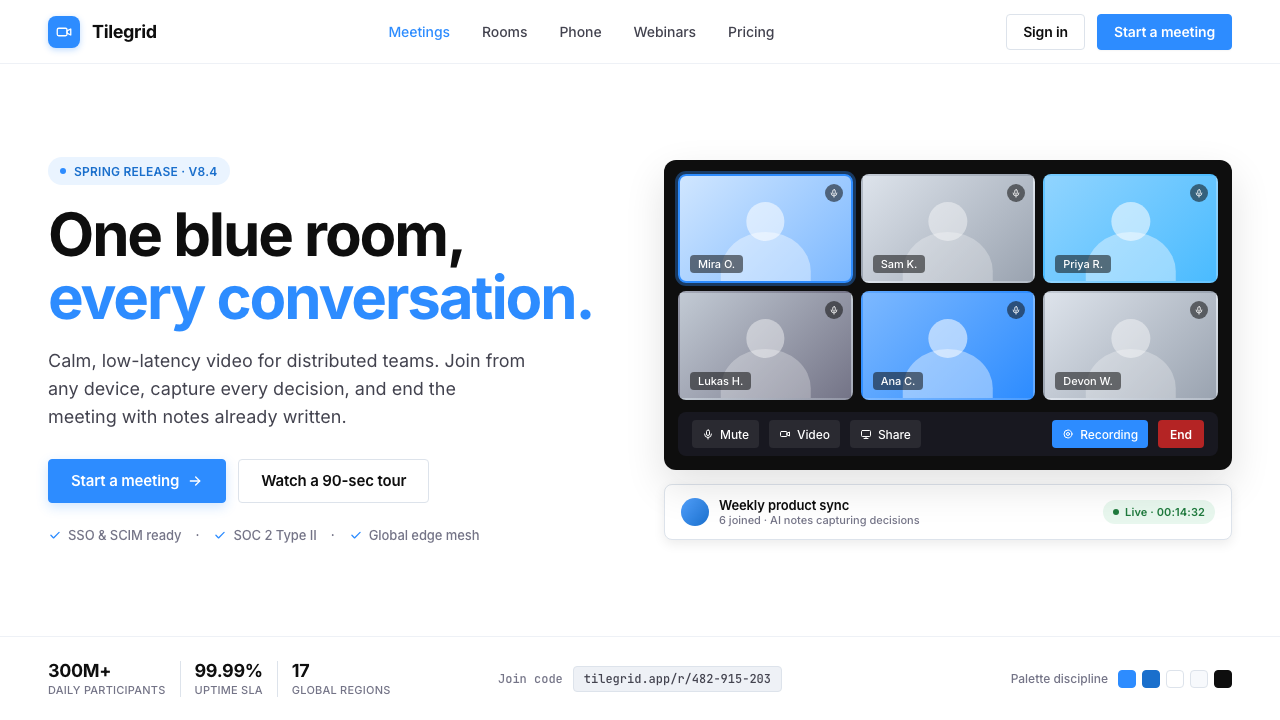 Zoom Meeting BlueRemote work's default discipline. One saturated cobalt on pure white, Inter s…
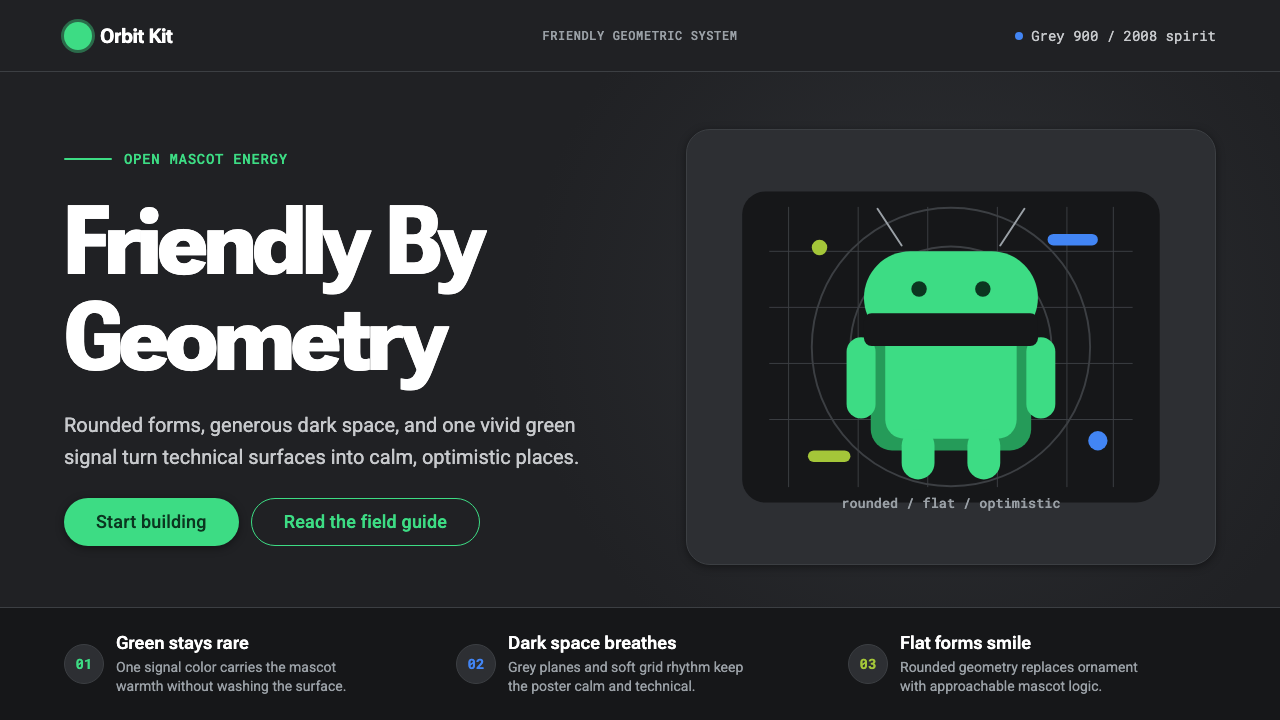 Android Bugdroid GreenFriendly tech, reduced to geometry. Vivid green pops from Grey 900 and rounde…
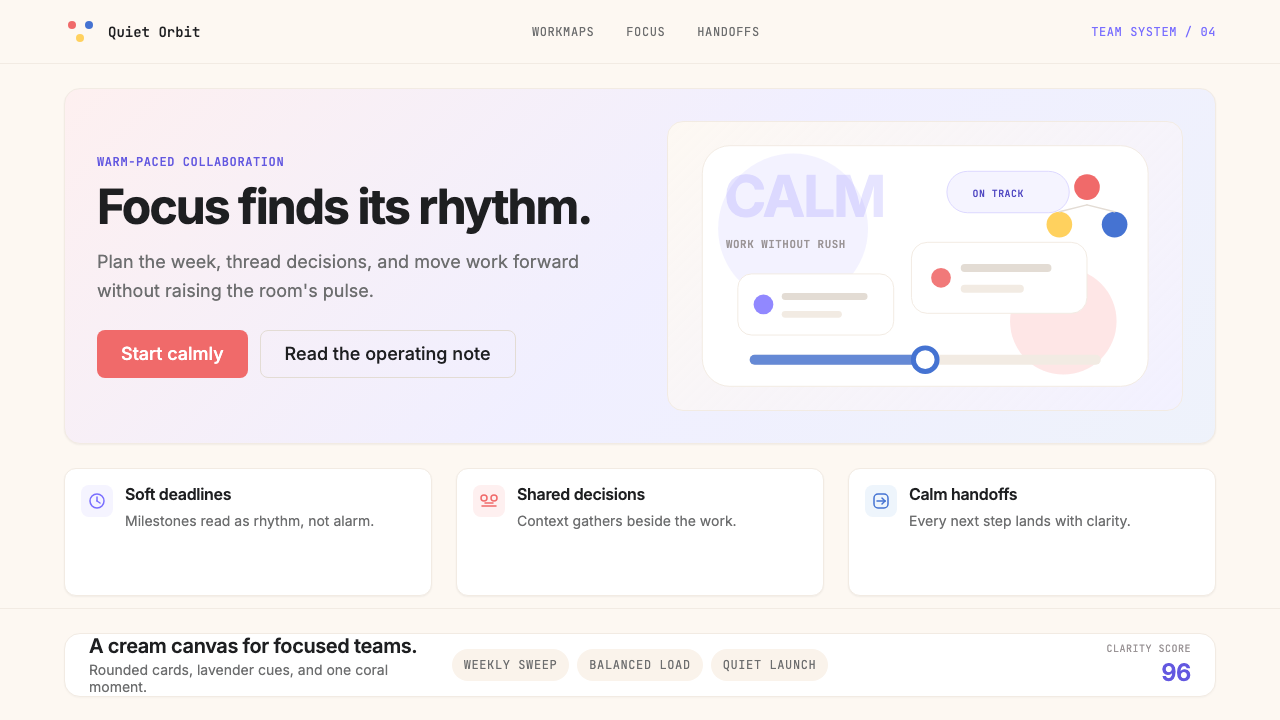 AsanaCalm productivity breathes. Cream canvas, lavender panels, coral-blue-yellow…