What is WhatsApp?
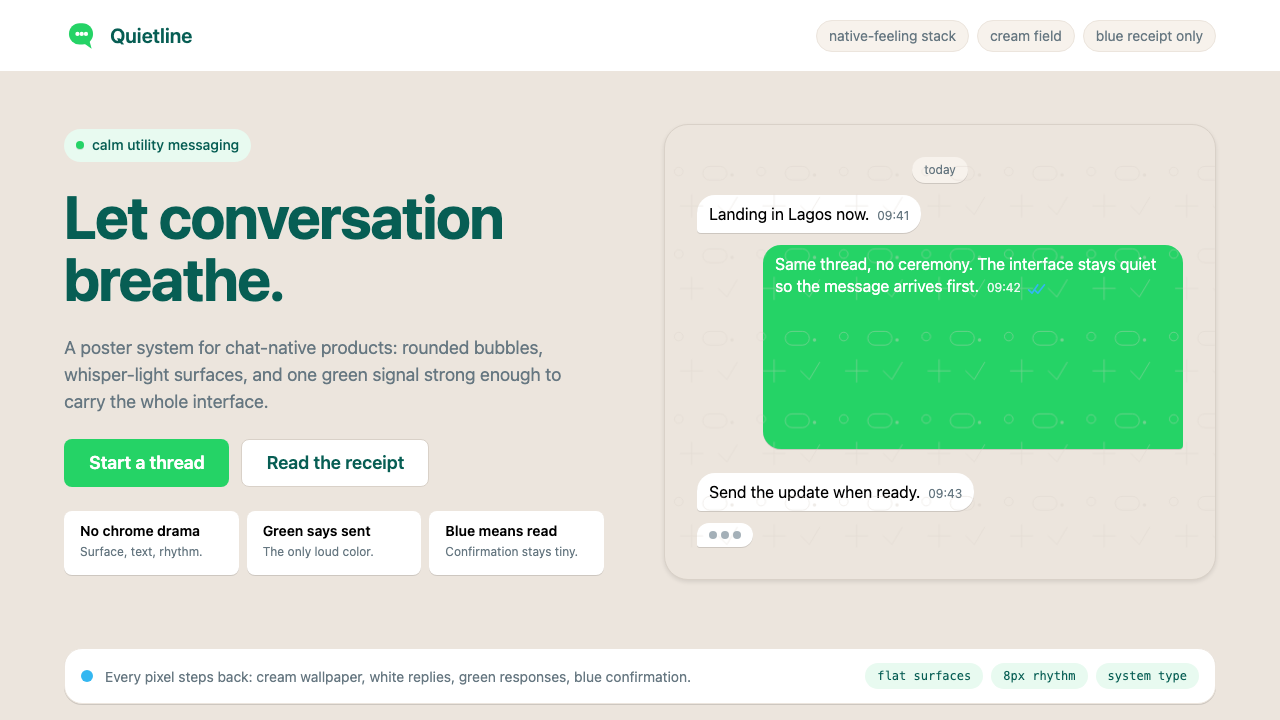
WhatsApp proved that a single shade of green, a cream wallpaper, and rounded bubbles could become the visual shorthand for two billion human conversations.
WhatsApp in brief
WhatsApp is a global messaging system whose visual identity is built on an almost radical degree of restraint. The interface consists of a warm off-white background, a signature green used for outgoing message bubbles and primary interactive elements, white bubbles for incoming messages, and nearly nothing else. There are no decorative borders, no gratuitous illustration, no ornamental color accents competing for attention. The chrome — buttons, headers, navigation — is kept so quiet that the conversation itself becomes the interface.
What distinguishes the WhatsApp aesthetic from mere minimalism is its warmth. The background is not a cold clinical white but a soft cream, evoking the faint texture of paper. The green is vivid and confident — a communicative signal, not a corporate badge — balanced by the gentleness of rounded bubble geometry that feels approachable on any device, from an entry-level handset in Lagos to a flagship phone in São Paulo. The famous blue double-check mark for read receipts layers one more layer of considered utility: a chromatic signal that carries information without introducing visual noise.
The system is a masterclass in calm-tech design — a philosophy that holds that technology should serve human needs quietly, drawing attention to the task rather than to itself. Every element in the WhatsApp visual language can be justified by communication utility. Nothing is there for decoration, and the result is a design that has aged exceptionally well across more than a decade of changing platform conventions and screen resolutions.

Where does WhatsApp come from?
WhatsApp was founded in 2009 by Jan Koum and Brian Acton, both former Yahoo engineers who had grown frustrated with the advertising-driven web. Koum, who had emigrated from Ukraine as a teenager and remembered what it meant to communicate across borders without reliable infrastructure, wanted to build something simple, fast, and private. The original application launched as a status-update tool — the name itself derives from the colloquial greeting 'What's up?' — before pivoting to messaging in 2009 when Apple introduced push notifications. From the beginning, the product philosophy was anti-chrome: no ads, no games, no social feed, and a visual identity that stayed entirely out of the way of the message.
The visual language that would become globally recognizable took shape gradually across the early 2010s. The signature green — a vivid mid-green that sits between the cool blue-greens of enterprise software and the saturated limes of consumer games — was chosen for its legibility at small size and its cross-cultural neutrality. Unlike red, which carries danger connotations in many markets, or blue, which was already the dominant color of the social-networking era, green read as fresh, communicative, and universal. The rounded speech-bubble icon, rendered in that green, became one of the most recognized app icons in the world within a few years of launch.
In 2014, Facebook — now Meta — acquired WhatsApp for approximately nineteen billion dollars, the largest technology acquisition at that time. Koum remained as CEO until 2018, preserving much of the original design philosophy through the transition. The years following the acquisition saw incremental refinements rather than overhauls: the wallpaper system was polished, dark mode was introduced in 2020, and the interface was progressively simplified across Android and iOS to align with each platform's evolving design conventions. Throughout these changes, the core visual DNA — green bubbles, cream ground, rounded geometry, blue ticks — remained intact.
The Meta-era consolidation, led by design teams in Menlo Park, brought WhatsApp's visual identity into closer alignment with Instagram and Messenger while preserving its distinct utilitarian character. Designer Antônio Padial and colleagues worked to ensure that the interface scaled gracefully across a vast range of devices and network conditions, reflecting the reality that WhatsApp's largest user bases are in markets where bandwidth is constrained and handset hardware is modest. This constraint-driven design discipline — building for the slowest connection and the smallest screen first — reinforced the aesthetic of radical restraint that had defined the product from its inception.
What defines the WhatsApp look?
The Signal Green
The defining color of WhatsApp is a vivid, confident mid-green that occupies the outgoing message bubble, the app icon, and all primary interactive controls. It sits in a distinctive chromatic register: warm enough to feel human, saturated enough to be immediately legible at small scale, and distinct enough from both teal and lime to be uniquely its own. Against the cream background, it carries the visual weight of a decision — this is your message, marked in green — without ever feeling aggressive or loud. The green is used sparingly: it appears where action or ownership must be indicated, and nowhere else.
Cream Ground
The chat background is not white but a warm off-white — a soft, slightly yellowed tone that echoes the surface of aged paper or a blank notebook page. This seemingly minor chromatic choice has significant perceptual consequences: it reduces the harshness of long reading sessions, makes the green and white bubbles read more naturally against the ground, and gives the entire interface an unhurried, tactile quality. The optional doodle-pattern wallpaper — a subtle geometric tiling of outlines in a slightly deeper tone — layers texture without introducing visual noise, functioning almost like a watermark.
Bubble Geometry
Message bubbles are rounded rectangles whose corner radii are generous enough to feel soft and conversational, yet restrained enough to maintain legibility and avoid cartoonishness. The asymmetry is subtle but meaningful: outgoing bubbles carry a small pointed tail at one corner that anchors them to the right side of the screen, while incoming bubbles are anchored left. This tail is the sole figurative element in the interface — a tiny speech-bubble convention — and it does enormous communicative work in a single pixel cluster, instantly conveying direction and speaker identity without any label.
The Blue Tick System
The delivery and read-receipt system — single grey tick for sent, double grey tick for delivered, double blue tick for read — is among the most elegant pieces of information design in consumer software. It introduces a third color into the palette (blue) without disrupting the visual balance, because the ticks appear only at small scale and in a single, consistent location within each bubble. The shift from grey to blue carries emotional weight disproportionate to its visual footprint: the moment the ticks turn blue is one of the most observed micro-interactions in the history of mobile communication.
Typographic Quietness
WhatsApp has historically used the system typeface of each platform — the typeface your phone already uses for its own interface — rather than imposing a custom brand font. This decision is philosophically consistent with the broader design ethos: the typography should feel native and unobtrusive, never calling attention to itself. Text size, weight, and color are deployed with single-minded clarity — message body text sits at comfortable reading size in near-black, timestamps appear in a visibly smaller and lighter tone, and sender names in group chats are distinguished by gentle color variation rather than bold weight.
Shadow as Touch, Not Depth
Shadows in the WhatsApp interface are whisper-light and diffuse — barely perceptible elevations that separate the message bubble from the ground without creating any theatrical sense of three-dimensionality. The effect is more tactile than spatial: bubbles feel like paper slips placed on a surface rather than objects floating above it. This approach contrasts deliberately with the heavier drop-shadow conventions of other messaging applications and reflects a broader preference for restraint over demonstration.
Radical Removal of Chrome
Perhaps the most distinctive structural characteristic of the WhatsApp visual system is what is absent: there are no decorative dividers between messages, no background illustrations behind active conversations, no persistent branding or logo within the chat view, no color-coded categories or tag systems in the default experience. The interface does not announce itself. Navigation elements are present but understated — icon-driven and kept to a single bar — so that the user's attention rests entirely on the content of the conversation rather than the apparatus surrounding it.

Who shaped WhatsApp?
Koum co-founded WhatsApp and served as its CEO until 2018. His personal history — immigrating from Soviet Ukraine as a teenager, growing up on food stamps, and later working as a cleaner at Yahoo before being hired as an engineer — shaped his conviction that communication tools should be simple, private, and accessible to everyone regardless of economic circumstance. He insisted that WhatsApp would never carry advertising, a position he defended through the Facebook acquisition and his eventual departure from the company when disagreements over privacy and monetization grew irreconcilable. The design restraint of the product is inseparable from the values he brought to it.
Acton co-founded WhatsApp with Koum after both were rejected by Facebook and Twitter in 2009. He served as the technical and business counterpart to Koum's product vision, and shared his partner's fierce commitment to a no-advertising model. After the Facebook acquisition, Acton stayed until 2017 before departing — forfeiting hundreds of millions of dollars in unvested stock — and subsequently co-founded Signal, the end-to-end encrypted messaging application, donating fifty million dollars to seed the Signal Foundation. His trajectory underlines how much the WhatsApp design philosophy was rooted in a specific set of ethical commitments rather than commercial expediency.
Padial served as a principal designer at WhatsApp during the Meta era and was instrumental in the interface refinements that carried the product through its transition to Material Design on Android and various iOS design evolutions. His work focused on ensuring that the visual system scaled gracefully across the extraordinary diversity of hardware and network conditions that characterizes WhatsApp's global user base — a design challenge fundamentally different from designing for a predominantly high-end Western device market. This constraint-first orientation kept the interface anchored to its core utilitarian values during a period when the parent company was pushing toward richer, more feature-laden product experiences.
As Meta's CEO, Zuckerberg oversaw the acquisition of WhatsApp in 2014 and subsequently shaped its strategic direction, including the introduction of end-to-end encryption by default in 2016, the launch of WhatsApp Business, and the gradual integration of Meta's cross-platform infrastructure. His decisions created the conditions under which WhatsApp's design evolved — or, more precisely, the conditions under which it was protected from evolving too rapidly. The product's visual identity remained more stable through the Meta years than that of Instagram or Facebook, in part because Zuckerberg recognized that the calm, utilitarian character of the interface was itself a key differentiator in markets where WhatsApp is the dominant communication layer.
How do you use WhatsApp today?
The WhatsApp visual system is deceptively transferable. Its power comes not from the green itself but from the underlying logic: maximum informational clarity with minimum interface decoration. Applying it well means committing to that logic first, and letting the palette follow. For any context where the content — the message, the data, the decision — should dominate over the container, this system offers a tested template.
For presentation slides, the WhatsApp aesthetic works best when the designer resists the temptation to fill empty space. A cover slide benefits from a single bold element — the title or a large numeral — placed against the cream ground, with the signal green used only for a single accent line, label, or background panel. Content slides should treat each piece of information as a message bubble: bounded, readable, and adequately spaced from its neighbors. Data slides can adopt the bubble geometry literally — wrapping key statistics in rounded rectangles on the cream ground — or translate it more abstractly into clean bar and line charts where the green is reserved for the primary data series and all annotation is rendered in a quiet grey.
For web UI, dashboards, and pricing pages, the system excels at conveying trustworthiness and focus. A dashboard built on this aesthetic uses the cream or off-white as the page background, renders card components with the lightest possible shadow to suggest elevation without depth, and deploys the signal green exclusively for active states, confirmation indicators, and primary call-to-action buttons. Pricing pages benefit from the bubble-inspired card layout: each tier is a rounded container, the recommended tier distinguished by green instead of the standard background, all in a layout that prioritizes scannability over persuasive decoration.
For editorial and marketing contexts, the WhatsApp visual language translates into a design sensibility that is warm and direct without being casual. An editorial layout built on this system keeps the typographic hierarchy simple — two or three sizes, one weight distinction — and uses the cream ground as a breathing field rather than filling it with background graphics. Marketing materials can leverage the global recognizability of the green-bubble-on-cream motif as a shorthand for direct, person-to-person communication: useful for campaigns involving messaging, accessibility, or human connection. The rounded corner geometry, applied to image crops and container elements, gives marketing layouts a conversational quality that distinguishes them from more formal corporate visual systems.
A common mistake when working in this system is over-saturating the palette or multiplying accent colors. The WhatsApp aesthetic depends on the signal green being used sparingly — if every button, every tag, every data highlight, and every interactive element is green, the color loses its ability to direct attention. A second common mistake is using pure white as the ground instead of the characteristic warm off-white: the shift is small but perceptually significant, and pure white makes the interface feel colder and more generic. Preserve the warmth of the cream, keep the green rare and purposeful, and resist adding secondary accent colors that the original system never needed.

WhatsApp — FAQ
Is the WhatsApp visual system the same as Material Design?
They overlap but are not equivalent. WhatsApp runs on Android and therefore implements Material Design conventions for system-level interactions — navigation gestures, notification behavior, and certain animation patterns. However, the WhatsApp visual identity predates Material Design and has a distinct character: the cream background, the specific mid-green, the rounded bubble geometry, and the extreme economy of decoration are WhatsApp-specific choices that sit on top of, rather than being derived from, the Material Design system. Think of Material Design as the operating layer and WhatsApp's visual identity as the product layer built above it.
Can this aesthetic work in a dark mode context?
WhatsApp introduced its own dark mode in 2020, and the result is instructive. Rather than simply inverting to black, the dark variant uses a very dark, desaturated green-grey as the chat background — a tone that nods to the brand's green identity while remaining easy on the eyes in low-light conditions. Outgoing bubbles shift to a darker but still distinctly green tone, and the cream of incoming bubbles darkens to a soft, warm grey. The key principle carries over: the background is never pure black, the green is still the signature but becomes more muted, and the blue ticks remain legible. This approach — dark but warm, restrained but identifiable — is the right model for applying this aesthetic in dark contexts generally.
Why does WhatsApp use system fonts instead of a custom typeface?
The decision reflects the product's foundational philosophy: the interface should feel native and frictionless, never calling attention to itself as a designed artifact. A custom brand typeface, however well executed, introduces a moment of mild foreignness — the sense that you have entered a branded environment rather than a neutral communication layer. System fonts feel like the phone speaking, not a brand speaking. There is also a practical dimension: system fonts are pre-loaded, require no network request to render, and are guaranteed to cover every character set needed by a truly global user base. The typographic quietness of the interface is not an accident of budget — it is a deliberate expression of the same philosophy that drives every other restraint in the system.
What kinds of products or brands benefit most from this aesthetic?
Products that position themselves around directness, reliability, and human connection are the strongest candidates. Communication tools, productivity applications, healthcare and financial services platforms targeting everyday users, and any product whose trust proposition depends on the interface not getting in the way. The warmth of the cream ground and the friendliness of the rounded geometry make it more approachable than colder utilitarian systems, so it works in consumer contexts where complete clinical austerity would alienate users. It struggles in contexts that require sensory richness — food, fashion, luxury, entertainment — where the absence of decoration reads as blandness rather than confidence. It also struggles when brand differentiation depends on a distinctive visual signature, because the WhatsApp aesthetic's greatest virtue — its self-effacement — is also its limitation as a brand identity system.
How does this aesthetic relate to other messaging app visual systems?
WhatsApp, iMessage, Telegram, and Signal all share the same foundational metaphor — the chat bubble — but their visual languages express very different values. iMessage is polished, platform-native, and leans into translucency and blur effects that assert Apple's premium hardware positioning. Telegram is denser, more feature-forward, and uses color more liberally across UI elements, reflecting its design-savvy power-user audience. Signal, co-founded by WhatsApp's Brian Acton, deliberately mirrors WhatsApp's restraint as a statement of shared values, but its color signature — a different shade of green-blue — gives it a slightly colder, more technical character. WhatsApp's specific warmth — cream, rounded, quietly green — occupies a position that is more human than technical and more universal than premium, which explains both its extraordinary global reach and its visual distinctiveness within the category.
Related design styles
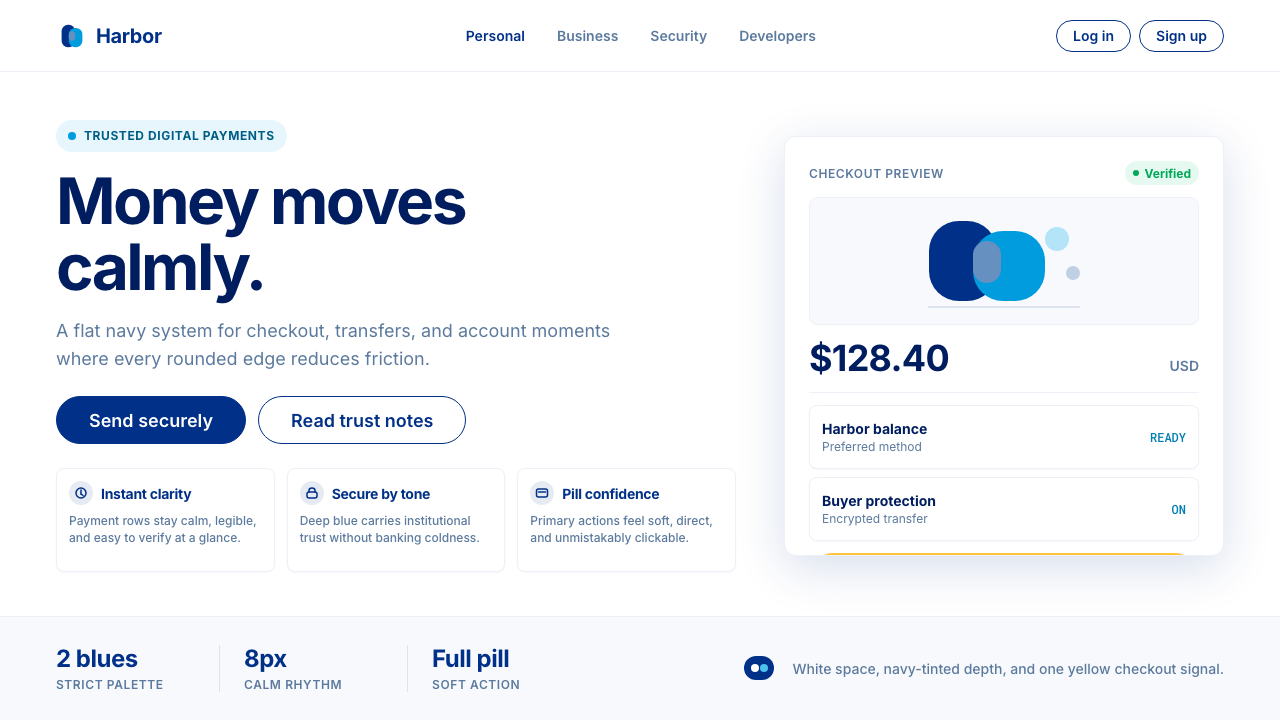 PayPalTrust without coldness. Deep navy, sky cyan, white cards, and pill checkout c…
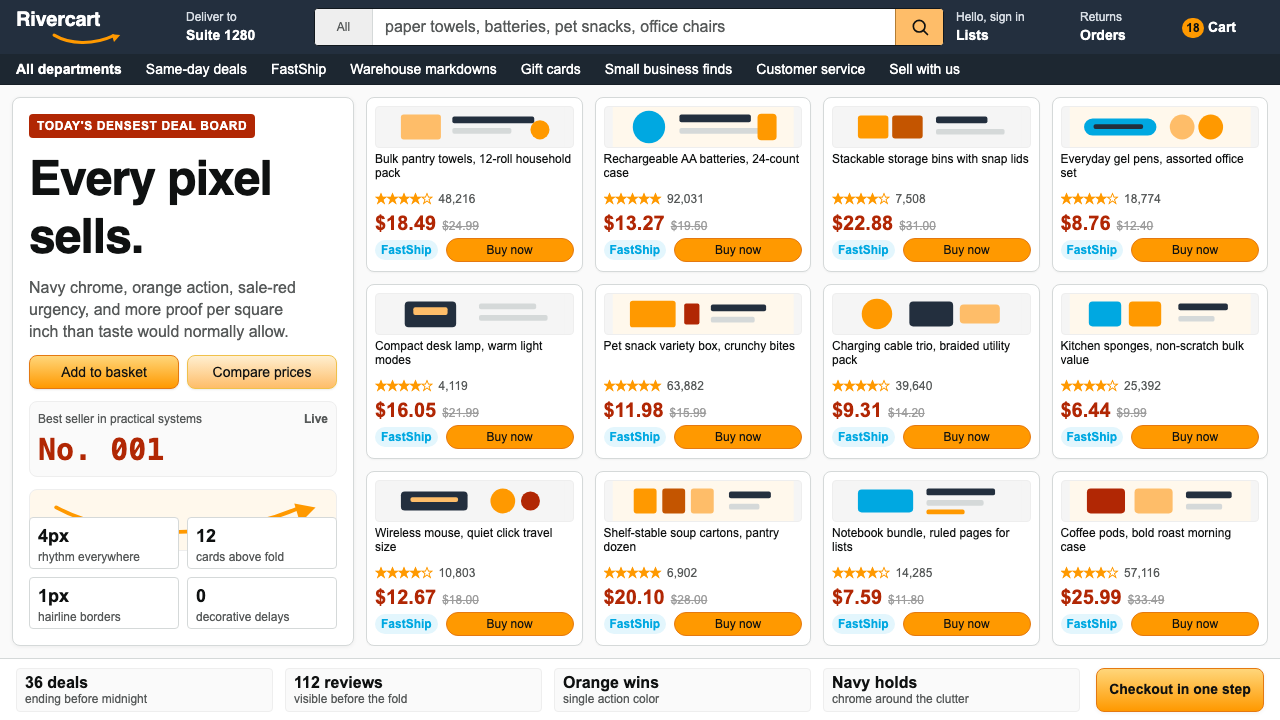 AmazonUgly sells efficiently. Navy chrome, orange buttons, red prices crowd a dense…
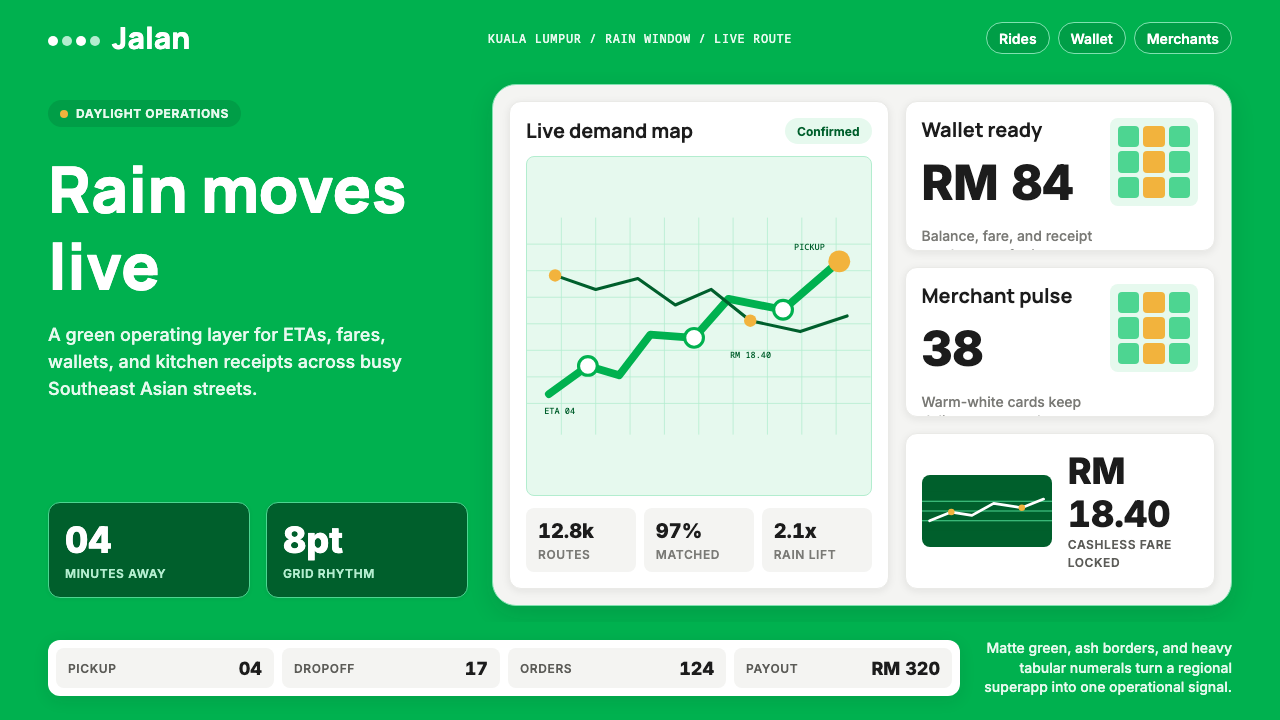 Grab SEA Superapp 2018Operational warmth. Saturated green, Inter numerals, and tight dashboard card…
 MongoDB Leaf GreenDisciplined green, open warmth. Forest leaf forms and Spring accents breathe…
 Android Bugdroid GreenFriendly tech, reduced to geometry. Vivid green pops from Grey 900 and rounde…
 AsanaCalm productivity breathes. Cream canvas, lavender panels, coral-blue-yellow…