What is Amazon?
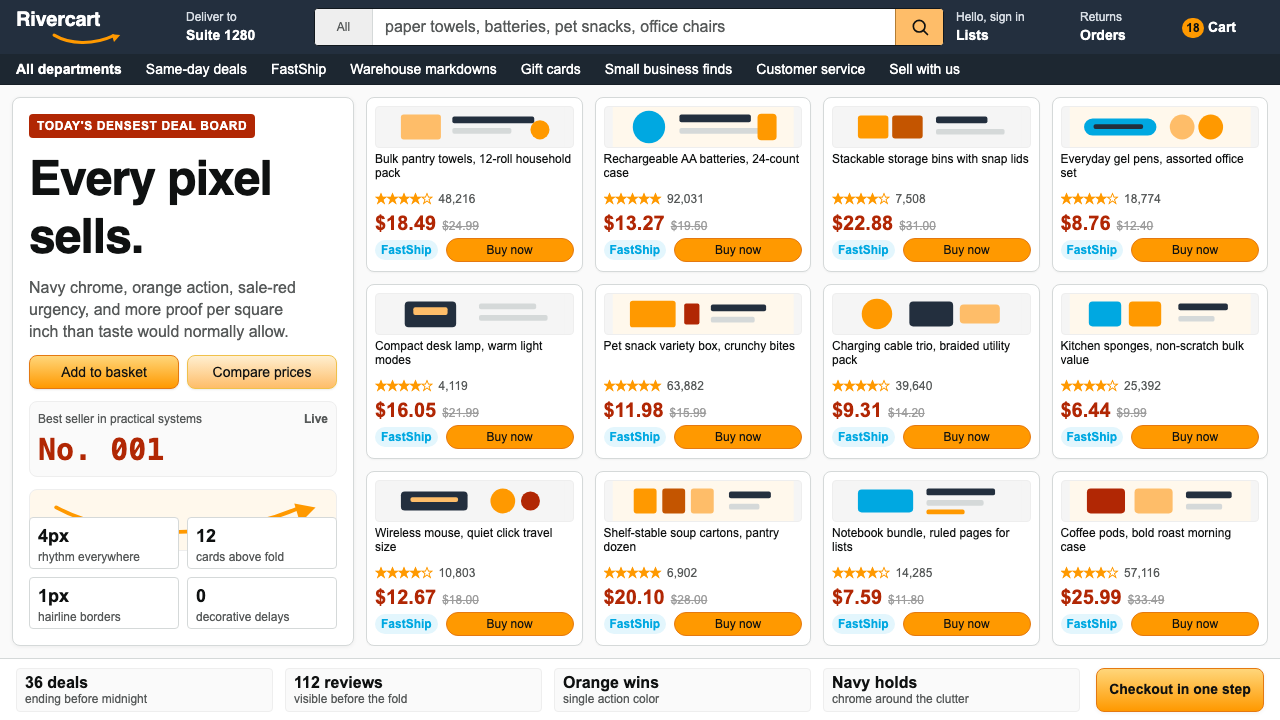
Amazon's visual language proves that relentless A/B optimization, not aesthetic theory, can itself become a design doctrine — one where every pixel earns its place by driving a conversion.
Amazon in brief
Amazon's visual identity is one of the most recognizable and most deliberately unglamorous in the history of commercial design. The orange smile-arrow logo, the deep navy navigation bar, the dense product grid crowded with star ratings, Prime badges, and red sale prices — these elements have remained largely unchanged since approximately 2003, not because Amazon neglected its interface, but because A/B testing consistently showed that the accumulated visual noise outperformed cleaner alternatives in conversion rates. The result is a design system that treats ugliness, or at least denseness, as a performance feature.
The core logic of the Amazon visual system is what might be called Walmart-aisle thinking applied to a screen. A physical retail aisle maximizes the number of products a shopper can see and compare within a single glance; Amazon's product grid does the same thing digitally, sacrificing whitespace and breathing room in favor of information saturation. Every element on a page — the price, the rating, the number of reviews, the shipping badge, the button color — has been individually tested and retained because removing it measurably reduced sales. This is design by elimination of everything except what works.
Unlike design systems rooted in a formal aesthetic movement — Bauhaus functionalism, Swiss rationalism, Muji restraint — the Amazon style has no founding manifesto and no named visual director who shaped it from the top down. It is the aggregate product of millions of user interactions, each one casting a vote through click-through rates and purchase completions. Its consistency comes not from a style guide enforced by designers but from the sheer inertia of a system too profitable to break.

Where does Amazon come from?
Amazon was founded by Jeff Bezos in July 1994 in Bellevue, Washington, initially as an online bookstore operating out of a garage. The earliest Amazon website, launched in 1995, had the functional spareness of most early commercial web pages — simple text links, minimal imagery, and a utilitarian structure driven entirely by what the web technology of the era could support. The orange and black color pairing appeared early, though its precise meaning was more practical than symbolic: high contrast for readability, warm accent for commercial urgency.
Through the late 1990s and early 2000s, as Amazon expanded from books into music, electronics, toys, and eventually almost every consumer category imaginable, the visual system evolved not through formal redesign campaigns but through continuous incremental adjustment. The company developed an early and intense commitment to data-driven decision-making under Bezos, who famously insisted that every product and interface decision be backed by measurable outcomes. This philosophy, combined with the company's scale, made A/B testing the de facto design methodology. By the time Amazon's visual identity stabilized around 2003, it had been shaped less by any individual creative vision than by the cumulative effect of thousands of small experiments.
The smile-arrow logo — a curved orange line running from the letter A to the letter Z in the Amazon wordmark, suggesting both a smile and the breadth of the product catalog — was refined by Turner Duckworth, a brand design agency, in the early 2000s. The logo encapsulates the Amazon brand philosophy in a single mark: friendliness (the smile), comprehensiveness (A to Z), and directional momentum (the arrow pointing forward and slightly upward). It remains one of the most globally recognized logos in commercial history, notable for communicating multiple meanings without a word of explanation.
The current visual identity, centered on what is informally called the Amazon Smile system, reflects a broader design culture that was consolidated during the company's expansion into cloud computing, streaming media, devices, and logistics. Andy Jassy, who succeeded Bezos as CEO in 2021, has overseen a period of refinement rather than reinvention — the core visual logic has proven durable enough to persist across Amazon's retail site, AWS console, Prime Video interface, Kindle ecosystem, and Alexa device packaging, each adapting the palette and density to its specific context while retaining the core vocabulary. Ben Kiel and other typographers have contributed to the typographic refinement of the broader brand system, though the retail interface specifically has remained closer to its A/B-tested roots than to any formal typographic system.
What defines the Amazon look?
Color System
Amazon's palette operates around three functional tiers. The primary navigation chrome uses a deep navy that reads as authoritative and institutional, providing a stable frame for the chaotic density below. The call-to-action orange — most visible in the 'Add to Cart' and 'Buy Now' buttons — is warm, high-urgency, and distinct enough from the rest of the interface that it consistently draws the eye. Red is reserved for price signals: sale prices, countdown timers, and lightning deal markers use red specifically because it triggers urgency and loss-aversion instincts in shoppers. Together these three colors function less as a coherent aesthetic palette and more as a traffic-control system, directing attention in a deliberate sequence.
Information Density
The Amazon product grid deliberately resists the whitespace conventions of contemporary design. Where most modern e-commerce and editorial interfaces reserve significant breathing room between elements, Amazon's grid maximizes the number of products visible within a single viewport and layers each product tile with multiple data points: star rating with review count, price with any applicable discount, Prime eligibility badge, estimated delivery date, and brief description text. This density is not an oversight or a legacy artifact — it has been repeatedly tested against sparser alternatives and has survived because users in a comparative-shopping mindset benefit from seeing more information faster, even at the expense of visual comfort.
Trust Signals
A distinctive feature of the Amazon visual system is its dense layer of social-proof and trust signals, each with its own visual treatment. Star ratings use a familiar five-point scale rendered in a warm amber that echoes the orange brand accent. The Prime badge — a small mark combining the Amazon smile with the word 'prime' — functions as a quality and speed guarantee recognized globally. 'Amazon's Choice' and 'Best Seller' ribbons overlay product images using contrasting colors that stand out against any product photography. Customer review counts are displayed numerically and are hyperlinked, making the data feel live and verifiable. These elements collectively create what behavioral economists call social validation — the sense that a purchase decision is confirmed by the aggregated wisdom of previous buyers.
Typography
Amazon's typographic approach is functional rather than expressive. The interface uses clean, neutral sans-serif letterforms that prioritize legibility at small sizes across diverse screen resolutions. Hierarchy is established through scale and weight rather than dramatic contrast or stylistic variation — a product title reads larger than metadata, which reads larger than supplemental details, in a clear descending stack. Price figures are typically given extra visual emphasis through larger size and sometimes bolder weight to ensure they register immediately. The system avoids decorative type treatments entirely; every typographic decision serves scanability above all else.
Button Hierarchy
The Amazon interface maintains a clear and consistent button hierarchy that users learn to navigate without conscious thought. Primary conversion buttons — 'Add to Cart', 'Buy Now', 'Subscribe & Save' — use the signature orange background, making them immediately identifiable as the highest-priority actions on any page. Secondary actions, such as adding to a wish list or comparing products, use a more subdued styling that competes less aggressively for attention. This hierarchy is applied with unusual consistency across the Amazon product suite, ensuring that the behavioral patterns users develop on the retail site transfer with minimal friction to other Amazon services.
Photography and Imagery
Product photography on Amazon follows strict standardized guidelines: main product images on a pure white background, consistent aspect ratios, and multiple-angle coverage. This standardization serves the grid's density — when every product image shares the same background treatment, the eye can compare products across the grid without the noise of competing photographic styles. Category and promotional imagery, used in hero banners and seasonal campaigns, follows a more conventional retail advertising idiom: lifestyle photography, seasonal color themes, and aspirational framing. These promotional images tend to be more visually polished than the product grid itself, marking a deliberate tonal shift between browsing mode and editorial marketing mode.
Conversion Architecture
What distinguishes the Amazon visual system most fundamentally from design systems built around aesthetic intent is its explicit subordination of visual form to conversion architecture. Every interface element — the placement of the price relative to the button, the size of review star ratings, the prominent display of shipping timelines — has been positioned and sized to minimize friction in the path from product discovery to purchase completion. This is not a layout built around a visual idea; it is a funnel rendered as a page. The visual system's coherence derives from the consistency of this underlying purpose rather than from any shared aesthetic vocabulary.

Who shaped Amazon?
Bezos founded Amazon in 1994 and served as CEO until 2021, during which time he established the data-driven, customer-obsession culture that shaped every aspect of the company's design approach. His insistence on working backwards from customer needs rather than from technological or aesthetic possibilities produced the A/B testing culture that effectively made Amazon's users, in aggregate, the designers of its interface. Bezos's famous two-pizza team structure and his emphasis on long-term thinking over short-term metrics also shaped the design system's unusual willingness to maintain visual choices that look unconventional but perform reliably.
Jassy succeeded Bezos as Amazon CEO in July 2021, having previously founded and led Amazon Web Services from its early days into the world's largest cloud computing platform. Under his leadership, Amazon has continued to extend its visual identity across new service categories and physical retail formats, including Amazon Go cashierless stores and Amazon Fresh. Jassy's AWS background is reflected in the more design-conscious treatment of the AWS console, which applies the Amazon color and typographic vocabulary to a professional tool context that demands greater clarity and less commercial urgency than the retail environment.
Turner Duckworth is the London- and San Francisco-based brand design agency credited with refining the Amazon smile-arrow logo that became the defining mark of the company's global identity. The agency's work distilled the Amazon proposition — breadth, friendliness, forward momentum — into a single curved orange line, a mark remarkable for communicating multiple layered meanings with minimal visual complexity. Turner Duckworth has also worked on brand identity for other major consumer companies, but the Amazon smile represents their most globally pervasive output, appearing on hundreds of millions of packages annually.
Ben Kiel is a type designer associated with typographic work within the broader Amazon brand system. His contributions represent the ongoing effort to bring greater typographic coherence and intentionality to a visual identity that evolved primarily through optimization rather than design planning. Work at this level of the Amazon system — the formal typographic layer beneath the A/B-tested retail interface — reflects the tension between the company's data-driven heritage and the more considered typographic thinking that a global brand of Amazon's scale increasingly demands for contexts beyond the retail storefront.
Jeff Wilke served as Amazon's CEO of Worldwide Consumer from 2016 until his retirement in 2021, overseeing the retail, operations, and consumer device divisions that constitute the core of the Amazon customer experience. His operational focus on reducing friction in the purchase path — from one-click ordering to same-day delivery infrastructure — shaped the design culture of the consumer-facing product in ways that reinforced the primacy of conversion and convenience over aesthetic ambition. Wilke represents the operational and business logic that has always governed Amazon's visual choices as much as any creative director.
How do you use Amazon today?
Applying the Amazon visual style to designed artifacts requires understanding its underlying purpose before replicating its surface characteristics. The style is not a set of aesthetic choices to be admired and imitated; it is a conversion optimization system, and its visual properties make sense only in the context of that purpose. When adapting it for presentations, interfaces, or marketing materials, the designer's task is to identify which principles transfer to the new context and which are specific to the high-density e-commerce environment where they originated.
For presentation slides, the Amazon approach works best when the goal is to communicate maximum information with minimum visual decoration. A cover slide in this idiom might use a deep navy background with orange typographic accent and a single high-contrast wordmark or title — establishing the tone of authoritative efficiency before content begins. Content slides benefit from the approach's emphasis on trust signals and data visibility: star ratings, percentage metrics, comparison tables, and review-style callout quotes rendered in a structured grid communicate a sense of validated, evidence-based argument. Data slides can adopt the 'orange for the most important number' logic, where the key metric is visually isolated in a warm accent color against a neutral field, with supporting figures in a smaller, more subdued treatment.
For web interfaces — particularly dashboards, pricing pages, and product comparison pages — the Amazon visual system offers a proven model for information-dense environments where users arrive in a comparative-shopping mindset. The approach: use a structured column grid to organize product or feature cards, apply orange selectively to primary action buttons and the single most important data point per card, use navy or dark grey for navigation and structural chrome, and reserve red strictly for urgency signals such as limited availability or time-sensitive pricing. Star-rating components and numerical review counts add social proof to any evaluation-oriented interface. The key adaptation is to resist the full density of Amazon's retail environment and instead use the vocabulary at a slightly lower saturation, appropriate to the specific context.
For editorial and marketing work, the Amazon style is most useful as a vocabulary for establishing commercial authority and consumer trust rather than as a complete aesthetic system. A product launch page might use the deep navy and orange pairing in a hero section, with clean typographic hierarchy communicating the key value propositions in descending importance. Marketing emails can adopt the orange call-to-action button convention, which users associate with reliable e-commerce purchase flows, to increase click-through rates on promotional content. The trust-signal vocabulary — ratings, review counts, delivery promises — can be adapted for service businesses and subscription products to provide the same sense of social validation that drives conversion on the retail site.
A common mistake when working in the Amazon visual idiom is conflating information density with visual clutter. Amazon's density works because every element has a specific function within the conversion architecture; removing any one element reduces conversion, which is why A/B testing has preserved them. In a context without that optimization infrastructure, reproducing the density without the function creates visual noise rather than useful information saturation. The discipline is to include only those elements that serve a specific purpose in the new context, applying the style's functional logic rather than its surface appearance. Similarly, the orange accent color loses its power if applied too broadly; it works precisely because it is reserved for the highest-priority action in any given view.

Amazon — FAQ
Is Amazon's visual style a design system in the conventional sense?
Not in the way most designers use the term. A conventional design system is a documented, intentional set of visual and interaction principles created by designers and applied consistently across products. Amazon's visual identity emerged primarily through A/B testing optimization rather than top-down design direction, which means its principles are implicit in the interface's performance history rather than explicitly documented in a design philosophy. Amazon does maintain internal design guidelines and component libraries for its product teams, but the visual choices that define the brand publicly — the orange buttons, the dense grids, the trust signals — were selected and retained because they convert, not because they express a coherent design vision.
Why hasn't Amazon redesigned its interface to be more visually modern?
Amazon has in fact updated its interface iteratively over the years, but the underlying visual logic has remained stable because changing any significant element risks disrupting the conversion patterns that current users have internalized. The company has publicly discussed how even small interface changes can produce measurable revenue impacts at Amazon's scale. There is also a well-documented phenomenon where the visual density that appears cluttered to a design-trained eye reads as information-rich and trustworthy to shoppers accustomed to it — Amazon's interface has trained its users as much as its users have shaped the interface. A dramatic visual overhaul would carry enormous commercial risk for a company where the interface is the revenue engine.
Can the Amazon visual approach work for luxury or premium brands?
Almost certainly not in its full expression. The Amazon visual system is optimized for mass-market comparison shopping, where the goal is to help a user find the best value among many similar options quickly. Luxury branding operates on an almost opposite logic: it uses restraint, whitespace, and the deliberate withholding of information (such as prominently displaying prices) to signal exclusivity and aspiration. A luxury brand that adopted Amazon's dense grid, orange call-to-action buttons, and prominent star ratings would actively undermine its positioning. Individual elements — a clear typographic hierarchy, a consistent call-to-action color — can be borrowed at the principle level, but the system as a whole is deeply incompatible with luxury positioning.
How does the Amazon visual system translate across Amazon's different product lines?
Amazon operates several distinct visual sub-systems under the broader brand umbrella, each calibrated to its context. The AWS console uses the Amazon color vocabulary in a more restrained configuration appropriate to professional developer tools — navy navigation, orange for the most critical actions, but significantly less density and commercial urgency than the retail site. Prime Video and Amazon Music adopt streaming-service conventions — darker backgrounds, cinematic imagery, hero-format content cards — while retaining the orange accent as a connective thread. Alexa and Echo device packaging uses clean product photography and a minimal typographic approach that aligns more with consumer electronics conventions than with the retail website. The smile logo and the orange-navy palette function as the connective tissue across all these contexts.
Is there an ethical dimension to Amazon's conversion-optimized design approach?
This is a legitimately contested question within UX and design ethics communities. Proponents argue that Amazon's system is honest: it surfaces all available information — prices, reviews, shipping costs, seller identity — and gives users the tools to compare and decide. Critics point to patterns such as the visual treatment of Subscribe and Save subscriptions, the difficulty of canceling Prime membership, and the use of urgency signals like 'Only 3 left in stock' as examples of design choices that exploit psychological vulnerabilities rather than serving user interests. The regulatory concept of 'dark patterns' — interface designs that manipulate users into actions they would not otherwise take — has been applied to some Amazon interface elements by consumer protection authorities in Europe and the United States. A design practitioner working in this visual idiom should be aware of where the line between conversion optimization and manipulation lies.
Related design styles
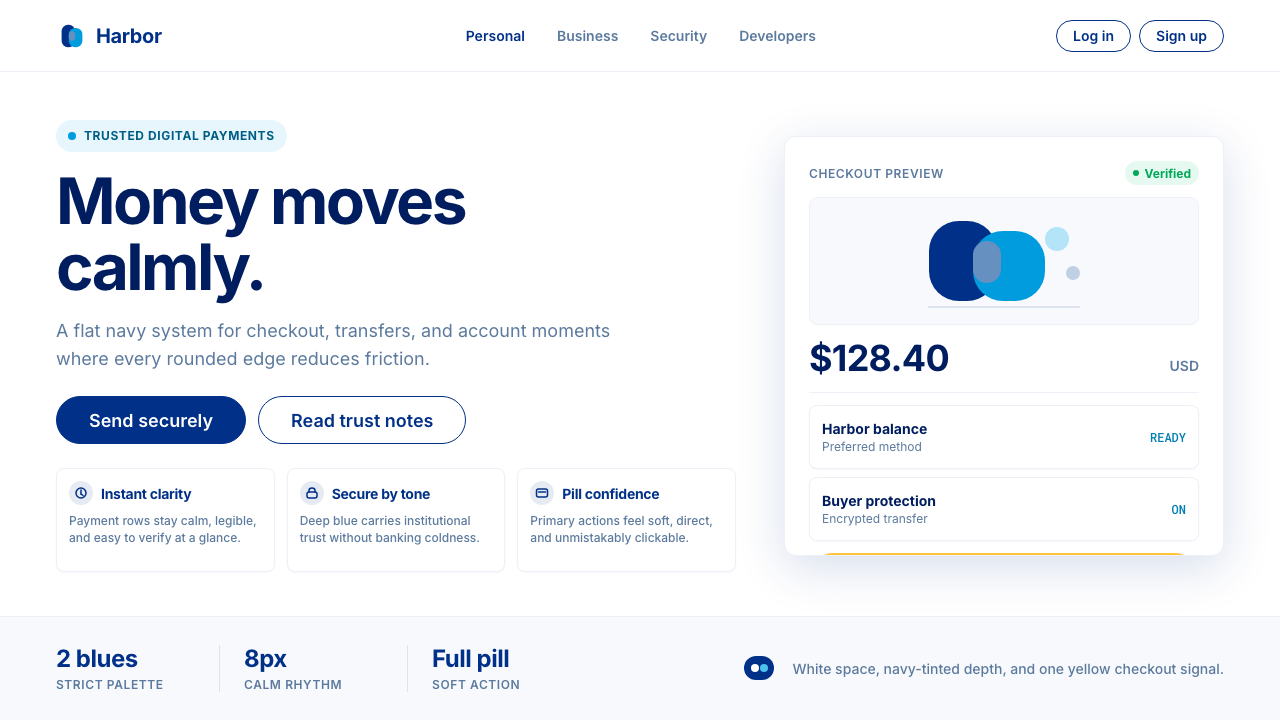 PayPalTrust without coldness. Deep navy, sky cyan, white cards, and pill checkout c…
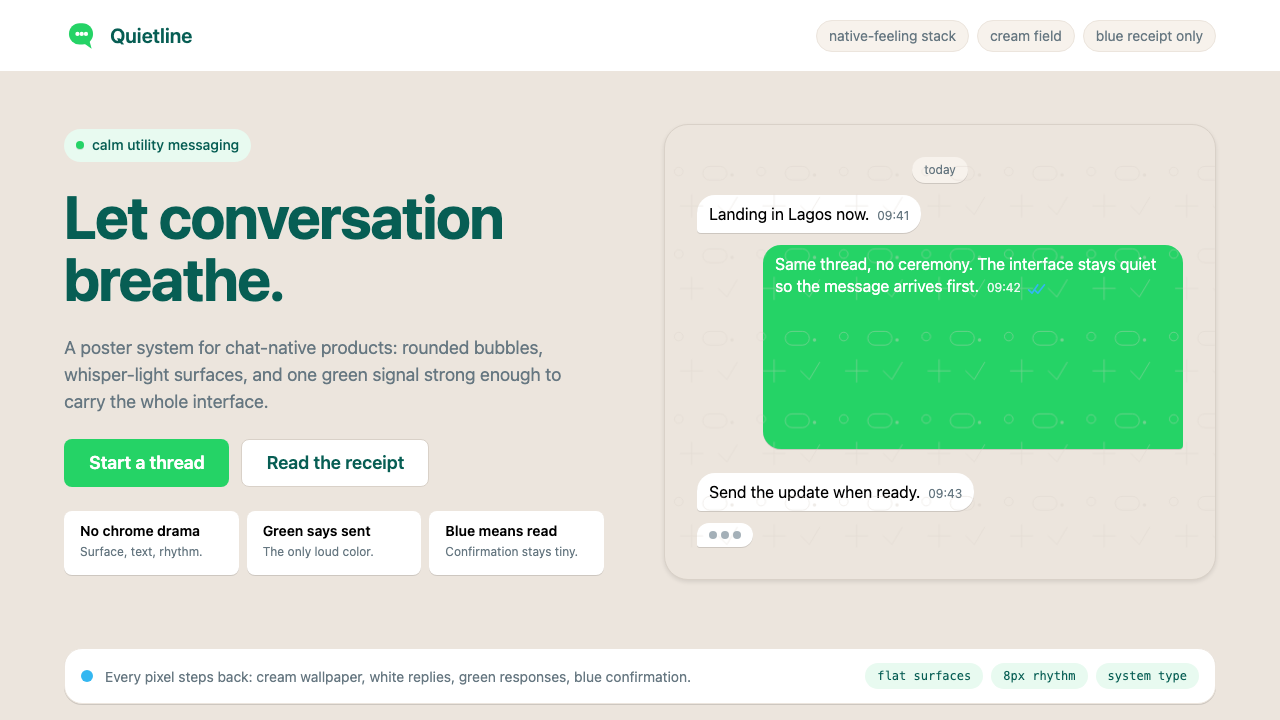 WhatsAppConversation is the interface. Cream wallpaper, green bubbles, and tiny blue…
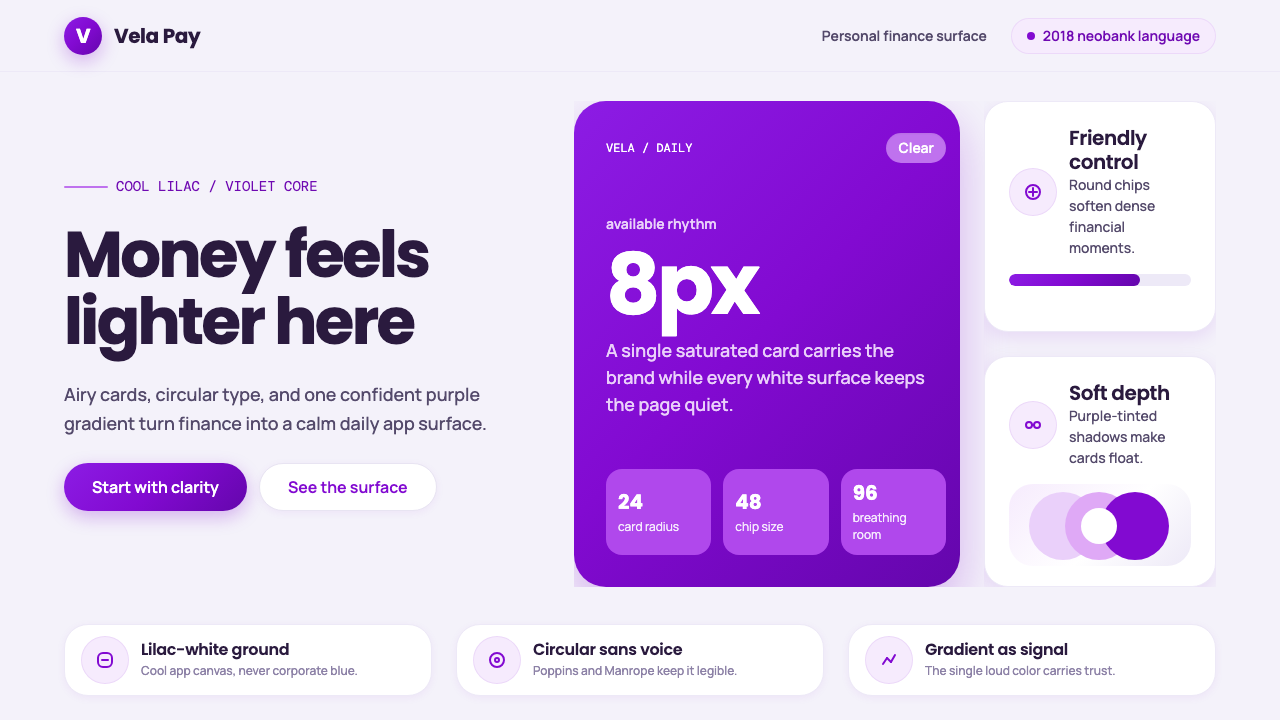 Circular FintechFinance feels light. Lilac-white space, rounded cards, and one vivid purple g…
 GitLab 2023DevOps in daylight. Tanuki orange-to-purple gradient, Inter, warm enough for…
 Grab SEA Superapp 2018Operational warmth. Saturated green, Inter numerals, and tight dashboard card…
 Airbnb 2014Coral red, soft pill cards, Cereal type. The Bélo wraps strangers in warm, da…