What is Grab SEA Superapp 2018?
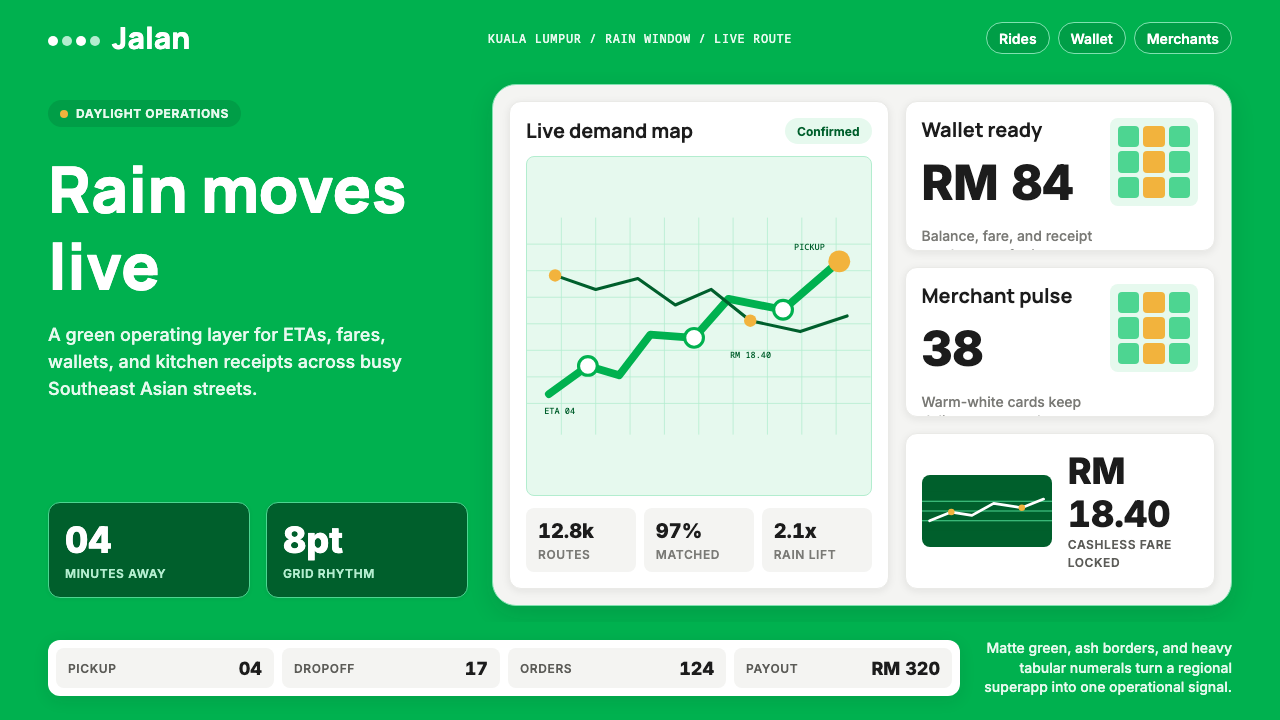
Grab's visual system distills six countries, a million motorcycle jackets, and an entire superapp economy into one unmistakable green — and the design logic behind it is as purposeful as the color itself.
Grab SEA Superapp 2018 in brief
The Grab SEA Superapp visual identity, as consolidated and formalized around 2018, is a dashboard-dense, daylight-first design language built for real-time operational clarity. Its visual grammar — a saturated signature green, matte surfaces, tight information cards, and typography that foregrounds numerals — emerged from the specific demands of a multi-country mobility and fintech platform serving users who range from daily commuters to first-time digital-wallet adopters.
Where many consumer technology brands of the era leaned on gradients, illustration, and soft UI, Grab's identity is grounded in immediacy and trust. The design speaks in the register of a live dashboard: fares, estimated arrival times, and payment amounts are the real content, and every layout decision serves their legibility. Photography of actual riders and hawker-stall operators replaces decorative illustration, anchoring the brand in the specific textures of Southeast Asian daily life rather than generic global tech.
The result is a style that feels simultaneously operational and warm — the warmth of a familiar neighborhood app, the precision of a logistics control room. It is a design language calibrated for the back of a motorcycle in the rain, for a merchant checking settlement figures on a budget handset, and for a first-generation smartphone user navigating a digital wallet with no prior banking relationship.
Where does Grab SEA Superapp 2018 come from?
Grab began in 2012 as MyTeksi, a taxi-hailing app founded in Malaysia by Anthony Tan and Tan Hooi Ling while they were students at Harvard Business School. The name reflected its origins: a local solution to the notoriously unreliable and often unsafe taxi market in Kuala Lumpur. The founding insight was not just that ride-hailing could be digitized, but that Southeast Asian urban mobility had specific characteristics — fragmented infrastructure, a large two-wheeler market, cash-first consumers — that required a regionally native approach rather than a copy of Western models.
Through the mid-2010s, the company expanded across six Southeast Asian countries and rebranded from MyTeksi to GrabTaxi and then simply to Grab, signaling its ambition beyond ride-hailing into food delivery, payments, and financial services. The visual identity during this phase was functional but not yet coherent — a product of rapid growth across engineering and market teams rather than a unified design strategy. The brand had a recognizable green, but the system around it was inconsistent.
The pivotal moment for the visual identity came in March 2018, when Grab completed the acquisition of Uber's entire Southeast Asian operation — the largest tech deal in the region's history at that point. Overnight, Grab absorbed Uber's driver partners, rider base, and operational infrastructure across eight countries. With that scale came the urgency of brand clarity: Grab was no longer just a ride-hailing challenger but the dominant superapp in the region, handling daily transactions for tens of millions of people. To establish the identity at that new scale, Grab partnered with DesignStudio London — the firm also known for rebranding Airbnb in 2014 — to formalize and elevate the visual system.
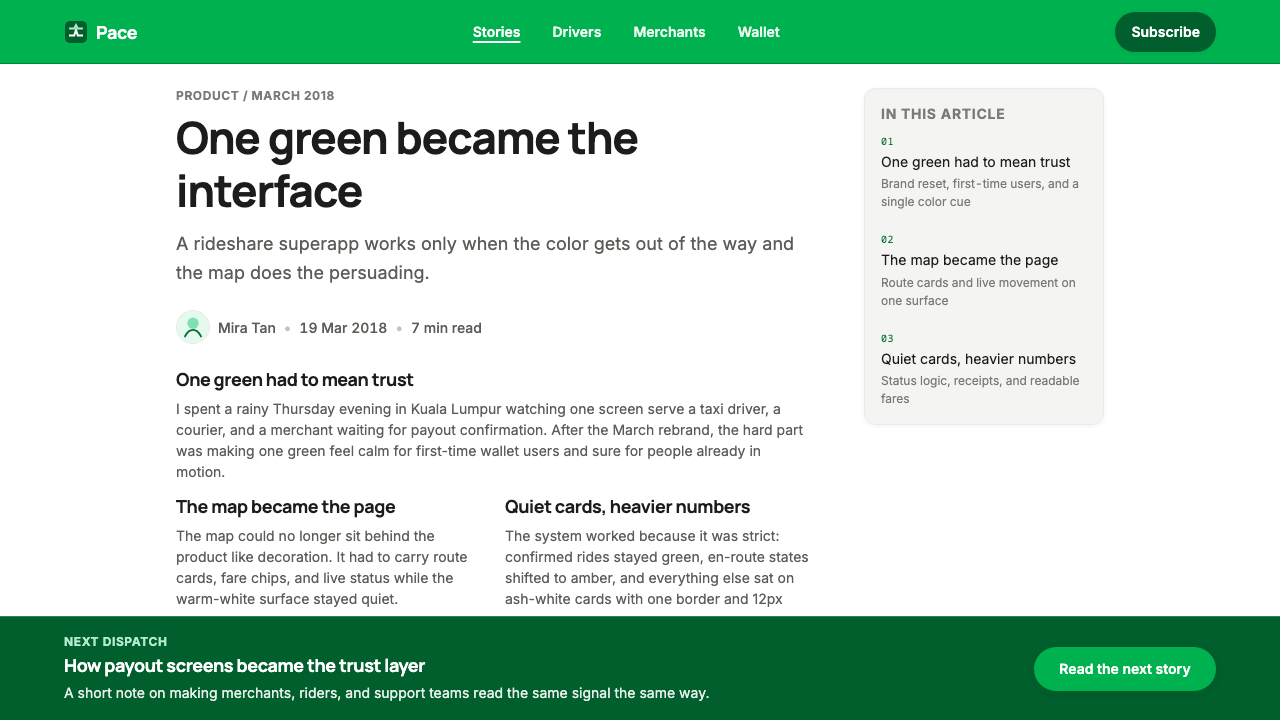
The design work with DesignStudio produced what became the recognizable Grab system: a singular, deeply saturated green elevated from a functional app color to a brand signature; a typographic approach that centered the numerals and data displays that were the true content of the product; and a photography direction grounded in real Southeast Asian environments rather than aspirational lifestyle imagery. The green itself is deliberate — it needed to read clearly in the bright ambient light of tropical cities, to stand out on a motorcycle jacket at dusk, and to convey reliability and forward motion. It is a working color, not a decorative one.
What defines the Grab SEA Superapp 2018 look?
Signature Green
The defining element of the Grab visual system is its single, deeply saturated green. Unlike the muted or sage greens common in wellness and organic branding, Grab green is vivid and unambiguous — calibrated for high ambient light, small screen sizes, and the need to read clearly against the varied visual noise of Southeast Asian street environments. It functions as both a brand signal and a wayfinding color: on a jacket, on a map pin, on a payment confirmation screen, the green is always doing work. Secondary colors are sparse and subordinate; the green carries almost all the chromatic weight.
Numerals First
Grab's core product content is numerical: fares, estimated minutes, distances, wallet balances, merchant settlement figures. The typography system treats these numbers as the primary typographic event. They are set at generous scale, with generous weight, in a neutral sans-serif that prioritizes clarity at small sizes on mid-range screens. Prose labels and supporting text step back to serve the numbers rather than competing with them. This hierarchy — data first, context second — is unusually explicit and reflects a design philosophy built around operational legibility rather than brand expressiveness.
Matte Surfaces and Flat Cards
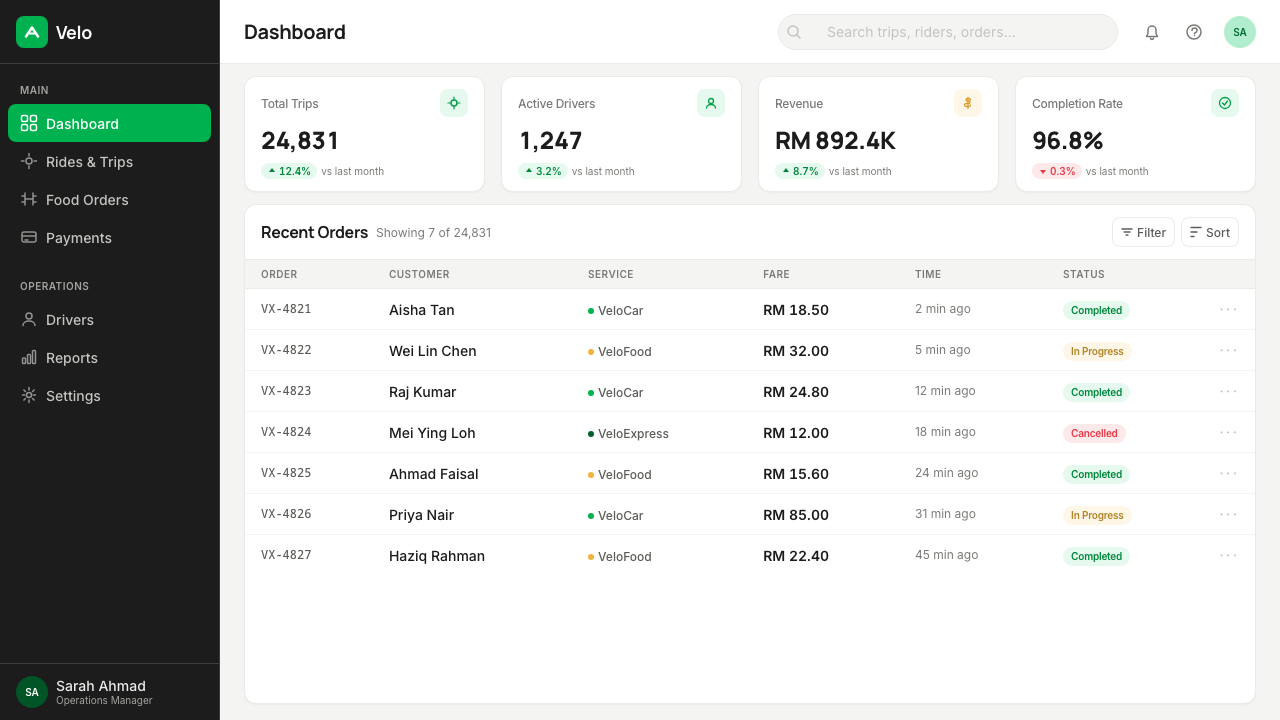
The Grab interface language is built on matte, non-glossy surfaces. Cards that contain trip information, merchant details, or payment summaries are flat-edged with subtle depth cues rather than heavy shadow or gloss effects. This flatness serves practical ends: matte surfaces are easier to read in bright outdoor light, they render consistently across a wide range of screen qualities, and they age better as display technology changes. The density of information within each card is high — Grab cards typically surface multiple data points simultaneously — but the flat surface keeps visual temperature cool and navigable.
Real Photography, Real Environments
Illustration is conspicuously absent from the Grab identity. In its place is documentary-style photography: drivers in their actual vehicles, hawker operators at their actual stalls, riders on actual city streets in Kuala Lumpur, Jakarta, Ho Chi Minh City. The images are not aspirational lifestyle shots — they are specific, humid, textured with the visual reality of Southeast Asian cities. This photographic direction communicates authenticity and regional rootedness, distinguishing Grab from global tech competitors whose imagery tends toward abstraction or universal aspiration. The photography reads as evidence of actual presence, not brand promise.
Operational Warmth
Perhaps the most distinctive tonal quality of the Grab design system is what might be called operational warmth — a quality rarely achieved when efficiency and friendliness are both explicit goals. The system is precise and data-forward without feeling clinical; it is approachable without sacrificing legibility. This tone is achieved through the combination of the green's inherent vibrancy, the grounding effect of real human photography, and spacing choices that give content room to breathe even at high density. The system does not condescend — it assumes a user who is competent and busy — but it also does not exclude newcomers.
Daylight Optimization
The Grab visual system is fundamentally a light-mode design, calibrated for the conditions in which it is most often used: bright daylight, direct sun on a phone screen, outdoor environments where contrast and color saturation need to work harder than in a controlled interior. The primary backgrounds are white or very light neutral, ensuring text and data remain readable under strong ambient light. Dark mode variants exist, but they are secondary; the baseline experience is a screen designed to function in a tropical street, not a Northern European office.
Inclusive Complexity
Grab serves a user base that spans from tech-native young professionals to first-generation smartphone users with no prior banking relationship. The design system manages this range through a consistent principle: the most important action is always the most visually prominent, regardless of the screen's total information load. Flows that involve financial decisions — paying, topping up a wallet, confirming a fare — are never buried or ambiguous. This is not simplification for its own sake; the system can carry genuine complexity, but the critical path through any task is always clear.
Who shaped Grab SEA Superapp 2018?
Anthony Tan co-founded MyTeksi with Tan Hooi Ling in 2012, drawing on his family's automotive industry background in Malaysia. His decision to build a Southeast Asia-native ride-hailing platform — rather than attempting to adapt Western models — shaped both the business strategy and the eventual design direction. As CEO through the company's rapid expansion and the Uber-SEA acquisition, Tan's emphasis on regional authenticity and trust as brand values directly informed the visual identity's prioritization of real photography, local context, and operational reliability over aspirational lifestyle aesthetics.
Tan Hooi Ling co-founded the company and served in senior operational and product roles through its growth phase. Her focus on the user experience for Southeast Asian consumers — including riders, driver-partners, and merchant partners — kept the design and product development grounded in the specific realities of the region's cities and economies. The emphasis on accessible financial services design within the Grab ecosystem, including wallet and payment interfaces for users with limited banking history, reflects priorities she championed throughout the company's evolution.
DesignStudio is the brand design agency that partnered with Grab around the time of the Uber-SEA acquisition to formalize and elevate the visual identity. Previously known for rebranding Airbnb in 2014, DesignStudio brought the experience of building global-scale consumer brand systems at a moment when Grab needed to signal that it had graduated from regional challenger to dominant superapp. Their work on the Grab identity — codifying the green, establishing the photographic direction, and structuring the design system — produced the recognizable visual language the brand uses today.
While not a single individual, the driver-partner community deserves recognition as a genuine influence on the Grab visual system. The distinctive green jacket worn by Grab's two-wheeler partners became one of the most recognized visual signals in Southeast Asian cities — a real-world manifestation of the brand color that predated and informed the formalized identity work. The jacket's practical requirements (visibility in traffic, readability in rain) aligned with the same concerns that shaped the digital brand: high contrast, real-world legibility, unmistakable presence.
The design system's specific character cannot be fully explained without acknowledging the physical and infrastructural context that shaped it: congested tropical cities with fragmented public transport, a dominant motorcycle and informal taxi culture, a large population of cash-first and newly banked consumers, and a diversity of device types from budget Android handsets to flagship phones. The Grab visual identity is an engineered response to this environment — the green for visibility, the flat surfaces for screen performance, the numerical emphasis for transaction clarity, the real photography for trust-building in a market where brand authenticity is hard-won.
How do you use Grab SEA Superapp 2018 today?
The Grab superapp visual style is applicable well beyond mobility and fintech contexts. Its core logic — dense information delivered at high speed, with trust signals foregrounded and hierarchy made immediately legible — translates to any design context where users need to make decisions quickly on the basis of numerical data. The style's discipline is structural: before applying any visual element, it asks what the user actually needs to read and act on, and builds hierarchy from that answer.
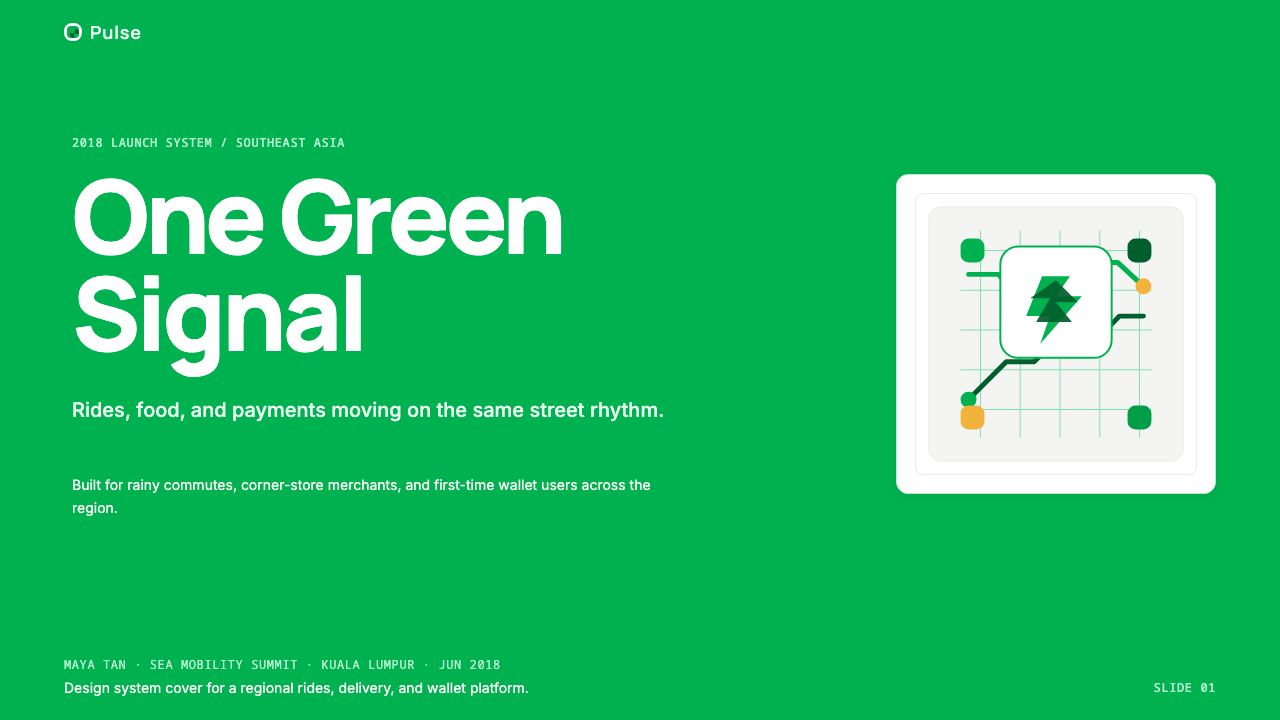
For presentation slides, the Grab approach works especially well for data-heavy decks in operational, financial, or business-review contexts. Cover slides benefit from a bold single-color field — ideally the brand's primary color at full saturation — with the title set in a clean sans-serif at substantial scale. Section headers can use a stripe or band of the primary color to divide content zones. Data slides should treat charts and tables as the primary visual event: give them generous space, remove gridlines and decorative chart furniture, and let the numbers carry their own visual weight. Slide backgrounds should stay light and neutral; the data itself provides the visual interest.
For web and app dashboards, the Grab design logic is directly applicable. Use a clear card system with flat or very low-relief surfaces: each card contains one cluster of related data, with the most critical number at the largest scale. Navigation should be minimal and text-first. Status indicators — active, pending, completed, error — should be conveyed primarily through color, with the primary brand color reserved for active or positive states. Keep the overall palette narrow: one dominant color, one neutral, one alert color, and white or near-white as the base.
For marketing and editorial work, the style's photographic ethic is its most transferable quality. Rather than stock imagery that projects aspiration, use photography that shows actual users doing actual things — the specificity creates authenticity. Pair this with typographic layouts that lead with a key number or fact: a large numeral at the top of a page or slide carries more conviction than a headline alone. Color fields behind text should use the brand's primary color at full strength, not diluted or tinted, to maintain the visual boldness that makes the style legible at distance.
A common mistake when applying a Grab-inspired system is over-indexing on density. The style accommodates high information density, but that density is always organized — each piece of data occupies a defined zone, with consistent internal margins and a clear reading sequence. Filling a screen with data without this structural discipline produces visual noise rather than operational clarity. The other frequent error is diluting the primary color: the style depends on a single fully saturated signature color, and using lighter tints or less saturated variants breaks the visual logic that makes the system work. When in doubt, use less color overall and more white space, with the primary color appearing only where it does real work.
Grab SEA Superapp 2018 — FAQ
Is the Grab design style specific to Southeast Asia, or is it broadly applicable?
The style originated from Southeast Asian conditions — tropical light, diverse device quality, cash-first consumers, two-wheeler culture — but the design principles it embodies are broadly applicable. Any product that handles real-time data, high transaction frequency, or users with limited digital experience will benefit from the same logic: numerical hierarchy, matte legible surfaces, a single strong color for orientation, and photography that shows real users rather than ideal ones. The regional flavor comes from the photographic choices and the specific hue of green; the structural logic transfers anywhere.
How does the Grab style differ from other ride-hailing brands like Uber or DiDi?
Uber's identity, particularly from its 2018 redesign onward, favors a tightly constrained black-and-white palette with carefully calibrated neutrals, leaning toward a global premium positioning. DiDi uses an orange that is similarly saturated but sits in a warmer register, and its design language has historically been denser and more layered. Grab's green is distinct from both — it operates in the cool-to-neutral range of the color spectrum and is calibrated for tropical outdoor visibility rather than indoor digital elegance. More importantly, Grab's photographic direction toward real Southeast Asian environments sets it apart from both competitors, which tend toward more universal imagery.
Can this style work for a light-touch consumer brand, or is it only suited to operational products?
The style is optimized for operational products, and applying it to contexts that call for sensory warmth, playfulness, or decorative richness will produce tension. A food or lifestyle brand that adopts the Grab structure without modification risks feeling clinical and impersonal. However, the underlying logic — a single strong color, real photography, numerical confidence — can be adapted. The key adjustment is softening the information density: fewer data points per screen, more generous white space, and photography that foregrounds the sensory experience of the product rather than its transactional mechanics. Used this way, the structural honesty of the style becomes a trust asset rather than a visual liability.
Why did Grab choose to work with a London agency rather than a Southeast Asian one?
The decision to partner with DesignStudio London for the 2018 brand formalization reflected Grab's strategic moment: following the Uber acquisition, the company needed to signal both regional dominance and global legitimacy simultaneously. DesignStudio, with its Airbnb rebrand as a reference point, had demonstrated the ability to build globally scalable brand systems. The goal was not a locally inflected identity but a world-class design system that happened to be deeply rooted in Southeast Asian reality — a distinction that the final identity largely achieves through its photographic direction and color calibration rather than through stylistic references to regional visual traditions.
How should the style handle dark mode or nighttime use cases?
The Grab visual system is fundamentally a light-mode design, and dark mode requires deliberate adaptation rather than simple color inversion. On a dark background, the signature green retains its recognizability but shifts in relative weight — it reads as a bright accent rather than a dominant field. The key principle is maintaining the same hierarchy: the most critical number or status remains the most prominent element, regardless of the background value. Supporting text and labels should use off-white or light neutral tones rather than pure white, which can feel harsh. The flat surface logic still applies; avoid adding glow effects or gradient halos to compensate for the dark background, as these undermine the operational clarity that defines the style.
Related design styles
 Circular FintechFinance feels light. Lilac-white space, rounded cards, and one vivid purple g…
 WhatsAppConversation is the interface. Cream wallpaper, green bubbles, and tiny blue…
 AmazonUgly sells efficiently. Navy chrome, orange buttons, red prices crowd a dense…
 PayPalTrust without coldness. Deep navy, sky cyan, white cards, and pill checkout c…
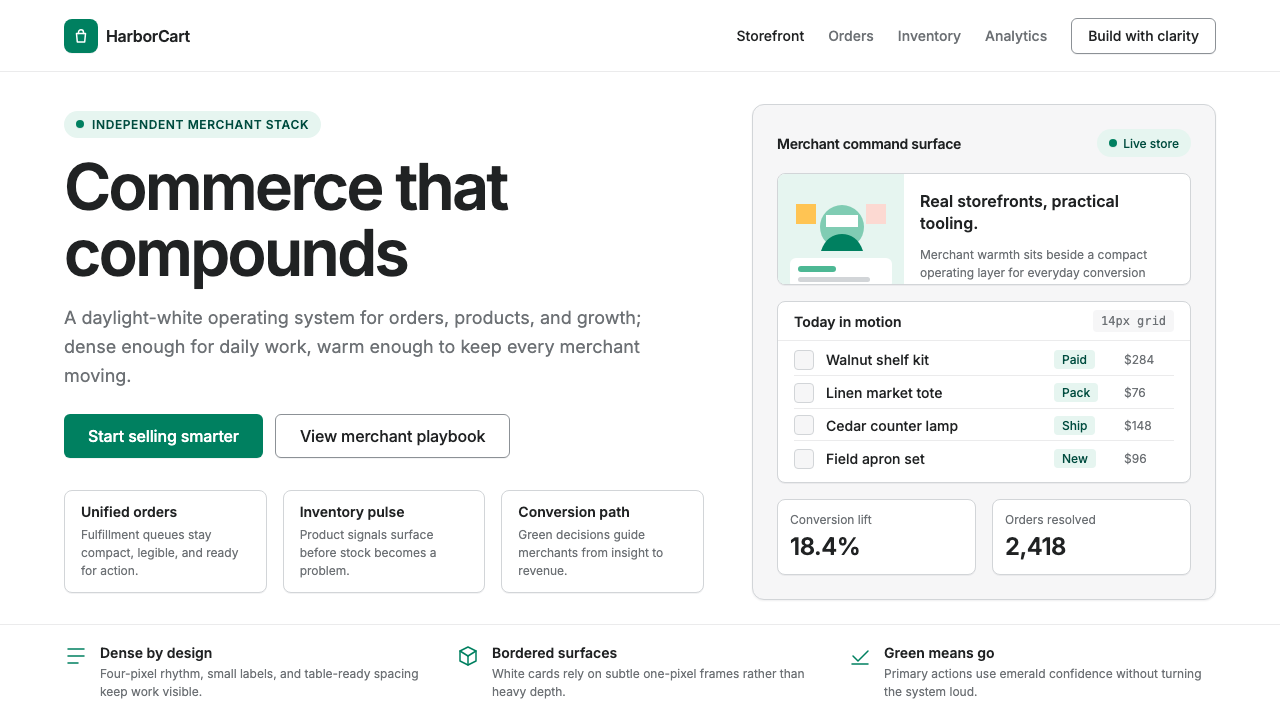 Shopify ModernMerchant ally, not corporate SaaS. Emerald actions on bordered white cards ca…
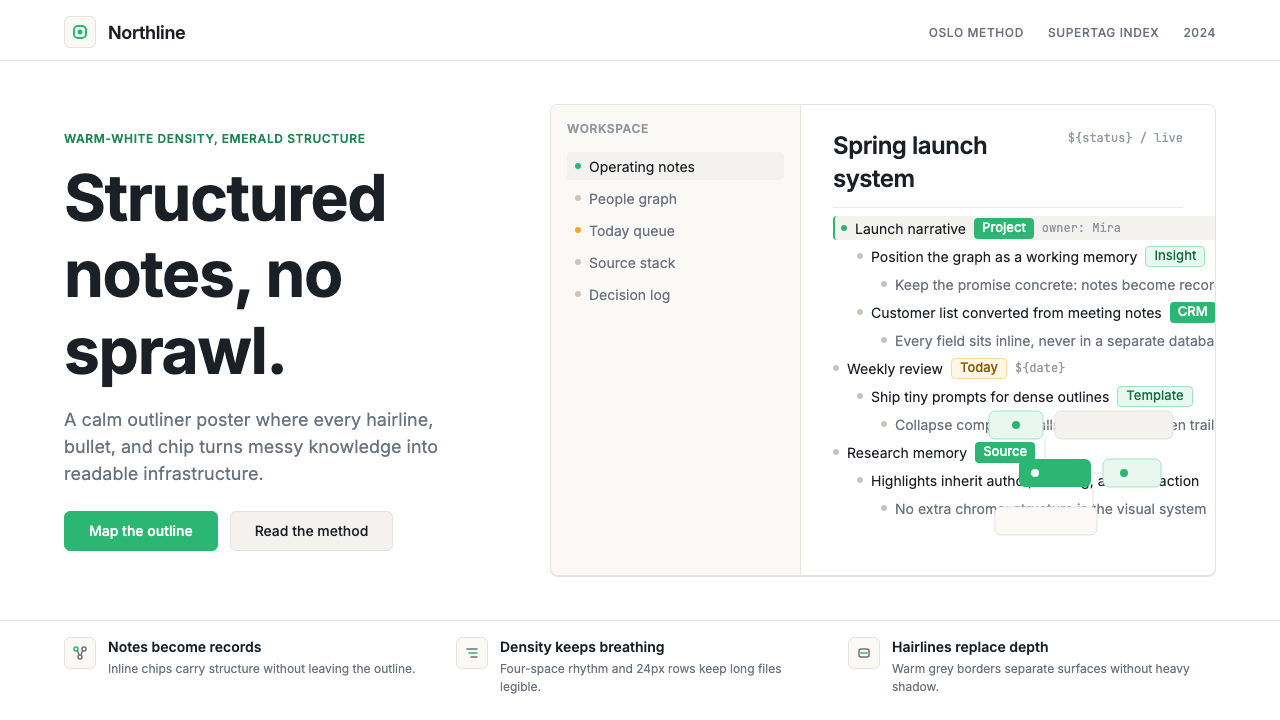 Tana SupertagsCalm density wins. Inter outlines and emerald chips punctuate pure white stru…