What is Shopify Modern?
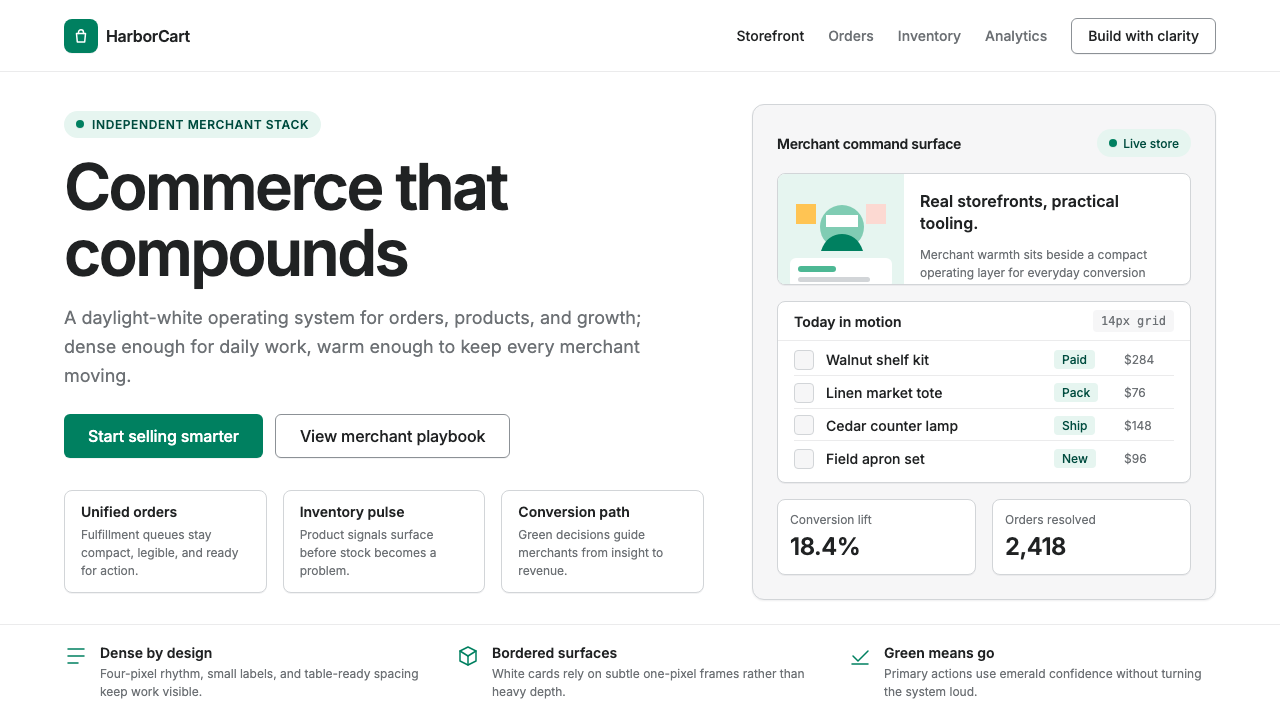
Shopify Modern is the rare commerce design system that feels equally at home in a merchant's back-office dashboard and a glossy brand billboard — professional warmth engineered for conversion.
Shopify Modern in brief
Shopify Modern is the visual and interaction language that Shopify formalized into its Polaris design system — a comprehensive set of components, patterns, and principles that govern how the platform communicates with millions of independent merchants worldwide. At its core, the style pairs a signature emerald green against daylight-white surfaces to deliver a tone that is at once businesslike and humane: serious about commerce, but unmistakably on the merchant's side.
The aesthetic balances two seemingly opposed registers. In the admin and product interface, the system is dense and utilitarian — compact data tables, tightly spaced action cards, and a hierarchy that surfaces the information a merchant needs without ceremony. In brand marketing contexts, the same visual language opens up into editorial generosity: real merchant photography, ample breathing room, and a warmth rarely associated with enterprise SaaS. This dual fluency is what makes Shopify Modern distinctive rather than merely competent.
The system is not purely minimalist. It embraces visible structure — bordered cards, clear section dividers, explicit state indicators — because merchants often arrive under pressure, checking an order on a phone between customer interactions. Every affordance must be legible at a glance. The result is a design language that earns trust through clarity and sustains loyalty through warmth.

Where does Shopify Modern come from?
Shopify was founded in Ottawa, Canada, in 2006 by Tobi Lütke and Daniel Weinand, two developers who had set out to sell snowboards online and found every existing platform inadequate for the task. Their frustration became the product: a commerce infrastructure that would give independent merchants access to the same selling capabilities as large retailers. The original interface was functional but unresolved — a patchwork of third-party components and ad-hoc decisions that reflected the company's scrappy startup origins more than any coherent visual philosophy.
As Shopify scaled through the early 2010s and its merchant base diversified from hobbyists to mid-market businesses, the accumulated design debt became a genuine product problem. Merchants were navigating an interface that varied in tone and behavior across different sections. Onboarding new employees to the codebase was slow because UI patterns were reinvented from page to page. The answer was not a visual refresh but a system — a shared language that could govern everything from a tiny inline error message to the architecture of a full-page data view.
In 2018, Shopify publicly released Polaris, its design system, making it one of the first major commerce platforms to open-source the principles underlying its interface. Polaris defined not just components but the reasoning behind them: accessibility requirements, interaction patterns, content guidelines, and the underlying values — merchant empowerment, clarity, and efficiency — that every design decision should serve. The emerald green that had been a brand color became a systematic signal: it appears on primary actions and calls to action, never on decorative elements, so merchants always know where agency lives.
The visual identity reached its current form through iterative refinement across the period from roughly 2022 to 2024. The system absorbed influences from several parallel trends in product design — the resurgence of visible borders and explicit structure as a counter-movement to the borderless, shadow-only interfaces of the mid-2010s; the elevation of photography as a brand asset rather than mere illustration; and the growing recognition in the design-system-first product organizations that the marketing surface and the product surface should share a common visual vocabulary. Shopify became a case study in how a commerce platform could extend a single coherent identity from a pricing-page hero image to a data-table row state.
What defines the Shopify Modern look?
Emerald as Semantic Anchor
The signature green is not applied freely across the interface — it is reserved for primary actions, calls to action, and interactive affordances that require merchant agency. This restraint transforms the color from a decorative choice into a reliable signal: wherever the green appears, something consequential can happen. The rest of the palette is deliberately neutral, allowing the green to carry full weight without competition.
Bordered Card Structure
Where many contemporary product interfaces rely on elevation and shadow to define containers, Shopify Modern uses explicit borders. Cards have visible strokes that clearly demarcate sections without demanding that users perceive subtle depth differences. This makes the interface readable under adverse conditions — bright sunlight on a phone screen, a quick glance between tasks — and gives the system a honest, workmanlike quality distinct from the softer, more atmospheric interfaces of consumer apps.
Merchant Photography as Warmth Engine
Shopify's marketing surfaces integrate real photographs of merchants, their products, and their workspaces — not generic stock imagery. The photography is warm in color temperature, documentary in feel, and often shows hands at work. This humanizes what would otherwise be a purely functional system and communicates the brand's core promise: that the platform exists to serve real people building real businesses. In editorial contexts, the photography takes on a generous scale, often bleeding to the edge of the layout.
Information Density at Admin Scale
The product interface is designed for professionals who spend hours each day inside it — not casual visitors who need to be hand-held. Type is set compact, tables are dense, and the spacing between elements is deliberately tight so that more information fits in a single viewport without scrolling. This density is not a compromise; it is a design value. Merchants who run their businesses in Shopify's admin need to see their orders, inventory, and analytics at a glance, not scroll through generous whitespace.
Dual Register: Admin and Brand
Shopify Modern operates in two distinct registers that share an underlying language. The admin register is compact, structured, and task-focused — every element earns its place by serving a merchant action. The brand register, used in marketing, homepages, and campaign materials, is open, editorial, and aspirational — generous whitespace, large photography, and headlines that carry emotional weight. The system's coherence comes from the consistent use of color, the shared type sensibility, and the same honest directness of voice across both registers.
Accessible Contrast and Color Use
The Polaris system was built with accessibility as a foundational constraint rather than an afterthought. Text meets rigorous contrast requirements against its backgrounds. Interactive states — hover, focus, disabled, error — each have distinct visual treatments that do not rely solely on color to communicate status. The green, rather than a purely decorative brand color, was chosen and calibrated partly for its legibility across a range of screen conditions and the accessibility of its contrast ratios against white.
Typographic Directness
The system's typographic sensibility favors clarity and utility over elegance. Headlines are set with enough weight to anchor page sections but not so decorative as to slow reading. Body type is sized for sustained reading in a professional context — not so small it strains, not so large it wastes space. The hierarchy is expressed through size and weight contrast alone; there are no decorative typographic treatments such as all-caps display sections, swash characters, or editorial ligatures.

Who shaped Shopify Modern?
Lütke co-founded Shopify after experiencing firsthand the inadequacy of existing commerce tools when trying to sell snowboards online in the early 2000s. As CEO, he shaped the company's foundational philosophy — that Shopify should function as a merchant ally rather than an extractive platform — and this philosophy permeates the design system. His engineering background influenced Polaris's emphasis on systematic consistency over one-off visual flair, and his framing of Shopify as 'arming the rebels' against large retail gave the design team a clear value hierarchy to design against.
Weinand, who co-founded Shopify with Lütke, served as the company's first designer and Chief Design Officer. In the early years, when the entire interface was built by a handful of people, Weinand established the tone and visual character that would later be systematized into Polaris. His insistence that commerce software could be both functional and visually considered — rather than accepting the drab utility common to enterprise tools of the era — set the expectation that the design team would later formalize.
The Polaris design system team — a cross-functional group of designers, engineers, and content strategists at Shopify — built and maintains the open-source component library and guidelines that constitute the formal expression of Shopify Modern. Their decision to publish Polaris publicly in 2018 was both a practical move, enabling third-party app developers to build consistent experiences within the Shopify ecosystem, and a philosophical one: making the reasoning behind design decisions legible and debatable. The team's ongoing work on accessibility, internationalization, and the dual admin-plus-brand register has kept Polaris current through multiple cycles of platform evolution.
Shopify Modern did not emerge in isolation. It was shaped by the broader rise of direct-to-consumer brands in the 2010s and the parallel maturation of SaaS product design. The DTC movement created a new class of merchant — visually sophisticated, brand-conscious, unwilling to accept the drab utility of traditional retail back-office software — whose expectations forced Shopify's interface to meet a higher visual standard. The design-system-first product organizations that proliferated in the same period provided both a methodology and a vocabulary for formalizing what Shopify's team had been building intuitively.
How do you use Shopify Modern today?
Shopify Modern is a highly practical reference for anyone designing commerce-adjacent products — checkout flows, merchant dashboards, inventory management tools, or any application where the user is a professional working under time pressure rather than a casual consumer browsing at leisure. The aesthetic communicates competence, trust, and respect for the user's time, which are the right values for a wide range of B2B and B2C-on-behalf-of-B-products.
For presentation slides, the style translates well in both cover and content contexts. A cover slide in this register benefits from a clean white or light-ground layout with a single strong emerald accent on the headline or a key visual element — a product photograph, a merchant scene — set at generous scale. Content slides should commit to visible structure: cards or bordered sections to separate data clusters, clear typographic hierarchy with a single dominant heading and subordinate body text, and any charts or data visualizations treated as clean geometric objects with color used only to distinguish categories rather than to decorate. Data slides gain credibility from the system's native density: tight tables with clear column headers and aligned values read as professional and considered rather than sparse.
For web interfaces — especially dashboards, admin panels, pricing pages, and SaaS product trials — Shopify Modern's principles translate directly. Define an explicit grid and commit to it; use bordered containers rather than shadow-only cards to define sections; reserve the green for primary calls to action and interactive elements so the color carries semantic weight rather than decorative warmth. Pricing pages benefit from the system's honest directness: clear tier labels, explicit feature lists, and a primary action button that uses the green without ambiguity. Avoid using the green as a background fill on large areas; its power comes from selectivity.
For editorial and marketing work — campaign pages, brand stories, product announcements — the key is to embrace the brand register of the system rather than the admin register. This means generous whitespace, large-format photography featuring real people and real work, and headlines with enough weight and scale to carry the emotional freight of the message. Section breaks can be marked by a horizontal rule or a shift in background tone from white to a very light warm neutral rather than decorative ornaments. The emerald green appears here primarily as a button or link treatment, never as a tint fill behind long-form text.
A common mistake when referencing Shopify Modern is applying the green too liberally — using it as a background color on banners, as a tint on card surfaces, or as a fill behind navigation items. The entire system's credibility as a semantic language depends on the green remaining scarce and purposeful. A second common error is importing the admin's density into marketing contexts where it reads as cluttered rather than professional. The two registers require switching deliberately: tight and structured for product, open and photographically generous for brand. Mixing them within a single surface without clear purpose produces a hybrid that has neither the utility of the admin view nor the warmth of the brand view.

Shopify Modern — FAQ
Is Shopify Modern a style or just a corporate brand guide?
It is both, but its influence extends well beyond Shopify itself. Polaris was published as an open-source design system, and its patterns — bordered cards, emerald primary actions, admin-scale density, the dual admin-and-brand register — have been widely adopted by commerce-adjacent SaaS products, fintech platforms, and internal tool builders who needed a visual language that reads as competent and trustworthy without being stiff. When designers reference Shopify Modern as a style, they mean the aesthetic principles distilled from Polaris: high structural honesty, selective use of a signature color, and the balance between professional density and human warmth.
How does Shopify Modern differ from other SaaS design systems like Stripe or Linear?
Each system reflects the values of its product and user base. Stripe's design language is polished and developer-elegant — refined type, restrained color, and a sense of architectural precision that speaks to technical users comfortable with abstraction. Linear's interface is dense and near-monochromatic, optimized for speed and focus in a way that prioritizes function over any warmth signal. Shopify Modern is warmer and more photographically grounded — it serves merchants who may not be technical, who need to feel that the platform is on their side, and who benefit from visual signals that are explicit and unmistakable rather than subtle. The emerald green and the merchant photography are expressions of that different user relationship.
Can the Shopify Modern aesthetic work for a non-commerce product?
Yes, with some adaptation. The underlying principles — structural honesty, explicit containment, selective use of a signature color for primary actions, and the balance between density and warmth — apply broadly to any professional tool where trust and clarity are design goals. The specific emerald green is so strongly associated with Shopify that using it directly would read as imitation; a designer should substitute a different signature color calibrated for their product's brand while retaining the semantic discipline that makes Shopify's system coherent. The photography-as-warmth principle transfers to any product serving human practitioners — a medical platform, a creative tool, a logistics application — where showing real humans doing real work humanizes the interface.
What is the biggest risk when applying this style to a presentation or marketing piece?
The largest risk is overusing the signature green to the point where it loses semantic meaning. In the Polaris system, the green is powerful because it is scarce — it appears only where primary action lives. When designers extract the green from that systematic context and use it as a general accent or background, the piece may look like it references Shopify Modern, but it has abandoned the principle that makes the color work. The second risk is applying the admin-register density — tight spacing, small type, compressed tables — to a context that calls for the brand register's generosity, producing something that reads as cramped rather than efficient. The discipline of deciding which register applies to a given surface, and then committing to that register, is the most important skill in working with this style.
Does Shopify Modern work well in dark-mode contexts?
The canonical Shopify Modern system is a light-mode aesthetic: daylight white surfaces, the green-on-white contrast, and the warmth of natural-light photography all depend on a light ground. A dark inversion is technically possible — and Shopify has explored dark surfaces in some contexts — but it requires careful recalibration. The emerald green, which reads as a confident accent against white, can shift toward an aggressive or oversaturated feel against very dark backgrounds. The photography that provides warmth in the light register loses some of that quality against dark surfaces. A dark-mode adaptation works best when it commits to a dark but not fully saturated background, chooses a slightly lighter or warmer variant of the signature green calibrated for that surface, and leans more heavily on structural elements and typographic hierarchy to do the work that photography and whitespace do in the canonical form.
Related design styles
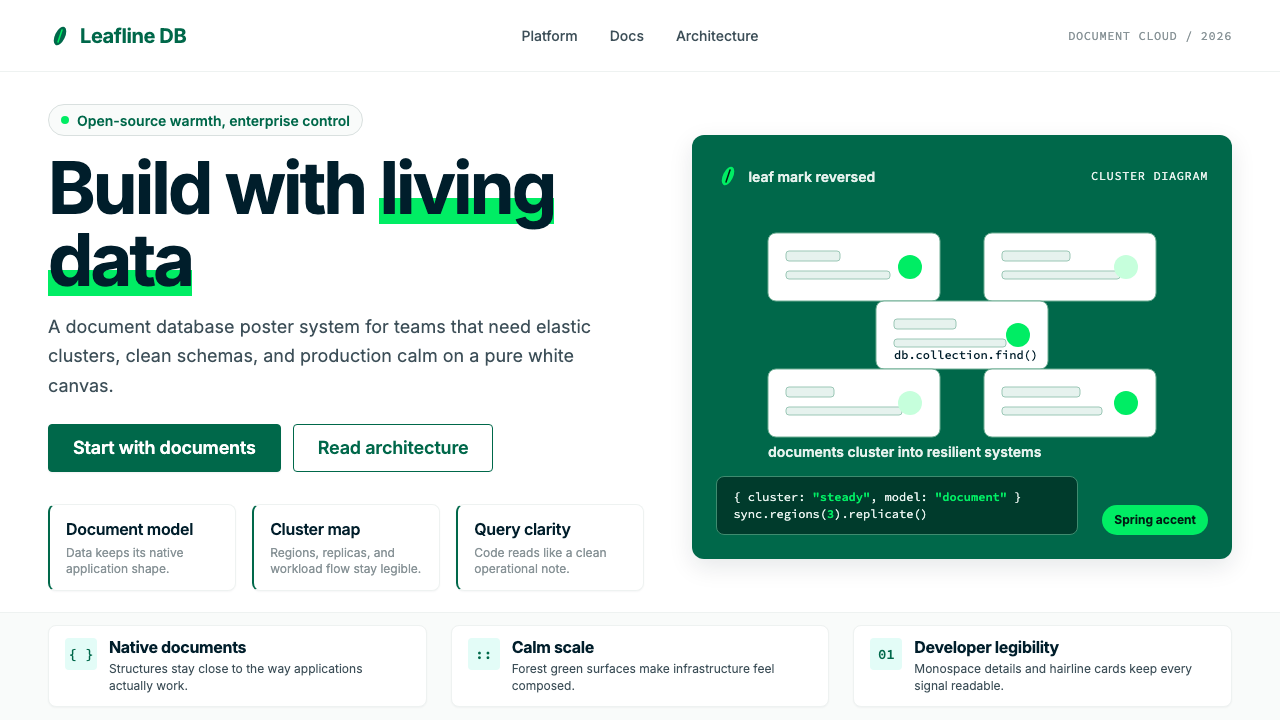 MongoDB Leaf GreenDisciplined green, open warmth. Forest leaf forms and Spring accents breathe…
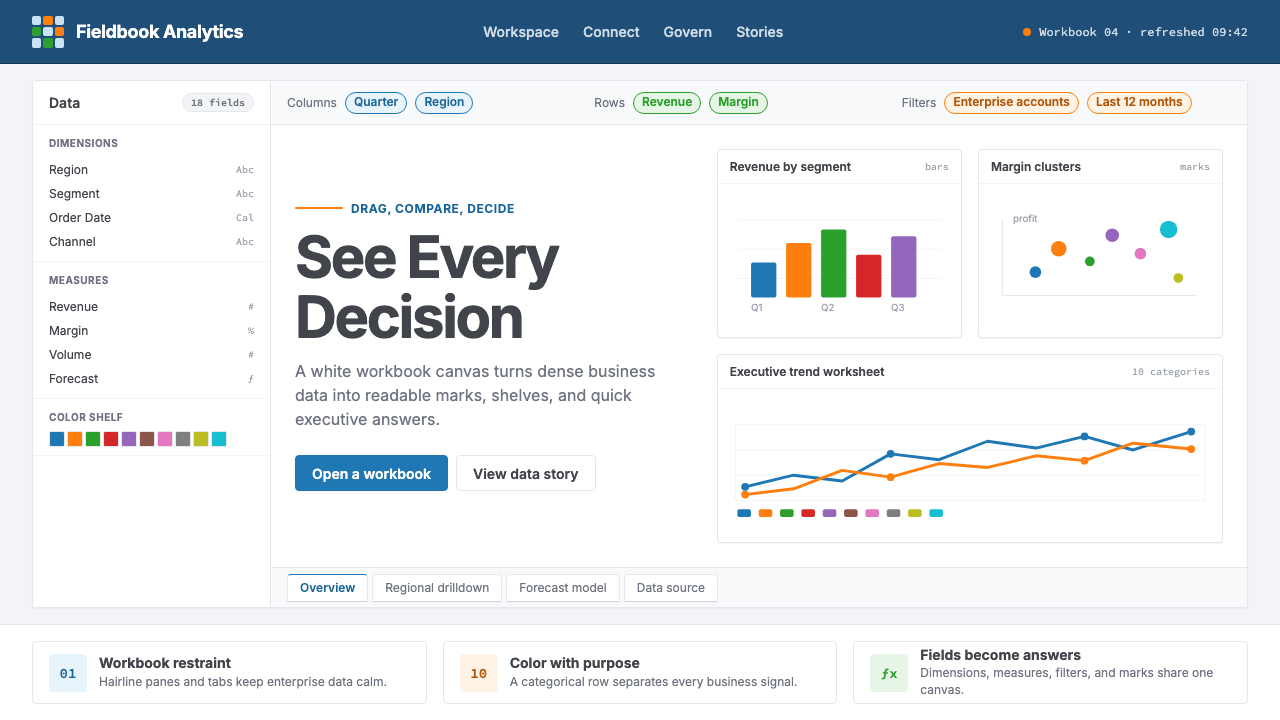 Tableau (Business Intelligence)Enterprise clarity. Navy workbook chrome, hairline panes, and 10-color marks…
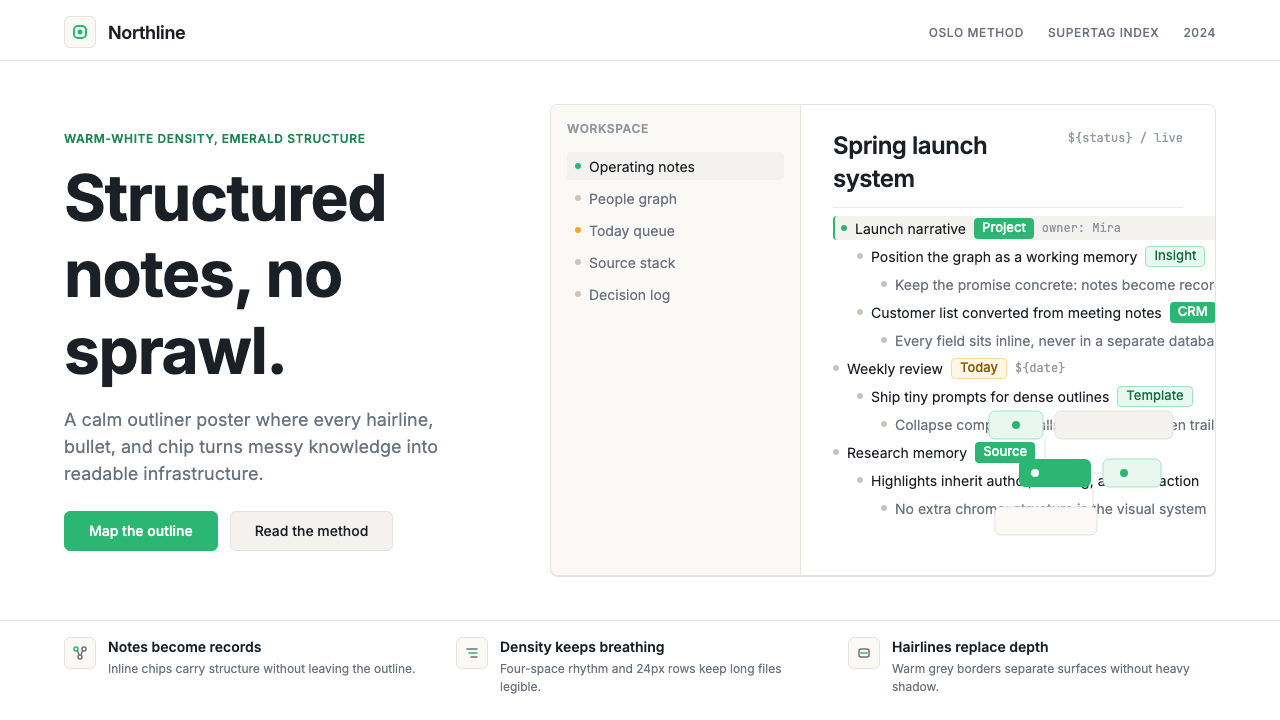 Tana SupertagsCalm density wins. Inter outlines and emerald chips punctuate pure white stru…
 Android Bugdroid GreenFriendly tech, reduced to geometry. Vivid green pops from Grey 900 and rounde…
 AsanaCalm productivity breathes. Cream canvas, lavender panels, coral-blue-yellow…
 GitLab 2023DevOps in daylight. Tanuki orange-to-purple gradient, Inter, warm enough for…