What is Tana Supertags?
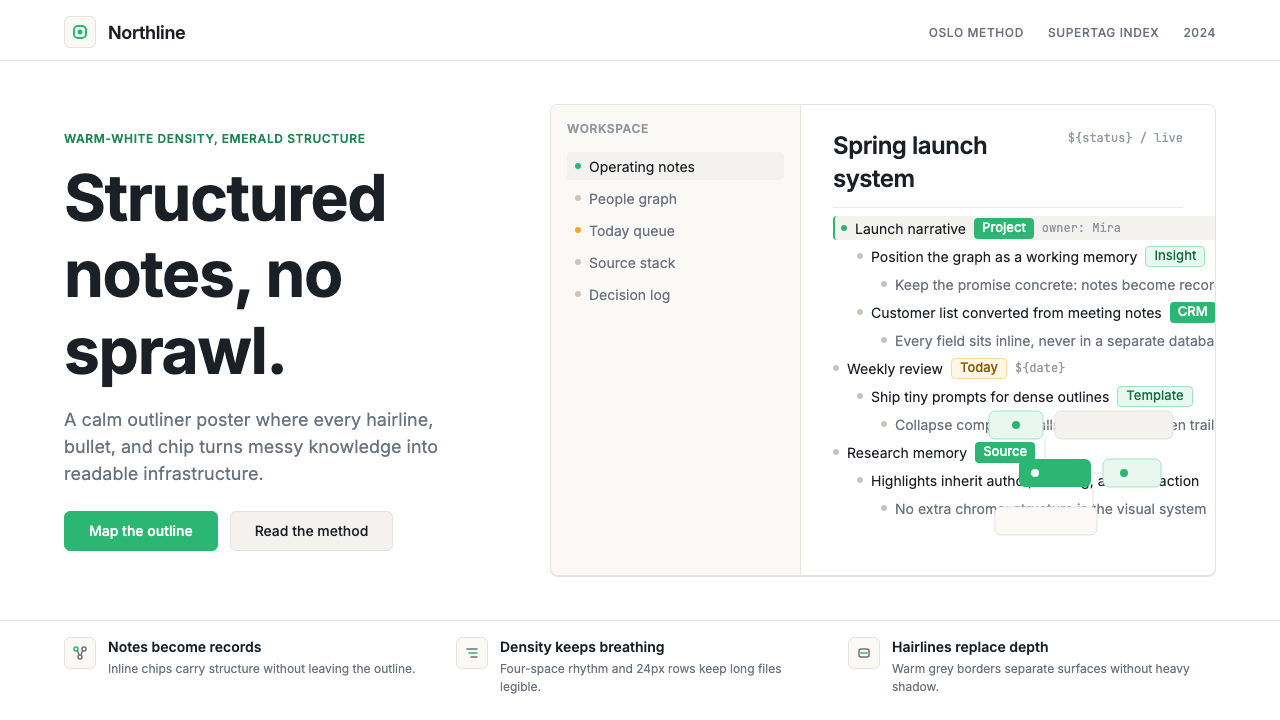
Tana reimagined the knowledge tool as a living database by collapsing notes and relational records into a single primitive — the supertag — and wrapping that power in a visual language so quiet it almost disappears.
Tana Supertags in brief
Tana is a personal knowledge management application and outliner born in Oslo, Norway, whose defining innovation is the supertag: a tag that simultaneously classifies a node and assigns it a typed schema, turning a bullet in an outline into a structured database record. A node tagged as a person carries fields for role, organization, and contact details; a node tagged as a meeting inherits fields for date, attendees, and action items — automatically, the moment the tag is applied. The outline and the database are the same object.
Visually, Tana makes a radical commitment to restraint. The interface is built almost entirely in white, with warm grey used for infrastructure elements — borders, sidebars, timestamps, and secondary metadata — that the eye learns to read without consciously registering. Against this near-silence, emerald chips announce supertags: the single saturated accent in a system that otherwise refuses color. The effect is a kind of tonal discipline borrowed from Scandinavian design traditions: the interface fades away so the information can breathe.
The design philosophy follows the product logic. When a tool is powerful enough that a single outline can function simultaneously as a CRM, a project tracker, a reading log, and a research database, the interface must do everything it can to stay out of the way of that density. Tana's visual quietness is not a stylistic preference — it is an engineering decision made in the service of information.
Where does Tana Supertags come from?
Tana was founded in Oslo in 2022 by a small, tightly focused team: Tarjei Vassbotn, Stian Håklev, Olav Sindre Kriken, and Mariam Hassib. The team emerged from the post-Roam ecosystem — a period in personal knowledge management defined by the block-based outliner Roam Research, which had demonstrated in 2020 that hyperlinked, hierarchical notes could replace relational databases for many knowledge workers. Roam's visual language was sparse and developer-adjacent; its successors competed on both the structural power of their data models and the polish of their interfaces.
Tana's founders had a specific theoretical bet: that the fundamental unit of a knowledge tool should not be a document, a block, or a linked note, but a node with a type. The supertag was the mechanism for assigning that type without requiring the user to think in schema-design terms. You write a note, tag it, and the schema appears — fields waiting to be filled. The technical challenge was making that schema-on-demand feel as fluid as freeform writing. The visual challenge was making a tool with relational database power look like a calm, writable surface.
The indie PKM ecosystem in which Tana launched was crowded and fast-moving. Notion had already established the dominance of the block-based document-database hybrid and had built a visual identity around color blocks, cover images, and a light pastel accent system. Obsidian had captured the graph-native crowd with its markdown-first, plugin-rich approach and its dark, graph-centric aesthetic. Logseq occupied a middle ground with an open-source ethos. Into this landscape, Tana entered in restricted beta, deliberately limiting access while refining the supertag model and gathering structured feedback from a core community of knowledge-management enthusiasts and researchers.
By 2023 and into 2024, Tana had developed a visual identity that set it apart from every competitor in the space. Where Notion used color generously and Obsidian leaned dark and technical, Tana chose near-total white, warm grey, and a single emerald green. This choice reflected both the Oslo design culture from which the team came — Scandinavian product design has a long tradition of subtracting rather than adding — and the particular demands of the supertag interface, where the structural complexity of typed fields and inline schemas required a background quiet enough to let the data architecture become the visual subject.
What defines the Tana Supertags look?
White Ground with Warm Grey Infrastructure
The canvas is pure white or very near to it, with warm grey reserved for the scaffolding: sidebar panels, item borders, timestamp annotations, and the faint indentation guides that mark outline depth. This two-tone base is not minimalism for its own sake — it is a deliberate hierarchy that separates structural chrome from content. The eye learns to treat the grey as furniture and the white as the surface where thinking happens. Nothing in the base palette demands attention; everything in it serves orientation.
Emerald as Sole Saturated Signal
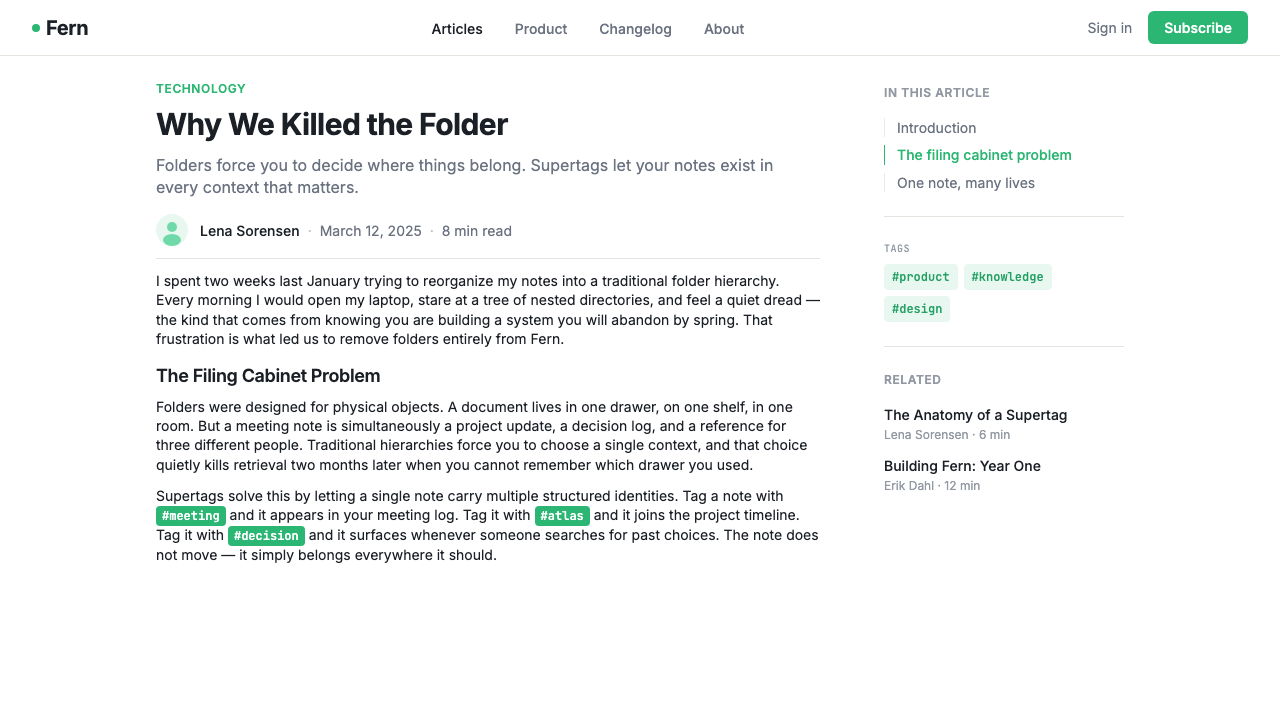
Tana uses a single saturated color — an emerald green — exclusively for supertag chips: the small pill-shaped labels that appear inline when a node carries a type. Because the entire rest of the interface is achromatic or near-achromatic, this single green carries an enormous semantic load. It says, without a word of text: this node is typed, it has a schema, it belongs to a structured collection. No other element in the interface is green. The restraint makes the signal unmissable. Color here is not decoration — it is a switch.
Outline Density as Visual Texture
A fully-loaded Tana document can contain hundreds of nodes in a single view, each with its inline fields, supertag chips, and nested children. Rather than hiding this density behind collapsed panes or paginated views, the interface is designed to render it readably: tight line rhythm, subtle indentation cues, and a type hierarchy that distinguishes node titles from field labels from field values. The density itself becomes the visual texture of the page — an active, information-rich surface that rewards close reading rather than skimming.
Typography as Pure Structure
Tana's typographic choices are made entirely in the service of hierarchy and scannability rather than personality or brand expression. The reading typeface is a clean, geometric sans-serif used at multiple scales to distinguish outline levels, field labels, and secondary metadata. There is no decorative variation in weight or style for its own sake; every typographic decision is a structural one. Headers are larger because they need to be found quickly in a dense outline. Field labels are smaller and lighter because they are secondary to the field values they introduce. Nothing in the typographic system exists for visual richness alone.
Node as First-Class Visual Unit
Where most note-taking tools foreground the document or the page, Tana foregrounds the node. Each bullet-point item is a discrete, clickable object that can carry structured data, be referenced from anywhere in the workspace, and be viewed independently of its containing outline. The visual design reinforces this: nodes have just enough visual weight — a subtle hover state, a faint border on expansion — to register as individual objects without disrupting the flow of the outline above and below them. The interface teaches users, through repetition, that the node is the fundamental thing.
Inline Schema Visibility
When a supertag is applied to a node, that node's typed fields appear inline beneath it, not in a separate panel or modal. The fields are displayed in a condensed, tabular style — label on the left, editable value on the right — that makes the database structure visible without interrupting the outline reading flow. Empty fields are shown in a subdued style to signal they exist without demanding they be filled. This inline visibility is a deliberate design argument: the structure of your knowledge should be visible in context, not hidden in a settings drawer.
Scandinavian Restraint as Brand
Tana's visual identity is inseparable from its Oslo origins. Scandinavian product design has long privileged the subtraction of unnecessary elements over the addition of expressive ones: the form that remains after everything unnecessary is removed. In Tana, this philosophy produces an interface where no feature announces itself, where the supertag chip is the most visually assertive element in the entire system, and where the overall impression is of a tool confident enough in its substance that it has nothing to prove through ornamentation. The restraint is the brand.

Who shaped Tana Supertags?
Co-founder and the primary architectural mind behind the supertag model. Vassbotn drove the core technical insight that a tag and a schema could be unified into a single primitive, eliminating the distinction between classifying a note and structuring it as a database record. His insistence on making the data model the product — rather than treating it as infrastructure behind a friendlier surface — shaped the fundamental character of Tana's interface and philosophy.
Co-founder and the team's primary connection to the academic and research knowledge-management community. Håklev brought a researcher's perspective to the product: the supertag model was informed by decades of academic work on typed knowledge representation, and his involvement helped ensure that Tana's data model was rigorous enough to handle the complex, heterogeneous knowledge structures that researchers, academics, and systematic thinkers actually work with.
Co-founder responsible for much of the interface design and visual identity. Kriken's design sensibility — rooted in Scandinavian design traditions of restraint and function-led form — produced the white-and-emerald visual system that distinguishes Tana from its competitors. His choices prioritized information density and structural legibility over visual expressiveness, making the interface a direct translation of the product's conceptual commitments into visual form.
Co-founder whose contributions encompassed product strategy, community development, and the careful management of Tana's restricted beta period. Hassib played a central role in building the early community of knowledge-management researchers and enthusiasts whose structured feedback directly shaped the supertag model's refinement. Her work on community building established Tana's early reputation as a serious tool for serious thinkers, setting the tone for how the product positioned itself in the PKM market.
How do you use Tana Supertags today?
Tana's visual language is highly specialized — it was built for a particular kind of information density — and it transfers most cleanly into contexts that share the same underlying values: structured information, calm hierarchy, and the subordination of visual expression to data legibility. Understanding what drives the aesthetic is more important than copying its surface features.
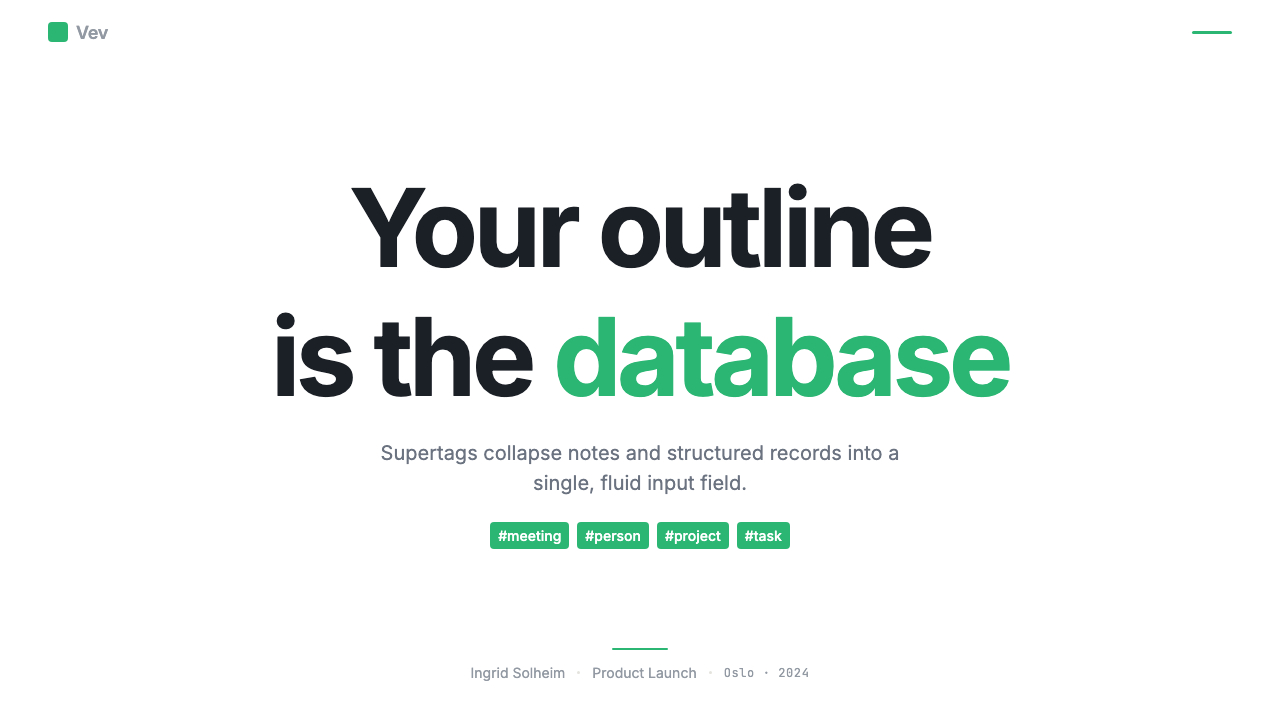
For presentation slides, Tana's palette works well on content-heavy slides where the data itself is the subject. A cover slide can use the white ground with a single emerald accent element and bold typographic hierarchy — the simplicity signals confidence in the content. Content slides benefit from the tight line rhythm of the Tana aesthetic: dense, clearly structured lists or tables with minimal visual decoration, where typographic size and weight carry all the hierarchy. Data slides should treat charts and tables as structural elements, not visual statements — simple forms on a white field, relying on position and size rather than color variation to communicate.
For web interfaces, the style is best suited to productivity tools, knowledge management applications, analytical dashboards, and any product where the user's primary activity is structured data entry and retrieval. The approach: near-white background throughout, warm grey for all structural chrome (navigation borders, sidebar backgrounds, dividers), and the single saturated accent reserved for the most semantically important interactive element — a primary action button, a selected state, or a key status indicator. Avoid applying the accent color to decorative or ambient elements; its power derives entirely from its exclusivity.
For editorial and marketing contexts, Tana's aesthetic requires careful adaptation. The white-and-emerald system reads as product-native rather than broadly editorial; direct application to a blog or marketing page can feel sterile. The most effective transfer is selective: borrow the typographic restraint and the principle of a single saturated accent, but allow more warmth in the typographic choices and more variation in spacing to give the content room to breathe. Marketing pages for technical products, developer tools, or knowledge-intensive services can adopt the aesthetic more fully — it signals precision and intentionality that resonates with technically sophisticated audiences.
A common mistake when drawing from Tana's visual language is treating the emerald accent as a general-purpose color — using it for decorative elements, illustrative backgrounds, or categorical color coding. In Tana, the green carries meaning precisely because it appears in exactly one place. Introducing it in multiple contexts strips it of that semantic weight and leaves you with a pleasant but semantically empty color choice. The discipline is to pick the single most important element in your interface, reserve the accent for it, and hold that reservation strictly.
Tana Supertags — FAQ
What makes the supertag different from a regular tag or a database field?
A regular tag classifies a note — it says this note belongs to category X — but it adds no structure to the note itself. A database field belongs to a table and is created by a database administrator, separate from the freeform writing surface. A supertag unifies both: applying it to a node simultaneously classifies the node and instantiates a typed schema directly on that node. You are writing a note that is simultaneously a database record, without ever leaving the outline. This collapsing of the distinction between writing and structuring is Tana's core conceptual contribution to the PKM field.
Why did Tana choose a restricted beta rather than open access?
The supertag model is powerful enough that its failure modes are also powerful — a poorly designed supertag structure can make an entire workspace harder to use rather than easier. Restricted beta allowed the team to gather structured feedback from users who were motivated to engage deeply with the model, to observe how real users designed and refined their supertag vocabularies over time, and to iterate on the interface before the model was exposed to a broader population that might form habits around early rough edges. The restriction was not scarcity marketing — it was a deliberate quality gate.
How does Tana's visual approach compare to Notion's?
Notion and Tana represent opposite ends of the expressiveness spectrum in productivity tooling. Notion is visually generous: it offers cover images, icon pickers, colored backgrounds, a light pastel accent system, and extensive customization of page appearance. The philosophy is that your workspace should feel personal and inviting. Tana is visually austere: white, warm grey, and a single emerald accent, with no cover images or color customization. The philosophy is that the interface should be invisible enough that the structure of your knowledge becomes the visual subject. Notion prioritizes the feeling of ownership; Tana prioritizes the legibility of structure.
Is the Tana aesthetic appropriate for consumer-facing products, or is it primarily a tool for specialists?
The Tana aesthetic is most at home in tools designed for knowledge workers, researchers, and systematic thinkers who value structural clarity over expressive warmth. It signals rigor, precision, and seriousness — qualities that resonate with technically sophisticated users but can read as cold or austere to general consumer audiences who expect more visual warmth, personality, and invitation from their tools. A consumer wellness app, a social platform, or a children's learning tool would struggle with this aesthetic. But for developer tools, analytical platforms, research applications, and any product whose primary audience values doing things correctly over doing things expressively, the Tana register is a strong fit.
Can the Tana visual system work in a dark-background variant?
A dark variant is technically feasible — the structural logic of the system (warm grey infrastructure, single saturated accent, typographic hierarchy) can be mapped onto a dark ground — but it requires significant care. The emerald accent, which reads quietly as a positive signal against white, becomes much more assertive against dark backgrounds and can tip from calm to aggressive if not carefully tuned. The warm grey infrastructure reads clearly against white but requires recalibration against dark grey or charcoal to maintain its subordinate role. Dark Tana variants appear in the product itself, so the mapping is known to work — but the accent behavior demands attention, and the warm-to-cool balance of the grey system shifts noticeably.
Related design styles
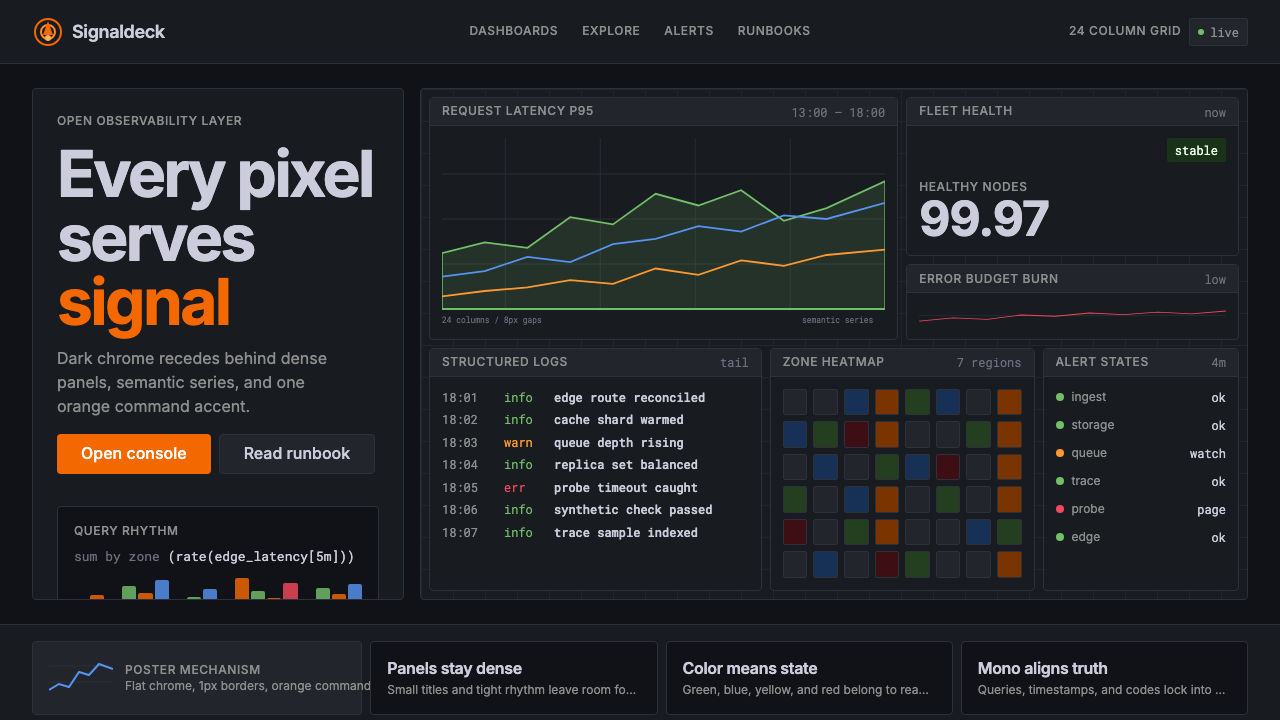 GrafanaData first, chrome last. Orange accent cuts through dense dark panels and sem…
 Shopify ModernMerchant ally, not corporate SaaS. Emerald actions on bordered white cards ca…
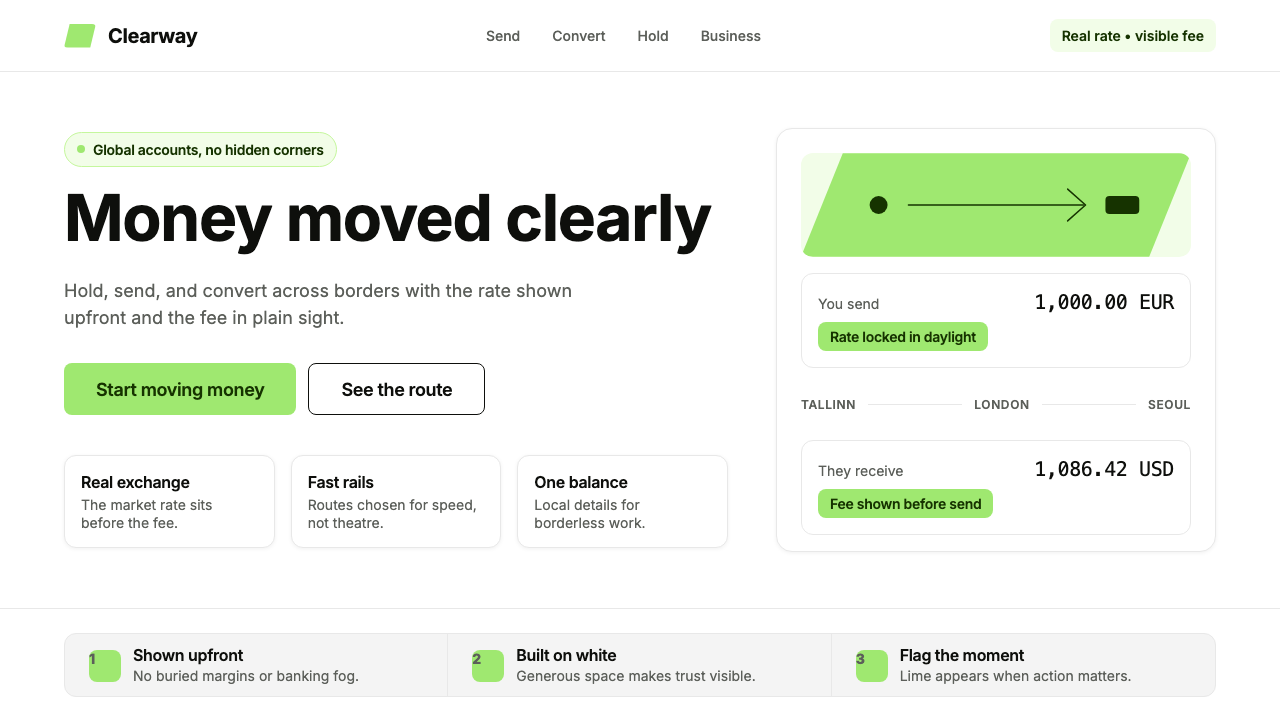 Wise (TransferWise)Clarity feels bankable. Lime flag on white, Inter geometry, quiet fee cards.
 Intercom ModernWarm chat, sharp software. Electric blue bubbles on a daylit white grid.
 MongoDB Leaf GreenDisciplined green, open warmth. Forest leaf forms and Spring accents breathe…
 Tableau (Business Intelligence)Enterprise clarity. Navy workbook chrome, hairline panes, and 10-color marks…