What is Arte Povera (Merz, 1968)?
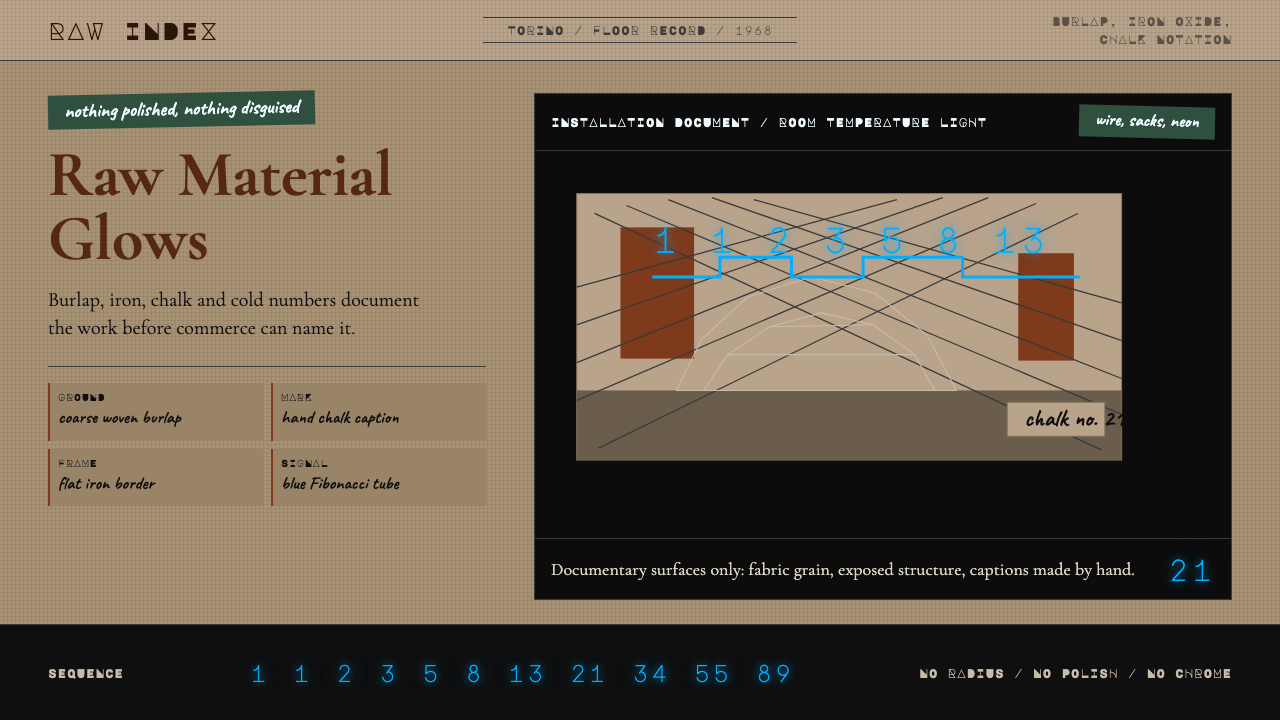
Arte Povera declared that dirt, burlap, and neon tubing were as legitimate as marble — and built a design language from that refusal to polish.
Arte Povera (Merz, 1968) in brief
Arte Povera — Italian for 'poor art' — was a movement born in the late 1960s among a generation of Italian artists who rejected the slick, commodified aesthetics of consumer culture and the art market alike. The critic Germano Celant coined the term in 1967, grouping together artists who worked with raw, humble, and unstable materials: dirt, felt, charcoal, glass, wax, live animals, and the industrial detritus of everyday urban life. The result was not a unified style so much as a shared stance — a conviction that art's raw material should feel genuinely unmediated, as though caught mid-process.
Translated into a design system, Arte Povera becomes something specific and recognizable: earth-toned surfaces that carry the visual memory of raw linen or aged iron; type that suggests chalk or pencil rather than digital precision; and sudden, cold eruptions of neon blue-green that interrupt the warmth like a Fibonacci sequence inscribed in light. The system is held together by a deliberate tension between the ancient and the industrial, the hand-hewn and the algorithmic.
What distinguishes Arte Povera from mere rusticity is this tension. The movement was never pastoral — it was urban, theoretical, and confrontational. Mario Merz's wire-mesh igloos were not cottages; they were structural diagrams of a mathematical sequence rendered in cold light. The design aesthetic that follows from this is not simply rough or aged, but rather rough-and-wired: organic surfaces punctuated by precise, almost clinical accents.
Where does Arte Povera (Merz, 1968) come from?
The movement emerged from the specific cultural climate of late 1960s Italy — a period of intense political ferment, student uprisings, and a deep suspicion of institutional authority. Turin, the industrial capital of the north, was its epicenter. Artists there had watched Minimalism harden into a kind of corporate aesthetic in America, and they responded with something deliberately anti-institutional: sculpture made from materials that could not be easily commodified, shown in ways that challenged the gallery's commercial function.
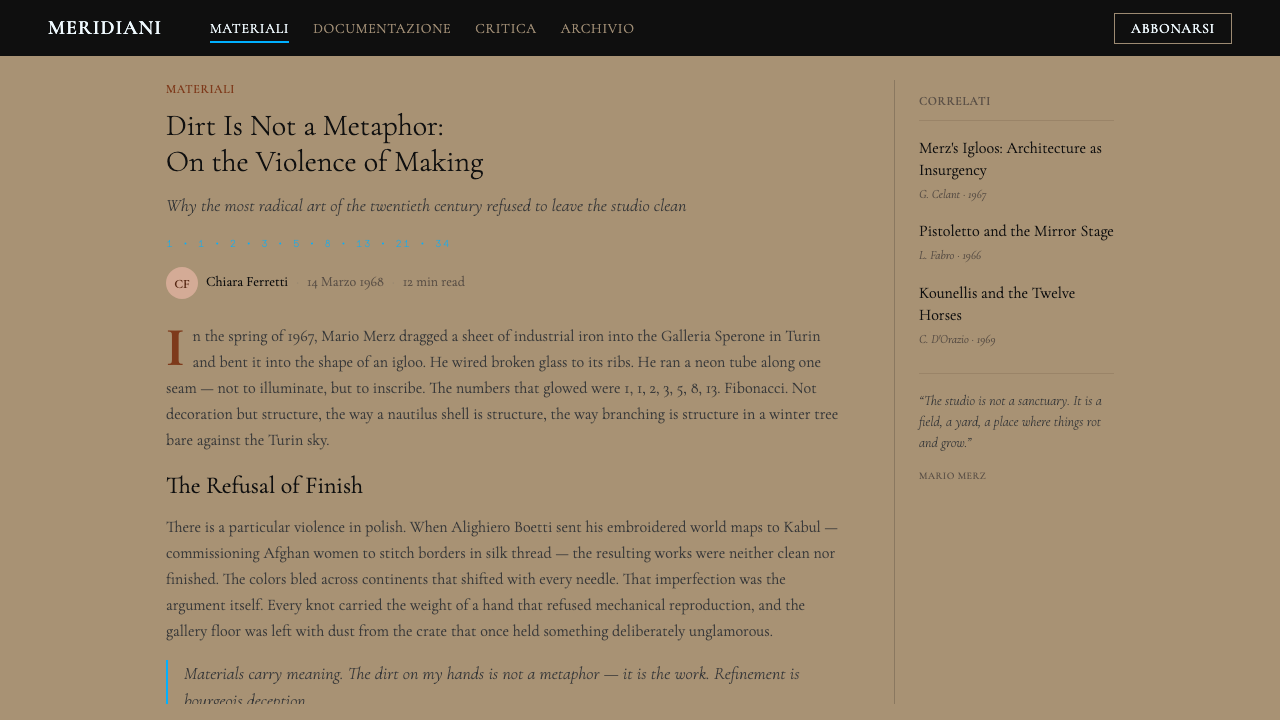
Germano Celant's September 1967 manifesto and accompanying exhibition gave the loose constellation of artists a name and a framework. He included Mario Merz, Jannis Kounellis, Michelangelo Pistoletto, Giovanni Anselmo, Gilberto Zorio, Giuseppe Penone, and Luciano Fabro. Their materials and methods differed, but they shared a commitment to what Celant called a direct relationship between the work and the world — bypassing the refined, mediated object in favor of something that retained the trace of its making.
Mario Merz became the movement's most distinctive visual signature. His obsession with the Fibonacci sequence — the mathematical progression in which each number is the sum of the two preceding it — led him to inscribe these numbers in neon tubing across his sculptures, photographs, and installations. Merz saw Fibonacci as a natural law connecting organic growth, architecture, and the cosmos. When rendered in cold blue or white neon against a rusted steel surface or a burlap ground, the sequence created an electric tension between the archaic and the technoscientific that became the movement's visual keynote.
The movement reached its peak intensity between 1967 and 1972, with landmark exhibitions in Turin, Rome, and Amalfi. By the mid-1970s, many artists had moved into related but distinct practices. However, Arte Povera's influence persisted and deepened over subsequent decades. The 1980s neo-expressionist turn in painting drew from its embrace of raw material; the 1990s interest in process and installation art owed direct debts to its methods. In design, the aesthetic re-emerged in the early 2000s as a counterpoint to the ubiquitous digital-clean minimalism of the period, valued for exactly what it refused to do: smooth over, clean up, or pretend that making is effortless.
What defines the Arte Povera (Merz, 1968) look?
Earth Tones and Material Color
The palette draws directly from the materials themselves: raw linen and burlap contribute warm beige and ochre grounds; iron and rusted steel provide deep oxide browns and muted terracottas; charcoal and soot introduce near-blacks that are warmer and less neutral than a printed black. These tones are never artificially brightened or saturated — they read as the residue of process rather than chosen colors, as though the surface has earned its hue through exposure and use.
Cold Neon Accent
Against warm, aged grounds, Arte Povera-derived design uses cold neon accents — a blue-green or icy white that reads as electric and industrial. These accents are sparse: a single sequence of numerals, a line, a word. The contrast between the tactile warmth of the base surface and the artificial coldness of the neon is the system's central visual drama. The accent should feel like it has been added by a different kind of intelligence than the one that made the ground.
Handwritten and Chalk-Like Type
Typography in this aesthetic registers as provisional and manual — letterforms that suggest chalk on blackboard, graphite on newsprint, or stencil spray. Captions, annotations, and secondary labels are treated as though written on the surface rather than designed into it. Where serif type appears, it tends toward the worn and archaic — the kind of letterform that has existed long enough to seem undesigned. This typographic approach reinforces the system's central claim that the work is not finished, not packaged, not ready for market.
Fibonacci and Mathematical Annotation
One of the movement's most distinctive design inheritances is the use of numerical sequences — particularly the Fibonacci progression — as both structural device and visual motif. Numbers are not labels or data; they are objects in the composition, rendered at scale, arrayed across surfaces, or used to regulate intervals and proportions. This introduces a kind of legible logic to layouts that would otherwise read as purely intuitive, creating a tension between organic and mathematical ordering that is central to the style's identity.
Textural Density and Process Marks
Arte Povera-derived layouts embrace surface irregularity as information. A background might carry the grain of burlap, the stain of charcoal, or the oxidation patterns of raw metal — not as decorative textures applied atop a neutral ground, but as the ground itself. Edges are left ragged; marks accumulate rather than being erased. The aesthetic is cumulative and archaeological: the final state carries evidence of the intermediate states, and this evidence is part of the meaning.
Structural Rawness, Not Decorative Roughness
The most important distinction in working with this aesthetic is between rawness that is structural and roughness that is merely decorative. Arte Povera's rough surfaces were not applied finishes — they were the actual material of the work. In a design context, this means that textural and hand-made qualities should determine the system's proportions, layout logic, and typographic relationships, not simply be sprinkled over a conventionally structured layout. The rawness should affect the grid, not just the background.
Tension Between Archive and Live Signal
A defining quality of the Arte Povera aesthetic is the coexistence of elements that read as very old and elements that read as very new — the effect is neither nostalgic nor futurist, but suspended between the two. In design terms, this tension is typically achieved by pairing aged, warm, analogue-feeling surfaces with sharp, cold, digital-feeling accents. The aged surface should feel genuinely historical, not retro-styled; the sharp accent should feel genuinely live, not merely decorative.
Who shaped Arte Povera (Merz, 1968)?
Celant was the critic and curator who named and theorized Arte Povera in his September 1967 manifesto and accompanying exhibition in Genoa. He drew on the work of theater director Jerzy Grotowski — who had spoken of a 'poor theater' stripped of all artifice — to articulate what the Italian artists were doing with material. Celant continued to write about and curate Arte Povera throughout his career, cementing the movement's historical status through exhibitions at major international institutions and establishing the critical vocabulary that designers still use when referencing the aesthetic.
Merz is the central figure for anyone working with the Arte Povera design aesthetic specifically. His igloo structures — frameworks of metal tubing or glass, sometimes covered with mud, sometimes with newspapers, always inscribed with Fibonacci numbers in neon — became the movement's most recognized image. Merz saw the igloo as a universal shelter form, timeless across cultures, and the Fibonacci sequence as a natural law underlying all growth. The combination of these two obsessions — the archaic and the mathematical — is the direct source of the design system's defining visual tension.
Kounellis, Greek-born but based in Rome, pushed Arte Povera's engagement with live and raw material to its most confrontational extreme. His 1969 installation at Galleria L'Attico in Rome — twelve live horses tethered in the gallery — became one of the most discussed works in postwar art history, not because of its shock value but because of the absolute directness of its statement: the living animal, requiring breath and space and feeding, was more real than any representation of nature could be. For designers, Kounellis's work is a reminder that the aesthetic's power comes from the genuine presence of material, not from its simulation.
Pistoletto's contribution to Arte Povera was the mirror painting — large polished steel sheets that reflected the viewer back into the work, making the gallery space and the people in it part of the composition at all times. His later rag ball sculpture, made from the discarded clothes of hundreds of people bound together, extended this democratic impulse into three dimensions. For design, Pistoletto is the Arte Povera artist who most directly interrogates the boundary between the artwork and its context — a concern that translates, in layout terms, into the question of how a design element relates to the space around it rather than asserting itself against it.
How do you use Arte Povera (Merz, 1968) today?
Arte Povera is among the more demanding historical aesthetics to translate faithfully into contemporary design, because its power depends entirely on the authenticity of its rawness. If the textural and material qualities are applied as surface decoration over a conventionally polished structure, the result is a pastiche — it will look artfully distressed rather than genuinely rough. The system works only when the aesthetic logic of material honesty reaches all the way down into the structural decisions: the grid, the spacing, the typographic hierarchy.
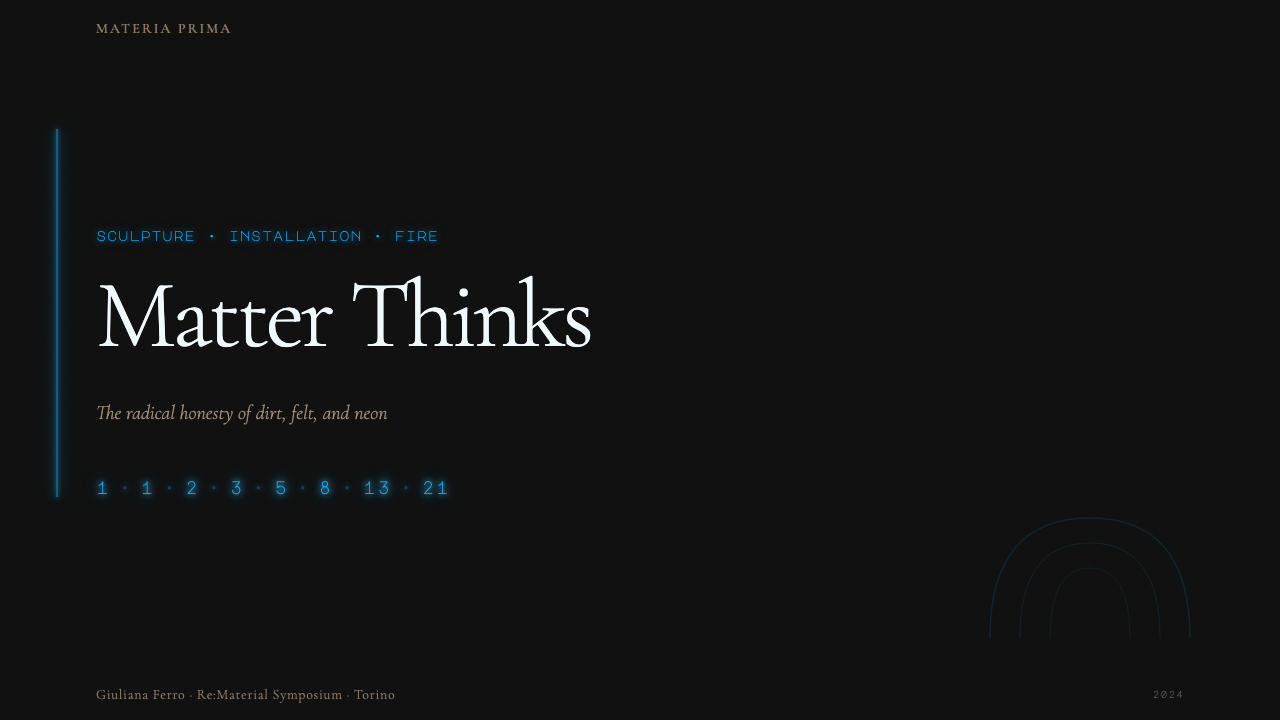
For presentation slides, the style works best on thematic or introductory material where the content warrants a certain weight and historical resonance. A cover page built around this aesthetic might use a full-bleed warm ground — a tone that reads as aged linen or oxidized paper — with a sparse title set in a worn serif or hand-pressured letterform, and a single cold neon accent line or numeral sequence positioned as though stenciled or chalked across the surface. Content slides should resist the temptation to fill: use generous margins, let type sit alone against a textured field, and annotate with handwritten-style secondary labels rather than styled callout boxes. Data visualizations can take on an archaeological quality when axes and data marks are treated as process notations rather than digital chart elements.
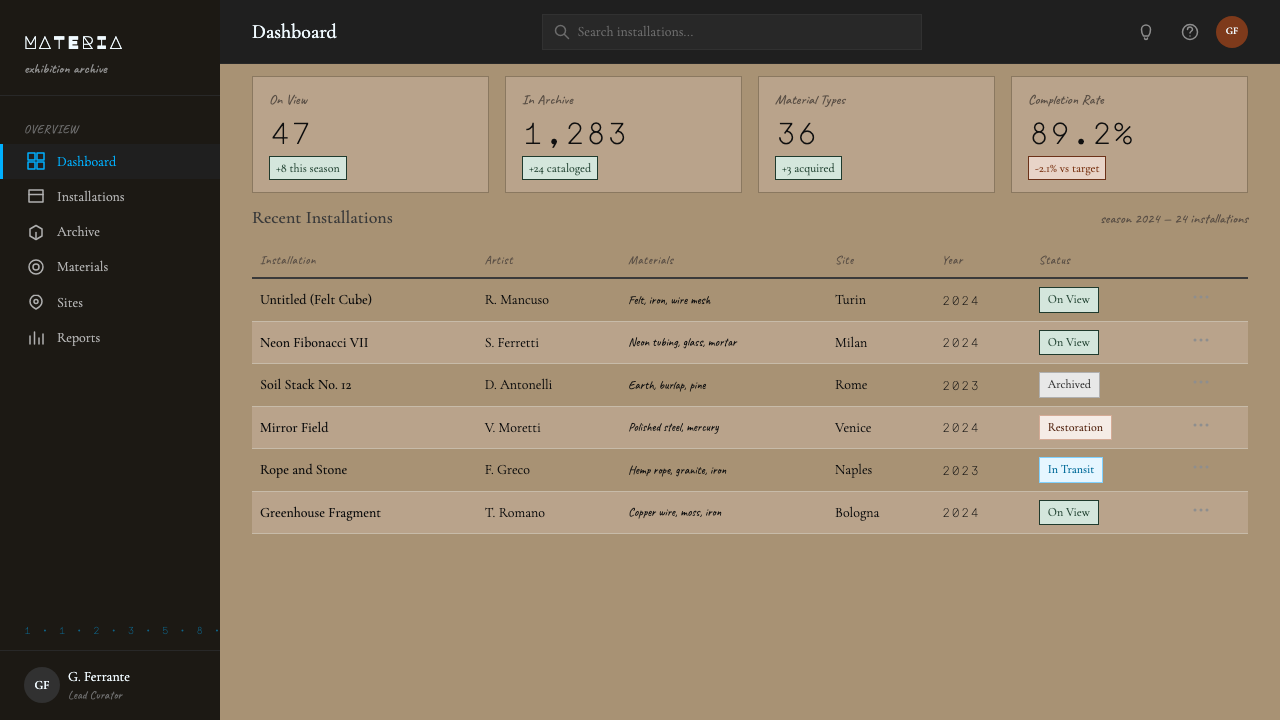
For web interfaces, Arte Povera's aesthetic is suited to contexts where authenticity, depth, and the sense of something genuinely made are brand values — editorial platforms, cultural institutions, independent studios, and craft-forward product brands. A dashboard built in this register might use an off-white or warm cream background with iron-toned borders and typographic navigation rather than icon-driven menus. Interactive states are marked not by color fills but by a cold neon underline or a typographic shift in weight. Pricing or feature comparison pages benefit from the style's capacity to make information feel considered rather than generated — long-form copy with annotated footnotes reads better in this aesthetic than a conventional feature grid.
For editorial and marketing work, Arte Povera offers a powerful counterpoint to the prevailing digital-native aesthetic of brightness and saturation. Magazine-style layouts built in this register use wide outer margins for handwritten-style annotations and source citations; headlines set in worn or archaic serif forms; and body text on a warm ground rather than pure white. The cold neon accent, used sparingly, can serve as a visual anchor for chapter breaks or key data points. Marketing pages for cultural projects — film, publishing, music, performance — benefit especially from the style's capacity to suggest both depth of craft and a refusal to pander.
A common failure mode when applying this aesthetic is mistaking roughness for the point. The Arte Povera design system is not about distressing things — it is about making the logic of material and process legible. When every element is equally textured, equally aged, equally rough, the system collapses into undifferentiated noise. The neon accent exists precisely to interrupt the warmth with something cold and precise; the Fibonacci sequence exists to introduce mathematical order into organic material. Without these counterpoints, the aesthetic becomes a mood board rather than a system. Restraint in applying the signature elements — very few neon accents, very few numerical sequences, very few handwritten notes — is what keeps the system coherent.
Arte Povera (Merz, 1968) — FAQ
How is Arte Povera different from other rough or vintage-inspired aesthetics?
The key difference is the presence of cold, precise, mathematical counterpoints. Most vintage or distressed aesthetics aim for a consistent warmth and organic feel throughout — they evoke nostalgia or artisanal craft. Arte Povera specifically requires the interruption of that warmth with something genuinely alien to it: a cold neon accent, a mathematical sequence, an industrial element that cannot be absorbed into the nostalgic register. Without this tension, what you have is a rustic or retro aesthetic, not Arte Povera. The movement was explicitly anti-nostalgic — it used archaic materials not to evoke the past but to make the present feel more real.
Can this aesthetic work in a light, modern digital product context?
Yes, but it requires selective application rather than full immersion. In a contemporary digital product, the Arte Povera aesthetic is most usefully deployed as a tonal counterpoint within an otherwise clean system — a warmly textured hero section against a white-ground content area, or a neon-accented data annotation within a conventional chart layout. Full application — rough grounds throughout, handwritten type everywhere, accumulated process marks across all surfaces — would conflict with the usability demands of a complex interface. The style works well at the level of brand expression, campaign materials, and feature showcases, where the user's task is aesthetic engagement rather than efficient information processing.
What role do numbers and sequences play in the layout system?
Numbers in the Arte Povera tradition — and particularly Fibonacci sequences, which Merz used obsessively — function simultaneously as content and as structure. In a design context, this means that numerical sequences can be used to regulate proportions and spacing: the intervals between sections, the scale relationships between typographic elements, or the sizing of image crops. This is not numerology — it is a way of making the structural logic of a layout visible and legible, rather than hiding it. When the sequence is also rendered as a visual element — large numerals floating in a composition — it serves both purposes at once.
Is Arte Povera appropriate for brand identity, or mainly for editorial and campaign work?
It is more naturally suited to campaign and editorial work, where it can be deployed at its full intensity for specific periods and contexts. As a permanent brand identity system, it carries significant risk: the aesthetic's deliberate roughness and anti-commercial stance can be difficult to maintain coherently across all brand touchpoints, and it can read as self-consciously art-world in contexts where the brand needs to communicate warmth or accessibility. It works well for brands whose identity is explicitly rooted in craft, cultural authority, or critical stance — independent publishers, art institutions, architectural and design studios, and certain categories of material goods where provenance and making process are part of the product's value.
How do you avoid the aesthetic feeling gimmicky or costume-like?
The test is whether the rough, material-honest qualities are structural or merely decorative. If the texture is only on the background while everything else — the grid, the type hierarchy, the spacing logic — follows conventional digital design norms, it reads as costume. The aesthetic is structural when the same logic that makes the surface feel raw also determines the proportions of the layout: irregular but intentional margins, type that is deliberately not optically corrected, spacing that refers to the Fibonacci-derived intervals rather than an even eight-point grid. The cold neon accent being rare rather than frequent is another test: if every interactive element glows blue-green, the accent has become decoration. One or two precisely placed neon marks across an entire spread is Arte Povera; a system full of glowing elements is something else entirely.
Related design styles
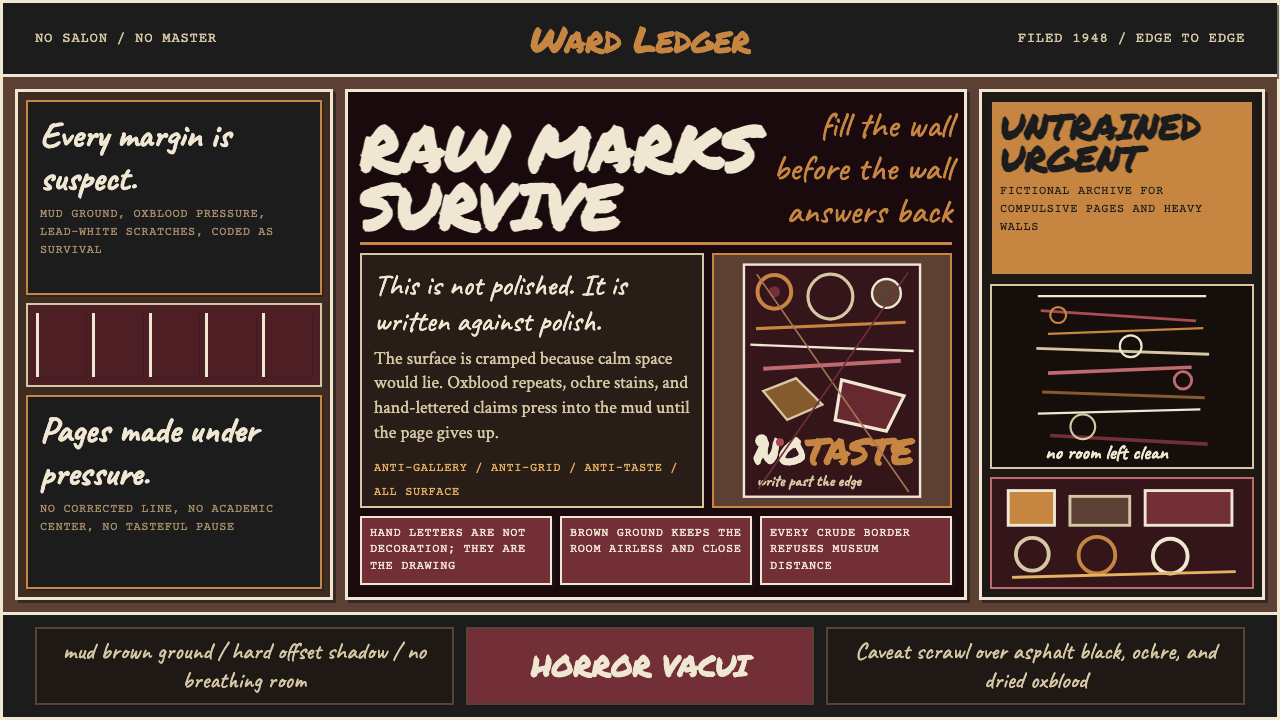 Art Brut (Dubuffet, 1948)Rawness crowds the frame. Mud brown, oxblood marks, and hand scrawl erase the…
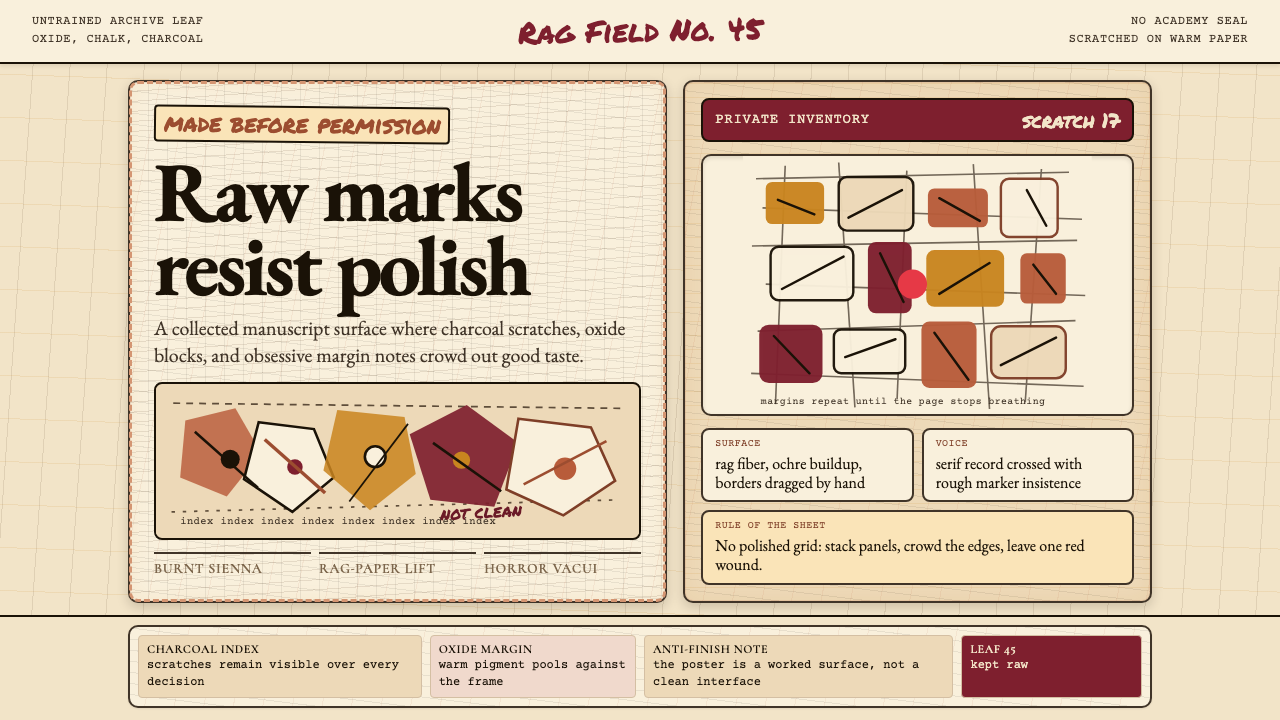 Art Brut (Dubuffet)Polish is refused. Bone-cream paper, earth pigments, scratched borders, dense…
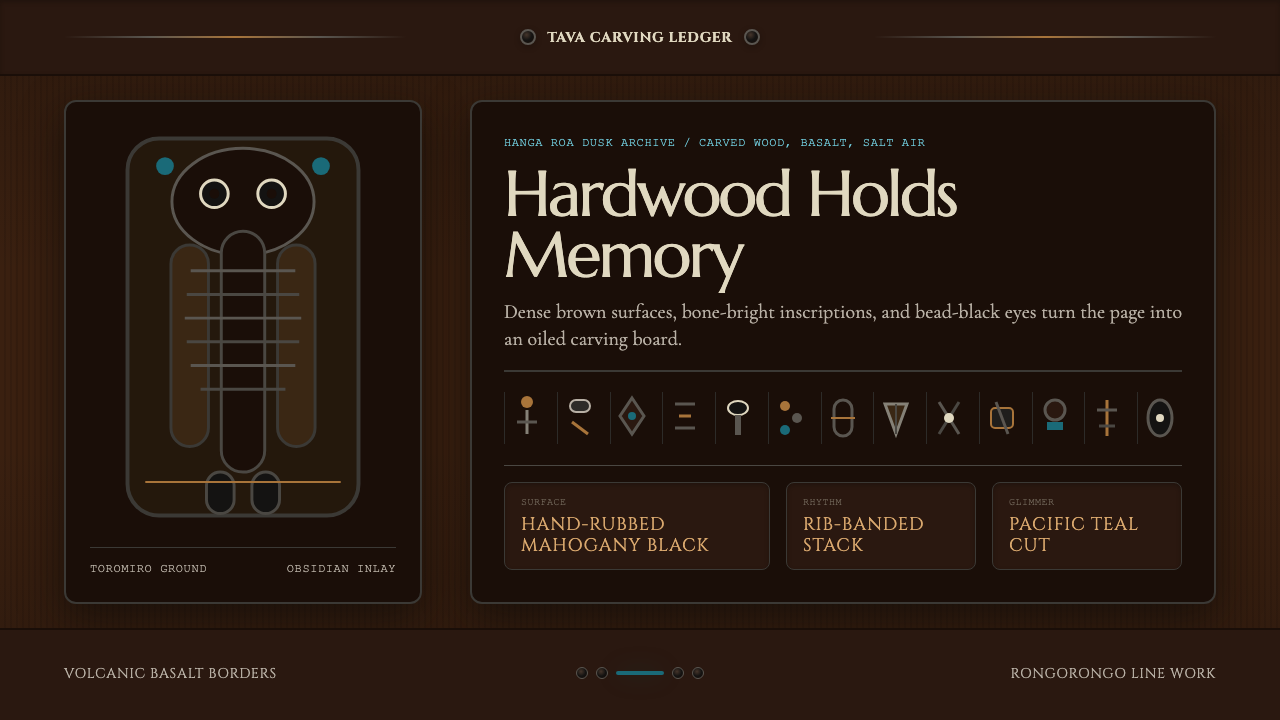 Chilean Rapa Nui Toromiro (Easter Island)Ancient weight, dusk-lit. Toromiro brown, Cinzel capitals, rib bands, obsidia…
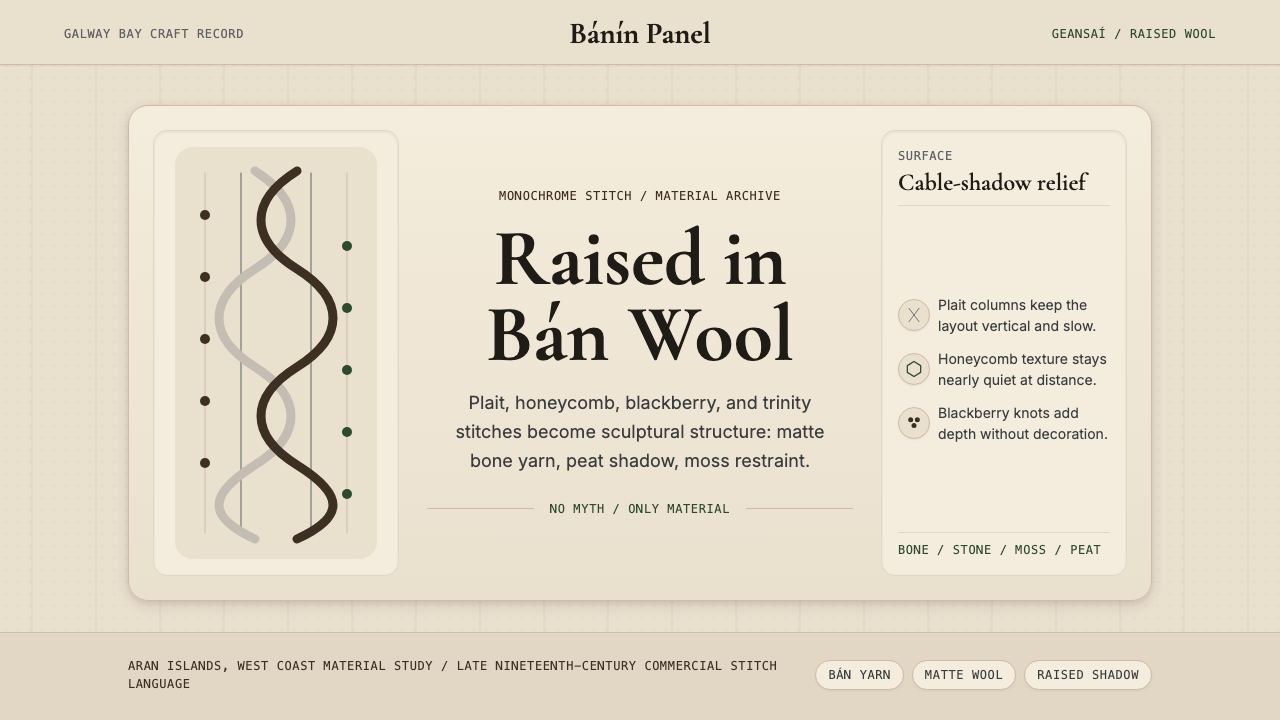 Irish Aran Island Cable KnitMaterial honesty raised in wool. Bone ground, moss ink, and cable columns cas…
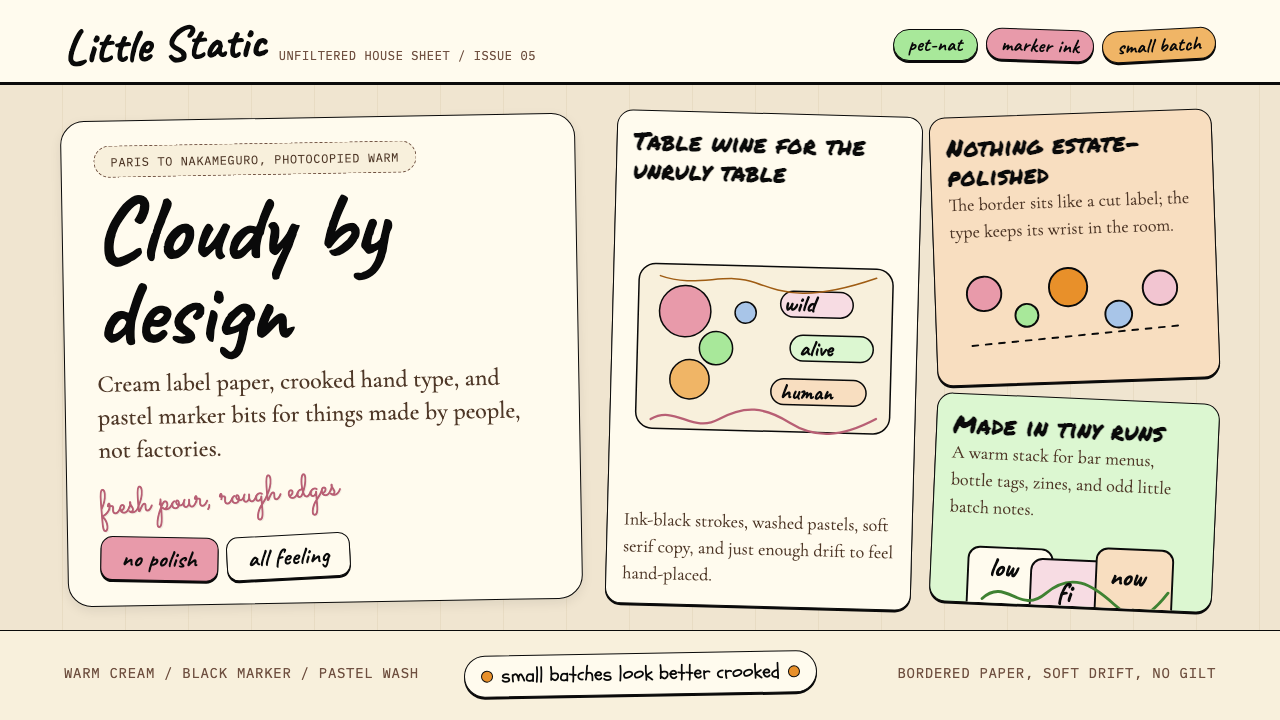 Natural Wine Low-FiWarm, scrappy, human. Cream paper, Caveat marker type, and pastel sticker geo…
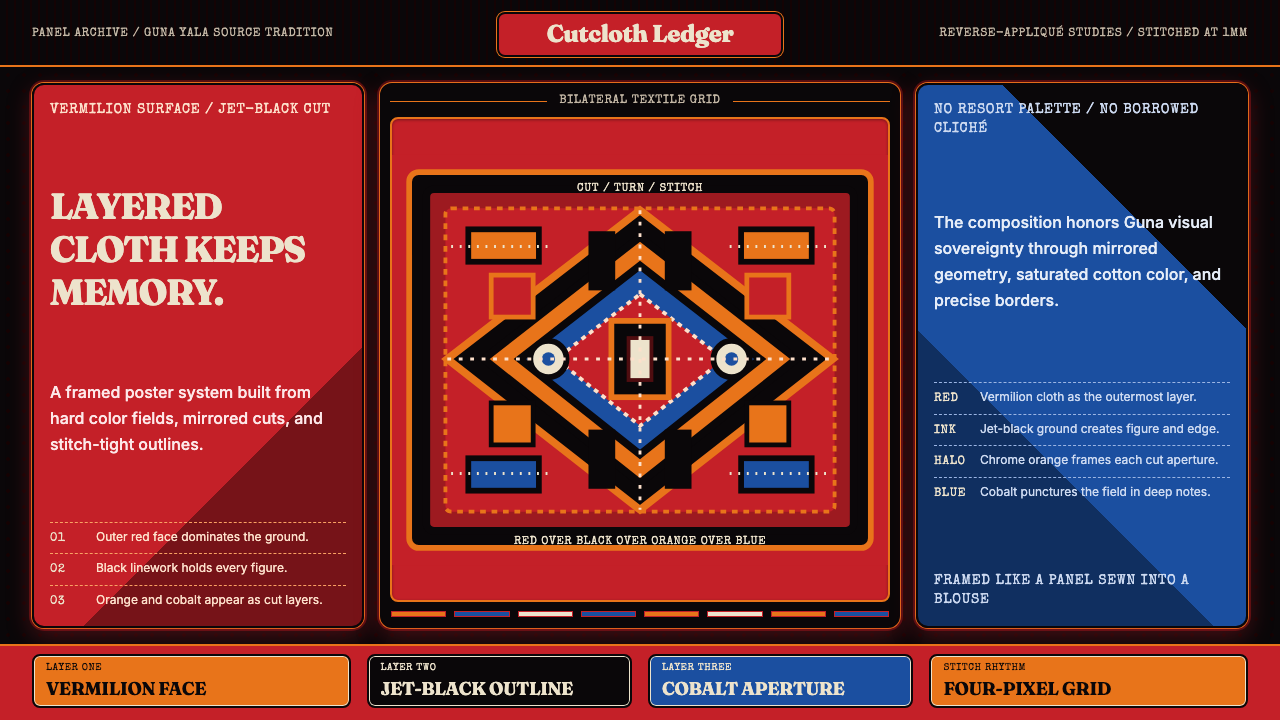 Panamanian Mola Kuna AppliquéSewn sovereignty. Vermilion panels reveal black, orange, and cobalt stitch-gr…