What is Panamanian Mola Kuna Appliqué?
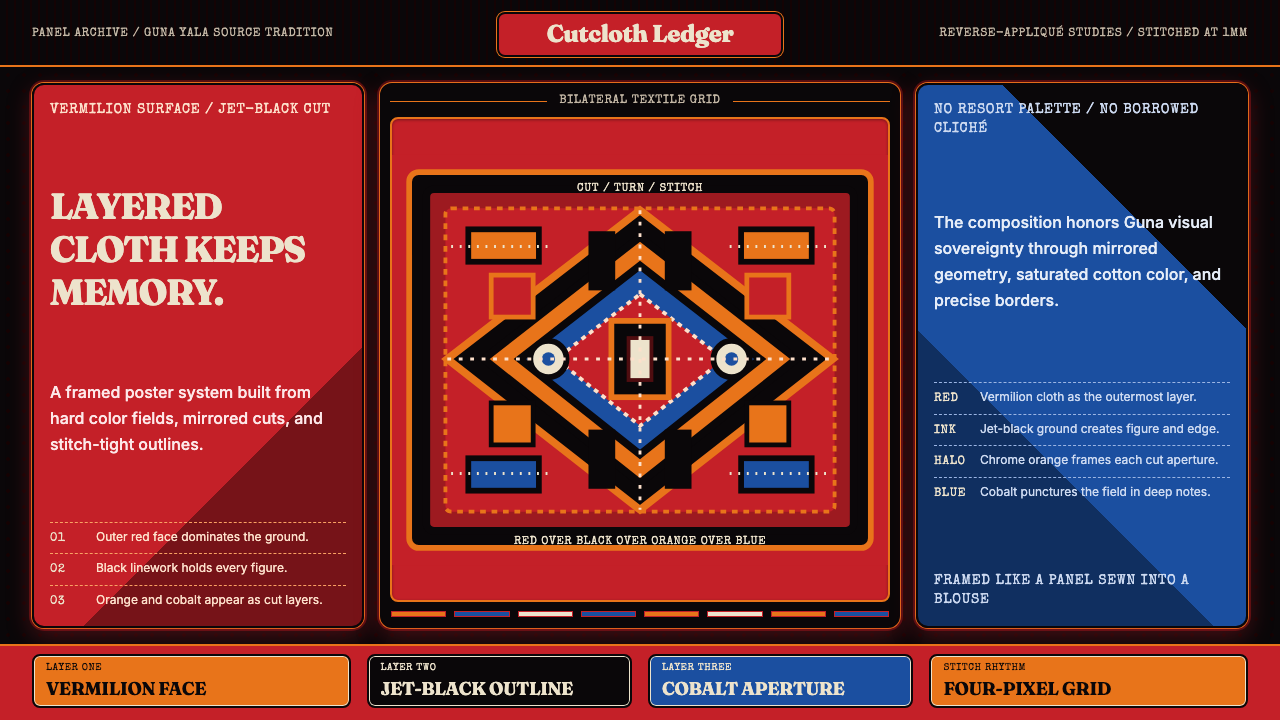
Mola is reverse-appliqué elevated to a sovereign art form — layers of cotton cloth cut away to reveal a blazing geometry of figure and ground that no single culture has ever replicated.
Panamanian Mola Kuna Appliqué in brief
Mola is the textile art form of the Guna people, an indigenous nation whose ancestral territory spans the Guna Yala archipelago — a chain of coral islands along the Caribbean coast of Panama and into Colombia. The word mola refers both to the cloth panels themselves and to the blouse front and back panels that Guna women have incorporated into their daily dress. Each panel is a compressed cosmology: animal, plant, spirit, and geometric forms locked in dense, reciprocal relationships across fields of saturated color.
What makes mola visually exceptional is the technique itself. Reverse appliqué begins with several layers of cloth — typically three to five, each a different color — stacked and basted together. The artist then cuts through the top layer to expose the color beneath, and through successive layers in smaller shapes, building up a figure by subtraction rather than addition. The resulting artwork has no paint, no dye applied after the fact, no digital interpolation. Every color visible in the finished panel was present as a discrete layer of cloth from the beginning. The surface reads as dense, labyrinthine, and almost vibrating — not because of optical illusion but because each edge is a stitch, and each stitch is a decision made at near-millimeter scale.
As a design aesthetic, mola translates into an interface vocabulary of high-contrast layering, figure-ground reversal, and interlocking positive-negative space. The palette is built on primary vermilion anchored against near-black, with secondary reveals in chrome orange, cobalt, and occasional gold or ochre. Backgrounds are never neutral: they are active, chromatic, and as visually weighted as the figures they frame. The overall effect is one of visual density without clutter — every inch of surface participates, but the hierarchy of forms remains legible.
Where does Panamanian Mola Kuna Appliqué come from?
The Guna people's history with body decoration stretches back well before European contact. Early accounts from Spanish colonizers in the sixteenth and seventeenth centuries describe Guna men and women painting geometric and figurative motifs directly onto their skin using natural pigments — a practice that encoded identity, spiritual status, and clan affiliation in visual form. The shift from body paint to cloth is generally dated to the mid-to-late nineteenth century, when imported cotton fabric became accessible through trade. The first mola panels appear to have been straightforward geometric bands; the layered reverse-appliqué technique developed over subsequent decades as the form became the primary vehicle for Guna visual expression.
The 1925 Guna Revolution — a brief but decisive armed uprising against Panamanian government attempts to suppress indigenous culture, including forced prohibitions on traditional dress — transformed mola from a personal textile art into a political statement. The revolution, which lasted only days but secured a degree of Guna territorial autonomy recognized in international law, established Guna Yala as a semi-autonomous comarcas. In this context, wearing mola became an act of cultural sovereignty. The garment was not merely clothing but a declaration of continuity with a way of life that colonial and postcolonial governments had tried to extinguish.
Through the mid-twentieth century, mola's visual complexity intensified alongside Guna women's growing engagement with the wider world. Figurative motifs proliferated: birds, fish, insects, and mythological creatures appeared alongside geometric forms inherited from body-paint traditions. Commercial imagery — product labels, playing cards, naval insignia encountered through trade — was absorbed and reinterpreted in the mola vocabulary, producing hybrid panels that treat capitalism's visual detritus with the same formal rigor applied to sacred motifs. This absorptive quality — taking outside imagery and reconstituting it on Guna terms — is a defining feature of the tradition.
International attention came in the latter half of the twentieth century through the work of anthropologists and textile collectors, most significantly Mari Lyn Salvador, whose fieldwork and museum collaborations from the 1970s onward brought Guna women's work to academic and curatorial audiences in North America and Europe. The commercialization that followed was double-edged: it created economic opportunity for Guna artisans while also generating a global market for imitation mola that frequently stripped the form of its cultural context. The Guna have actively advocated for intellectual property protections on their cultural heritage, and the debate over mola's reproduction remains unresolved.
What defines the Panamanian Mola Kuna Appliqué look?
Color Architecture
The mola palette is not chosen — it is revealed. Colors appear in the order the cloth layers were stacked: the deepest layer, often jet-black or near-black, forms the innermost outlines and the finest detail channels. Over this sits a chrome orange or cobalt layer, and the top surface is typically a vivid vermilion or saturated red. The palette reads as high-contrast and commanding, never pastel or muted. When additional colors appear — gold, ochre, turquoise — they arrive as accent layers inserted between the primary ones, always bounded by narrow channels of outline color that keep each hue from bleeding into its neighbor.
Figure-Ground Reciprocity
In most design systems, figure and ground are assigned roles: the foreground carries meaning, the background recedes. Mola refuses this hierarchy. The negative space between and around figures is as rigorously shaped as the figures themselves, often forming its own secondary patterns of interlocking geometric channels. Rotating a mola panel ninety degrees typically reveals an entirely different set of implied forms in what was previously read as background. This reciprocity between positive and negative space is the deepest structural principle of the aesthetic and the hardest to replicate without understanding the physical process that generates it.
Outline Language
Every form in a mola is bounded by a narrow channel of contrasting color — typically black or near-black — that physically exists as the exposed bottom layer of cloth. This outline is not drawn or applied; it is the gap between cut edges, stitched to hold its shape. The width of this channel is remarkably consistent within a single panel, giving the composition a rigorous internal calibration that reads as the work of a practiced, disciplined hand. In translated digital form, this translates to borders and outlines that are thinner than most designers would instinctively set and consistently weighted throughout a composition.
Interlocking Complexity
Mola panels are dense. There is no restful empty space, no generous padding, no room for elements to breathe in the conventional typographic sense. Yet the compositions do not feel chaotic — they feel complete. This is achieved through a system of interlocking: each element's boundary defines the shape of its neighbor, like a jigsaw where every piece is also the negative mold of every adjacent piece. The resulting surface has an almost ceramic quality, a tessellation where removing any single form would unravel the whole. This density is a feature, not a failure of restraint.
Figurative Synthesis
Traditional mola imagery draws from the Guna visual cosmology — birds, serpents, fish, crabs, and other creatures hold spiritual significance in Guna belief and are rendered with recognizable features while conforming to the geometric demands of the technique. What distinguishes mola figuration from naturalistic illustration is that animal forms are always adapted to the layering logic rather than depicted literally. A bird's wing may become a series of concentric stepped arches; a serpent's body may resolve into a spiral of interlocking S-curves. The creature is legible, but the geometry is primary.
Symmetry and Its Violations
Most mola panels organize around one or more axes of rough symmetry — a central figure mirrored left and right, a repeating border pattern, a four-quadrant division. But symmetry in mola is always approximate rather than mechanical. Minor variations in the mirrored elements, slight asymmetries in border widths, small differences in the depth of cut channels — these deviations are not errors but evidence of the hand. They give even the most geometrically severe mola an organic tension that printed or digitally generated pattern reproduction cannot achieve. When translating to digital design, this principle suggests deliberate micro-variations over perfect gridded repetition.
Border and Frame
Traditional mola panels are almost invariably bounded by a multi-stepped border — a series of concentric rectangular frames in alternating colors that separate the central composition from the plain cloth of the garment. These borders are not decorative afterthoughts; they are structural conclusions that contain the central density and allow the eye to rest before re-entering. The border system typically uses the same color layer logic as the interior, maintaining visual continuity while clearly distinguishing field from frame. In interface design, this principle maps to component boundaries, card frames, and the disciplined use of containment — defining where a visual system begins and ends.
Who shaped Panamanian Mola Kuna Appliqué?
Cited in ethnographic literature as one of the most accomplished mola makers of the mid-twentieth century, Restrepo represents the generation of artists who established the formal conventions that later became the international standard for the art form. Her work exemplifies the technical hallmarks of mature mola: extraordinarily fine channel widths, complex multi-layer compositions, and the integration of figurative and geometric elements into a single coherent field. Though she worked in obscurity from the wider world's perspective, her panels circulated through the anthropological collections that introduced mola to Western scholarship.
An anthropologist at the University of California, Berkeley, and later at the Oakland Museum of California, Salvador conducted the most sustained scholarly engagement with mola as an art form across the final decades of the twentieth century. Her landmark 1978 study brought rigorous art-historical methodology to the analysis of mola's compositional logic, formal vocabulary, and cultural function. Salvador's work was instrumental in establishing mola's presence in museum collections globally, and her collaborations with Guna women artists helped set ethical precedents for how indigenous textile traditions are documented and presented in non-indigenous cultural contexts.
A Guna cultural authority and traditional leader whose advocacy helped shape the post-1925 framework of Guna autonomy in which mola making flourished as a protected cultural practice. Within Guna governance structures, figures like Lipuwagana — known as sahilas, or chiefs — held responsibility for maintaining both political sovereignty and cultural continuity. The post-revolution period under such leadership established the social and legal conditions under which mola could develop as an economically significant art form on Guna terms rather than those imposed by outside commercial interests.
One of the principal leaders of the 1925 Guna Revolution, Olonibiginya stands as a founding figure of the modern Guna autonomy movement whose political success created the conditions for mola's survival as a living cultural form. Without the territorial protections secured by the revolution — culminating in formal recognition of Guna Yala's semi-autonomous status — the pressure to assimilate into mainstream Panamanian dress culture would have continued to accelerate. By resisting that assimilation, the revolution preserved the social context in which mola could continue to be made, worn, and passed down between generations of Guna women.
How do you use Panamanian Mola Kuna Appliqué today?
Mola is a high-commitment aesthetic. Unlike styles whose principles can be approximated by adjusting a single visual parameter — adding a serif typeface, adopting a color palette — mola's core logic is relational and spatial. The defining characteristic is not any individual color or motif but the way every element is bounded by, and gives shape to, every adjacent element. Applying it correctly means thinking in layers and inversions rather than in objects placed on backgrounds.
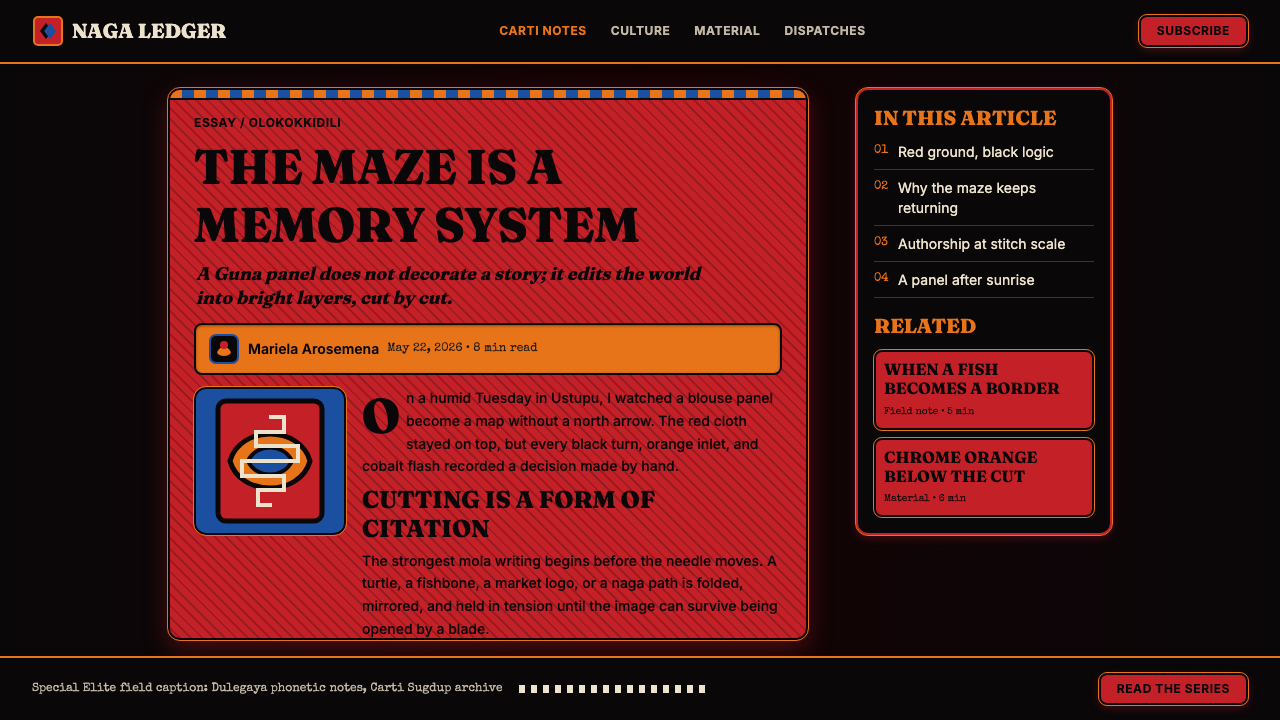
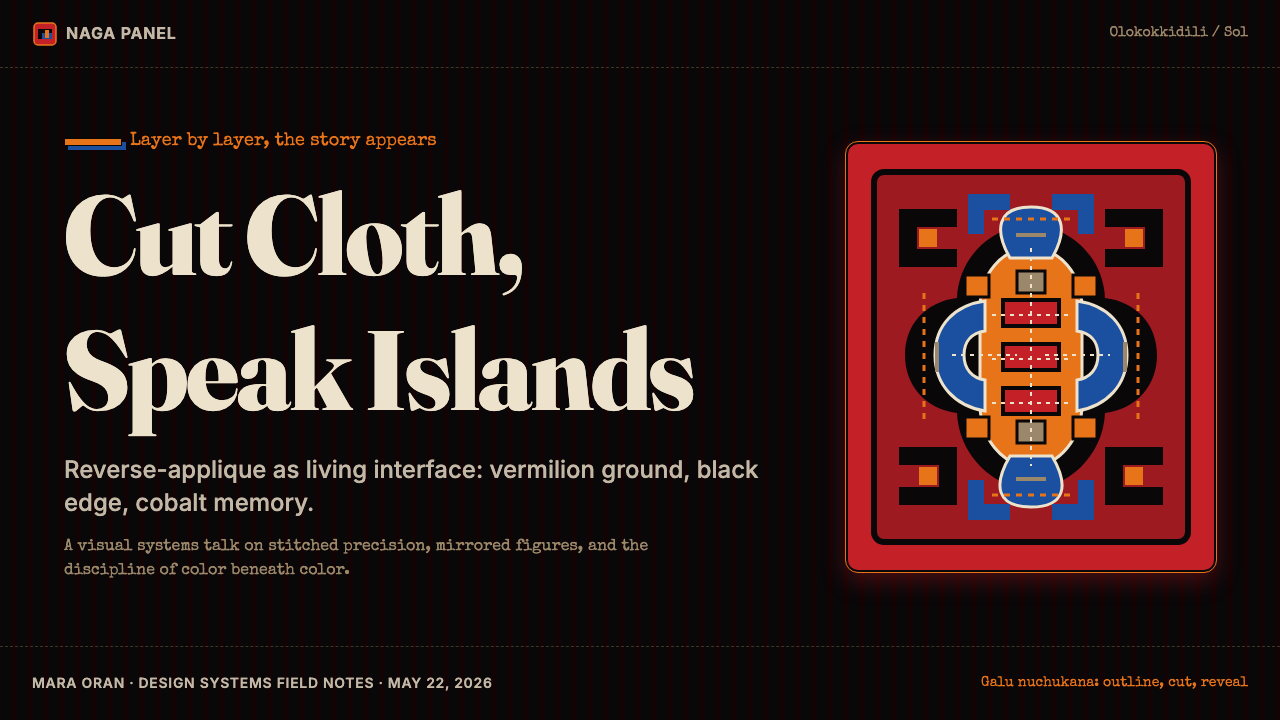
For presentation slides, mola works best when used as a contained system rather than a whole-document treatment. A cover slide built on mola principles draws on the aesthetic's poster-like intensity: a central motif — geometric, animal-derived, or purely abstract — fills the composition to near-edge, bounded by a multi-stepped border and rendered in the characteristic dark-anchor-plus-vivid-surface color relationship. Title text sits within the composition rather than above it, treated as another layer in the system. For content slides, a mola-derived approach uses bold color banding in headers, hard-edged section dividers, and strong figure-ground contrast in data visualization — keeping negative space active and shaped rather than empty. Charts and diagrams adopt the interlocking logic: bars, segments, and nodes are separated by fine contrast channels rather than empty gap or soft drop-shadow.
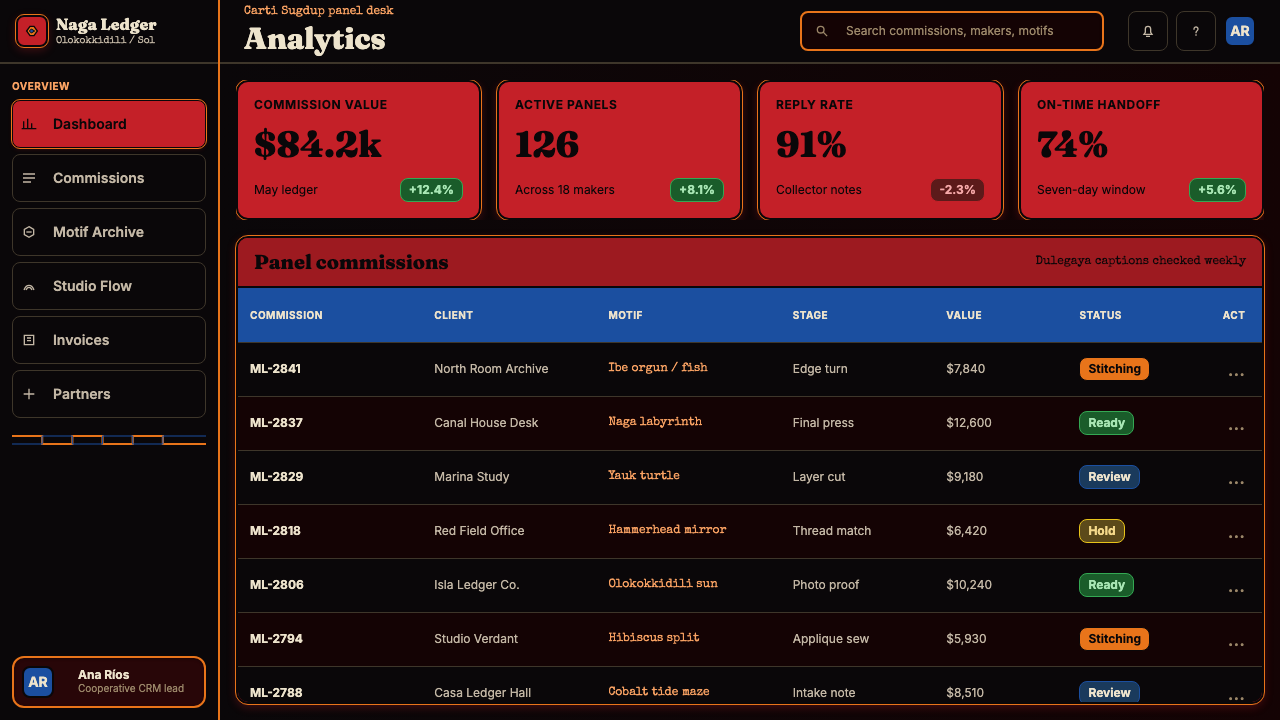
For web interfaces and dashboards, the style is most effective in contexts where visual richness signals cultural depth or creative authority — museum platforms, cultural organizations, artisan marketplaces, editorial design tools. The layering principle translates to component stacking with visible, crisp boundaries; the color architecture translates to a base-layer dark ground with successive reveals of vivid color in interactive states and highlighted data. Navigation systems benefit from the border-and-frame logic: sidebars and section headers carry stepped inset borders rather than simple lines. The high-density tolerance of the aesthetic makes it viable for data-dense interfaces that would feel overwhelming in a more minimal style.
For editorial and marketing contexts, mola's strength is in impact imagery and section-break design. Full-bleed mola-derived pattern blocks — using the interlocking geometry without necessarily reproducing specific cultural motifs — serve as section dividers or pull-quote backgrounds in long-form editorial. Marketing materials benefit from the style's poster legacy: a vermilion-dominant image field with the product or message rendered in high-contrast relief reads as bold and culturally grounded without requiring figurative photography. Brand identity systems built on mola principles tend toward wordmarks and icons that carry the characteristic outline-channel treatment, distinguishing them from the mass of flat or gradient-dominant contemporary marks.
A common mistake when adapting mola for digital design is flattening the layering logic into simple two-color pattern repetition — adding stripes or geometric fills in a dark-and-vivid color pair and calling it mola-inspired. The result typically misses the defining characteristic: that in authentic mola, figure and ground are mutually defining and mutually active, not simply a pattern printed on a neutral field. A second error is scaling up the density beyond what the rendering context can support: mola's fine channel work requires sufficiently high resolution and screen density to remain legible. At low resolution or small size, the intricate boundary work collapses into visual noise. Establishing a minimum scale for mola-derived motifs before deploying them across a design system prevents this degradation.
Panamanian Mola Kuna Appliqué — FAQ
Is using mola-inspired design appropriation?
This is a real tension, not a rhetorical one. Mola is a living tradition made by Guna women as part of their daily dress and cultural identity — not a historical artifact. The Guna have explicitly advocated for intellectual property protections on their cultural heritage and have expressed concern about commercial reproduction that removes the form from its context. The ethical use of mola-derived design involves several distinctions: there is a difference between studying and citing the tradition versus passing work off as authentic mola; a difference between abstracting formal principles versus reproducing specific sacred or clan motifs; and a material difference between commercial exploitation by outside parties versus design that benefits Guna artisans directly. Using the design aesthetic requires acknowledging its origin, which this library does explicitly, and the deeper the engagement, the greater the responsibility to understand the cultural context.
How does mola relate to other reverse-appliqué traditions worldwide?
Reverse appliqué appears independently in multiple textile cultures — including the San Blas islands' neighboring traditions, parts of West Africa, and certain Southeast Asian hill tribe textiles. These traditions share the basic technique of layering and cutting but differ substantially in color logic, motif vocabulary, spatial density, and cultural function. Mola is distinctive for its extreme density, its symmetrical-but-varied compositional logic, the specific color range dominated by vermilion and near-black, and its integration into daily wearable dress rather than purely ceremonial or decorative use. When comparing mola to similar traditions, the comparison reveals how much the Guna visual system is its own fully developed language rather than a regional variant of a universal form.
Can mola work effectively in a light-background design system?
The traditional mola palette is built on deep, saturated grounds — the darkest layer provides the foundational anchor from which all lighter colors are revealed. Inverting this to a light or white ground is possible but produces a substantially different aesthetic. On a light background, the bold outline channels that normally read as dark depth lose their weight; the characteristic density becomes fragile rather than commanding. A light-ground variant works best when it maintains high saturation in the figure colors — keeping vermilion vivid and the secondary colors intense — and preserves the fine outline work in a deep chromatic color rather than black. The result can feel more approachable and less visually demanding, which may be appropriate for certain contexts but should be understood as a significant departure from the source tradition's visual logic.
What is the relationship between mola motifs and Guna spiritual belief?
Many traditional mola motifs carry specific meanings within Guna cosmology and oral tradition. Animals — particularly birds, sea creatures, and insects — appear not merely as decorative forms but as references to spirit beings, clan identities, or narrative events from Guna mythology. The layered structure of mola itself has been interpreted as a visual analog to the Guna cosmological view of the world as multi-layered, with the visible world resting atop deeper, less accessible spiritual realms. However, the relationship between specific motifs and specific meanings is held within the community and is not fully documented in external scholarship — partly by design, as the Guna have chosen not to fully externalize the sacred dimensions of their visual culture. This means that using mola-derived design without cultural guidance requires defaulting to the formal and aesthetic dimensions and acknowledging the limits of outside knowledge.
How do contemporary Guna artists engage with the mola tradition?
The mola tradition is alive and actively evolving. Contemporary Guna women continue to make mola as everyday dress while also producing panels for commercial sale, museum acquisition, and international collectors. Younger artists have experimented with the form's boundaries — incorporating text, abstract compositions without figurative anchors, and references to contemporary global imagery alongside traditional motifs. Some Guna cultural advocates have argued for strict preservation of traditional motif vocabulary, while others see the tradition's absorptive quality — its historical willingness to incorporate outside imagery on Guna terms — as itself traditional. The field is not static but contested, and the most honest engagement with mola-inspired design acknowledges that the form being referenced is not a museum artifact but a living practice with active practitioners who hold their own views on how the tradition should develop.
Related design styles
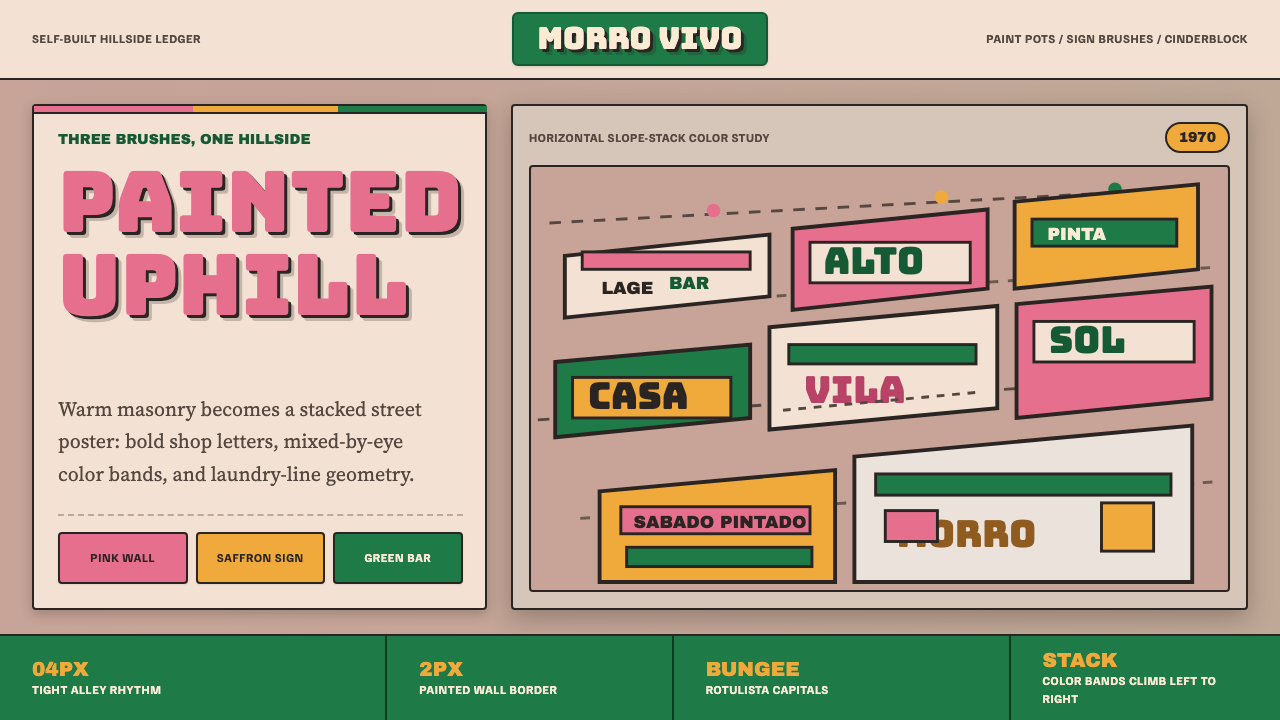 Brazilian Favela Rocinha 1970sHand-built warmth. Pink, saffron and green stripes climb cinderblock in rotul…
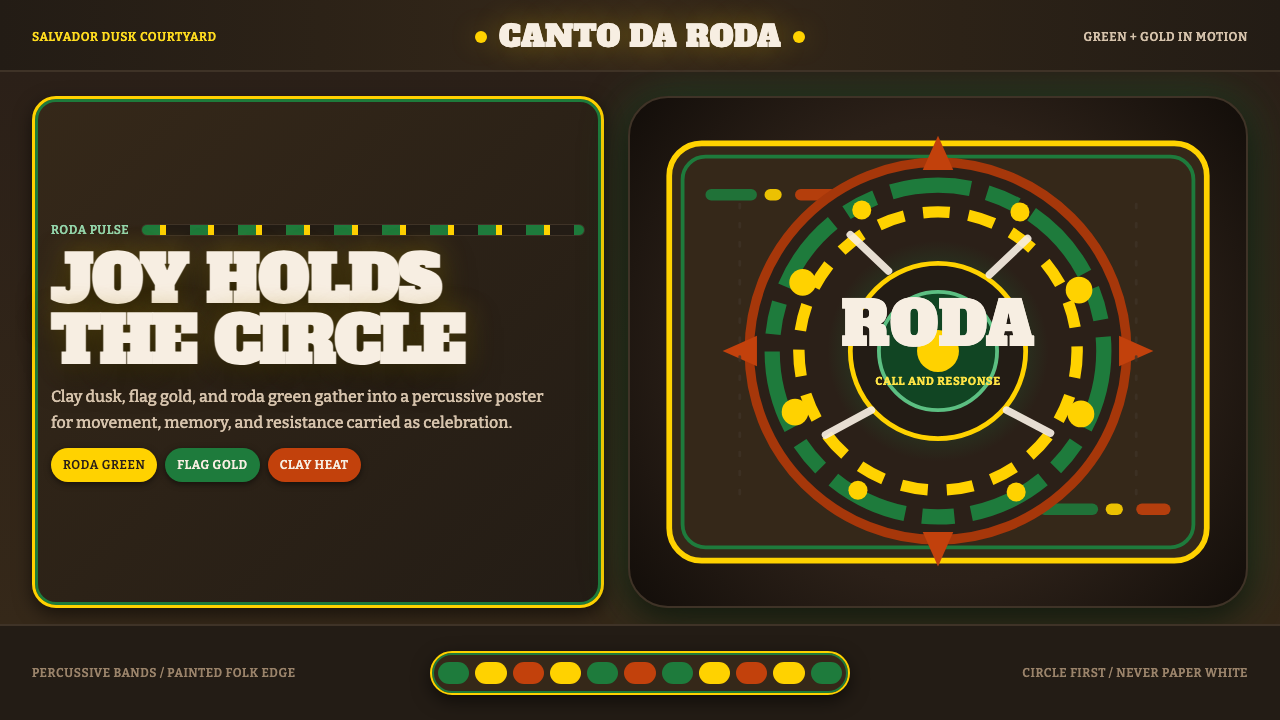 Capoeira RodaJoy as resistance. Roda green and flag gold orbit on dusk-clay terracotta.
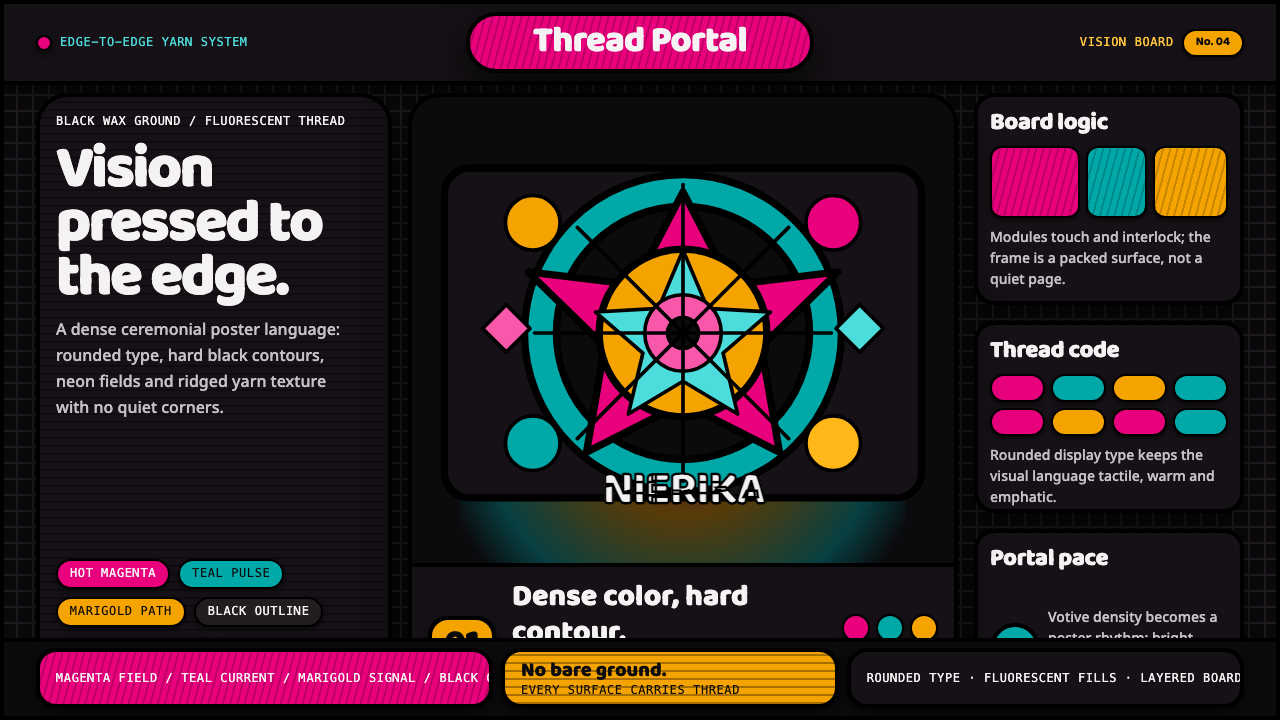 Huichol Yarn NierikaCeremonial density glows. Neon yarn colors lock into black-contoured, edge-to…
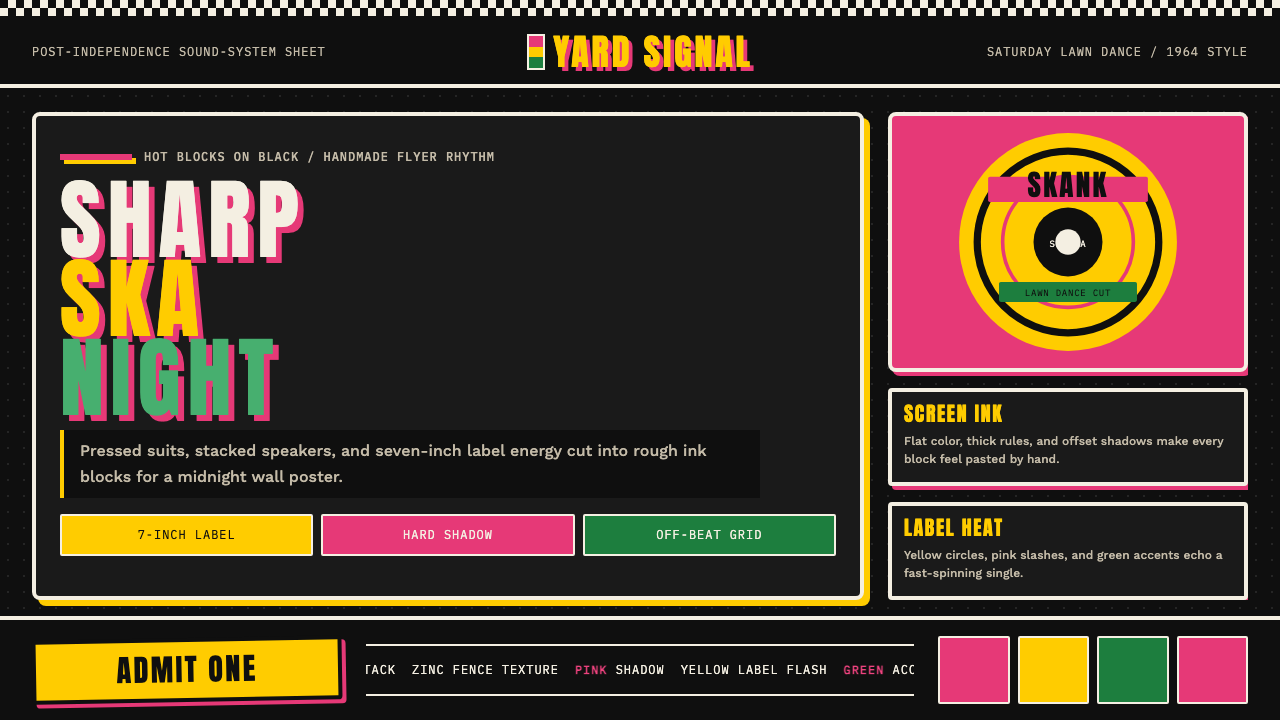 Rude Boy Jamaica Ska (1960)Street swagger hits hard. Hot pink and yellow blocks, checker trim, chunky ty…
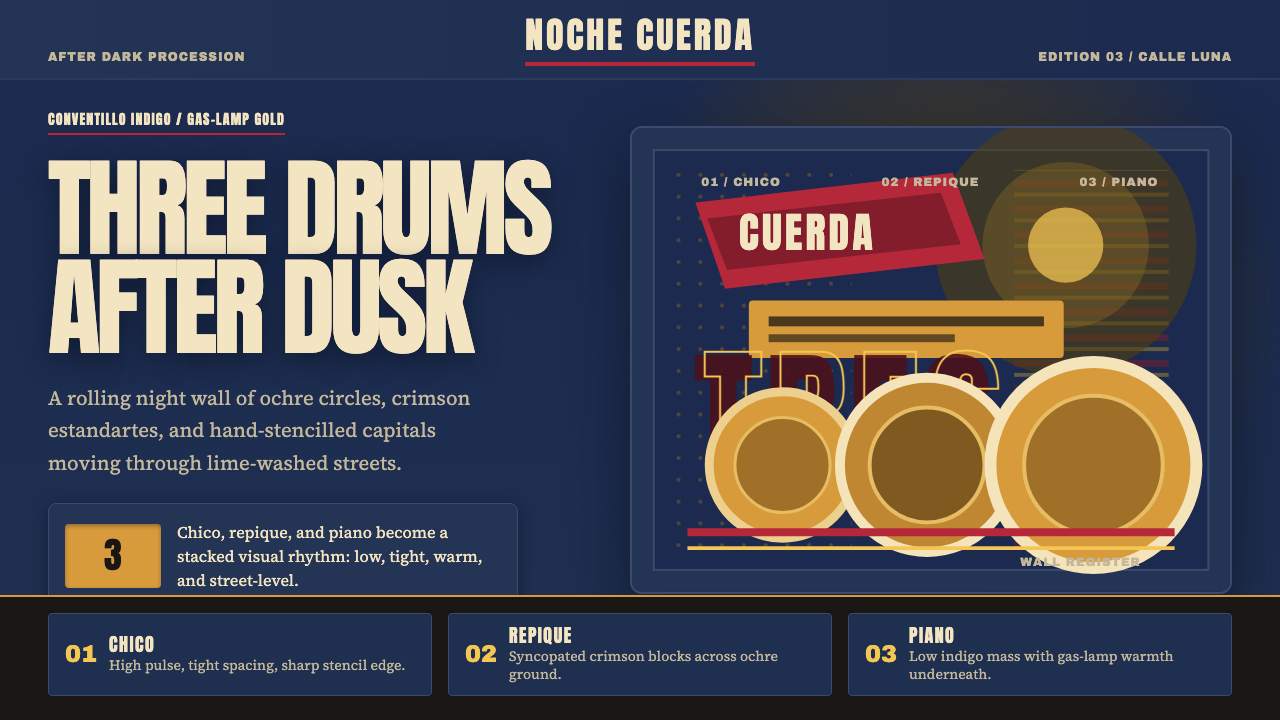 Uruguayan Candombe LlamadasCandombe after dark. Indigo ground, ochre drum circles, crimson banner type.
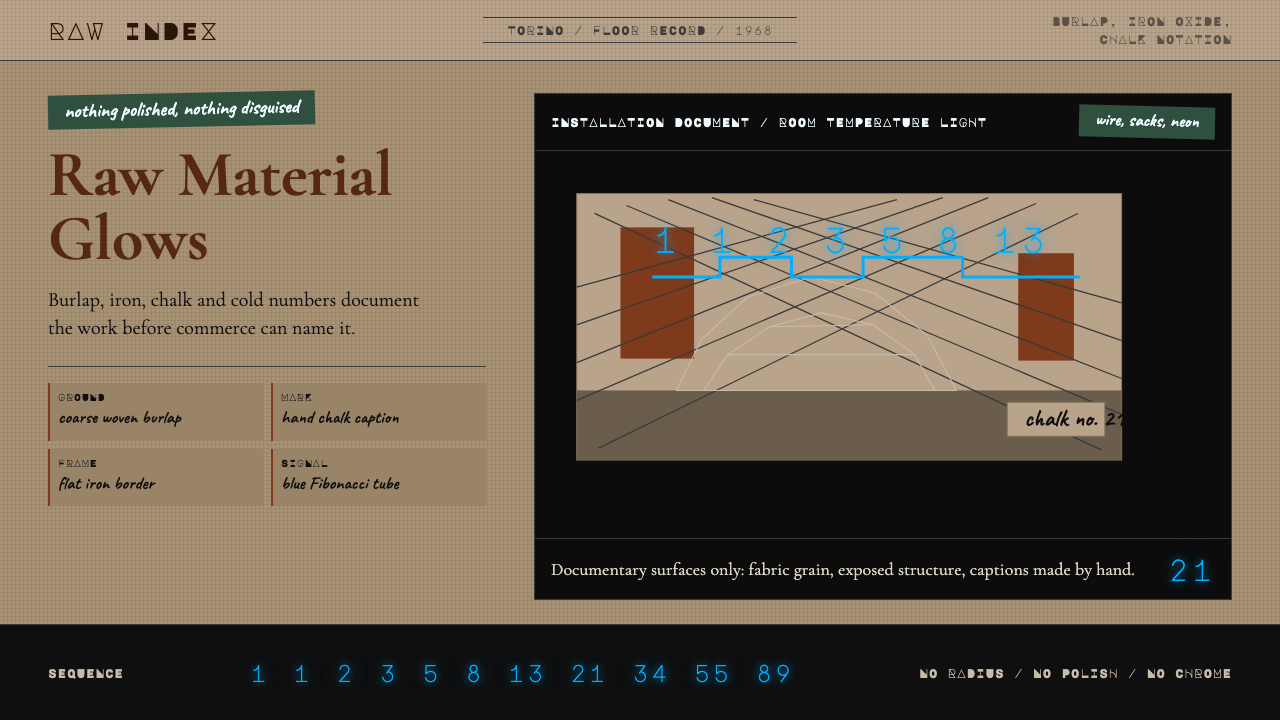 Arte Povera (Merz, 1968)Material refuses polish. Burlap ground, rust serif, chalk marks, neon Fibonac…