What is Brazilian Favela Rocinha 1970s?
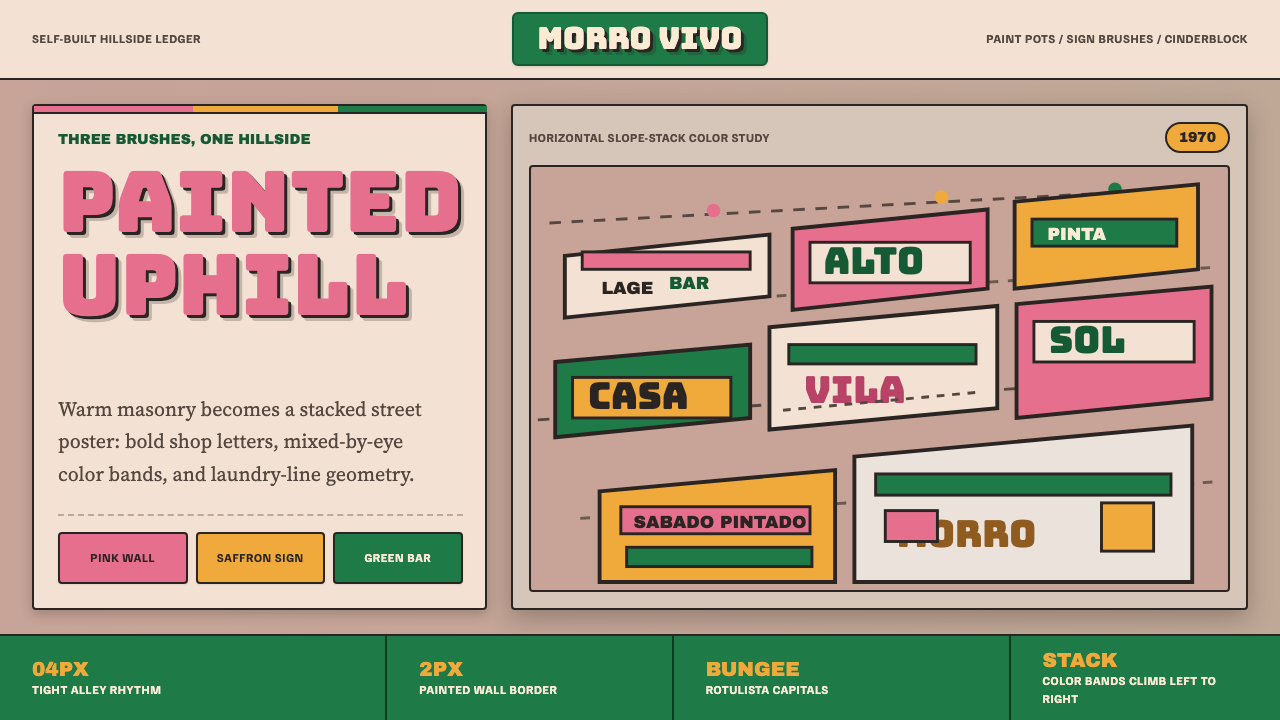
Rocinha's hillside became one of the most vivid design environments in the world — not through architecture school or city planning, but through paint buckets, bold brushwork, and a community's instinct to make its walls sing.
Brazilian Favela Rocinha 1970s in brief
Brazilian Favela Rocinha 1970s is a design aesthetic rooted in the self-built visual culture of Rio de Janeiro's largest favela during its most densely populated and visually exuberant decade. It draws on the colors, textures, and hand-lettered signage of a community that constructed its own environment from the ground up — cinderblock by cinderblock, paint stroke by paint stroke — without the intervention of professional designers or urban planners.
The aesthetic is characterized by raw masonry warmth as the dominant ground tone, against which hand-painted exterior stripes in sun-bleached pinks, saffron yellows, and the deep green associated with the Antarctica beer brand read as bold, joyful declarations. Hand-lettered signage — produced by specialist artisans called rotulistas who painted bars, clubs, and shops with thick brushes and oil-based enamels — gave every facade a typographic personality that no digital font could replicate.
What distinguishes this style from other folk-vernacular or outsider aesthetics is its internal coherence. The palette emerged organically from what was commercially available and affordable in Brazilian hardware stores of the 1970s, yet the combinations achieved across thousands of independent walls read today as an extraordinarily resolved visual system — warm, honest, and alive with human presence.
Where does Brazilian Favela Rocinha 1970s come from?
Rocinha began as a squatter settlement on the steep hillside between the affluent neighborhoods of São Conrado and Gávea in the 1930s, when rural migrants fleeing the drought-stricken Northeast of Brazil arrived in Rio de Janeiro in large numbers. The name — from the Portuguese word for a small farm or market garden — echoes the agricultural origins of its first settlers, who initially grew produce on the slopes before the informal housing density overwhelmed any remaining cultivated land.
The practice known as autoconstrução — self-construction — was the engine of Rocinha's physical growth. Families built on weekends, pooling labor with neighbors and relatives, expanding upward and outward as finances and materials allowed. The building material of choice was the cinderblock, cheap and widely available, whose rough gray surface became the literal and aesthetic foundation of the community's built environment. Paint was applied not to conceal this rawness but to celebrate it: stripes, panels, and full-facade color-washes turned each building into a declaration of occupancy and pride.
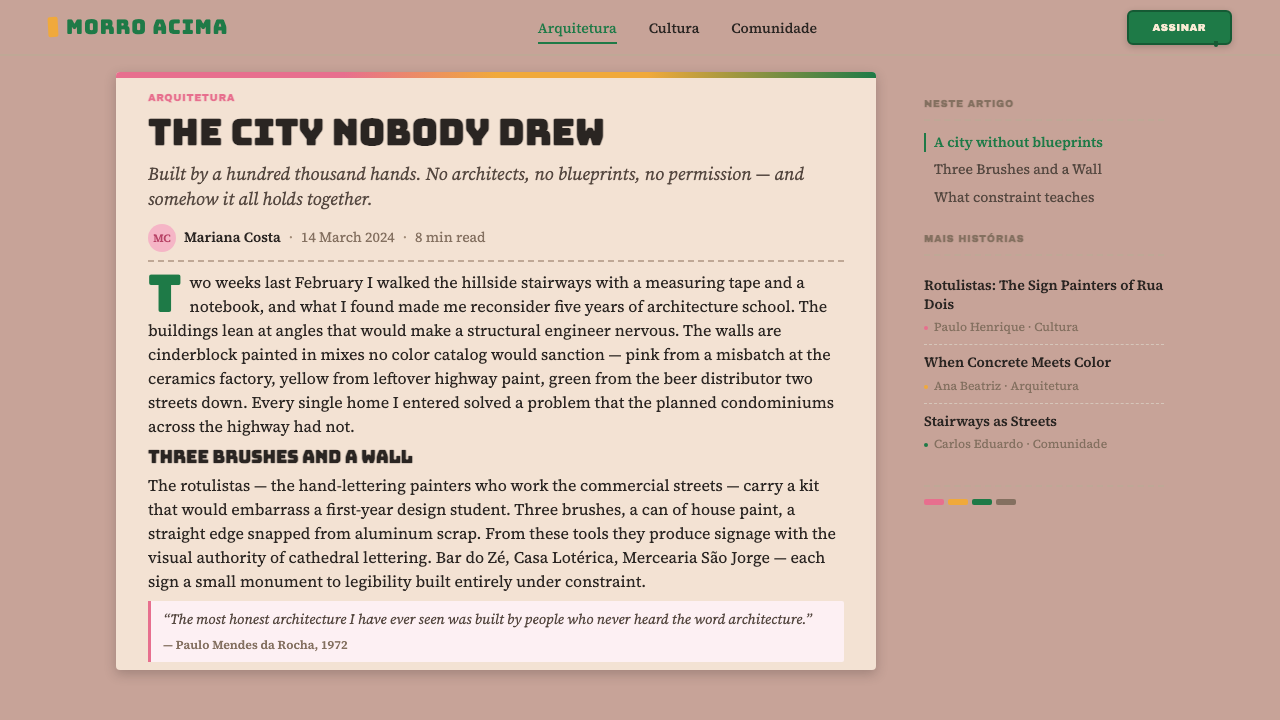
The rotulista trade emerged as a crucial cultural institution within this self-built world. These itinerant sign painters were trained not in art schools but through apprenticeship, inheriting hand-lettering techniques that blended Portuguese commercial tradition with the exuberant flourishes of Brazilian popular culture. A skilled rotulista could render legible, bold letterforms freehand on an irregular wall surface, calibrating weight and spacing by eye alone. Their tools were few — a handful of brushes, a palette of oil-based enamels, a steady hand — and their output was the visual voice of commerce and community in the favela.
The 1970s represented a visual peak for Rocinha, coinciding with Brazil's period of rapid economic growth and urbanization. The community's population swelled toward one hundred thousand residents. The density of building meant that the hillside, viewed from the luxury beachfront below, presented a shimmering vertical tapestry of color — an accidental but coherent cityscape that documentary photographers, sociologists, and eventually designers would recognize as something singular. Carlos Nelson Ferreira dos Santos, an architect and urban planner who spent years studying Rocinha, documented this period and argued that the community's spatial intelligence and aesthetic vitality deserved acknowledgment on par with any formally designed urban environment. Sociologist Janice Perlman's fieldwork from the same era reached similar conclusions, pushing back against the dominant narrative that favelas were simply problems to be solved rather than communities with their own complex cultures.
What defines the Brazilian Favela Rocinha 1970s look?
Palette
The colors are warm, sun-modified, and mixed by eye rather than matched to any standard. Pink ranges from near-coral to faded dusty rose; saffron yellow is rich but softened by tropical light; green leans deep and bottle-like, anchored to the cultural memory of the Antarctica beer brand. These three hues work against the raw cinderblock gray, which serves as both literal building material and neutral anchor. The overall impression is of warmth and density — many colors coexisting without discord, because each is softened by heat, age, and the bleaching effect of the Rio sun.
Surface Texture
Cinderblock is never smoothed over or concealed — it is the ground. Even when paint is applied thickly, the block's grid of joints and the slight irregularities of the surface remain visible beneath. This honest material presence means that every color sits in a field of gentle texture rather than on a flat ground, giving the palette a depth and warmth that no flat digital reproduction fully captures. Translating the aesthetic into digital contexts means accepting that perfect flatness is not the goal — a slight grain or warm-toned ground brings the work closer to its source.
Stripe Structure
Horizontal and vertical stripes are the primary organizing device on building facades, dividing walls into color panels that mark floors, owners, or simply aesthetic preference. These stripes are rarely precise — hand-painted with a wide brush, they carry slight wobbles and varying edge quality that read as human rather than mechanical. The composition that results is hierarchical without being rigid: a bold stripe at lintel height anchors the eye, a lighter wash above opens the plane, a contrasting color on a neighboring wall creates rhythm across the whole block.
Rotulista Typography
The hand-lettering tradition of the rotulista is defined by weight, confidence, and a complete absence of digital precision. Letters are wide, boldly weighted, and painted directly onto irregular surfaces with oil-based enamel — the slight wobble of an uncertain surface absorbed into the letterform rather than corrected. The resulting typefaces are not any single style but a family of related approaches: a blocky serif for a botequim name, an outlined grotesque for a price announcement, a fluid script for a personal greeting. What unites them is a willingness to occupy space fully and a visible human hand in every stroke.
Compositional Density
The favela aesthetic is not about breathing room — it is about fullness. Every surface carries information: paint color, club insignia, lettered sign, draped laundry, potted plant on a ledge. Translated into design practice, this means a tolerance for visual density that Western minimalism discourages. Elements can be close together without becoming chaotic, because each is rooted in a clear local logic — a function, a pride, a message. The challenge in using this style is maintaining that local logic while scaling to a designed artifact rather than sliding into decorative noise.
Cultural Insignia
Soccer club shields, samba school colors, and beer brand greens are not background decoration in this aesthetic — they are its primary symbolic vocabulary. These insignia carry the allegiances and identities of the community, appearing on building facades with the same weight given to structural architectural elements. Any design work drawing on this style should treat symbols and emblems as structural objects rather than decorative additions: they organize space, signal belonging, and create the sense that the environment means something beyond its surface appearance.
Vernacular Warmth
The Rocinha aesthetic is, fundamentally, warm. Not in the precise color-temperature sense, but in the experiential sense: it feels inhabited, touched by human hands, made for and by specific people rather than for an anonymous market. The irregularities are not errors; they are evidence of presence. This quality — vernacular warmth — is the hardest to translate into designed artifacts, because it cannot be produced by rule or formula. It emerges from authentic engagement with the source culture and a willingness to let imperfection remain.
Who shaped Brazilian Favela Rocinha 1970s?
One of the prominent rotulistas associated with Rocinha's commercial signage culture, Genival represents the professional lineage of hand-letterers who gave the favela's walls their typographic character. Rotulistas like him trained through apprenticeship rather than formal schooling, inheriting a practice that predated digital typography and maintained its relevance through craft excellence and deep community embeddedness. Their work was not art in the gallery sense but a skilled trade — one that happened to produce some of the most characterful lettering in twentieth-century Brazilian visual culture.
An architect and urban planner who became one of the most important advocates for taking favela communities seriously as designed environments rather than problems to be solved. His fieldwork in Rocinha during the 1970s and beyond challenged the prevailing view in Brazilian planning circles that informal settlements were temporary aberrations to be cleared. He documented the spatial intelligence, aesthetic vitality, and social coherence of the community and argued that its self-built fabric had lessons to teach formal urban design — not least about how identity and aesthetics emerge from need, labor, and collective action.
A community leader whose long engagement with Rocinha's cultural institutions — including samba schools and neighborhood associations — helped sustain the social fabric within which the favela's visual culture flourished. Figures like Tião demonstrate that the aesthetic vitality of a place like Rocinha is never separable from its social organization: the bold colors on the walls and the shields on the facades were expressions of communities held together by real bonds of loyalty, festivity, and mutual support. Without that organizational substrate, the aesthetic becomes merely decorative.
An American sociologist whose landmark 1976 study The Myth of Marginality challenged the Brazilian government's characterization of favela residents as marginal, dangerous, and outside the social mainstream. Perlman's fieldwork, conducted partly in Rocinha, demonstrated that favela communities had rich internal social lives, strong work ethics, and aspirations entirely consistent with mainstream Brazilian values — and that the communities' physical environments, far from being simply chaotic, had their own spatial logics and aesthetic coherence. Her work gave academic legitimacy to what architects like Carlos Nelson were arguing from a design perspective.
How do you use Brazilian Favela Rocinha 1970s today?
The Rocinha 1970s aesthetic is most effective when used to communicate warmth, human presence, and a specific kind of lived authenticity — qualities that corporate minimalism and polished digital design often deliberately suppress. It works against brands, events, and communities that want to signal accessibility, vitality, and a connection to real human experience rather than idealized consumer aspirations.
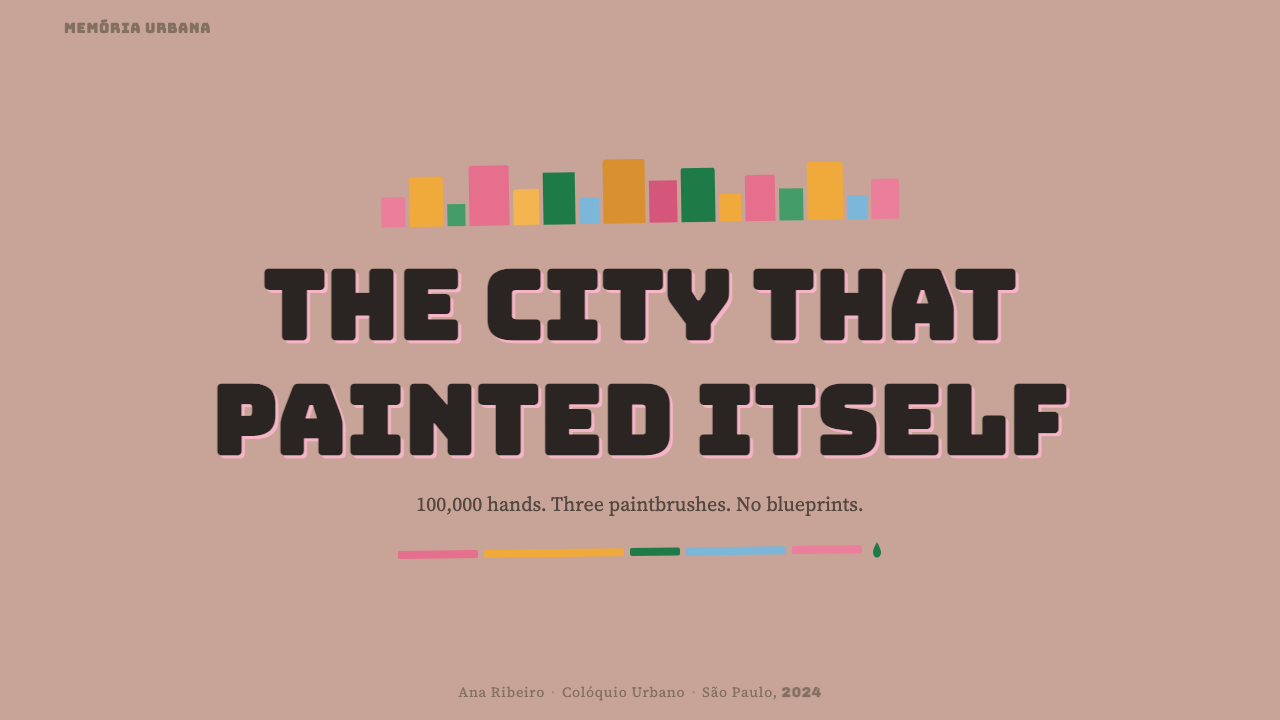
For presentation slides, the style works powerfully as a cover treatment: a warm cinderblock-gray ground with a bold horizontal stripe in saffron or deep green, and a title set in a heavy, wide letterform that echoes the rotulista tradition. Section dividers can use the stripe motif — a thick painted band in one of the palette's key colors — rather than typographic rules or decorative ornaments. Content slides should respect the aesthetic's density without replicating its chaos: keep the warm ground tone, allow text and image to sit closer together than minimalist grids would permit, and use the palette's saturated hues as section-coding devices.
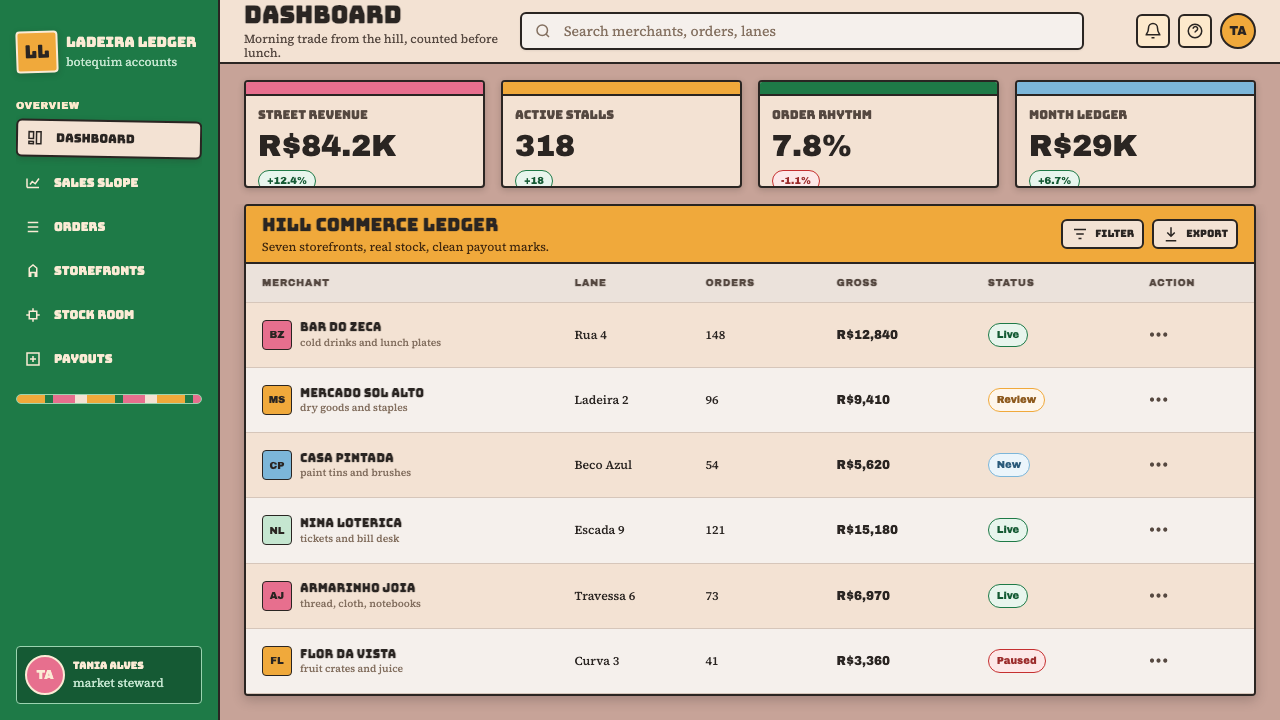
For web interfaces and dashboards, this style suits platforms where personality and community are more important than clinical precision — event discovery tools, neighborhood apps, cultural institution websites, food and drink platforms, music streaming interfaces. The approach: warm off-white or pale warm-gray backgrounds, bold typographic headlines in wide, weighted letterforms, accent color drawn from the saffron-pink-green palette, and card components with visible texture or warm-toned backgrounds rather than clean white.
For editorial and marketing work, the aesthetic gives full-page feature spreads and event posters a festive, handmade quality that professional polish cannot replicate. A double-page layout using the stripe structure as a compositional skeleton — a bold color band across the top quarter, the main image inhabiting the cinderblock-warm middle field, a rotulista-inspired pull quote running large at the base — creates a visual rhythm that feels both designed and inhabited. Marketing campaigns drawing on the style benefit from commissioning actual lettering artists rather than simulating the hand-painted quality digitally.
A common mistake is reducing the aesthetic to its most superficial markers — slapping a bright pink stripe on a white background and calling it favela-inspired. Authentic application requires engaging with the warmth and density of the source: the colors need the cinderblock ground to sit against, the lettering needs weight and human irregularity, and the overall composition needs to feel full rather than airy. Equally, designers must approach this cultural source with genuine respect — the visual language of Rocinha emerged from real community life and economic constraint, not as a style choice, and treating it as mere surface decoration risks a superficiality that the source itself would recognize and reject.
Brazilian Favela Rocinha 1970s — FAQ
Is it appropriate to use favela aesthetics in commercial design work?
It can be, with care. The visual culture of Rocinha is a genuine aesthetic tradition developed by a community over decades — it is not a protected ethnicity or religion, and visual traditions naturally cross cultural boundaries. The key distinction is between engagement and extraction. Design work that acknowledges its sources, brings genuine understanding of the aesthetic's origins, and uses the style with depth and respect is different from work that simply borrows surface markers for shock or novelty value. When in doubt, collaborating with Brazilian designers or commissioning artists from the tradition itself adds both authenticity and reciprocity.
How does this style differ from other Brazilian visual traditions?
Brazil has several distinct visual traditions that are sometimes conflated. The Rio de Janeiro Carnival aesthetic is more theatrical, feathered, and sequined — spectacular in a different register. The modernist tradition associated with Lúcio Costa and Oscar Niemeyer is internationally oriented, abstract, and architecturally ambitious in the formal sense. The Bahian visual culture, rooted in Candomblé and African diaspora traditions, uses a different color logic and symbolic vocabulary. The Rocinha aesthetic is specifically the product of informal urban settlement in Rio's South Zone — its warmth is literal (cinderblock and paint) and its vernacular is commercial (botequim signs, club shields) rather than ceremonial or monumental.
Can this style work for digital-first products or does it require physical texture?
It works in digital contexts, but requires deliberate adaptation. The style's warmth in its original form comes partly from physical imperfection — the grain of cinderblock, the slight unevenness of hand-applied paint — that flat digital screens cannot reproduce exactly. The solution is not to abandon the style but to find its digital equivalent: warm-toned background colors rather than pure white, typography with some visible irregularity or softness rather than machine-perfect rendering, and color palettes that read warm and saturated rather than cold and corporate. The result will be a reinterpretation rather than a literal translation, which is appropriate — the source aesthetic itself was always a reinterpretation of available materials rather than a fixed canon.
What is autoconstrução and why does it matter for understanding this aesthetic?
Autoconstrução is the Portuguese term for self-construction — the practice by which favela residents built their own homes incrementally, using their own labor and whatever materials they could acquire. Understanding this practice is essential to understanding why the aesthetic looks the way it does. The visual system was not designed by anyone: it emerged from thousands of independent decisions about which paint to buy, which colors to use, how to divide a facade. The coherence of the result is not the product of coordination but of shared material conditions and cultural norms. This gives the aesthetic its specific quality — genuine rather than simulated, varied rather than uniform, deeply rooted in actual human decision-making rather than in abstract design principle.
What makes the rotulista tradition different from modern hand-lettering?
Modern hand-lettering — as practiced by contemporary calligraphers and lettering artists — is typically a deliberate aesthetic choice made by trained designers working in a context of abundant alternatives. The rotulista tradition was a skilled trade that arose from necessity: signs had to be painted because there was no affordable alternative, and the people who did it developed deep expertise through constant practice across many surfaces and contexts. The result has a directness and functional confidence that aestheticized contemporary hand-lettering often lacks — it was made to be read quickly from across a street, not to be admired closely on a screen. That directness, and the specific mark-making vocabulary it produces, is what makes the tradition a genuine design resource rather than simply a nostalgic reference.
Related design styles
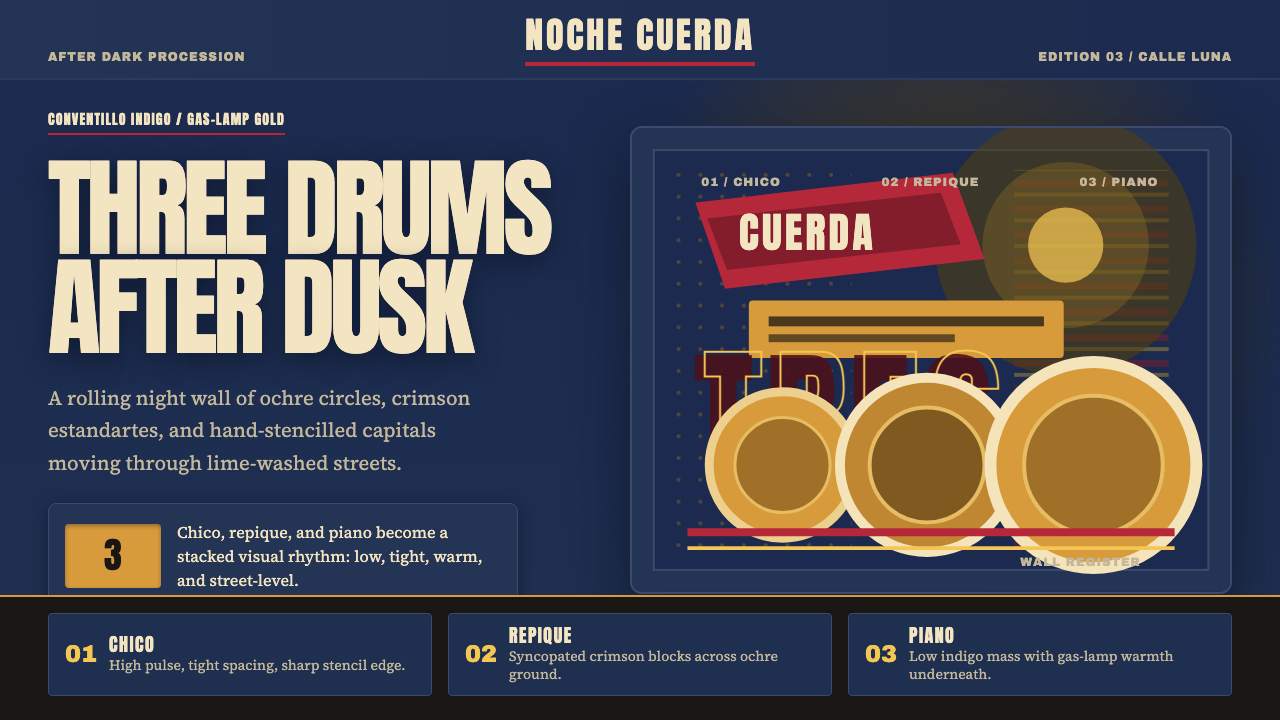 Uruguayan Candombe LlamadasCandombe after dark. Indigo ground, ochre drum circles, crimson banner type.
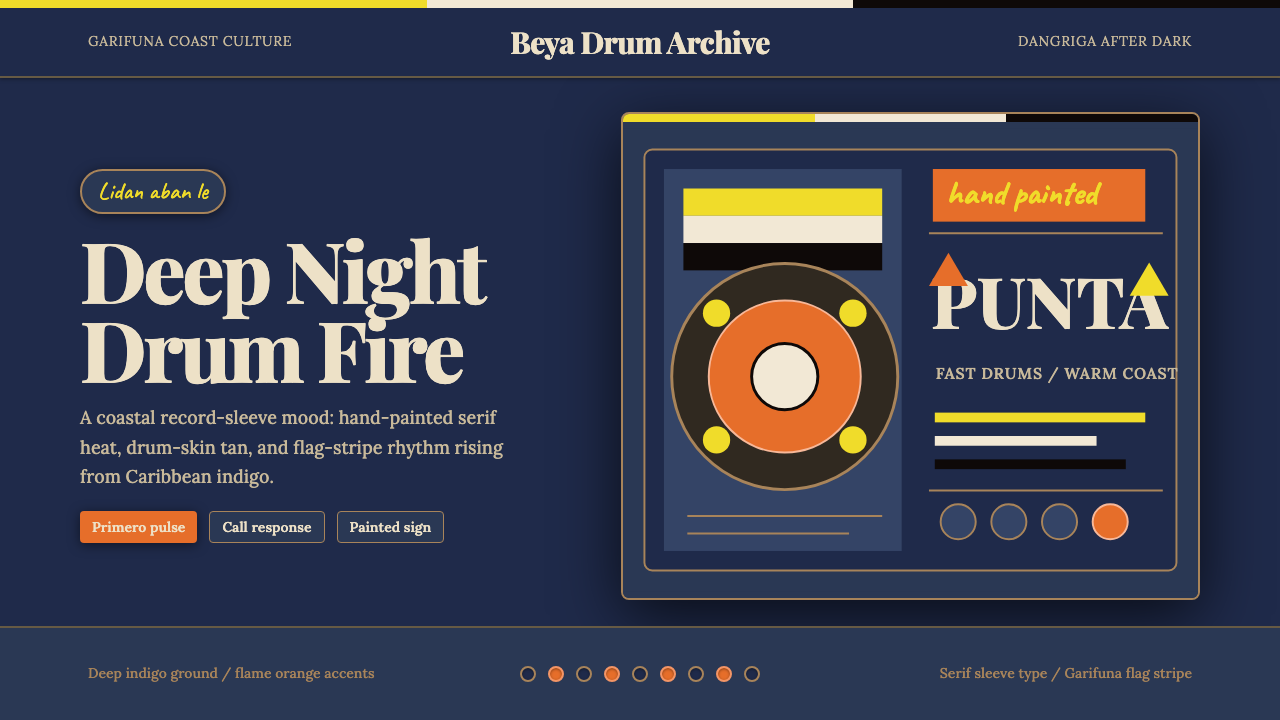 Belizean Garifuna PuntaNight rhythm burns. Indigo fields, flame-orange serif type, and flag stripes…
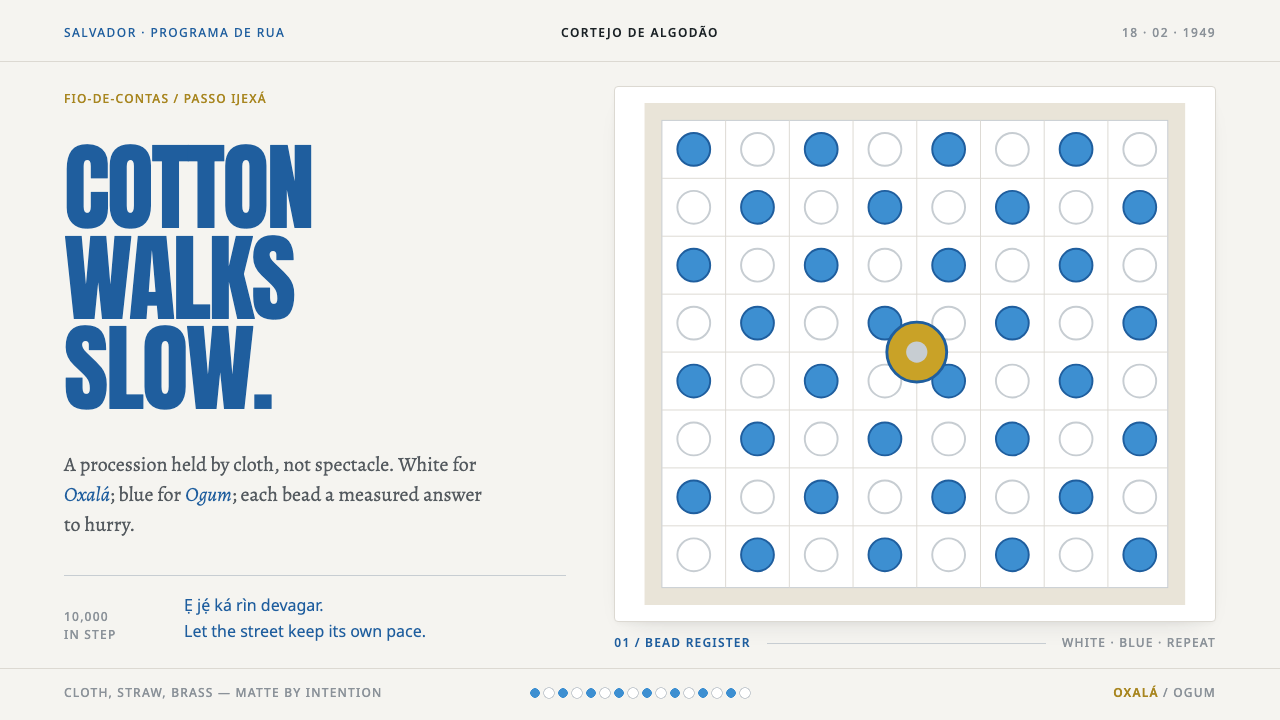 Afoxé Filhos de GandhyA procession that refuses to hurry. Cotton white and bead blue repeat in a me…
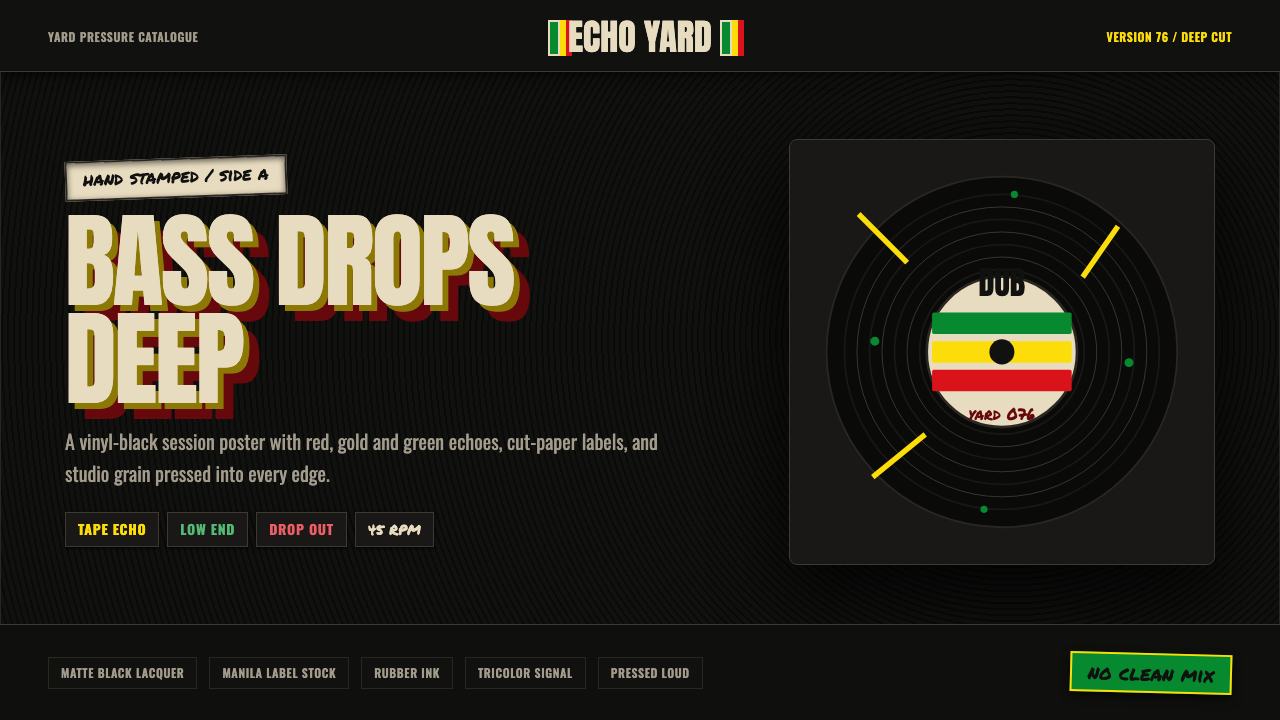 Dub SoundsystemStudio-dark and heavy. Vinyl grooves, manila stamp, green-gold-red echo type.
 Huichol Yarn NierikaCeremonial density glows. Neon yarn colors lock into black-contoured, edge-to…
 Panamanian Mola Kuna AppliquéSewn sovereignty. Vermilion panels reveal black, orange, and cobalt stitch-gr…