What is Northern Soul Wigan (1970)?
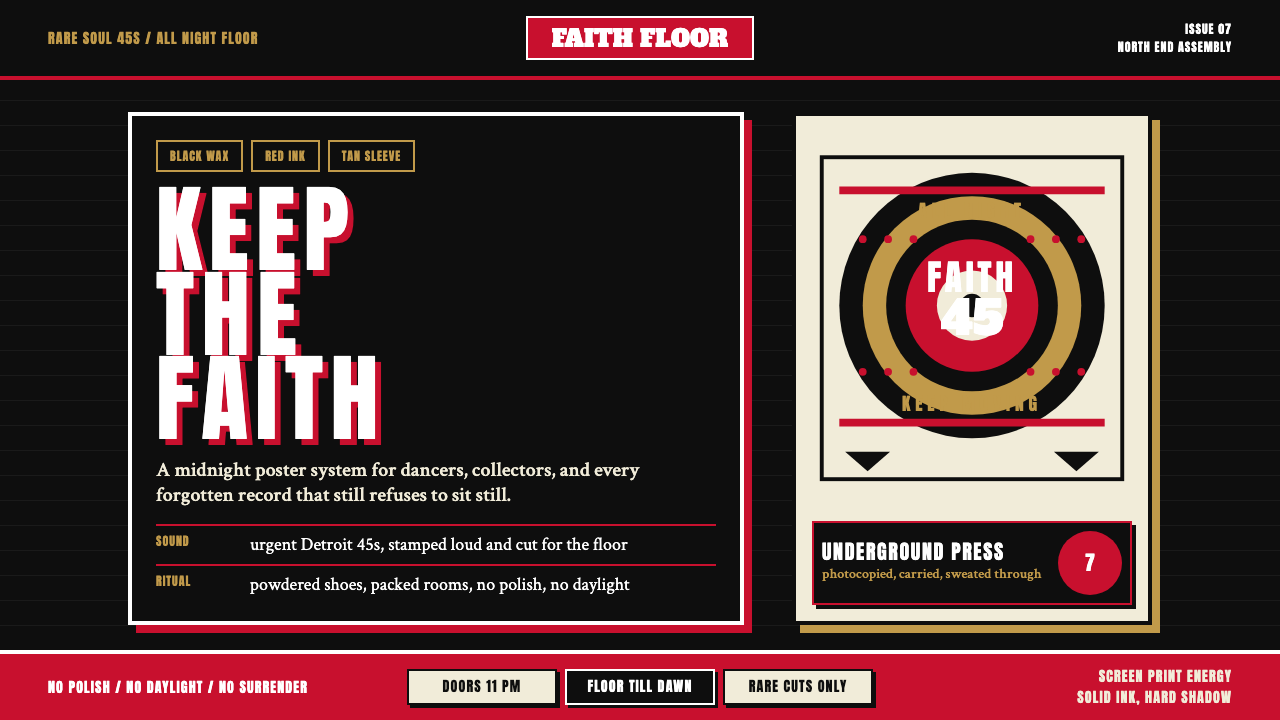
Northern Soul is the design language of the all-nighter — black as a 4am dancefloor, fist-red type that won't let you sleep, and the devotional urgency of a rare record still spinning at dawn.
Northern Soul Wigan (1970) in brief
Northern Soul is a visual design system rooted in the underground dancefloor culture that emerged in the working-class towns of Northern England during the 1970s. Its aesthetic draws directly from the graphic vernacular of that scene: monochrome screen-printed posters, hand-painted club flyers, vinyl label reproductions, and the clenched-fist emblem that became the movement's universal badge. The result is a dark, urgent, obsessively specific graphic language — one that treats black not as background but as presence, and red not as accent but as conviction.
Where many historical design systems derive their visual logic from fine art or architectural theory, Northern Soul derives its logic from devotion. Participants in the scene were collectors and true believers — people who traveled hundreds of miles to hear a single rare 45rpm record played at full volume. That fanaticism is encoded in the design aesthetic: nothing is casual, nothing is decorative for its own sake. Every element carries the weight of something that matters deeply. The type is heavy and confrontational; the palette is stripped to essentials; the composition is immediate.
The darkness at the center of the aesthetic is not nihilistic but protective. The all-nighter happened in the hours when the mainstream world was asleep — a deliberate retreat into a closed community of shared passion. The black ground of the Northern Soul visual system carries this sense of enclosure: it is the dark room where something rare and irreplaceable is happening, visible only to those who know where to look.
Where does Northern Soul Wigan (1970) come from?
The Northern Soul scene grew from the ashes of British Mod culture. When Mod's fixation on American rhythm and blues intensified through the mid-1960s, a subset of enthusiasts began seeking out the obscurer records — the ones that had flopped commercially in Detroit or Chicago but whose driving, uptempo rhythms were ideal for the athletic, acrobatic dancing style that evolved in Northern England's clubs. The Twisted Wheel in Manchester, active from 1963 to 1971, is widely acknowledged as the birthplace of the all-nighter format and the early crucible of the aesthetic. Dancers and DJs arrived late and stayed until morning, sustained by rare records and communal intensity.
The term 'Northern Soul' was coined by the record dealer and journalist Dave Godin in 1970, writing for Blues and Soul magazine. Godin needed a label to distinguish the music being played in Northern clubs — obscure American soul from the 1960s — from the contemporary soul music being promoted to London's more fashion-conscious audiences. The name stuck. It also gave the scene a geography and a pride: Northern England, so often cast as industrial and peripheral in British cultural imagination, became the definitive custodian of something the mainstream had overlooked and discarded.
Wigan Casino, which opened as a Northern Soul all-nighter venue in September 1973, became the scene's defining institution. Under the residency of DJs Russ Winstanley and Richard Searling, the Casino hosted weekly all-nighters that drew thousands of dancers from across Britain. The BBC awarded it the title of 'Best Disco in the World' in 1978. The visual culture of the Casino years — the screen-printed posters advertising rare records, the cloth patches bearing the clenched fist and the phrase 'Keep the Faith,' the hand-drawn flyers passed between scene members — established the Northern Soul graphic vernacular that this design system inherits.
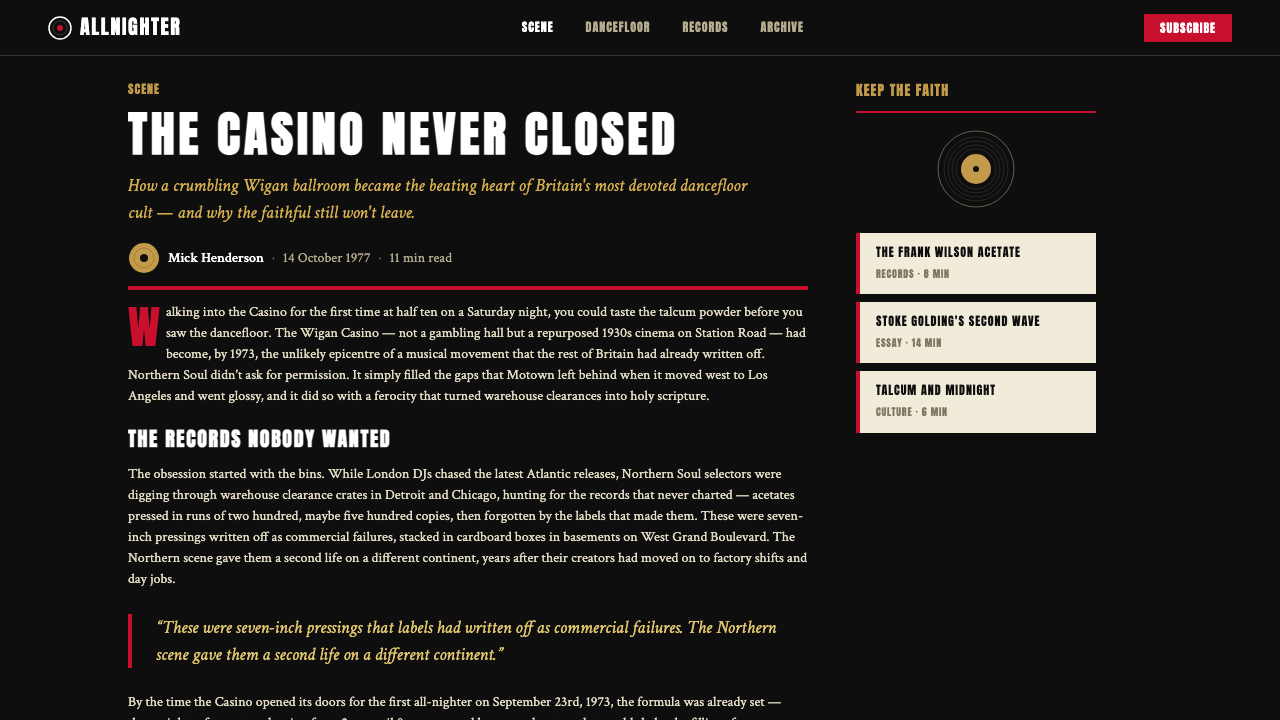
The clenched fist, borrowed from broader working-class and civil rights symbolism, became the scene's most potent emblem. On Northern Soul patches and posters it carried a specific meaning: loyalty to the music, the dancefloor, and the community against all commercial pressure. The scene was defined in part by its hostility to commercial success — a record that crossed over to mainstream chart success was viewed with suspicion, even contempt. 'Keep the Faith' was the declaration of that devotion, and the fist was its visual form. The design system carries this graphic inheritance: bold, direct, rooted in the conviction that some things matter too much for compromise.
What defines the Northern Soul Wigan (1970) look?
Color Palette
The foundational palette is extreme in its restraint: deep black as the dominant ground, a fist-red that reads as both blood and urgency, and a warm soul-tan drawn from the buff and amber tones of vintage vinyl record labels. Against this triad, white appears only for maximum contrast — a label reproduction, a band of tight reversed type, the edge of a fist. Nothing is softened; no tint, no intermediate neutral. The palette communicates before the type is even read.
Typography
Type is the muscle of the Northern Soul aesthetic. Display lettering favors chunky, high-contrast forms — the kind of condensed, heavily weighted letterforms that print clearly from a hand-cut screen at speed, that read across a dark room at distance. Headlines are set tight, often in all capitals, with minimal letterspacing. Body copy, where it appears, is treated as a secondary system entirely subordinate to the headline impulse. The feeling is not refined — it is insistent.
Offset Shadow and Block Construction
The defining decorative technique is the offset block shadow: a shape or letterform reproduced at a slight displacement in a second color, creating the impression of depth without any gradient or softness. This effect is a direct artifact of screen printing, where a second pass of ink at a shifted registration produces exactly this kind of hard-edged doubling. In the Northern Soul system, it reads as urgency — the visual equivalent of a sound starting a fraction before you expect it.
Vinyl and Circular Motifs
The seven-inch vinyl record — the physical object that the entire scene revolved around — contributes a recurring circular visual motif. Concentric rings, label reproductions, and disc silhouettes appear as compositional anchors, providing a warmth and specificity that counterpoints the severity of the type and palette. These circular forms are never decorative in the conventional sense; they carry documentary weight, referencing actual objects of devotion. A circle in this system is not an abstract form — it is a specific thing held in a specific hand.
Poster and Print Vernacular
The entire aesthetic is built around the logic of hand-made print production: limited ink passes, registration imprecision accepted as character rather than error, large flat areas of solid color, and type that can be set fast and read under low light. This is design made under conditions of scarcity and speed, and those conditions are honored rather than smoothed over. Where contemporary design trends often fake analog imperfection as a stylistic device, Northern Soul's roughness is structural — it is the style's reason for being.
Emblematic Imagery
The clenched fist is the scene's heraldic mark, appearing on posters, patches, and flyers with the consistency of a logo system. In the design vocabulary, it functions as a focal anchor — a human gesture rendered in flat silhouette, concentrating the ideology of the scene into a single image. Supporting emblems include stars, crowns, and shield forms, borrowed from a wider tradition of badge-making and subcultural heraldry. The imagery is bold enough to read at a glance and carry weight at any scale.
Darkness as Ideology
Black is not merely a background color in this system — it is a statement. The all-nighter happened after midnight and lasted until morning; the dark ground of Northern Soul design is the literal context of the culture. Beyond the practical, it carries ideological weight: black grounds mark the work as belonging to an underground, to a scene that defined itself against the lit-up, commercially viable mainstream. Against that darkness, every colored element reads as something hard-won and worth defending.
Who shaped Northern Soul Wigan (1970)?
Godin was a record dealer, journalist, and scene theorist who coined the term 'Northern Soul' in 1970. His writing in Blues and Soul magazine gave the scene a language and a self-consciousness that proved essential to its identity. He was also a passionate advocate for the music on its own terms — not as nostalgia, but as a living devotional practice. His critical framing of Northern Soul as a deliberate rejection of commercial soul music established the ideological seriousness that the scene's design aesthetic reflects.
Winstanley was the founding DJ and co-promoter of the Wigan Casino all-nighters, which ran from 1973 to 1981. His programming shaped the sonic and ultimately the graphic identity of the Casino years — the records he chose to champion, the sequences he constructed, and the atmosphere he cultivated in the room created the reference point against which all subsequent Northern Soul events were measured. The Casino's distinctive visual material — its posters, flyers, and merchandise — was produced under his tenure and remains the definitive document of the aesthetic.
Levine was a DJ and record collector who became one of the most important figures in shaping the Northern Soul canon. Resident at the Blackpool Mecca Highland Room from the early 1970s, he was known for unearthing obscure American soul records that had never had commercial distribution in Britain, and for championing a faster, more dance-floor-oriented sound than some purists preferred. His work represents the scene's relentless forward momentum — the insistence on the new find, the undiscovered record, the rare groove not yet played.
Searling was a DJ and radio presenter whose work at the Wigan Casino alongside Winstanley helped define the sound of the scene's peak years. He was also a prolific advocate for Northern Soul in print and on air, contributing to the scene's documentation and to its public image beyond the dancefloor. His longevity in the scene — spanning from the early Wigan years through decades of revivalism — makes him a living continuity between the culture's original moment and its ongoing afterlife.
How do you use Northern Soul Wigan (1970) today?
Northern Soul is among the most viscerally distinctive historical styles available to contemporary designers, but its power depends entirely on restraint. The system is built on darkness, weight, and conviction — applied without those qualities, it becomes costume rather than character. Before reaching for the palette and the heavy type, establish whether the project's values genuinely align with what the aesthetic communicates: urgency, devotion, authenticity, and a deliberate rejection of the polished mainstream. Brand work for a specialist, community-driven, or counter-cultural product will find natural resonance; luxury, corporate, or broadly accessible products will fight the style rather than be served by it.
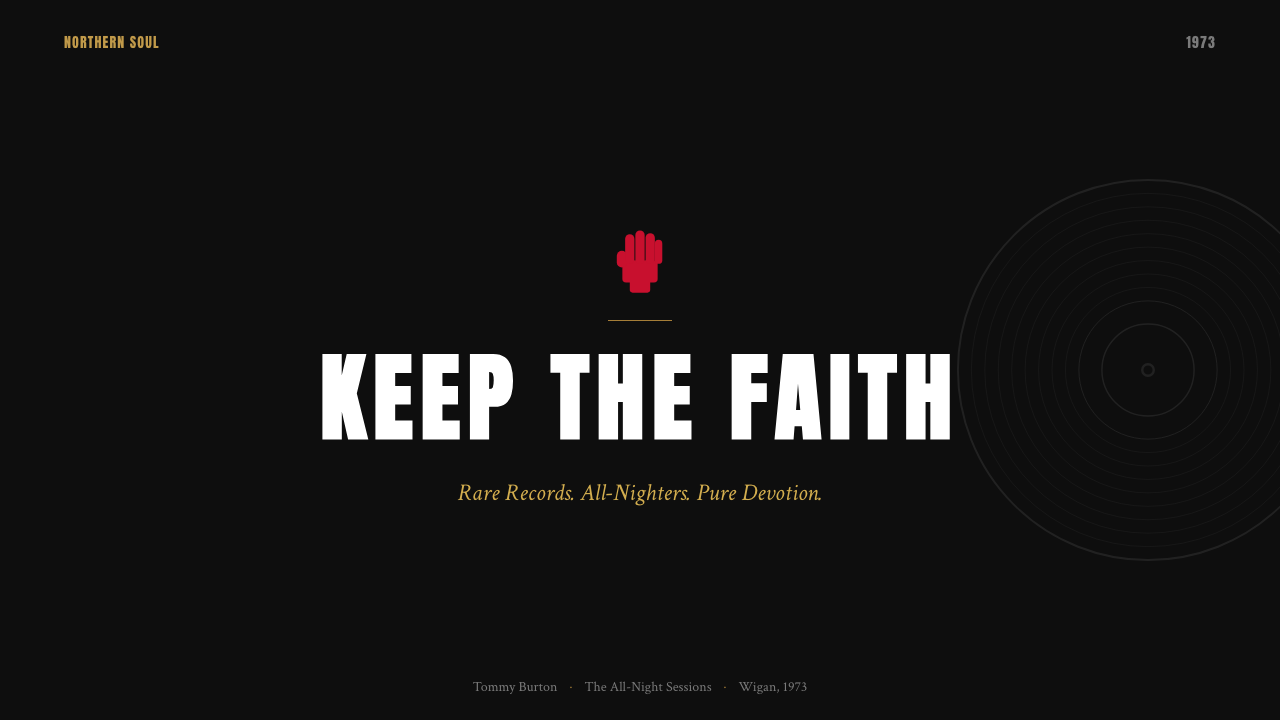
For presentation slides, the Northern Soul visual language is most powerful on high-stakes, statement-level decks rather than informational slide-by-slide narratives. A cover using a full black ground, a single large display headline in the characteristic heavy type, and the offset block shadow technique immediately signals that what follows is not ordinary. Section dividers can carry vinyl-inspired circular motifs or fist emblems as compositional anchors. Data slides require care: on a dark ground, charts and graphs must use the warm soul-tan or red as the primary data color, with white reserved for axis labels and values. Avoid introducing pale grays or blues that would dilute the palette's conviction.
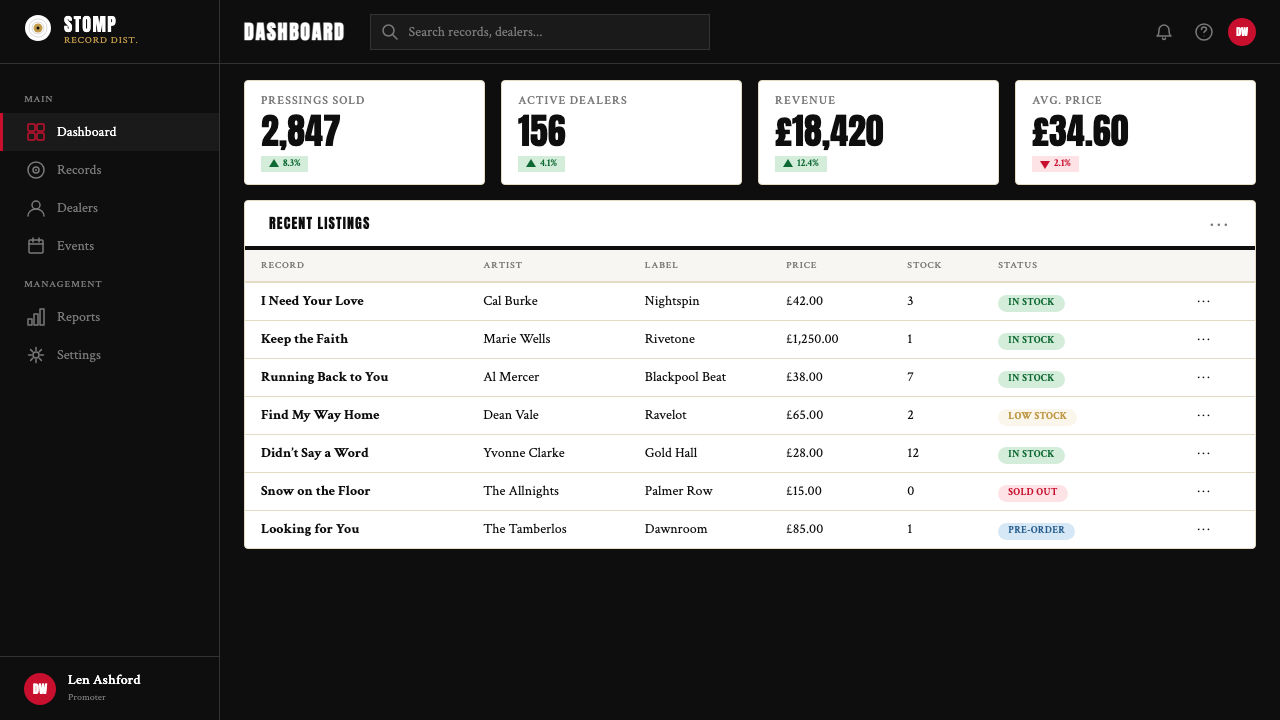
For web interfaces and dashboards, the style suits products where the user base has strong in-group identity and values authenticity over polish. A music discovery platform, a specialist community tool, or a product that explicitly positions itself as an alternative to mainstream options can use the dark ground, heavy type hierarchy, and circular vinyl motifs to signal alignment with those values. Navigation should be typographic and unapologetically bold — no gradient pill buttons, no soft hover states. Interactive elements use the red or soul-tan for active states; inactive states remain in the near-black or deep-charcoal range.
For editorial and marketing work, the style functions as a high-contrast attention device. Event promotional materials, limited-edition product launches, and campaigns with a counter-cultural or community-first positioning can deploy the poster vernacular directly — full-bleed black, oversized display type, the fist or circular motif as a compositional anchor. Marketing copy should be short, declarative, and free of hedging. The aesthetic has no room for bullet-pointed benefits lists or soft persuasion language; it assumes an audience that is already predisposed to care deeply about the subject.
The most common mistake when applying this style is treating the black ground as a mood rather than a structural commitment. Designers who use the dark palette but then populate it with soft gradients, light-touch typography, and gentle transitions end up with something that looks like generic dark-mode UI rather than Northern Soul. The style requires the hard offset shadow, the genuinely heavy type, the limited palette used without dilution, and the compositional boldness that comes from placing elements with conviction rather than caution. A second frequent error is reaching for nostalgia — using the style to signal pastness rather than urgency. Northern Soul was never about looking backward; it was about finding something old and insisting it was the most important thing in the room right now.
Northern Soul Wigan (1970) — FAQ
Is Northern Soul design the same as general retro or vintage style?
No — and the distinction matters. General retro and vintage design borrow visual cues from past decades as a form of nostalgia or stylistic play. Northern Soul design is not nostalgic in that way: it is the direct continuation of a living visual vernacular that has remained consistent since the 1970s precisely because the scene never stopped. The roughness, the dark ground, the heavy type, and the fist emblem are not period costume — they are an ongoing graphic identity that has never been updated because it has never needed to be. Applying these elements as pastiche rather than as a coherent system will produce work that reads as generic vintage rather than as something that carries genuine conviction.
Can this style work on a light or white background?
It can, but with significant trade-offs. The dark ground is structural to the style's meaning — it is the 4am dancefloor, the enclosed community, the deliberate retreat from the bright mainstream. A light inversion replaces the darkness with legibility but sacrifices the ideological weight that makes the aesthetic more than just a type-and-color choice. If a light ground is required by context (a long-form editorial piece, a corporate document), the style can survive through the typography and the restricted palette — the heavy display type, the red-and-tan color accent, the offset shadow on key elements — but it becomes a tonal reference rather than a full system. Reserve the full dark treatment for materials where the context genuinely supports it.
How does this style differ from other dark, underground-rooted aesthetics like punk or goth?
All three share the dark ground and a countercultural stance, but they diverge sharply in their underlying emotional register and visual grammar. Punk is aggressively deconstructive — ransom-note type, deliberately torn layouts, rejection of skill itself as a value. Goth is romantic and atmospheric, gravitating toward ornament, decay, and melancholy. Northern Soul is neither deconstructive nor melancholic: it is devotional and urgent. The type is heavy but controlled, not torn. The composition is bold but organized, not fractured. The emotional keynote is not despair or rebellion but loyalty — the specific loyalty of a community that found something rare and refused to let the mainstream take it away.
What kinds of projects are a poor fit for this style?
The style struggles in contexts that require warmth, accessibility, or softness as primary values. Children's products, healthcare interfaces, food and beverage brands, wellness platforms, and any product that depends on projecting approachability or comfort will work against the aesthetic's inherent severity. Corporate materials that require institutional legibility — annual reports, compliance documents, investor presentations — will also resist the style's confrontational directness. The test is simple: if the product's core value proposition involves making people feel comfortable, reassured, or welcomed, Northern Soul is working against the brief. The style earns its power by excluding as much as it includes.
Is 'Keep the Faith' a phrase I should use literally in design work?
Used without context, it reads as generic motivational copy and loses all its specificity. Within the Northern Soul design system, the phrase carries the full weight of the scene's history: the loyalty to rare music against commercial pressure, the devotion maintained over decades, the community that kept something alive that the mainstream had discarded. If you use it, it should appear in a context where that weight is legible — where the audience either knows the reference or where the surrounding design signals clearly enough what kind of devotion is being named. Used carelessly, it is a cliché; used precisely, it is a thesis statement for everything the aesthetic stands for.
Related design styles
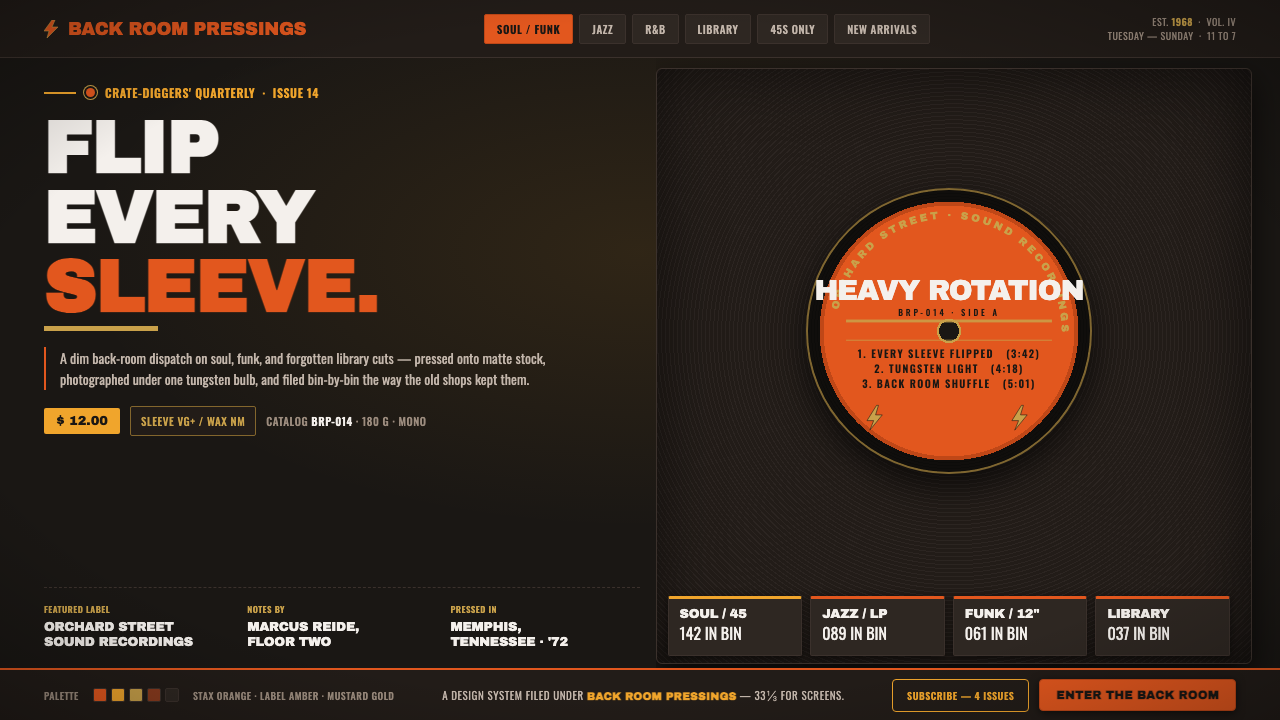 Vinyl Crate DiggingThe back room of a used record store. Stax-orange labels on near-black vinyl,…
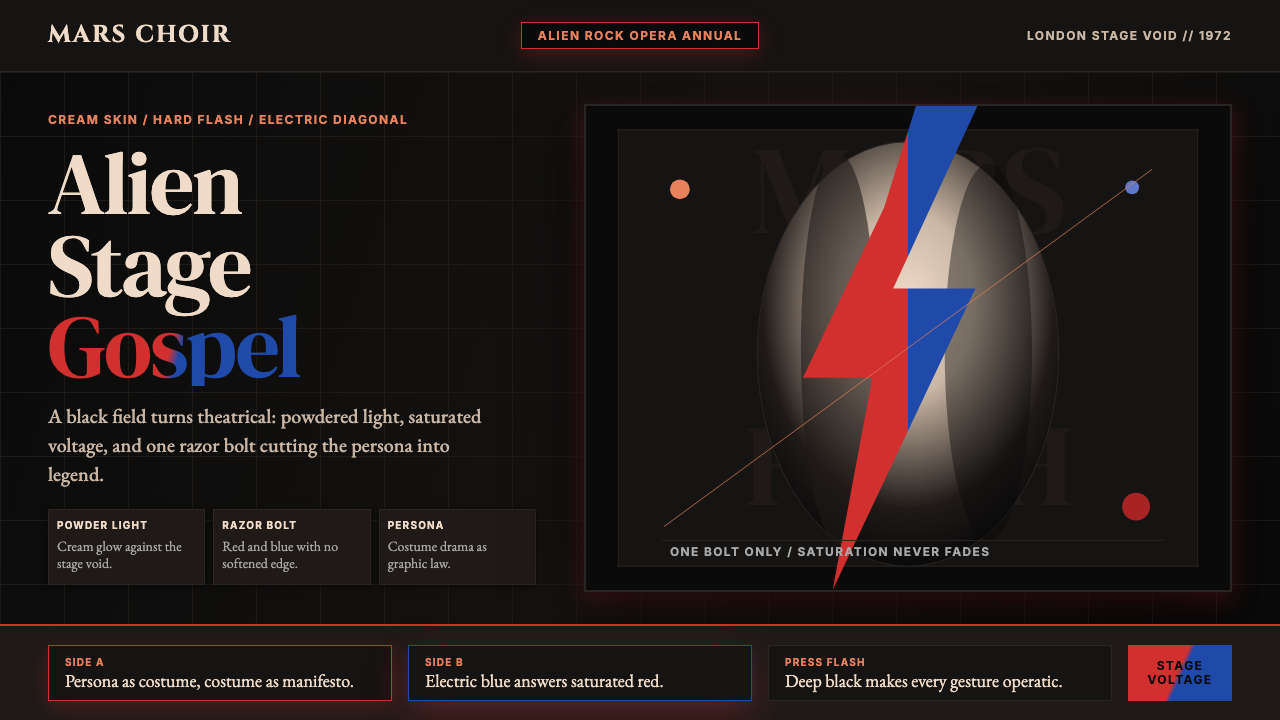 Bowie — Ziggy StardustTheater at full voltage. Cream-on-black portrait cut by one red and electric-…
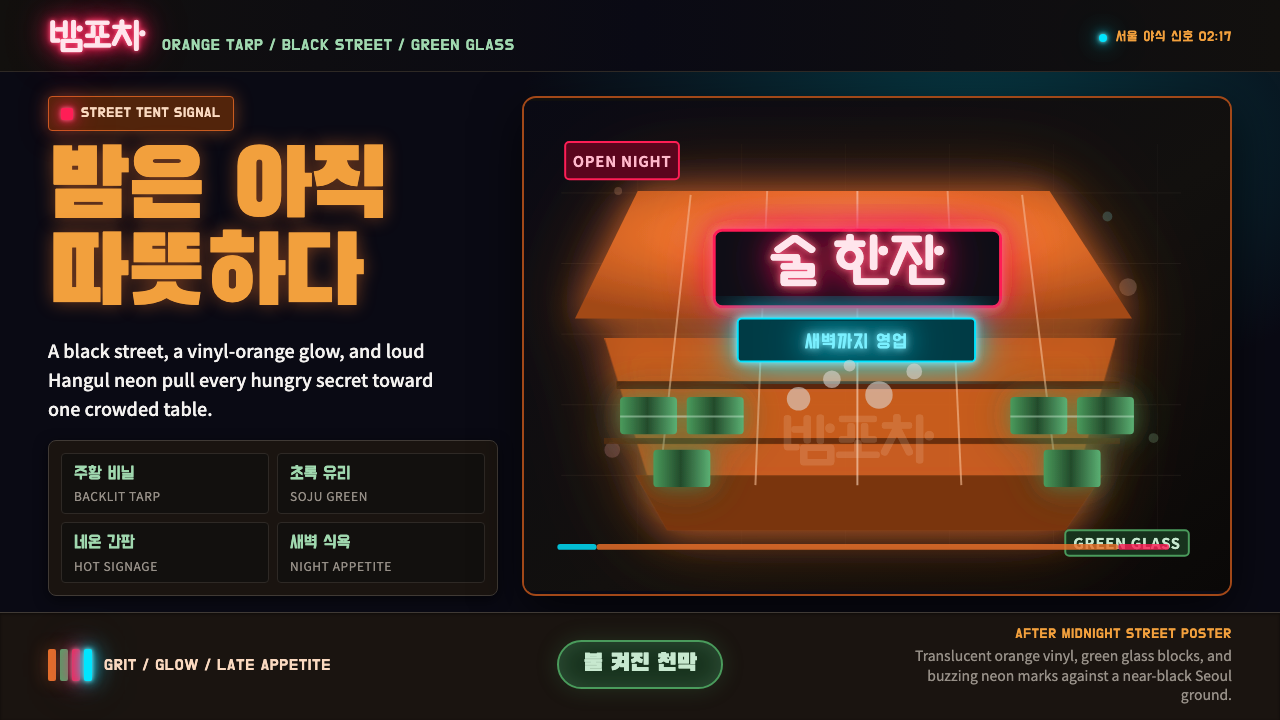 Pojangmacha Soju TentNight appetite glows. Orange tarp panels burn over black, cut by Hangul neon…
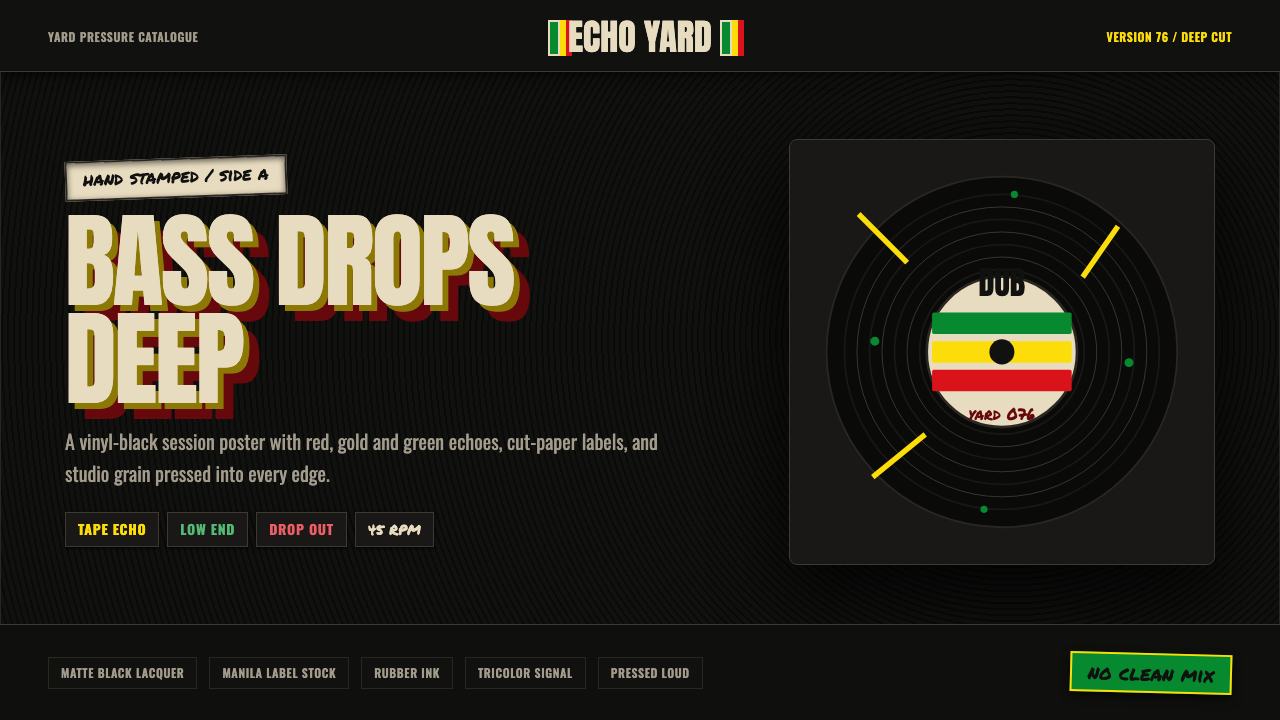 Dub SoundsystemStudio-dark and heavy. Vinyl grooves, manila stamp, green-gold-red echo type.
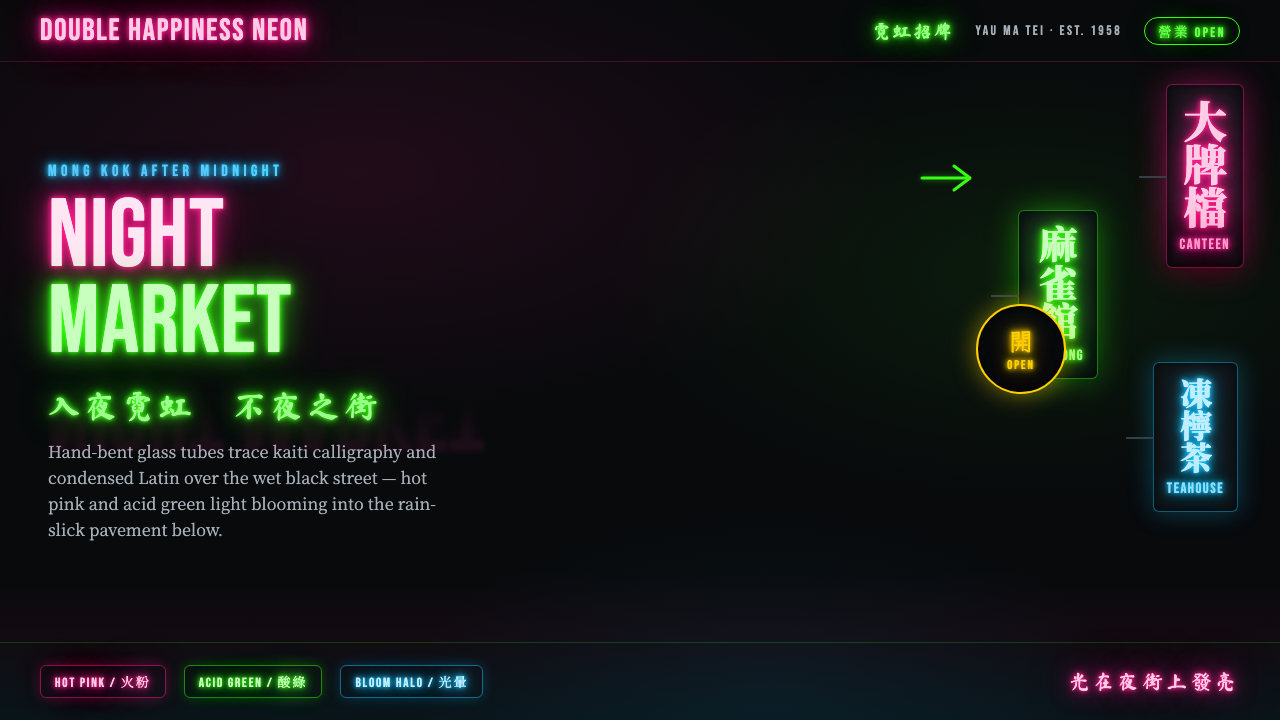 Hong Kong Neon SignboardsLight only reads against the wet black night. Hand-bent pink and green tubes…
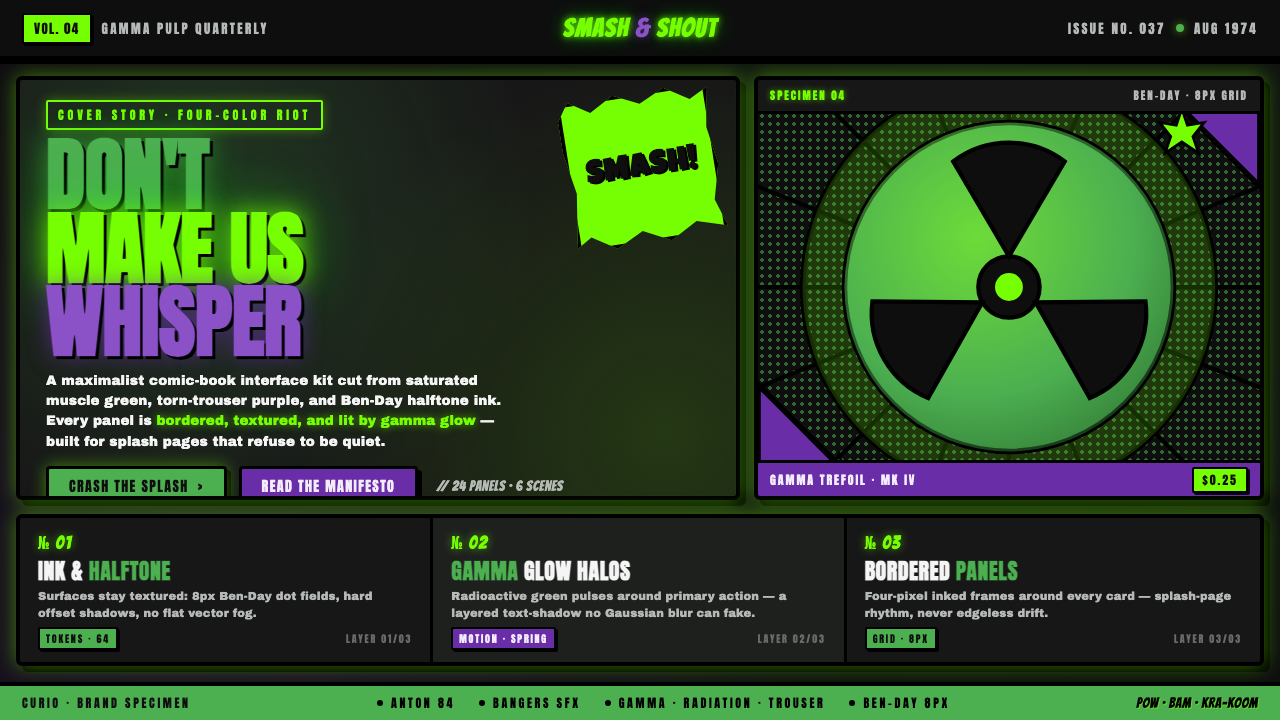 Hulk Gamma GreenDon't make us whisper. Muscle green, trouser purple, inked panels, Ben-Day ha…