What is Belizean Garifuna Punta?
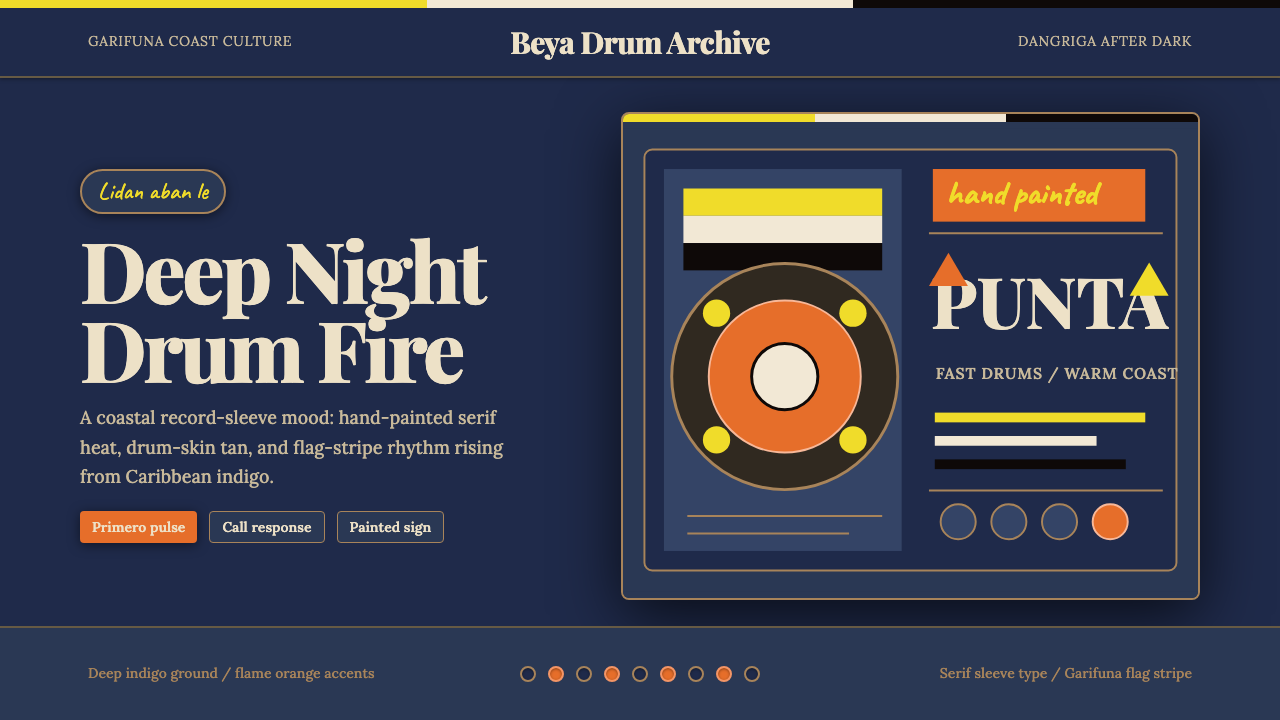
Born from exile and shaped by drum, punta is the heartbeat of the Garifuna people — a design voice that carries Caribbean night, hand-drum heat, and the fierce pride of a culture that refused to disappear.
Belizean Garifuna Punta in brief
Belizean Garifuna Punta is a design language rooted in the cultural world of the Garifuna — an Afro-Indigenous people settled along the Caribbean coast of Belize, Honduras, Guatemala, and Nicaragua. It draws its visual energy from the punta dance tradition: fast, percussive, communal, and charged with the rhythmic interplay of primero and segunda hand-drums, turtle-shell shakers, and call-and-response singing in the Garifuna language.
At its core, the style is built around deep-night indigo grounds, the warm tan of drum skin, and a bold flame-orange that pulses through composition like a beat. This is not a polished or corporate aesthetic — it evokes the hand-painted signage of coastal towns like Punta Gorda and Dangriga, the photographic warmth of recording-era album sleeves, and the expressive directness of community murals. Typography leans on strong serif letterforms that carry a declarative weight, grounded in the tradition of flag and banner lettering.
The result is a style simultaneously ancient and alive — one that holds historical memory without becoming a museum piece. Its darkness is not mournful but atmospheric; its warmth is not decorative but grounded in a living culture. It is a visual system that communicates presence, resilience, and the deep cultural confidence of people who have kept their language, music, and identity intact across three centuries of displacement.
Where does Belizean Garifuna Punta come from?
The story of the Garifuna begins in the seventeenth century on the island of St. Vincent in the eastern Caribbean, where Carib and Arawak Indigenous peoples had intermingled with African survivors of slave shipwrecks. The resulting community — later called Black Caribs by European colonizers, and Garifuna by themselves — developed a distinct language and culture that fused West African, Amerindian, and Caribbean elements into something wholly new. For over a century they resisted British colonial expansion, and their military resistance was among the most sustained of any Indigenous or African-descended group in the Caribbean.
In 1797, following a prolonged conflict, British forces deported the Garifuna population from St. Vincent to the Bay Islands of Honduras — a deliberate act of exile intended to scatter and dissolve a community that had refused submission. Instead, the Garifuna spread along the Central American coast, founding towns on the shores of what are now Belize, Honduras, Guatemala, and Nicaragua. November 19, 1802 is commemorated as Garifuna Settlement Day in Belize — the date the first settlers arrived at the settlement of Dangriga — and remains one of the most important cultural observances in Belizean national life.
Within this displaced community, music and dance became the primary vehicle for cultural transmission. Punta is the form most directly identified with Garifuna identity: performed at wakes, celebrations, and communal gatherings, it is driven by the primero and segunda hand-drums (each tuned to a different pitch), the húnguhúngu (turtle shell rattle), and maracas, with call-and-response vocals in the Garifuna language. Its rhythm is fast and intensely physical — punta dancing involves rapid, controlled hip movement and is considered both a social form and a spiritual practice connected to ancestor communication.
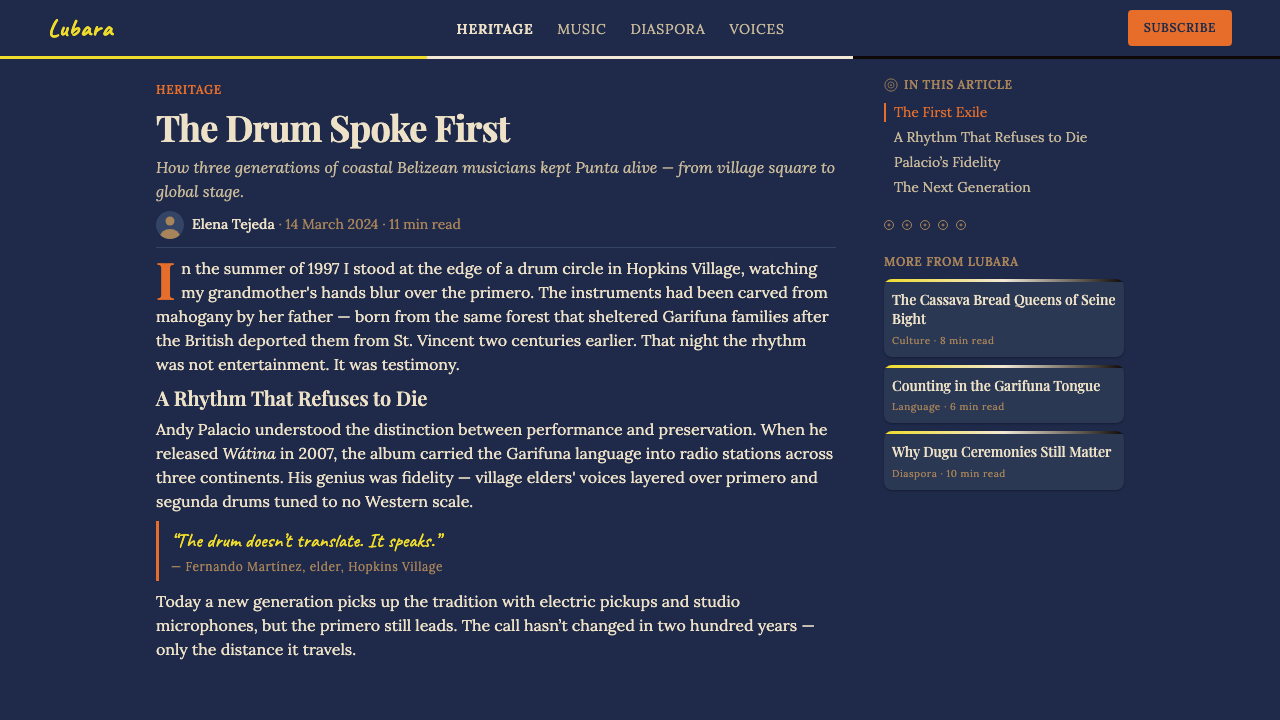
The contemporary reach of Garifuna culture owes much to the work of musicians who bridged tradition and global audiences. Andy Palacio, the guitarist and singer from Barranco, Belize, became the most internationally recognized Garifuna artist through his 2007 album Wátina, produced with Ivan Duran on the Stonetree Records label. The album brought together Garifuna elders including the singer Paul Nabor and reached listeners far beyond Belize, winning international recognition and leading to UNESCO proclamation of Garifuna language, dance, and music as Intangible Cultural Heritage of Humanity in 2001. Painter and musician Pen Cayetano pioneered the Punta Rock genre in the early 1980s, fusing traditional punta rhythms with electric guitar to create a form of pop music rooted in Garifuna identity. Honduran guitarist Aurelio Martínez continued this tradition of fusion and advocacy into the 2010s, representing Garifuna culture on international stages.
What defines the Belizean Garifuna Punta look?
Color Field
The dominant ground is a deep-night indigo — the blue-black of the Caribbean coast after dark, absorbing light rather than reflecting it. Against this field, a flame-orange functions as the percussive accent: warm, insistent, and energetic, it carries the visual equivalent of the lead drum. A drum-skin tan bridges the two poles, providing a mid-tone warmth that softens the contrast and evokes the physical material of the instruments themselves. The overall palette reads as deeply saturated but never garish — it is night music rendered in color.
Typography
Letterforms lean toward robust, declarative serifs — the kind found on hand-painted tropical signage, political placards, and record sleeve lettering. The type has physical weight and legibility at a distance, suggesting something meant to be announced rather than whispered. Hierarchy is established through dramatic size shifts: a headline that commands the composition is set many times larger than supporting text, with the flame-orange reserved for words or phrases that carry the emotional core of the message. Capitals appear frequently, reinforcing the proclamatory register.
Textural Warmth
Unlike purely flat digital aesthetics, this system carries a sense of material surface — the slight roughness of hand-applied paint, the grain of photographic film, the warmth of analog reproduction. This is not achieved through artificial noise filters but through color choices that evoke warmth and craft: the tan tones, the slightly impure oranges, the indigo that reads as dyed rather than printed. The visual texture is one of physical making — something touched and shaped by human hands rather than generated on a screen.
Rhythm and Repetition
Composition mirrors the call-and-response structure of punta music. Visual elements are arranged in rhythmic repetition — horizontal bands, stripe motifs drawn from the Garifuna flag, repeated geometric accents — that create a sense of forward momentum. The layout does not rest in static balance; it pulses. Areas of density alternate with areas of release, mimicking the dynamic variation of drum-driven music. This rhythmic quality distinguishes the style from decorative Caribbean pastiche, which tends toward symmetrical, static arrangement.
Cultural Signifiers
The visual system draws on legible cultural references without reducing them to exoticism. The horizontal stripes of the Garifuna flag — black, white, and yellow — appear as structural elements within compositions, used as dividers, backgrounds, or framing devices. The drum form itself occasionally appears as a silhouette or abstract shape rather than a literal illustration. Coastal landscape references — the horizon line, the night sky, the texture of sand and sea — provide spatial depth without relying on representational photography.
Darkness as Presence
The dark ground is not a stylistic choice borrowed from contemporary dark-mode convention — it is thematic. The deep indigo night is where punta is performed: at wakes, at open-air celebrations, on the coast under a Caribbean sky. The darkness carries meaning: it is the context in which the culture has preserved and transmitted itself for generations. When flame-orange and tan appear against this ground, they do not merely provide contrast — they represent fire, warmth, and the human presence that persists through the night.
Hand-Made Energy
The aesthetic sensibility draws from vernacular craft rather than institutional design. This means embracing visual decisions that feel direct and intentional rather than refined and neutral: type that sits with authority rather than retreating into elegance, color relationships that are bold enough to be read by firelight, layouts that prioritize immediate communication over subtle sophistication. The influence is the tradition of hand-painted signage, printed broadsheets, and community murals — work made by people for their community, not by studios for clients.
Who shaped Belizean Garifuna Punta?
Born in 1960 in the Garifuna fishing village of Barranco in southern Belize, Andy Palacio became the defining voice of Garifuna music for an international audience. Initially trained as a schoolteacher, he pursued music through the 1980s and 1990s, contributing to the early Punta Rock movement before deepening his engagement with traditional Garifuna forms. His 2007 album Wátina, produced with Ivan Duran and featuring elders including the elderly singer Paul Nabor, was widely recognized as a landmark recording. Palacio died in January 2008, weeks after suffering a stroke, but Wátina continued to reach new audiences and cemented his legacy as the artist who brought Garifuna culture most fully into global consciousness.
Pen Cayetano is the Belizean musician and visual artist credited with founding Punta Rock in the early 1980s. Frustrated by the older generation's conservatism around traditional punta, Cayetano began incorporating electric guitar and a rock-music sensibility into the drum-driven form, creating a hybrid that became enormously popular among young Garifuna and Belizeans generally. His visual art — largely self-taught, bold in color, and figurative in subject — documents Garifuna community life with the same directness that characterizes his musical approach. He represents the creative principle at the heart of this design style: cultural continuity through transformation, not preservation through stasis.
Ivan Duran is the producer and founder of Stonetree Records, the Belizean independent label he established in the 1990s that became the primary platform for Garifuna and Belizean music reaching international audiences. His work with Andy Palacio on Wátina demonstrated a production philosophy that placed traditional Garifuna performance at the center while creating recordings of international quality. Duran's aesthetic sensibility — visible in the visual language of Stonetree album covers — balances documentary warmth with crafted presentation, a balance that informs the design style associated with this tradition. He has continued producing Garifuna artists and advocating for the music's preservation and dissemination.
Aurelio Martínez is a Honduran Garifuna guitarist, singer, and political figure who has been among the most active international ambassadors for Garifuna culture in the 2000s and 2010s. His music fuses the rhythmic foundation of traditional punta with Afrobeat, blues, and reggae influences, producing a sound that is simultaneously rooted and globally inflected. As a member of the Honduran National Congress, he has also worked to defend Garifuna territorial rights against displacement — connecting the culture's survival to its people's material conditions in ways that echo the historical reality from which the style draws its depth.
How do you use Belizean Garifuna Punta today?
Applying Belizean Garifuna Punta to contemporary design work requires understanding what the visual system is doing at a structural level: it uses darkness as an atmospheric container, warmth as a signal of life and presence, and rhythmic repetition as a compositional organizing force. These are not decorative choices — they are arguments. Successful application means committing to those arguments rather than borrowing the palette and leaving the logic behind.
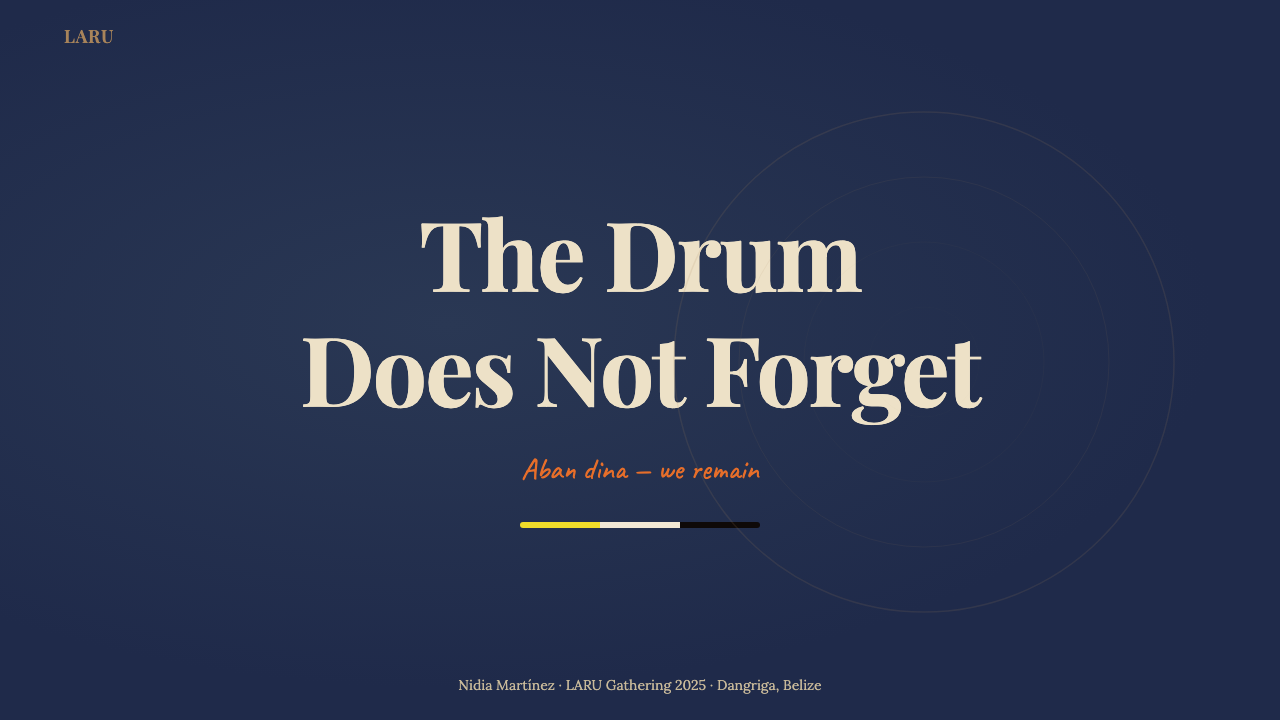
For presentation slides, the style excels at high-stakes contexts where emotional impact matters as much as information delivery: cultural advocacy, artistic proposals, event promotion, and community storytelling. A cover slide works best with a strong typographic composition — a single headline phrase in large, declarative serif type against deep indigo, with a flame-orange accent on the key word. Content slides should use the dark ground consistently, organizing information into clear rhythmic bands rather than isolated cards or bullet lists. Data slides can employ the stripe motif as a background element, with bar charts and proportional figures rendered in the palette's three core tones to create visual hierarchy through color.
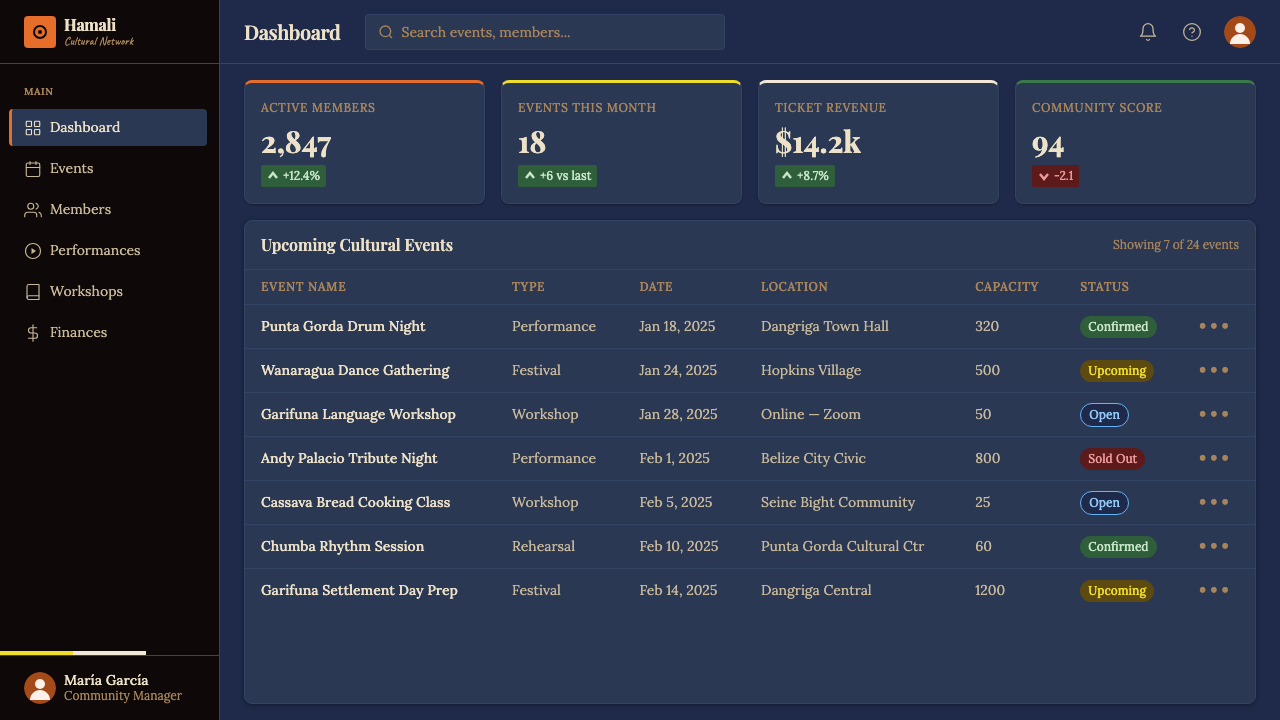
For web interfaces, the style is well-suited to landing pages, event sites, cultural institution pages, and music-related platforms where atmosphere and identity take precedence over functional neutrality. The approach: hold the deep-indigo ground through hero sections and featured content areas, use a lighter neutral or tan for body-content zones to maintain readability at length, and deploy flame-orange exclusively for calls to action, links, and the single most important phrase on each page. Navigation should be typographic, with generous spacing that allows the dark ground to breathe between elements.
For editorial and marketing work — album artwork, cultural program covers, festival materials, brand identity for artists or organizations with roots in Afro-Caribbean traditions — the style's directness and warmth make it highly distinctive. Print applications benefit from the palette's naturally high contrast: text in warm tan or flame-orange against indigo reads at even small sizes, and the stripe motifs work as structural dividers across both portrait and landscape formats. In marketing contexts, the hand-made energy of the style signals authenticity and community rather than corporate polish — a valuable signal for brands where cultural credibility matters.
A common mistake when working with this system is treating the flame-orange as an accent color to be used generously throughout a layout. In punta music, the lead drum punctuates rather than saturates; the orange should work the same way — appearing at specific moments of emphasis and then returning to the warmth of the indigo and tan. Similarly, using a contemporary sans-serif typeface in place of the declarative serif breaks the cultural register of the style: the serif carries historical weight and hand-craft reference that a neutral grotesque cannot replicate.
Belizean Garifuna Punta — FAQ
Is this style appropriate for brands without Garifuna cultural roots?
The question deserves honest consideration. Belizean Garifuna Punta is a living cultural tradition, not a historical artifact, and its visual language carries specific meaning for a community that has actively preserved it through sustained adversity. Using it thoughtfully — to amplify Garifuna voices, to create platforms that serve the community, or to honestly engage with Caribbean and Afro-Indigenous cultural heritage — is meaningfully different from applying it as a decorative exotic backdrop with no cultural connection. The more distant the brand from the culture, the more important it is to consider what the visual language is communicating and whether that communication is honest.
How does this style differ from other Caribbean-inspired design aesthetics?
Most Caribbean-inspired aesthetics in contemporary design draw from tourist-facing, resort, or festival imagery: bright turquoise and coral, tropical foliage, loose painterly textures, and a general atmosphere of leisure and warmth. Garifuna Punta is night-facing rather than day-facing: deep indigo rather than turquoise, flame rather than pastel, percussive rhythm rather than decorative pattern. It has the weight of cultural memory rather than the lightness of vacation imagery. The darkness and the declarative typography set it distinctly apart from both the colorful folk-craft traditions of other Caribbean cultures and the sun-bleached lightness of resort aesthetics.
Can the style work in a light-ground version?
Technically yes, but with significant cost to the style's integrity. The deep-indigo ground is not arbitrary — it is the atmospheric condition from which all other elements derive meaning. A light-ground inversion that uses white or cream as the base with indigo and orange as accents becomes something closer to a generic Caribbean-inspired palette than to the specific cultural register of punta. If a light ground is required by the application context — for extended reading comfort in a document, for example — the recommendation is to reserve the dark-ground treatment for hero elements, covers, and high-emphasis sections, and use the light ground only for body-content zones where the dark palette would impair readability.
What makes the stripe motif culturally specific rather than generically decorative?
The horizontal stripes in this visual system reference the Garifuna flag: black (for the people's African heritage), white (for peace and the spiritual dimension of Garifuna culture), and yellow (for the prosperity of the land). Used as structural elements — as section dividers, background bands, or framing devices — they carry this specific referential weight. The distinction from generic stripe decoration lies in how they are deployed: not as pattern fill or surface ornament, but as compositional structure with directional energy. When the stripes organize a layout, they are doing the same work they do on the flag — asserting presence, defining space, and marking identity.
How should imagery be handled within this design system?
Photography within this system works best when it carries the same atmospheric qualities as the palette: warm-toned, slightly grain-forward, and shot in conditions that evoke performance or community rather than studio isolation. Images treated with warm analog-film color grading sit more naturally in the system than clean, color-corrected digital photographs. Silhouette treatment — figures or objects isolated against the deep-indigo ground — creates a powerful visual register that balances the typographic weight of the compositions. Abstract illustration, if used, should draw from simple geometric shapes rather than detailed figurative work: drum forms, wave patterns, horizon lines. The system resists both generic stock photography and over-produced commercial imagery, favoring images that feel made rather than purchased.
Related design styles
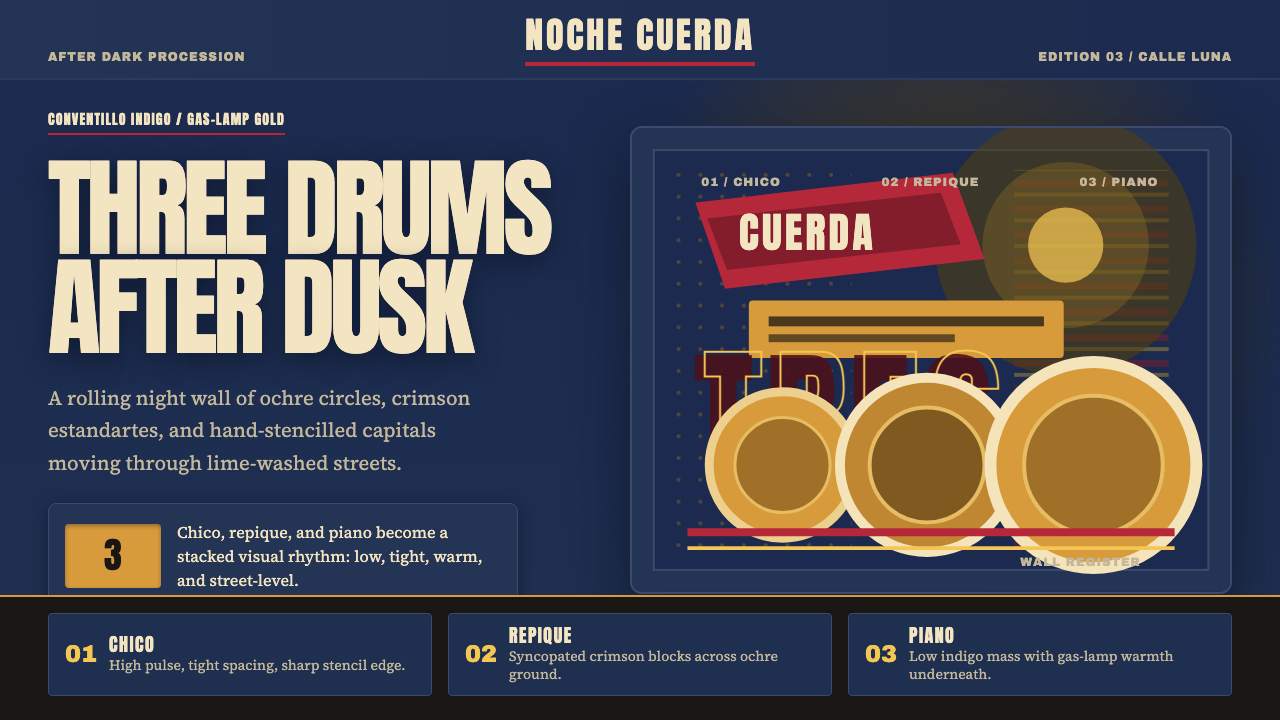 Uruguayan Candombe LlamadasCandombe after dark. Indigo ground, ochre drum circles, crimson banner type.
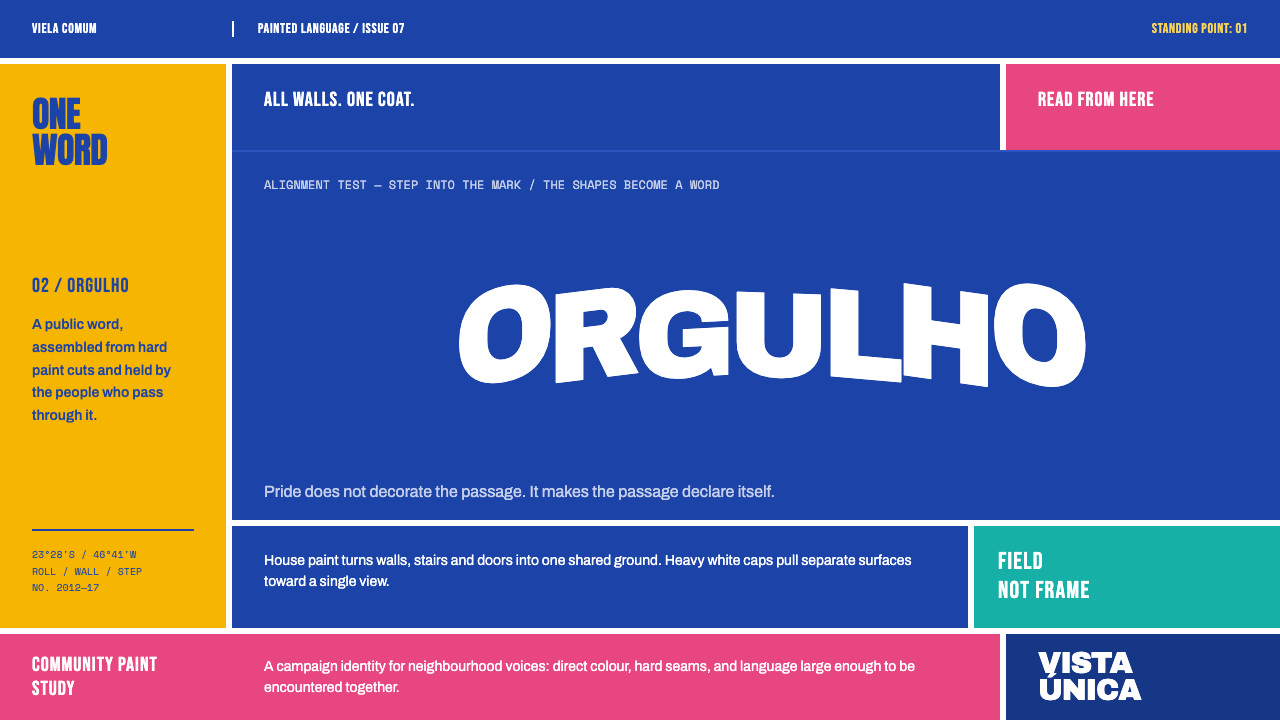 Boa Mistura Favela PaintingPride fills the passage. White Archivo Black caps snap across an ultramarine…
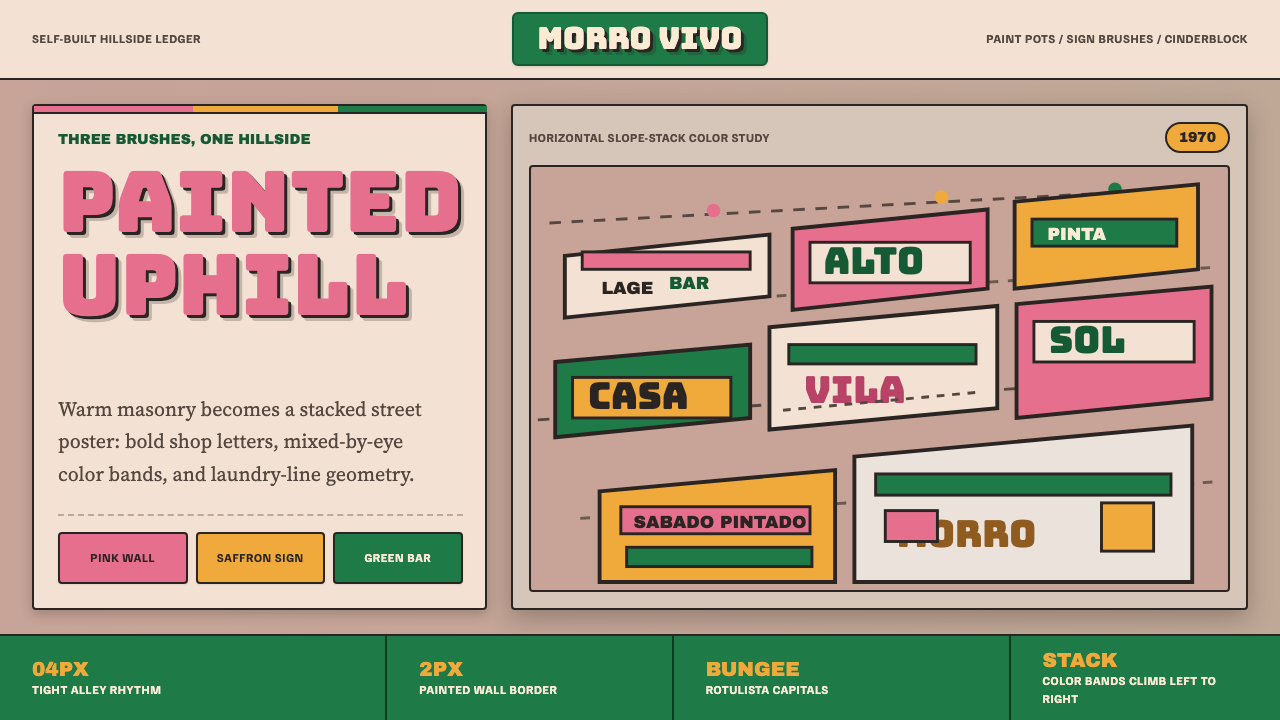 Brazilian Favela Rocinha 1970sHand-built warmth. Pink, saffron and green stripes climb cinderblock in rotul…
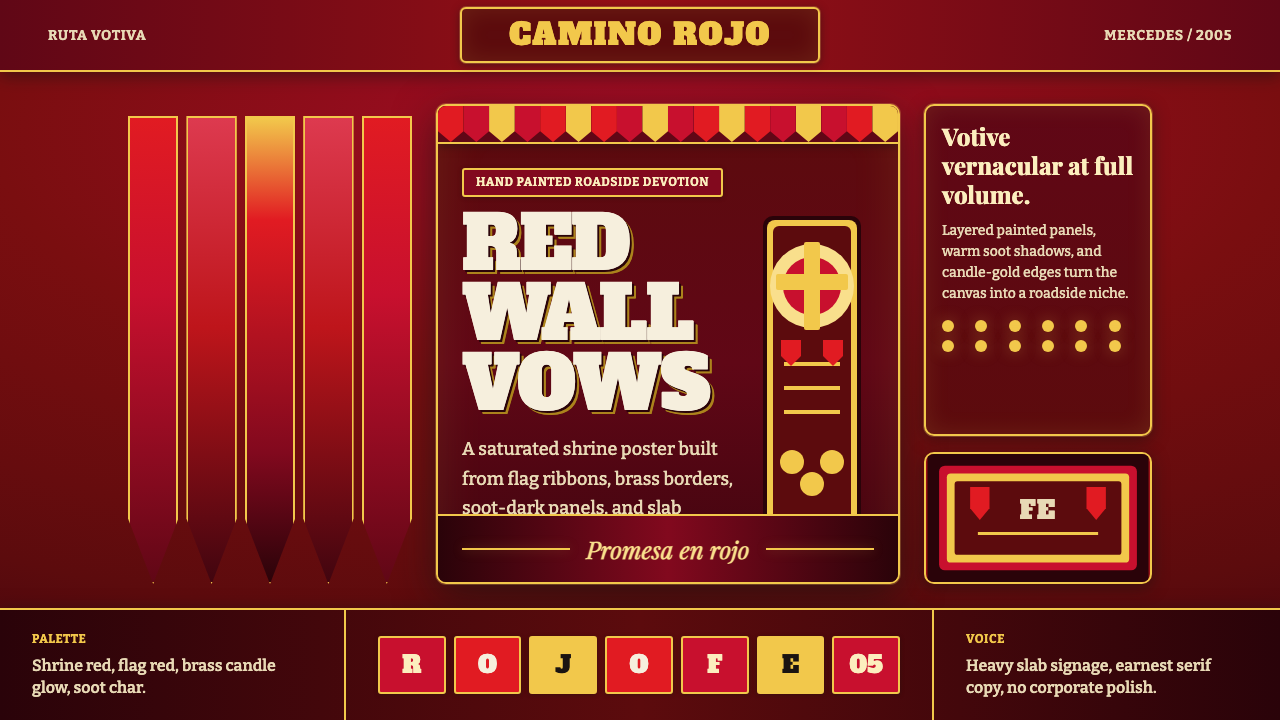 Gauchito Gil ShrineDevotion burns red. Flag ribbons, brass borders, and slab signage glow on soo…
 Afoxé Filhos de GandhyA procession that refuses to hurry. Cotton white and bead blue repeat in a me…
 Amores Perros New WaveRaw street cinema. Crushed black, sodium amber, Oswald credits, heavy 35mm gr…