What is Bangladeshi Rickshaw Painting (Dhaka)?
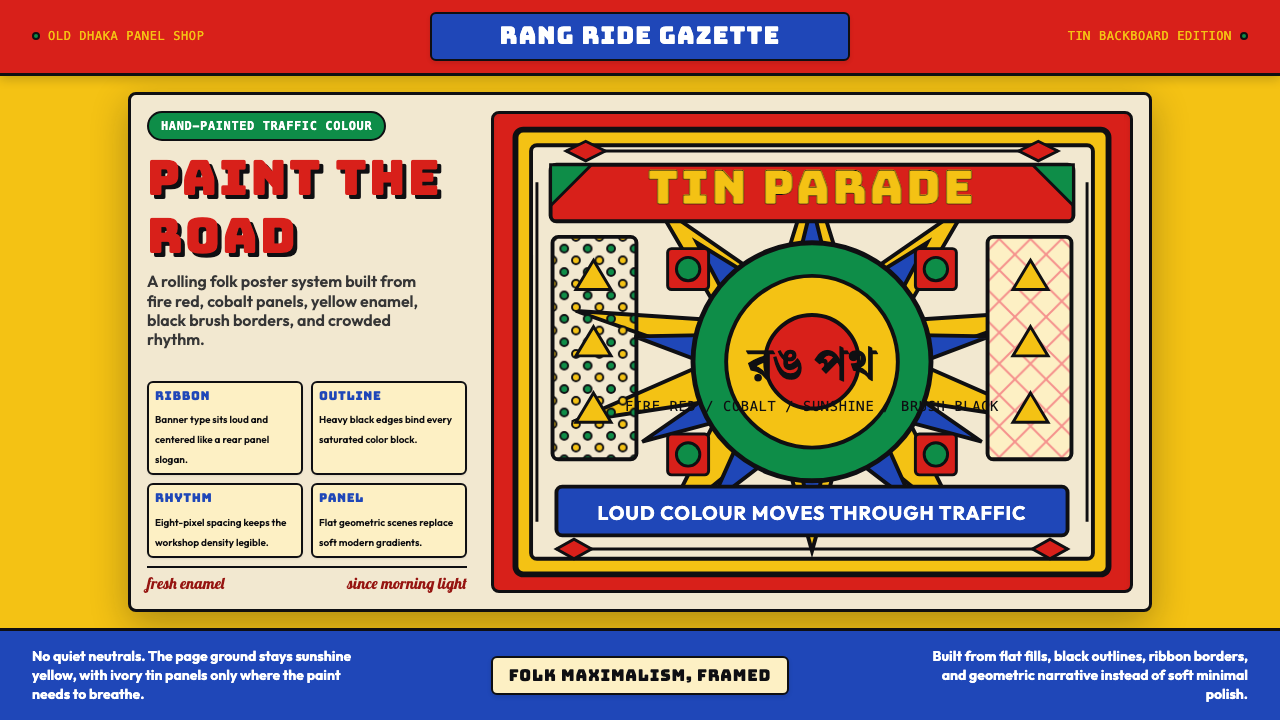
Dhaka's cycle-rickshaws are a rolling folk-art gallery — each hand-painted back panel a vivid explosion of saturated color, centred composition, and ornamental ribbon borders that has been turning heads in city traffic since the 1950s.
Bangladeshi Rickshaw Painting (Dhaka) in brief
Bangladeshi Rickshaw Painting is a living folk-art tradition practiced across Dhaka and other major Bangladeshi cities, in which the back panels, hoods, and side fenders of cycle-rickshaws are painted by hand with bold imagery — film stars, tigers, mosques, natural landscapes, political slogans, and scenes from mythology — framed within ornamental borders and set against intensely saturated grounds. Each panel is a self-contained composition, typically oriented in a vertical or near-square format, that must read clearly from several metres away in chaotic traffic while simultaneously rewarding close inspection with intricate detail.
As a design system, Rickshaw Painting offers a maximalist counter-argument to minimalism: it demonstrates that saturated, competing colors and dense layered imagery can coexist with compositional clarity when a strong centred focal hierarchy and disciplined border framing are maintained. The visual logic is closer to folk poster-making than to academic fine art — every element is chosen for immediate legibility and emotional impact, not for conceptual subtlety. The result is a style of extraordinary energy and warmth that has influenced contemporary South Asian graphic design, fashion textile printing, and digital interface work.
Unlike many folk-art traditions that retreated with industrialization, Rickshaw Painting adapted and persisted. Workshops in Old Dhaka, Mohammadpur, and Mirpur continued to produce hundreds of panels weekly well into the 2010s. Under cultural pressure from cheaper vinyl-print alternatives, master painters and organizations such as the Bengal Foundation began documenting and recontextualizing the tradition, bringing it into gallery spaces, textile design, and — increasingly — digital product aesthetics.
Where does Bangladeshi Rickshaw Painting (Dhaka) come from?
The cycle-rickshaw itself arrived in Dhaka during the 1930s and 1940s, introduced during the late colonial period as a human-powered transit solution for the city's dense, narrow neighbourhoods. Decoration of the vehicles began almost immediately, but it was during the 1950s — in the years following Partition (1947) and then the establishment of East Pakistan — that a distinctive visual idiom emerged. Early panels drew on the conventions of South Asian film-poster painting: bold facial portraits, dramatic skies, and hand-lettered title treatments in the regional Bengali script tradition.
The craft took root in specific neighbourhoods of Old Dhaka, where workshops developed informal apprenticeship structures. Young men from rural areas came to the city, attached themselves to established painters, and learned not from formal instruction but from proximity and repetition — watching the master lay in color fields, tracing border ornament, eventually graduating to painting secondary figures and backgrounds before attempting central portraits. The painters developed a shared vocabulary of motifs: the lotus, the tiger, the mosque dome, the film star couple, the rising sun — each rendered according to conventions that changed slowly across generations.
The 1970s and 1980s — the decades following Bangladeshi independence in 1971 — were the tradition's peak period in terms of number of practitioners and cultural visibility. The newly formed nation's identity politics gave fresh urgency to imagery celebrating Bengali landscape, folk heroes, and national pride. At the same time, the Dhaka film industry was generating a prolific supply of movie-poster commissions that both fed the painters economically and drove visual innovation. Painters such as R.K. Das and A. Lateef developed reputations that extended beyond the workshop into cultural recognition.
Anthropologist and folklorist Joanna Kirkpatrick, who conducted field research in Dhaka from the 1980s onward, produced the earliest sustained academic documentation of the tradition — photographing workshops, interviewing painters, and tracing the iconographic genealogies of recurring motifs. Her work helped establish Rickshaw Painting as a legitimate subject for cultural and visual studies scholarship, and later contributed to UNESCO discussions around intangible cultural heritage nomination. Hanif Pala, a painter who bridged the workshop tradition and the contemporary art world, became a key figure in the Bengal Foundation's efforts to translate the tradition into gallery-compatible work without severing it from its vehicular origins.
What defines the Bangladeshi Rickshaw Painting (Dhaka) look?
Color Saturation and Contrast
The palette operates at maximum saturation. Fire-engine red, cobalt blue, and sunshine yellow are the anchor hues, used in large unbroken fields that compete for visual dominance without cancelling one another out. The secret to the system's stability is the use of heavy black outlines and black border zones that separate competing color areas and prevent visual mudding. Against the saturated fields, white and cream appear as breathing space — a thin highlight on a face, a gap between border elements — rather than as a background ground. The effect is one of radiant luminosity: colors seem to glow from within.
Centred Focal Hierarchy
Unlike Western design traditions that favour asymmetric composition, Rickshaw Painting is centred and symmetrical in its primary axis. The main subject — a portrait, a building, a wildlife scene — occupies the geometric centre of the panel and is rendered at the largest scale. Secondary elements (sky, landscape, floral fill) recede concentrically around the focal subject. This centred hierarchy evolved from practical necessity: a panel must communicate its subject to a viewer approaching from directly behind the vehicle, and centred symmetry achieves instant recognition. The approach gives the style a heraldic, frontal quality that translates well to digital formats such as thumbnail cards and cover images.
Ornamental Border Systems
Every panel is framed by one or more concentric border bands, each carrying its own decorative vocabulary — geometric repeats, floral chains, interlocking ribbons, or calligraphic flourishes derived from Bengali manuscript and architectural ornament traditions. The borders serve both an aesthetic and a structural function: aesthetically, they enrich the periphery and signal the completeness of the composition; structurally, they contain the central subject and prevent the saturated colors of the interior from bleeding visually into the vehicle's metal body. Border widths are proportional — wider at the outer edge, narrower as they approach the central image — creating a sense of graduated framing that dignifies the central subject.
Hand-Lettering and Bengali Script
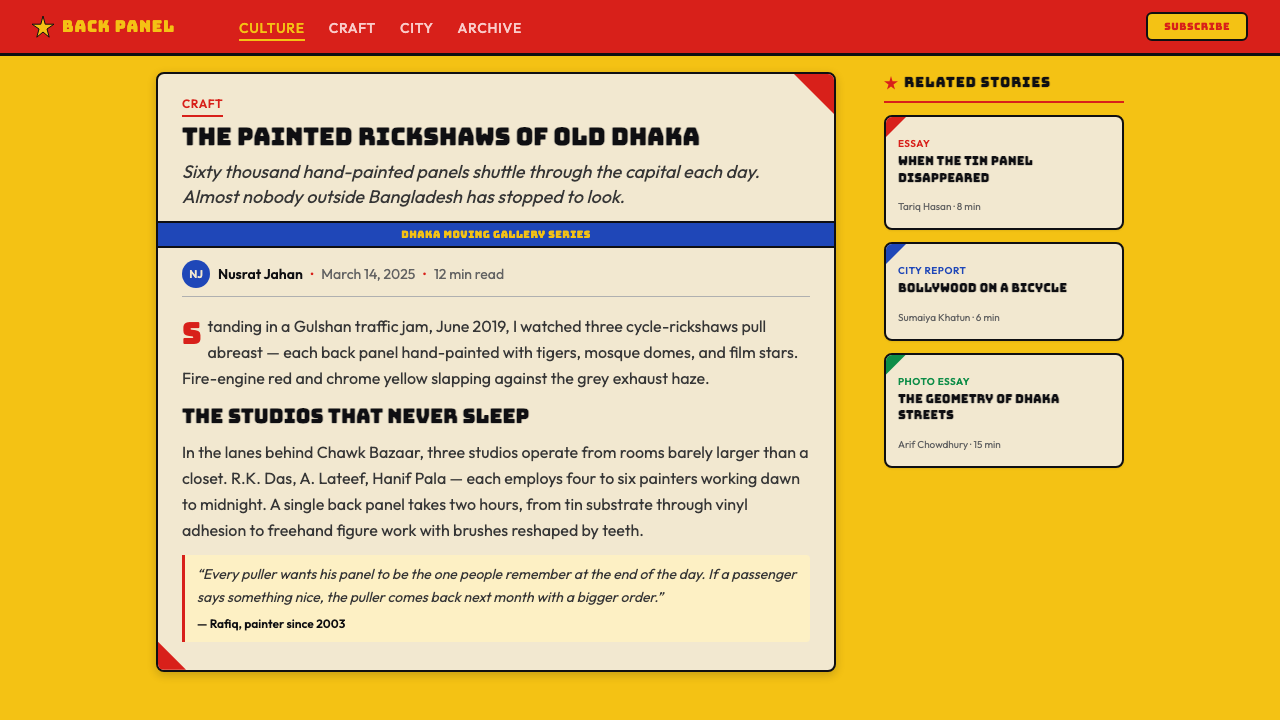
Text appears in many panels as slogans, film titles, prayers, or owners' names, and it is invariably hand-lettered rather than applied with stencil or transfer. The Bengali script's characteristic horizontal headline stroke — the matra — lends lettering a natural architectural quality, with letters hanging from a shared top bar rather than sitting on a baseline. Rickshaw painters developed letterform conventions that emphasize this quality: wide, rounded bowls, bold strokes, and generous spacing that holds legibility at a distance. Latin-script lettering, when it appears, is typically rendered in a similarly bold brush style, absorbing rather than imitating Western type conventions.
Layered Narrative Imagery
Rickshaw panels are not abstract — they depict. The imagery is consistently representational and often narrative: a famous actress mid-scene, a tiger emerging from jungle foliage, a mosque framed by flowering trees, a riverboat crossing at sunset. This representational tradition distinguishes the style sharply from modernist abstraction and connects it to centuries of South Asian visual storytelling in manuscript painting, temple relief, and street theatre poster art. Multiple narrative layers can coexist in a single panel — a foreground subject, a middle-distance setting, a sky or atmospheric background — each rendered in its own color register while held together by the border framing and the centred focal hierarchy.
Impasto Energy and Brushwork Texture
Because the panels are made in volume under economic time pressure, the brushwork is confident and economical rather than fussy or overworked. Enamel and oil-based paints are applied in a relatively thick film that catches raking light and gives the surface a subtle three-dimensional texture. This impasto quality — the visible evidence of the painter's hand — is part of the tradition's aesthetic signature. When translated to digital contexts, referencing this quality means prioritizing bold, slightly uneven color fields and textural surface interest over the perfectly flat uniformity of production-software defaults.
Maximalist Completeness — No Empty Ground
Where a minimalist aesthetic prizes empty ground as active negative space, Rickshaw Painting treats emptiness as a problem to solve. Sky areas are filled with graduated color and cloud motifs; background zones receive landscape fill or decorative patterning; border areas carry their own ornamental systems. The goal is a surface that is everywhere considered and nowhere vacant. This completeness is not chaos — it is managed abundance, in which each zone of the composition has its designated register of color and pattern, and the whole is unified by the centred hierarchy and the containing border.
Who shaped Bangladeshi Rickshaw Painting (Dhaka)?
One of the most celebrated workshop masters in Dhaka's rickshaw painting tradition, R.K. Das developed a reputation for portrait work of unusual refinement within the constraints of the craft — achieving expressive faces and detailed costume rendering in panels that had to be completed quickly and survive outdoor exposure. His workshops in Old Dhaka trained multiple generations of painters who carried his compositional conventions and border vocabulary forward into subsequent decades.
A. Lateef was known particularly for his treatment of natural imagery — tigers, herons, river landscapes — rendered with a painterly sensitivity that gave his panels an almost editorial quality distinct from the more graphic poster conventions of many contemporaries. His approach to the graduated sky — moving through deep blue at the top to a warm ochre at the horizon — became a widely referenced convention in Dhaka workshops during the 1970s and 1980s.
Hanif Pala occupies a transitional position in the tradition's history: trained in the workshop system, he later became a central collaborator of the Bengal Foundation's efforts to bring Rickshaw Painting into gallery and textile contexts without stripping its folk identity. His advocacy helped articulate the distinction between authentic practice and commercial pastiche, and his public demonstrations — painting full-scale panels before gallery audiences — drew new audiences to the tradition at a moment when vinyl printing was threatening workshop viability.
An American anthropologist and folklorist, Joanna Kirkpatrick conducted decades of field research in Dhaka beginning in the 1980s, producing the first systematic academic documentation of Rickshaw Painting as a craft tradition. Her photographic archives, interviews with painters, and analysis of iconographic conventions established a scholarly foundation that subsequent researchers and cultural institutions drew on. Her work was instrumental in framing the tradition as intangible cultural heritage worthy of preservation and study rather than ephemeral street art.
How do you use Bangladeshi Rickshaw Painting (Dhaka) today?
Bangladeshi Rickshaw Painting is a bold, emotionally warm style that translates best to contexts where expressive energy, cultural richness, and immediate visual impact are priorities. Applying it well requires committing to its core logic: saturated color, centred hierarchy, ornamental framing, and representational imagery. Applying it partially — borrowing only the colors without the compositional structure, or the border ornament without the saturated grounds — produces work that reads as generic South Asian pastiche rather than as a coherent design system.
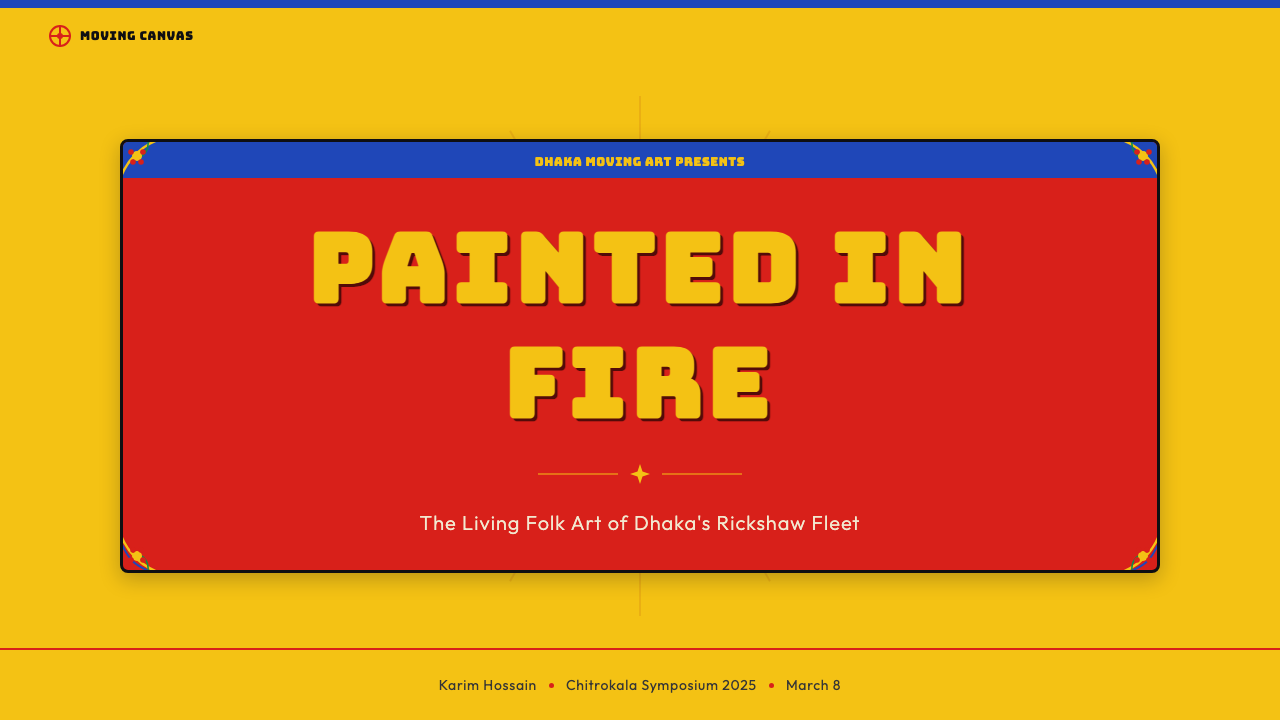
For presentation slides, the style works best when the slide architecture mirrors the panel's compositional logic. A cover slide should place a single strong central image — a photograph, an icon, a bold typographic mark — at the visual centre, surrounded by a thematically consistent color field, with the presentation title rendered in hand-lettered or display typography at the bottom or top of the composition. Border ornament translated as a consistent repeating frame around slides creates the sense of a considered, complete surface. Content slides benefit from using the style's color logic as a semantic system: one anchor color for section headings, a second for data highlights, warm grounds rather than white for body text areas.
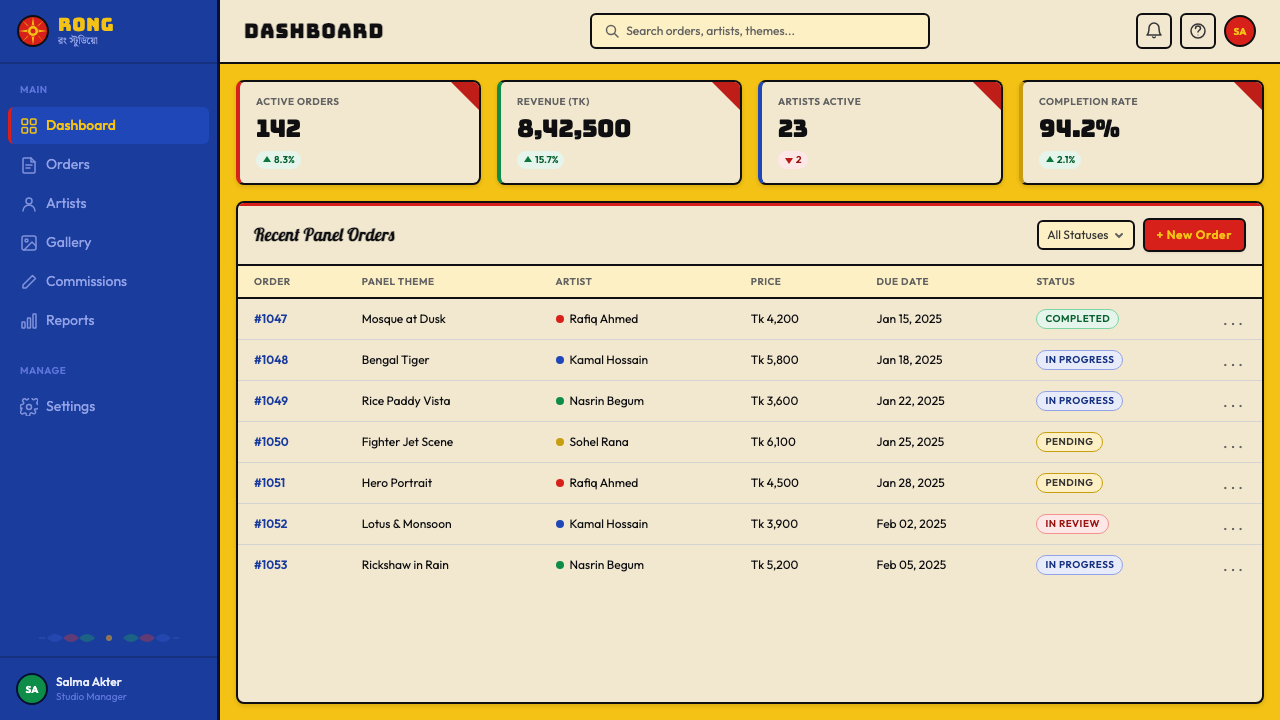
For web interfaces, the style suits marketing pages, landing pages, and cultural platforms where warmth and visual richness are valued over austere clarity. A rickshaw-painting-inspired dashboard would use deeply saturated panels as section backgrounds, centred card layouts with strong figurative thumbnail imagery, and ornamental dividers between sections rather than flat hairlines. Navigation and typographic elements should be bold and generous — fine type at small sizes fights against the style's expansive energy. The style is not naturally suited to data-dense analytical interfaces where cognitive load reduction is paramount: its richness competes with the clarity those contexts demand.
For editorial and marketing work, the style offers powerful opportunities for cultural storytelling contexts — travel brands, food and beverage, arts and music festivals, fashion campaigns with South Asian references. Full-bleed saturated color backgrounds, centred photographic or illustrated subjects, and ornamental border treatments are all directly translatable. The style also supports vibrant packaging design and textile print patterns, where the border-within-border structure can be adapted to repeat modules and edge treatments.
A common mistake when working with this aesthetic is confusing saturation with disorder. Rickshaw Painting is maximalist but not random: every color area has a defined zone, every border has a consistent internal logic, and the centred focal hierarchy anchors the whole composition. Designers who borrow the palette without internalizing the structural discipline — who scatter saturated elements without a clear focal hierarchy or containing frame — produce work that is merely loud rather than vivid. The second common error is sanitizing the palette toward pastel or muted versions to make it feel more 'designed'; this strips the style of its essential quality, which is precisely the confidence of full-saturation commitment.
Bangladeshi Rickshaw Painting (Dhaka) — FAQ
How is Rickshaw Painting different from other South Asian folk-art traditions like Madhubani or Warli?
Madhubani (from Bihar, India) and Warli (from Maharashtra, India) are both ancient traditions tied to religious ceremony and domestic ritual, typically worked in earth pigments and natural dyes with an emphasis on two-dimensional pattern and symbolic geometry. Rickshaw Painting is modern by comparison — it emerged in an urban, commercial context in the twentieth century — and is explicitly representational and narrative rather than symbolic or geometric. It uses industrial enamel paint at full saturation rather than muted natural pigments, and its subject matter is secular and contemporary: film culture, national identity, wildlife, and devotional imagery coexist without hierarchy. The comparison that is perhaps more useful is with Mexican lowrider car culture or Haitian tap-tap bus painting — other traditions of vernacular vehicle decoration that transformed functional transport into mobile public art.
Is the tradition dying out, or is it genuinely thriving?
The honest answer is complicated. The number of full-time workshop painters working in the traditional hand-painted mode has declined significantly since the 1990s as vinyl-print sticker panels became cheaper and faster to produce. Many rickshaw owners today opt for printed panels that imitate the aesthetic of hand-painting without requiring a skilled painter. However, the tradition as a cultural practice is experiencing renewed interest: design schools, textile manufacturers, and visual artists across South Asia are drawing on Rickshaw Painting as a source vocabulary; gallery exhibitions and craft-fair markets have created new economic pathways for skilled painters; and digital tools now allow the aesthetic to reach global audiences who would never encounter a Dhaka rickshaw. The challenge — familiar from many endangered craft traditions — is maintaining the living workshop transmission system through which technical mastery is passed from master to apprentice.
What kinds of subjects are traditionally depicted, and are there subjects that are considered inappropriate?
The canonical subjects are film stars (especially actors from the Dhaka film industry, Bollywood, and Bengali cinema), tigers and other wildlife, mosques and Islamic architectural motifs, natural landscapes (rivers, rice fields, mountains), patriotic imagery (national flag, liberation war scenes), and devotional imagery (mosques, Quranic calligraphy in some periods). Political figures — especially figures associated with Bangladeshi independence — have been popular subjects in certain periods. Explicitly erotic imagery is not part of the tradition, given the Muslim cultural context of most workshops. Western cultural imagery appears occasionally but is generally absorbed and transformed rather than copied directly — a Hollywood actor might appear, but rendered in the same style and scale conventions as a Dhaka film star rather than in a photorealistic Western portrait tradition.
Does this style work well in dark-mode or dark-background digital interfaces?
Surprisingly well, with some adjustment. The original tradition uses saturated color on mid-toned grounds — the reds, blues, and yellows read at full intensity against the grounded ochre or teal of the vehicle body rather than against pure white. Translating to a dark digital ground, the saturated hues maintain their luminosity and can actually intensify — particularly warm reds and yellows, which advance against dark backgrounds with particular force. The adjustment required is in the border treatment: on a dark ground, the black outlines that separate color fields in the original tradition lose their contrast function and must be replaced with gold, ochre, or white outlines. Dark-ground rickshaw-painting-inspired interfaces tend to feel more jewel-like and theatrical than the original tradition, which suits entertainment, festival, and premium cultural brand contexts.
How do I avoid cultural appropriation concerns when using this style outside of a Bangladeshi cultural context?
The clearest approach is attribution and abstraction. If using the style for a project unrelated to Bangladesh or South Asian culture, draw on its structural and coloristic logic — the saturated palette, the centred hierarchy, the ornamental border framing — without directly reproducing specific sacred or culturally significant imagery (Quranic calligraphy, specific political figures, national symbols). Commission or license work from Bangladeshi artists where the project budget allows. Credit the tradition explicitly in design documentation and public-facing about pages. The structural vocabulary of Rickshaw Painting — bold saturation, centred composition, border systems, layered narrative — is a genuinely useful design toolkit that can be applied with integrity when the cultural source is acknowledged rather than obscured.
Related design styles
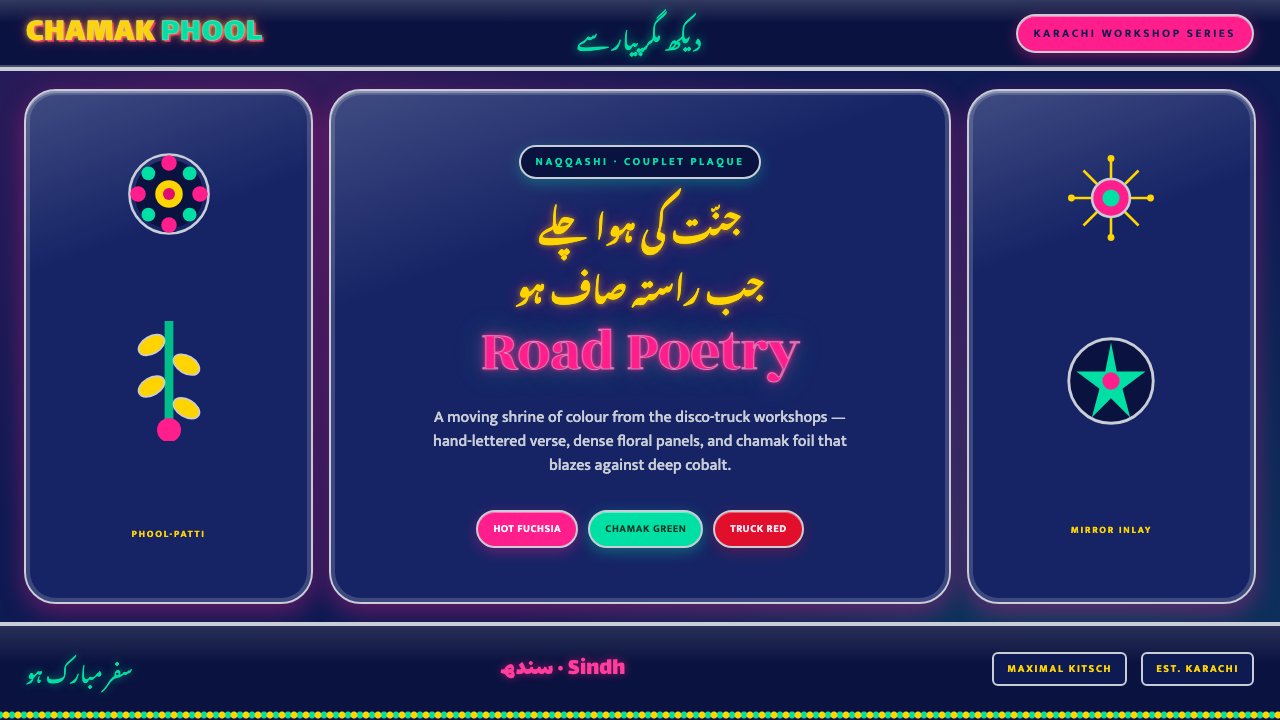 Sindhi Truck CalligraphyKarachi truck art, digitized. Hot fuchsia and chamak green blaze on deep coba…
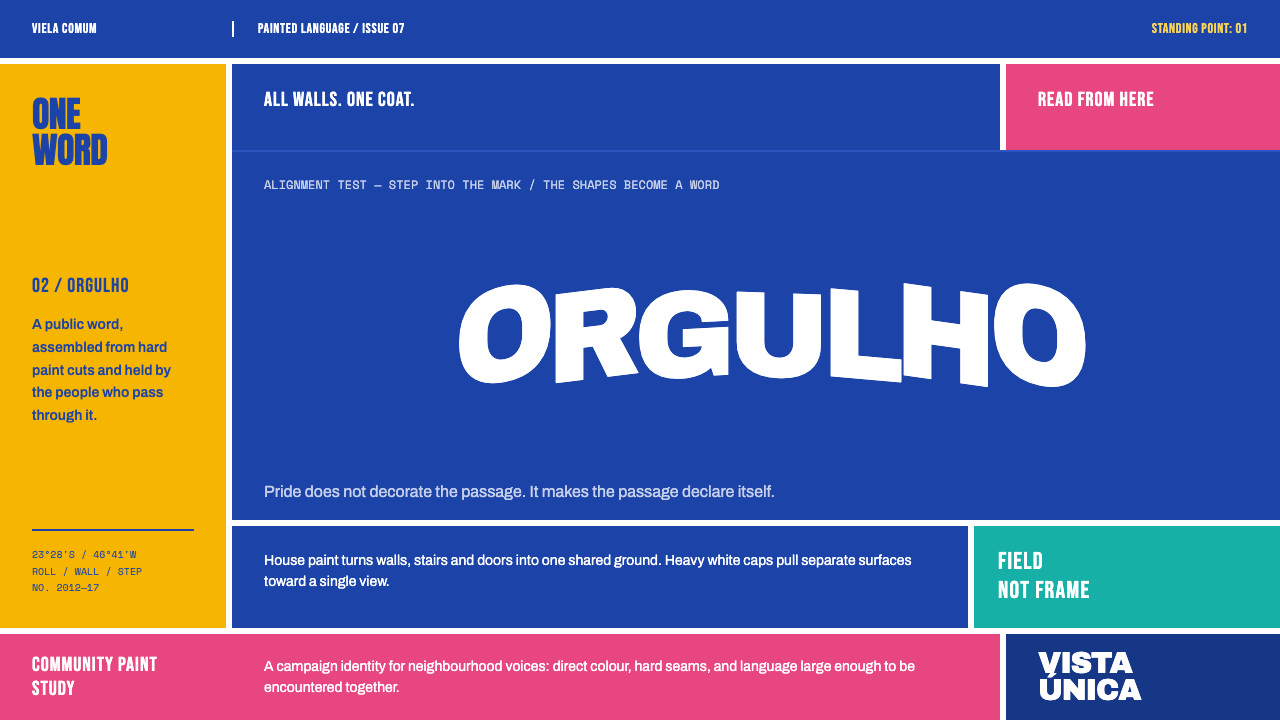 Boa Mistura Favela PaintingPride fills the passage. White Archivo Black caps snap across an ultramarine…
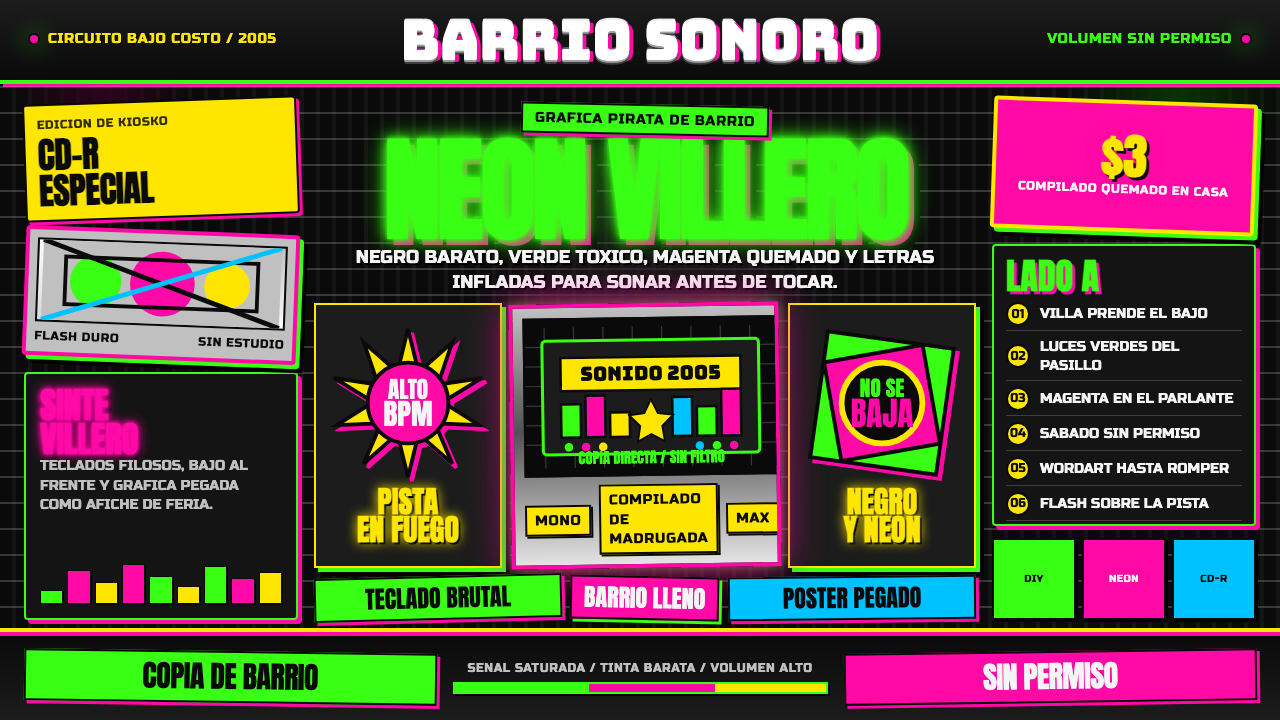 Cumbia VilleraLow-budget defiance. Neon green and hot magenta crowd black with chrome inlin…
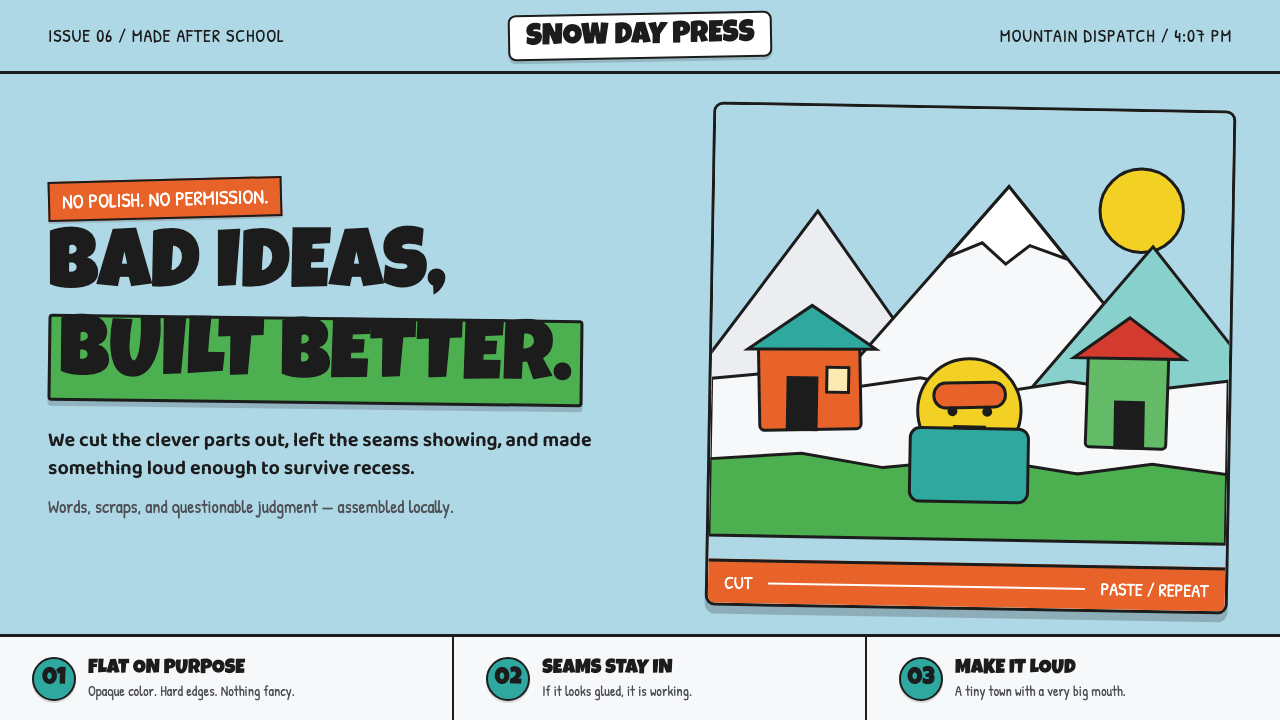 South Park Cutout (1997)Crude is the charm. Opaque paper shapes, marker-black seams, and snow-bright…
 Trinidad Carnival Soca (2010)Joy overload. Turquoise field, vermilion banners, gold sequins, feather-fan g…
 Belizean Garifuna PuntaNight rhythm burns. Indigo fields, flame-orange serif type, and flag stripes…