What is Rick and Morty?
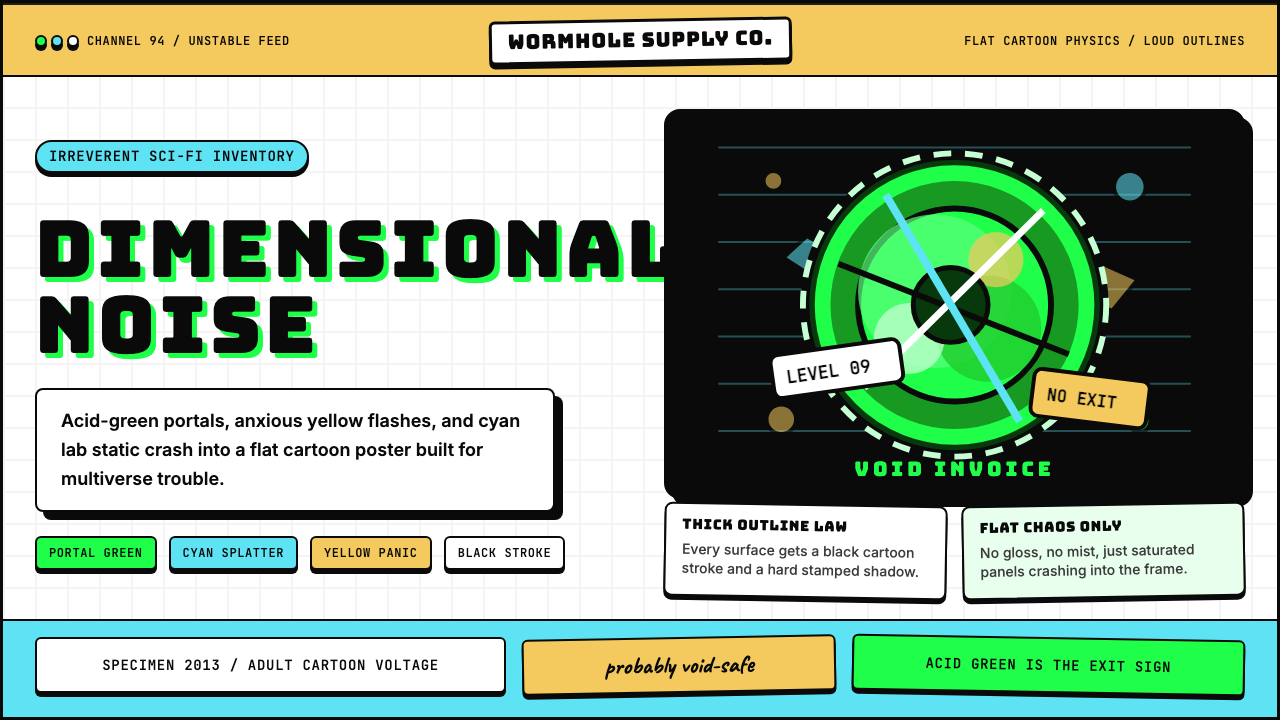
Rick and Morty weaponized the Saturday-morning cartoon — acid-green portals, thick black outlines, and a multiverse of screaming color that made irreverence look like philosophy.
Rick and Morty in brief
Rick and Morty is the visual language of Adult Swim's flagship sci-fi animated series, premiered in 2013 and created by Dan Harmon and Justin Roiland. Its aesthetic is not accidental or incidental to the show's themes — it is an argument. The saturated acid-green portal, the chunky black character outlines, the riot of flat multiverse color all announce a world that is simultaneously childlike and nihilistic, accessible and philosophically abrasive.
The design language operates on a deliberate contradiction: it uses the visual grammar of children's television — thick outlines, flat fills, bold primary-adjacent colors, expressive character geometries — to carry content that is deliberately adult, chaotic, and self-aware. This tension is structural. The cartoon form is not a wrapper for the ideas; it is inseparable from them. The show's visual identity has become one of the most recognized and referenced aesthetics in contemporary animation and graphic design.
As a design system applied outside the show itself, the Rick and Morty aesthetic signals irreverence, intelligence, and a refusal to take conventional visual hierarchies seriously. It is the visual equivalent of a joke that is also an argument. Applied correctly, it produces work that feels energetic, opinionated, and memorably bold — a useful counterpoint to the polished minimalism that dominates most contemporary digital design.

Where does Rick and Morty come from?
The show premiered on Adult Swim — Cartoon Network's late-night block for adult animation — on December 2, 2013. Its visual style was shaped from the outset by the production studio Williams Street and later Starburns Industries, working within the aesthetic conventions of Adult Swim's existing lineup while pushing them into more chaotic, color-saturated territory. The character designs by Justin Roiland deliberately echo the loose, slightly off-model quality of improvisational sketch animation: Rick and Morty are both instantly recognizable and visually unstable, their outlines slightly wobbly, their proportions cartoonishly exaggerated.
The acid-green portal — arguably the show's single most recognizable visual element — was established in the pilot and became an immediate visual shorthand for interdimensional travel, danger, and possibility simultaneously. Its color sits in a register that does not exist in nature at such intensity: it is a screen color, a fluorescent color, a color that could only exist in a lit medium. This intentionality distinguishes it from the more naturalistic palettes of contemporaries: the green is not illustrative but symbolic, functioning more like a brand mark than a narrative color choice.
The broader color system pairs that portal-green with what might be called Morty-yellow — the warm, slightly anxious yellow of Morty's shirt and much of the human-world palette — and Rick-blue, the cool, slightly otherworldly blue of Rick's hair and many alien environments. These three colors form the show's primary visual triangle, with black outlines and white fills providing structure. Secondary and environmental colors are used freely and often violently across alien worlds and interdimensional sequences, but the core trio anchors every scene that takes place in recognizable space.
Dan Harmon's background in improvisational writing and Justin Roiland's roots in internet animation culture both contributed to a visual ethos that valorizes roughness over refinement, expressive exaggeration over photorealistic detail, and tonal instability over polish. The show's visual style was never designed to be beautiful in a conventional sense — it was designed to be legible, energetic, and capable of supporting extreme emotional range, from cosmic horror to bathroom humor, within a single scene. This range is itself part of the aesthetic: the cartoon form must be robust enough to contain both registers without collapsing into either.
What defines the Rick and Morty look?
Portal Green
The defining color of the system is an almost fluorescent acid green that occupies a visual register beyond naturalistic illustration — it reads as artificial, electric, and urgent. This color functions as the system's anchor and brand mark simultaneously, used for the show's signature portal device and extended across interface elements, backgrounds, and typographic accents wherever the aesthetic is applied. It is not a green that invites contemplation; it is a green that demands attention.
Character Yellow and Rick Blue
Complementing the portal green, a warm, slightly anxious yellow drawn from Morty's iconic shirt anchors the human-world palette, while a cool, slightly otherworldly blue — associated with Rick's hair and alien environments — provides tonal contrast. These two colors operate as secondary and tertiary anchors within the system, creating a three-way chromatic tension that is energetic rather than harmonious. The combination reads as deliberately off-balance, which is part of its expressive purpose.
Thick Black Outlines
Every character and major design element in the system is bounded by a heavy, consistent black stroke that reads as decisive and slightly rough rather than refined. These outlines are not the elegant variable-weight lines of fine illustration; they are uniform, chunky, and assertive — the visual equivalent of a marker on paper. They flatten depth, unify disparate elements, and give the system its legibility at any scale. The outline is the system's most transferable structural element.
Flat Cartoon Geometry
Shapes are filled with flat, unmodulated color — no gradients, no texture, no ambient occlusion. Character bodies, environmental elements, and decorative shapes all share this quality of being solidly, completely themselves: a yellow shirt is entirely yellow, a green portal is entirely green. This flatness makes the system's elements behave like graphic design elements rather than illustrations, which is precisely why the aesthetic transfers so cleanly from animation frames to slides, posters, and digital interfaces.
Expressive Typography
Display type in the Rick and Morty aesthetic tends toward chunky, bold letterforms — often condensed, all-caps, with exaggerated weight contrasts. The typographic approach prioritizes impact and legibility over elegance, using type as a blunt instrument to command attention rather than as a refined compositional element. Letter spacing is typically tight; type blocks are treated almost as shapes, with mass and weight that can compete visually with the saturated color fields around them.
Multiverse Color Chaos
Beyond the core three-color system, the aesthetic endorses a controlled use of color chaos — particularly in backgrounds, alien environments, and accent elements. Complementary and clashing hues appear side by side without apology, echoing the show's narrative premise that the multiverse contains infinite variation and that visual order is itself a convention rather than a law. This permission to clash is not arbitrary; it is bounded by the structural presence of black outlines and the anchoring role of the portal-green and character palette.
Controlled Roughness
The system deliberately retains an imperfect, hand-drawn quality that reads as spontaneous rather than mechanical. Character outlines are slightly wobbly; shapes are not geometrically perfect; proportions are exaggerated to the point of caricature. This controlled roughness is not laziness — it is an aesthetic position that signals authenticity, creative velocity, and a rejection of the over-refined output of premium design tools. In applied design work, this quality can be introduced through hand-drawn illustration elements, deliberately imperfect shapes, or textures that evoke marker and ink.

Who shaped Rick and Morty?
Harmon co-created Rick and Morty with Justin Roiland and serves as its primary narrative architect. His background in improvisational comedy and community television gave him an ethos that valued tonal instability, self-aware structure, and the deliberate violation of genre conventions. The show's visual aesthetic reflects these values: its cartoon form is simultaneously embraced and undermined, used sincerely and ironically within the same frame. Harmon's narrative method — in which every scene follows a strict internal logic even when the surface content is chaotic — maps directly onto the show's visual approach of using structured color and outline systems to contain maximum chromatic disorder.
Roiland co-created the series and voiced both lead characters, Rick Sanchez and Morty Smith, through the first six seasons. His aesthetic roots are in internet animation culture of the early 2010s — lo-fi, deliberately imperfect, comfortable with visual roughness and tonal extremity. The character designs he developed for Rick and Morty carry this sensibility: they are recognizable from a distance, expressive up close, and deliberately resistant to the over-clean output of mainstream animation pipelines. Roiland's visual language can be understood as a counter-argument to prestige animation aesthetics.
Goldstein served as a writer on the series and contributed to the development of its narrative and visual identity during key early seasons. The writers' room's collective sensibility — which blended high-concept science fiction with absurdist comedy and philosophical inquiry — directly shaped the visual demands placed on the production: the aesthetic had to be able to hold extreme visual contrast, rapid tonal shifts, and environments ranging from suburban mundanity to cosmic horror. Goldstein represents the writing team's role in defining those visual requirements.
Siciliano worked in the production design and visual development of the series, helping to establish and maintain the visual system across seasons and across the expanding multiverse of the show's environments. The challenge of maintaining visual coherence across an intentionally chaotic universe — where every alien planet and every timeline can look completely different — required developing a set of underlying design rules that could absorb infinite variation while remaining recognizably itself. This work represents a sophisticated application of flexible systems thinking within an aesthetic defined by deliberate disorder.
How do you use Rick and Morty today?
Applying the Rick and Morty aesthetic to designed work requires understanding its core contradiction: it uses the grammar of children's illustration to carry adult, chaotic, and philosophically loaded content. The style works best when the same tension is present in the application — when the designed artifact needs to be immediately accessible while also signaling that it is not taking conventional hierarchies at face value. A productivity tool dashboard, a gaming platform, or an event brand for a creative or technical community are natural homes for this aesthetic.
For presentation slides, the style excels at cover pages and section breaks. A cover should commit to the portal-green as a dominant field or accent, use all-caps bold type with tight tracking, and include at least one character or geometric element with a visible black outline. Content slides should resist the temptation to use full multiverse chaos — instead, pull back to a two-color system anchored by the portal-green and black outlines, using the third color only for data highlights or call-outs. Data visualizations work well when chart elements are given cartoon weight: bars with visible outlines, fills in the core palette, labels in bold condensed type. Avoid photorealistic illustration or soft-shadow card components — they cancel the aesthetic entirely.
For web interfaces and dashboards, the style requires commitment. A half-applied Rick and Morty aesthetic reads as inconsistent rather than bold — the system needs the black outlines, the flat fills, and the saturated accent color working together. Navigation and header elements should use the portal-green or deep black as background, with white or yellow type. Cards and containers should be outlined rather than shadow-elevated. Interactive states should use color change rather than soft elevation — hover states that shift to portal-green or character-yellow feel native to the system. Pricing pages work particularly well: the boldness and color differentiation between tiers reads clearly, and the style's irreverence can offset the transactional nature of pricing communication.
For editorial and marketing work, the aesthetic shines in contexts where energy and distinctiveness are more important than refinement. Event posters, email campaign headers, social cards, and launch announcement graphics all benefit from the system's poster-like boldness. Use the portal-green as a dominant background on a primary visual, pair it with white or black type, and introduce character-yellow as a secondary accent. If using illustration, it should be in the thick-outline, flat-fill style — not photorealistic, not softly rendered. Copy tone should mirror the visual tone: direct, slightly irreverent, confident.
A common mistake when applying this aesthetic is treating the multiverse color chaos as the primary design move rather than the structural elements that contain it. The system's legibility comes from its outlines and its flat fills — the chaos is only readable because of the structure beneath it. Designers who lead with clashing complementary colors and forget the anchoring role of black outlines, portal-green, and bold type produce work that reads as simply noisy rather than energetically chaotic. The other frequent error is mixing the aesthetic with soft-shadow components, gradient backgrounds, or refined sans-serif type at small weights — each of these signals a different visual system and dilutes the Rick and Morty language into incoherence.

Rick and Morty — FAQ
Is this style limited to entertainment brands, or can it work for serious products?
The style is not inherently limited to entertainment, but it does carry strong connotations of irreverence and youthful energy that need to be matched by the product's positioning. It works well for developer tools, gaming platforms, creative software, and any product that wants to signal it is not taking the established order too seriously. It is less well-suited to financial services, healthcare, legal platforms, or any context where the user's baseline expectation is conservative authority. The question to ask is not whether the style is serious enough, but whether the product's audience will read its irreverence as a positive value signal or as a mismatch.
How should this aesthetic handle data-heavy interfaces without becoming visually overwhelming?
The key is understanding which elements carry the aesthetic weight and which should recede. In a data-heavy context, let the structural chrome — headers, navigation, section dividers — carry the portal-green and character-yellow accents, while the data layer itself operates in a more restrained black-and-white or black-and-cream register. Chart elements can have the flat fills and outlined strokes that fit the system without being high-saturation. Reserve the full color intensity for the most important signals: error states, success indicators, primary call-to-action elements. The system's black outline logic is particularly useful here — outlined cards and table rows feel native to the aesthetic without requiring saturated fills.
Can the Rick and Morty aesthetic be applied in a light and a dark mode version?
Both modes are viable, but they require different handling. The light mode — cream or white background with portal-green and character-yellow accents — is closer to the show's human-world palette and tends to feel more approachable. The dark mode — deep black background with portal-green as the dominant accent — echoes the show's alien and interdimensional environments and reads as more intense and immersive. The main risk in dark mode is that the portal-green and character-yellow can both feel overwhelming at full saturation against black; consider using the character-yellow more sparingly in dark contexts and leaning on white type and portal-green for the primary visual hierarchy. Black outlines remain essential in both modes — without them, elements lose the cartoon weight that defines the system.
How does this style differ from other cartoon-influenced aesthetics like Futurama or Adventure Time?
All three are Adult Animation aesthetics, but they occupy different visual registers. Futurama's design language is more streamlined and retrofuturist — it references 1950s science fiction illustration with cleaner lines and a more optimistic color palette. Adventure Time operates in a softer, more organic register with rounded forms and a pastel-influenced range that signals childlike wonder rather than nihilism. Rick and Morty is the most deliberately rough, the most saturated, and the most typographically aggressive of the three. Its portal-green is more chemical than nostalgic, its outlines are thicker and less refined, and its overall palette tends toward high-energy clash rather than thematic harmony. The key distinguishing quality is intentional instability: where the other two aesthetics aim for internal coherence, Rick and Morty valorizes the kind of visual tension that comes from pushing color and form to the edge of readability.
What is the single most important rule for using this aesthetic well?
Commit to the outlines. The entire system's legibility and tonal identity rests on the presence of consistent, heavy black strokes around every major element. Designers often adopt the color palette — the portal-green, the character-yellow, the flat fills — while treating outlines as optional or decorative. This produces work that has the energy of the system without its structure, and the result reads as loud rather than bold. The outline is not decoration; it is the load-bearing element. Once that principle is established, the rest of the system — the flat fills, the saturated accents, the expressive type — falls into place naturally.
Related design styles
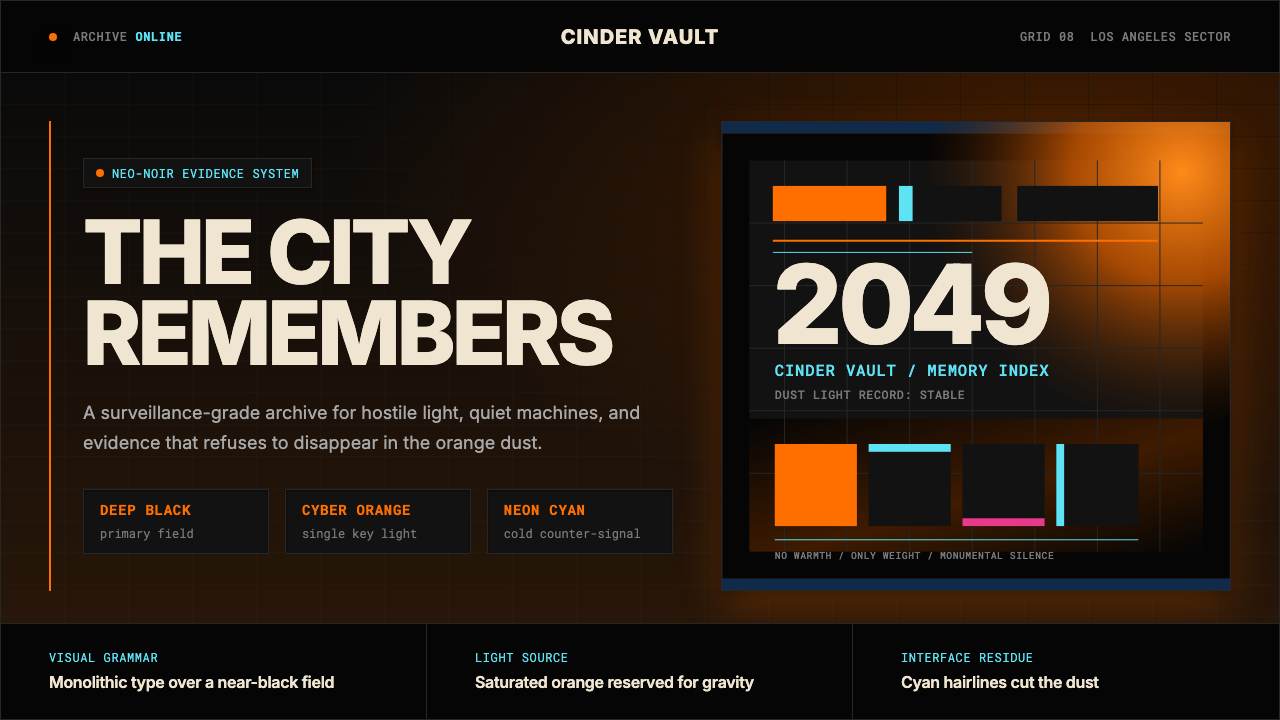 Blade Runner 2049Noir with tectonic weight. Orange dust, cyan hairlines, and monumental Inter…
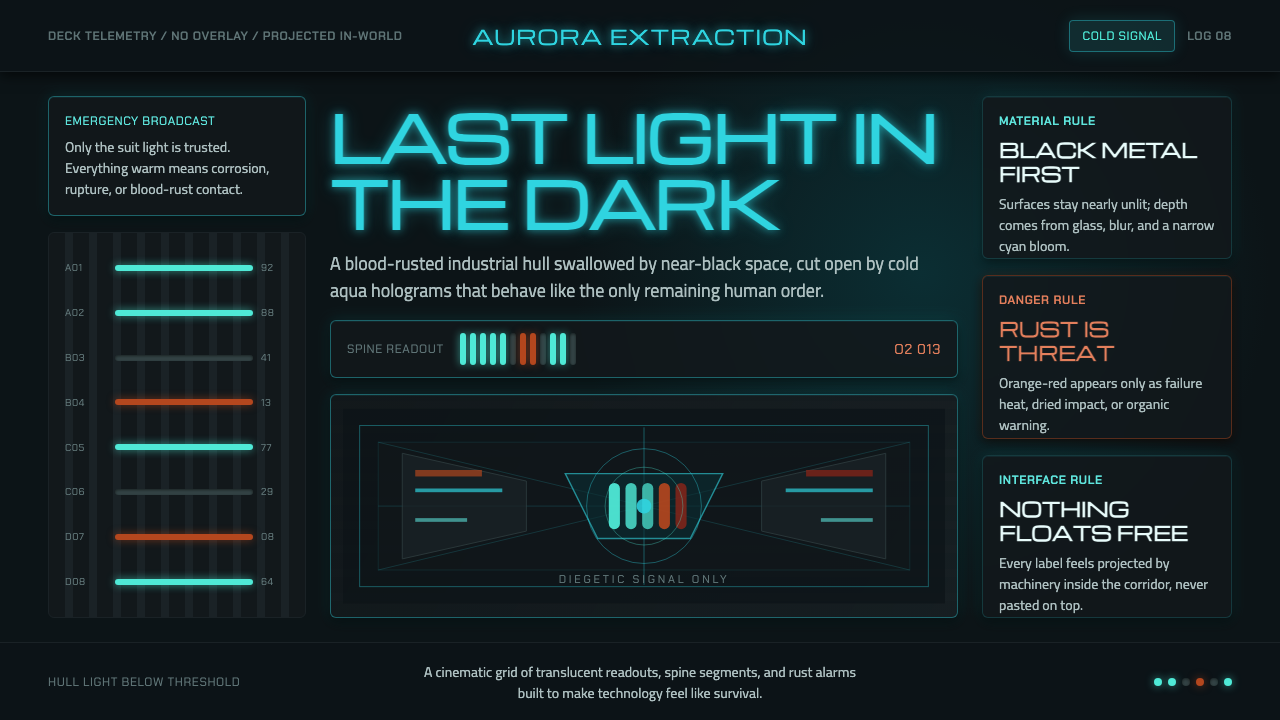 Dead Space IshimuraLast light in the dark. Near-black rust cut by aqua holographic panels.
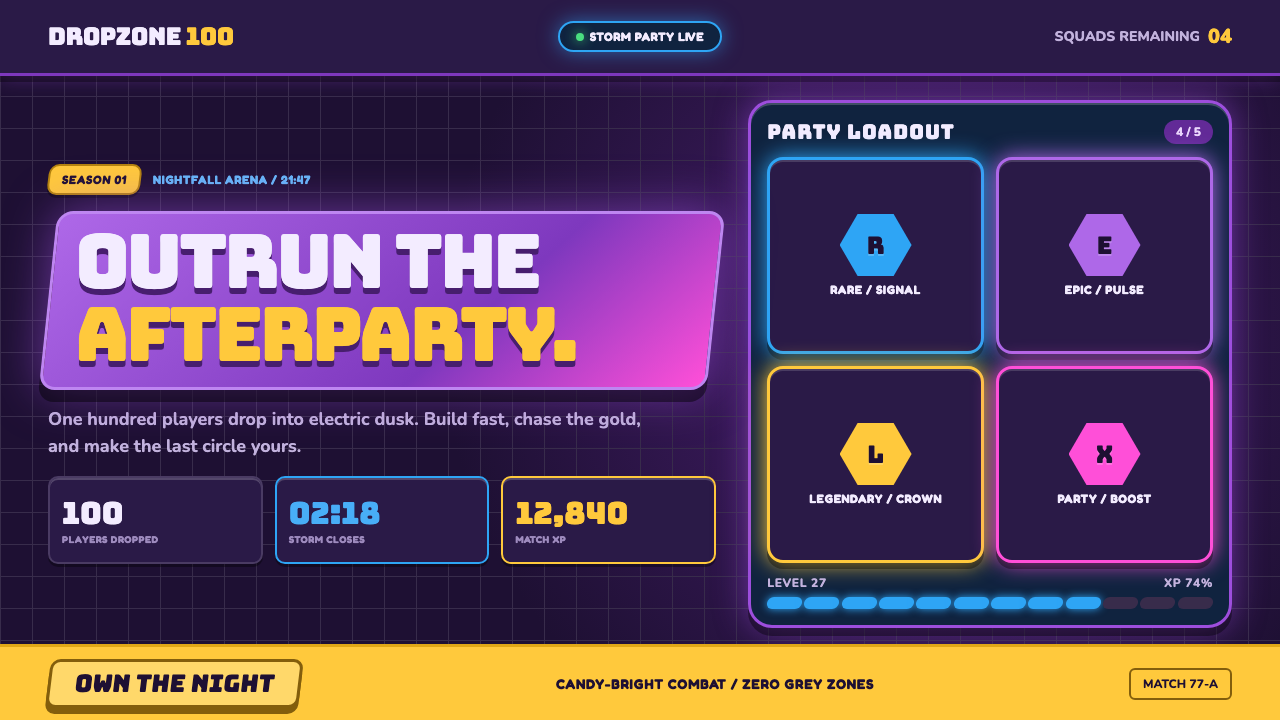 Fortnite (2017 Battle Royale)Battle royale becomes a neon party. Chunky caps and rarity glows electrify st…
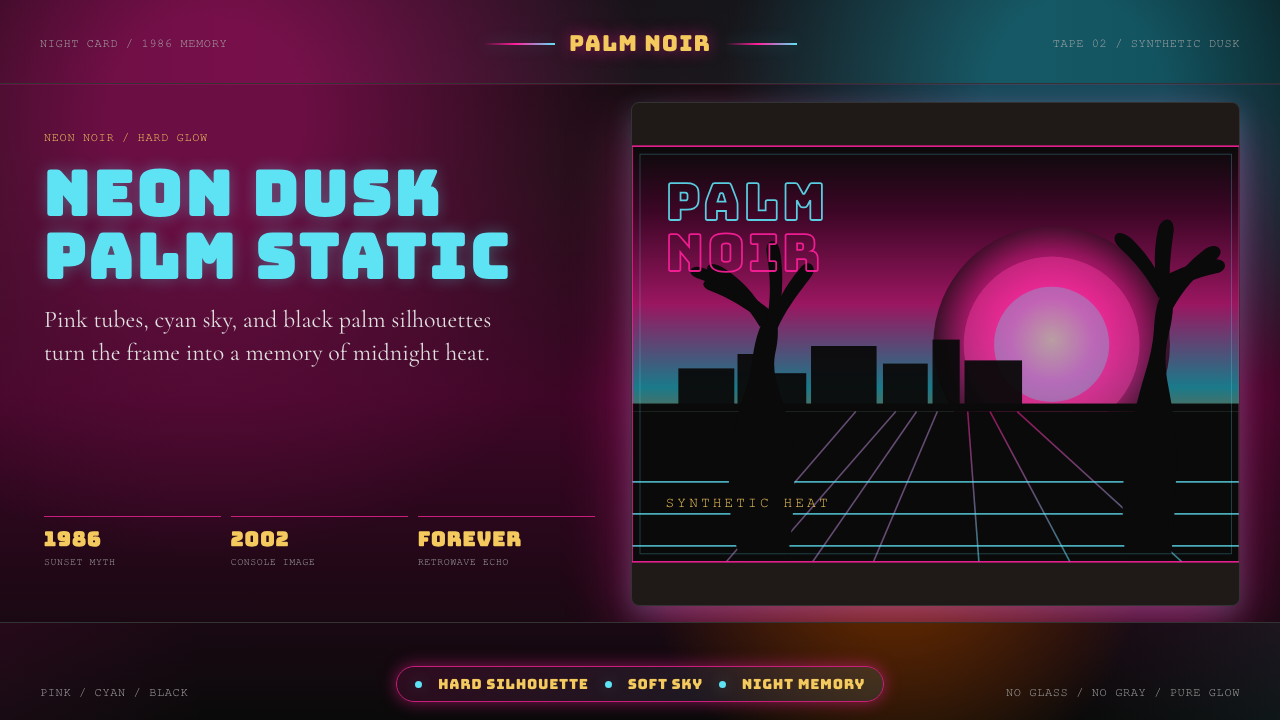 GTA Vice City (2002)Neon-noir nostalgia. Pink-cyan dusk, chunky type, and palm silhouettes.
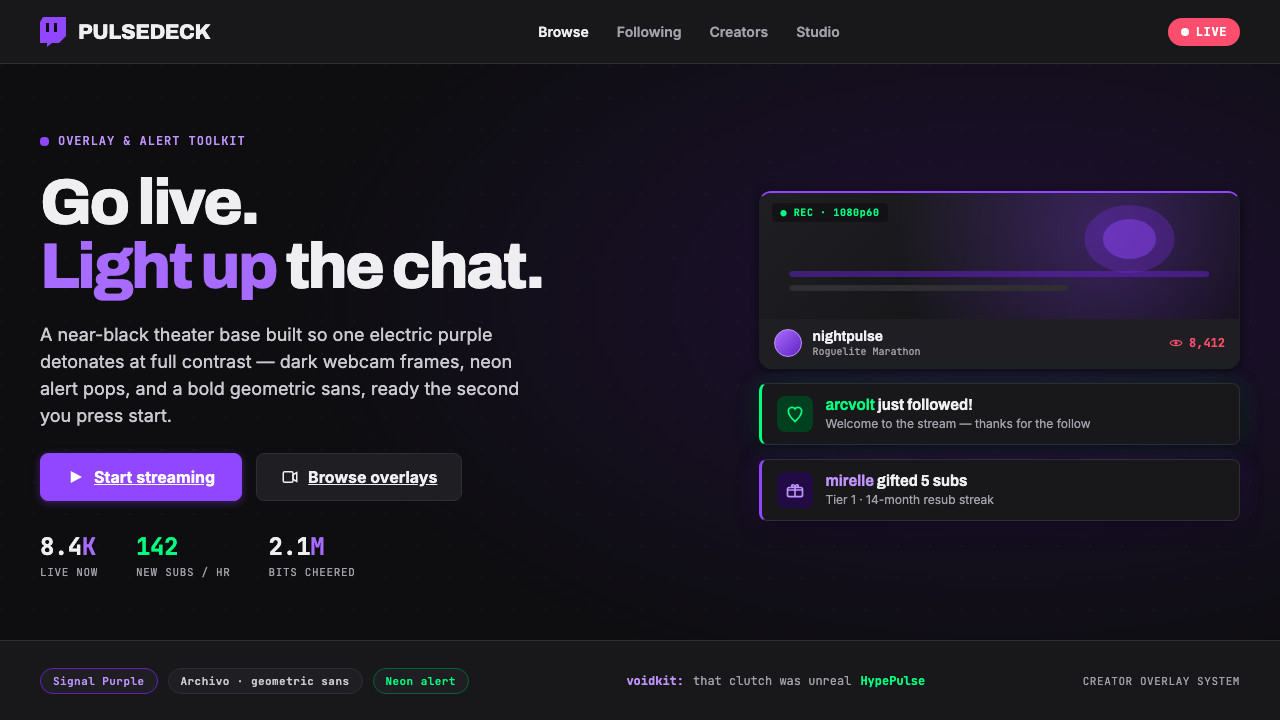 Twitch Streamer OverlayNear-black theater base, one electric purple. Dark webcam frames, neon alert…
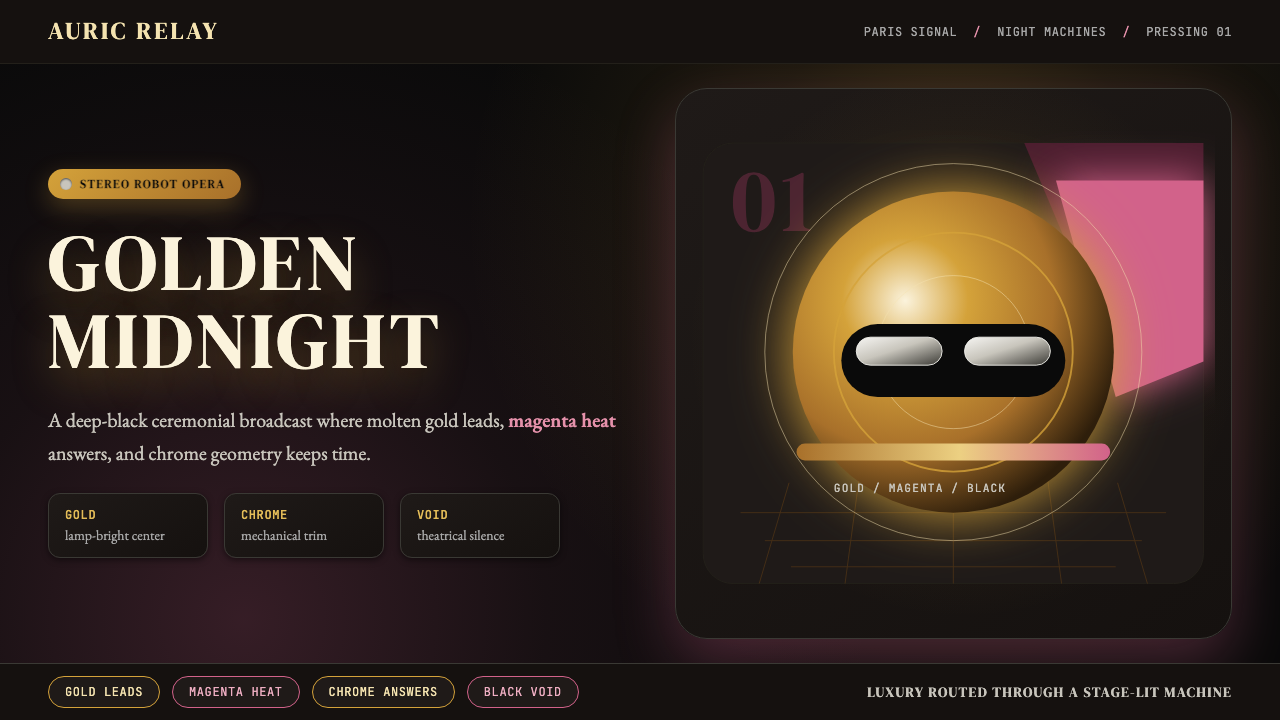 Daft Punk Discovery (Gold-Helmet)Warm sci-fi disco. Gold serif caps orbit a magenta void with chrome-disc geom…