What is Nigerian Nollywood DVD Poster (2010)?
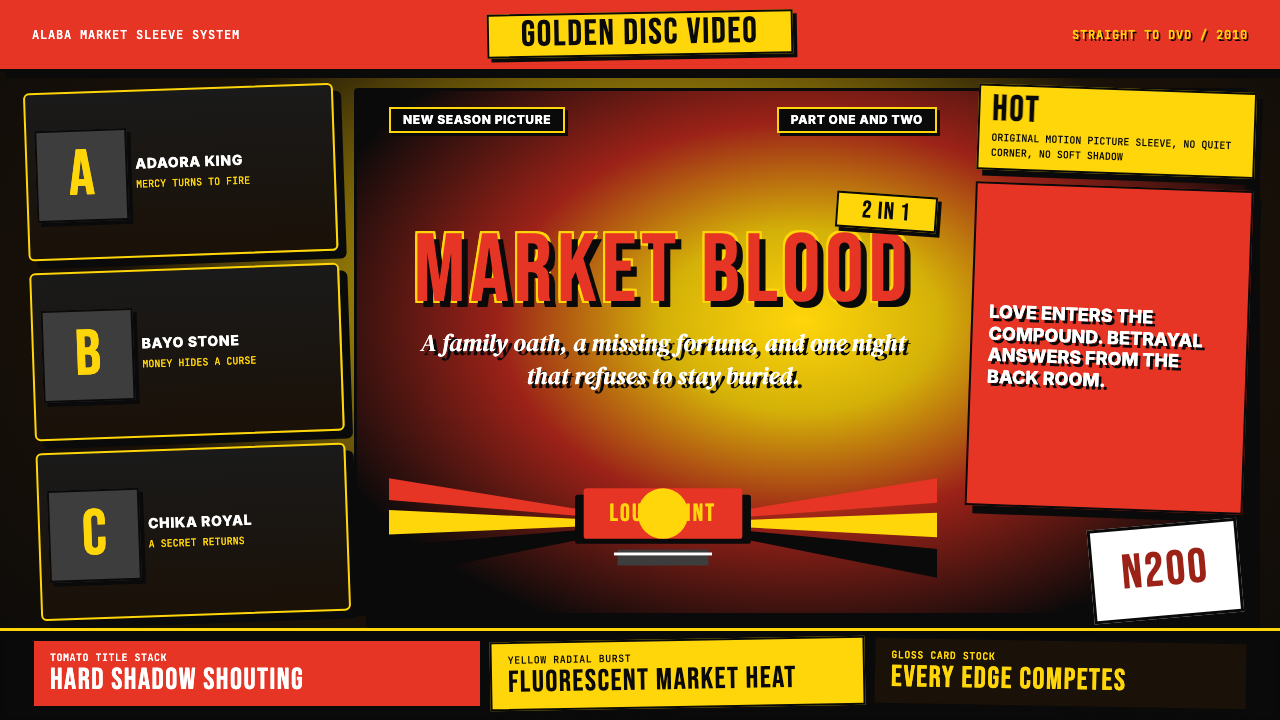
Nollywood's DVD sleeve was never just packaging — it was a one-card marketing department, built from pure visual noise and absolute commercial urgency.
Nigerian Nollywood DVD Poster (2010) in brief
Nigerian Nollywood DVD Poster (2010) is the visual language that powered the world's second-largest film industry through its straight-to-DVD era. Between roughly 2000 and 2015, Nollywood studios bypassed theatrical release entirely, flooding Lagos markets like Idumota and Alaba International with hundreds of new titles every month. The DVD sleeve was the sole marketing instrument — it had to sell the film from a distance of two meters, in a crowded stall, under harsh fluorescent light, at a price of around two hundred naira.
The result was a design system defined by maximum contrast and zero restraint. Tomato-red titles in condensed all-caps letterforms scream across jet-black grounds. Radial yellow burst graphics — starburst explosions of energy — push actor cutouts into aggressive foreground prominence. Drop shadows with exaggerated offsets give every element a dimensional urgency. The composition is dense, hierarchical, and deliberately confrontational: if your eye is not arrested in under a second, the sleeve has already failed its purpose.
This aesthetic did not emerge from a design studio or a creative brief — it emerged from the economics of a market stall. Graphic artists in Alaba developed visual shortcuts that reliably communicated genre, star power, and emotional stakes at a glance. Horror titles reached for greens and reds with jagged brush strokes; romantic dramas softened slightly with gradient skies. But the underlying grammar — heavy type, saturated color, hard cutouts, burst graphics — remained constant across the genre spectrum. It is one of the few design traditions of the twenty-first century that was shaped entirely by its distribution medium.
Where does Nigerian Nollywood DVD Poster (2010) come from?
Nollywood's origin story is inseparable from the cassette economy of early 1990s Lagos. Kenneth Nnebue, a Lagos electronics trader, is widely credited with producing the first commercial Yoruba home-video film in 1992 using blank tapes he was trying to sell. The straightforward commercial logic — make a film, distribute it on the same medium you already sell — created an industry almost by accident. By the mid-1990s, dozens of production companies were releasing films on VHS cassette; by the 2000s, DVD technology made duplication cheaper, storage smaller, and print quality dramatically better, which directly enabled the sleeve's visual ambition.
The Alaba International Market in Lagos became the nerve center of Nollywood distribution. Wholesale dealers there could move tens of thousands of copies of a single title in a weekend. For the sleeve to work in this environment, it needed to communicate across multiple simultaneous pressures: it had to stand out in a pile of competing titles, survive being handled hundreds of times, and convey genre, mood, and star in under a second. These constraints — not aesthetic ideology — produced the visual language. Red and yellow were chosen because they are the highest-contrast pairing against black available in standard CMYK printing; condensed caps were chosen because they pack the most readable letterforms per centimeter of sleeve width.
The key figures associated with the Nollywood DVD era were primarily directors and producers rather than graphic designers, because sleeve design was almost never credited. Genevieve Nnaji, who became Nollywood's biggest female star through the mid-2000s, appeared on sleeves with a frequency that shaped the visual template of the romantic drama subgenre: her face, heavily retouched, cropped against a sunset or a burst graphic, became so common it functioned as genre signage. Tunde Kelani and Kunle Afolayan brought higher production values to their sleeves from the late 2000s onward, experimenting with more refined type and composed photography rather than hard photo cutouts, foreshadowing the post-DVD era.
By 2012, the Nollywood DVD model was already under pressure from cinema multiplex expansion — Silverbird and Genesis Cinema chains began growing rapidly across Lagos and Abuja — and from the earliest piracy pressures of internet-distributed content. The sleeve aesthetic began to bifurcate: prestige productions adopted poster conventions borrowed from American cinema, while the lower-budget direct-to-market tier doubled down on the maximalist formula. The 2010 vintage captured here represents the peak and the beginning of the end simultaneously — maximum visual intensity just before the medium that required it began to fade.
What defines the Nigerian Nollywood DVD Poster (2010) look?
Color
The palette is built around extreme contrast rather than harmony: jet black grounds anchor compositions, with tomato red and golden yellow deployed as the two primary signal colors. Red carries urgency and genre seriousness — it appears almost universally on titles and most prominently in action and horror sleeves. Yellow, particularly in its burst-graphic form, signals energy, surprise, and commercial excitement. Both colors are applied at full saturation with no tinting or tonal modulation; subtlety was not a production value in this context. Secondary colors appear in photography — actor clothing, setting — but the graphic overlay elements stay within the red-yellow-black triad.
Typography
Type is the loudest element on the sleeve. Film titles are set in heavily condensed uppercase letterforms — squeezed to pack maximum letters across a narrow width while maintaining legibility at any viewing distance. The condensed proportion creates a vertical tension that reads as urgency. Supporting credits, cast names, and taglines appear in secondary sizes that still maintain a dramatic size hierarchy; there is rarely a gentle gradation between levels. All type is rendered with hard drop shadows offset diagonally, giving letterforms a cut-out three-dimensional quality without any softness. Italic and oblique settings appear frequently as additional emphasis devices.
Burst Graphics
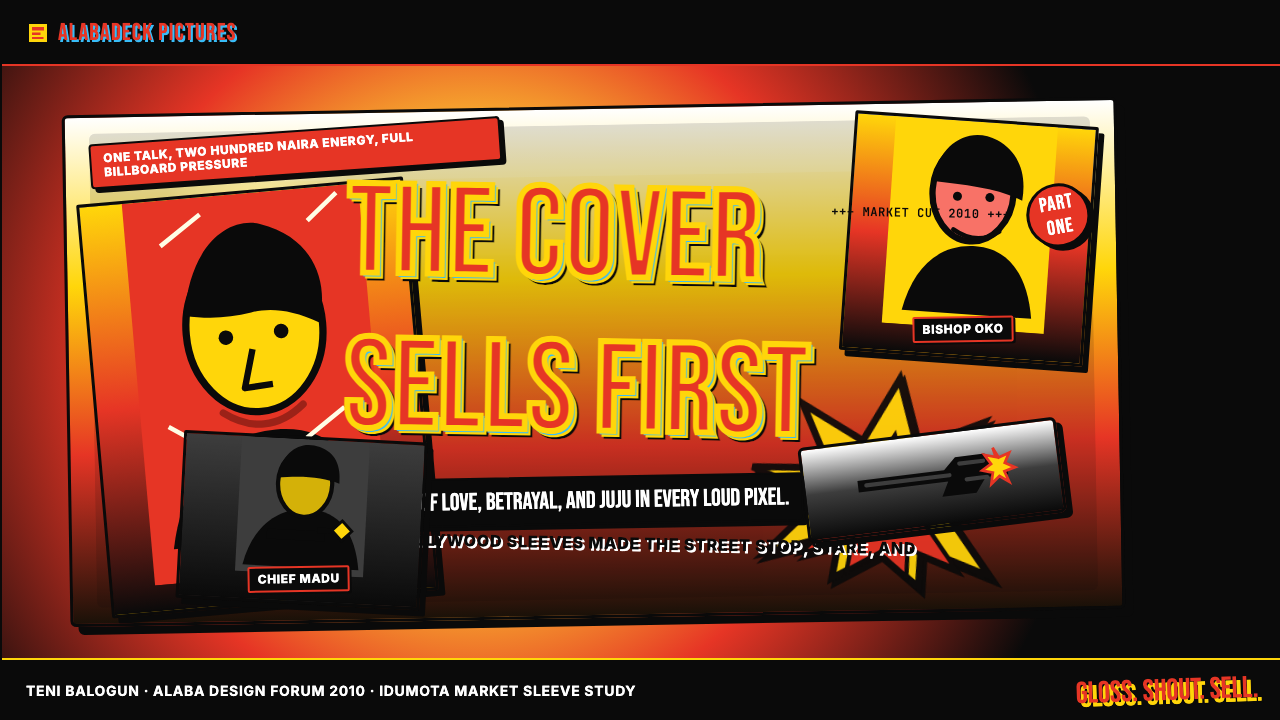
The radial burst — a starburst or sunray pattern radiating from a central point — is the single most recognizable motif of this visual tradition. Bursts function as backgrounds for actor portraits, as attention-directing devices behind title text, and as raw expressions of energetic excess. They are almost always rendered in bright yellow or a yellow-to-orange gradient against the black ground. Their origin is partly practical — a burst creates a natural vignette that separates a photo cutout from the background — and partly semiotic: the burst graphic has roots in comic book visual language for impacts and revelations, imported wholesale into popular African commercial art.
Actor Cutouts
Photography in Nollywood sleeves is almost never composed for the sleeve — it is cut out, scaled, and repositioned from existing production stills or promotional portraits. The hard-edge cutout (a silhouette with a sharp, clean boundary, no feathering) is both a production method and a visual signature. Multiple actors are frequently stacked in a diagonal arrangement, each scaled to indicate their billing importance, with the lead character largest and most centrally placed. Retouching is heavy — skin smoothing, brightness boosting, eye enlargement — creating an idealized hyper-real representation quite different from photographic naturalism.
Composition and Density
Nollywood sleeves reject negative space almost as a matter of principle. Every area of the composition carries either a visual element or a block of text; white or empty space reads as wasted selling real estate. The hierarchy is typically organized vertically: title at top in the largest type, actor faces spanning the middle, taglines or distributor credits at the bottom, with burst graphics and color fills occupying the spaces between. The density is not chaotic — there is a clear reading order — but it is aggressive in a way that assumes the viewer will invest close attention only after the sleeve has already shouted for it.
Shadow and Outline
Drop shadows in this tradition are hard-edged, heavily offset, and rendered as solid opaque shapes rather than transparent blurs. A title's shadow might be offset by a distance almost equal to the letter height itself, creating the impression of three-dimensional letters lifted off the surface. Outlines — thin stroke borders around letters and graphic elements — appear frequently as an additional separation device, allowing red type to be legible even when placed over a complex photographic region. The layering of outline, shadow, and color on every text element contributes to the visual noise that is, paradoxically, the system's principal organizational technique.
Genre Coding
Within the broader maximalist framework, specific visual signals encode genre with surprising consistency. Horror and thriller sleeves emphasize green accents alongside the red-black base, often incorporating dripping or cracking texture effects. Romantic drama sleeves allow slightly softer photograph color grading and may introduce pastel accent tones in sky backgrounds. Family and spiritual drama sleeves frequently feature multiple actors arranged around a symbolic motif — a cross, a crown, a family house. These genre signals function as a shared visual vocabulary between producers and the market-stall buyer who needed to categorize a title in seconds.
Who shaped Nigerian Nollywood DVD Poster (2010)?
Nnebue is credited as the father of Nollywood by many historians, having produced the 1992 film that launched the home-video industry almost inadvertently while trying to move surplus blank tapes through his electronics shop. His commercial instinct — packaging a product for direct consumer sale rather than institutional distribution — established the straight-to-market logic that shaped every aspect of the visual tradition that followed, including the sleeve design imperative of selling the product at the point of display.
Nnaji became the most recognizable face of Nollywood between the mid-2000s and the mid-2010s, and her ubiquitous presence on DVD sleeves shaped the visual conventions of the romantic drama subgenre more than any single director or designer. Her retouched portrait — luminous skin, expressive eyes, composed against burst graphics or sunset backgrounds — served as a genre signal that buyers could read from a distance. Her later directorial work on Lion Heart (2018) marked the formal end of the sleeve-first era she had come to embody.
Kelani, working through his production company Mainframe Film and Television, consistently pushed Nollywood sleeve design toward more composed and culturally rooted imagery from the early 2000s onward. His films drew on Yoruba literary and oral traditions, and his sleeves often featured more considered photographic framing, Yoruba-script elements, and references to traditional textile patterns rather than the generic maximalism of market-stall production. He represents the documentary and auteur tendency within Nollywood that existed in tension with the commercial mainstream.
Afolayan, son of the veteran Nollywood director Adeyemi Afolayan, brought cinematic production values into the home-video market with films like The Figurine (2009) and Phone Swap (2012). His sleeves were among the first to treat the photographic image as a composed element rather than a cutout — using depth of field, intentional lighting, and designed color grading. This approach anticipated the prestige Nollywood era that followed the DVD period, and his visual choices influenced a generation of sleeve designers who aspired to move beyond the Alaba aesthetic.
How do you use Nigerian Nollywood DVD Poster (2010) today?
The Nollywood DVD Poster aesthetic is one of the most legible maximalist traditions available to contemporary designers precisely because its rules are so consistent. The system works through a small set of highly amplified signals — extreme color contrast, condensed bold type, burst graphics, hard shadows — and succeeds or fails based on how fully each of those signals is committed to. Half-measures produce incoherence; full commitment produces an unmistakable visual loudness that cuts through digital noise in exactly the same way it cut through market-stall competition.
For presentation slides, this system is most effective in contexts where disruption, energy, or cultural celebration are the intended tone. Cover slides benefit most: a full-bleed black background, a central actor-style portrait or product image cut out against a yellow burst, and a condensed-caps title in tomato red with a diagonal shadow creates an immediate cinematic drama. Content slides within a Nollywood-inflected deck should retain the color coding — red for titles, yellow for highlights, black grounds — but reduce the density significantly. Data slides work well with the color palette applied to chart elements, keeping backgrounds dark and bars or segments in the primary red-yellow range.
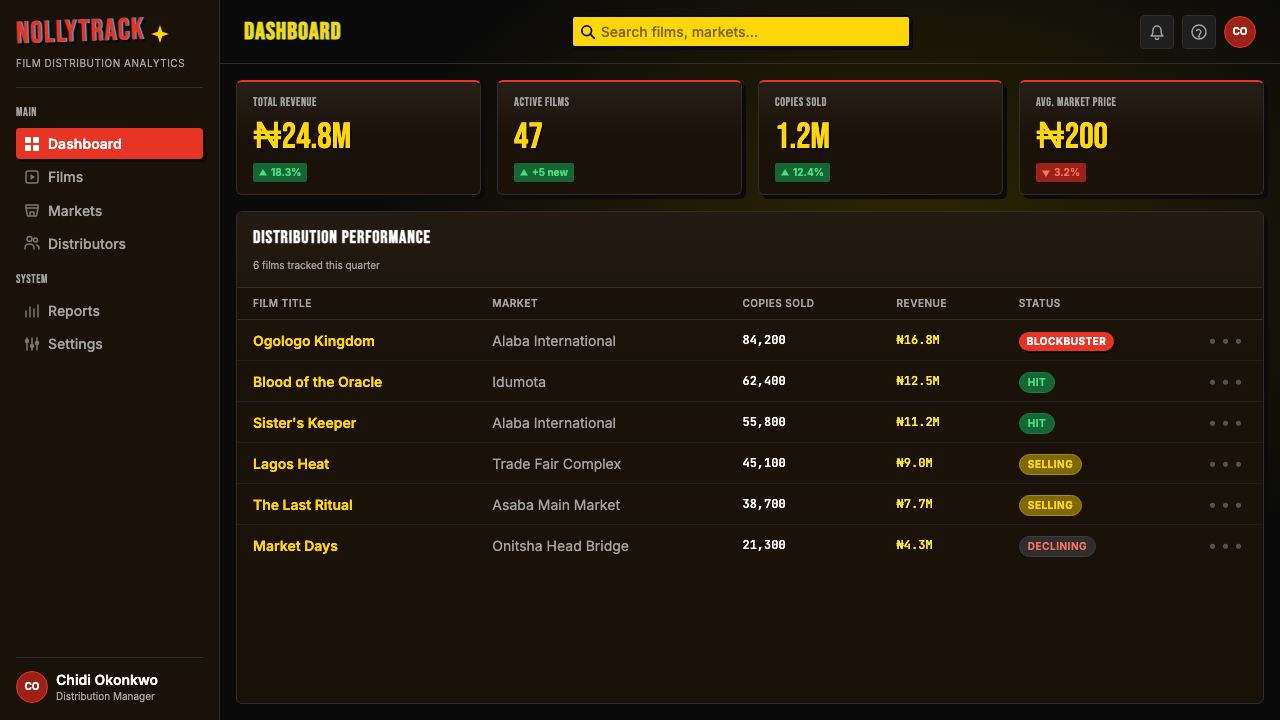
For web and digital interfaces, the style adapts most naturally to hero sections, promotional banners, and event-announcement contexts where a single message needs maximum immediacy. A dark-ground hero with a burst graphic behind a product image, condensed type in the primary palette, and a hard-shadow call-to-action button captures the tradition's energy without overwhelming the rest of a UI. Dashboard or pricing contexts benefit from the color system — red for critical states or primary tier, yellow for highlight or featured — while restraining the burst graphics and type density to maintain navigational clarity.
For editorial and marketing work — particularly for brands in entertainment, music, African diaspora culture, or any context celebrating popular energy — this style offers a visual register that no European or American design tradition provides. Event posters, album covers, social media announcement graphics, and promotional emails all work well with Nollywood-derived composition. The key is maintaining the genre coding logic: decide which color means urgency and which means energy, assign them to information types, and stay consistent.
The most common mistake when applying this aesthetic is confusing maximalism with randomness. Nollywood sleeves are dense, but they have a strict visual hierarchy: one dominant color temperature (warm dark), one signal red, one accent yellow, a clear reading order from top to bottom. Designers who import the saturation and the burst motifs without imposing that hierarchy produce work that reads as noisy rather than bold. A second frequent error is softening the shadows — feathering them, reducing their offset, making them transparent. Soft shadows undermine the cut-out physicality that gives this tradition its kinetic energy. If the shadow is not hard, it is not Nollywood.
Nigerian Nollywood DVD Poster (2010) — FAQ
Is this style appropriate outside of African or Nigerian cultural contexts?
Yes, with intentionality. The Nollywood poster aesthetic is a fully formed design system, not simply a cultural artifact, and its visual logic — contrast-driven hierarchy, burst energy graphics, condensed type — transfers to any context where maximum attention-capture is the goal. Entertainment brands, music industry work, festival and event promotion, and any product positioning itself as bold and accessible rather than refined and exclusive are natural fits. The caution is to engage with the tradition knowingly rather than superficially: understand why the visual language is structured as it is, rather than borrowing only surface elements like the burst graphic or the red-black color contrast.
How do I avoid the style looking like unintentional bad design?
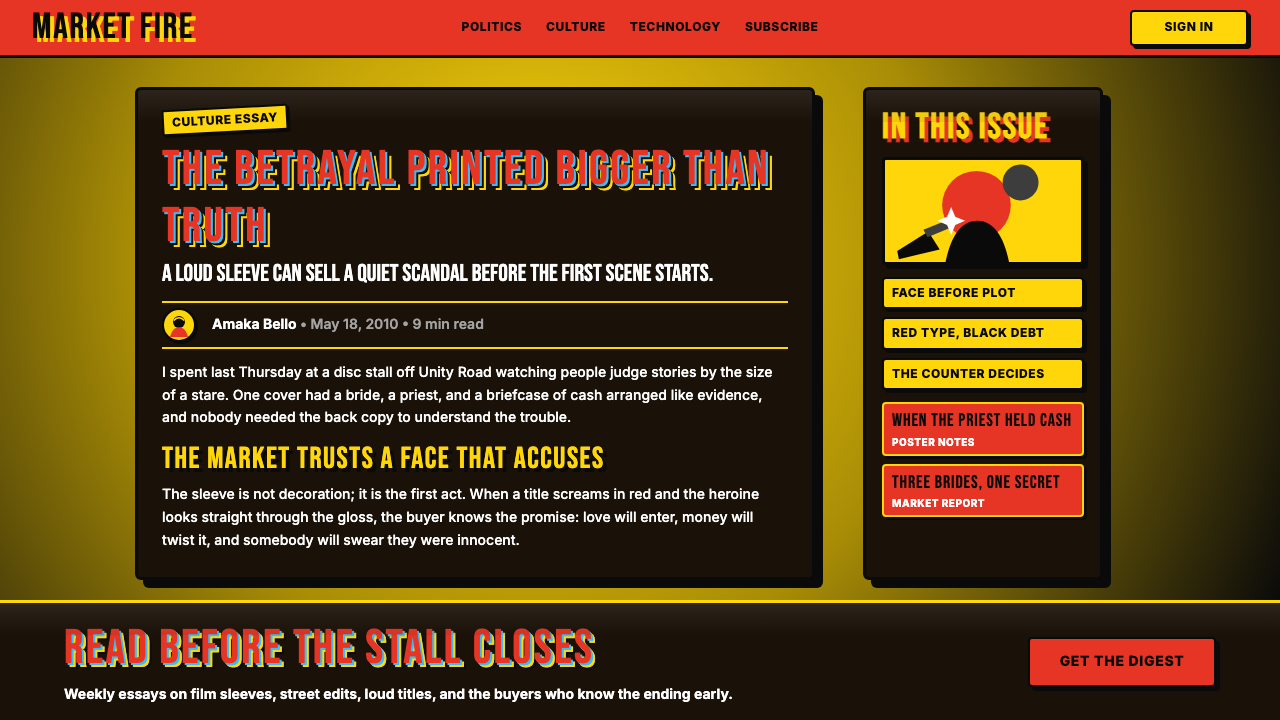
The distinction between a knowing use of the Nollywood aesthetic and a simply poorly designed piece comes down to intentional control of hierarchy and commitment. Three signals indicate intentionality: first, the color assignments are consistent and purposeful — red always signals one type of information, yellow another; second, the type hierarchy is legible at multiple distances, with dominant elements clearly dominant; third, the burst and shadow graphics are applied at full intensity, not watered down into approximate versions. Diluted execution reads as accident; fully committed execution reads as style. Additionally, adding any element that does not belong to the system — soft gradients, neutral tones, centered symmetrical layouts — immediately breaks the internal logic and signals unintentional pastiche.
Can this style work in digital-first contexts like mobile screens or social media?
The style transfers extremely well to social media and mobile contexts — in some ways better than to print, because the high contrast and bold type are optimized for small-screen legibility at a distance, which is exactly how social media graphics are consumed. The burst graphic reads clearly as a thumbnail at low resolution. The condensed caps title communicates even when a post is scrolled past at speed. The primary palette of red, yellow, and black retains maximum contrast on both OLED dark screens and standard light-mode interfaces. The main adaptation for digital is to reduce the total number of elements per composition — the DVD sleeve could accommodate ten separate text blocks because it was held in the hand; a social post should probably reduce this to three or four.
What is the relationship between Nollywood poster design and other African popular visual traditions?
Nollywood poster design sits within a broader lineage of West African popular commercial art that includes Ghanaian hand-painted cinema signs (made famous by artists like Kwame Akoto and popularized by the retroactive collection of painters from Kumasi), Nigerian bar and barber-shop signage, and the hand-lettered truck and bus art of the Mammy Wagon tradition. What these share is a commitment to maximum communicative force in the most economical format possible, using locally available tools and materials. The Nollywood sleeve is the digital and offset-print evolution of this tradition — it retained the visual energy and hierarchy logic of hand-painted commercial art while adapting to CMYK printing workflows and photo-manipulation software. The contemporary Ghanaian movie poster tradition is closely related and developed in parallel, sharing the burst graphic, hard-cutout photography, and condensed-caps typography.
How did Nollywood sleeve design change after the DVD era ended?
The transition to streaming — primarily Netflix Africa, Amazon Prime Video, and local platforms like ShowMax — changed the marketing artifact from a physical sleeve to a digital thumbnail and poster image. The thumbnail context rewarded high contrast (still present in the tradition) but penalized information density (the sleeve's key mode). Post-DVD Nollywood marketing graphics generally became more similar to American streaming art: composed photography, less burst graphics, more careful typographic spacing, and a softer overall palette. However, the market-stall sensibility did not disappear entirely — it migrated into social media promotional content for events and music videos associated with Nollywood talent, where the burst-graphic and condensed-caps aesthetic still appears as a genre signal, particularly for content targeting Nigerian diaspora audiences.
Related design styles
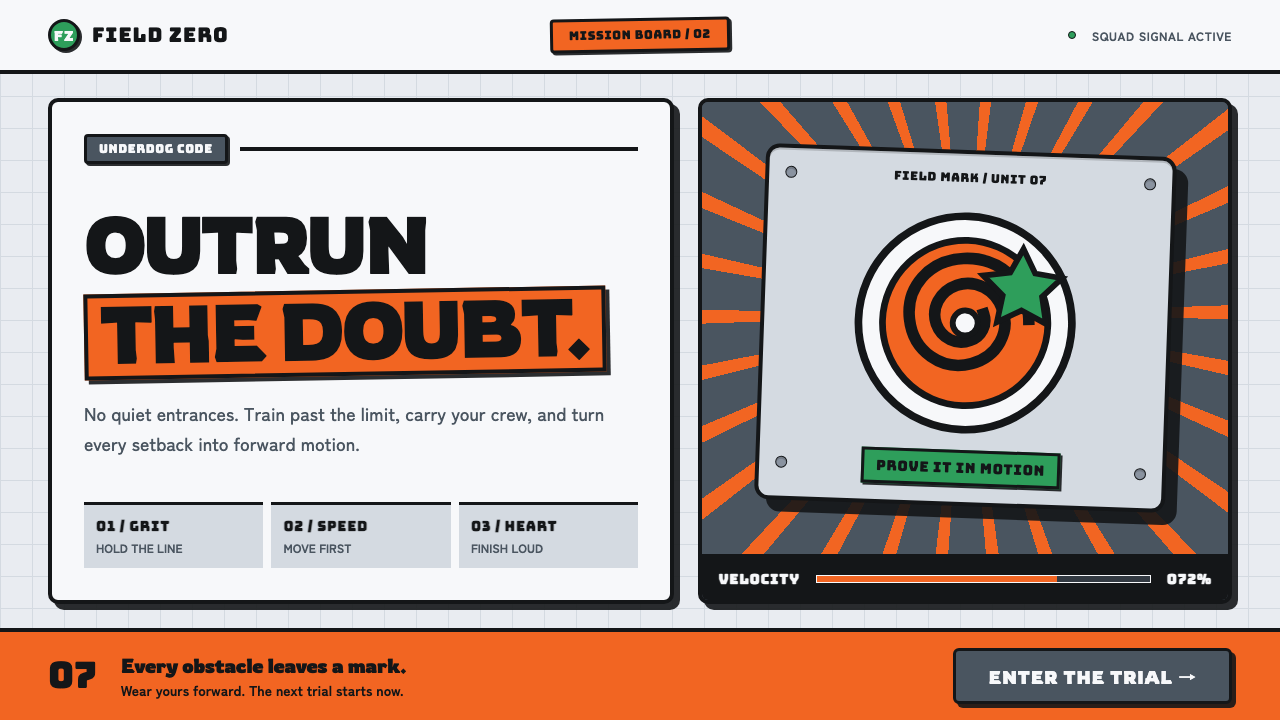 Naruto (2002 anime era)Underdog energy refuses the background. Hazard orange strikes steel-gray grid…
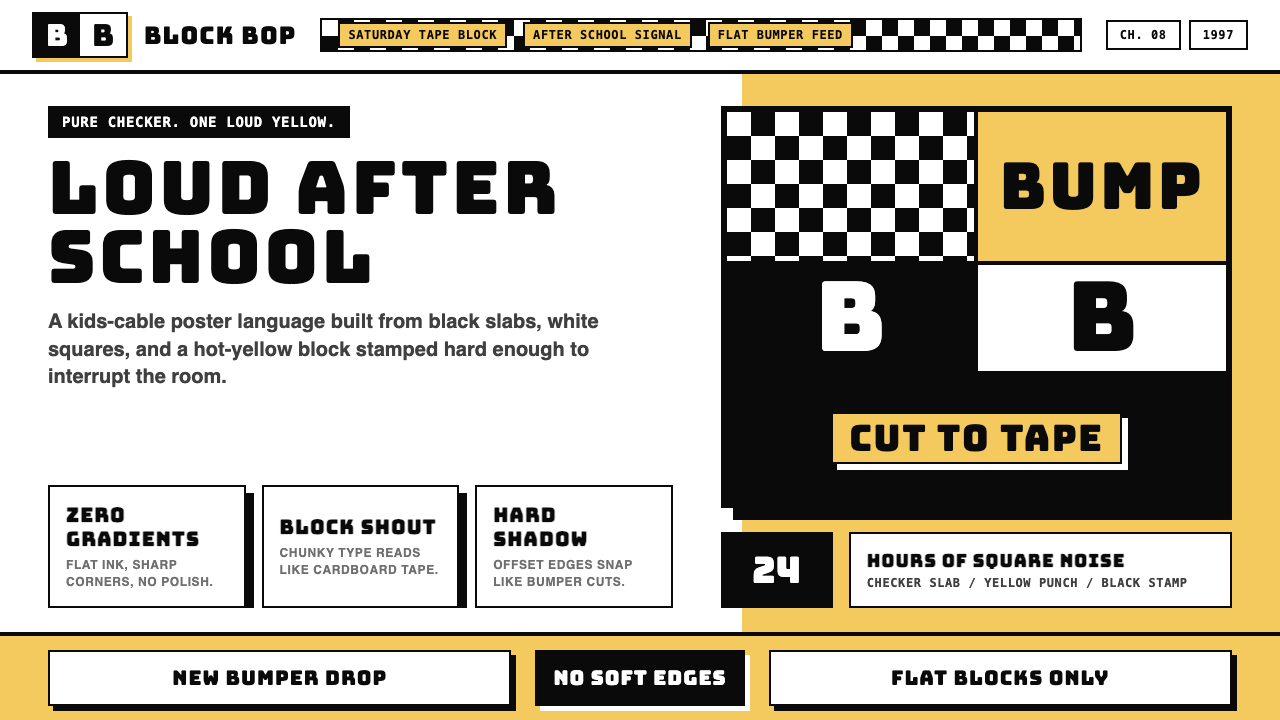 Cartoon Network 90s BlocksKids-cable noise, squared. Black-white checkerboards crash into hot-yellow Bu…
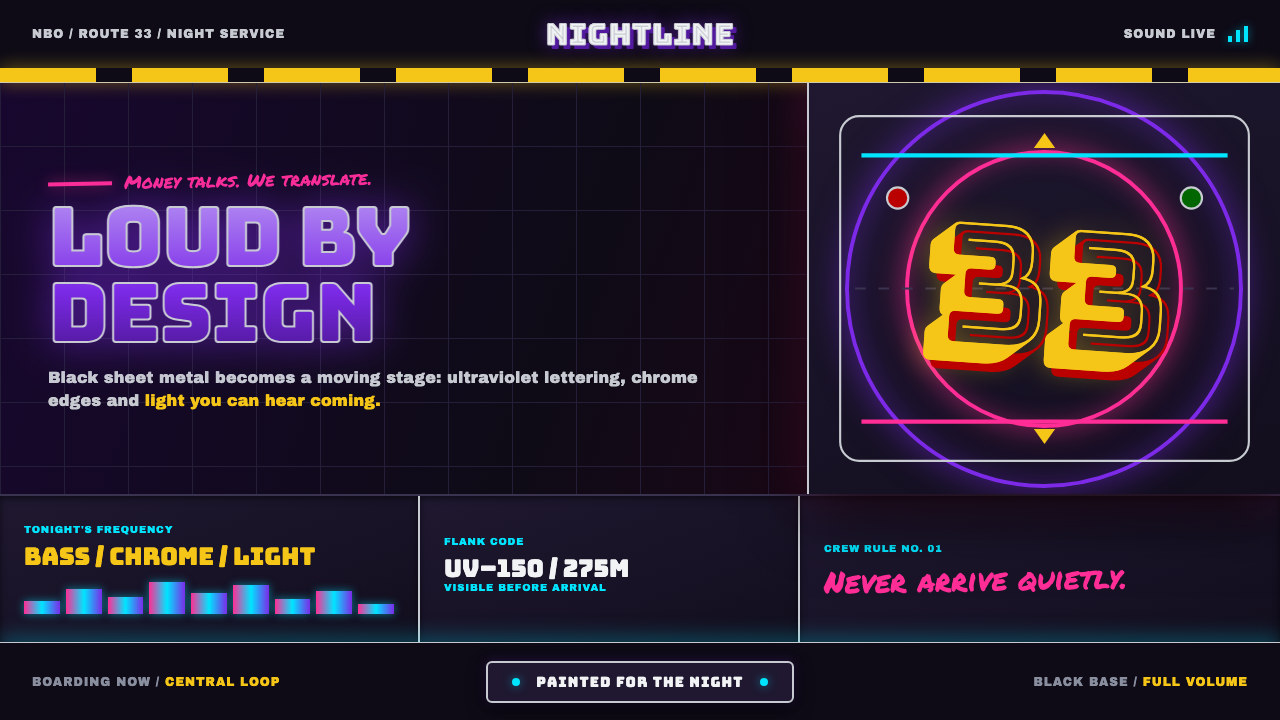 Nairobi Matatu ArtBuilt to be unmissable. Neon airbrush and chrome blaze across night-black hor…
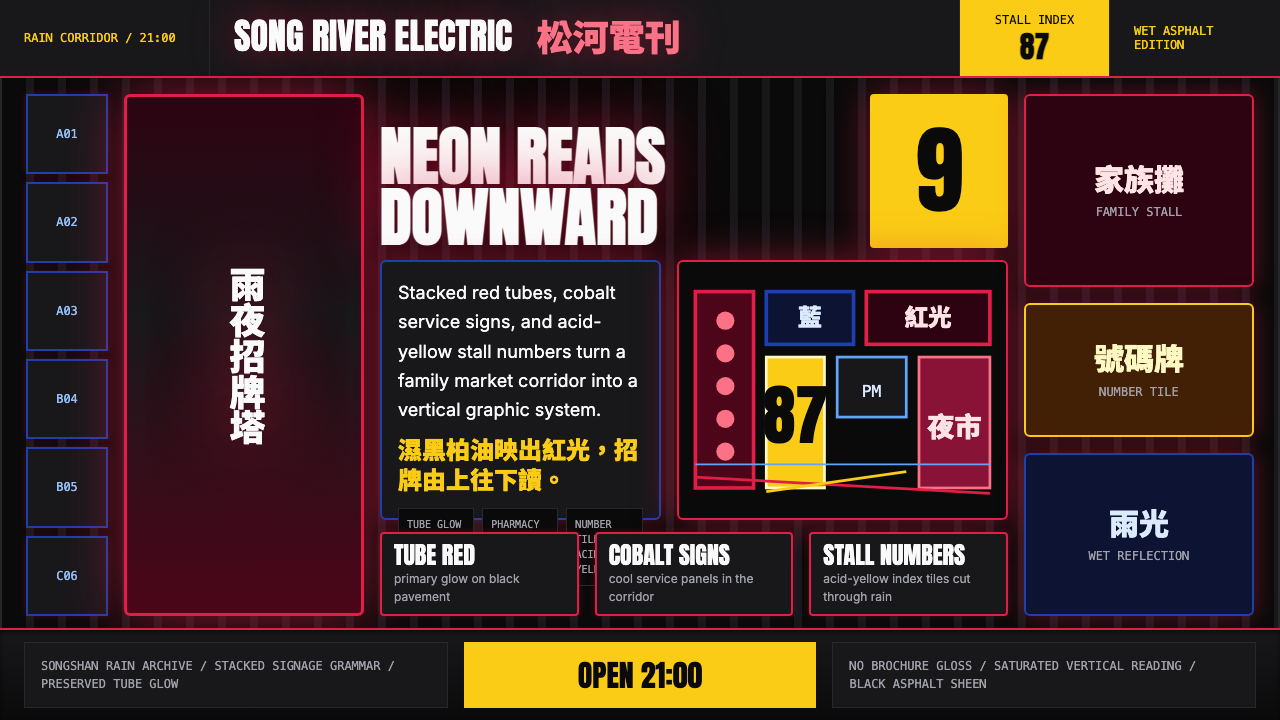 Taiwanese Raohe Night Market NeonTaipei night reads vertically. Neon red, cobalt panels, and acid-yellow numbe…
 Thai Mor Lam Isaan (2020)Joy at maximum volume. Fuchsia-cyan neon, chrome type, and halftone grids hit…
 Daft Punk Discovery (Gold-Helmet)Warm sci-fi disco. Gold serif caps orbit a magenta void with chrome-disc geom…