What is Thai Mor Lam Isaan (2020)?
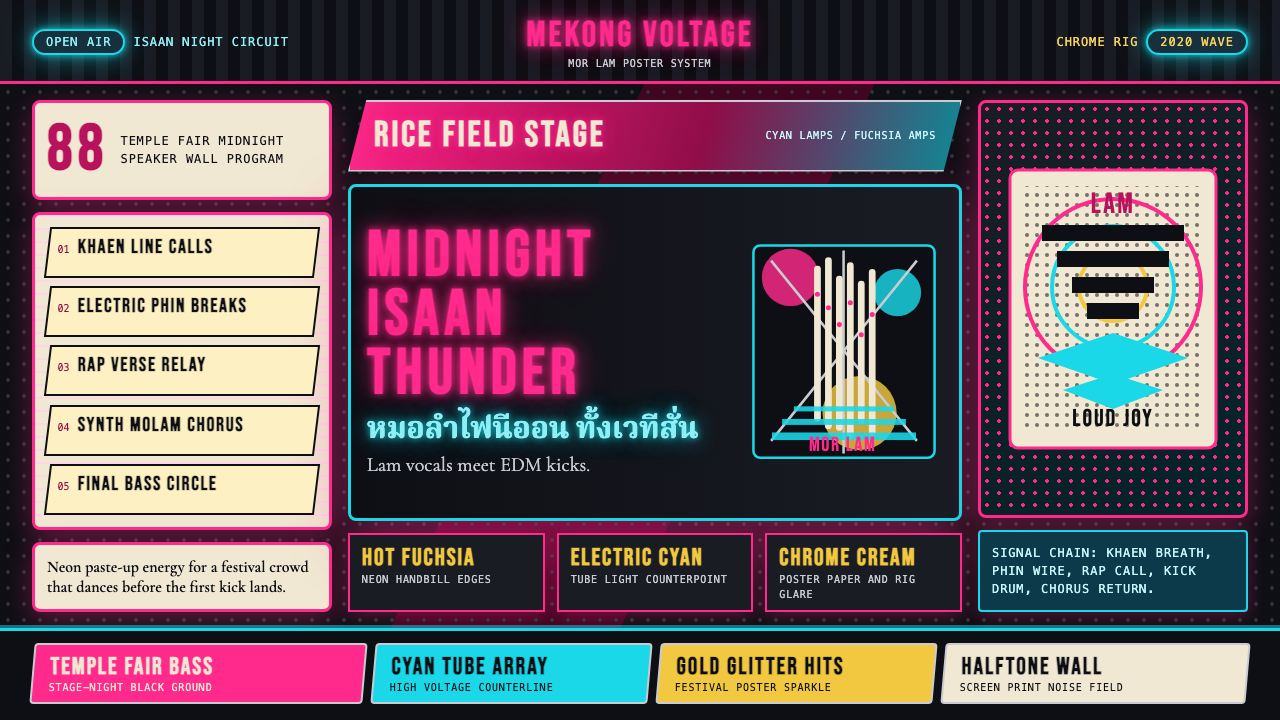
Mor lam is joy at maximum volume — a collision of khaen mouth-organ tradition, synth-pop electricity, and neon-drenched festival spectacle that turned northeastern Thailand's night skies incandescent.
Thai Mor Lam Isaan (2020) in brief
Thai Mor Lam Isaan (2020) is a design aesthetic rooted in the live concert culture of northeastern Thailand's Isaan region, where Lao-ethnic communities have cultivated a distinctive musical tradition for centuries. The visual language distills the sensory overload of a stadium-scale mor lam festival: deep stage-black grounds, blazing fuchsia-magenta neon, electric cyan accents, chrome-silver surfaces, and glitter-gold highlights, all organized through halftone-print textures and the bold collage logic of hand-printed concert posters.
The system captures a specific moment — the 2020s — when mor lam underwent a full-scale EDM fusion, with performers arriving on hydraulic stages flanked by LED towers, fog machines, and laser rigs borrowed from international pop concerts. The design language that emerged is simultaneously vernacular and spectacular: it carries the grain of photocopied provincial flyers and the scale of a Times Square billboard. Nothing here is shy, and nothing is accidental — every visual decision amplifies the joyful excess that defines the music.
Unlike design systems derived from fine-art movements or corporate brand manuals, Mor Lam Isaan's aesthetic comes from the street, the temple fairground, and the festival stage. Its authority is collective and communal rather than authored by any single designer. That populist origin gives it an irreducible vitality: this is not a style designed to impress critics; it is a style designed to make thousands of people feel, simultaneously, that the night will never end.
Where does Thai Mor Lam Isaan (2020) come from?
The khaen, a free-reed mouth organ made from bamboo pipes, is the ancestral instrument of Isaan and Lao musical culture. Its sound — breathy, droning, capable of complex polyphony — has accompanied agricultural festivals, spirit rituals, and courtship singing across the Mekong basin for centuries. Mor lam, literally 'expert in lam singing,' describes the vocal tradition built around the khaen, in which skilled singers improvise verse on themes of love, politics, and village life. By the late nineteenth century, traveling mor lam troupes were the dominant popular entertainment across northeastern Thailand.
Electrification transformed the tradition beginning in the 1970s. Amplified khaen, electric phin lutes, drum kits, and eventually synthesizers entered the mor lam ensemble, producing a hybrid sound that could fill outdoor festival spaces with genuine force. The concert stage grew accordingly: lights, chrome scaffolding, and hand-painted banners announced performers in a visual language that was part carnival, part religious pageant, part professional wrestling promotion. By the 1990s, stars like Jintara Poonlarp and Lamyai Haitongkam were selling out venues across the northeast and carrying the Isaan cultural identity to Bangkok's migrant worker communities.
The period between roughly 2015 and the early 2020s saw the most dramatic transformation, as mor lam producers began importing the full visual and sonic apparatus of global EDM. Hydraulic stages, LED video walls, and choreographed laser sequences turned regional temple fair concerts into events that could credibly be described as stadium spectacles. Poster art evolved in parallel: the hand-lettered, hand-printed flyers of earlier decades gave way to digitally composed designs, but the aesthetic logic remained — maximum contrast, maximum chromatic intensity, condensed display type screaming performer names in fuchsia and cyan against stage-black grounds.
The Isaan Lao-ethnic identity revival, which accelerated through the 2010s, gave the aesthetic additional cultural weight. Mor lam became not merely entertainment but a declaration of regional pride in the face of Bangkok's cultural and economic dominance. Iconic visual markers — the khaen silhouette, the sticky-rice basket, temple fair lanterns, and the sinuous forms of traditional textile motifs — were incorporated into the neon-and-chrome visual vocabulary, linking the maximalist contemporary stage spectacle to deep historical roots. The design system that emerged by 2020 carries all of this layering: it is simultaneously ancient and synthetic, local and global.
What defines the Thai Mor Lam Isaan (2020) look?
Color
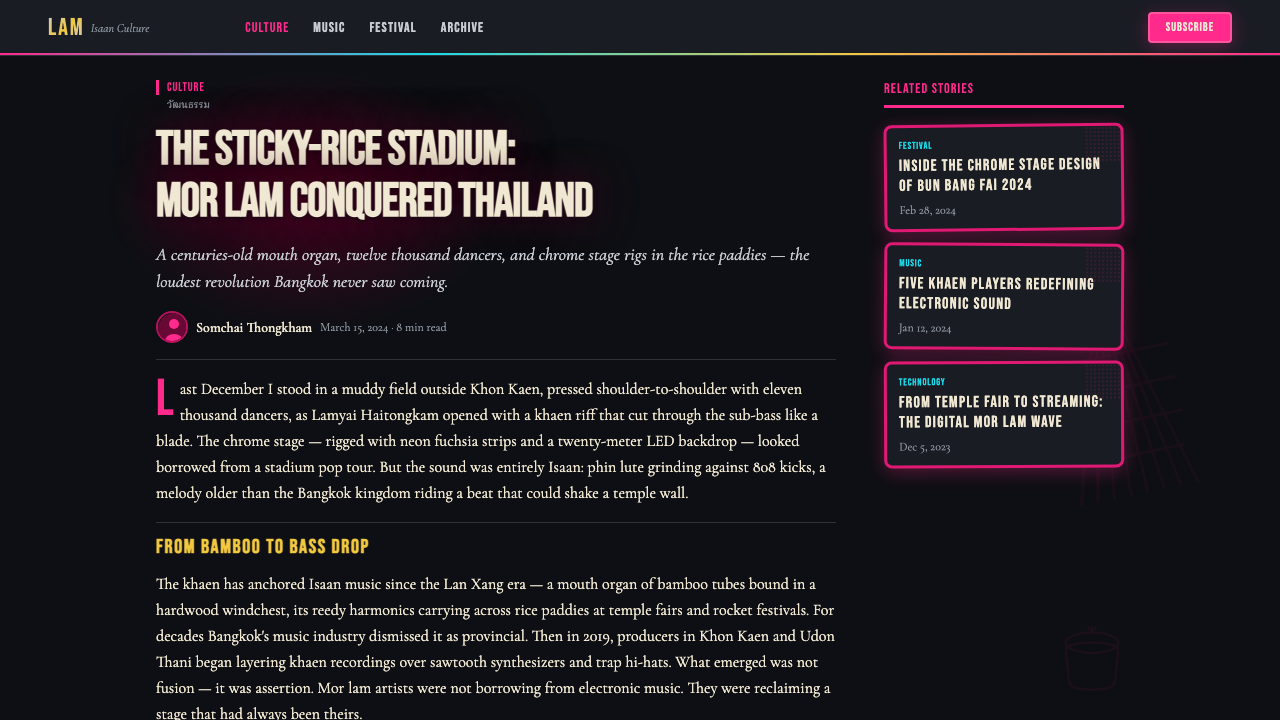
The palette is built on extreme contrast: a near-total stage black serves as the ground, against which hot fuchsia-magenta neon and electric cyan vie for dominance. Chrome silver provides a metallic mid-tone that reads simultaneously as material texture and luminosity, while glitter gold punctuates focal points and performer names. Colors are used at saturation levels that border on uncomfortable by conventional design standards — the aesthetic intention is not refinement but incandescence, the sensation of standing close to a bank of stage lights.
Typography
Display type is condensed, ultra-bold, and set at sizes that dominate the composition. Performer names are the primary typographic event — they are often larger than any supporting imagery, tracked tightly, and treated with chrome or neon-glow effects that make letterforms read as luminous objects rather than flat marks. Supporting information — dates, venues, supporting acts — is set in much smaller weights, creating a stark two-tier hierarchy that mirrors concert poster conventions worldwide while amplifying them to their logical extreme.
Halftone Texture
Halftone dot patterns — the visible grain of mass-market offset and letterpress printing — appear throughout as a unifying surface texture. They give the aesthetic its connection to the physical history of provincial concert promotion, where limited-budget printing on newsprint or cheap card stock produced this characteristic grain as a by-product of the process. In the 2020s digital incarnation, halftone is applied deliberately and decoratively, adding visual noise that prevents the design from reading as purely clean or corporate.
Collage and Layering
Composition in Mor Lam Isaan works through collision and accumulation rather than through the clean separation of elements. Performer portraits are cropped aggressively and overlaid on geometric bursts of neon color; text blocks sit atop halftone gradients which in turn layer over photographic fragments. Multiple elements compete for attention simultaneously, and the visual hierarchy is resolved not by separating them but by intensifying the contrast between them. This layering logic mirrors the density and simultaneity of the concert experience itself.
Cultural Iconography
Specific visual symbols anchor the aesthetic's Isaan identity within its contemporary spectacle: the silhouette of the khaen instrument, the conical form of the traditional bamboo sticky-rice basket, temple fair lantern shapes, and decorative motifs drawn from woven textile traditions. These icons appear as screen-printed overlays, silhouette cutouts, or geometric abstractions — never as ethnographic illustration but as charged signs that locate the design system within a specific cultural geography.
Neon Glow and Light Effects
A defining characteristic is the simulation of stage lighting: neon glow halos radiate from text and edge elements, spotlight bursts illuminate performer portraits, and light-leak effects bleed between color zones. These are not photorealistic lighting simulations but schematic representations — graphic shorthand for luminosity that reads as immediately theatrical. The glow effects also serve a structural function, separating layers that would otherwise bleed into each other on a dark ground.
Scale and Hierarchy
The compositional logic is unapologetically hierarchical, with performer identity placed at the absolute apex. Everything else — supporting acts, venue details, sponsor logos, decorative elements — exists to frame and amplify that central presence. Scale relationships are extreme: the gap between the largest and smallest typographic elements is much wider than conventional design systems would permit, which gives even complex compositions an immediate legibility from a distance — a practical requirement for festival posters viewed across a crowded fairground.
Who shaped Thai Mor Lam Isaan (2020)?
One of the foundational figures of modern mor lam recording, Pongsri helped establish the form's commercial viability during the electrification era of the 1970s and 1980s. Her recordings brought northeastern music to Bangkok audiences and created the template for the performance persona — the commanding stage presence, the alternation between traditional lam vocal technique and pop melody — that later generations of performers would scale to arena dimensions.
Banyen is widely regarded as one of the greatest traditional khaen singers of the twentieth century, a living link between the pre-electrification oral tradition and the contemporary stage. Her mastery of poetic improvisation within the strict formal constraints of lam singing established the artistic standard against which later fusion performers measure themselves. Her continued presence in the culture keeps the ancestral roots of the aesthetic visible even within its most maximalist contemporary expressions.
Jintara represents the crossover generation — performers who achieved mainstream Thai commercial success without abandoning the Isaan sonic and cultural identity. Her visual branding during the 1990s and 2000s established many of the poster conventions that the 2020s aesthetic would later amplify: the dominance of performer portraiture, the use of dramatic lighting against dark grounds, and the blending of traditional costume elements with contemporary fashion. Her career arc models how the mor lam aesthetic travels between regional and national audiences.
Among the defining stars of the EDM-mor-lam fusion era, Lamyai brought a scale of production to regional concerts that had not previously been seen. Her stage shows — with hydraulic stage elements, elaborate costume changes, and synchronized light design — established the template for the contemporary spectacular concert that the 2020s design system reflects. Her visual identity, built around the collision of traditional Isaan signifiers with international pop aesthetics, directly embodies the layered hybridity that the design system formalizes.
How do you use Thai Mor Lam Isaan (2020) today?
Mor Lam Isaan is a maximalist system and works best in contexts that can sustain — and benefit from — high visual energy. Before applying it, consider whether the communication goal is to signal intensity, celebration, regional or subcultural identity, or nocturnal entertainment. Contexts that call for calm authority, clinical precision, or delicate refinement will resist this aesthetic; contexts that need to communicate excitement, communal energy, or cultural pride will find it extremely well suited.
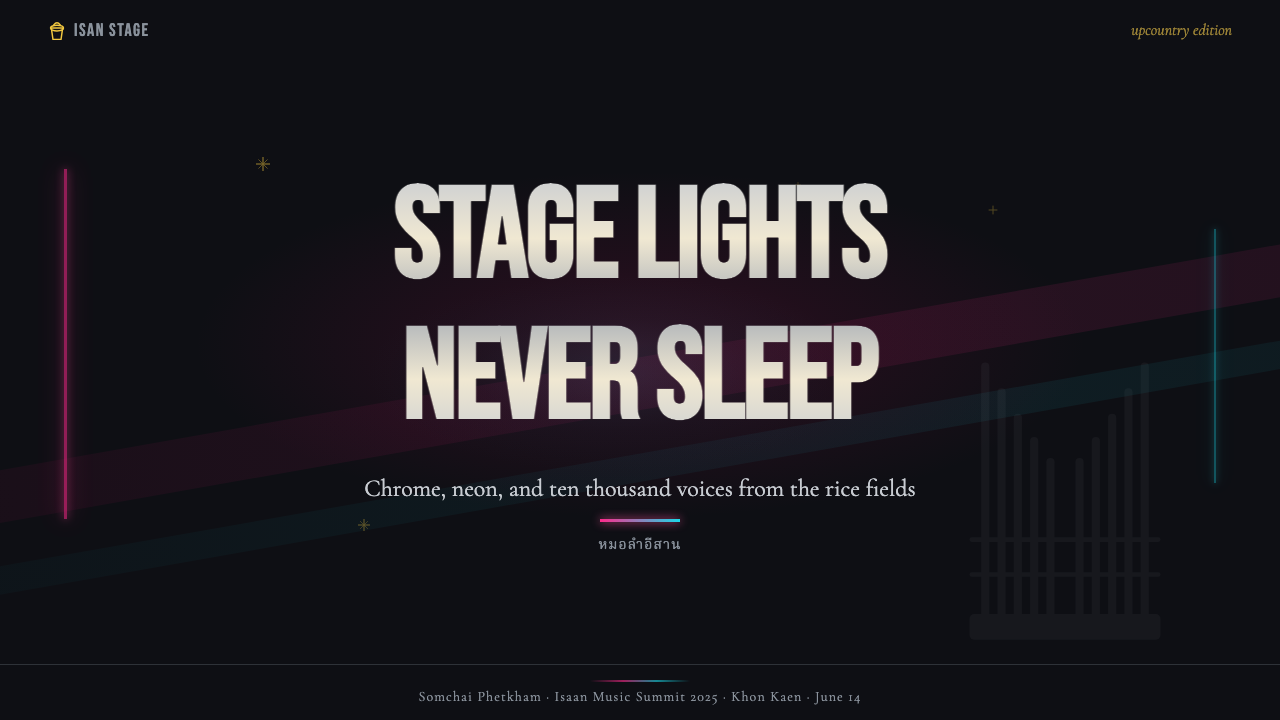
For presentation slides, the system makes an immediate impact on cover pages: a deep black background, a performer- or subject-name treatment in oversized condensed type with a fuchsia or cyan neon-glow effect, and a supporting image treated with halftone overlay. Content slides require more restraint — use the dark ground with a single accent color (fuchsia or cyan, not both simultaneously) to highlight key data points or section headers, and keep body text legible in a clean light weight. Data slides can lean into the aesthetic by rendering charts and graphs with neon-accent fills against black grounds, treating data visualization as if it were stage lighting: isolate the number that matters most and make it glow.
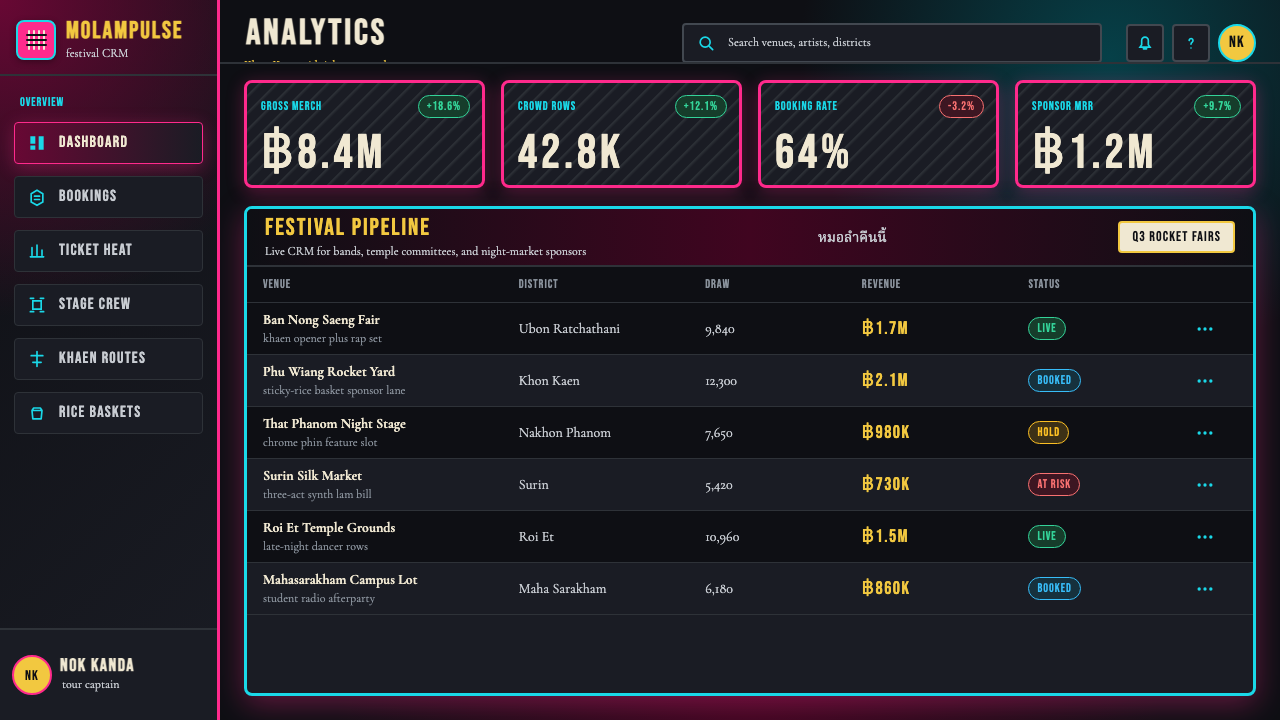
For web interfaces, the system is suited to entertainment platforms, event ticketing, cultural promotion, and nightlife-adjacent products. A dashboard built in this aesthetic would use a near-black background with fuchsia or cyan as interactive accent colors for key states and alerts. Navigation should be bold and typographic; icon decoration, where used, should favor outlined or silhouetted forms rather than filled and detailed icons. The halftone texture can be applied as a subtle background pattern to prevent large dark surfaces from feeling flat and empty. Pricing pages can use the dramatic contrast palette to make tier distinctions immediately legible — each tier differentiated by its accent color.
For editorial and marketing work, the aesthetic supports event promotion, cultural journalism, music publication, and festival branding with particular strength. A Mor Lam Isaan-derived editorial spread uses full-bleed dark photography treated with neon-glow overlays, condensed display type for section titles, and generous use of the halftone texture to link photographic elements to the designed frame. Marketing posters and social content benefit from the system's poster-logic: one central image, one dominant performer or subject name at maximum scale, supporting details at minimum scale, and the full chromatic palette concentrated in the center of the composition rather than spread edge to edge.
The most common error when applying this system is attempting to soften it — reducing contrast, introducing neutral mid-tones, choosing muted alternatives to the fuchsia and cyan, or replacing hard-edge glow effects with gentle soft-shadow equivalents. Each of these moves drains the aesthetic of what makes it distinctive. A related mistake is treating the cultural iconography as mere decoration: the khaen silhouette, sticky-rice basket, and temple-fair lantern are not generic ethnic motifs but specific markers of a living cultural identity. Using them without understanding their specificity risks producing a generic 'tropical Asia' pastiche rather than a genuine Isaan aesthetic. If the iconography feels unfamiliar, lean harder on the color and typographic system and leave the specific cultural symbols out rather than misapplying them.
Thai Mor Lam Isaan (2020) — FAQ
Is Mor Lam Isaan the same as general Thai design, or is it specific to a region?
It is emphatically specific — and that specificity is a significant part of its meaning. Isaan is the northeastern region of Thailand, home to a predominantly Lao-ethnic population with its own language, cuisine, musical traditions, and cultural identity distinct from Central Thai culture. Mor lam is an Isaan tradition, not a national Thai one, and the visual aesthetic it produced reflects that regional identity. Applying it as a generic 'Thai design' is a cultural misreading — Bangkok design, royal Thai court aesthetics, and southern Thai visual culture are each quite different. If you are working with this system, let its Isaan identity be specific rather than generalized.
How does this system work for light-background designs?
With considerable difficulty. The Mor Lam Isaan aesthetic is structurally dependent on darkness — the neon glow, chrome reflections, and spotlight effects that define it require a dark ground to function as visual phenomena. On a white or cream background, fuchsia and cyan become aggressive and ungrounded; the glow effects lose their luminous quality and become flat color blobs; the halftone texture loses its grain-against-night character. A light inversion is possible but requires a nearly complete reconception: the chromatic palette would need to be substantially desaturated and darkened, and the glow effects replaced with flat bold treatment. At that point, you are probably working in a different system. For digital applications where dark mode is not possible, consider using dark-ground cards or feature panels within a lighter overall layout rather than forcing the full system onto a light background.
What separates an authentic Mor Lam Isaan aesthetic from kitsch?
The difference is in structural intentionality versus arbitrary loudness. Authentic Mor Lam Isaan work has a clear compositional hierarchy — even at maximum chromatic intensity, there is a legible reading order from the most important element to the least. The maximalism is purposeful: every layer of neon, every halftone texture, every cultural icon is doing a specific job within the composition. Kitsch applies the surface elements — the neon, the black ground, the chrome — without the underlying compositional logic, resulting in visual noise that lacks the theatrical clarity of the real thing. A useful test: can you immediately identify the most important information in the composition? If yes, the system is working. If the eye has nowhere to rest and no clear hierarchy to follow, the maximalism has collapsed into chaos.
Can this system work for products targeting audiences unfamiliar with Isaan culture?
Yes, but with calibration. The chromatic and typographic logic of the system — deep black, neon contrast, condensed bold display type, halftone grain — is legible as a nocturnal festival aesthetic to audiences with no knowledge of Thailand or mor lam. It communicates night, music, celebration, and energy in a way that crosses cultural contexts. The specifically Isaan iconography — the khaen silhouette, the sticky-rice basket — will be opaque to uninitiated audiences, but they can still function as distinctive formal elements rather than meaningful cultural symbols. The risk is that using culturally specific imagery as pure decoration, stripped of meaning, is a form of aesthetic extraction. If the product has no genuine relationship to Isaan culture, leaning heavily on the universal elements — the color, the typography, the glow effects — and lightly on the culture-specific icons is both more honest and less vulnerable to criticism.
How does the system scale for small-format applications like mobile UI or social media cards?
The system scales better to small formats than many maximalist aesthetics, because its compositional logic is already built around extreme hierarchy and legibility at distance — qualities that translate well to small screens. The key adaptations are: reduce the number of active color accents from two to one (fuchsia or cyan, not both), scale back the halftone texture to a very fine grain or remove it entirely to avoid visual noise at small sizes, and ensure that the typographic hierarchy is reduced to at most two levels. The neon glow effect, if used, should be confined to a single focal element rather than applied throughout. Social media cards benefit from treating the dark background as the 'stage' and allowing one performer or subject to dominate entirely, with all other information subordinated to minimum readable scale.
Related design styles
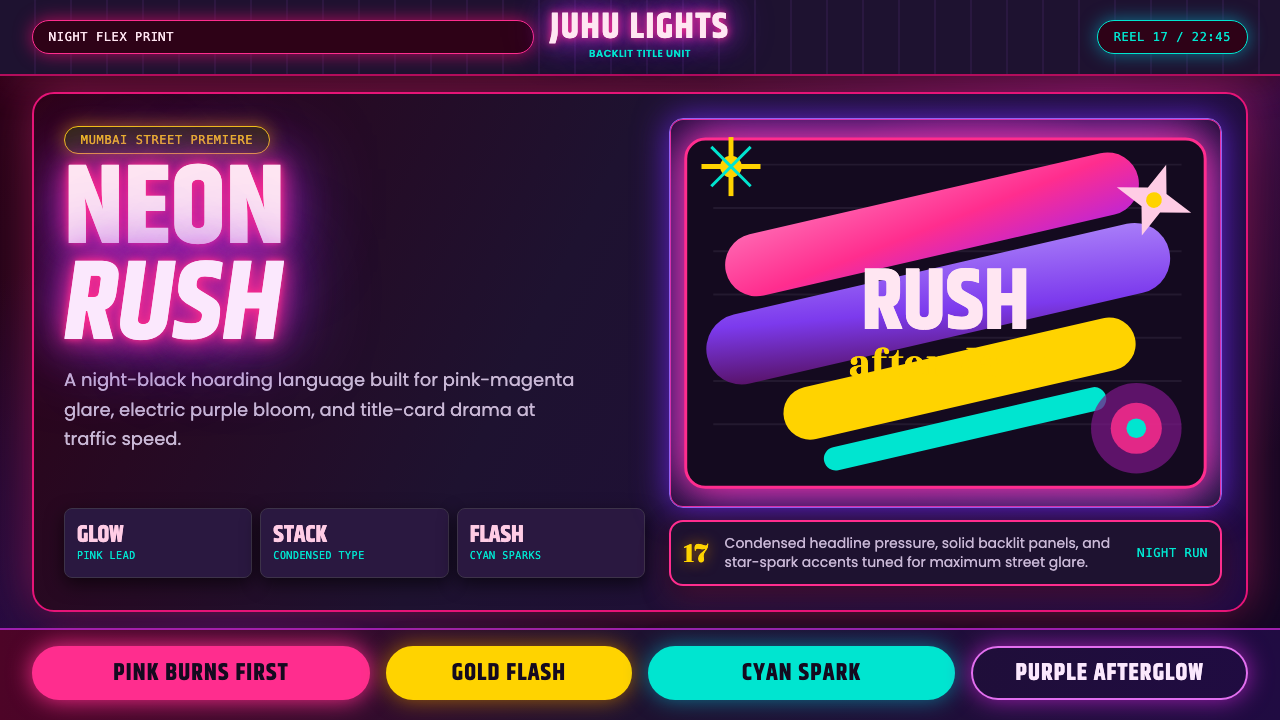 Bollywood Neon MumbaiMumbai pop burns bright. Khand stacks glow over night-black, with pink-purple…
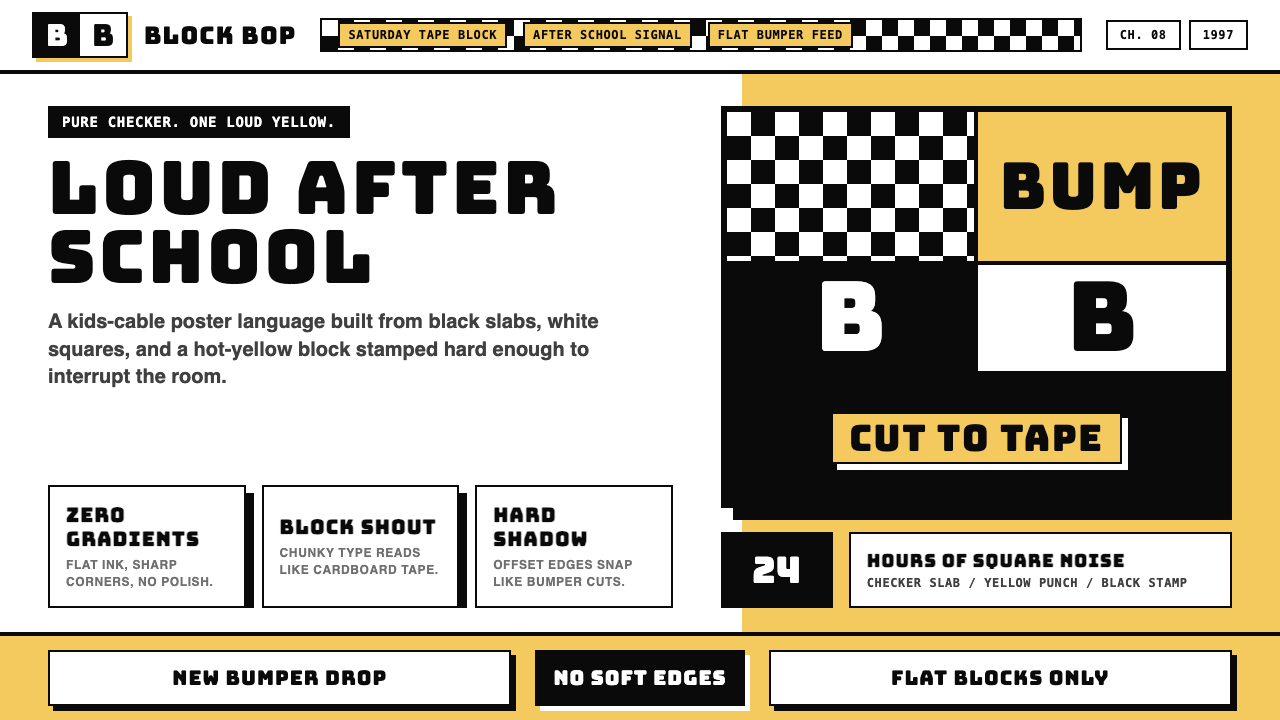 Cartoon Network 90s BlocksKids-cable noise, squared. Black-white checkerboards crash into hot-yellow Bu…
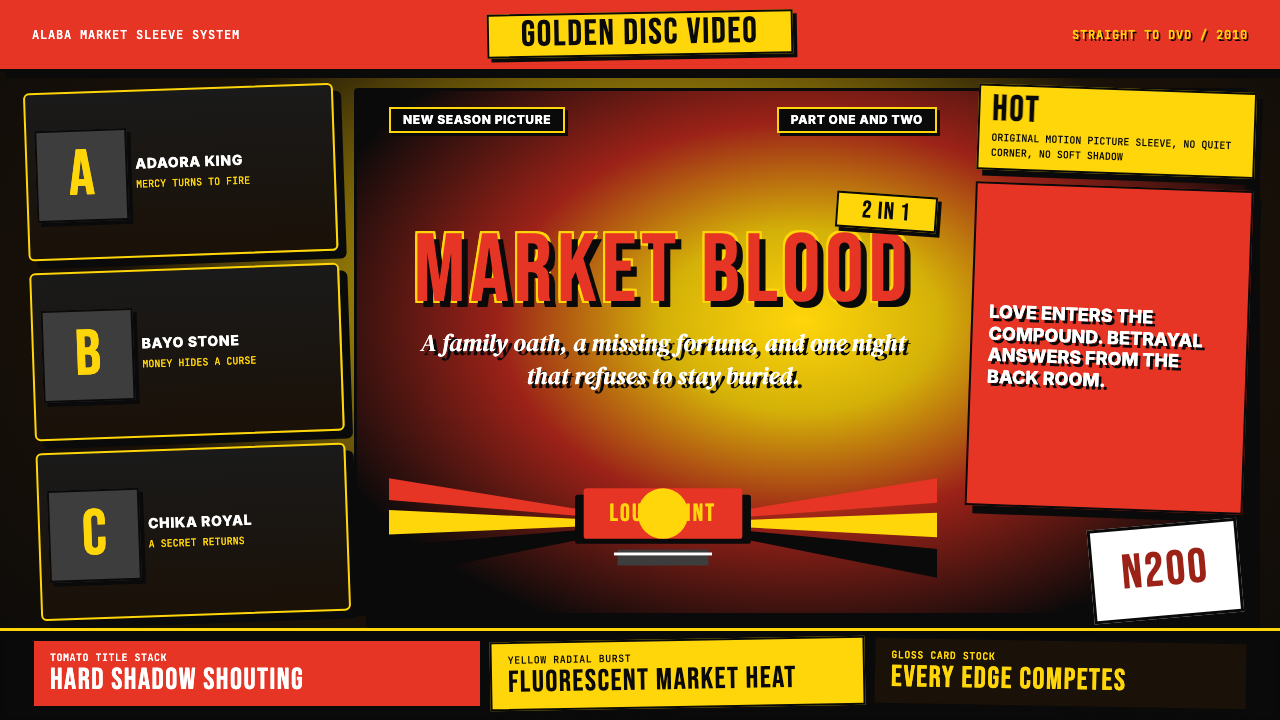 Nigerian Nollywood DVD Poster (2010)Market-stall cinema shouts. Tomato red type and yellow burst collide on jet b…
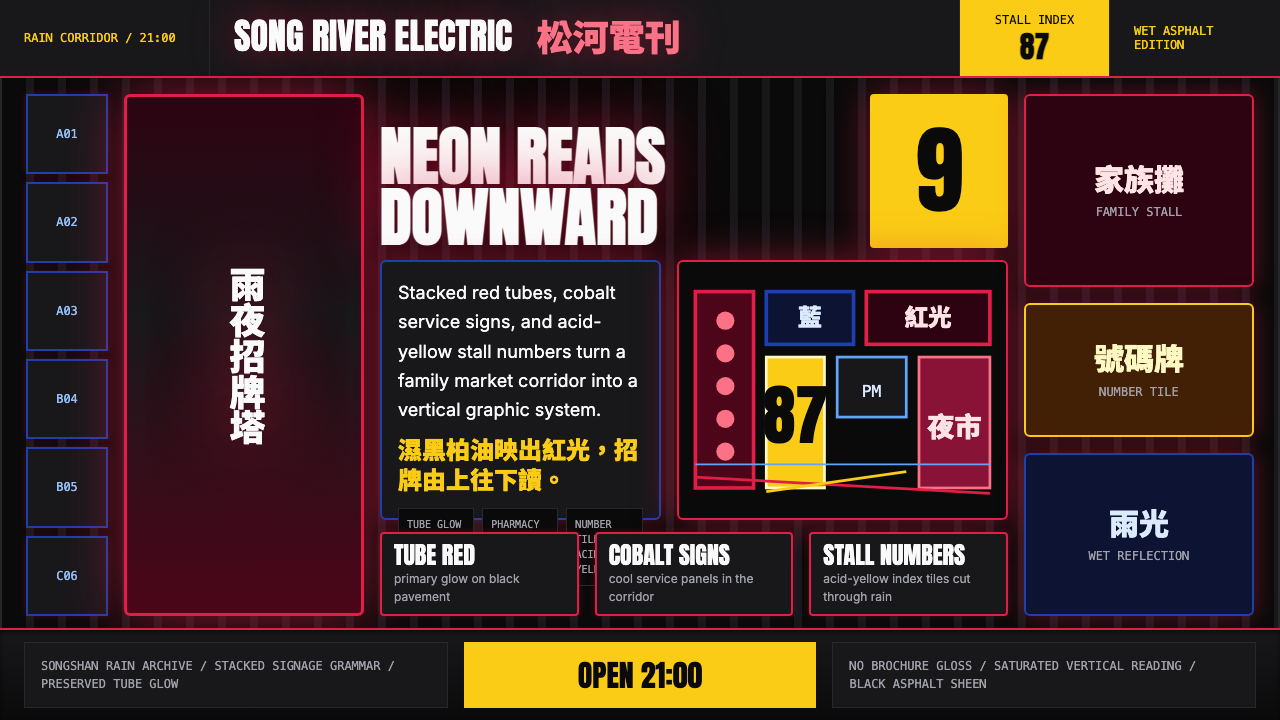 Taiwanese Raohe Night Market NeonTaipei night reads vertically. Neon red, cobalt panels, and acid-yellow numbe…
 Bad Bunny YHLQMDLGMaximal night-pop collides. Bubblegum pink and acid lime stickers glow on mid…
 Jamaican Dancehall 1990 PosterMidnight volume. Acid lime and hot pink type stack like screenprint ink on bl…