What is Balatro Poker Roguelike?
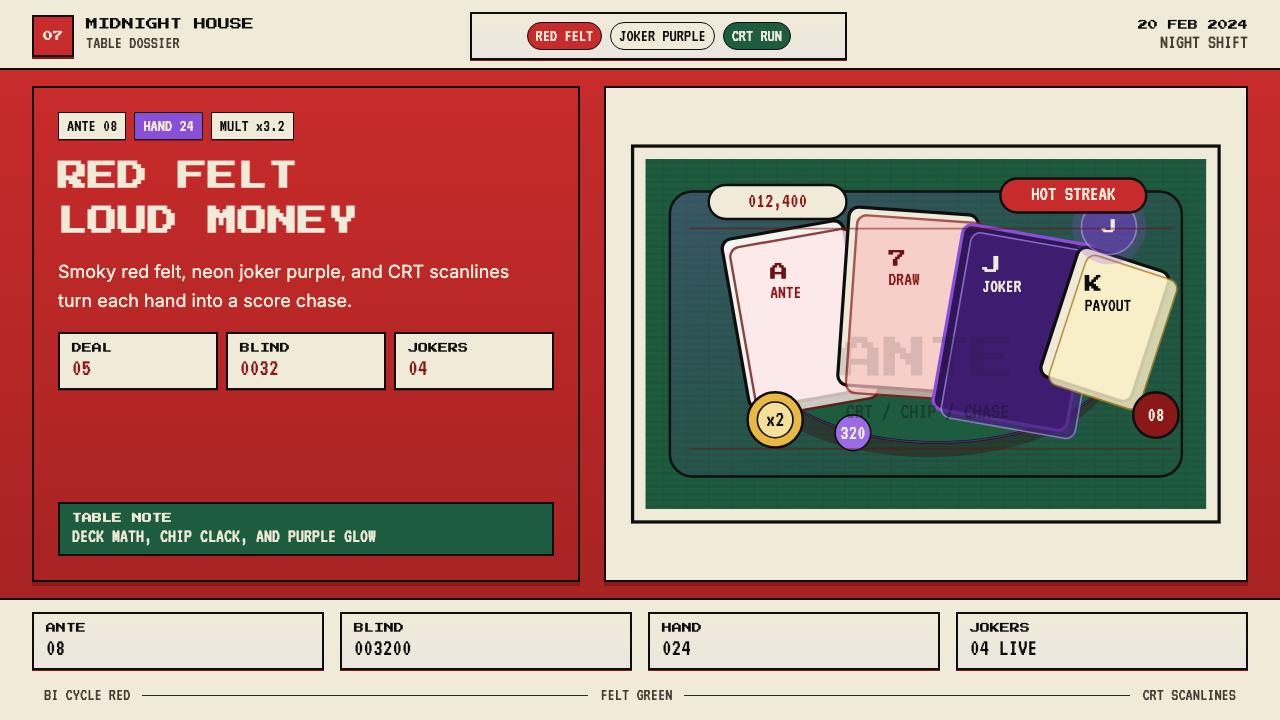
Balatro distills the smoky romance of the poker table into a visual language of casino-felt green, Bicycle-card red, and CRT scanlines — proving that a solo developer with a strong aesthetic instinct can define a genre.
Balatro Poker Roguelike in brief
Balatro Poker Roguelike is the visual design system born from the 2024 indie game Balatro — a single-player card game that blends poker hand-building with roguelike run structures. Its aesthetic is not borrowed from any prior game genre but assembled from real-world gambling culture: the deep baize green of a casino card table, the Bicycle playing-card red that has anchored American card design since the 1880s, the purple-edged neon glow of 1980s arcade marquees, and the CRT scanline filter that wraps the entire experience in a layer of smoky, late-night analog warmth.
The system is defined by a small but highly deliberate palette and a set of layout rules that prioritize legibility under tension — because roguelike games ask players to read many numbers quickly under pressure. Card faces snap to a portrait proportion that echoes real playing cards. Score counters use monospaced type so that digit changes never cause layout jitter. Gold chip accents punctuate winning moments. Every visual element earns its place by serving the core feedback loop: play cards, score points, understand consequences.
What makes the Balatro style unusually transferable outside gaming is its disciplined mix of nostalgia and precision. The CRT texture and neon palette carry emotional warmth that pure minimalism cannot, while the grid-locked card layouts and monospaced counters carry the legibility of a good dashboard. It is a system that looks handmade but behaves like an information display — which is why designers have found it useful for data-heavy interfaces, editorial layouts, and presentations that want personality without chaos.

Where does Balatro Poker Roguelike come from?
Balatro was built almost entirely by a single developer operating under the pseudonym LocalThunk, working from Brandon, Manitoba, a mid-sized city on the Canadian prairies. The game was released on February 20, 2024, after roughly two years of solo development. LocalThunk has remained anonymous, declining interviews and public appearances while speaking through the game's Steam page and occasional social media posts — a decision that redirected all attention toward the work itself rather than the creator's biography.
The visual system was not drawn from a formal design background but assembled through close study of real gambling ephemera: vintage Bicycle and Bee playing-card decks, casino chip sets, felt table surfaces, and the particular green that casino operators have used for decades because it reduces eye strain under artificial light. The CRT scanline layer was added to evoke the early video poker terminals and slot machine screens of the 1980s and early 1990s — the exact moment when gambling and digital display technology first converged in popular culture. This layering of pre-digital gambling nostalgia onto a digital card game creates the system's core emotional texture.
The game's publisher, Playstack, and its composer LouisF contributed to the surrounding context — the soundtrack's late-night jazz and accordion cues reinforce the visual system's smoky backroom atmosphere. But the aesthetic decisions appear to have been driven almost entirely by LocalThunk, making Balatro a rare case of a coherent, finished design language emerging from a single sensibility rather than a collaborative process.
Balatro won The Game Awards Best Independent Game and BAFTA Game of the Year in 2024, bringing its visual identity to an exceptionally wide audience. The game's success within the indie roguelike and deckbuilder community — a genre boom that had been building since games like Slay the Spire (2019) and Monster Train (2020) — coincided with a broader revival of CRT-aesthetic and pixel-art visual styles across indie game development. Balatro is distinctive within this revival, however, because its reference points are not retro gaming but retro gambling: the aesthetic is drawn from physical card and casino culture rather than from 8-bit or 16-bit screen memory.
What defines the Balatro Poker Roguelike look?
Casino-Ground Palette
The palette is anchored by three historically grounded colors: the deep baize green of a card table felt (a hue that casino operators have standardized for over a century because it reduces eye strain under tungsten light), the particular warm red of a Bicycle playing-card back (a red that reads as festive and authoritative simultaneously), and a neon purple-violet borrowed from 1980s arcade marquee lighting. Against these three, gold appears as a consistent accent for score displays and high-value items, and off-black serves as the universal background for night-mode panels. The palette is dense and saturated rather than muted — it wants to be read across a room.
CRT Scanline Overlay
A horizontal scanline texture is applied as a global overlay across the entire visual field, simulating the phosphor-line structure of cathode-ray tube monitors from the 1980s and early 1990s. The scanlines are subtle enough to read through but prominent enough to shift the perceived surface from crisp digital to tactile analog. Their primary function is atmospheric: they make every color feel slightly warmer, slightly more worn, and slightly more private — as if the game is running on a terminal tucked into the back corner of a casino lounge. The texture also unifies elements that would otherwise feel disparate, acting as a consistent ground beneath the card graphics, UI panels, and background.
Card-Grid Layout
All card objects are sized and positioned according to a portrait proportion that closely matches a physical playing card — roughly the ratio of a standard Poker-size card. Cards snap to a grid rather than floating freely, which means the layout reads as orderly even when the table is full. The grid spacing is generous enough to allow each card to breathe individually, while the overall array reads as a single organized field. This discipline means that adding or removing cards from the hand produces a layout shift that feels deliberate rather than accidental — a quality that carries directly into slide and dashboard design when the style is applied outside gaming.
Monospaced Score Typography
Score counters, chip tallies, and numerical multipliers are displayed in monospaced type — a deliberate choice from the world of terminals and cash registers rather than of graphic design. The monospaced character means that as numbers tick upward, each digit occupies the same horizontal space regardless of whether it is a one or an eight; the counter does not shift left or right as values change. This is a functional decision with a strong aesthetic signature: the counters feel mechanical, like an odometer or a slot machine reel, rather than like a contemporary app badge. Headline and card-title type uses a bolder, pixel-influenced display face that references arcade high-score boards.
Gold Accent Hierarchy
Gold — a warm, metallic yellow rather than a bright primary — is used sparingly and consistently as the signal for high value. It appears on chip stacks, on bonus multiplier labels, on legendary-tier joker card frames, and on any UI element that represents the player's most consequential resource. The restraint in its use is what gives it power: because gold appears only where something matters most, the eye learns to trust it as a signal rather than treating it as decoration. This is a lesson from physical chip design — casino chips use gold accents precisely because the color is not used anywhere on the felt table surface itself.
Layered Depth Without Gradients
The Balatro interface creates a strong sense of depth — cards float above the table, panels sit above the background, tooltips hover above panels — without relying on soft drop shadows or gradient fills. Depth is achieved through a combination of hard-edged borders, slight scale differences between layers, and the CRT overlay that visually recedes the background relative to foregrounded UI elements. The result is a depth hierarchy that is clear to read even on lower-quality displays. This approach echoes the physical layering of actual card game components: the felt beneath the cards, the cards themselves, the chips stacked above the cards.
Joker-Card Expressionism
The game's joker cards — the most powerful and visually varied objects in the system — are each illustrated in a cartoonish, expressive style that deliberately breaks from the clean grid of the playing-card UI. Each joker has a unique face, a distinct color personality within the overall palette, and a small illustrated vignette that communicates its effect through visual metaphor. This controlled injection of character and illustration into an otherwise disciplined grid system is one of the Balatro aesthetic's most instructive qualities: the expressiveness of the joker cards earns its place because it is contained within a defined card-shaped frame and never bleeds into the surrounding UI.

Who shaped Balatro Poker Roguelike?
LocalThunk is the anonymous solo developer who designed, programmed, and directed Balatro from its inception through commercial release. Working from Brandon, Manitoba, they made nearly all aesthetic decisions — palette, typography style, CRT overlay, card proportions — without a design team or art director. The choice to remain pseudonymous has kept the focus entirely on the work itself. LocalThunk's background is not in professional game development or graphic design, which may explain why the visual system draws so directly from physical source material (real card decks, casino furniture) rather than from conventions of prior video game art.
Playstack is the London-based indie game publisher that partnered with LocalThunk to bring Balatro to market across multiple platforms. While their direct contribution to the visual design system is limited — the core aesthetic predates the publishing agreement — Playstack played a role in the game's marketing presence and platform deployment, decisions that shaped how the Balatro visual identity was presented to press and storefronts. Their track record with other mid-scale indie titles gave LocalThunk distribution reach that reinforced the aesthetic's cultural spread.
LouisF composed the Balatro soundtrack, a collection of late-night jazz, accordion, and ambient casino-lounge cues that form the auditory complement to the visual system. The music is unusual for an indie roguelike in that it avoids the chiptune and electronic palettes common to the genre, instead referencing the same physical gambling world that the visual design draws from. This cross-modal coherence — where the sonic and visual references are both drawn from mid-century casino culture — is part of what gives the overall Balatro aesthetic its unusual solidity. A design system that extends into sound as well as image is notably harder to imitate superficially.
While not a person, the Bicycle brand — produced by the United States Playing Card Company since 1885 — is a direct visual ancestor of the Balatro aesthetic. The Bicycle card back design, with its interlocking red scrollwork on a white ground, established the specific shade of warm playing-card red that Balatro samples. The card's portrait proportions, the feel of its face-card illustration style, and even the semantic weight of the suits (spades, hearts, clubs, diamonds) are all active references within the game. Understanding the Bicycle card as a designed artifact helps explain why the Balatro palette feels authoritative rather than arbitrary.
How do you use Balatro Poker Roguelike today?
The Balatro style is most effective in contexts where the designer wants high legibility paired with strong atmosphere — situations where the work needs to feel alive and specific rather than generic and polished. Applying it correctly requires understanding its two registers: the disciplined grid and monospaced legibility system on one hand, and the saturated palette and CRT warmth on the other. The two registers must be held in balance; losing either one collapses the aesthetic into either a generic dark-mode dashboard or a vague retro pastiche.
For presentation slides, the style works particularly well for covers and section dividers that need immediate visual impact. A cover built in this system might place a large card-shaped frame at center, set the title in a bold display face with slight pixel texture, and ground the whole composition in the deep casino green with a gold accent. Content slides should lean into the grid discipline: treat each information block as a card object with a consistent border treatment, use monospaced type for any numerical data, and reserve the neon accent color for the single most important figure on each slide. Data slides benefit from treating charts as card objects — bar charts with bordered frames and casino-palette coloring read as part of the system rather than as inserted graphics.
For web UI, the Balatro aesthetic is well-suited to dashboards, analytics interfaces, and any product that presents numerical information as its primary content. The approach: establish a dark near-black background as the base layer, use bordered card components with slight hard-edge shadow for information panels, apply monospaced type to all counters and metrics, and use the gold accent exclusively for the highest-priority value on any given screen. The CRT texture can be applied as a subtle full-page overlay or omitted entirely for a cleaner read — the grid and palette carry the style without it. Pricing pages work well with the system's chip-and-tier metaphor: each pricing tier reads as a card object, and the recommended tier receives the gold accent treatment.
For editorial and marketing work, the style supports a poster-sensibility that photograph-heavy layouts cannot achieve through the palette alone. A feature article opener might use the casino-green as a full-bleed background, set the headline in the bold display face at very large scale, and introduce a card-shaped image container rather than a freeform bleed image. Marketing one-pagers benefit from treating section headers as card labels — a bordered chip-style container for each section title gives the page consistent internal rhythm. The joker-card illustration principle is instructive here: contained, expressive character illustration within a defined frame works well for product mascots, feature icons, or any illustrated element that needs personality without overwhelming the surrounding information.
A common mistake when applying this style is over-relying on the CRT scanline texture as a substitute for structural discipline. The texture creates atmosphere, but it does not organize information. Designs that lead with the CRT effect and neglect the underlying grid and color hierarchy produce work that reads as a costume rather than a system — visually noisy and difficult to scan. The correct sequence is to establish the card-grid structure, color hierarchy, and monospaced type logic first, then apply the CRT overlay as a finishing layer. Similarly, the neon purple-violet should be used with the same restraint as the gold accent — it is a signal color, not a background treatment.

Balatro Poker Roguelike — FAQ
Is the Balatro style only appropriate for gaming-related projects?
No. The style's game origin is a source of its emotional texture, not a limitation on its application. The underlying system — a dark ground with high-contrast bordered card components, a disciplined color hierarchy, and monospaced numerical displays — functions as well in a financial analytics dashboard or a conference presentation as it does in a game UI. What the style brings to non-gaming contexts is atmosphere: a sense that the interface takes its information seriously and has a specific point of view. Projects where this directness would feel appropriate include data products, developer tools, design tools, poker and card game adjacent apps, and any brand that wants to project confidence and specificity rather than approachability and warmth.
How does the Balatro style differ from generic dark-mode design?
Generic dark-mode design typically uses neutral near-black backgrounds, subtle elevation shadows, and a single brand-color accent. It aims for universality and inoffensiveness. The Balatro style is distinguished by its specificity: the background is not a neutral dark but a saturated casino green or deep felt tone; the card-grid structure is not a generic card component pattern but a reference to physical playing-card proportions; the type system includes a deliberately retro pixel-influenced display face that generic dark-mode avoids. The CRT scanline overlay is the most obvious differentiator, but the deeper difference is that every element in the Balatro system carries a historical reference rather than a neutral design-system token. Applying one without the others produces a confused result.
Can the Balatro aesthetic work on a light background?
It is possible but significantly more difficult. The system's atmosphere depends heavily on the contrast between its saturated accent colors and a deep background — the neon purple and gold only sing against dark grounds. On a light background, these same accents tend to read as garish rather than dramatic. If a light-background version is required, the recommended approach is to invert selectively: keep the card components on a casino-green or near-black ground even if the overall page background is light, treating the cards as dark islands in a lighter sea. The CRT overlay does not translate to light backgrounds at all and should be omitted. The monospaced type system and card-proportion grid remain fully usable on light grounds.
What is the right way to handle illustration within this style?
The joker-card system provides the model: character illustration belongs inside defined frames, not loose on the page. Each illustrated element should live within a card-shaped or chip-shaped border that contains its expressiveness and prevents it from competing with the surrounding information hierarchy. Style-wise, the illustration language should lean toward bold outline, limited color fills drawn from the main palette, and a slightly cartoonish or caricature quality — not photorealism, not flat vector minimalism, but the kind of illustrative energy you would find on a vintage cigarette card or a theatrical poster from the early twentieth century. Photography is generally discouraged within the system; if used, it should be treated as high-contrast and tightly cropped rather than ambient and full-frame.
How should the CRT scanline effect be implemented without making the interface feel like a Halloween decoration?
Restraint in opacity is the entire answer. The scanline overlay in the original Balatro game is subtle enough that many players do not consciously notice it — they only feel its effect as a warmth and slight softness in the color rendering. An opacity that is just visible at close inspection but invisible at normal viewing distance is the target. Common mistakes include setting the scanline too dark (which creates a harsh striped pattern that competes with content), setting the line spacing too wide (which creates a venetian-blind effect rather than a phosphor glow), or applying the effect only to certain components rather than globally. The scanline should function as a surface quality of the entire screen — like the grain of a film photograph — not as a decorative frame applied to selected elements.
Related design styles
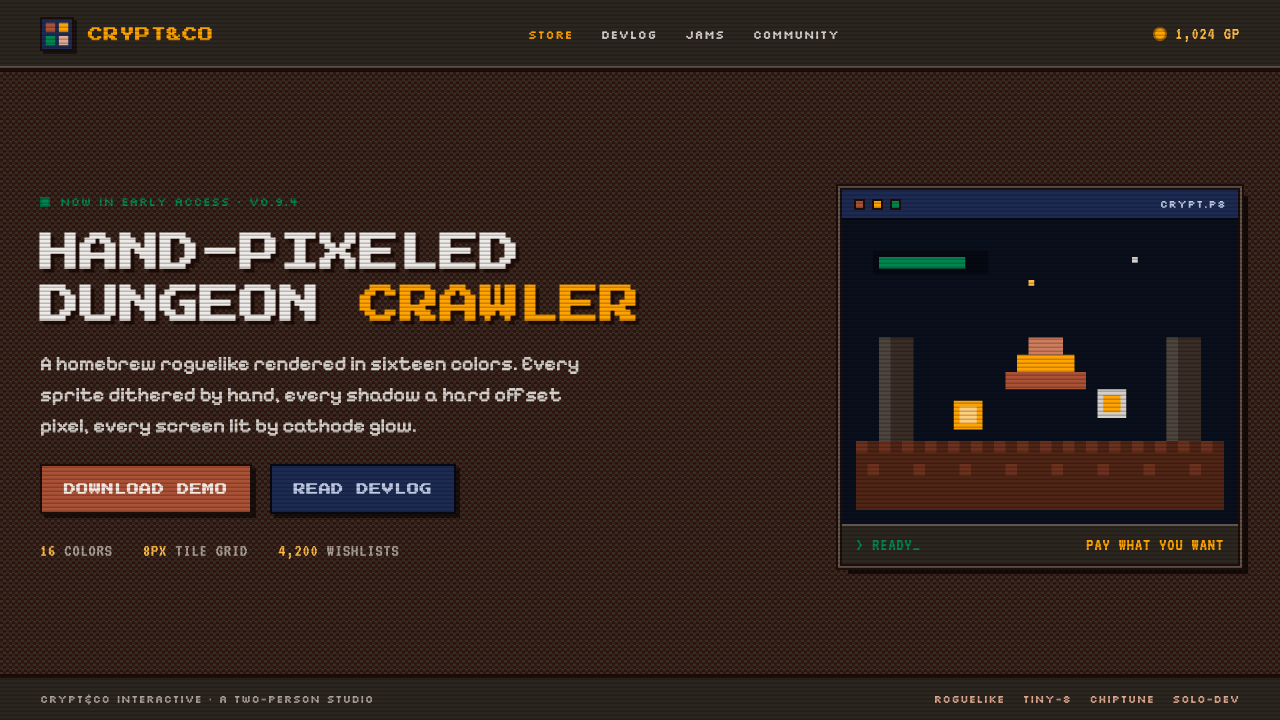 Indie Pixel-Art GameMade by hand, lit by cathode. Sixteen dithered earthy colors, blocky bitmap t…
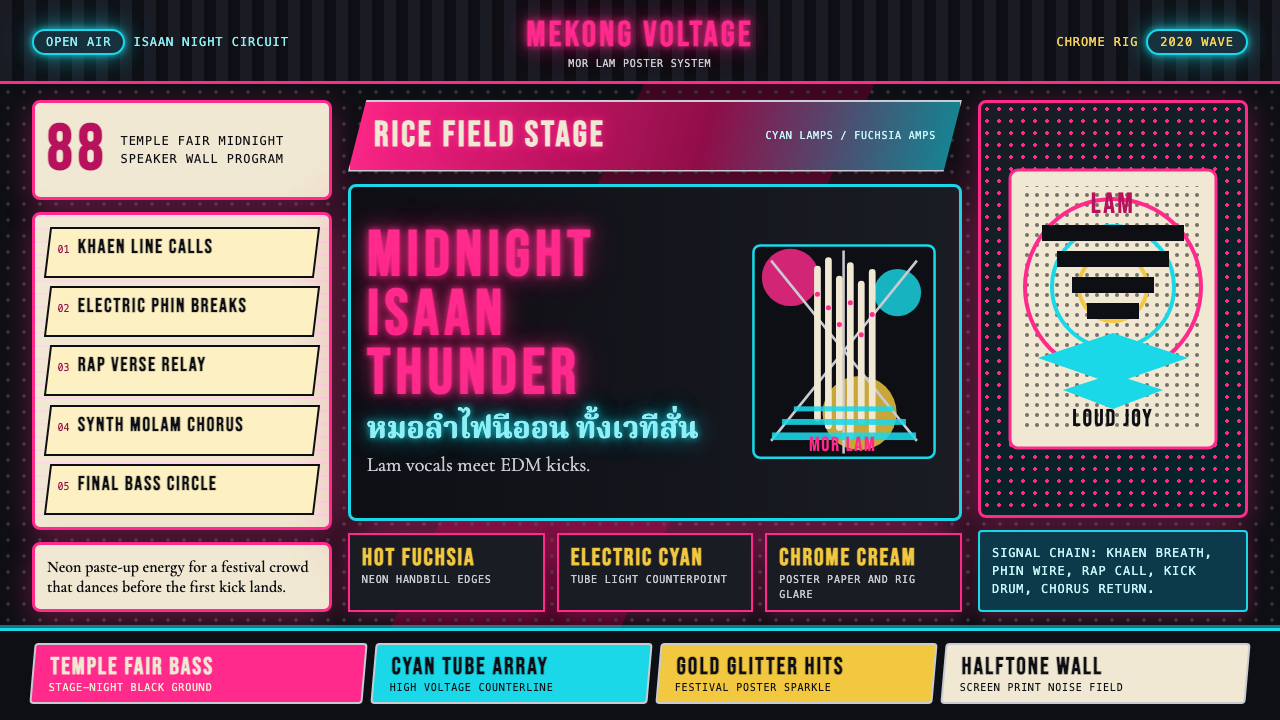 Thai Mor Lam Isaan (2020)Joy at maximum volume. Fuchsia-cyan neon, chrome type, and halftone grids hit…
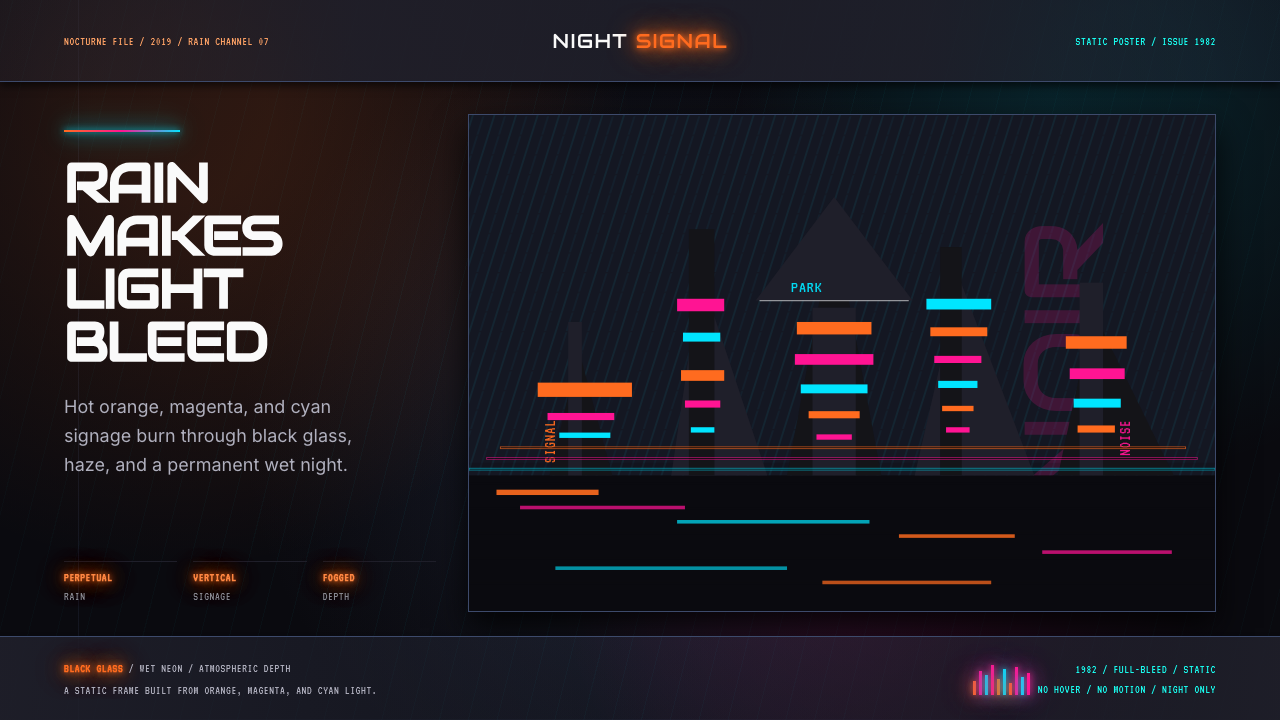 Blade Runner 1982 Neon NoirRain-soaked noir. Orange, magenta, and cyan neon cut black glass.
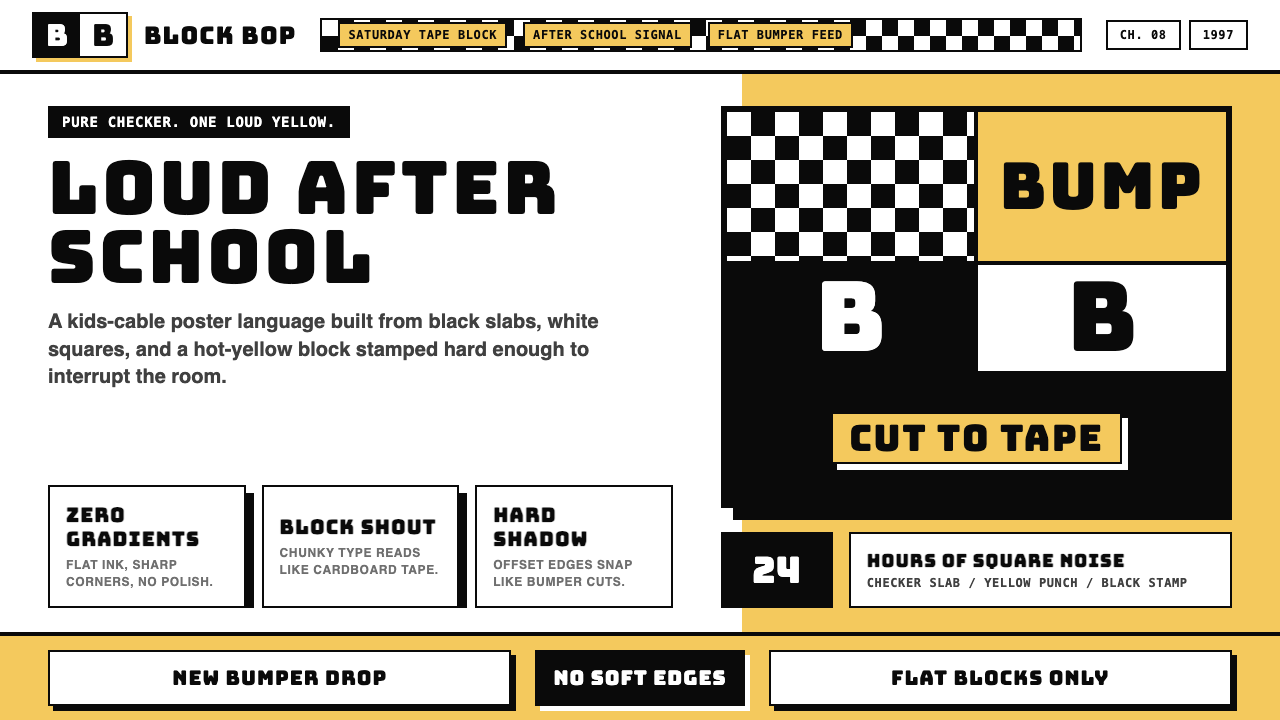 Cartoon Network 90s BlocksKids-cable noise, squared. Black-white checkerboards crash into hot-yellow Bu…
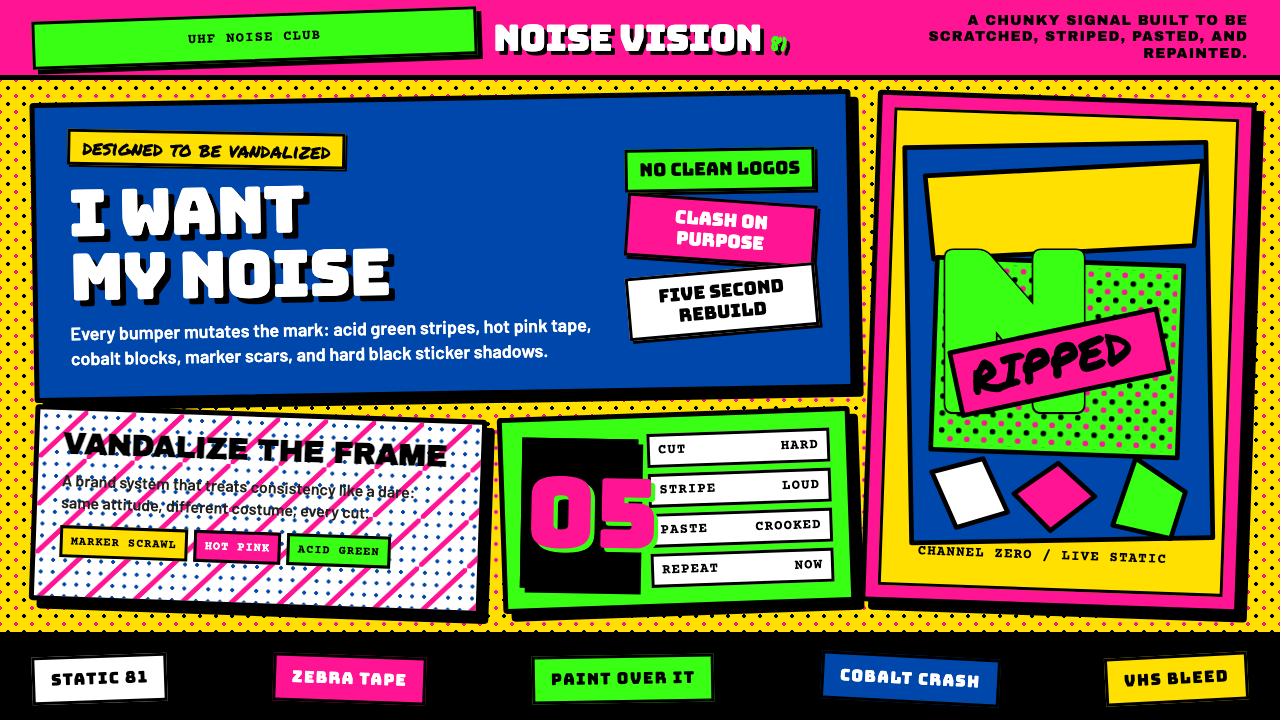 MTV Launch Identity (1981)Built to be vandalized. Hot pink, acid green, Bungee blocks, and crooked stic…
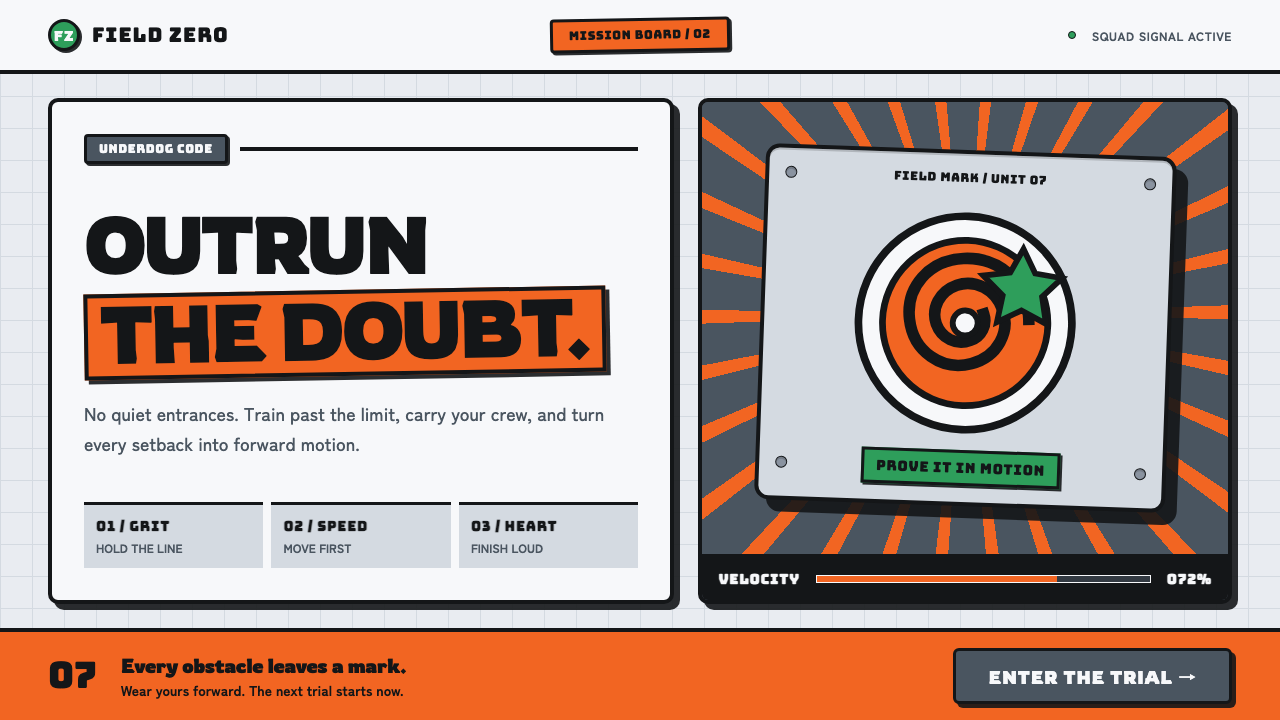 Naruto (2002 anime era)Underdog energy refuses the background. Hazard orange strikes steel-gray grid…