What is Seapunk 2011?
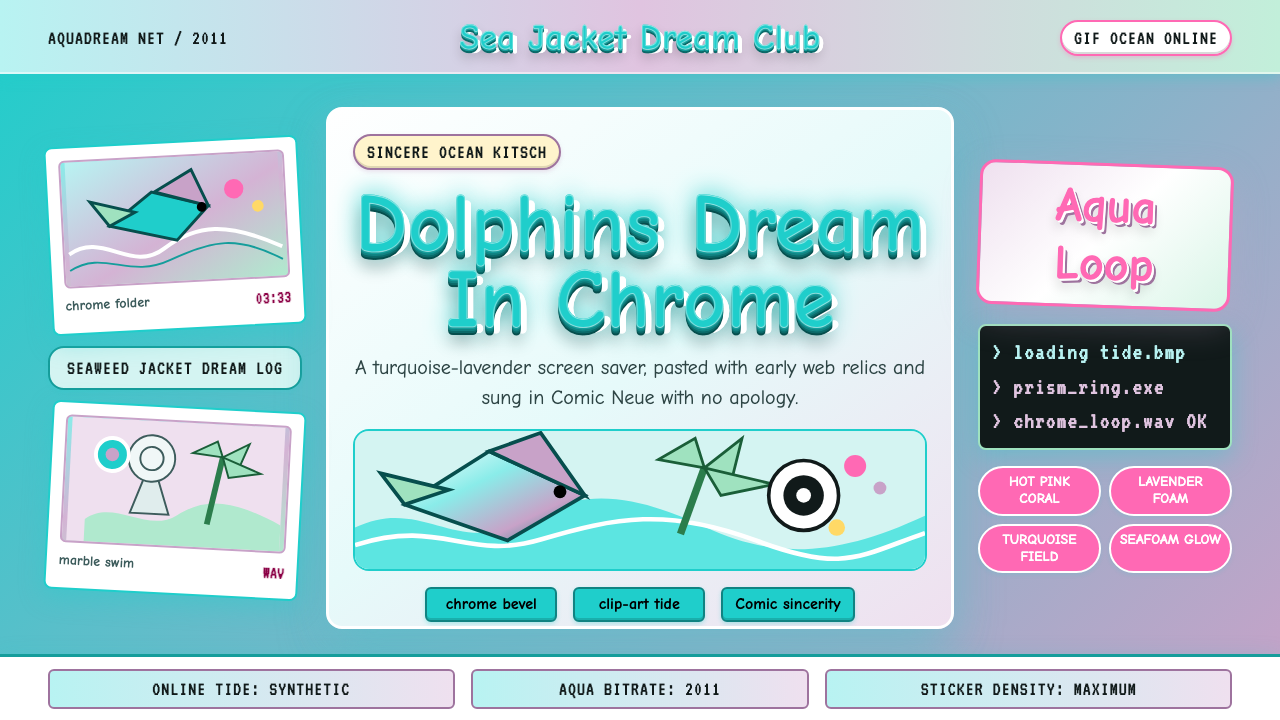
Seapunk crashed ashore in 2011 as a single Tumblr dream about a seaweed jacket — and surfaced as the internet's most earnest collision of nineties nautical kitsch, GIF-compressed turquoise, and deliberate bad taste.
Seapunk 2011 in brief
Seapunk is a 2011 internet microaesthetic born on Tumblr, defined by the collision of early-nineties nautical computer graphics — dolphins leaping through pixelated waves, marble busts floating in void space, Yin-Yang symbols spinning on tiled backgrounds — with the irreverent irony of the early social-web. Its color world is saturated and watery: deep turquoise, seafoam green, and lavender dominate, lit by the pale glow of early CRT monitors and drenched in gradient washes that recall period screensavers and CD-ROM title screens.
The aesthetic is self-consciously kitsch and self-consciously sincere — a combination that sounds contradictory but is essential to understanding the movement. Seapunk did not mock its source material. It recycled nineties ocean imagery with genuine affection, treating clip-art dolphins and chrome-beveled WordArt headings not as failures of taste but as an underappreciated vernacular. Text is treated as a graphic object: chrome or liquid-metal lettering, heavy drop shadows at exaggerated offsets, and Comic Sans deployed with full awareness of its cultural baggage as an act of aesthetic defiance.
Visually, seapunk work is layered and dense rather than spare. Multiple translucent elements overlap on tiled or gradient backgrounds. GIF animation is structural, not incidental — animated starfish, looping wave patterns, and blinking text belong to the image, not just to its delivery format. The overall effect is deliberately overwhelming in the way a beachside souvenir shop is overwhelming: joyful visual noise organized around a coherent chromatic identity.

Where does Seapunk 2011 come from?
The movement can be dated with unusual precision. On May 27, 2011, the Twitter account @LILINTERNET — operated by a young Chicago-based musician and internet artist — posted a tweet describing a vivid dream: a leather jacket covered in seaweed, the word 'seapunk' as the name for whatever this was. The tweet propagated quickly through Tumblr reblogs and music-adjacent internet communities. Within weeks, a loose creative cluster had formed around the term, producing music, visual art, and fashion under its banner.
The cultural raw material was already abundant. Early-nineties CD-ROM design, desktop publishing aesthetics, low-polygon oceanic CGI from period nature documentaries, and the visual grammar of nineties rave flyers all fed into seapunk's image bank. What the movement supplied was a curatorial sensibility: it identified these sources as beautiful rather than embarrassing, ironic rather than naive, and worth treating as a genuine design vocabulary. Albert Redwine and the Coral Records Internazionale crew were among the most visible early practitioners, producing music releases and visual identities that codified what seapunk imagery looked and sounded like.
Tumblr's infrastructure was inseparable from the aesthetic's character. The platform's reblog economy rewarded visual density and immediate recognizability. GIF support made animation a native part of any image. The absence of strict layout templates meant that seapunk blogs could pile clip-art, tiled ocean textures, and multicolored text into pages that were themselves objects of the aesthetic rather than neutral containers for it. The movement lived inside its medium in a way that made it difficult to fully translate to any other platform.
In 2012, seapunk received its most high-profile mainstream moment when Rihanna's team used the visual vocabulary wholesale for a Saturday Night Live performance. The ocean blue lighting, underwater CGI, and digital wave imagery were unmistakably derived from the Tumblr movement. The appropriation caused a minor internet controversy and a broader conversation about how quickly subcultural internet aesthetics could be absorbed into commercial pop production — a dynamic that would recur with vaporwave, cottagecore, and every subsequent microaesthetic. The seapunk community largely viewed the event as confirmation that the movement had already peaked, with its most interesting phase belonging to 2011 and early 2012.
What defines the Seapunk 2011 look?
Color
The palette orbits deep turquoise and seafoam green as its anchoring hues, with lavender, soft coral, and electric periwinkle as secondary accents. Colors are applied at high saturation and often as gradients — horizontal washes that shift from one underwater hue to another, evoking period screensavers and nineties multimedia title screens. Black is used sparingly; near-black navy serves as the primary dark tone. White appears mainly as the ground for chrome lettering effects. The overall chromatic effect is luminous and slightly overexposed, like a sunlit shallow sea viewed through a CRT monitor.
Typography
Seapunk typography is deliberately anti-hierarchical in the modernist sense: Comic Sans is used with full awareness, deployed as an aesthetic statement rather than a mistake. Chrome or liquid-metal bevel effects applied to headlines are structural — the three-dimensional quality of the letterform is the design. Drop shadows appear at large, exaggerated offsets rather than subtle close-cropped positions, producing a floating, depth-heavy effect. Type is often outlined, glowing, or set against tiled pattern backgrounds in ways that would be considered unreadable by conventional standards, but which are legible within the aesthetic's logic of deliberate sensory abundance.
Motifs and Iconography
The seapunk image bank draws heavily from early-nineties computer clip-art and low-polygon CGI rendered in the period's characteristic flat-shaded style: dolphins, palm trees, sea turtles, starfish, tropical fish, conch shells, and Yin-Yang symbols. Ancient marble busts — a motif the movement shares with early vaporwave — appear floating in aquatic environments, creating a temporal collision between classical antiquity and early digital aesthetics. These objects are typically silhouetted or presented without environmental context, floating freely on gradient or tiled backgrounds.
Texture and Pattern
Tiled backgrounds are central to seapunk's visual identity — repeating patterns of waves, water surfaces, tropical fish, or geometric ocean-derived forms fill fields that in other aesthetics would be left as solid color. These tiles are drawn from early web design conventions and period CD-ROM interfaces, where tiling was a practical response to technical memory constraints that the movement repurposes as a stylistic value. Overlapping translucent or semi-transparent layers, lens flares, scanline effects, and pixelated noise add additional texture, producing an image surface that is dense and materially rich rather than clean.
Animation and GIF Culture
GIF animation is not decoration in seapunk — it is a fundamental structural element. Looping animated elements, including spinning Yin-Yang symbols, cycling wave patterns, and blinking or scrolling marquee text, are integral parts of the composition rather than additions layered over a static base. The GIF format's technical limitations — its restricted color palette, visible dithering, and harsh looping cuts — are embraced as aesthetic properties rather than worked around. Seapunk images are often meant to be experienced as moving, and a static export of a seapunk composition loses a primary dimension of the aesthetic.
Sincerity and Irony
Unlike many aesthetics that engage with low-brow or kitsch source material at ironic distance, seapunk insists on sincerity. The dolphins are not jokes. The Comic Sans is not a wink. The nineties ocean clip-art is genuinely loved rather than condescendingly appreciated. This combination of ironic self-awareness — these practitioners knew their sources were culturally stigmatized — and genuine affection is the movement's defining emotional register. Work that applies seapunk imagery purely as parody misses this core quality and reads as hollow rather than exuberant.
Density and Layering
Seapunk compositions favor visual density over breathing room. Negative space is not a design value in this aesthetic — it is an absence waiting to be filled with another wave, another dolphin, another glowing outline. Elements are layered rather than arranged, overlapping and sometimes competing for the eye in ways that a designer trained in modernist principles would describe as chaotic. Within the aesthetic's own logic, however, this density is coherent: it mirrors the visual experience of a reef, a tide pool, or the nineties multimedia interfaces from which the movement draws its grammar.

Who shaped Seapunk 2011?
@LILINTERNET, a Chicago-based musician and internet artist active in early Tumblr-era online communities, is credited with coining the term 'seapunk' in a May 2011 tweet describing a dream about a seaweed-covered leather jacket. This single post became the nominal origin point of an entire subcultural aesthetic movement. Whether the term would have crystallized a pre-existing visual sensibility or actively created one remains debated, but @LILINTERNET's role as the movement's naming event is uncontested. Their music releases in 2011 and 2012 helped define the sonic counterpart to the visual aesthetic.
Albert Redwine was one of the most visible early visual practitioners of seapunk, producing artwork and visual identities for releases in the movement's orbit. His work helped translate the aesthetic from a loosely shared Tumblr sensibility into a more codified visual language with recognizable conventions. Along with the Coral Records Internazionale crew, he was instrumental in demonstrating that seapunk could sustain a consistent visual system across multiple projects rather than remaining a scattered collection of individual Tumblr posts.
Coral Records Internazionale was a loosely organized label and creative collective that operated at the center of seapunk's most active period between 2011 and 2013. The crew produced music releases, visual art, and online content that collectively defined what the seapunk aesthetic looked and sounded like in its most concentrated form. Their work on Tumblr and affiliated platforms served as reference material for the broader community's understanding of what seapunk meant visually, and their releases helped associate the aesthetic with a specific sonic character that persisted into the vaporwave era.
Rihanna's 2012 Saturday Night Live performance did not create seapunk but became its most discussed moment of mainstream contact. Her team's use of underwater CGI environments, oceanic lighting, and digital wave imagery drew directly from the Tumblr movement's established visual grammar. The performance sparked debate about the speed at which subcultural internet aesthetics are absorbed into commercial production and whether such absorption constitutes appreciation, appropriation, or simply the normal diffusion of visual ideas. For the seapunk community, the event marked a transition: the aesthetic's underground period was definitively over.
Seapunk cannot be attributed to individual authors in the way that many art movements can, because it emerged from the collective reblog economy of early Tumblr. The platform's architecture — where any post could be reblogged with additions, where aesthetic communities formed around shared visual sensibilities rather than institutional affiliations, and where anonymity and pseudonymity were standard — meant that the aesthetic was genuinely co-authored by hundreds of contributors whose individual names were rarely preserved. This distributed authorship is itself a historical fact about how internet microcultures of the 2011 era operated.
How do you use Seapunk 2011 today?
Seapunk is one of the few historical internet aesthetics that translates effectively into contemporary design contexts precisely because its rules are specific and its chromatic identity is strong. Applying it correctly requires committing to the aesthetic's emotional register — sincere kitsch, not ironic distance — and understanding that the style's density is a feature, not a problem to be solved by modernist restraint.
For presentation slides, seapunk works best as a full-commitment cover treatment or as a themed deck where the visual language is maintained consistently across every slide. A cover benefits from a gradient field in turquoise-to-lavender, with chrome or outlined headline type and at least one floating clip-art motif — a dolphin, a conch shell, a marble bust — placed deliberately in the composition. Content slides should carry the gradient background and tiled texture through, with body text set in a clean contrasting face to maintain readability. Data visualizations benefit from the palette's high saturation: bars and segments in seafoam, coral, and periwinkle read vividly against the aquatic background. A half-and-half approach — seapunk cover, neutral content slides — defeats the aesthetic's logic by treating it as decoration rather than identity.
For web interfaces, seapunk is most at home in contexts where expressive visual identity outweighs navigational clarity: promotional microsites, event landing pages, artist portfolios, and music release pages. Dashboard and productivity applications are a poor fit because the aesthetic's density works against the rapid scanning that functional interfaces require. When applying seapunk to a web context, commit to tiled or gradient backgrounds throughout, use animated elements sparingly but deliberately, and ensure that interactive affordances — buttons, links, inputs — are visually distinguished from the decorative layer through size and contrast rather than visual quiet.
For editorial and marketing work, the style supports immersive branded environments rather than informational hierarchies. A seapunk-inflected event poster or album cover works well because the density and chromatic intensity translate into physical media. Marketing pages for music events, digital art shows, or internet-culture retrospectives are natural fits. Body copy should be set in a high-contrast clean typeface against the gradient or tiled background rather than in decorative display type, preserving the aesthetic's character in the environment while maintaining readable content. The style struggles in contexts requiring professional authority — financial services, healthcare, B2B software — where the aesthetic reads as playful rather than competent.
A common mistake when applying seapunk is treating turquoise as the sole signal of the aesthetic while discarding the other elements that give it meaning — the density, the motifs, the chrome type effects, and above all the sincere relationship to its source material. A minimal layout with a teal gradient is not seapunk; it is just teal. The other common error is using the aesthetic's kitsch elements as ironic quotation rather than genuine commitment, which produces work that reads as condescending to its source. Seapunk requires its practitioner to find the nineties ocean imagery genuinely compelling rather than merely amusing — and that shift in attitude is the whole design brief.
Seapunk's relationship to vaporwave is worth understanding before deploying either aesthetic. Both movements drew from early-nineties digital visual culture and shared motifs like marble busts and Yin-Yang symbols. Vaporwave, which emerged in 2013 and after, is more melancholic, more compressed in its color range toward pastels and desaturated pinks, and more concerned with corporate aesthetics and consumerist critique. Seapunk is warmer, wetter, more saturated, and emotionally affirmative rather than elegiac. Using the two interchangeably will produce incoherent results; they share vocabulary but not grammar.

Seapunk 2011 — FAQ
What is the difference between seapunk and vaporwave?
Seapunk came first, emerging from Tumblr in 2011, while vaporwave crystallized as a distinct aesthetic around 2013. Both movements drew on early-nineties digital visual culture and share certain motifs — marble busts and Yin-Yang symbols appear in both. The emotional registers are different, however. Seapunk is warm, saturated, and emotionally affirmative; its color world skews toward deep ocean blues and greens with high saturation, and its relationship to nineties kitsch is genuinely loving. Vaporwave is cooler, more melancholic, and more concerned with consumerist critique; its palette runs toward desaturated pastels and neon pinks, and it treats the corporate aesthetics of the eighties and nineties with a more ironic, elegiac distance. Using the two interchangeably in a design context will produce inconsistent results — they share visual vocabulary but not emotional grammar.
Can seapunk be applied in a minimal or restrained way?
It can be referenced in a restrained way, but the result will be a derivative rather than an authentic application of the aesthetic. Seapunk's visual logic depends on density, layering, and chromatic intensity — these are not surface qualities that can be removed while preserving the underlying identity. A design that takes only the turquoise gradient or only the chrome type effect will borrow the aesthetic's most recognizable signal while discarding the system that gives it meaning. If the project context calls for restraint, it may be worth asking whether seapunk is the right choice at all, rather than attempting a minimal version that risks reading as generic rather than seapunk.
Why is Comic Sans considered a legitimate aesthetic choice in seapunk rather than a mistake?
Comic Sans became culturally stigmatized during the nineties and early two-thousands as a signifier of design incompetence — it was the typeface that appeared on lost-pet flyers and corporate birthday cards, the face you used when you did not know any better. Seapunk's relationship to Comic Sans is meta-aware: its practitioners knew exactly what cultural baggage the typeface carried and used it anyway, as a deliberate act of aesthetic refusal. In this context, Comic Sans is not a failure of taste but a statement about taste — an argument that the professional design community's hierarchy of acceptable and unacceptable typefaces is itself arbitrary and worth challenging. This is a key instance of seapunk's broader principle that sincere engagement with stigmatized material is more interesting than ironic distance from it.
How does seapunk handle the tension between nostalgia and irony?
Seapunk resolves this tension by refusing to choose between them. It is simultaneously nostalgic — genuinely affectionate toward the nineties internet and desktop publishing aesthetics it recycles — and aware of the cultural position that nostalgia occupies, which gives it an ironic dimension without making irony the primary mode. This is sometimes described as post-ironic sincerity: the practitioners know the material is considered kitsch, they know that liking it can be read as ironic performance, and they choose to mean it anyway. The result is an aesthetic that reads differently depending on the viewer's relationship to the source material — those who grew up with nineties multimedia will experience seapunk as nostalgic; those who encounter it fresh will experience it as kitsch. Both readings are valid within the aesthetic's own logic.
What happened to seapunk after 2012, and does it have a contemporary legacy?
After the Rihanna Saturday Night Live moment in late 2012, seapunk as an active scene largely dissipated. Many of its key visual practitioners moved on to other projects, and the Tumblr ecosystem that had sustained it began to fragment. The aesthetic's direct descendant is vaporwave, which absorbed many of its motifs — particularly the marble busts and early CGI objects — while shifting the emotional register from warmth to melancholy and the color world from saturated ocean blues to desaturated pastels. Seapunk's broader legacy lies in demonstrating that internet-native microcultures could produce coherent aesthetic systems with as much internal logic as any institutionally produced art movement, and that the compressed, meme-accelerated timescale of Tumblr-era culture could produce aesthetic movements with genuine historical specificity — dated, yes, but in ways that carry real information about the moment of their production.
Related design styles
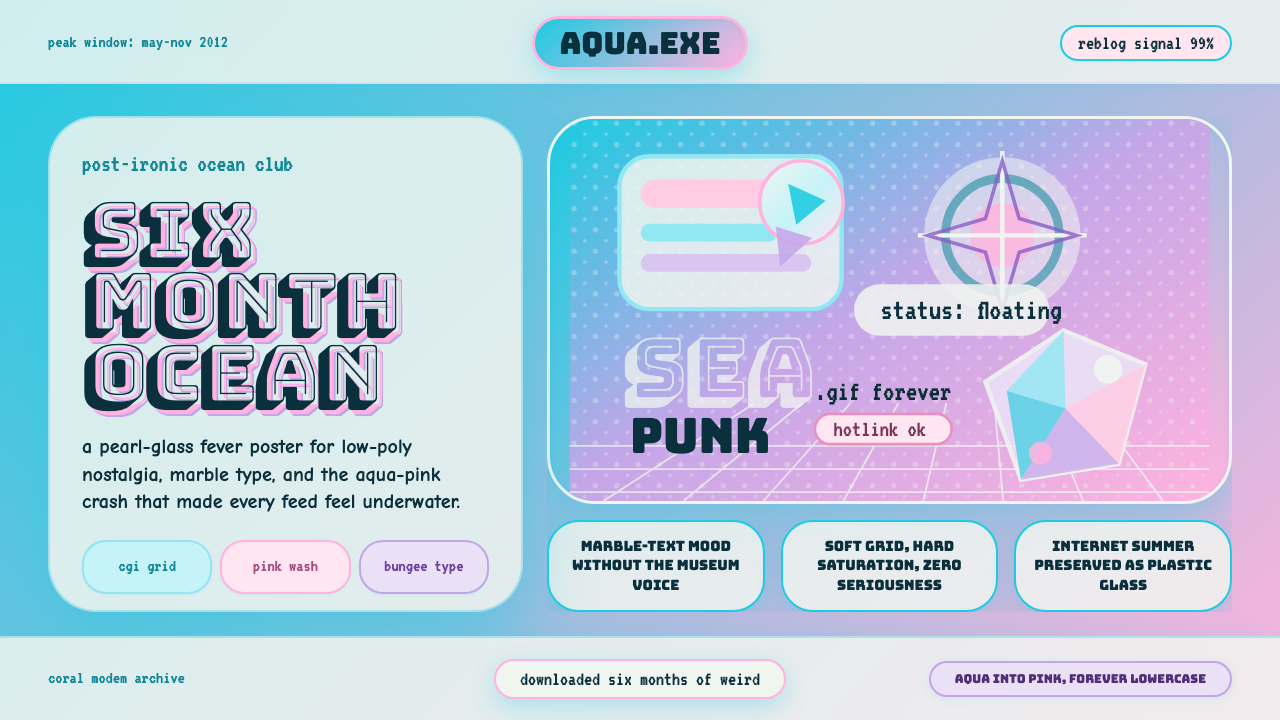 Seapunk Tumblr (2012)Burns bright then crashes. Aqua-pink wash, Bungee type, glassy CGI-grid colla…
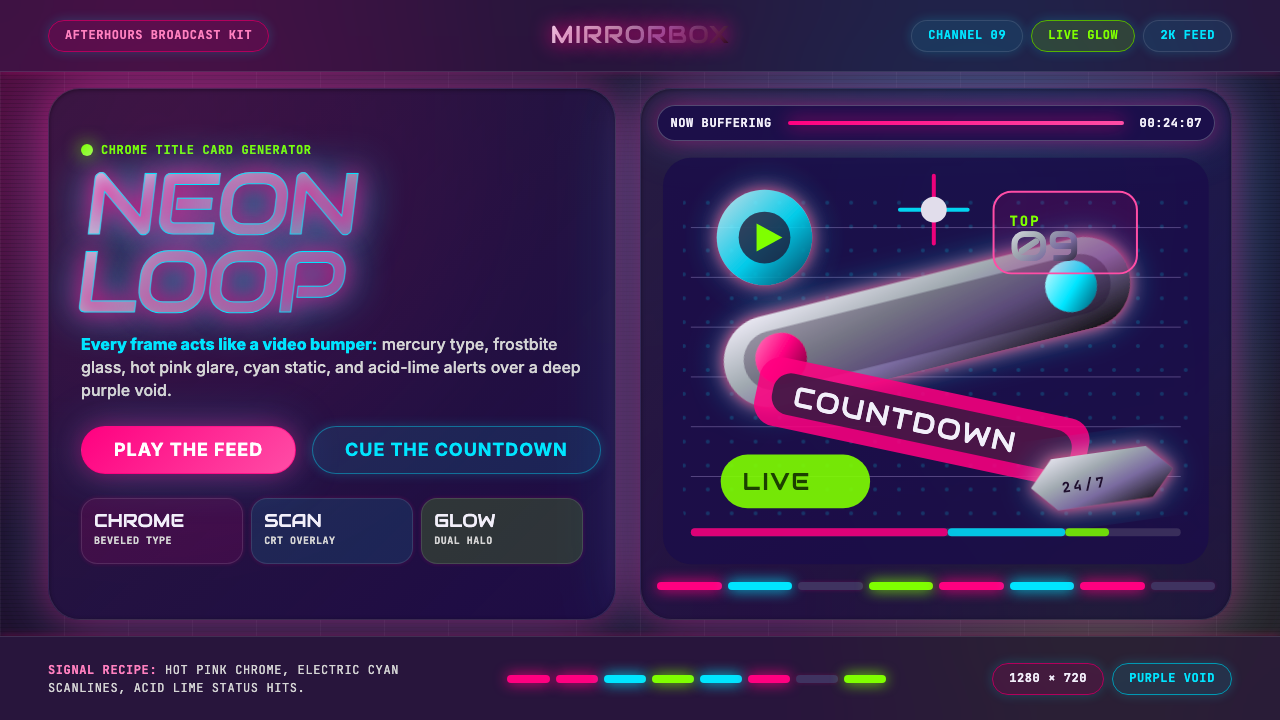 MTV Y2K (2000s)Maximum-volume Y2K. Hot pink chrome, cyan scanlines, and lime hits burn over…
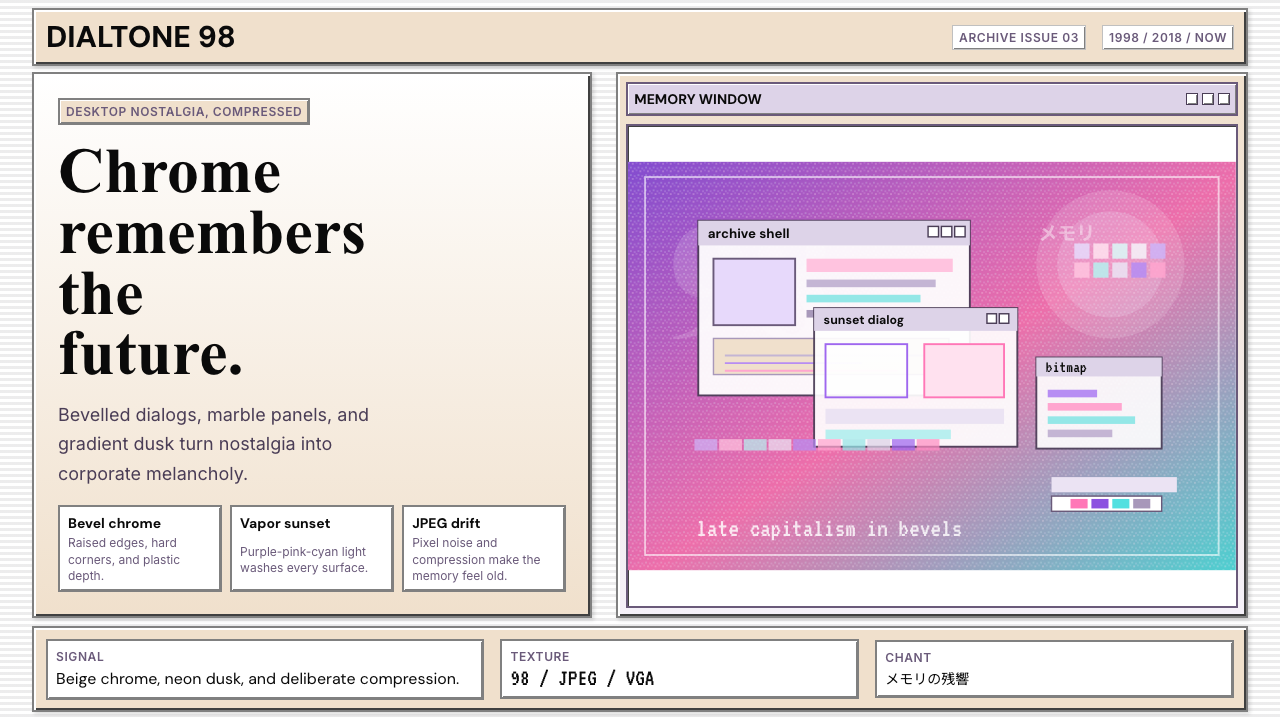 Windows 98 VaporwaveCorporate melancholy glows. Bevelled panels and purple-pink-cyan dusk do the…
 Funk Carioca FavelaMaximalist and unruly. Magenta, cyan, and chrome slam into black at thumbnail…
 Weird Twitter / ShitpostGloriously ugly on purpose. Blown-out HDR reds and white-stroke Impact caps o…
 Balatro Poker RoguelikeLate-night poker math with a grin. Bicycle red, felt green, and CRT scanlines.