What is Windows 98 Vaporwave?
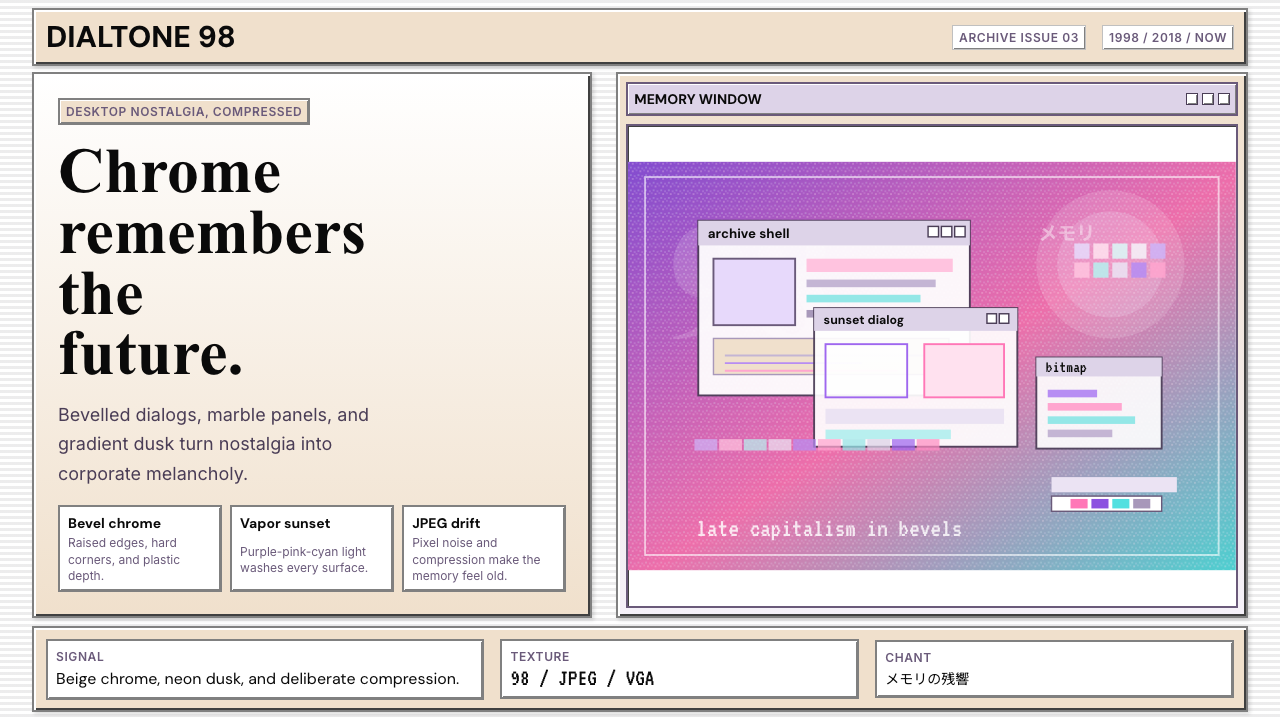
Windows 98 Vaporwave is where corporate nostalgia melts into a purple-pink-cyan fever dream — every bevelled button and bitmap glyph a monument to digital melancholy.
Windows 98 Vaporwave in brief
Windows 98 Vaporwave is a hybrid visual aesthetic that fuses the literal graphical interface of Microsoft's 1998 operating system with the hallucinatory gradient dreamscapes of vaporwave, the early-2010s internet music and art movement. The result is a style that holds two seemingly opposite sensibilities in deliberate tension: the grey corporate functionalism of late-1990s desktop computing and the lavender-pink-cyan romanticism of an era obsessed with its own digital past.
The visual grammar of this style is immediately recognizable. Raised, bevelled panel borders — the hallmark of the Win32 interface toolkit — frame content against marble-cream or charcoal backgrounds. Bitmap typefaces with a distinctly compressed, low-resolution quality sit alongside gradient washes that shift from deep violet through rose pink to electric cyan. Greek marble busts, Roman columns, and classical statues float over degraded JPEG sunsets and CRT scanline textures, referencing the vaporwave canon of ironic classicism. Pixel-art dithering patterns inherited from sixteen-color VGA palettes appear as background textures or decorative fills.
What distinguishes Windows 98 Vaporwave from generic vaporwave is its deliberate grounding in a specific piece of software history. The style does not simply evoke a retro digital mood — it quotes a precise graphical system, complete with its window chrome, its system font, its grey-scale UI controls, and its particular brand of institutional blandness. The vaporwave gradient palette then acts as a chromatic contradiction injected into that system: corporate grey made electric, office beige drenched in neon twilight. The resulting aesthetic is one of ironic mourning — for a technological moment, for a particular shape of digital capitalism, for the innocence of a pre-social-media internet.

Where does Windows 98 Vaporwave come from?
The two halves of this aesthetic have separate genealogies that converged online in the mid-2010s. Windows 98 launched in June 1998 as Microsoft's consumer-facing update to Windows 95, standardizing the grey-bordered, bevelled-panel visual language of the Win32 API across millions of household computers. By the time the aesthetic was nostalgized, Windows 98 had become a shared cultural touchstone for an entire generation of internet users who had grown up with it: its Start button, its system tray, its modal dialog boxes, and its particular palette of grey, white, and teal were the visual backdrop of early internet culture.
Vaporwave as a musical and visual genre emerged around 2010 to 2011, associated with artists including Daniel Lopatin (recording as Oneohtrix Point Never), James Ferraro, and most definitively Ramona Xavier, who performed as Vektroid and released the landmark album Floral Shoppe in 2011 under the alias Macintosh Plus. Vaporwave sampled and slowed down the smooth-jazz corporate music of the 1980s and early 1990s, recontextualizing it as ambient meditation on consumerism, globalization, and late capitalism. Its visual culture — developed simultaneously across Tumblr, SoundCloud, and early internet art communities like Are.na — drew on Greek marble statuary, Miami Vice palette choices, Japanese katakana typography, and the iconography of 1980s and 1990s consumer electronics.
The synthesis into Windows 98 Vaporwave took hold between approximately 2014 and 2018, driven largely by the Tumblr community alongside early Reddit communities dedicated to vaporwave art. The specific OS was chosen for its resonance: Windows 98 sat at the hinge point between the pre-commercial internet and the dotcom bubble, between analogue and digital culture, between corporate blandness and something still genuinely new. Artists like Mary Bell and anonymous online contributors began overlaying the vaporwave gradient palette directly onto screenshotted Windows 98 interfaces, adding classical marble busts behind dialog boxes and inserting pixel-dithered sunset textures into desktop wallpapers.
The aesthetic developed further through the seapunk and post-internet art movements, which shared vaporwave's interest in internet detritus as raw artistic material. Its spread was accelerated by its memetic reproducibility: the style's core components — a bevelled panel, a gradient, a marble bust, a system font — were simple enough for any amateur to assemble in image editing software, which meant the aesthetic proliferated widely and quickly. By the late 2010s it had crossed from niche internet culture into mainstream graphic design, appearing in music videos, album art, merchandise, and eventually commercial branding.
What defines the Windows 98 Vaporwave look?
Bevelled Panel Architecture
The defining structural element of this style is the raised, bevelled panel border derived directly from the Win32 graphical interface. Borders are rendered with a light edge on the top-left and a dark edge on the bottom-right, creating the illusion of a surface extruded slightly toward the viewer. This bevelling applies to buttons, window frames, scrollbars, and container elements alike. The effect reads as simultaneously functional and antique — a reminder that the third dimension was once something that had to be faked in software, pixel by pixel.
Gradient Palette
The chromatic heart of the style is a gradient that sweeps from deep violet or indigo through magenta and rose pink toward electric cyan or turquoise. This palette originates in vaporwave's interpretation of Miami Vice aesthetics and 1980s consumer electronics advertising, transposed into a digital context. Against the neutral grey and cream of the Windows interface, the vaporwave gradient functions as an intrusion — the unconscious of the operating system bleeding through its institutional facade. Gradients are typically applied to skies, backgrounds, and decorative elements rather than to interactive UI components.
Bitmap Typography
Typography in this style is anchored by bitmap or bitmap-influenced type that recalls the screen-optimized fonts of late-1990s computing. Characters are rendered with visible pixel structure, aliased rather than smoothed, echoing the pre-antialiasing era of desktop interfaces. This low-resolution quality is treated not as a limitation but as a period marker — a timestamp encoded in the letterform itself. Katakana and other CJK characters occasionally appear as decorative elements, referencing vaporwave's engagement with Japanese consumer culture.
Classical Imagery and Digital Decay
A recurring motif is the juxtaposition of classical Western sculpture — marble busts, Roman columns, Venus figurines — with visible marks of digital compression and reproduction. JPEG artifacts, pixelation, and colour-banding appear not as errors to be corrected but as deliberate textural elements that locate the imagery firmly in the early internet era. The marble bust becomes a symbol for something timeless being dragged through a lossy compression algorithm — culture processed, degraded, and reposted.
CRT Textures and VGA Dithering
Scanline patterns referencing cathode-ray tube monitors appear as overlays on images and backgrounds, adding horizontal striping that evokes the physical experience of viewing content on older display hardware. Alongside these, dithering patterns inherited from sixteen-color VGA palettes — where areas of solid colour are represented through alternating pixel grids — function as both historical reference and decorative texture. Together these elements mark the style as belonging to a specific hardware generation.
Institutional Grey as Foil
The neutral grey of the Windows 98 interface is not merely a background — it is an essential chromatic foil. The style depends on the contrast between the operating system's deliberate blandness and the intrusive vividness of the vaporwave palette. Without the grey, the gradients lose their ironic charge; without the gradients, the grey is simply grey. The two registers work together to produce the style's central affect: the sensation of something beautiful erupting through something bureaucratic.
Ironic Interface Quotation
Unlike many retro aesthetics that evoke a general era, Windows 98 Vaporwave quotes specific interface elements with accuracy: the exact proportions of a title bar, the three-button window control cluster, the recessed text input field, the tabbed dialog panel. This precision of quotation is what separates the style from generic retro-computing nostalgia. The interface is treated as a found object — appropriated, reframed, and loaded with meaning it was never designed to carry.

Who shaped Windows 98 Vaporwave?
Ramona Xavier, performing under the alias Vektroid and releasing as Macintosh Plus, created Floral Shoppe in 2011 — the album whose artwork established the defining visual template for vaporwave. The image of a marble bust and Japanese characters against a digital background, rendered in a pink-to-purple gradient, became the visual reference point that subsequent artists, including those working in the Windows 98 subgenre, consistently returned to. Xavier's work demonstrated that the aesthetic could operate simultaneously as critique and as sensory pleasure.
Daniel Lopatin, recording as Oneohtrix Point Never, is among the earliest artists to develop the musical and visual language of vaporwave. His 2010 work Eccojams Vol. 1 — loops of slowed, pitched-down consumer music — established the sonic vocabulary that the visual style would mirror: the uncanny, the institutional, the nostalgic. Lopatin's intellectual framing of the project as a meditation on late capitalism's affective residue gave the broader movement a theoretical underpinning that influenced how later artists, including those working in Windows 98 Vaporwave, articulated their own practice.
James Ferraro's 2011 album Far Side Virtual used the sounds of early smartphone interfaces, corporate hold music, and digital notification tones to construct a portrait of consumer-technological optimism on the verge of collapse. His approach to technology as both subject matter and sonic material anticipated the visual strategy of Windows 98 Vaporwave: treating the graphical interface as a readymade, full of embedded cultural assumptions waiting to be denaturalized. Ferraro's influence is felt in the style's emphasis on corporate iconography as a site of critique.
Active within the online communities where Windows 98 Vaporwave coalesced, Mary Bell was among the visual artists who worked explicitly at the intersection of operating system aesthetics and the vaporwave palette. Her work helped establish the specific vocabulary of the subgenre: the placement of classical sculpture within screenshotted interface elements, the use of gradient fills behind system dialog boxes, and the treatment of error messages and system prompts as found poetry. Bell's practice exemplifies the genre's origin as a genuinely grassroots, platform-native art form.
How do you use Windows 98 Vaporwave today?
Windows 98 Vaporwave is a high-specificity style with strong tonal associations — irony, nostalgia, digital melancholy, and a particular strain of post-internet cultural criticism. Applied well, it signals cultural awareness and visual sophistication. Applied carelessly, it reads as pastiche or arbitrary retro decoration. The first discipline in using this style is understanding its register: it should feel like a deliberate and knowing quotation, not like a theme applied because it looks cool.
For presentation slides, the style works most powerfully when it commits fully to the interface metaphor. Cover slides benefit from treating the entire slide surface as a desktop: a bevelled window frame contains the title text, which is set in a bitmap-influenced typeface against a marble-cream or deep charcoal panel. The gradient — violet bleeding into rose pink — appears in a background sky element or as a dramatic full-bleed wash behind the window. Content slides should use the panel border system to organize information, with section titles set in a heavier, slightly compressed typeface and body content in a clean, readable weight. Data slides take on a particular power in this aesthetic: chart containers styled as Windows dialog boxes, with the chart itself rendered in the vaporwave palette against a grey or cream ground, produce a striking visual that holds information while maintaining the style's ironic frame.
For web interfaces, this style is well-suited to products that want to position themselves as culturally aware, creatively independent, or nostalgically adjacent — independent music platforms, creative tool dashboards, portfolio sites, artist pages, and experimental digital publications. The approach: use panel borders and raised button elements for interactive components, reserve the gradient for hero sections and decorative backgrounds, and maintain neutral grey or cream for data-dense areas where legibility is paramount. Pricing pages can employ the style to great effect by styling each tier as a separate raised dialog box — the visual vocabulary of software installation wizards recontextualized as a commercial offering.
For editorial and marketing work, the style rewards restraint. A marketing campaign that overloads every element with gradients, marble busts, and scanline textures quickly becomes visually exhausting and loses the ironic distance that makes the style interesting. The most effective editorial applications use the style selectively: a bevelled panel framing a key quote, a vaporwave gradient sky behind a product photograph, a bitmap typeface headline with body text set in a clean contemporary face. The contrast between the nostalgic surface elements and functional contemporary typography preserves the style's wit.
A common mistake when applying this style is treating the gradient as the whole aesthetic. Windows 98 Vaporwave derives its meaning from the tension between the corporate interface and the dreamy palette — without the structural quotation of the OS, the gradient alone becomes generic vaporwave. Similarly, accumulating too many period signifiers simultaneously — marble bust, scanlines, JPEG artifacts, VGA dithering, and a system font all in the same composition — produces visual noise rather than layered meaning. Effective application involves selecting two or three signature elements and allowing them to operate clearly against a restrained ground.

Windows 98 Vaporwave — FAQ
Is Windows 98 Vaporwave the same as general vaporwave?
They share a palette and cultural attitude but differ in structure. General vaporwave draws freely from 1980s aesthetics, Miami Vice colour fields, Japanese consumer branding, and early internet imagery without committing to a specific graphical system. Windows 98 Vaporwave is more precise: it grounds the aesthetic in the particular interface language of a specific operating system, which introduces the bevelled panel, the bitmap system font, the grey-scale UI control, and the ironic corporate-functional framing that distinguishes the subgenre. Think of it as vaporwave with an anchor — a specific historical artefact that gives the dreamy palette something structural to push against.
Does the style have to be ironic, or can it be used sincerely?
The style's origins are ironic — the operating system as monument to late capitalism, the marble bust as victim of lossy compression — but contemporary application need not carry that theoretical weight explicitly. Many designers now use Windows 98 Vaporwave elements for their pure visual qualities: the warmth of the gradient palette, the tactile interest of bevelled panels, the legibility of bitmap type. Sincere application works best when the visual elements are chosen for their formal qualities rather than their cultural baggage, and when the composition does not overplay the period references to the point of parody. The irony can remain latent rather than foregrounded.
How do I avoid making it look like a joke or a meme?
The difference between a thoughtful application of this style and a meme template lies in proportion and restraint. Meme versions pile on every signifier at once: marble bust, scanlines, deep-fried JPEG artifacts, system error box, gradient sky, all at maximum intensity simultaneously. Considered design work selects one or two primary elements — perhaps the bevelled panel system and the gradient palette — and lets them operate with clarity against a restrained, well-structured layout. Typography discipline matters particularly: a well-chosen, clearly-sized bitmap or bitmap-influenced typeface reads as intentional; multiple clashing period typefaces read as noise. Less simultaneity, more specificity.
What kinds of projects suit this style best?
The style performs best for projects where the cultural associations of the aesthetic align with the product's values or audience. Independent music releases, creative tool landing pages, digital art portfolios, experimental editorial publications, gaming and entertainment brands with a culturally literate audience, and merchandise for communities that share the nostalgic reference point are all well-served. It is less appropriate for products requiring unconditional trust or warmth — healthcare, financial services, children's education — where the ironic register and conspicuous nostalgia may undermine credibility or approachability. The style's specificity is also a risk in contexts where the cultural reference will not be recognised by the primary audience.
How does this style relate to Y2K aesthetic and other 2000s nostalgia trends?
Windows 98 Vaporwave, Y2K aesthetic, and related early-internet nostalgia trends share a common temporal territory — the late 1990s and early 2000s — but emphasize different aspects of that era. Y2K aesthetic tends toward the optimism of that period: chrome finishes, inflated forms, digital-native type, and a sense that technology was glamorous and new. Windows 98 Vaporwave is more melancholic and ironic, foregrounding institutional grey and corporate blandness as much as the vibrant gradient palette. Where Y2K aesthetic celebrates the era's utopian technological confidence, Windows 98 Vaporwave mourns it — or at least holds the mourning and the celebration in unresolved tension.
Related design styles
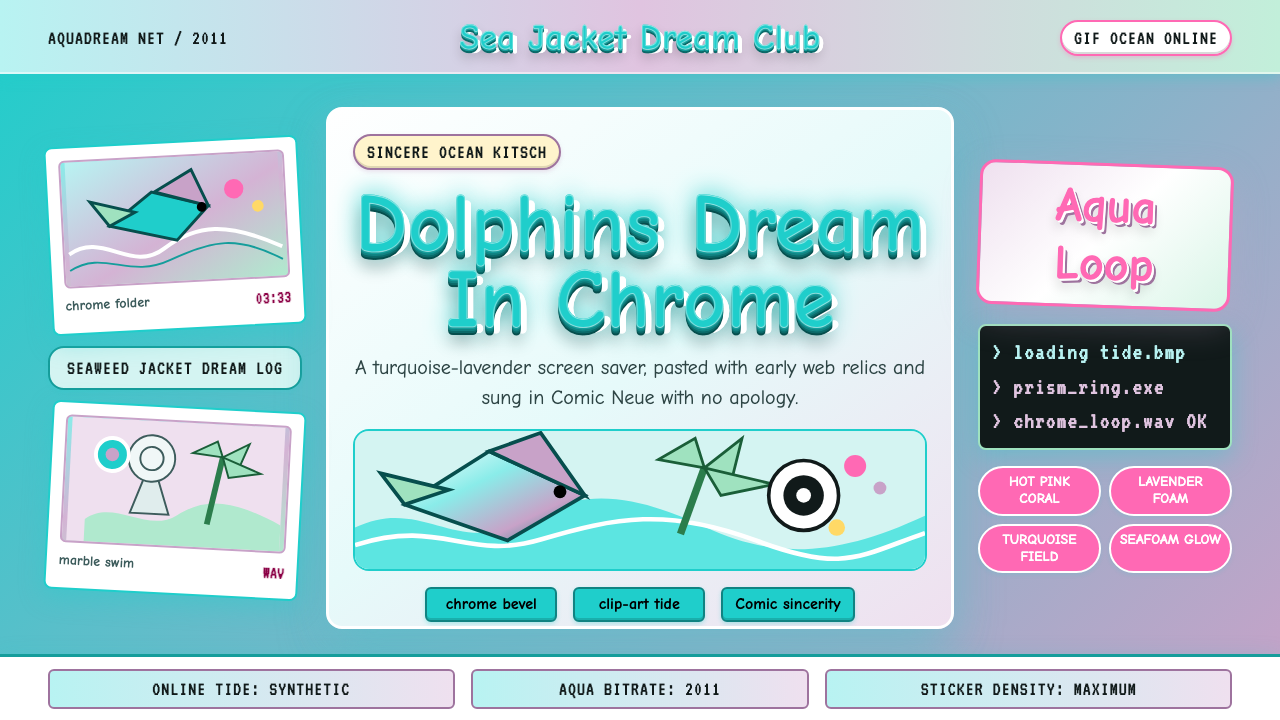 Seapunk 2011Sincere ocean kitsch. Turquoise gradients, Comic Neue chrome, and clip-art do…
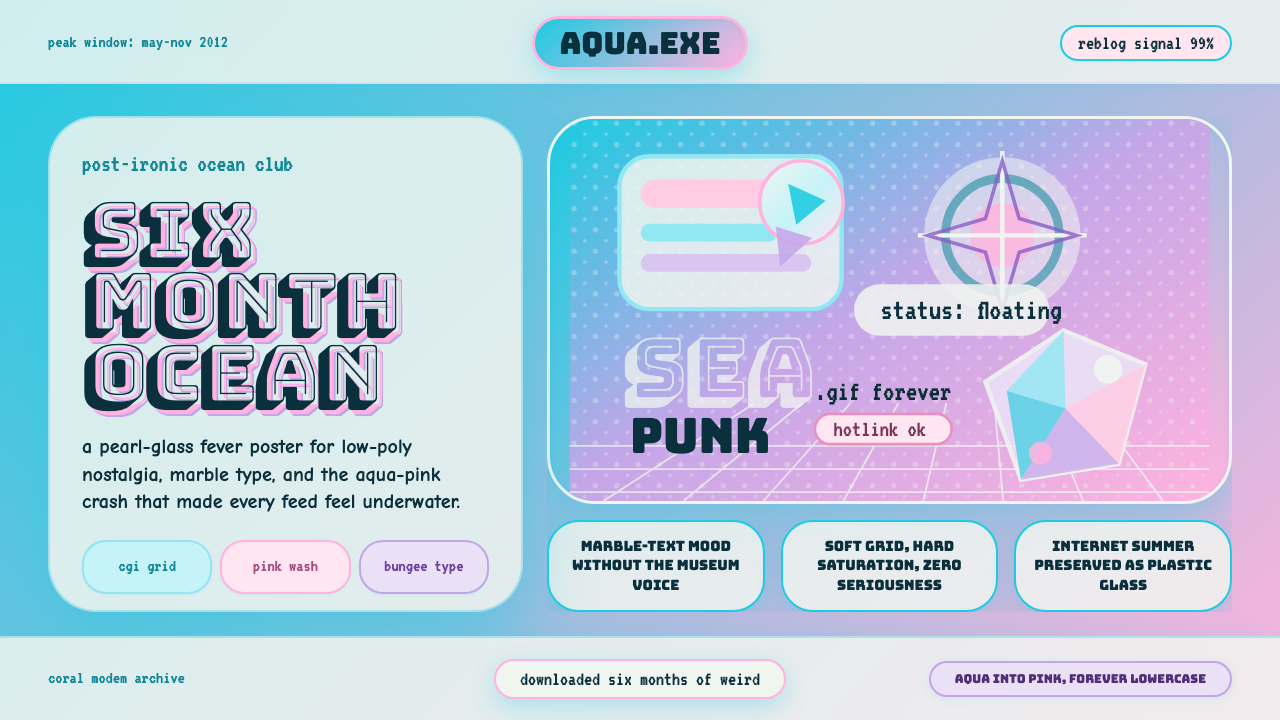 Seapunk Tumblr (2012)Burns bright then crashes. Aqua-pink wash, Bungee type, glassy CGI-grid colla…
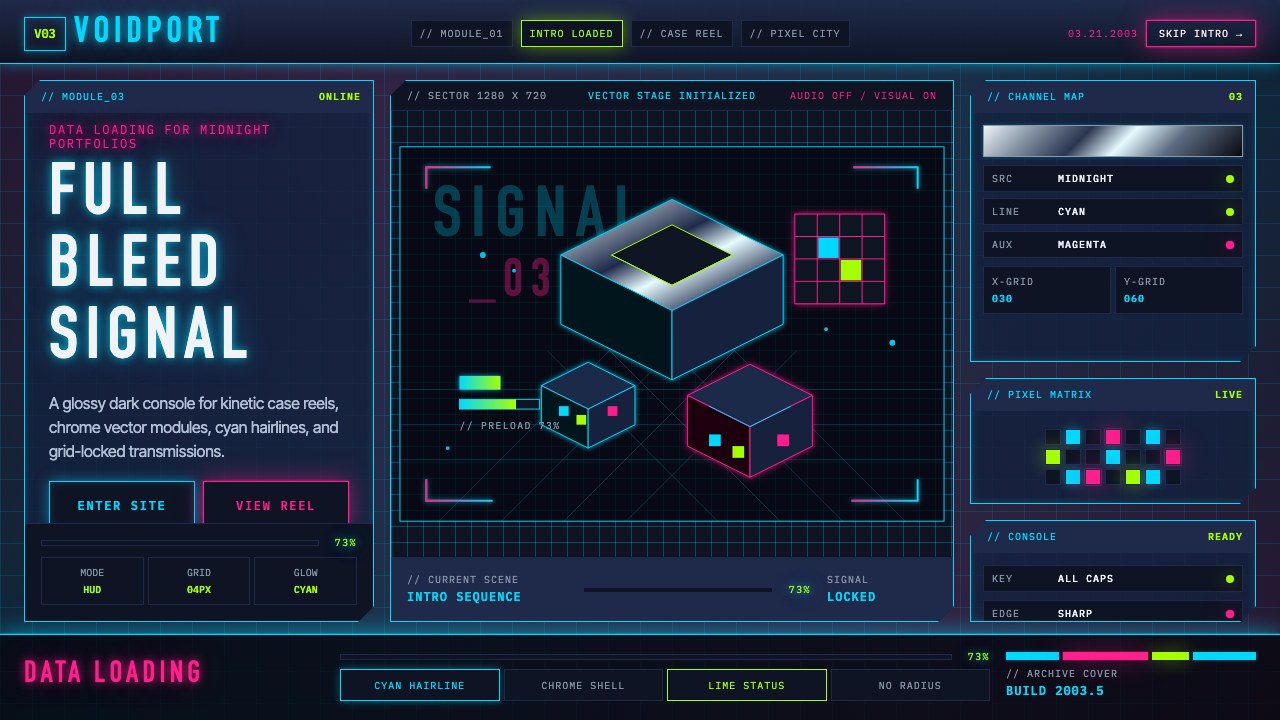 Flash Website Era (2003)A browser turned sci-fi console. Cyan HUD hairlines, chrome gradients, and 4p…
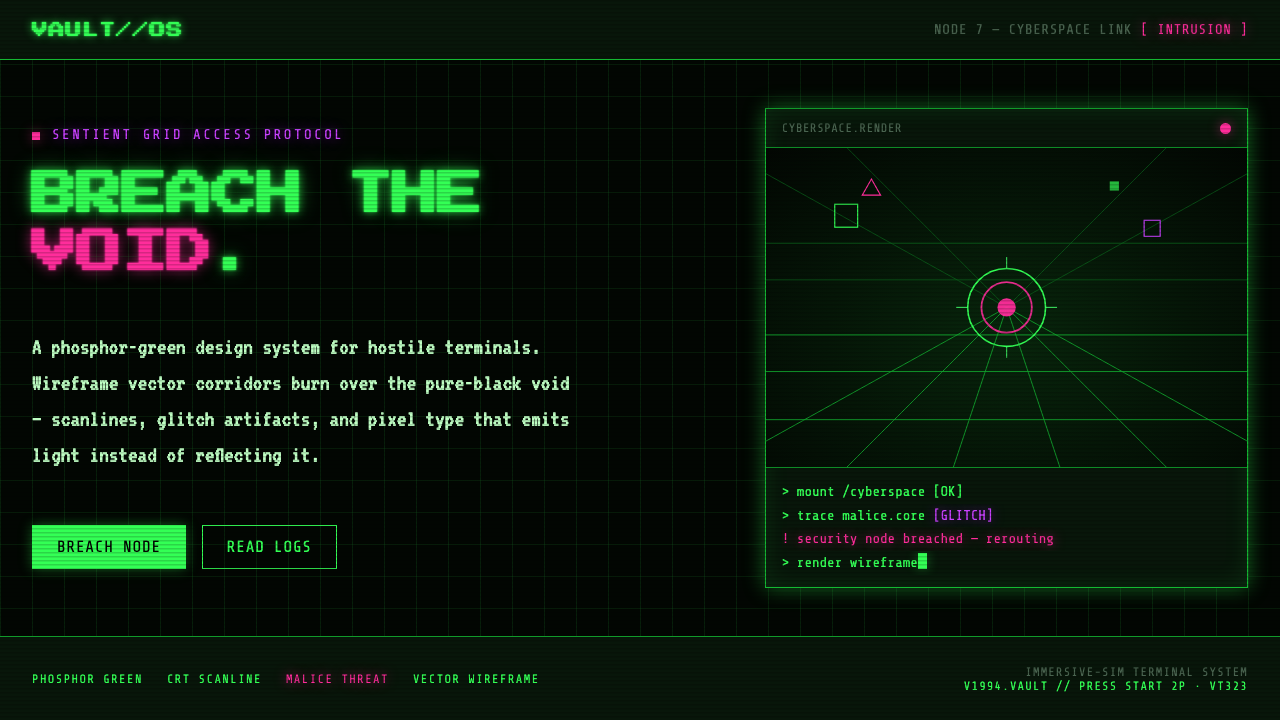 System ShockHostile retro terminal. Phosphor-green wireframes burn over black, magenta ma…
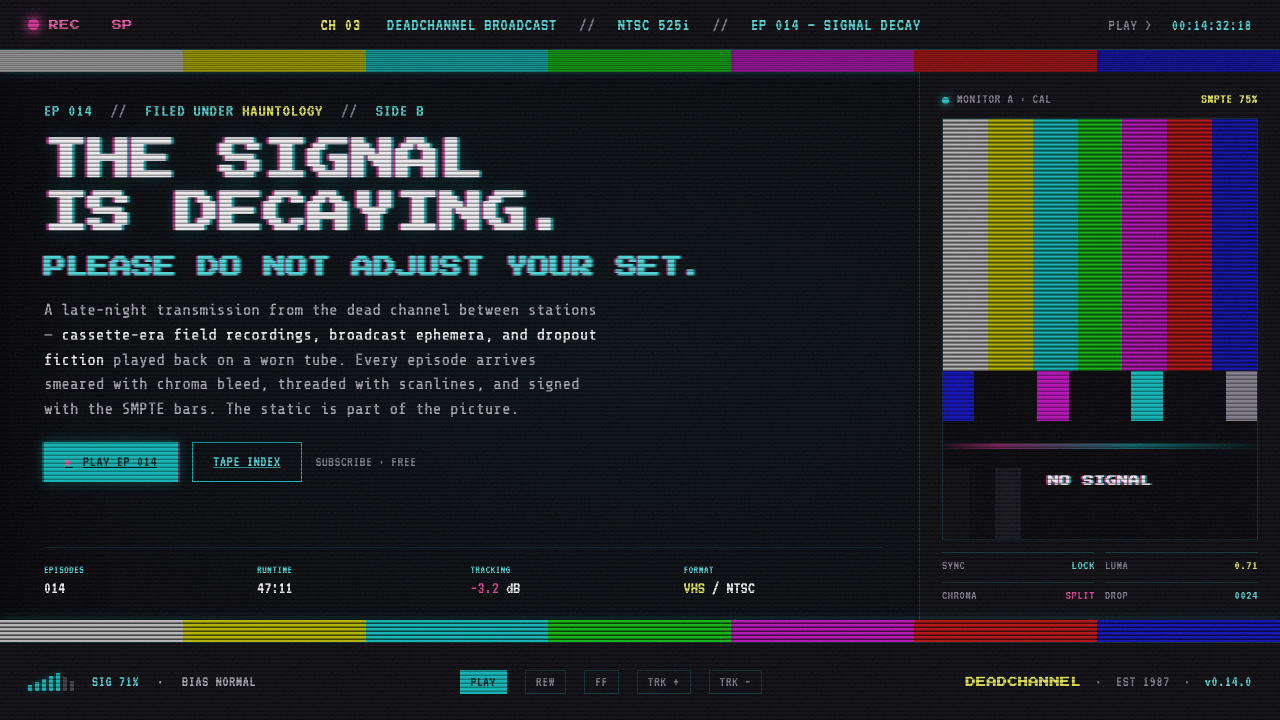 VHS Glitch TapeThe signal is decaying, on purpose. SMPTE color bars, scanlines, chroma split…
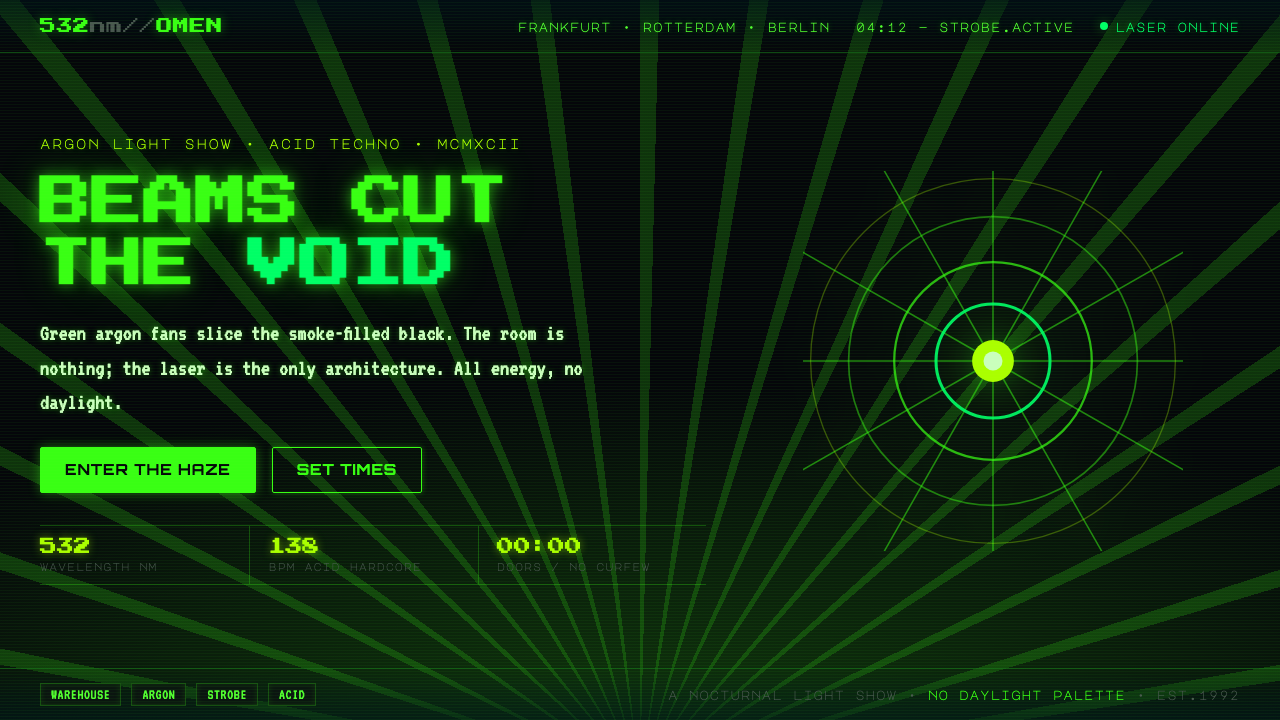 Acid Rave Laser Show 1992Beams cut the void. Argon green on pitch-black smoke, pixel marquee type, add…