What is Xbox Original (2001)?
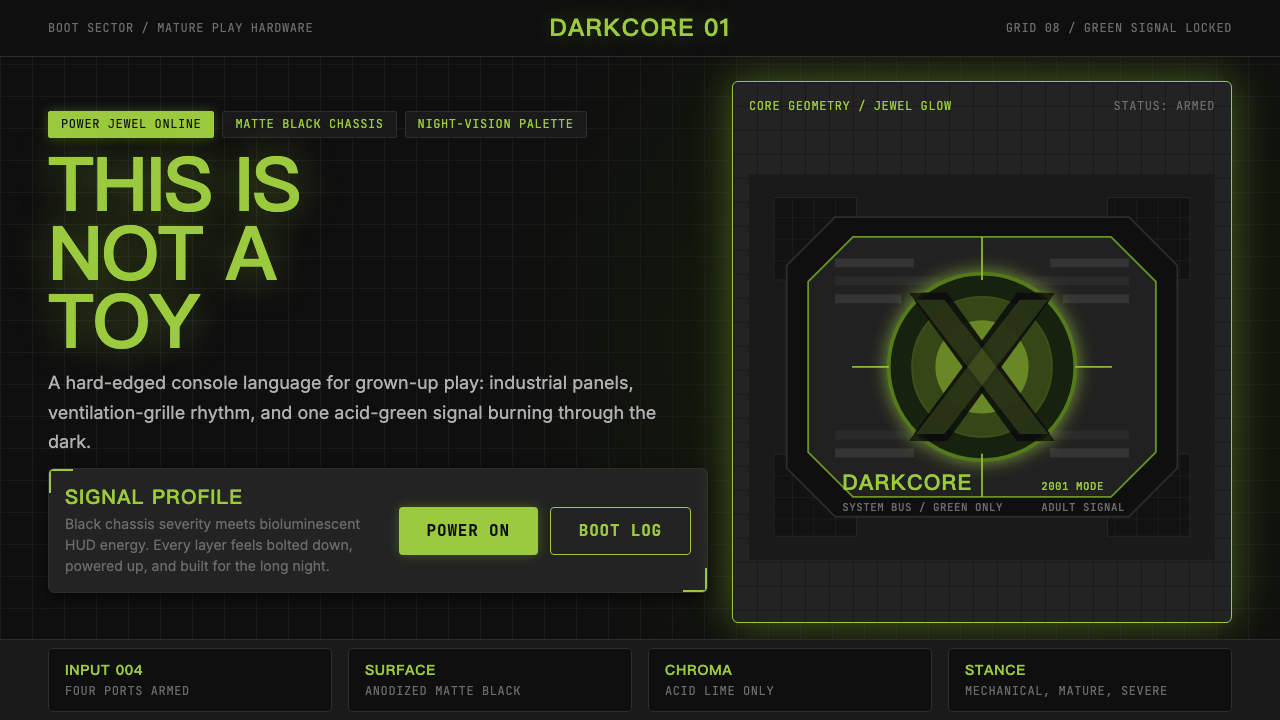
A matte-black monolith with a glowing green jewel — the original Xbox declared that games were serious business and rewrote the visual grammar of console culture.
Xbox Original (2001) in brief
The Xbox Original design system is a visual language built on a single, absolute contrast: acid green against matte black. Every surface is dark and hard-edged, communicating industrial weight and mechanical precision. The lone accent color — a searing, bioluminescent lime — cuts through the darkness like a heads-up display readout, evoking night-vision optics, circuit-board traces, and the green-on-black terminals of early cyberpunk aesthetics.
This is not a friendly or playful visual system. Where competitors leaned into bright primaries and rounded forms to signal approachability, Xbox Original announced itself as a machine for serious players. The design vocabulary is closer to a server rack or a piece of military hardware than to a toy — all grilles, chamfered edges, and purposeful geometry. The aesthetic was sometimes called 'black box brutalism' in contemporary gaming press.
Applied to digital surfaces, the system produces high-contrast compositions where green functions as a pure signal color: it marks action, progress, and interaction against a field of dark neutrals. Typography is set in heavy, bold letterforms with wide tracking, lending every headline the authority of a system readout. Imagery, when present, is treated with high-contrast processing that strips softness away, reinforcing the overall mood of controlled, technological intensity.

Where does Xbox Original (2001) come from?
The original Xbox emerged from a skunkworks project inside Microsoft in the late 1990s, driven by four engineers — Seamus Blackley, Kevin Bachus, Ted Hase, and Otto Berkes — who worried that Sony's PlayStation 2 would become the dominant computing platform of the living room, displacing Windows from the center of home entertainment. Their internal pitch was as much a strategic business argument as a product proposal: if Microsoft did not build a console, it risked ceding the television screen permanently to a competitor.
J Allard, a senior Microsoft executive who had championed internet strategy earlier in the decade, became the project's cultural architect. Allard's brief was precise and deliberately confrontational: the Xbox had to be the anti-Nintendo. Where Nintendo was colorful, cartoonish, and family-oriented, Xbox would be dark, angular, and adult. Where Sony's PlayStation aesthetic was sleek and consumer-electronic, Xbox would feel heavy, mechanical, and purposefully intimidating. Allard and designer Horace Luke developed the industrial language that became the console's identity — matte black surfaces, a prominent green jewel power button, and an 'X' motif deeply incised into the top face.
The visual direction drew on multiple currents of late-1990s and early-2000s culture. The late Y2K period was saturated with cyberpunk imagery: The Matrix arrived in 1999 and flooded popular culture with green-on-black terminal aesthetics, bullet-time kinetics, and the idea of technology as something that could be either liberating or threatening. Industrial and military hardware design — matte black finishes, no-nonsense geometry, visible screws and vents — was being appropriated by consumer electronics brands attempting to project seriousness. The DirectX branding heritage, which the Xbox name directly referenced, contributed a software-engineering sensibility that treated the product as a piece of infrastructure rather than entertainment.
The console launched in North America in November 2001, competing directly against the already-launched PlayStation 2 and the Nintendo GameCube. Its physical size — significantly larger than either competitor — was both a technical necessity (the hardware was built around a desktop-derived architecture including a standard hard drive) and a deliberate aesthetic choice: bigger read as more powerful in the imagination of the target audience. The original controller, nicknamed 'The Duke' by press and players, was similarly oversized. The launch campaign, developed with advertising agency McCann, emphasized the phrase 'It's good to play together' but the visual imagery was consistently dark, mechanical, and adult. The design system established in 2001 remained the foundation of Xbox brand identity for nearly a decade, evolving through the 360 era before being significantly lightened and consumerized.
What defines the Xbox Original (2001) look?
Color
The palette is binary and absolute: near-black as the universal ground, and a single accent of acid green — a hue with a bioluminescent, almost toxic quality that reads instantly as digital and non-natural. The black is not glossy or reflective; it is matte and absorptive, suggesting mass and industrial finishes rather than consumer polish. The green appears only where it must signal action, life, or interaction — a power state, a progress bar, a selected element. Secondary neutrals, where they appear, are deep grey or charcoal, never warm. No tertiary colors are used; the system's emotional impact depends entirely on the severity of this single contrast.
Surface Texture
Matte and tactile surfaces are the rule. The black ground should read as a material — not a void or a canvas, but something with physical presence and controlled reflectivity. Grille patterns, cross-hatching, and mechanical perforations are appropriate textural motifs because they reference the console's own industrial hardware form. Gloss, specularity, and smooth gradients are antithetical to the system; any sheen undermines the sense of deliberate mechanical weight that distinguishes this aesthetic from generic dark-mode design.
Typography
Type is bold, wide-tracked, and assertive. Headlines carry the weight of system output — they do not invite; they inform. The preferred register is all-caps or near-all-caps for short display text, with generous letter spacing that prevents any sense of crowding. Body text, where present, is set in a clean, geometric sans-serif at a comfortable reading size but without warmth — precision is the quality to project, not friendliness. Green is reserved for active or interactive typographic states; neutral text is near-white or light grey on the dark ground.
Form and Edge
The geometry is hard and angular with deliberate chamfering — edges that are cut or beveled rather than rounded. Where curves appear, they serve a mechanical function, like the barrel of a connector or the arc of a vent aperture. Soft, organic, or friendly curves have no place in the system. UI elements in this aesthetic are rectangular with tight corner radii or no rounding at all; buttons read more like hardware switches than software affordances.
Lighting and Glow
The defining lighting motif is the contained glow — a source of green light that emanates from within a dark form, suggesting powered electronics and internal energy. This is not an ambient or atmospheric effect but a localized, purposeful one: the glow marks the active state of the system. In UI applications, this translates to luminous green elements — indicators, highlights, selection states — that appear self-illuminated against the dark ground rather than lit by an external source. The effect should feel like looking at a screen or a status LED in a darkened room, not like a decorative lighting scheme.
Iconography and Motif
The 'X' mark — used in both the brand logo and the cross-shaped controller button — is the system's primary symbolic motif. It reads simultaneously as a directional indicator, a hardware button, and an emblem of exclusion (this is not for everyone). Supporting motifs include grille patterns referencing the console's ventilation design, target or crosshair forms evoking gaming precision, and circuit-trace geometries suggesting the machine's internal architecture. Decorative illustration is absent; every graphic element either serves wayfinding or reinforces the mechanical-technological character of the system.
Negative Space
The dark ground functions as active negative space rather than passive background. Because the black field is the dominant visual mass, the placement and sizing of green and light elements must be considered with precision — a small green indicator isolated in a large black field carries enormous visual weight. This inverts the usual logic of light-background design, where white space signals air and breathing room; here, the black field is the air, and green is the mark that charges it with energy.

Who shaped Xbox Original (2001)?
A physicist and game developer who had shipped the technically ambitious Jurassic Park: Trespasser, Blackley became the internal evangelist who made the case to Microsoft leadership that the company could build a competitive gaming console. His credibility as someone who had shipped games — and understood the DirectX technology at the core of the proposal — gave the skunkworks pitch enough weight to survive early executive skepticism. Blackley's insistence on hardware performance as the non-negotiable design constraint shaped the machine's oversized form factor and in doing so inadvertently reinforced its imposing visual identity.
Allard was the strategist and cultural architect of the Xbox identity. He articulated the anti-Nintendo positioning that gave every visual decision its rationale — dark where competitors were bright, angular where they were rounded, serious where they were playful. His background in internet strategy (he had written an influential internal memo in 1994 urging Microsoft to embrace the internet) informed his belief that the Xbox was not just a game console but a platform play, and that the design needed to communicate platform-level seriousness rather than toy-category approachability. Allard later led the design of the Zune media player, applying a related set of dark, industrial aesthetic sensibilities.
Luke was the lead industrial designer responsible for translating the strategic positioning into hardware form. Working within the constraints of a large, hot-running PC-derived architecture, he developed the matte-black chassis, the green jewel power button, and the 'X' grille incised into the console's top face — three elements that together established the design language that would define Xbox visual identity for years. Luke's approach was to treat the console as a piece of designed technology rather than a consumer appliance, and to make its size and weight feel like strengths rather than compromises. He later became Chief Innovation Officer at HTC.
Berkes was the software architect whose DirectX expertise gave the original Xbox proposal its technical foundation. His insight — that the PC's DirectX graphics API could be adapted to run on dedicated console hardware, allowing Windows-developed games to be ported with relatively low friction — was the engineering argument that made the project viable. While his contribution was primarily architectural rather than visual, the project's naming (Xbox, from DirectX box) and its self-conception as serious technology infrastructure rather than a toy traces directly to Berkes's framing of the proposal.
Although not hardware designers, the team at Bungie — acquired by Microsoft in 2000, specifically to have a flagship title for the Xbox launch — shaped the Xbox visual identity through Halo: Combat Evolved. The game's aesthetic of dark, industrial military science fiction, rendered in green and olive tones against dark environments, perfectly harmonized with and reinforced the console's design language. Halo became so synonymous with Xbox that its visual sensibility — green armor, dark interiors, authoritative sans-serif typography — retroactively felt like it had informed the hardware rather than the reverse.
How do you use Xbox Original (2001) today?
The Xbox Original aesthetic is a high-stakes design choice: it communicates power, seriousness, and technological authority without compromise, but it does so by eliminating warmth, approachability, and decorative pleasure entirely. Applying it well requires committing fully to its constraints — a partial application that retains rounded corners, soft shadows, or warm neutrals alongside the dark ground and green accent will read as confused rather than cool. The system rewards discipline.
For presentation slides, the design works most effectively as a full-bleed dark system — the slide background should be a rich, deep near-black with no gradient, and all slide content should respect a strict grid with generous margins. Cover slides benefit from a single large typographic treatment in wide-tracked, bold type, with a green accent element that isolates against the dark field. Content slides should lead with bold section labels in green, with body content in near-white or light neutral type. Data visualization fits the system well: charts and progress indicators take on a tactical, readout-like quality when rendered in green against dark grounds, with minimal grid lines and no decorative fill.
For web UI, the aesthetic is particularly well-suited to dashboards, developer tools, and technology platform landing pages where the audience expects to be addressed as a technical peer rather than a casual consumer. Navigation bars should be dark and type-led, with minimal icon use. Cards and panels read as hardware-like components with hard edges and dark interior surfaces. Interactive states — hover, focus, active — are marked exclusively through green color shifts and brightness changes rather than motion or shadow. Pricing pages in this system convey confidence through restraint: tier names and key numbers set large, in near-white, with green reserved for the call-to-action tier.
For editorial and marketing applications, the design system scales well to event branding, gaming press materials, and technology product launches where the subject matter aligns with the aesthetic's values. A poster or social card built in this system leads with a large green typographic element against a field of matte black, with secondary information in smaller near-white type. Marketing email headers follow the same logic: dark ground, bold green feature headline, clean information hierarchy below. The style is less well-suited to lifestyle or fashion contexts, where its severity can feel imposing rather than aspirational.
The most common mistake when applying this system is treating it as generic dark mode with a green accent added. Generic dark mode softens edges, uses layered dark greys to create depth, and relies on subtle drop shadows to separate components — all of which work against the Xbox Original aesthetic, which derives its character from flatness, hardness, and the shock of a single stark green against undifferentiated black. The second common error is over-using green: it is a signal color, not a fill color. If green covers more than a small fraction of the visible composition, it loses the contrast that makes it effective and the design loses the sense of controlled intensity that defines the style.

Xbox Original (2001) — FAQ
Is this style usable for a light-background product?
Technically yes, but it requires significant adaptation and the result will feel more like an Xbox-inspired design than an authentic application of the system. The defining power of the style comes from the contrast between a dominant dark field and a small area of luminous green — that relationship does not transpose cleanly to a light background. On white or light grey, the green loses much of its impact (it becomes a standard green accent rather than a glowing signal), and the overall mood shifts from authoritative to merely technical. If a light-background product needs to reference this aesthetic, confine the dark treatment to specific components — a hero panel, a navigation bar, a feature block — rather than inverting the full system.
How does this style relate to general cyberpunk or dark-mode aesthetics?
Xbox Original is a specific, historically grounded version of early-2000s cyber aesthetic that predates the diffusion of generic dark mode. The distinction is intentionality and restraint. Generic cyberpunk visual design often accumulates references — neon accents in multiple colors, rain-streaked textures, Japanese typography, lens flares — to signal the genre. Xbox Original is stripped of all such referential layering. It achieves its effect through subtraction: one color, one material, one contrast. It is cyberpunk distilled to a hardware object rather than illustrated as a scene, and that restraint is what makes it durable. Contemporary dark-mode interfaces, meanwhile, are typically designed for readability and perceived neutrality rather than attitude — they use layered greys and minimal color, which is structurally different from the stark binary of black and green.
Can the Xbox Original aesthetic work for brands outside gaming and technology?
It can, but the style carries strong connotative baggage: matte black plus acid green reads as gaming, military, or industrial technology in most cultural contexts. Brands where those associations are assets — extreme sports, professional audio equipment, performance vehicles, cybersecurity products — can adopt the system with relatively low translation cost. Brands where those associations are liabilities — food, fashion, children's products, healthcare, hospitality — will find that the aesthetic works against their positioning. The deepest limitation is emotional: the Xbox Original system generates feelings of power and competence but not warmth, delight, or human connection. Any context where the latter emotions are central to the brand relationship is a poor fit.
How should green be used to avoid looking like a generic green-on-black terminal theme?
The terminal aesthetic — common in retro-computing tributes and hacker-culture signaling — uses green type on black ground as its primary mode, with the green covering a large proportion of the visible surface and often using a monospaced, bitmap-influenced typeface. The Xbox Original system is structurally different: green is a mark on black, not a field on black. In practice, this means green should appear on less than a fifth of any given composition, concentrated in focal points — a button state, a header accent, a progress indicator — rather than spread across text or background regions. The typeface should be contemporary and bold rather than retro and monospaced. The overall impression should be industrial and authoritative, not nostalgic or countercultural.
What happened to the Xbox Original visual identity after the first console generation?
The Xbox 360, launched in 2005, marked a significant evolution: the hardware moved to a curved, white primary color option (alongside the black variant), signaling an attempt to broaden the audience beyond the core hardcore demographic. The design language became more consumer-friendly, with softer forms and greater color variety. The accent green persisted but became more domesticated — a brand color rather than a stark signal against darkness. By the time of the Xbox One launch in 2013, the visual system had been substantially redesigned around a flat, tile-based interface influenced by Microsoft's Metro design language, which was itself an evolution toward a different design tradition entirely. The original 2001 aesthetic exists now as a period piece — a crystallization of a particular cultural moment in gaming history — rather than a living design system.
Related design styles
 Metroid Prime Scan VisorDiegetic helmet HUD on black glass. Amber reticles lock content, cyan telemet…
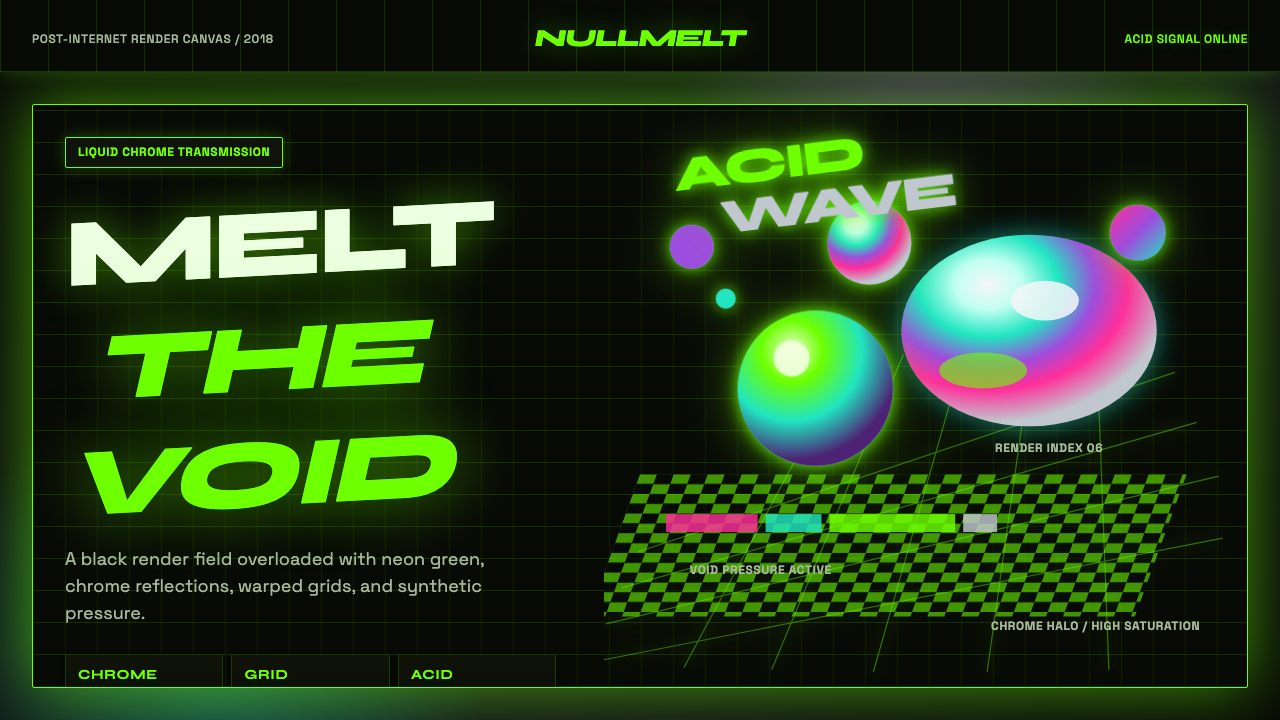 Acidwave 3D RenderPsychedelia hits the render engine. Neon green, chrome orbs, and warped grids…
 Mad Max Fury Road (2015)Built to roar. Molten saffron cuts through petrol teal, riveted grids, and ha…
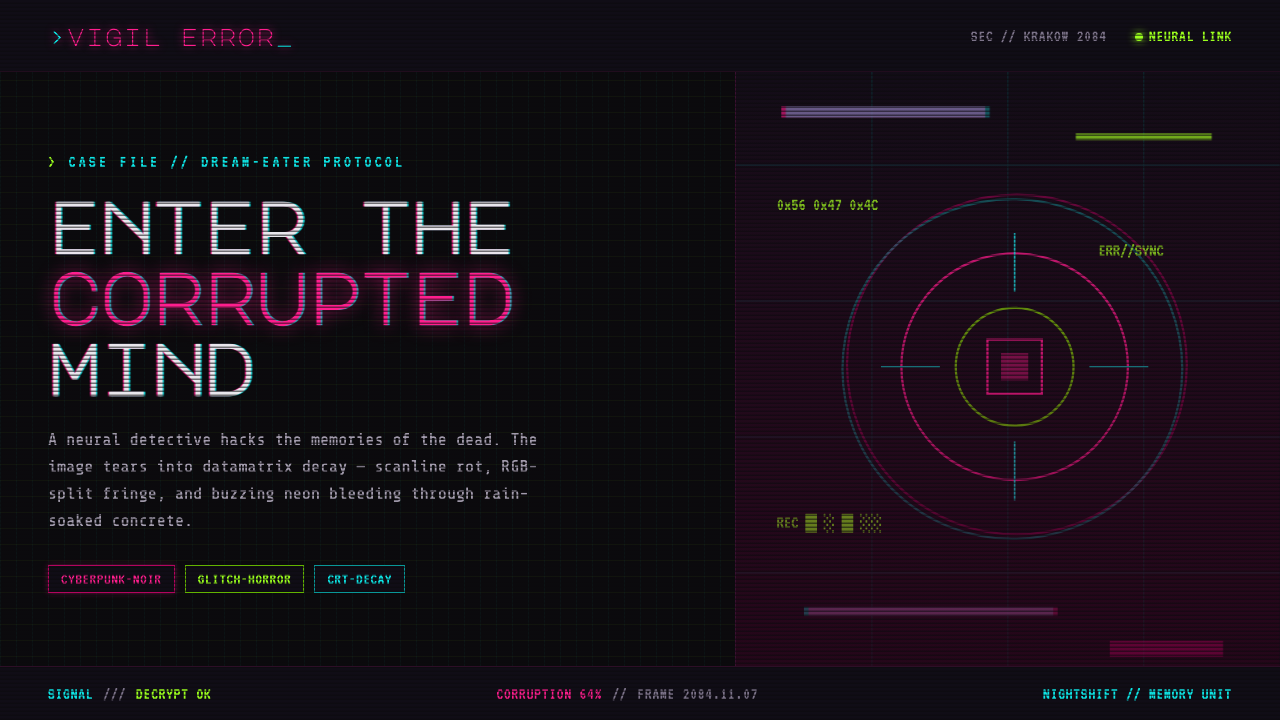 ObserverTech, but corrupted. Neon magenta and acid green tear through rain-black conc…
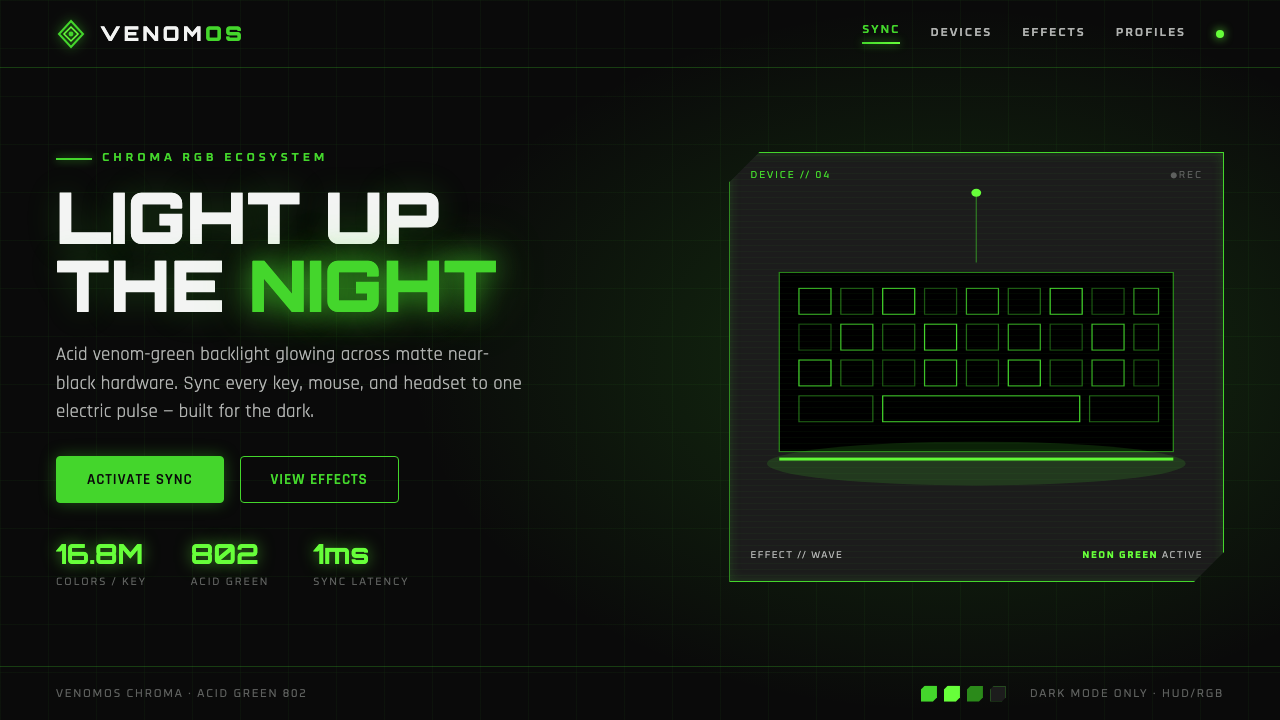 Razer Chroma GreenEsports gear at night. Acid Pantone-802 green burns on matte black via RGB gl…
 Detroit TechnoCold machines dream. Electric cyan circuits and chrome display type lock to a…