What is Flash Website Era (2003)?
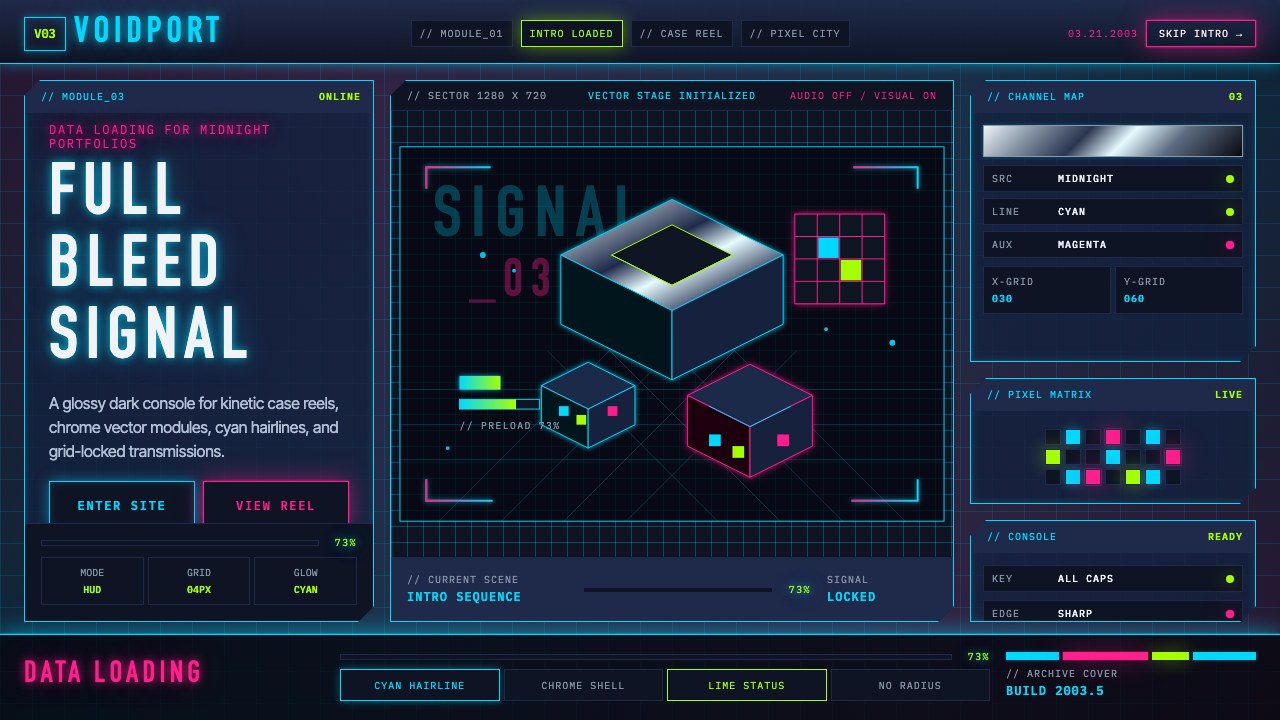
When the browser became a sci-fi cockpit — dark-navy HUDs, electric-cyan hairlines, chrome gradients, and a loading bar that made you wait.
Flash Website Era (2003) in brief
The Flash Website Era is the high-water mark of pre-mobile web design: a period roughly spanning the late 1990s through the mid-2000s, with its design-portfolio peak concentrated around 2003 to 2005, when studios and independent designers treated the browser window not as a page but as a full-bleed interactive canvas. Powered by Macromedia Flash — a plugin that delivered vector animation, synchronized audio, and scripted interactivity at a time when HTML offered none of those capabilities — these sites operated as self-contained cinematic experiences. Navigation was revealed only after an opening animation played. The 'SKIP INTRO' button, perched at the corner of the screen, became one of the era's most recognizable typographic artifacts.
The visual language of the Flash era is immediately legible: a deep navy or near-black background serves as the stage; electric-cyan or ice-blue hairlines draw the HUD panels and dividers; chrome and brushed-metal gradients coat buttons and interface rails; neon magenta and acid-lime punctuate status indicators and hover states. Typography runs in condensed all-caps — tight, military, and data-driven. Percentage-counter loading bars, animated particle fields, and rotating orbital rings fill the transitional moments. The total effect is a sci-fi operating console designed for an audience that had grown up on James Cameron films and cyberpunk fiction.
The style sits at the intersection of two currents: the isometric pixel art of digital illustrators like eBoy, who built intricate low-resolution city panoramas, and the motion-design ambitions of new-media studios like 2Advanced, who treated every page-load as a broadcast event. What unites them is the conviction that the web could be a medium with the same authorial control as film — that a designer could choreograph exactly what a visitor saw, heard, and experienced, down to the millisecond.

Where does Flash Website Era (2003) come from?
The technical foundation was laid in 1996 when Macromedia acquired FutureSplash Animator, a small vector-animation tool, and relaunched it as Flash 1.0. In its first years, Flash was used primarily for simple banner animations and modest interactive elements. The plugin's ubiquity grew steadily through the late 1990s as Macromedia distributed it aggressively, and by 1999 Flash 4 had introduced ActionScript — a rudimentary scripting language — which transformed the tool from an animation player into a genuine programming environment. By Flash 5 and MX (released in 2000 and 2002 respectively), designers and developers had the means to build entire site architectures inside a single SWF file: loading sub-SWFs on demand, controlling sound, detecting mouse position, and executing conditional logic. The technical ceiling had risen dramatically.
The cultural context was equally formative. The late 1990s dot-com boom flooded the web with investment capital and a corresponding hunger for prestige. Agencies competed for interactive design awards — most notably the FWA (Favourite Website Awards, founded in 2000) and Webby Awards — and the winning work was almost universally Flash-heavy. Studios like 2Advanced (founded by Eric Jordan in San Diego), Hi-ReS!, and Hillman Curtis in New York attracted blue-chip clients by promising an entirely new kind of web presence: not a brochure online, but an event. Meanwhile, independent designers — particularly Yugo Nakamura in Japan and Joshua Davis in New York — published experimental Flash work on personal portfolio sites that the industry tracked obsessively. Davis's praystation.com, which generated generative artwork in real time using ActionScript, became a canonical reference for what the medium could aspire to.
The visual grammar that emerged drew from several contemporary sources: the HUD aesthetics of late-1990s science-fiction films (particularly The Matrix and its contemporaries), the UI design of PC strategy and flight-simulator games, and the isometric pixel illustration style pioneered by eBoy — a Berlin-based design collective whose work appeared on postcard merchandise and in editorial illustration throughout the early 2000s. All of these shared an interest in dense, information-rich surfaces, technical precision, and the visual language of screens monitoring complex systems. The Flash designer absorbed these references and adapted them to the constraints of a browser window running over dial-up connections.
The era ended in stages rather than all at once. Apple's iPhone launch in 2007, followed by Steve Jobs's public declaration in 2010 that iOS would never support Flash, dealt the decisive blow. But the creative peak had already passed by 2006 or 2007 as broadband expansion and shifting user expectations began to favor lighter, faster-loading sites. Adobe (which had acquired Macromedia in 2005) continued developing Flash until it formally announced end-of-life in 2017, with browser support terminating at the close of 2020. The design vocabulary of the era has since migrated into CSS animation, WebGL, and contemporary dark-mode UI systems that still echo the HUD palette.
What defines the Flash Website Era (2003) look?
Dark-Field HUD Palette
The canonical Flash-era background is a very deep navy or near-black field, positioned as the 'stage' on which all interface elements perform. Against this ground, electric cyan and ice blue serve as the primary structural color — hairline borders, panel dividers, glowing labels, and active-state indicators. Neon magenta and acid lime appear as secondary punctuation: percentage counters, alert states, and hover highlights. Chrome gradients running from near-white to mid-grey coat interactive rails, buttons, and panel edges, lending a sense of physical material to what is otherwise a flat screen.
Condensed All-Caps Typography
Text in Flash-era interfaces is treated as a form of data — terse, precise, and systematically sized. Labels run in extremely condensed grotesque letterforms, set entirely in capitals, often with generous tracking. Longer descriptive text, when it appears, uses a slightly wider but still technical-looking sans-serif. Type sizes are handled through strict contrast: navigational labels are small and methodical; headline text is large and commanding. No decorative serifs, no calligraphic flourish — the letterform should look like it belongs in a cockpit manual or a military schematic.
Panel-Based Interface Architecture
Rather than a scrolling document, Flash-era sites organize content into discrete panels — rectangular regions with hairline borders, sometimes with softly glowing edges — that animate into view on demand. The metaphor is closer to a multi-window operating system than a book: tabs, sub-panels, expandable drawers, and modal overlays all feature prominently. Empty space within panels is intentional and structural, creating the impression of a precision instrument rather than a layout. Panel corners are often chamfered or squared with deliberate geometry.
Kinetic Transitions and Loading Theater
Motion is not decorative in the Flash era — it is structural. Panels slide, rotate, or materialize; particles stream across the background field; orbital rings and scanning lines suggest a living system. The loading preloader — a progress bar with a percentage counter, often accompanied by an animated logo or particle effect — is itself a designed experience, not an apology for slow bandwidth. The transition between states is choreographed to give the impression that the site 'knows' the visitor is there and is responding with intention.
Isometric and Orthographic Illustration
Alongside the HUD-and-panel school, a parallel current within Flash-era design favored isometric pixel illustration: densely rendered city scenes, machines, and characters built on a strict diagonal grid without perspective distortion. eBoy's work is the clearest example — pixel cities packed with visual jokes, brand references, and hyperdetailed vignettes. This approach treats the low resolution of early digital screens as an expressive material rather than a technical limitation, and its grid discipline is as rigorous as any modernist design system.
Chrome and Metallic Gradients
Where gradients are applied — on buttons, rails, and panel headers — they describe a specific material: polished chrome or brushed aluminum. The gradient runs from a near-white highlight at one edge through a cool mid-grey to a deep shadow at the opposite edge, producing a cylindrical or banded metallic effect. This is not gradient used for atmospheric warmth or visual interest in the abstract; it is gradient as a material claim, asserting that the interface is built from physical stuff — that the button you are about to press has weight.
Parametric Generative Accents
At the experimental fringe of the era, designers like Joshua Davis used ActionScript to generate visual elements algorithmically — branching structures, recursive geometries, ink-wash simulations — in real time, so that no two visits to a site looked identical. These generative accents were not purely decorative: they demonstrated that the web could be a medium of genuine formal invention, not only delivery of pre-authored content. The aesthetic outcome tends toward dense organic-geometric hybrids: forms that look grown rather than drawn, set against the dark ground of the HUD canvas.

Who shaped Flash Website Era (2003)?
Eric Jordan founded 2Advanced Studios in San Diego in 1999 and became the most influential practitioner of the sci-fi HUD aesthetic. His sites for clients including Acer, NVIDIA, and various government agencies set the template for dark-navy backgrounds, electric-cyan hairlines, and choreographed panel-reveal animations. 2Advanced's work won FWA recognition repeatedly and was widely imitated by agencies worldwide. Jordan's design language was so coherent and so technically accomplished that 2Advanced volumes became reference books for the generation of Flash designers that followed.
Joshua Davis, working under the alias Praystation and later Once-Upon-a-Forest, used ActionScript as an artistic medium rather than a production tool. His personal site praystation.com generated abstract generative artworks in real time, using randomized algorithms to combine geometric modules into compositions that changed with every visit. Davis won a Prix Ars Electronica Golden Nica in 2000 for this work and delivered the keynote at the first Flash Forward conference. More than any other figure, he established the idea that the Flash designer could be an author — someone whose creative intentions shaped an experience, not merely someone who built to a brief.
Tokyo-based designer Yugo Nakamura brought a uniquely physical and poetic sensibility to Flash interaction. His work at yugop.com explored gesture, mass, and elasticity — interfaces that responded to mouse movements with the kind of deferred, weighted momentum you might feel in a physical object. Nakamura's influence was particularly strong on the interaction-design side of the discipline: his experiments demonstrated that the 'feel' of an interface — how it moved, how it resisted and responded — was as much a design decision as its visual appearance. He later went on to found IDEO Japan.
New York-based Hillman Curtis occupied a distinctive position in the Flash era as both a practitioner and a chronicler. His agency created motion-centric web work for clients including Adobe, Fox Searchlight, and MTV, but his deeper contribution was authorial: his books Flash Web Design and MTIV (Moving to Intelligence and Vision) gave the discipline its first serious critical framework, explaining not just how to use Flash but why particular design decisions produced meaning. Curtis also directed a long-running series of short documentary films profiling designers, artists, and musicians, and died in 2012 at fifty-one.
eBoy is a Berlin-based design collective founded in 1997 by Steffen Sauerteig, Svend Smital, and Kai Vermehr. Working in isometric pixel illustration long before the style became fashionable, they built extraordinarily dense scenes — pixel cities, pixel portraits, pixel branding — that were collected as merchandise, licensed to magazines, and circulated widely online. Their aesthetic sits in deliberate tension with the HUD current: where 2Advanced sought technological authority, eBoy sought playful density and cultural saturation. Yet both drew on the same underlying discipline — the pixel grid as a precise, unforgiving medium — and eBoy's influence is visible everywhere from early 2000s editorial illustration to contemporary nostalgia-retro game art.
How do you use Flash Website Era (2003) today?
The Flash Website Era aesthetic translates most naturally into contemporary contexts where technological authority, precision, and controlled drama are desired — dark-mode dashboards, developer-tool landing pages, gaming or esports platforms, and any product positioning itself at the intersection of software and spectacle. The key is to commit fully to the dark-stage principle: the background must be deep enough that the electric-cyan and metallic accents read as luminous, not merely colored.
For presentation slides, the style rewards full commitment on cover slides and transitions, and disciplined restraint on content slides. A cover works best as a composed HUD panel: a deep navy field, a central focal element rendered with a chrome or cyan accent, the title in condensed all-caps at commanding scale, and a supporting label in smaller condensed type. Content slides should use the panel metaphor — defined borders, structured data zones, minimal prose — rather than attempting to reproduce the full kinetic complexity of a Flash site. Data slides suit the era's language naturally: bar charts and graphs become interface readouts, with data series colored in the electric accent palette against the dark ground.
For web interfaces, the style is well-matched to dashboards, admin panels, and monitoring tools where users are expected to read dense information at speed. Apply a strict column grid; reserve the dark navy or near-black for the primary surface; use the cyan-and-metallic accent system for interactive affordances, alerts, and status indicators only. Navigation should be typographic and condensed, not icon-heavy. Components that work especially well in this mode include bordered cards with subtle glow-border hover states, panel headers with a thin metallic gradient rail, and tabbed interfaces that slide between states rather than full-page reload.
For editorial and marketing work, the Flash-era vocabulary supports high-drama feature moments — hero sections, product announcement pages, and event-specific microsites. A full-width dark hero with a scanning-line or particle animation in the background, a central product image treated with a cyan or chrome outline, and a condensed all-caps headline reads as serious and technically credible. Restraint becomes essential in long-form editorial: use the dark palette for emphasis sections only, alternating with a near-white ground for body text to maintain readability.
A common mistake when working in this aesthetic is confusing drama with noise. Flash-era masters like Eric Jordan and Yugo Nakamura were precise and economical — every animated element served a navigational or informational purpose. Contemporary applications that add glow effects, particle systems, and gradient overlays without structural logic produce visual fatigue rather than technological authority. A second frequent error is treating the electric-cyan accent as an ambient color rather than a signal color: it should appear on interactive elements, active states, and primary data labels — never as a background fill or decorative wash.

Flash Website Era (2003) — FAQ
Is the Flash Website Era the same as 'Y2K aesthetic'?
They overlap but are not identical. The Y2K aesthetic — which became a popular revival term in the early 2020s — covers a broader cultural moment from roughly 1997 to 2003, encompassing the chrome-and-silver consumer product design of that era, the fashion of low-waist jeans and metallic fabrics, and the techno-optimism of the millennial transition. The Flash Website Era is a subset of that cultural moment, focused specifically on screen-based digital design. A Y2K product design might be about curves, silver plastics, and translucency; a Flash-era web design is about dark backgrounds, HUD interfaces, and kinetic interactivity. The color palette and material language overlap in the chrome and metallic directions, but the Flash era's dark-ground HUD aesthetic has no equivalent in Y2K product design.
Can this style work in a light-background context?
With significant modifications, yes — but the result is no longer recognizably the Flash era aesthetic. The style's most distinctive qualities (glowing edge-light on dark panels, luminous cyan against near-black) depend entirely on the dark ground. On a light or white background, the electric cyan reads as merely teal, the chrome gradients flatten to grey, and the sense of a luminous interface disappears entirely. A light-ground adaptation can preserve the condensed all-caps typography, the panel-and-grid architecture, and the metallic button language — but it will read as a generic technical style rather than as a specific reference to the Flash era. If a light background is required by the design brief, a different historical reference — Swiss International Style, for instance — will likely serve the goals more coherently.
Why did Flash-era design rely so heavily on opening animations and intro sequences?
Several forces converged. Technically, opening animations served as preloaders: while the animation played, the rest of the site's assets loaded in the background, so the user was entertained rather than confronted with a progress bar. Culturally, the studios making these sites — many of which had roots in broadcast and film production — brought with them an expectation that a designed experience should have a beginning, a middle, and an end. The opening sequence was the 'establishing shot' of a web experience, setting tone and demonstrating craft before the user reached the functional content. And commercially, the intro was where a studio could demonstrate its full motion-design capabilities to potential clients — the rest of the site might be relatively static, but the intro was the showreel. The backlash was real: by 2004 or 2005, usability researchers were documenting that users actively resented forced waits, and the 'SKIP INTRO' button's omnipresence was itself an admission that the medium had overreached.
What happened to the designers who defined this era after Flash ended?
Their trajectories diverged considerably. Eric Jordan continued as a creative director and digital agency leader, applying his design sensibility to post-Flash technologies. Joshua Davis became a professor, creative director at Hulu, and a continuing figure in generative art — his approach translated directly into JavaScript-based creative coding environments. Yugo Nakamura founded Tha Ltd. in Tokyo and continued designing interaction-rich experiences for major Japanese brands, adapting his physical-metaphor interaction language to mobile and web technologies. Hillman Curtis transitioned to documentary filmmaking before his death in 2012. eBoy continued producing pixel illustration work that gained new appreciation with the retro-gaming revival of the 2010s. The broader community of Flash designers largely migrated to HTML5, CSS animation, and JavaScript frameworks — skills that, while technically different, drew on the same core discipline of designing time-based, interactive experiences.
Is the Flash Website Era aesthetic appropriate for brands that want to appear approachable or consumer-friendly?
Not as a primary aesthetic system, and the mismatch is worth understanding clearly. The Flash-era aesthetic projects authority, technical sophistication, and controlled intensity — qualities that serve B2B software, developer tools, gaming platforms, and defense or aerospace applications well. It does not project warmth, playfulness, accessibility, or organic human connection. A wellness brand, a food company, a children's platform, or any brand whose value proposition depends on emotional approachability will find this aesthetic works against them: the dark ground, metallic surfaces, and all-caps typography read as exclusive rather than welcoming. The style can be deployed selectively for a single dramatic product-launch moment within a broader approachable brand system — but as the dominant visual language, it signals a very specific attitude that not every product benefits from.
Related design styles
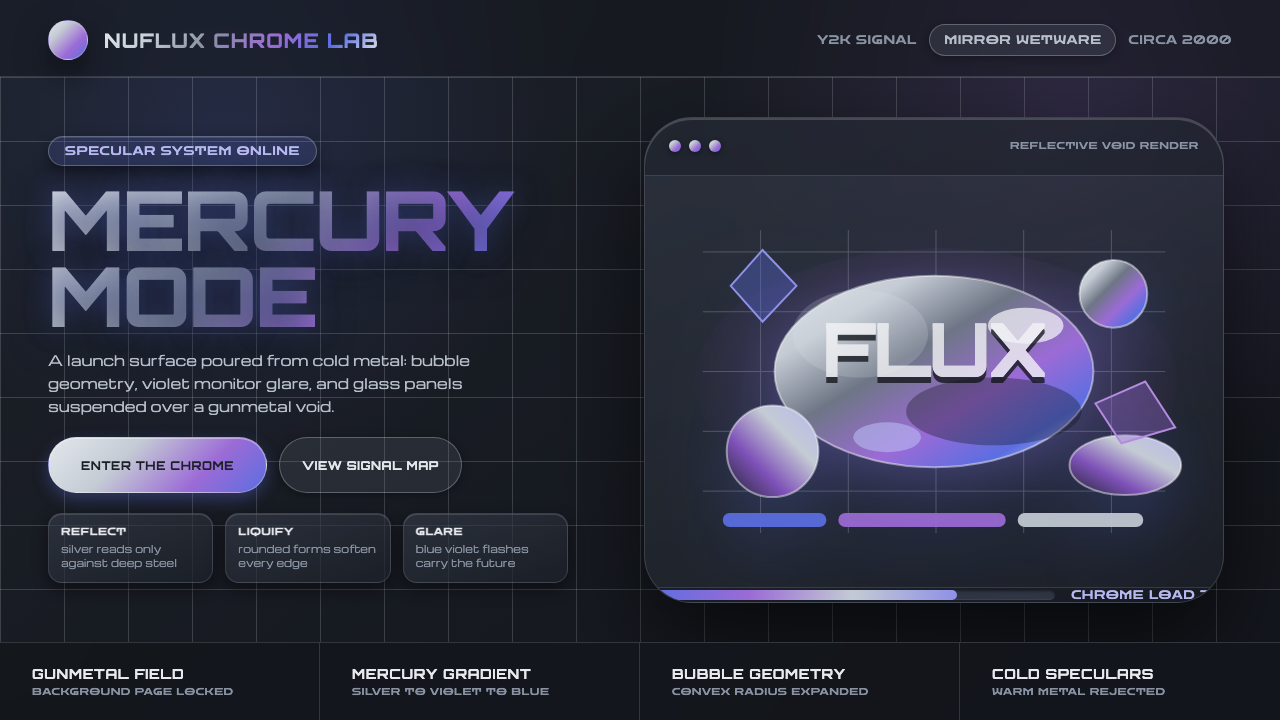 Liquid Chrome Y2KChrome needs darkness. Gunmetal voids make silver blobs and blue-violet glare…
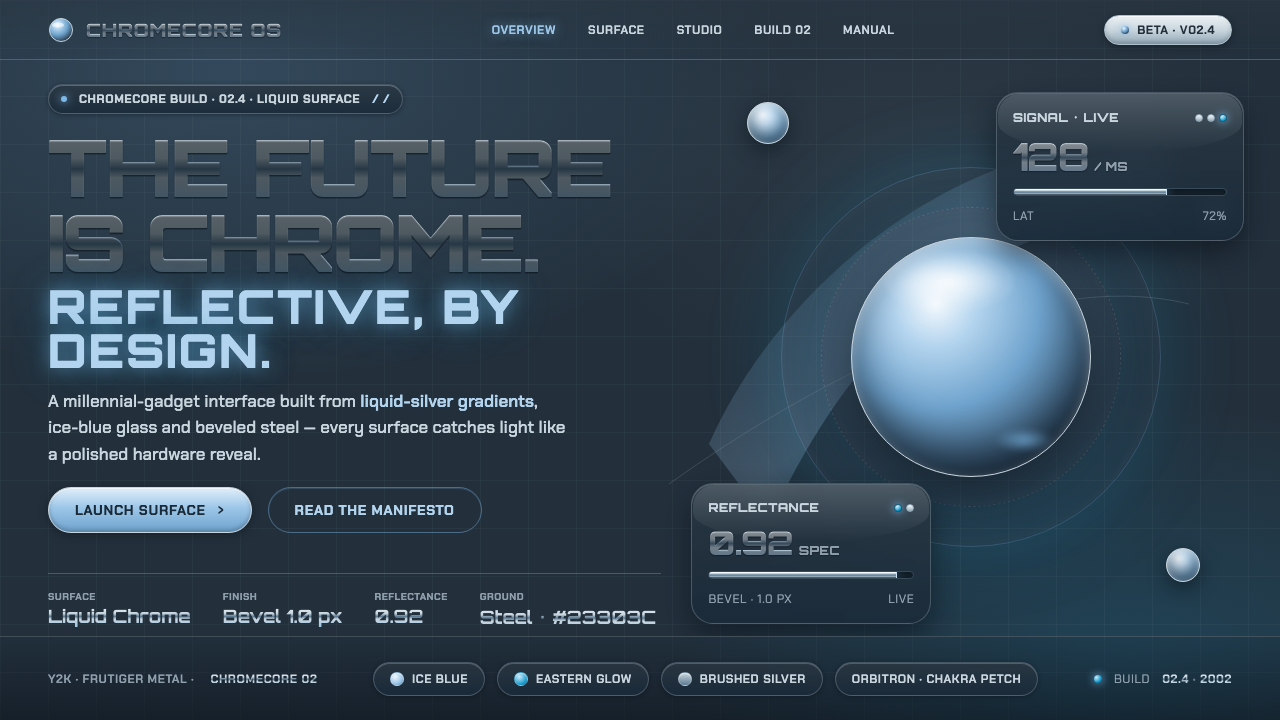 Y2K Frutiger MetalThe future is chrome. Liquid-silver gradients, ice-blue glass and beveled ste…
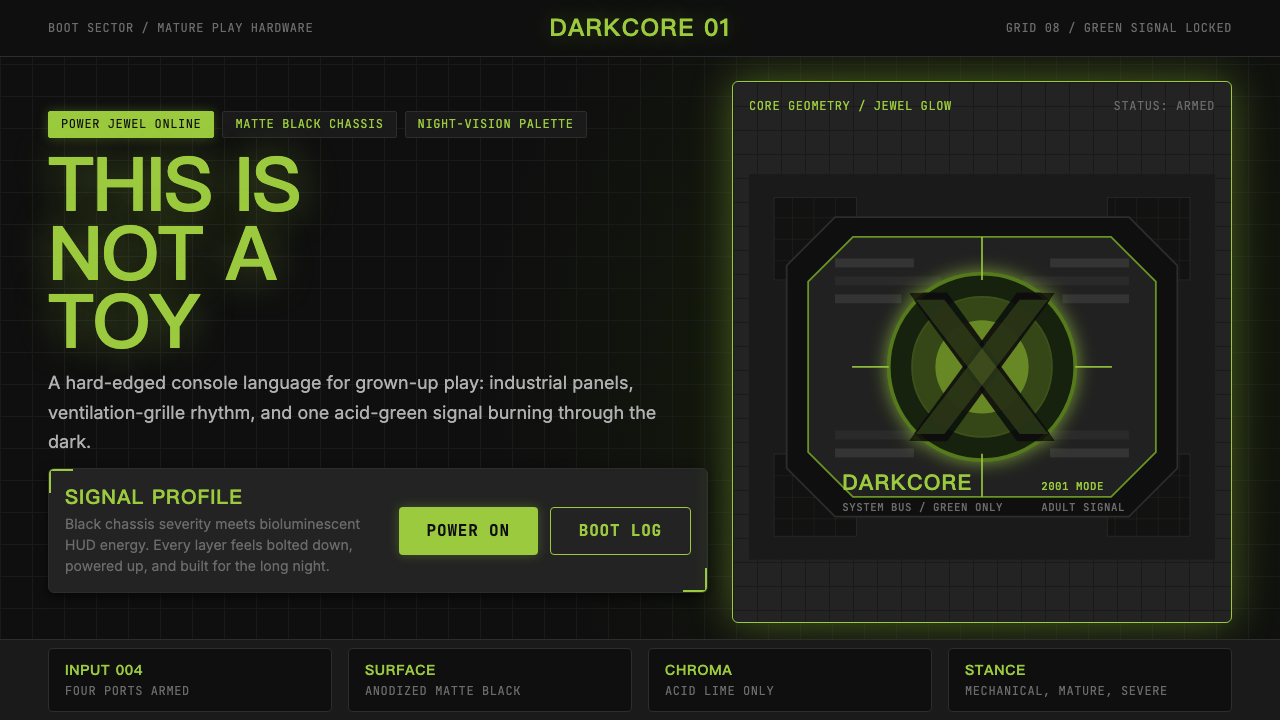 Xbox Original (2001)Not a toy. Acid green cuts matte black in a rigid grille-and-jewel hardware p…
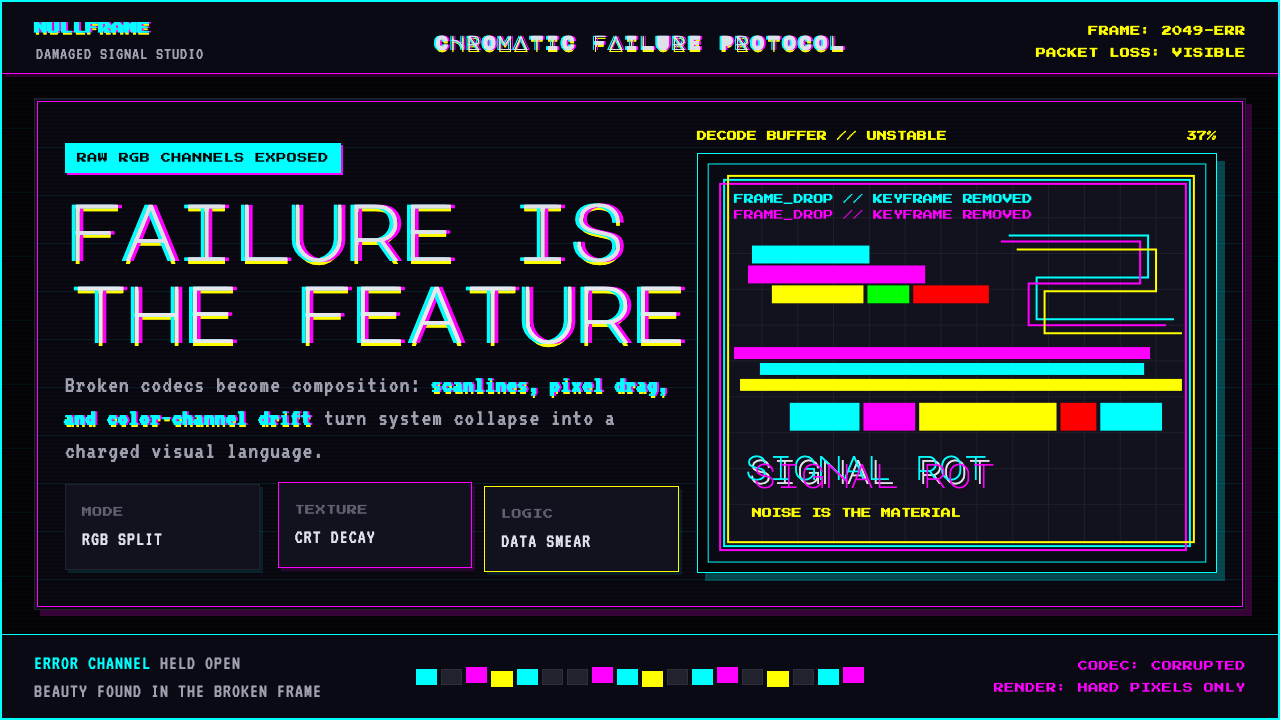 Glitch DatamoshErrors as composition. Corrupted JPEGs, RGB splits, scanlines — failure treat…
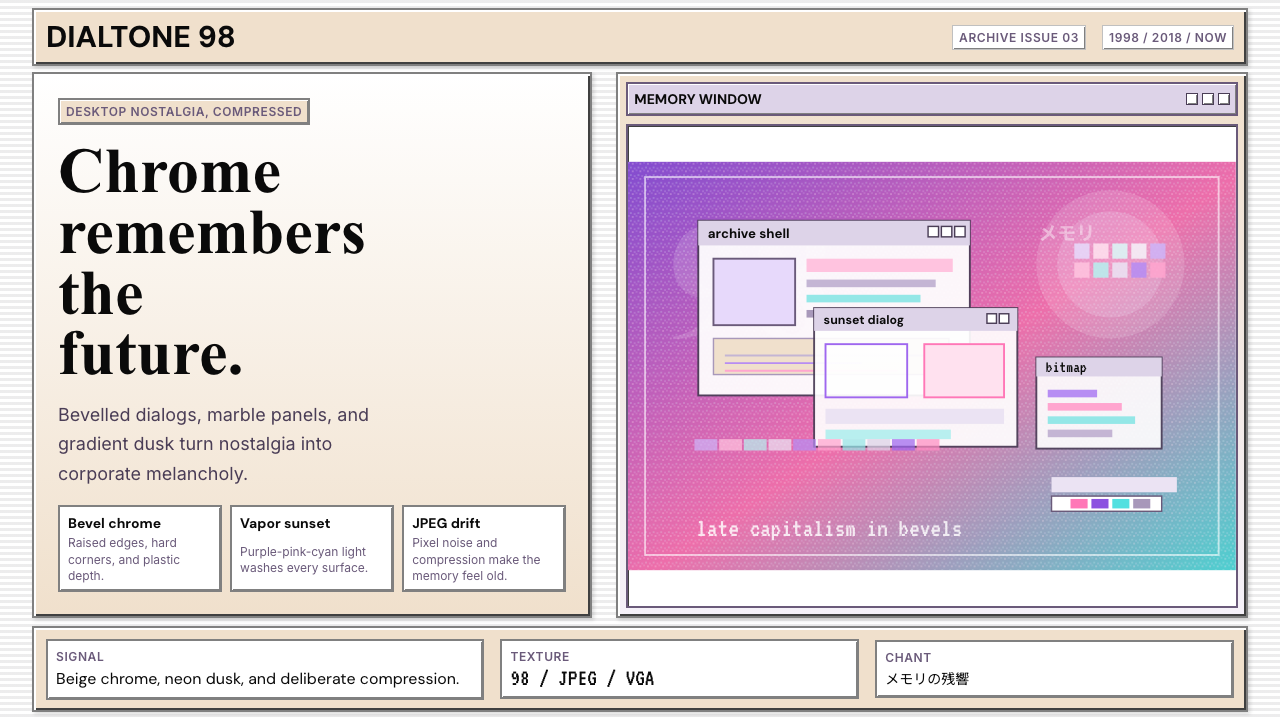 Windows 98 VaporwaveCorporate melancholy glows. Bevelled panels and purple-pink-cyan dusk do the…
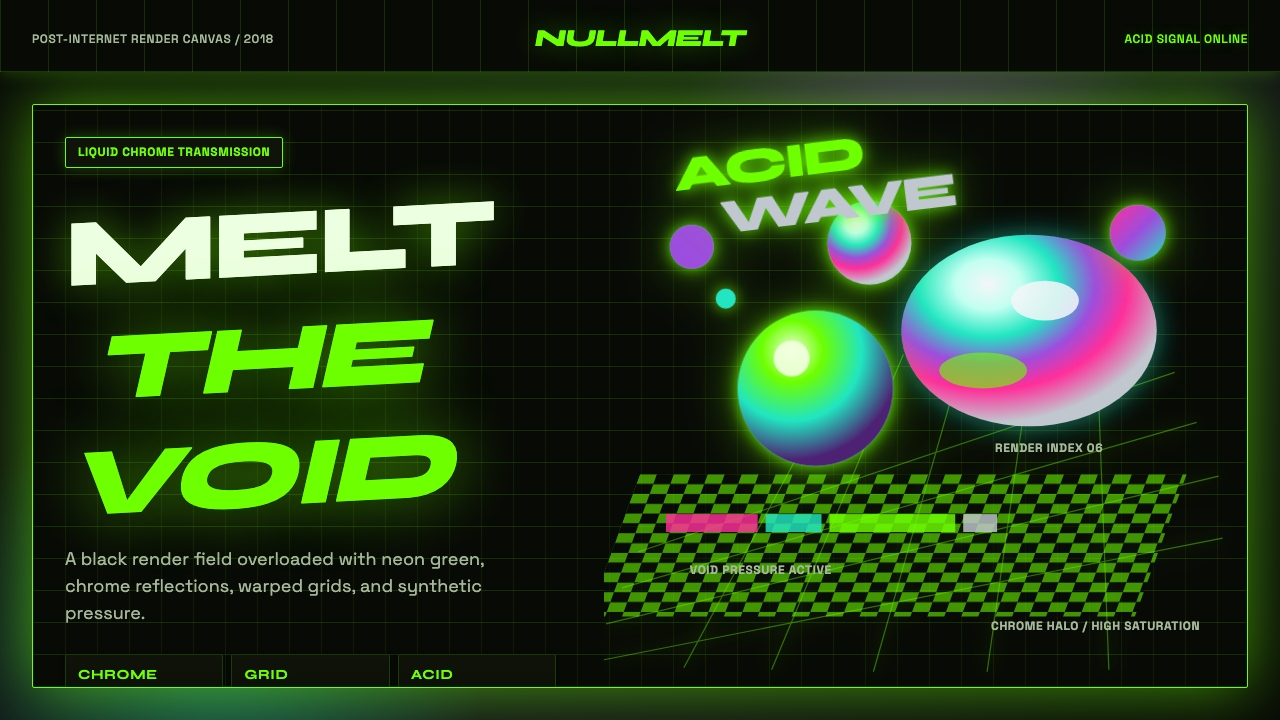 Acidwave 3D RenderPsychedelia hits the render engine. Neon green, chrome orbs, and warped grids…