What is Cyberpunk 2077 (Screen UI)?
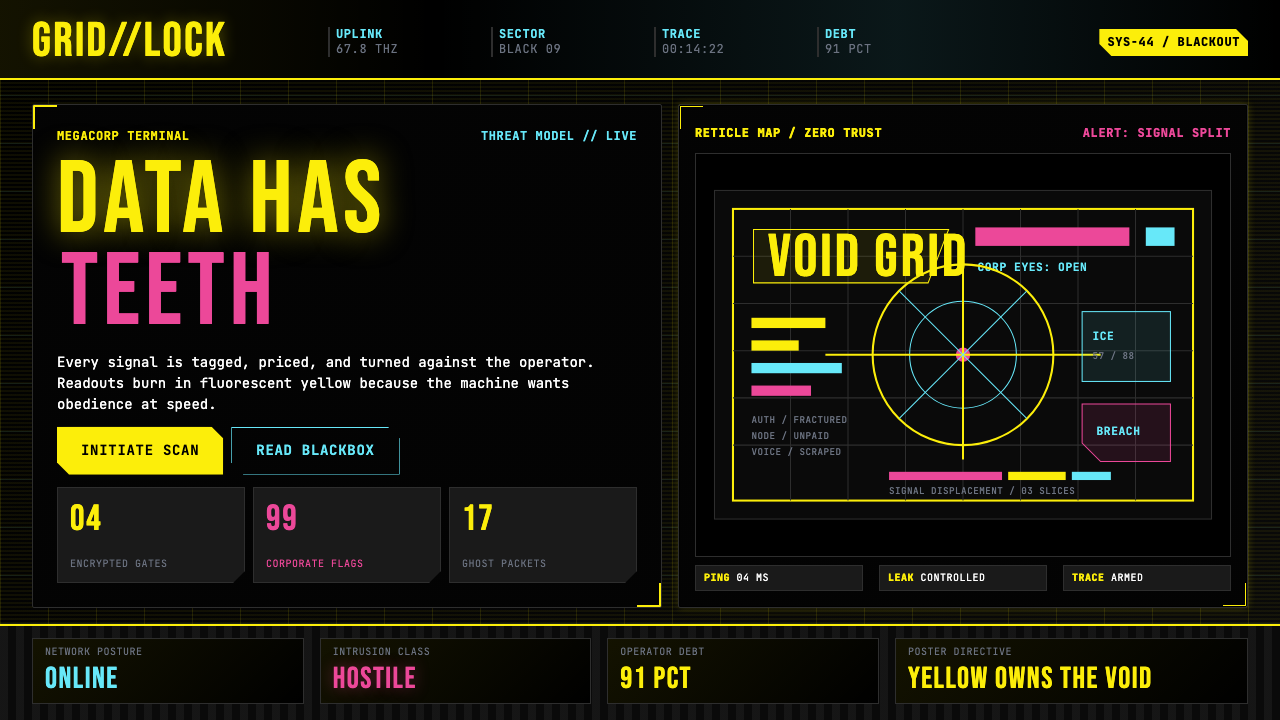
Cyberpunk 2077's screen UI is four decades of dystopian fiction compressed into a single operating system — fluorescent yellow on void black, scanlines, HUD brackets, and the unsettling conviction that every surface is a corporate data terminal.
Cyberpunk 2077 (Screen UI) in brief
The Cyberpunk 2077 screen UI style is the visual language developed by CD Projekt RED for their 2020 open-world RPG set in the fictional Night City. It translates the cyberpunk literary and anime visual tradition into a functioning, navigable interface — one where the aesthetic is inseparable from the fiction it inhabits. The screen language is built on a handful of absolute choices: pure black backgrounds, fluorescent yellow as the dominant text and action color, hot magenta for alerts and danger states, cool cyan for network and system status, and a monospace typeface ruling almost every surface.
Visually, the style reads as a military targeting system crossed with a megacorporation advertisement. Panels are framed with L-bracket corner marks — partial borders that evoke weapon reticles and satellite overlays. Horizontal scanlines simulate the phosphor decay of cathode ray tubes, layering analog noise over digital content. A tall condensed display face descending from the Eurostile and Microgramma typefaces of 1960s science fiction film design stamps headlines at monument scale. A fixed-width monospace typeface handles every data readout, label, and body element — because in Night City the distinction between a human message and a system log is deliberately blurred.
The compositional logic is density-first. Cyberpunk interfaces do not breathe — they fill every available pixel with information, status indicators, faction markers, and ambient data noise. The grid is tight, gutters are narrow, and negative space is treated as wasted real estate. This is intentional: the fictional world implies a society where attention is the primary commercial resource and every screen competes for it.

Where does Cyberpunk 2077 (Screen UI) come from?
The lineage begins in prose. William Gibson's Neuromancer (1984) imagined cyberspace as neon geometry inscribed on void — cowboys jacking into a consensual hallucination rendered as luminous data. That founding text established the genre's core visual tension: the beautiful and the dangerous are the same object, and both are legible as information. Gibson wrote about interfaces before most people had used one, and the visual vocabulary he invented on the page — glowing screens, corporate logos burned into retinas, data cascading like rain — became the genre's dominant metaphor.
The anime tradition translated Gibson's prose into moving images. Katsuhiro Otomo's Akira (1988) rendered Neo-Tokyo's motorcycle dashboards as dense, instrument-heavy HUD overlays; the panels of his manga are so information-saturated they read more like technical diagrams than comics pages. Mamoru Oshii's Ghost in the Shell (1995) gave the genre its canonical terminal aesthetic: phosphor characters cascading on black, network addresses resolving like falling water, the human nervous system treated as a hackable operating system. These films did not illustrate the literary tradition — they extended it, establishing the visual grammar that every subsequent cyberpunk screen designer would work within or against. Ridley Scott's Blade Runner (1982) contributed the neon-rain noir palette and the dystopian city-as-advertisement logic, where every surface is simultaneously shelter and commercial intrusion.
CD Projekt RED, working from Warsaw rather than Tokyo or Los Angeles, synthesized these reference points into a coherent design system for Cyberpunk 2077. The studio's color choice — a fluorescent near-chartreuse yellow as the dominant HUD accent — stamped a single chromatic identity onto the entire game world. Night City's megacorporations each have their own faction colors and typography, but the underlying screen language is unified: black void, yellow primary, bracket framing, mono type. The result is a game UI that reads simultaneously as a functioning corporate operating system and as a designed artifact explicitly commenting on its own genre history.
The canonical status of the game's visual language was reinforced by Studio Trigger's anime adaptation, Cyberpunk: Edgerunners (2022), which proved that the interface aesthetic could migrate from game HUD to screen-within-screen in animated storytelling without loss of coherence. By the time the game's visual language entered broad cultural circulation, it had become one of the most recognized dark-mode interface aesthetics in contemporary design — a benchmark reference for any project that needs to signal high-technology, urgency, and controlled danger simultaneously.
What defines the Cyberpunk 2077 (Screen UI) look?
Color System
The palette is adversarial by design. Pure black is not a dark-mode convenience — it is a declaration that the screen is off until data activates it. Fluorescent yellow functions as the dominant HUD text, primary action, and attention color: it is the color of weapon damage numbers, megacorp branding, and anything that demands immediate response. Hot magenta signals danger, corporate intrusion, and alert states. Cool cyan represents network health and system status. Every hue is synthetic and saturated — there are no earth tones, no warm neutrals, no soft gradients. The screen palette is engineered to be read at a glance in a chaotic environment, drawing on the same adversarial legibility logic as warning signage in industrial settings.
Typography
Two typeface roles govern the entire system, and neither is neutral. The display role belongs to a tall, condensed, zero-weight-variation face set in all-caps with generous letter-spacing — referencing stenciled military markings and the title cards of 1960s and 1970s science fiction cinema. The body and data role belongs to a fixed-pitch monospace face that handles every readout, label, input, and UI chrome element, enforcing the fiction that all surfaces are data terminals. Uppercase defaults combined with tracked-out spacing create a specific tension between legibility and urgency that defines the style. There is no friendly typeface anywhere in the system — softness of form is treated as an admission that the interface is not serious.
Scanlines and CRT Noise
A repeating horizontal stripe overlay at low opacity simulates cathode ray tube phosphor line decay, applied to full-page backgrounds and panel surfaces alike. The scanline effect performs two functions simultaneously: it reads as aging, damaged technology — screens that have survived a decaying future — and it adds a layer of visual texture that softens the otherwise stark digital geometry. The CRT noise is not cosmetic filler; it is the visual equivalent of ambient sound design, signaling that this interface exists in a specific time and world, not in the timeless void of flat design. Without it, the palette alone risks reading as a generic dark theme rather than as a lived-in artifact.
HUD Bracket Framing
Corner L-bracket marks — partial borders placed at the four corners of a panel rather than a continuous rectangle — are the style's most distinctive compositional device. They reference military targeting reticles, satellite image overlays, and the weapon acquisition HUDs of action film and game convention. The practical effect is that panels feel monitored, targeted, and under active data surveillance rather than simply contained. The brackets are rendered in fluorescent yellow at a thin hairline stroke, maintaining the overall line thinness that gives the style its etched, precision-instrument quality. Full rectangular borders are reserved for form inputs and data table cells; structural panels use only the corner marks.
Glitch and Displacement
Glitch displacement — horizontal slice artifacts that suggest momentary data corruption or signal interference — appears primarily as a hover and transition effect. A panel or image element shifts into misaligned horizontal slices for a brief interval, then snaps back to coherence. The effect signals that the network is not fully stable, that data feeds can be interrupted, and that the interface itself is subject to the same fragility as the world it operates in. Glitch effects must be used sparingly: overuse collapses the effect from a meaningful instability signal into meaningless decoration, and excessive motion can trigger vestibular discomfort for sensitive users.
Glow-Based Elevation
Traditional drop shadows simulate a light source above the surface. In Night City, light sources are neon signs and holographic projections — objects emit light rather than cast shadows. Elevation and focus in the cyberpunk system are expressed through outward glow: fluorescent yellow emission at increasing intensities replaces the conventional shadow ladder for raised elements. Focus states use cyan glow rings rather than outline borders. The system produces depth through emitted light, surface layering from pure black through near-black to deep charcoal, and the convention that brighter elements are closer to the viewer. It is a depth logic built entirely from luminance rather than occlusion.
Sharp Geometry
Border radius is absent throughout the system — every corner is a knife edge. Buttons are rectangular. Inputs are rectangular. Panels cut hard into the black void with no softening. This universal sharpness is the visual inverse of the rounded-rectangle paradigm that dominates consumer UI design. It communicates that this is not a product designed to feel friendly or approachable, but one designed to process information at high velocity without the friction of reassurance. The angularity is a functional argument: round corners signal safety and welcome; zero radius signals a system indifferent to whether you are comfortable using it.

Who shaped Cyberpunk 2077 (Screen UI)?
The Warsaw-based studio behind Cyberpunk 2077, responsible for synthesizing four decades of cyberpunk visual culture into a coherent, production-grade UI design system. The studio's decision to use their own brand yellow — a fluorescent, near-chartreuse hue — as the dominant HUD accent color gave Night City's interface a singular chromatic identity distinguishable from any prior cyberpunk reference. Their UI team built a system legible at controller-distance on a television and at cursor-distance on a monitor, establishing benchmarks for dark-mode information density that influenced broader product design practice.
The Canadian-American author whose 1984 novel Neuromancer founded the cyberpunk literary genre and established the visual vocabulary that all subsequent screen designers in the tradition have worked with. Gibson coined the term 'cyberspace' and described it as a 'consensual hallucination' — framing digital space as simultaneously a sensory environment and a corporate battleground. His vision of data as luminous geometry on black void, of corporate logos as retinal invasions, and of the hacker as a figure navigating hostile information architecture became the generative metaphor for an entire design tradition.
Manga artist and filmmaker whose Akira (1982 manga, 1988 film) established the anime side of the cyberpunk visual grammar. Otomo's dense, information-saturated panel layouts — motorcycle dashboards rendered as instrument-heavy overlays, urban environments designed as vertical accumulations of signage and cable — defined the compositional logic of data density that cyberpunk interfaces inherit. His influence on Night City's environmental visual design is direct, and the HUD framing conventions that appear in the game's interface trace directly to the manga's approach to depicting human-machine instrumentation.
Director of Blade Runner (1982), the film that established the neon-noir visual palette and the dystopian city-as-advertisement logic central to cyberpunk screen design. Scott's production designer Syd Mead coined the term 'retro-fitted future' for Blade Runner's visual approach — a world where advanced technology is overlaid on decaying infrastructure, where advertisements are projected onto rain-slicked surfaces, and where corporate branding is omnipresent and inescapable. This logic — every surface is simultaneously a screen and a sales pitch — runs directly through the Night City interface design.
Director and studio behind Ghost in the Shell (1995), the film that gave cyberpunk its canonical terminal aesthetic: phosphor text cascading on black, network addresses resolving in real time, the human body itself depicted as a hackable hardware substrate. Production I.G's visual language — particularly the membrane-like translucency of holographic overlays and the clinical precision of network sequence animations — established the benchmark for how cyberpunk interfaces should render information as something simultaneously beautiful and threatening. The film remains a direct reference for any dark-mode interface invoking the genre.
How do you use Cyberpunk 2077 (Screen UI) today?
Applying the Cyberpunk 2077 screen UI style requires committing to its core tension: this is an interface that treats information as a weapon, not a service. Watered-down applications — black background with a few yellow accents and a monospace label here and there — produce pastiche, not cyberpunk. The style works when the entire composition submits to its logic: maximum information density, adversarial color, universally sharp corners, scanline or CRT noise texture, and HUD bracket framing at every structural decision point.
For presentation slides, the style is most effective on high-stakes technical or data-driven presentations — product launches, security briefings, data analyses, and concept demonstrations for technology products. A cyberpunk cover slide works as a full-bleed black field with a single condensed all-caps headline in fluorescent yellow at large scale, flanked by HUD bracket marks and a thin horizontal rule. Content slides should treat each panel as a terminal readout: monospace type for all text, cyan for data labels, yellow for emphasis, magenta for critical callouts. Avoid prose paragraphs — this style favors tightly packed lists, data tables, and isolated figures over flowing text.
For web UI, the style is specifically suited to dashboards, monitoring interfaces, developer tools, cybersecurity products, and any platform where data density and urgency are legitimate values rather than stylistic impositions. The canonical pattern is a pure black page background, with near-black surface panels outlined in deep charcoal, fluorescent yellow as the primary action and heading color, and monospace type for all UI text. Interactive states use yellow glow intensification on hover and cool cyan glow rings on focus. Tables and data grids are where the style performs best — dense rows of fixed-width data on dark backgrounds, with colored status indicators in the appropriate semantic accent colors.
For editorial and marketing contexts, the style carries strong genre signaling: products using it position themselves as high-tech, high-stakes, and culturally fluent in the gaming and speculative fiction space. Effective marketing uses include event posters for gaming conferences, launch campaigns for developer tools or API products, and editorial design for publications covering technology and digital culture. The full-bleed black background with fluorescent yellow typography functions as a poster aesthetic — legible at distance, immediately recognizable in a crowded feed.
The most common mistake is deploying the color palette without the compositional logic. Fluorescent yellow text on a black background alone does not read as cyberpunk — it reads as poor contrast execution or unfinished design. The style requires the full supporting vocabulary: scanlines, bracket framing, monospace type, zero border radius, and the density-first layout logic. A second common failure is using glitch effects as cosmetic decoration throughout the interface. Glitch signals instability; applied to every interaction, it reads as broken rather than intentional. Reserve glitch displacement for loading states, error conditions, and feature reveals where instability is semantically appropriate.

Cyberpunk 2077 (Screen UI) — FAQ
Is the cyberpunk screen UI style the same as 'dark mode'?
No. Dark mode is a preference setting that inverts light surfaces to dark ones while preserving the underlying visual logic of a design system. The Cyberpunk 2077 screen UI is an entire compositional doctrine built ground-up for black voids: the color palette, typographic choices, elevation system (glow instead of shadow), corner treatment (universally sharp), and information density all proceed from that foundation. A dark mode version of a friendly SaaS product and a cyberpunk interface are as different as a photograph taken at night and a painting explicitly about darkness. One adapts a light system for dark conditions; the other treats darkness as the primary expressive medium.
How does the cyberpunk style differ from other sci-fi UI aesthetics like Star Trek LCARS or Mass Effect?
LCARS (Star Trek's Library Computer Access and Retrieval System, designed by Mike Okuda) is a utopian interface: warm amber and orange on black, rounded pill shapes, generous spacing, and a reading experience designed to feel cooperative and calm. It envisions a future of abundance where humans and machines are at peace. The Mass Effect interface uses a similar utopian legibility, with cool blue tones and architectural spaciousness. Cyberpunk is the inverse: adversarial color, zero rounded corners, maximum density, and the constant suggestion of system fragility. LCARS assumes you are authorized; cyberpunk assumes you are not. One is functional in the service of human comfort; the other is functional in the service of corporate extraction.
Can this style work for a consumer-facing product, or is it limited to gaming and developer contexts?
It can work for consumer products, but the product's own values need to align. Cyberpunk signals high-technology, urgency, controlled danger, and genre fluency. Products where these are genuine values — gaming peripherals, esports platforms, DJ software, security tools, VPN products, and certain music streaming interfaces — can use the style authentically. Where it fails is in products that need warmth, trust, or accessibility as primary values: healthcare, finance, children's products, e-commerce for general audiences. The cyberpunk aesthetic actively suppresses warmth and makes a visual argument that the user is navigating a hostile system — which is precisely the right message in some contexts and absolutely the wrong one in others.
What is the biggest pitfall when implementing the glitch and scanline effects?
For scanlines: the stripe overlay needs to be a non-interactive layer that sits above content visually but does not block pointer events — otherwise it will intercept clicks on interactive descendants. The stripe opacity must be kept low enough that it adds texture without significantly degrading contrast ratios below accessibility minimums. For glitch: the slice animation should be applied to contained child elements rather than to layout containers with many descendants, to avoid expensive repaints. Both effects must be disabled under a user's reduced-motion preference to satisfy accessibility requirements — glitch in particular, which can trigger vestibular discomfort, is a hard accessibility failure if it runs unconditionally for all users.
How should the three accent colors — yellow, magenta, and cyan — be used without them competing?
The three colors serve strictly distinct semantic roles and should almost never appear at the same visual weight simultaneously. Fluorescent yellow is the primary action and attention color — it should be the first color the eye lands on in any given panel. Cyan is for system status, focus states, and secondary interactive elements; it reads as subordinate to yellow because it is cooler and less optically advancing. Magenta signals danger, alerts, and error states — it should appear only when something is actually wrong or critically urgent, meaning sparingly. A useful composition rule: in any given screen, one color should be dominant by area and saturation, the other two present only as small indicators or single-line accents. Treat the palette as a traffic light system — yellow means proceed with attention, cyan means informational, magenta means stop or warn.
Related design styles
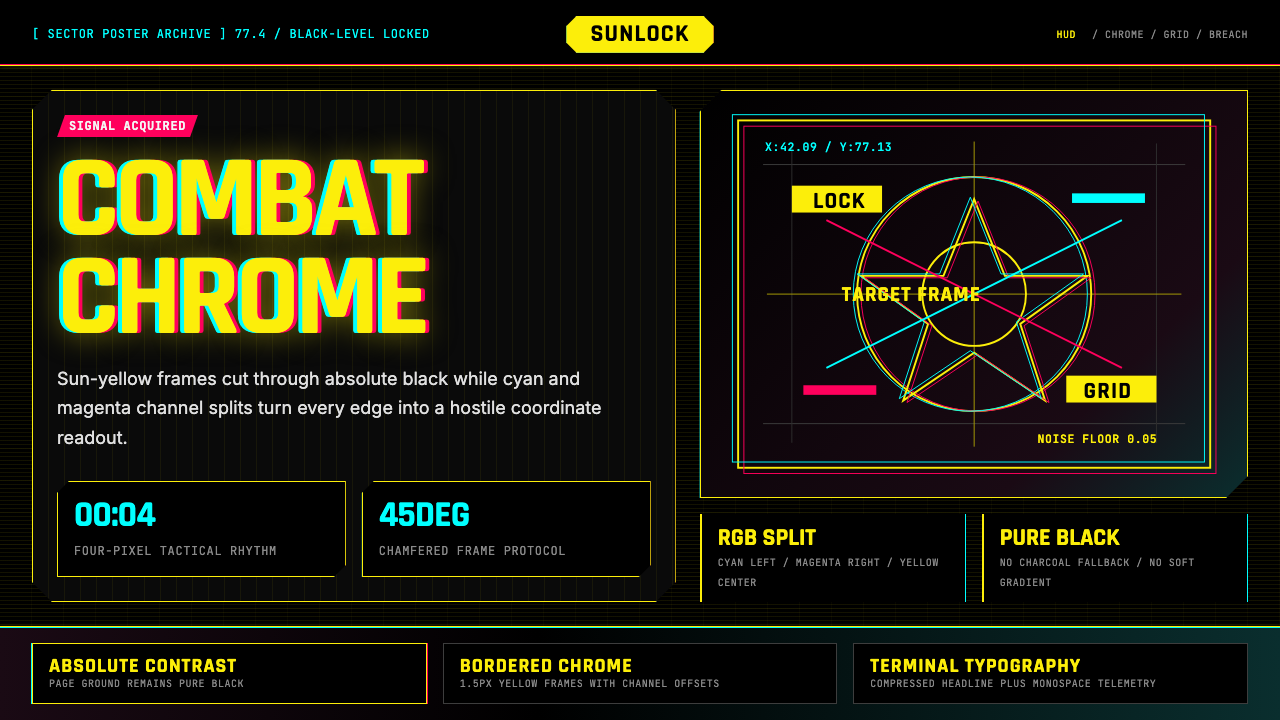 Cyberpunk 2077 Night City YellowCombat HUD on black. Sun-yellow chrome splits into magenta-cyan coordinate gr…
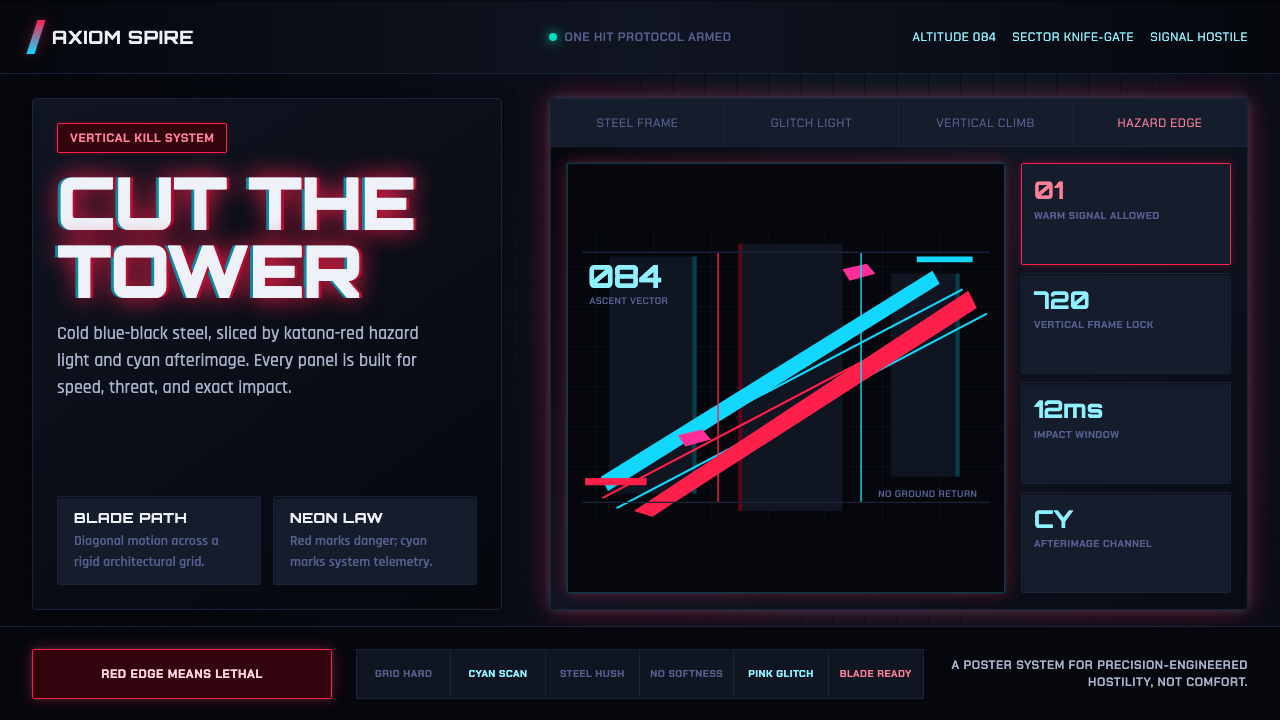 Ghostrunner Dharma TowerHostile precision at speed. Blue-black steel grids cut by red neon and cyan g…
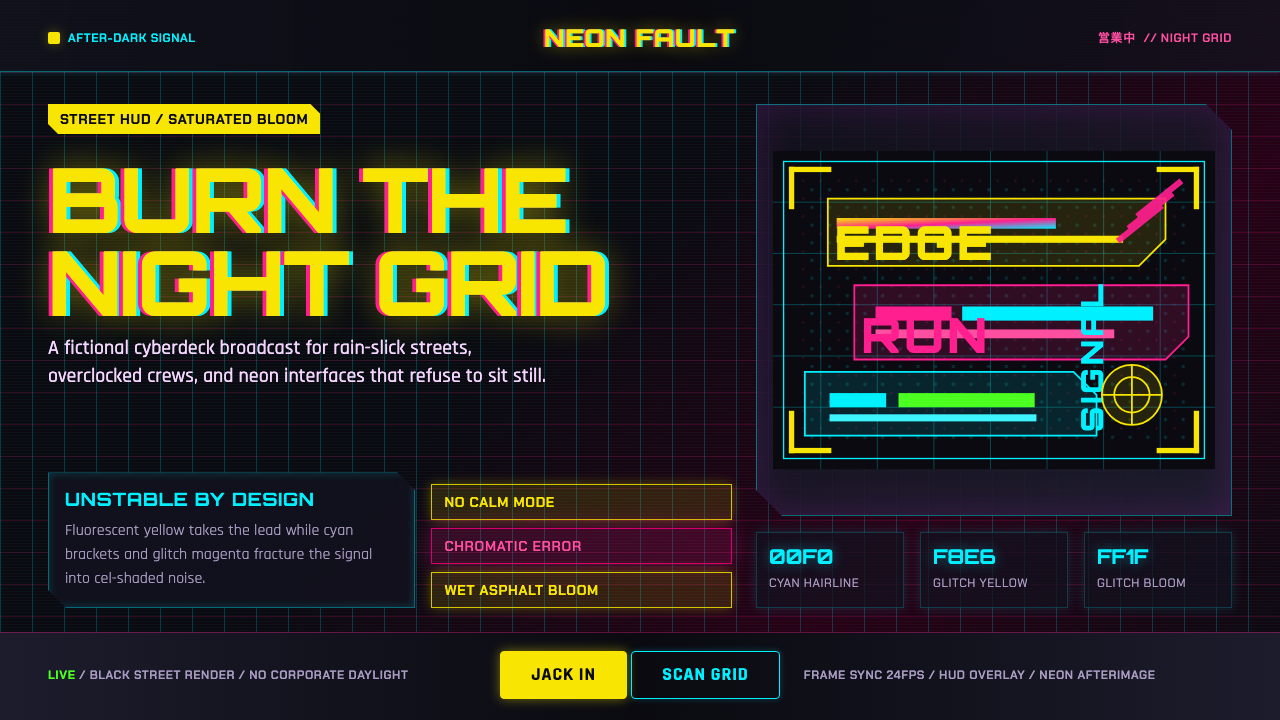 Edgerunners NeonNeon overload. Fluorescent yellow, cyan HUD grids, and magenta glitches burn…
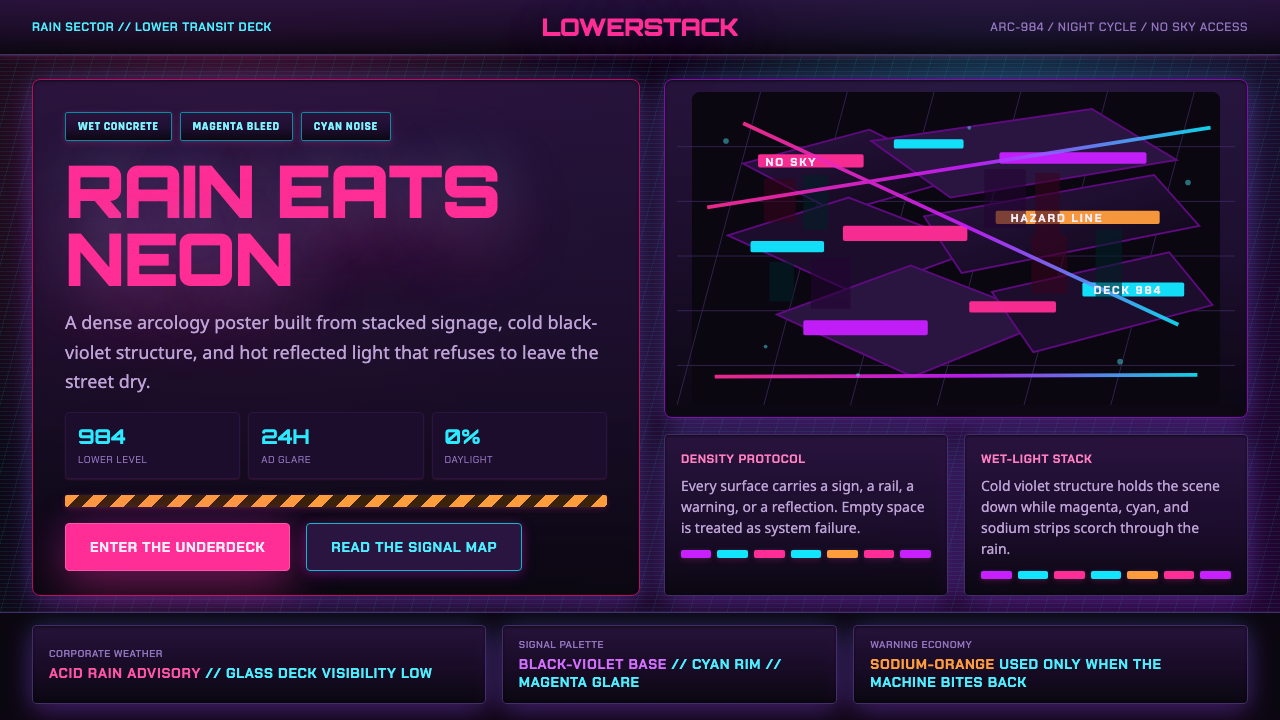 The Ascent ArcologyNeon suffocates the dark. Magenta and cyan signage stacks over wet black-viol…
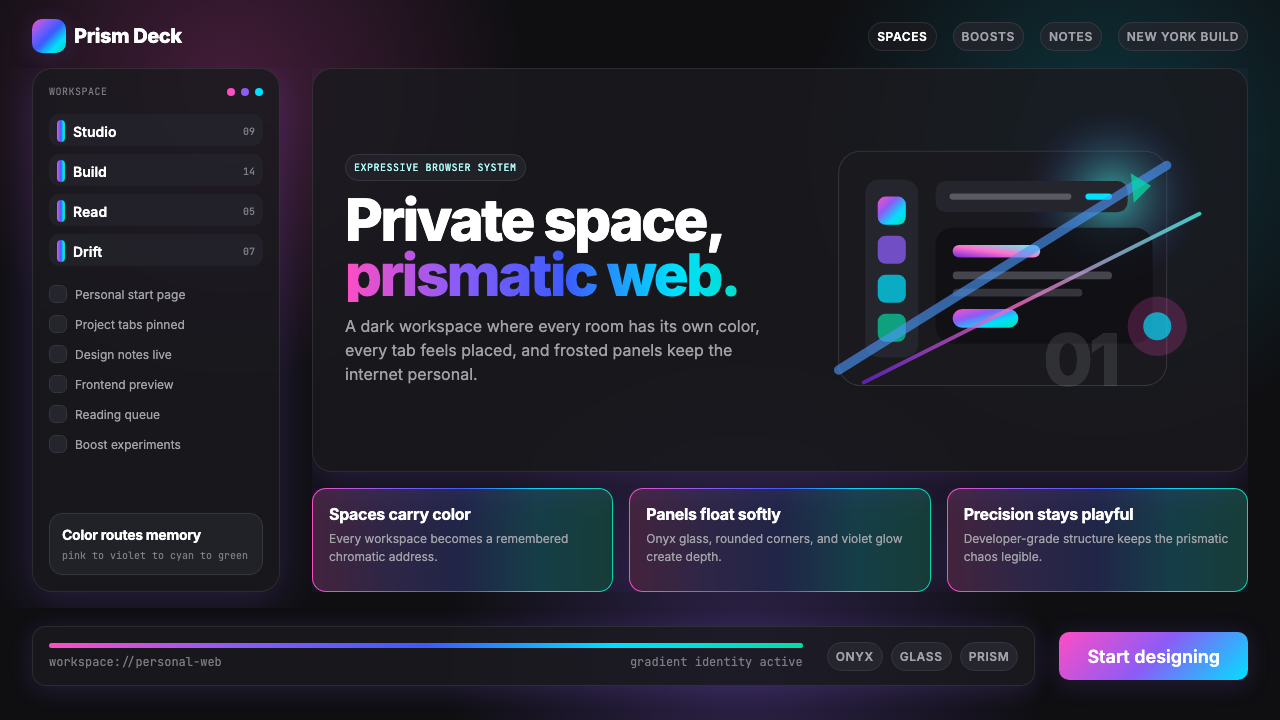 Arc Browser Prismatic (2023)Color is architecture. Pink-violet-cyan ribbons glow over onyx glass and roun…
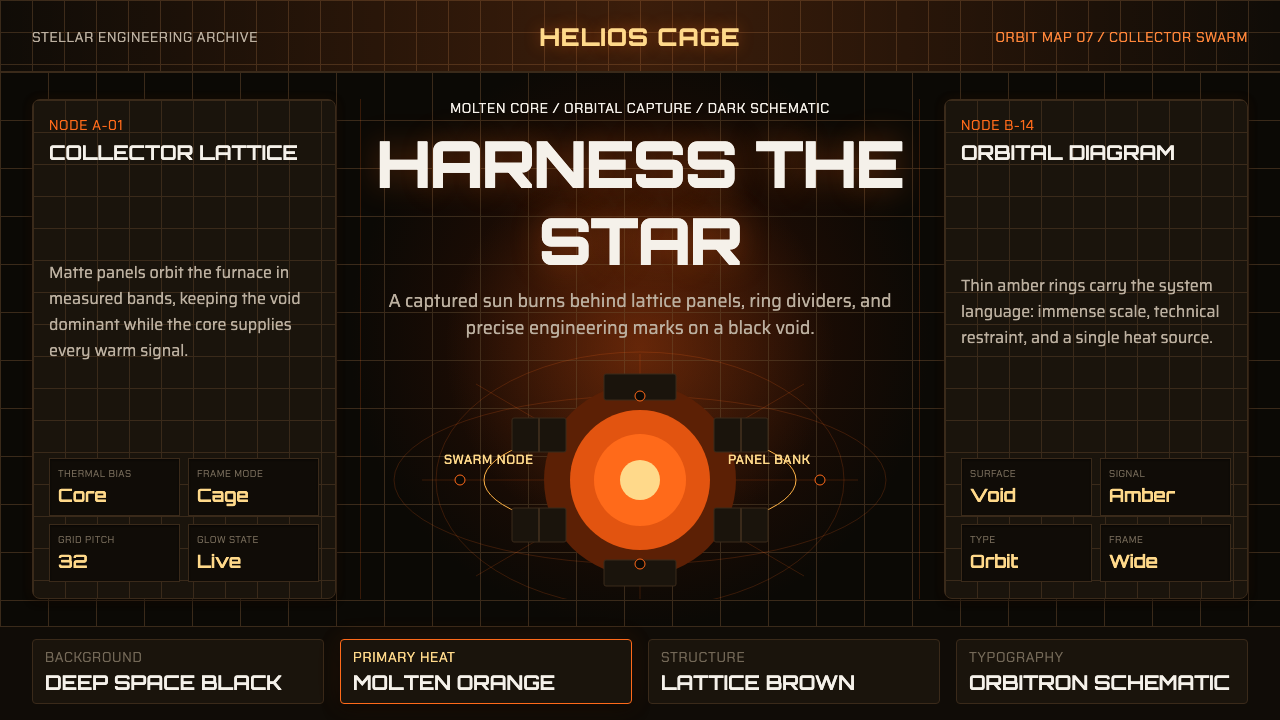 Dyson Sphere MegastructureCold void, captive heat. Molten orange core caged by brown lattice and orbita…