What is Cyberpunk 2077 Night City Yellow?
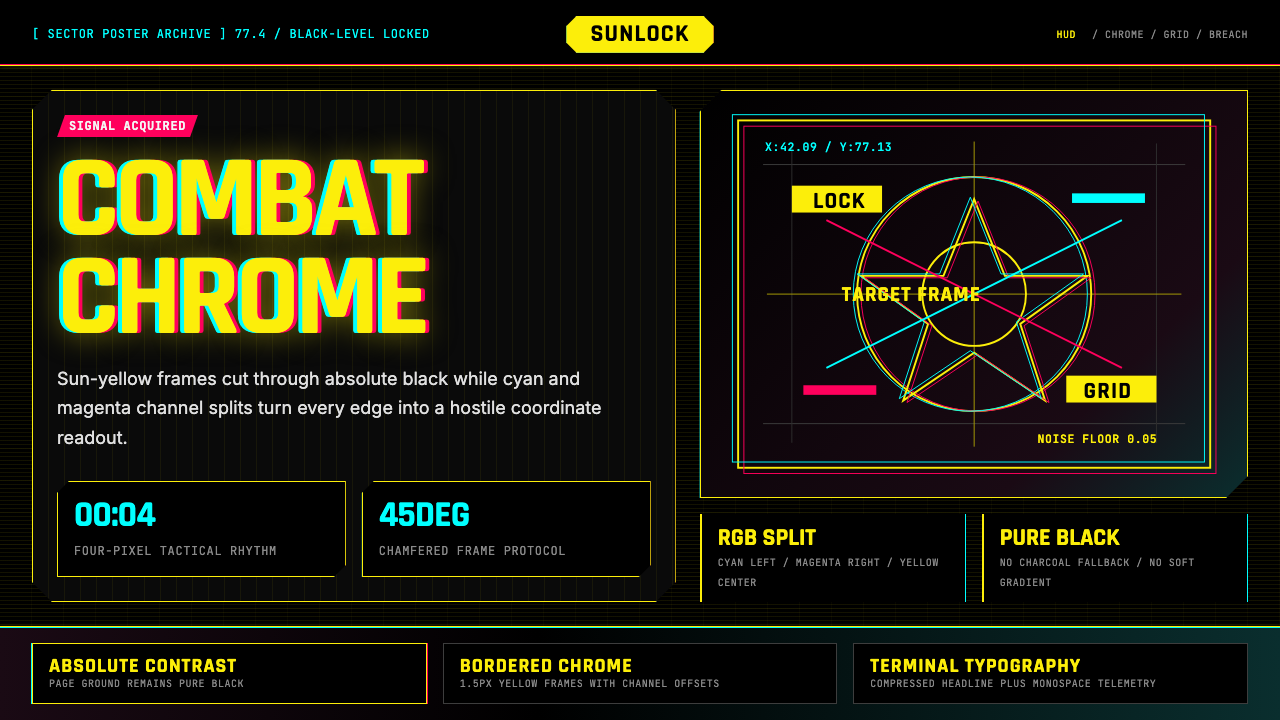
Cyberpunk 2077 Night City Yellow is a weaponized brand system — sun-yellow combat interfaces slicing through pure black, flanked by chromatic-aberration glitches that make every surface feel like a crumbling city's last warning signal.
Cyberpunk 2077 Night City Yellow in brief
Cyberpunk 2077 Night City Yellow is the visual identity forged by CD Projekt Red for their 2020 role-playing game set in the dystopian megalopolis of Night City. Its defining grammar is stark: an aggressive sun-yellow dominates against a pure black ground, while magenta and cyan chromatic-aberration splits fracture every edge into a three-channel RGB glitch — the visual equivalent of signal corruption in a networked world where bodies are hardware and data is oxygen.
The aesthetic is built on the logic of the heads-up display. Every typographic element, every geometric frame, every data overlay is conceived as combat interface: angular chamfered corners cut across bounding boxes, monospace coordinate systems overlay background imagery, and scanline noise textures every surface with the grain of a cathode-ray monitor running too hot. The effect communicates that information is urgent, the environment is hostile, and the viewer is always one second from a threat.
What distinguishes this system from generic neon-noir or vaporwave is its industrial precision. The glitch effects are not decorative noise — they are applied systematically to indicate hierarchy and state. The yellow marks primary information: interactive elements, health status, mission objectives. The chromatic splits mark instability: damaged states, corrupted data, enemy territory. The result is a visual language where every color decision is a functional signal rather than an atmospheric garnish.
Where does Cyberpunk 2077 Night City Yellow come from?
The intellectual lineage of Night City Yellow begins in 1988, when cyberpunk author William Gibson codified the genre's visual imagination: neon against rain-slicked black streets, corporate logos blazing above human misery, the body as site of technological modification. But it was tabletop game designer Mike Pondsmith who first crystallized this into a systematic visual and mechanical language. Pondsmith's 'Cyberpunk' rulebook, published in 1988 by R. Talsorian Games in Berkeley, California, introduced Night City as a setting and established a chromatic vocabulary that would persist for three decades: high-contrast yellow, electric blue, and the specific quality of artificial light against absolute darkness.
CD Projekt Red, the Warsaw-based studio founded in 1994, acquired the license for a video game adaptation in 2012. The development team spent eight years building not just a game but a brand system capable of operating across in-world advertising, UI, packaging, and marketing simultaneously. The UI team, working under art direction informed by Blade Runner and Akira, developed pure black as the base field, sun-yellow as the primary signal color, and magenta-cyan for the chromatic aberration effect that became the style's most recognizable signature.
The chromatic aberration motif has specific technical origins in analog video: when a lens fails to focus all wavelengths of light at the same point, the image splits into offset color channels, producing the fringe effect visible at high-contrast edges. The Night City system co-opted this artifact of optical failure as an intentional design element — signaling that the world of 2077 is always on the verge of breakdown, the interface between human perception and machine data perpetually unstable.
The game released in December 2020 to enormous cultural impact. The visual identity proved robust enough to sustain the 'Phantom Liberty' expansion in 2023 and the Netflix animated series 'Cyberpunk: Edgerunners', directed by Hiroyuki Imaishi at Studio Trigger in 2022. The animated series extended the visual language into hand-drawn form, demonstrating that the Night City aesthetic was a transferable graphic system capable of surviving translation across radically different production contexts while remaining instantly recognizable.
What defines the Cyberpunk 2077 Night City Yellow look?
Color Structure
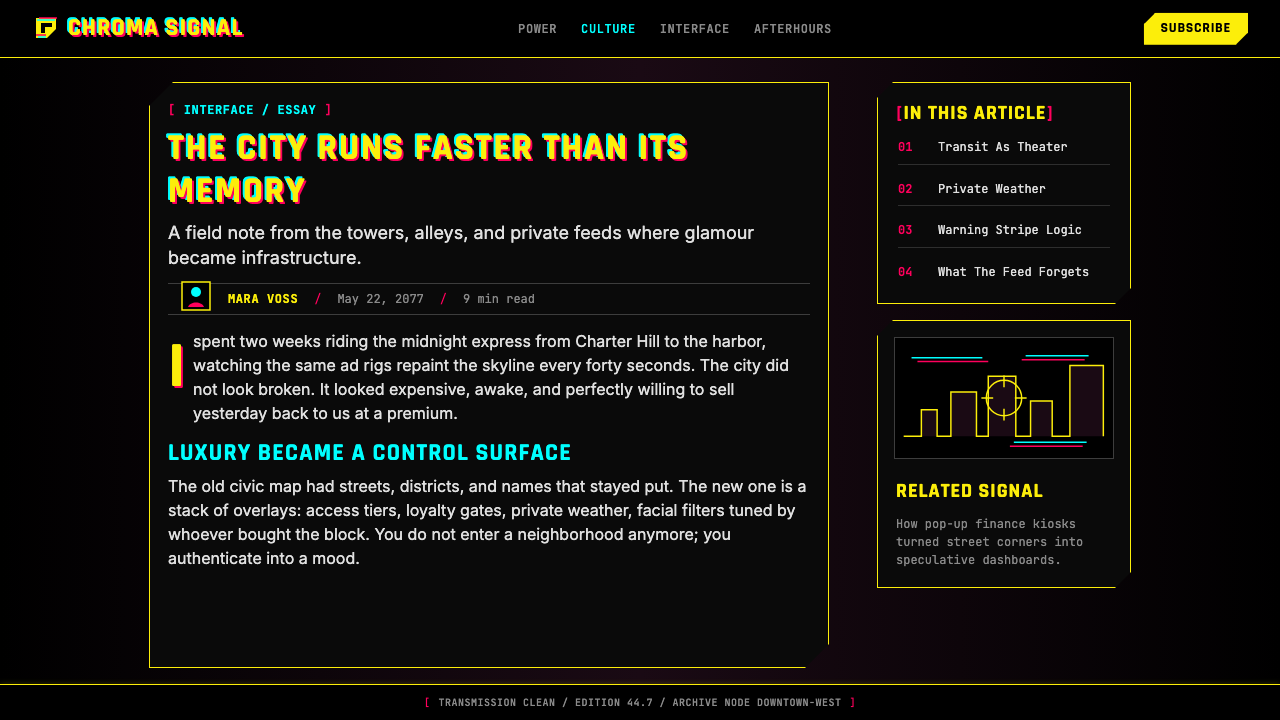
The palette operates on strict hierarchy: pure black serves as the absolute ground, sun-yellow functions as the primary signal and action color, and the magenta-cyan pair exists exclusively for the chromatic aberration effect. White and near-white appear for secondary text and fine coordinate lines. This tight constraint means color is never decorative — every hue assignment is a functional classification. Yellow means 'attend to this.' Cyan-magenta fringing means 'this edge is under stress.' Black means 'background, stand down.'
Glitch and Chromatic Aberration
The chromatic aberration split — offsetting the magenta and cyan channels at high-contrast edges — is the most distinctive signature of this system. It is applied asymmetrically: more intense on elements marked as damaged, corrupted, or dangerous; minimal or absent on stable, safe, or trusted information. This means the glitch effect is not randomized noise but a controlled semantic signal. The degree of fringing indicates the degree of system stress.
Angular Geometry and Chamfered Frames
Bounding boxes and UI panels in the Night City system reject right-angle corners in favor of chamfered cuts — corners sliced at forty-five degrees, as though the interface were a piece of military-grade hardware manufactured for durability rather than elegance. This angular language pervades every frame, modal, and tooltip. The result is a geometry that reads as engineered rather than designed: functional, industrial, built to withstand.
Monospace Coordinate Overlays
A defining textural layer is the coordinate-system overlay: fine grid lines, numerical readouts in monospace letterforms, and targeting reticles that impose the logic of a combat map onto any surface. Rendered at low opacity over background imagery, they function as a second layer of meaning: this space is being monitored in real time. The monospace typeface carries its own semantic weight — machine-generated output, not human-authored text.
Scanline Texture and Surface Noise
Every surface in the Night City system is read as a display — and in 2077, displays are aging monitors, degraded projection screens, corroded holographic panels. Scanline patterns and grain noise applied across backgrounds suggest a world where the infrastructure of information is perpetually worn and barely functional: industrial entropy made visible.
Typography as Interface Data
Text in the Night City system is never neutral prose — it is always interface output. Headlines are treated as system alerts, set in condensed all-caps with wide letter-spacing that mimics military hardware display conventions. Secondary information runs in tight monospace. Hierarchy is communicated through brightness and weight contrast against black rather than color variation, keeping yellow reserved for the most critical calls to action.
Darkness as Foundation
Unlike systems that use dark backgrounds as a mode or option, the Night City system is constitutively dark: black is not a choice applied over a light-mode base, it is the ontological ground of everything. This absolute darkness makes sun-yellow appear to emit light rather than reflect it, and gives glitch effects a violence they would lack on any softer background. The darkness is the city.
Who shaped Cyberpunk 2077 Night City Yellow?
Pondsmith created the original 'Cyberpunk' tabletop roleplaying game in 1988, establishing Night City as a setting and defining the chromatic and thematic vocabulary that CD Projekt Red would later adapt. His vision — corporate dystopia, transhumanism, and the aesthetics of neon-lit noir — forms the philosophical and visual foundation on which all subsequent Night City design rests. He served as a creative consultant on the video game, helping ensure continuity between the 1990 canon and the 2020 adaptation.
Mielniczuk served as lead UI designer on Cyberpunk 2077 at CD Projekt Red, responsible for translating Night City world-building into a coherent interface language. His team developed the 'chrome and yellow' system — chamfered geometry, coordinate overlays, and the chromatic aberration signature — into a design language operating consistently across the game's menus, combat overlays, dialogue systems, and environmental signage.
Tomaszkiewicz worked as lead quest designer on Cyberpunk 2077, shaping the narrative environments that gave the Night City visual identity its cultural context. His work ensured that the aggressive yellow-black aesthetic was not merely a UI skin but a legible expression of the game's world — where corporate advertising, gang territory markings, and augmentation displays speak the same high-contrast language because Night City demands maximum visibility to survive.
Imaishi directed 'Cyberpunk: Edgerunners' at Studio Trigger, the 2022 Netflix series that extended the Night City visual identity into hand-drawn animation. His frenetic, high-saturation direction proved the aesthetic could survive translation out of photorealistic rendering into a completely different medium, introducing the visual language to an audience that had never played the game and cementing it as a cross-media cultural identity.
Gibson's 1984 novel 'Neuromancer' established the literary foundation of cyberpunk aesthetics, coining the word 'cyberspace' and articulating the genre's core tensions: corporate omnipotence, biological modification, and the beauty of technology against human decay. Though Gibson had no direct involvement in Cyberpunk 2077, his influence permeates the Night City visual logic — information as visible danger, neon as the light of capital, the body as a designed object.
How do you use Cyberpunk 2077 Night City Yellow today?
Night City Yellow is a high-commitment style — its vocabulary is extreme enough that partial application produces incoherence. Using it effectively requires understanding its structural grammar: black is the only valid ground, yellow is the primary signal color, and glitch effects are semantic rather than decorative. Softening the system with warm grays or rounded corners does not produce a more accessible version — it produces a broken one.
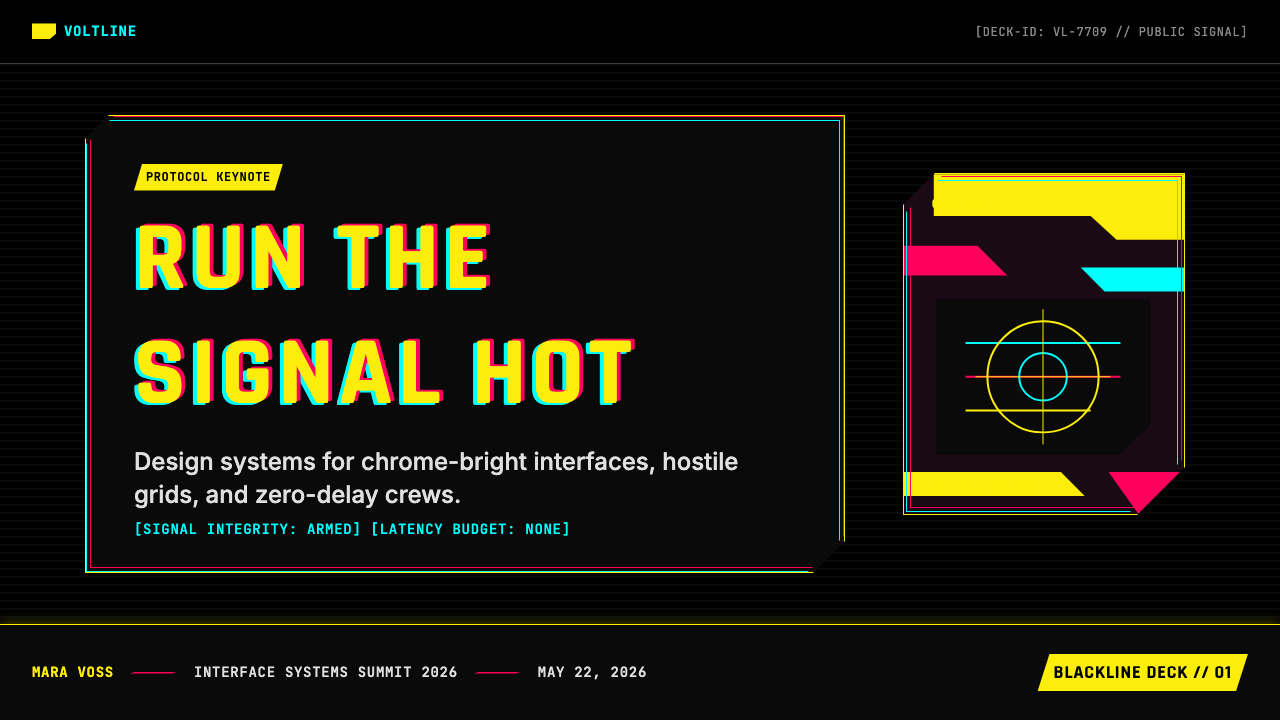
For presentation slides, this style excels at high-stakes technical briefings and product launches in gaming or technology. A cover slide uses full-bleed black with a single large yellow headline treated as a system alert — all-caps, condensed, wide-spaced — and a subhead in fine white monospace. Content slides treat data as combat intelligence: charts in yellow against black, with coordinate-style axis labels and a minimal grid overlay.
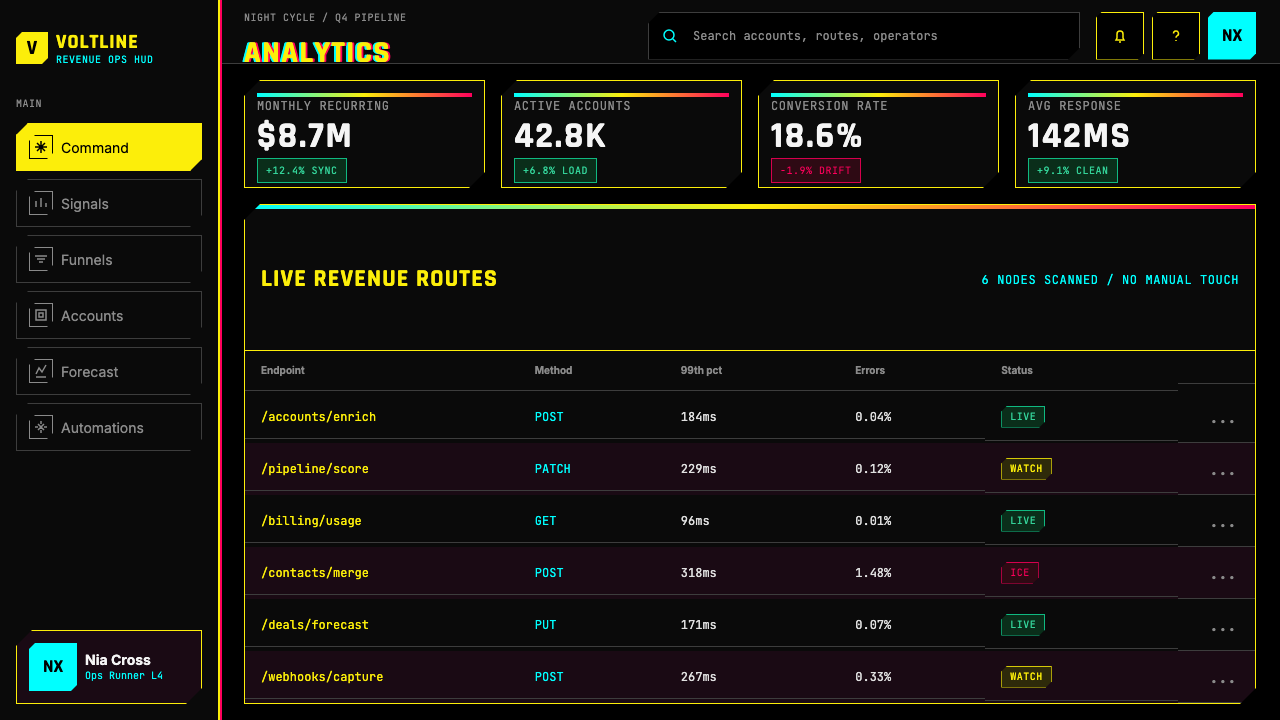
For web interfaces, Night City Yellow suits dark-mode dashboards, gaming peripherals, developer tools, and cybersecurity platforms. Commit fully to black as the only background; use yellow exclusively for calls to action and live status indicators; apply chromatic-aberration hover effects to image elements. Navigation and body text should use clean white or near-white — the eye needs rest areas to make yellow pop. Avoid yellow for large text blocks; the contrast becomes fatiguing at scale.
For editorial and marketing work, the style suits product announcements in technology, gaming, or streetwear. A full-spread layout uses black across the full bleed, a large yellow headline in the top third, and secondary information in tight white monospace. Photography takes high-contrast processing with a slight chromatic-aberration edge treatment rather than naturalistic color.
The most common mistake is treating glitch effects as decorative flourishes rather than semantic markers — applying chromatic aberration uniformly at equal intensity destroys the information hierarchy the system depends on. A second mistake is using yellow for body text: it is a high-attention signal, not a reading color. A third is introducing warm light sources — candle orange, amber glow — which clash with the cold, artificial, machine-generated quality of the Night City world.
Cyberpunk 2077 Night City Yellow — FAQ
How does Night City Yellow differ from generic neon-noir or vaporwave?
Neon-noir borrows the atmospheric quality of cyberpunk — night, rain, neon, moral ambiguity — but uses color decoratively and varies its conventions by project. Vaporwave is deliberately lo-fi and ironic, drawing on early digital consumer aesthetics with pastel colors and retro computer references. Night City Yellow is neither nostalgic nor ironic — it is a weaponized brand system with precise functional rules. Color assignments are semantic, geometry is consistent, and glitch effects are controlled signals rather than texture. That difference — quoting a visual tradition versus actually building a system — is the essential distinction.
Can this style work for a light-background product?
Not coherently. Every element of the Night City visual language is calibrated for a black ground. Sun-yellow reads as a luminous signal against black; against white, it reads as an ordinary accent with no particular urgency. The chromatic aberration effect requires high-contrast dark edges to be legible, and scanline textures lose their meaning on a light surface. Porting this system to a light-background product requires rebuilding almost every element from scratch — at that point you are no longer working with this style.
How should body text and long-form content be handled in this system?
Body text should always be set in clean white or near-white against black — never in yellow. Yellow-on-black is a short-burst attention signal for headlines and calls to action, not sustained reading. For longer passages, slightly reduced brightness — a cool medium-gray rather than pure white — reduces eye fatigue while maintaining the dark-mode register. Line spacing and measure should be generous: tight leading and narrow columns amplify the claustrophobic quality in ways that become oppressive in long-form contexts.
Is this style appropriate for mainstream consumer applications?
With care, and only for specific segments. Night City Yellow is well-received by audiences who identify with gaming culture and digital subcultures — they read it as a signal of authenticity and shared taste. For general consumer applications in health, finance, food, or lifestyle, it reads as aggressive, cold, and exclusionary. The same qualities that make it feel authoritative in gaming — its severity, its artificial quality, its suggestion of systemic threat — become liabilities wherever approachability and warmth are required.
How does the chromatic aberration effect translate to print?
In print, chromatic aberration requires deliberate misregistration of color separations — shifting the cyan and magenta plates slightly out of alignment with the black plate at selected edges. This works well for posters and high-production packaging where the printer has precision to control it; at small scales or on low-quality stock, it turns muddy. Digital contexts offer more control: offset channels can be applied precisely and adjusted per-element, which is why the effect looks most resolved in screen-based work.
Related design styles
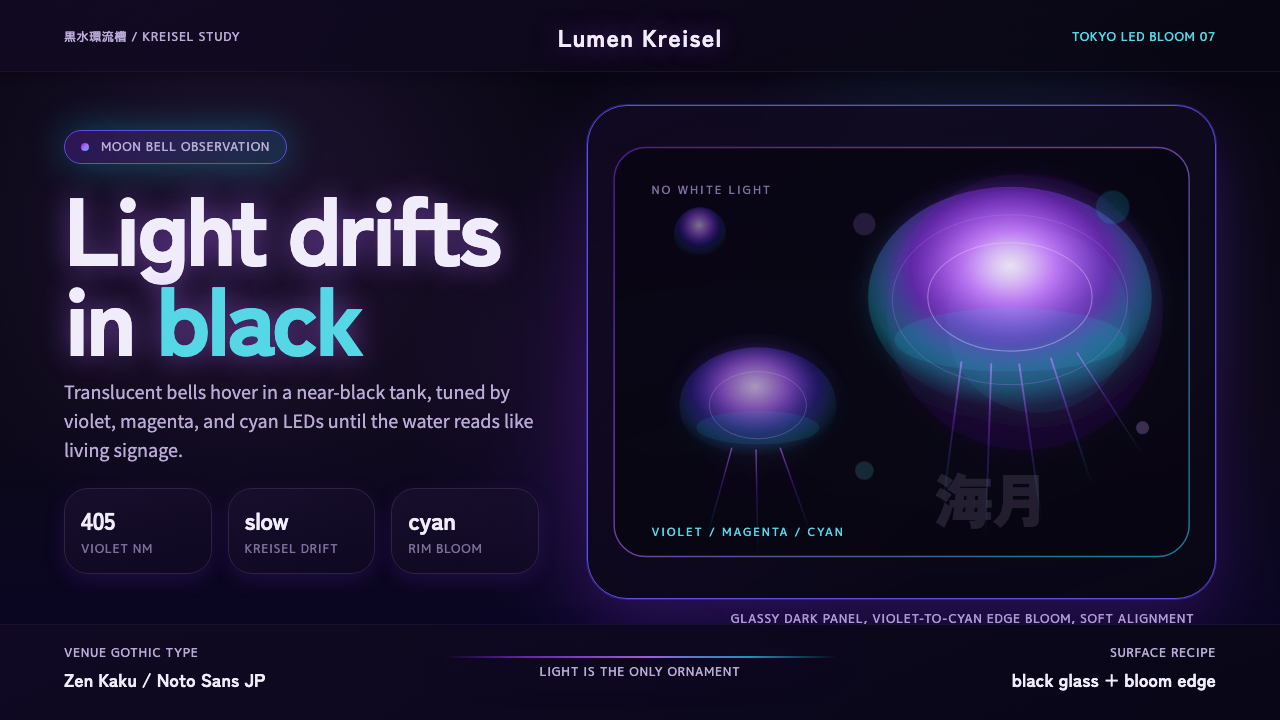 Jellyfish Aquarium StudyLight is the ornament. Violet-cyan glow floats in black glass with venue-goth…
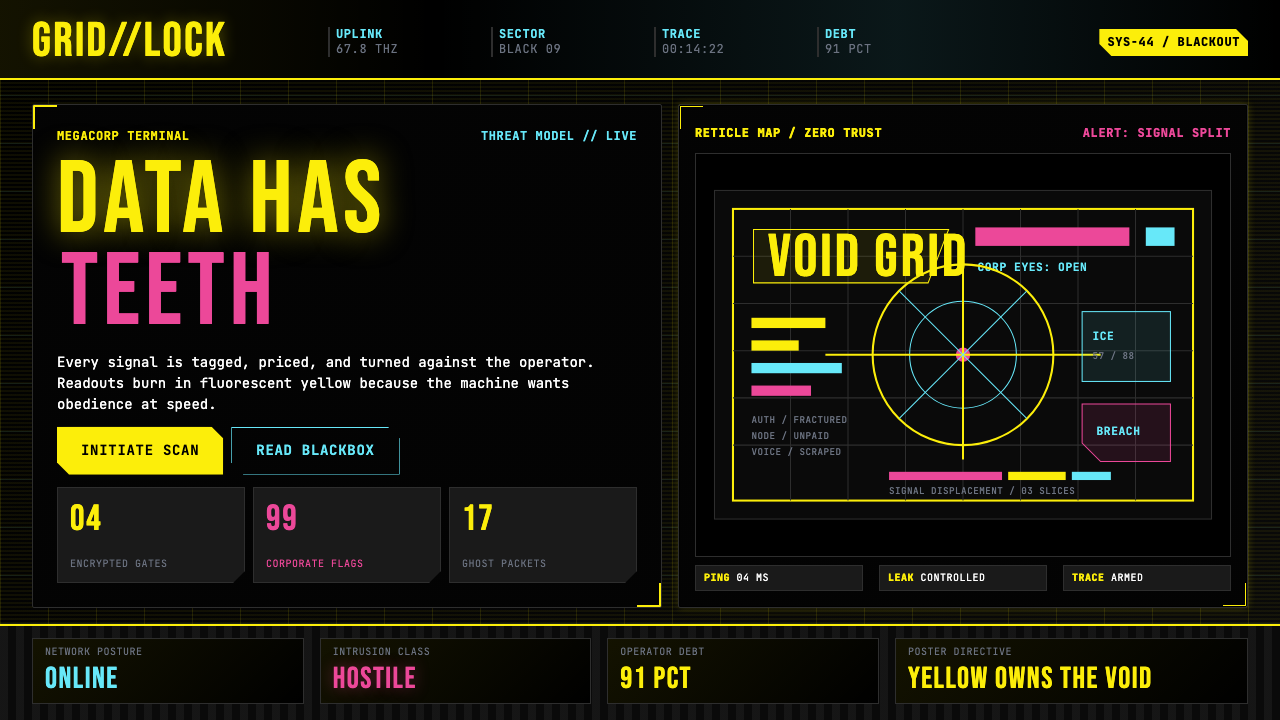 Cyberpunk 2077 (Screen UI)Weaponized terminals. Fluorescent yellow on black, scanlines and bracketed HU…
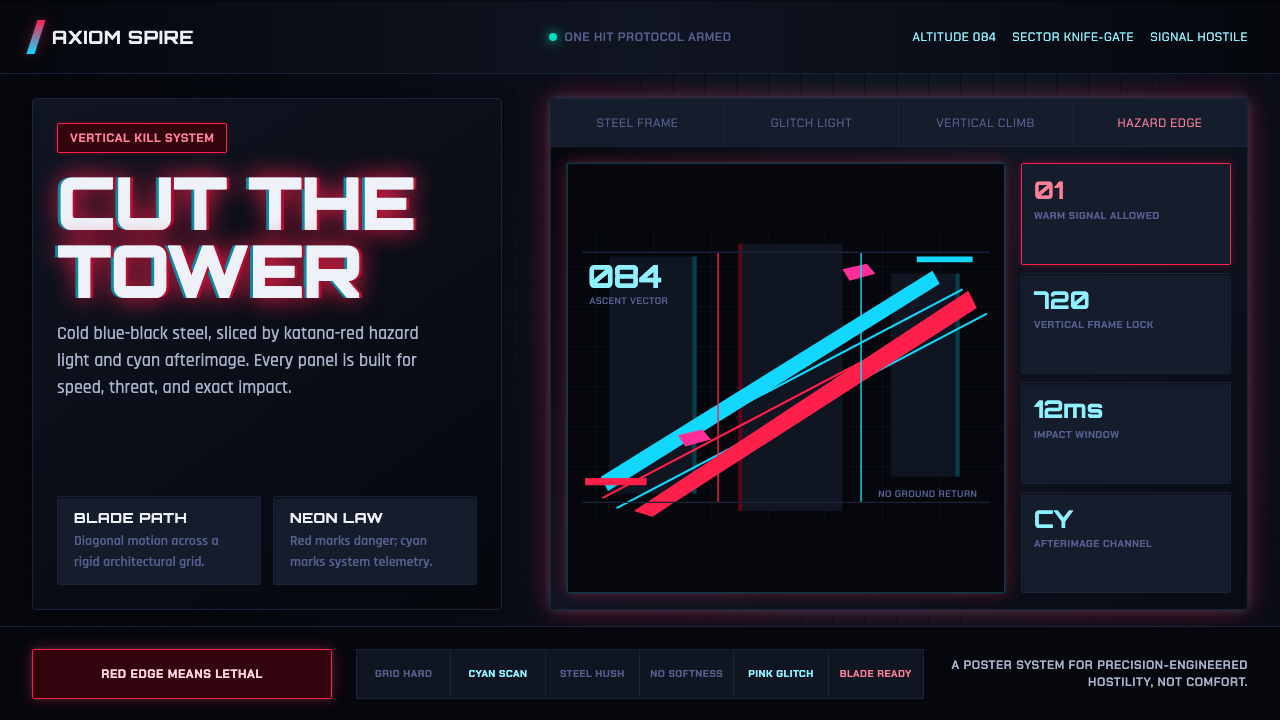 Ghostrunner Dharma TowerHostile precision at speed. Blue-black steel grids cut by red neon and cyan g…
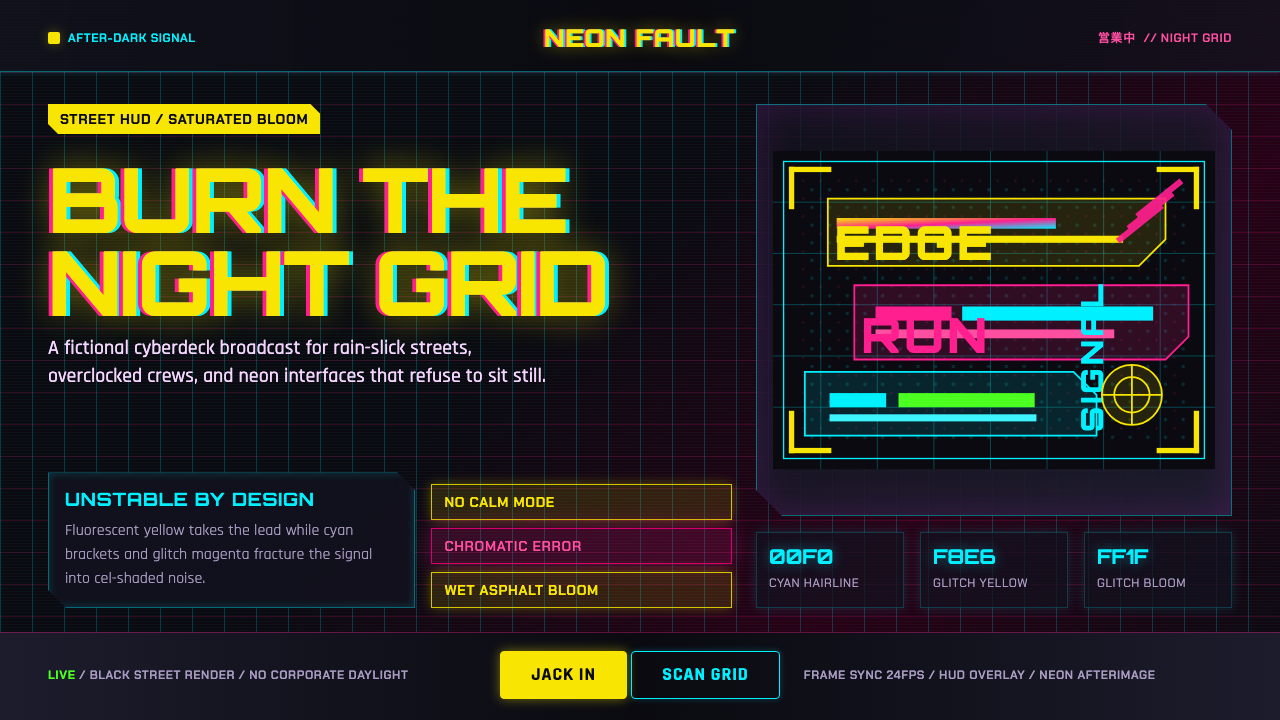 Edgerunners NeonNeon overload. Fluorescent yellow, cyan HUD grids, and magenta glitches burn…
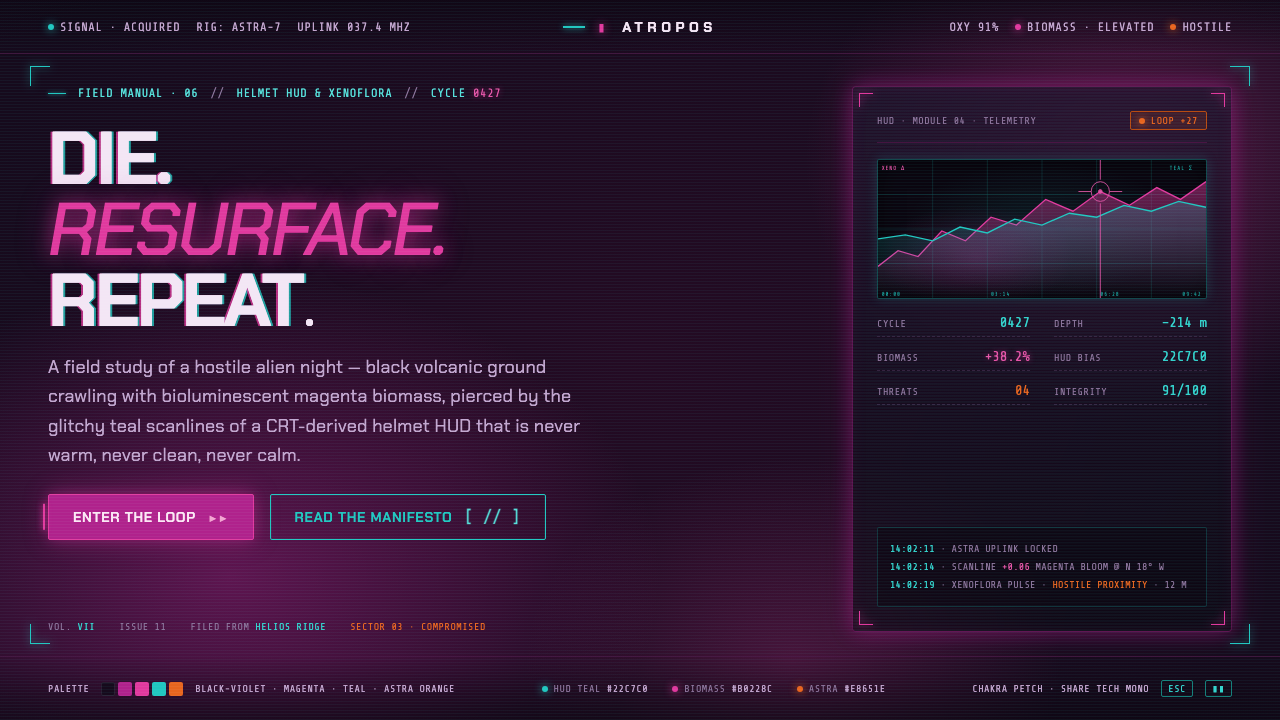 ReturnalNever warm, never clean, never calm. Magenta biomass on a violet night, pierc…
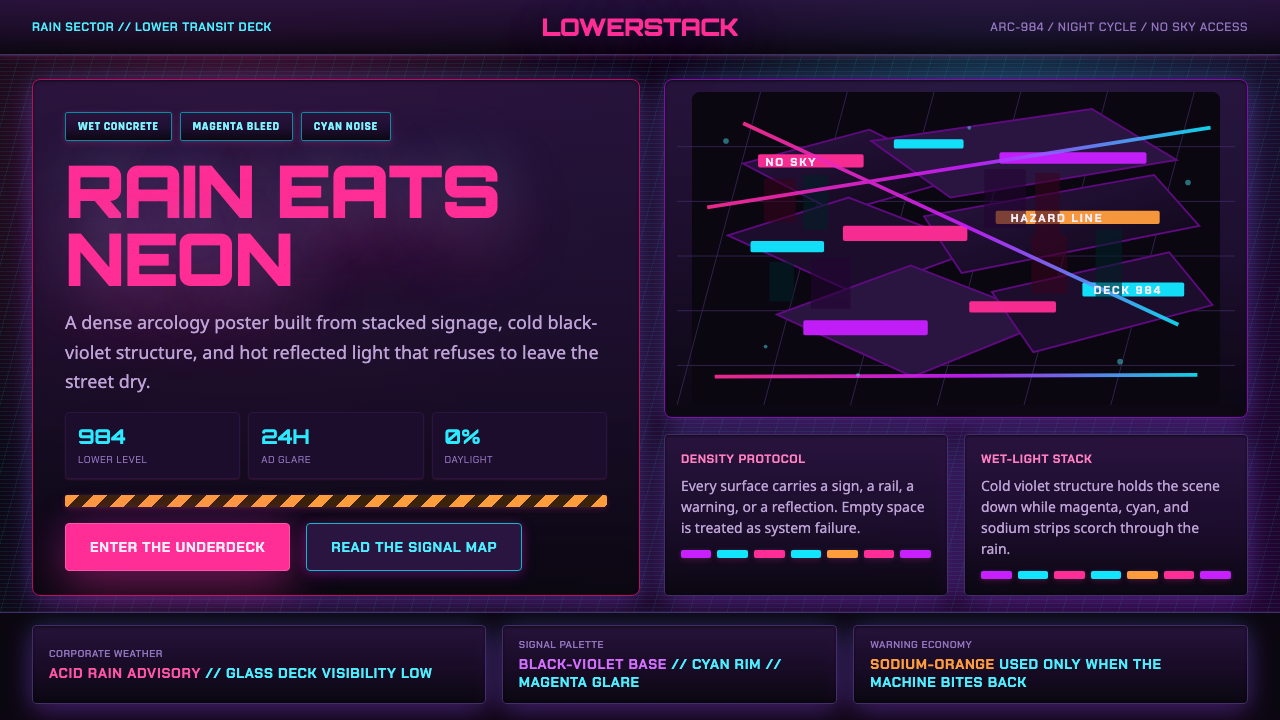 The Ascent ArcologyNeon suffocates the dark. Magenta and cyan signage stacks over wet black-viol…