What is Bio-Organic Generative?
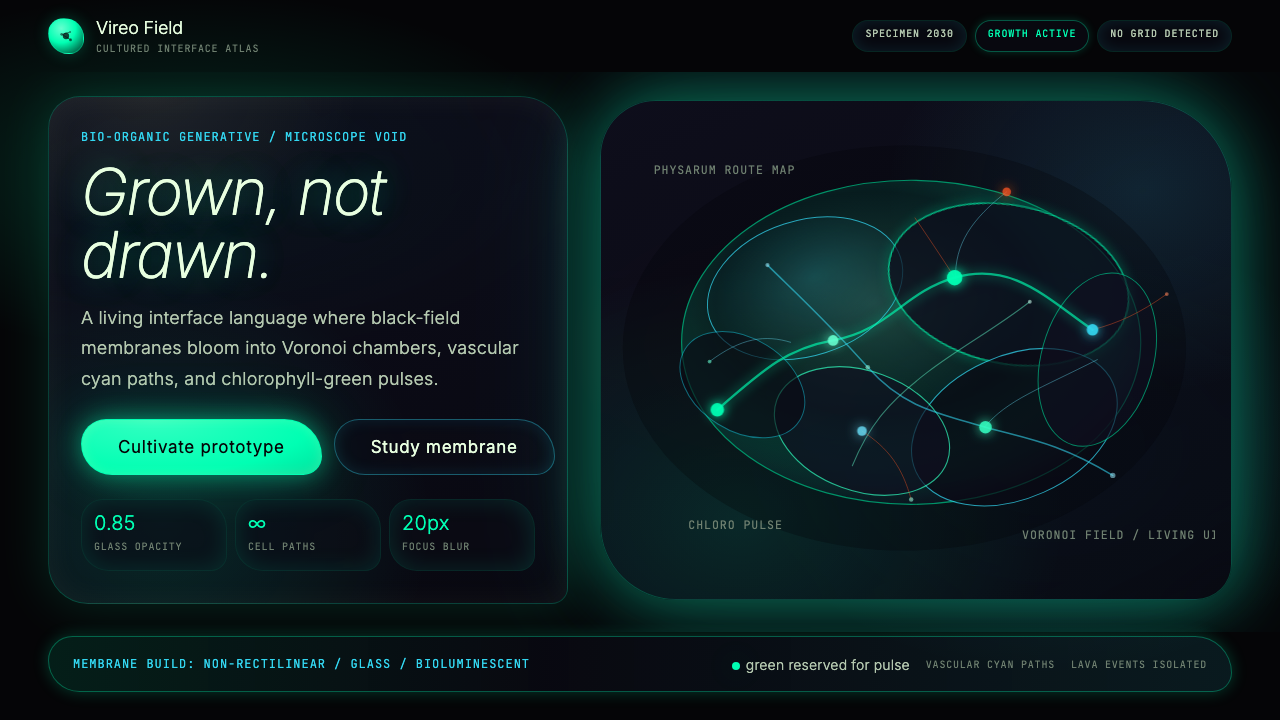
Bio-Organic Generative imagines interfaces grown rather than drawn — Voronoi membranes, mycelium branches, and bioluminescent blooms rendered under the microscope of a machine.
Bio-Organic Generative in brief
Bio-Organic Generative is a speculative design aesthetic oriented around the year 2030, born from the convergence of computational biology, generative artificial intelligence, and biomimicry architecture. Where conventional digital interfaces are built from rectangles, grids, and Cartesian logic, Bio-Organic Generative replaces that vocabulary entirely: surfaces become membranes, edges become growth paths, and every accent color mimics a living emission of light. The result is not a style that imitates nature photographically — it is one that imitates nature structurally, importing the underlying growth algorithms of organisms into the visual layer of a screen.
The aesthetic is characterized by deep, near-lightless backgrounds against which organic forms glow from within. Cell-like Voronoi tessellations tile surfaces the way tissue cells tile a biological specimen slide. Branching structures trace paths the way mycelium networks or river deltas do — never straight, always finding the most efficient organic route between two points. Accent colors draw from the bioluminescent spectrum: the cool chlorophyll green of algae under ultraviolet light, the electric blue of deep-sea creatures, the hot amber of volcanic vents. These colors do not merely decorate — they signal biological states: active, dormant, high-energy, terminal.
Crucially, Bio-Organic Generative is defined by its generative origins. The forms that populate this aesthetic are not hand-crafted shapes inspired by nature — they are the literal output of procedural algorithms, physics simulations, and machine learning models trained on biological imagery. No human designer would plot these exact curves; that is the point. The aesthetic carries within it the visible trace of a non-human process, which is what gives it both its uncanny quality and its philosophical coherence as a vision of interfaces that are genuinely alive.

Where does Bio-Organic Generative come from?
The intellectual roots of Bio-Organic Generative reach back to the late twentieth century's collision between computation and biology. In 1990, Craig Reynolds published his Boids simulation, demonstrating that three simple rules — separation, alignment, cohesion — could generate the emergent flocking behavior of birds without any centralized choreography. Around the same time, researchers studying Physarum polycephalum (a single-celled slime mold) discovered that the organism could solve complex network optimization problems by growing and retracting its branching body. These biological discovery moments established a key proposition that would echo through the aesthetic decades later: nature already runs algorithms, and those algorithms produce forms of extraordinary visual complexity.
The architectural and material dimension of the aesthetic crystallized around the work of Neri Oxman at the MIT Media Lab, particularly through her Mediated Matter research group active in the 2010s. Oxman's silk pavilions — structural forms grown by silkworms onto algorithmic scaffolds — and her fabrication experiments layering biological and synthetic materials demonstrated that the boundary between the designed and the grown could be dissolved in physical space. Her concept of Material Ecology, which positioned computation, fabrication, and the living world as a single continuous design medium, became a foundational reference point for digital designers seeking to import similar logic into screen-based work.
The visual breakthrough that gave the aesthetic its screen-ready identity came through the practice of Refik Anadol, the Istanbul-born, Los Angeles-based media artist whose Machine Hallucinations series (launched around 2018) used generative machine learning models trained on millions of photographs to produce large-scale data sculptures — fluid, cell-like, membrane-like formations that moved and breathed on building facades and gallery walls. Anadol demonstrated that generative AI could produce organic visual behavior at architectural scale. The moment that work entered broader cultural awareness — through museum retrospectives and viral documentation — it also gave the broader design community a new visual vocabulary: deep backgrounds, glowing cell structures, and forms that seemed to grow in real time.
The speculative projection toward 2030 reflects converging technological and cultural pressures. As real-time generative AI becomes computationally affordable for consumer devices, and as climate urgency pushes design culture toward ecological themes, Bio-Organic Generative represents a plausible trajectory for interface aesthetics: interfaces that perform their ecological awareness visually, that use the language of biology to communicate machine intelligence, and that treat darkness and emission rather than flatness and reflection as their fundamental surface logic. The aesthetic also draws on the parametric architecture tradition associated with designers such as Marcos Novak and the fashion experimentation of Iris van Herpen and Patricia Urquiola, all of whom have worked at the intersection of computational process and organic form.
What defines the Bio-Organic Generative look?
Ground and Void
The background in Bio-Organic Generative work is not merely dark — it is intentionally void, evoking the lightless medium of a Petri dish, the interior of a deep-sea trench, or the space between stars. Against this void, every illuminated form takes on the quality of something that emits rather than reflects light. This ground-figure logic is inverted from most design conventions: the negative space is primary, and the positive forms are intrusions of luminosity into darkness. Depth is achieved not through layering or shadow casting but through the dimming and brightening of organic forms as they recede toward or emerge from the void.
Voronoi and Cellular Tessellation
The Voronoi diagram — a mathematical partition of space into cells based on proximity to seed points — is the structural backbone of this aesthetic. Voronoi patterns appear in biological structures ranging from giraffe markings to dragonfly wings to the corneal endothelium of the human eye, which is why their use in Bio-Organic Generative work reads as genuinely cellular rather than merely geometric. The cells vary in size and shape in ways that suggest growth under pressure: some elongated and stretched as if pulled by neighboring cells, others compact and dense as if resisting compression. The cell edges themselves glow faintly, tracing the membrane logic that gives the aesthetic its living quality.
Bioluminescent Accent Palette
Color in this aesthetic is not chosen from a brand palette or a trending gradient — it is selected from the narrow spectrum of colors that living organisms actually produce through bioluminescence. Chlorophyll green, the cold and highly saturated green of algae and leaves under intense light, serves as the primary life-signal accent. Electric cobalt blue, drawn from the emission spectra of deep-sea jellyfish and dinoflagellates, marks information flows and data states. Molten amber or lava orange signals high-energy events, stress states, or critical alerts — it is the color of bioluminescent distress. These colors glow against the dark ground rather than sitting flatly on a surface, achieved through diffuse bloom effects and subtle inner luminosity that evoke the actual optical quality of living light.
Mycelium and Branching Networks
Where Voronoi tessellation handles surface and area, branching network structures handle connectivity and flow. These structures draw their visual logic from mycorrhizal networks, vascular systems, lightning discharge patterns, and river delta formation — all governed by similar mathematical principles of minimum-path finding and resource distribution. In interface contexts, branching networks appear as navigation paths, data relationships, or structural connectors between modules. They are never drawn as straight lines or perfectly even curves; their credibility as organic forms depends on the visible irregularity that generative algorithms introduce: slight variations in branch thickness, asymmetric bifurcations, occasional dead ends.
Membrane Motion and Pulse
Bio-Organic Generative is rarely a static aesthetic — motion is intrinsic to its meaning. Membranes breathe: they expand and contract on a rhythm that evokes respiration or heartbeat, with the timing deliberately irregular to avoid the mechanical feel of a looping animation. Cellular structures pulse with slow, asynchronous luminosity shifts, as if each cell has its own metabolism operating on a slightly different clock. Data flows move through branching networks like bioluminescent signals moving through a neural pathway. This motion is not decorative — it carries semantic weight, indicating system state, data activity, or processing load in ways that conventional icon-based status indicators do not.
Generative Asymmetry
Every form in this aesthetic carries the mark of its algorithmic origin: no element is perfectly symmetrical, no two cells are exactly the same size, no branch bifurcates at a mathematically clean angle. This is the opposite of the controlled asymmetry of modernist grid design, where asymmetry is a deliberate compositional choice made by a human. In Bio-Organic Generative work, asymmetry is the natural output of procedural rules operating over time — growth, pressure, path-finding — and its authenticity depends on the designer resisting the impulse to manually correct or regularize the results. The irregularity is not noise; it is evidence of a living process.
Depth Without Shadow
Conventional digital depth cues — drop shadows, elevation overlays, layered blur — are absent in this aesthetic. Depth instead emerges from luminosity and scale: forms closer to the viewer emit more light or occupy more of the visual field, while forms receding into the background dim toward the ground color. This is the depth logic of bioluminescent environments — caves, deep ocean, microscope slide — where there is no external light source casting shadows, only intrinsic emission varying with distance and density. The result is a spatial quality that feels fundamentally different from material skeuomorphism or flat layering: it is atmospheric, like looking through a medium rather than at a surface.

Who shaped Bio-Organic Generative?
Neri Oxman founded the Mediated Matter research group at the MIT Media Lab, where her team developed fabrication methods that placed biological organisms — silkworms, bacteria, human cells — as co-designers in the production of architectural structures. Her Silk Pavilion project, in which 6,500 silkworms completed a structure initiated by robotic fabrication, became a widely cited example of computation and biology operating as a unified design medium. Her theoretical framework of Material Ecology, which dissolves the boundaries between the digital, biological, and physical, provided a conceptual foundation that digital designers later translated into screen-based visual language.
Refik Anadol is a media artist and director whose Machine Hallucinations series, begun around 2018, used generative machine learning models trained on enormous photographic datasets to produce large-scale living data sculptures. Projected onto building facades and displayed in museum contexts, these works demonstrated that AI-generated organic form could operate at architectural scale and achieve genuine visual complexity indistinguishable from natural growth. Anadol's work provided the immediate visual precedent for Bio-Organic Generative's aesthetic of dark grounds, glowing cellular structures, and forms that appear to emerge and dissolve in real time.
Dutch fashion designer Iris van Herpen has worked at the intersection of science, technology, and haute couture since the early 2010s, collaborating with architects, scientists, and engineers to produce garments grown rather than sewn. Her collections have employed magnetic fluid dynamics, crystallization processes, and digital fabrication to produce forms that appear to be mid-transformation — caught between liquid and solid, between biological growth and technological process. Her work established that the aesthetic of biological becoming, visually expressed through organic form and material ambiguity, could carry cultural authority and aspirational value in premium design contexts.
Marcos Novak, a Los Angeles-based architect and theorist, coined the term 'liquid architecture' in the early 1990s to describe computational spaces that respond, transform, and behave according to algorithmic rather than static rules. His theoretical and built work explored the idea of architecture that is never finished — that grows, adapts, and mutates over time in response to its inhabitants and environment. This concept of designed form as ongoing process rather than fixed artifact became a philosophical underpinning for Bio-Organic Generative's treatment of interface as living system rather than static layout.
Milan-based Spanish designer Patricia Urquiola has consistently worked at the boundary between organic form and industrial production, designing furniture, textiles, and interiors that reference biological structures — petal arrangements, woven cellular patterns, branching supports — while remaining entirely contemporary in their material and manufacturing logic. Her work demonstrates that organic visual language does not require a sacrifice of functional clarity or market viability, and her sustained influence across Milan's design culture helped normalize biological references as a serious design vocabulary rather than a decorative novelty.
How do you use Bio-Organic Generative today?
Bio-Organic Generative is among the most technically demanding styles to apply correctly, because its visual authority depends on the forms looking genuinely procedural — not hand-drawn approximations of organic shapes. Applying it well requires either working with actual generative tools (physics simulations, Voronoi generators, machine learning output) or sourcing assets that carry the visible irregularity of algorithmic origin. Surfaces and backgrounds should be developed with real depth: not flat dark colors, but layered atmospheric grounds with subtle luminosity variation that implies three-dimensional volume in the manner of a deep-sea environment or a microscopic slide.
For presentation slides, the aesthetic works most powerfully on cover and section-divider pages. A cover built in this style uses the full dark ground, places a single glowing organic form — a Voronoi membrane, a branching network, a pulsing cell cluster — as the dominant visual element, and sets the title in clean, light-weight type that reads against the dark field without competing with the organic form. Content slides require restraint: the complex background textures that work on covers will overwhelm body text and data. For content pages, reduce the organic texture to a subtle edge treatment or a faint background pulse, and rely on a clean typographic hierarchy. Data slides can adopt a diagrammatic version of the style: charts and graphs rendered with the bioluminescent accent palette against a near-black ground, with glowing nodes marking significant data points and thin branching lines connecting related series.
For web interfaces, the aesthetic is most naturally at home in contexts with high aspirational or speculative positioning: AI product dashboards, biotech company sites, climate data visualization platforms, generative art tools. Navigation and layout should still be functionally clear — the dark ground with its complex organic textures can make conventional text hierarchies difficult to read, so a disciplined typographic system is non-negotiable. Reserve the full organic treatment for hero sections and feature showcases; let utility surfaces (forms, data tables, settings panels) run cleaner, retaining only the dark ground and accent palette while simplifying the texture. Pricing pages work well when tier differentiation uses the bioluminescent palette: one tier glows in cool chlorophyll green, another in electric cobalt, the premium tier in the warmer amber register.
For editorial and marketing applications, the style carries strong associations with frontier science, speculative technology, and ecological futures. Long-form editorial layouts can use the aesthetic for chapter openers and pull-quote treatments — a branching network rendered in the background of a spread, or a Voronoi-textured section break that dissolves into clean white for body text. Marketing campaigns for biotech, sustainability-focused brands, or AI products can use the full visual vocabulary for launch imagery and social cards, where the short exposure time allows the complex texture to read as atmospheric richness rather than visual noise. Print applications require attention to ink behavior: the luminous glow effects that work on screen must be translated into careful ink density and spot-color choices to approximate the emission quality without literal light.
A common mistake when applying Bio-Organic Generative is treating it as an illustrative style — placing hand-drawn organic shapes or stock botanical imagery against a dark background and calling it done. The aesthetic's credibility depends entirely on the forms carrying algorithmic truth: irregular, asymmetric, never perfectly resolved. Hand-crafted organic shapes, even skillfully executed ones, read as decoration; algorithmically generated forms read as data. A second common error is saturating the entire composition with glowing accent colors, which destroys the ground-figure relationship that gives the aesthetic its depth. The bioluminescent accents should be used sparingly — they are signals, not fills — and the vast majority of the visual field should remain in the dark, near-void ground register.

Bio-Organic Generative — FAQ
How do I tell genuine Bio-Organic Generative work from dark-background decoration that merely uses organic shapes?
The clearest test is algorithmic authenticity: does the form carry the irregularity and complexity that only a generative process would produce? In genuine Bio-Organic Generative work, no two Voronoi cells are the same size, no two branch bifurcations occur at the same angle, and the overall system has the quality of something that was optimized by a process rather than chosen by a person. Decorative dark-background work typically uses symmetrical or nearly symmetrical organic motifs, softly glowing stock botanical imagery, or hand-crafted shapes with a regularity that betrays deliberate human control. The second test is whether the motion (where present) is genuinely asynchronous and biologically-paced, or whether it follows a mechanical loop that reveals its decorative intent.
Can Bio-Organic Generative work in a light or white-background context?
Technically possible but structurally difficult. The aesthetic's depth and luminosity logic depends on the dark ground — without it, the bioluminescent accent colors lose their emission quality and read as ordinary saturated hues, and the Voronoi and branching forms lose their appearance of emerging from void. A light-ground adaptation would need to invert the figure-ground relationship entirely: organic forms rendered as delicate line work in muted biological tones against a near-white field, with accent color appearing only in concentrated focal elements. This produces a related but distinct aesthetic — closer to scientific illustration or botanical drawing than to the speculative bioluminescent identity that defines the style at its most characteristic. For contexts that require accessibility or light-mode compatibility, this inversion can be treated as a deliberate variant rather than a compromise.
Is this style appropriate for products that have nothing to do with biology or AI?
The style carries strong semantic associations — biological intelligence, speculative technology, ecological depth, machine-generated complexity — and those associations will transfer to whatever product uses it, whether intended or not. For products in biotech, climate tech, AI tools, generative media, or premium scientific instruments, those associations are likely to reinforce positioning. For products in unrelated categories — retail, food service, children's education, conventional finance — the associations may feel incongruous or create expectation mismatches that undermine trust. The style is not wrong for these contexts in principle, but the cultural meaning it carries is specific enough that the designer should consciously decide whether that meaning serves the product's communication goals rather than treating the aesthetic as a neutral visual choice.
How does Bio-Organic Generative relate to the broader dark-mode and glassmorphism trends of the 2020s?
Dark mode and glassmorphism both use dark backgrounds and translucency, which gives them surface similarities to Bio-Organic Generative, but their underlying logic is different. Dark mode is an accessibility and battery-efficiency response that inverts conventional light-ground interfaces while maintaining their grid, typography, and geometric structure intact. Glassmorphism adds translucency and blur to create a sense of material depth, but the forms remain rectangular and human-authored. Bio-Organic Generative replaces the structural vocabulary entirely — the grid is gone, the rectangles are gone, and the forms are procedural rather than authored. Where dark mode and glassmorphism are modifications of existing interface paradigms, Bio-Organic Generative proposes a different paradigm entirely: one in which the interface grows rather than being built.
What are the most important things to get right when first attempting this aesthetic?
Three things matter most. First, the ground: invest the most design time in the background layer — it needs genuine atmospheric depth, subtle luminosity variation, and a sense of volume that makes the glowing organic forms feel like they are inside a medium rather than on a flat surface. A flat dark rectangle will immediately read as lazy. Second, the accent discipline: choose one primary bioluminescent accent color and use it with extreme restraint — it should appear in perhaps ten to twenty percent of the visual field, and primarily on the forms that carry the most semantic weight. Spreading accent color evenly collapses the figure-ground relationship and makes everything look like an undifferentiated glow. Third, the authenticity of the organic forms: if you cannot source or generate genuinely procedural forms, it is better to use a simpler, more restrained version of the aesthetic — clean dark background with a single glowing element — than to populate the composition with hand-crafted approximations that read as decorative rather than generative.
Related design styles
 Mariana TrenchLight is self-made below ten thousand meters. Hadal-black ground, cyan pinpoi…
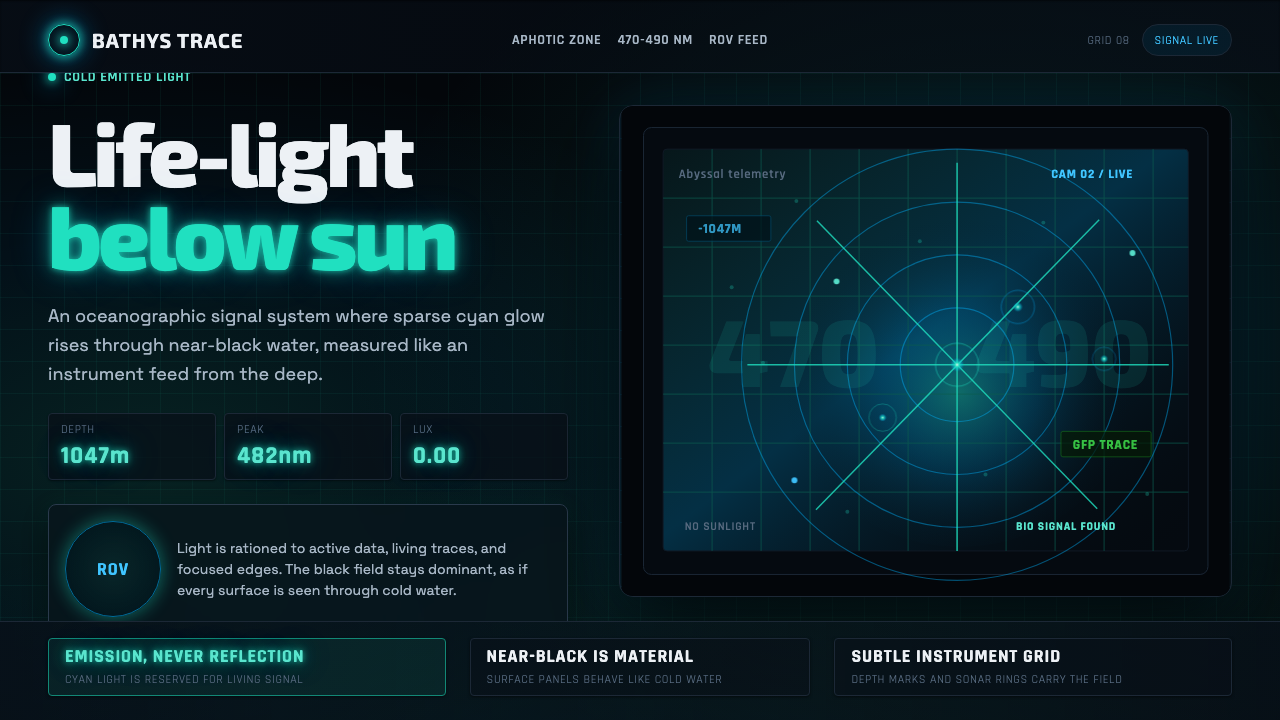 Abyssal BioluminescenceDark carries the signal. Electric cyan pins and Exo 2 readouts surface from a…
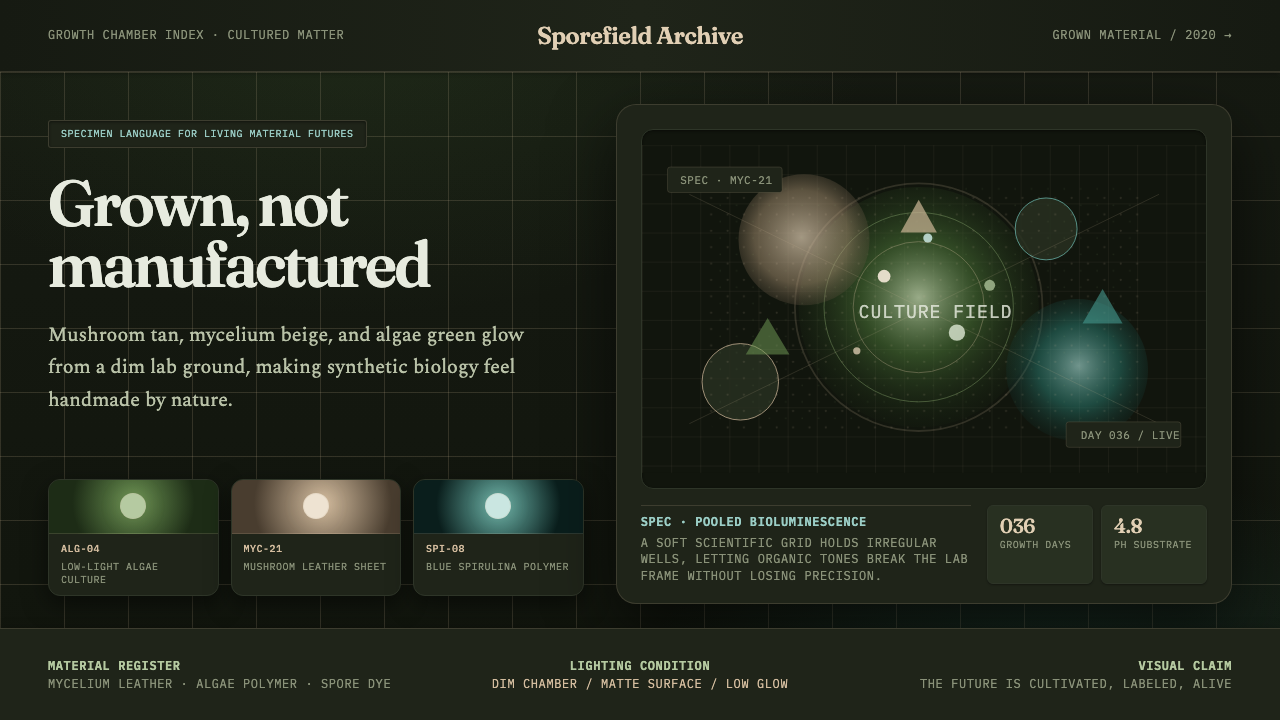 Biopunk GrownLife replaces industry. Algae green glows on chamber dark with serif voice an…
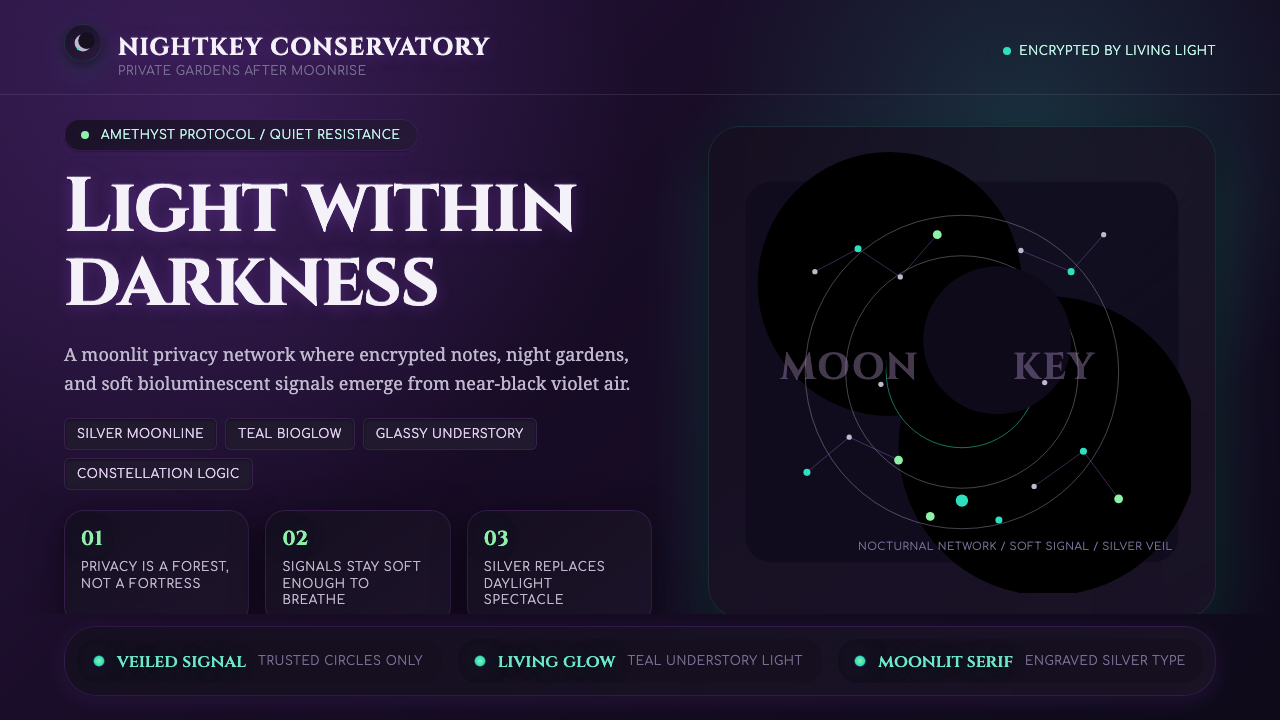 LunarpunkLight hides in darkness. Amethyst night, silver serif, and teal bioglow surfa…
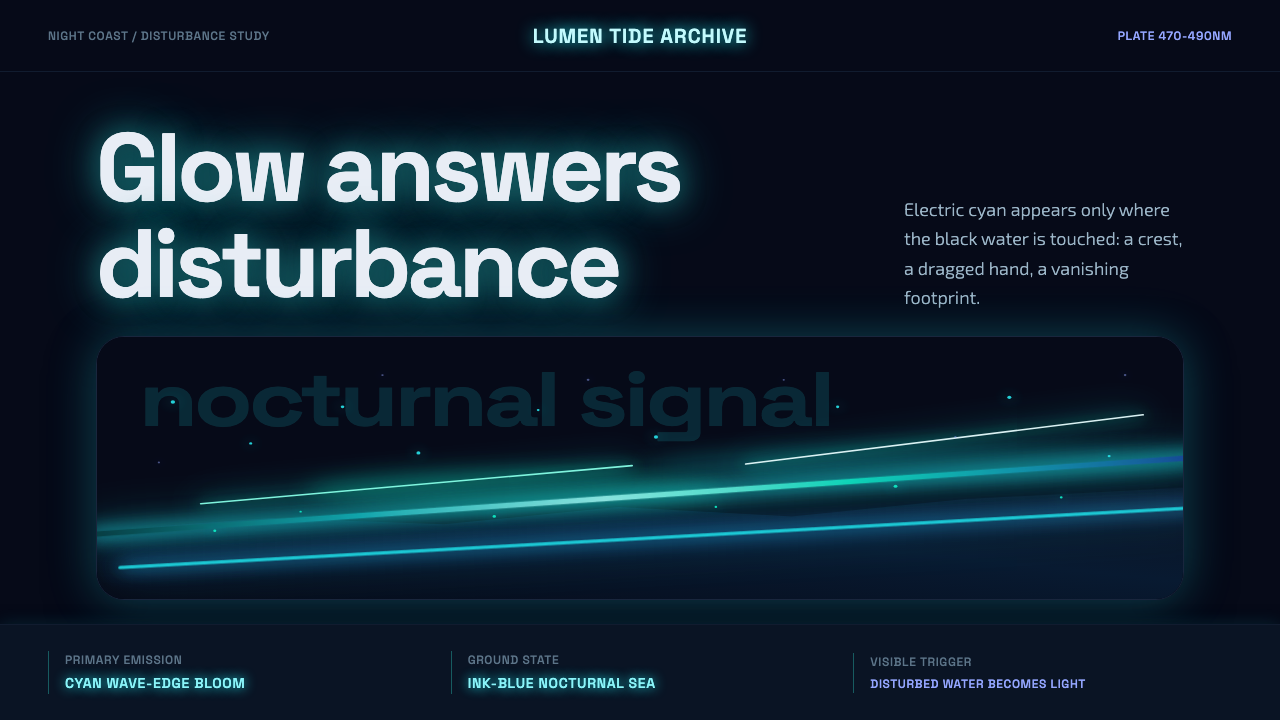 Bioluminescent ShoreDarkness becomes alive. Cyan wave-lines and specks ignite over an ink-blue se…
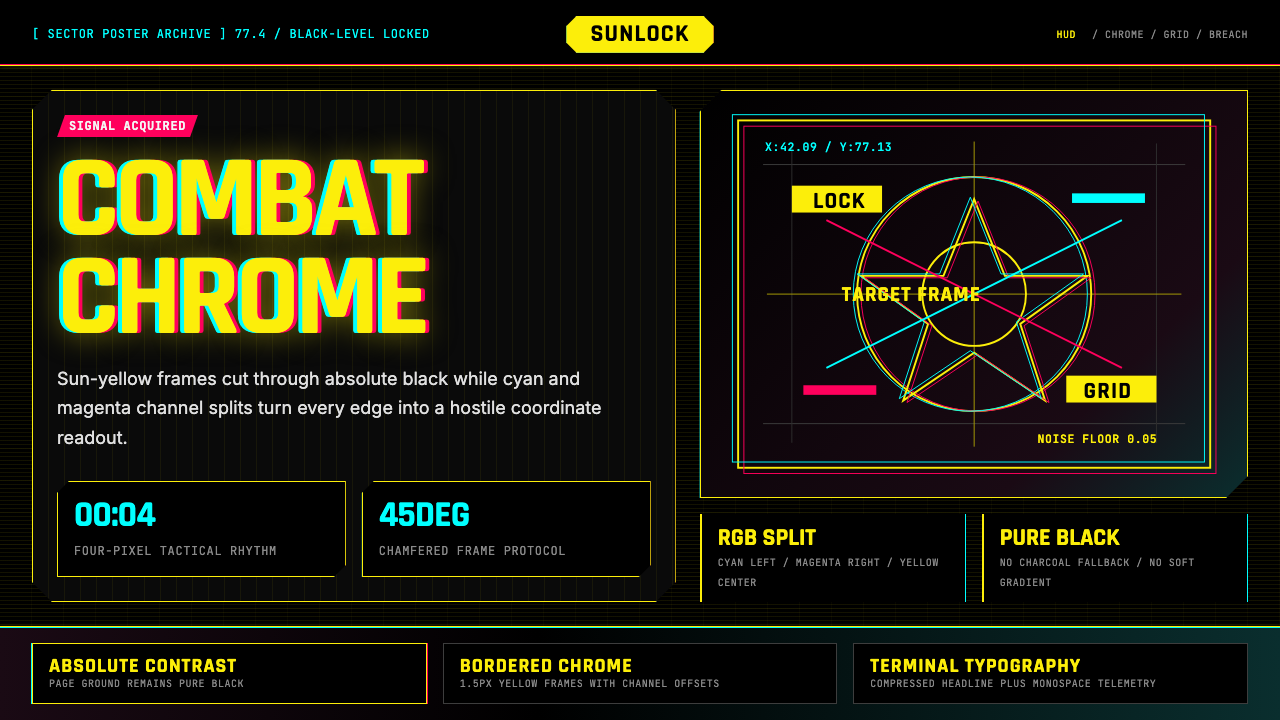 Cyberpunk 2077 Night City YellowCombat HUD on black. Sun-yellow chrome splits into magenta-cyan coordinate gr…