What is Generative AI Data Art (Refik Anadol era)?
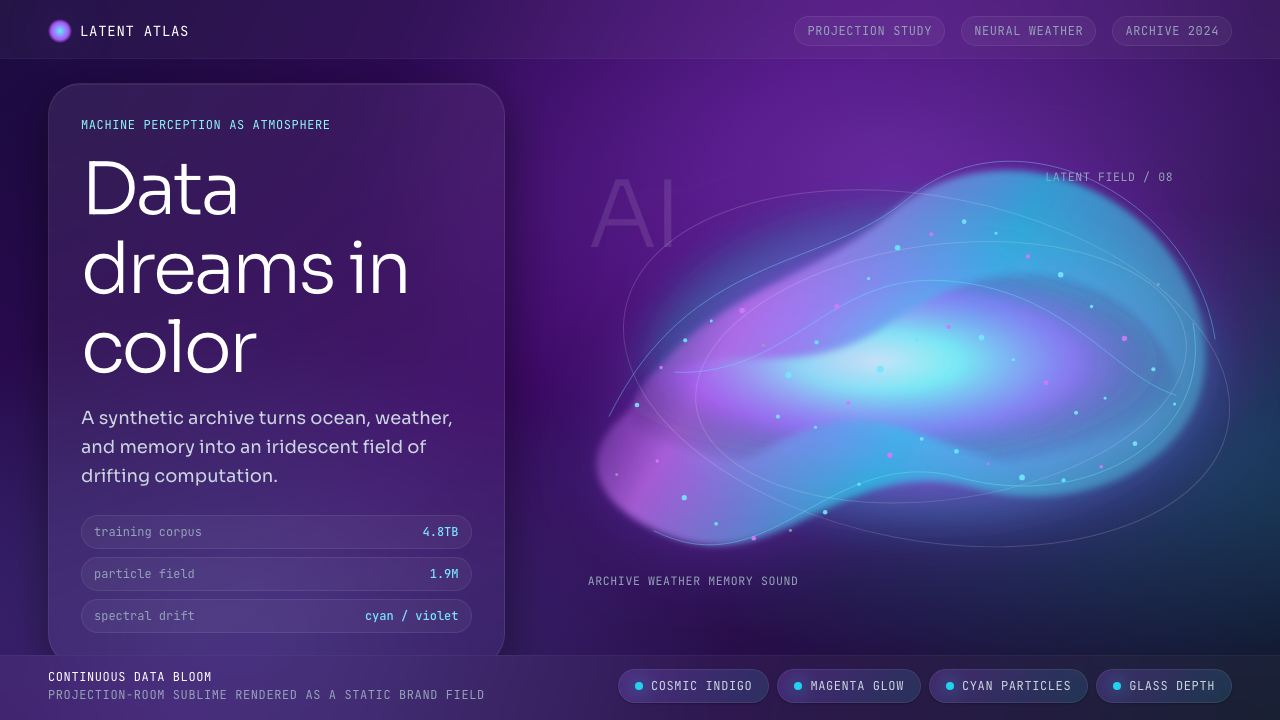
Generative AI Data Art transforms raw datasets into living cosmic spectacles — fluid particle oceans and iridescent gradient clouds that make computation feel like nature itself breathing.
Generative AI Data Art (Refik Anadol era) in brief
Generative AI Data Art is a visual movement defined by large-scale machine-learning systems trained on real-world datasets — weather patterns, ocean currents, archival imagery, sound recordings — and made visible as fluid, organic, continuously shifting forms. The aesthetic vocabulary is deep and cosmic: near-black or very dark indigo grounds, multi-stop gradient flows arcing through cool blues, electric cyans, hot magentas, and spectral purples, all animated by dense swarms of luminous particles. Every composition feels both alien and familiar, like a satellite image of a nebula that somehow encodes a memory.
Unlike earlier data visualization traditions that translated numbers into charts or graphs, this movement treats data as raw material for an almost sculptural experience. The machine-learning model is not a tool that draws the data — it is a mind that has dreamed on the data, and what it renders is closer to hallucination than report. The resulting images and installations have a painterly depth: gradients that are not clean transitions between two hues but dense, multi-layered atmospheric passages, particle clouds that cluster and disperse with organic logic rather than algorithmic rigidity.
Typography in this system is ultra-light, almost translucent — letterforms chosen for their near-invisibility, receding behind the visual spectacle rather than competing with it. Every text element whispers rather than announces. The design sensibility is one of sublime immersion: the viewer is not reading information but inhabiting it.

See the Generative AI Data Art (Refik Anadol era) design system
Where does Generative AI Data Art (Refik Anadol era) come from?
The movement's roots reach back to the computational art practices of the late twentieth century — Processing sketches, early generative graphics, and the tradition of artists like Casey Reas who built entire visual worlds from nothing but code and mathematical rules. But the decisive shift arrived when machine learning moved from academic papers into accessible creative tools, roughly between 2014 and 2018. Training a neural network on a corpus of images and then asking it to generate new images from that latent space produced something qualitatively different from what any rule-based generator could achieve: forms that felt genuinely discovered rather than designed.
Refik Anadol, a Turkish-American media artist and architect based in Los Angeles, became the central figure of this era by working at the intersection of architecture, machine intelligence, and public spectacle. His studio began training machine-learning models on datasets provided by cultural institutions — the archive of the Museum of Modern Art in New York, NASA satellite imagery, decades of melting glacier photographs — and projecting the resulting hallucinations at architectural scale. Works like 'Machine Hallucination' (2019), 'Melting Memories' (2018), and 'Unsupervised' (2022–2023) defined the visual canon: vast dark surfaces alive with flowing light, color, and particle motion that seemed to breathe with the data they encoded.
Parallel developments expanded the movement. Casey Reas, co-creator of Processing and a pioneer of software art, brought the rigorous conceptual lineage of algorithmic art into dialogue with machine learning. Memo Akten, a British-Turkish artist and researcher, used neural networks to find unexpected visual correspondences between disparate datasets — fire behaving like water, crowds behaving like flocking birds — introducing a philosophical dimension about perception and pattern. Tyler Hobbs, working on-chain with generative algorithms on blockchain platforms, brought a different audience into contact with the aesthetic through the NFT moment of 2021, when generative art achieved unprecedented public visibility.
The visual language consolidated into recognizable conventions during the period from approximately 2018 to 2024. Deep dark grounds — navy, near-black, rich indigo-violet — became the near-universal base. Gradient flows through multiple stops of blue, cyan, magenta, purple, and occasionally warm amber became the primary expressive gesture. Particle systems, rendered as fine glowing dots or short luminous streaks, provided a sense of density and life within the gradient fields. Ultra-light, almost hairline weight type was adopted as the only kind of text that could coexist with such visually dense environments without destroying the atmosphere. This was the moment a lab aesthetic became a design language.
What defines the Generative AI Data Art (Refik Anadol era) look?
Ground and Atmosphere
The foundational color field is always very dark — deep navy, rich indigo-violet, or near-black — chosen to make luminous particle and gradient elements read as light against darkness rather than pigment on a surface. This dark ground is not flat; it typically holds subtle tonal variation, as if lit from within at the edges. The overall impression is of space rather than paper, atmosphere rather than canvas.
Gradient Flows
Color in this system is expressed primarily through multi-stop gradient meshes rather than flat fills. These gradients arc across the composition through cool blues, electric cyans, vivid magentas, deep purples, and occasional warm accent hues, creating the sense of a spectrum in motion. The transitions are never mechanical — they are irregular and painterly, suggesting weather systems or undersea currents rather than designed color ramps. Each gradient passage implies that some underlying data structure is being made visible.
Particle Systems
Fine luminous dots and short glowing streaks populate the gradient fields, forming clouds, vortices, and filaments that follow fluid dynamics rather than geometric rules. These particle systems create a sense of micro-scale texture within macro-scale flows — zoom into any region and there is always more detail. The particles read collectively as atmosphere or fog, individually as sparks or data points. Their density, direction, and clustering behavior carry most of the composition's sense of life and motion.
Typography as Whisper
Text in this aesthetic system is ultra-light in weight — the thinnest strokes the chosen typeface offers — and often rendered in a near-white or very pale cool tone that allows it to float above the visual field without asserting dominance. Letterforms are typically wide-tracked, giving each character room to breathe and preventing the text from pooling into a dense block. Headlines are restrained in size relative to the visual elements; labels and metadata are even smaller. The effect is of text that annotates rather than commands.
Organic Asymmetry
Compositions generated by machine-learning processes are inherently asymmetric — the latent space from which they are drawn has no axis of symmetry. The resulting forms spread across the frame in organic, irregular ways: a gradient bloom offset to one quadrant, a particle filament curving diagonally through the center, a dense cluster anchoring one edge while the opposite edge breathes open. This asymmetry feels discovered rather than designed, which is central to the style's claim of authenticity.
Data as Subject
The content of the underlying dataset is never merely decorative — it shapes the visual character of the output in ways that are not always legible but are always present. A model trained on ocean temperature data produces different gradient contours from one trained on archival music recordings. This indexical relationship between source data and visual form is philosophically central to the movement: the image is evidence of its own process, a visualization not of what the data means but of what the model learned to dream from it.
Luminosity Over Opacity
Visual elements in this system behave like light sources rather than painted marks. Gradient areas glow rather than sit flat; particle clusters bloom at their centers with near-white intensity and fade into the surrounding atmosphere. Color mixing follows the additive logic of light — overlapping regions become brighter rather than murkier. The overall luminosity of the composition creates a screen-native quality that feels fundamentally different from print-based design traditions and is inseparable from the digital medium in which this work lives.

See the Generative AI Data Art (Refik Anadol era) design system
Who shaped Generative AI Data Art (Refik Anadol era)?
Anadol is the defining practitioner of this aesthetic era. Born in Istanbul in 1985 and trained in both architecture and media arts, he founded Refik Anadol Studio in Los Angeles and went on to create immersive installations for institutions including MoMA New York, the Serpentine Gallery, and Google. His methodology — training machine-learning models on institution-provided archives and projecting the resulting hallucinations at architectural scale — gave the visual language its most recognizable expression. Works such as 'Melting Memories' (2018), 'Machine Hallucination' (2019), and 'Unsupervised' (2022–2023) became landmark documents of the movement, and his appointment as the first Artist in Residence at Google Arts and Machine Intelligence cemented his central role. Anadol also founded DATALAND, conceived as the world's first museum of AI, reflecting his conviction that data-generated imagery belongs not in commercial contexts alone but in the cultural institution.
Reas is a foundational figure in computational art and the co-creator of Processing, the open-source programming language and environment that democratized generative graphics for artists and designers worldwide. His own artistic practice — which spans software, video, print, and installation — explores how simple computational rules generate visual complexity, and how the boundary between order and chaos produces aesthetic meaning. Reas brought the rigorous intellectual lineage of algorithmic art into the machine-learning era, advocating for code as a medium with its own cultural history. His academic work at UCLA and his collaborations with the broader software-art community helped establish the conceptual framework within which artists like Anadol are understood.
Akten is a British-Turkish artist and researcher whose practice sits at the intersection of artificial intelligence, perception science, and live performance. His work uses neural networks not to generate images for their own sake but to reveal unexpected structural correspondences between seemingly unrelated phenomena — the visual similarity between fire and turbulent water, between human crowd flow and murmuration. This approach introduces a philosophical dimension that distinguishes the movement from mere spectacle: machine learning as a tool for perceiving pattern and relationship across categories that human cognition normally keeps separate. Akten's performances and installations create a sense of wonder specifically about the nature of perception itself.
Hobbs is an American generative artist whose practice focuses on long-form algorithmic systems that produce series of works with internal coherence and variation — each output is unique but clearly kin to the others. His breakthrough work 'Fidenza' (2021), generated using flow-field algorithms and released on the Art Blocks platform, reached an enormous audience during the height of the generative NFT moment and introduced hundreds of thousands of people to the visual language of algorithmic art. Hobbs operates somewhat differently from Anadol's machine-learning approach, relying on classical computational geometry rather than neural networks, but his work shares the movement's conviction that code-driven process is a legitimate and rich source of aesthetic discovery.
How do you use Generative AI Data Art (Refik Anadol era) today?
Generative AI Data Art translates naturally into presentation contexts when the goal is to convey scale, sophistication, or a sense that something immense is being made comprehensible. Applied correctly, the style communicates that the organization behind the slides handles complexity at a high level — it is the visual equivalent of a confident understatement. Applied carelessly, it becomes noise: gradient overload, unreadable ultra-light text, and particle effects that distract rather than support.
For slide covers, the approach works best when a single dominant visual — a gradient bloom or particle cloud — occupies most of the frame, with the title set in ultra-light type at the upper or lower third, generously spaced, and given enough contrast against the dark ground to remain legible. A brief subtitle or date in an even smaller weight completes the hierarchy. Resist the temptation to add logos or supplementary graphic elements to a cover built in this style — the visual field should breathe, not accumulate. For content slides, keep the dark ground but pull back on the particle density so that data, text, and diagrams can occupy the center without fighting the atmosphere. Charts in this system work best when their structural lines are hairline-weight and their data fills borrow from the gradient palette — bars that shift from cool blue to magenta across their length, area fills that glow rather than sit flat.
For web interfaces, this aesthetic is most appropriate for dashboards, data product landing pages, and any context where the audience expects to see large volumes of information rendered elegantly. The key adaptation for interactive use is restraint in animation: constant motion fatigues the eye in ways that a projection installation — experienced for minutes — does not. Reserve particle animation and gradient shifts for hero sections and loading states; static dark-ground layouts with luminous accent colors handle content areas more sustainably. Navigation and controls should be in the lightest possible weight of the chosen typeface, set against the dark ground with sufficient contrast for accessibility. Pricing pages and feature grids can use the gradient palette for tier differentiation — a free tier in a cooler blue register, a premium tier in a warmer magenta-violet one.
For editorial and marketing uses, this style performs well in contexts that need to communicate technological ambition, scientific rigor, or a connection to cutting-edge research. Conference keynote decks, annual reports for technology and data companies, and brand campaigns in the artificial intelligence space all find natural alignment here. A marketing page in this style uses a very dark background for the hero section, transitions to a slightly lighter dark for content sections, and uses luminous gradient accents exclusively for calls to action, key statistics, or pull quotes. The ultra-light type convention works at display size but should be reconsidered for body text — at reading size, hairline type on a dark ground can fall below comfortable legibility thresholds, and stepping up to a slightly heavier weight is the correct adaptation.
The most common mistake when applying this aesthetic is treating the gradient and particle effects as decoration to be layered on top of an otherwise conventional layout. This produces a result that is simultaneously overwhelming and unconvincing — the dark ground and flowing light fight with the content rather than framing it. The style demands that content be designed for it from the ground up: type chosen for its behavior at ultra-light weights, visual hierarchy established through luminosity contrast rather than size alone, and data elements treated as first-class visual objects with the same care given to the gradient fields. A second frequent error is using this style in contexts that call for warmth, approachability, or human texture — consumer wellness brands, children's platforms, community-focused products. The aesthetic of the computational sublime is genuinely cold, and forcing it into warm-communication contexts produces a tonal mismatch that no amount of craft can fully resolve.

See the Generative AI Data Art (Refik Anadol era) design system
Generative AI Data Art (Refik Anadol era) — FAQ
Is this style only appropriate for technology and AI companies?
Not exclusively, though that is its strongest native context. The aesthetic has been adopted successfully by cultural institutions presenting research or archival projects, by scientific publishers visualizing complex datasets, and by premium consumer brands in categories like automotive and luxury that want to communicate precision and forward-looking ambition. The connective tissue is not industry but attitude: the style suits any organization that wants to signal that it operates at the frontier of something. Where it fails is in contexts that require warmth, accessibility, or cultural specificity — it is a universalizing aesthetic that deliberately subordinates the human to the computational.
How do you prevent the gradient and particle effects from overwhelming the content?
The key is treating the visual field as a background system and the content as a foreground system, with a genuine compositional gap between them. In practice, this means: reduce particle density in areas where text or data will sit; create a tonal hierarchy in the gradient so that the brightest, most active areas are at the edges or in dedicated visual zones rather than behind primary reading content; use the type size and weight to ensure that even ultra-light letterforms have enough surface area and contrast to read cleanly. The golden test is whether the content can be read comfortably without squinting — if not, the visual field needs to be pulled back, not the type pushed harder.
Can this style work in a light-background or print context?
The foundational visual logic of this style — luminous elements glowing against dark — is inseparable from its dark ground. Transposing it to a white or light background does not produce a light variant of the same aesthetic; it produces a different aesthetic entirely. The gradients lose their sense of glowing, the particles lose their luminous quality, and the ultra-light type becomes difficult to read against pale surfaces without losing the intended delicacy. If a light-background format is required, the better approach is to carry only the color palette — the blues, cyans, and magentas — into a more conventional compositional system, treating the palette as the reference point while building the rest of the layout according to the target medium's own logic.
What distinguishes authentic work in this style from superficial imitation?
Authentic work in this style carries an internal logic that traces back to data: the visual forms feel generated, not arranged. The gradient passages have an atmospheric irregularity — they do not follow predictable sweep directions or perfectly even progressions. The particle fields have local variation in density and direction that suggests underlying flow rather than random scatter. The most common superficial imitation uses a dark background, adds a pre-made gradient overlay and a particle texture, then places conventional content on top. The result looks like this style from a distance but reads as costume rather than conviction when examined closely, because the elements are decorating rather than constituting the image.
How does this style handle data visualization specifically — charts, graphs, maps?
Data visualization in this aesthetic system works best when the chart types themselves are treated as generative rather than conventional. Network graphs, flow diagrams, geographic heatmaps, and particle-based scatterplots are native to the style and require minimal adaptation. Conventional chart types — bar charts, pie charts, line graphs — can be used but should be stripped of all decorative scaffolding: no chart borders, no background fill, no grid lines heavier than hairline, no legend boxes. Structural lines should be near-invisible; data fills should borrow from the gradient palette and be treated as glowing color rather than flat fill. The axis labels and data callouts follow the ultra-light type convention. The goal is for the chart to feel like it grew from the same data-driven aesthetic as the surrounding gradient field, not like a spreadsheet dropped into an art installation.
Related design styles
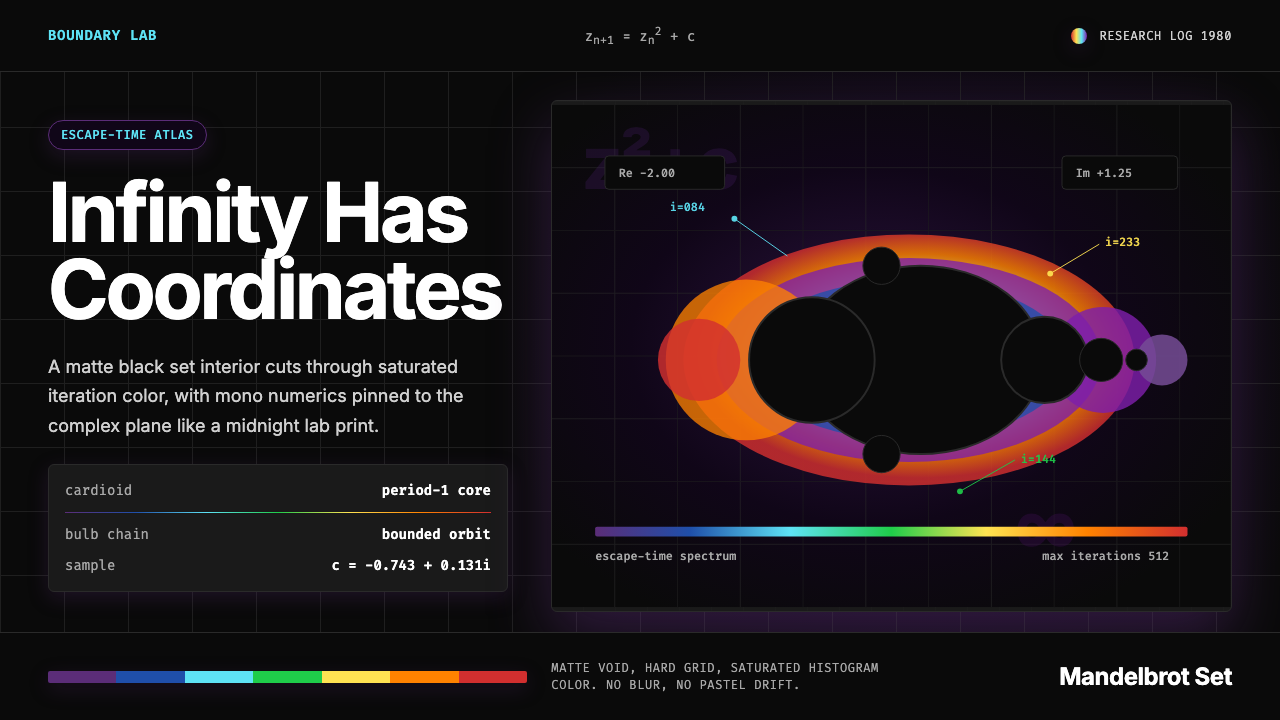 Mandelbrot FractalMath turns electric. Deep purple void, cyan mono type, and a rainbow iteratio…
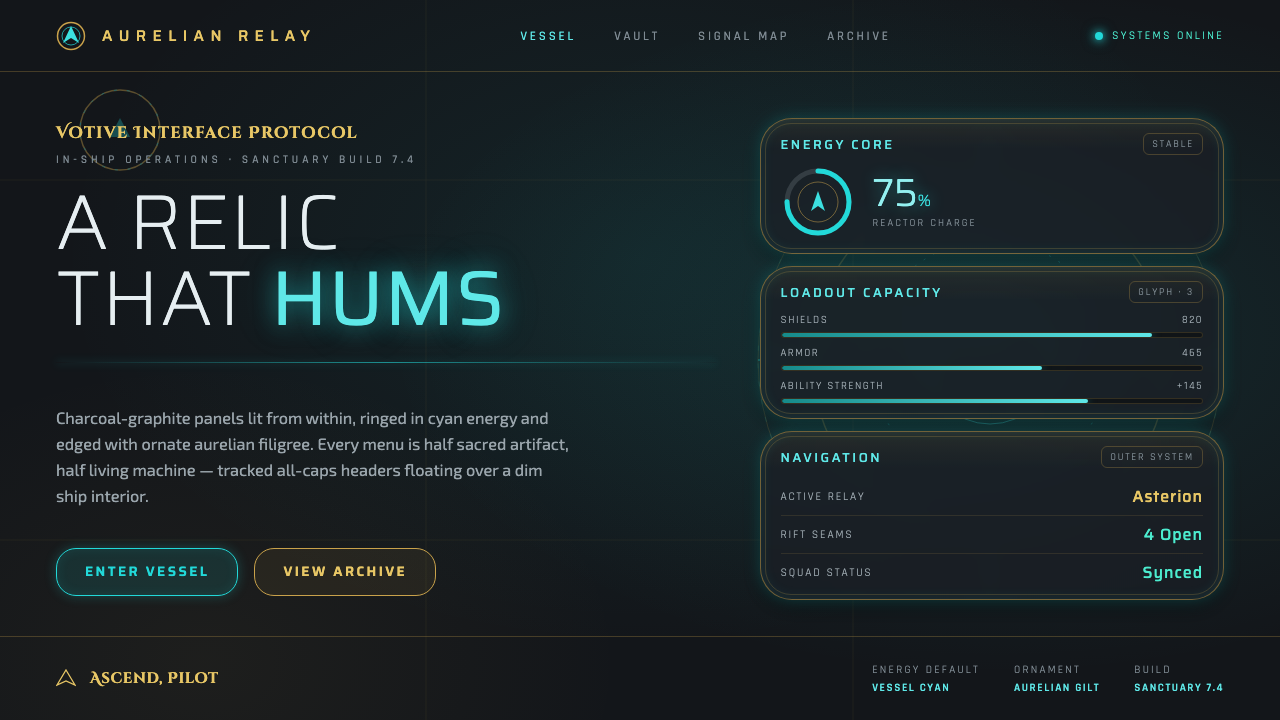 Warframe Orbiter UIHalf sacred relic, half living machine. Cyan energy rims, gold Orokin filigre…
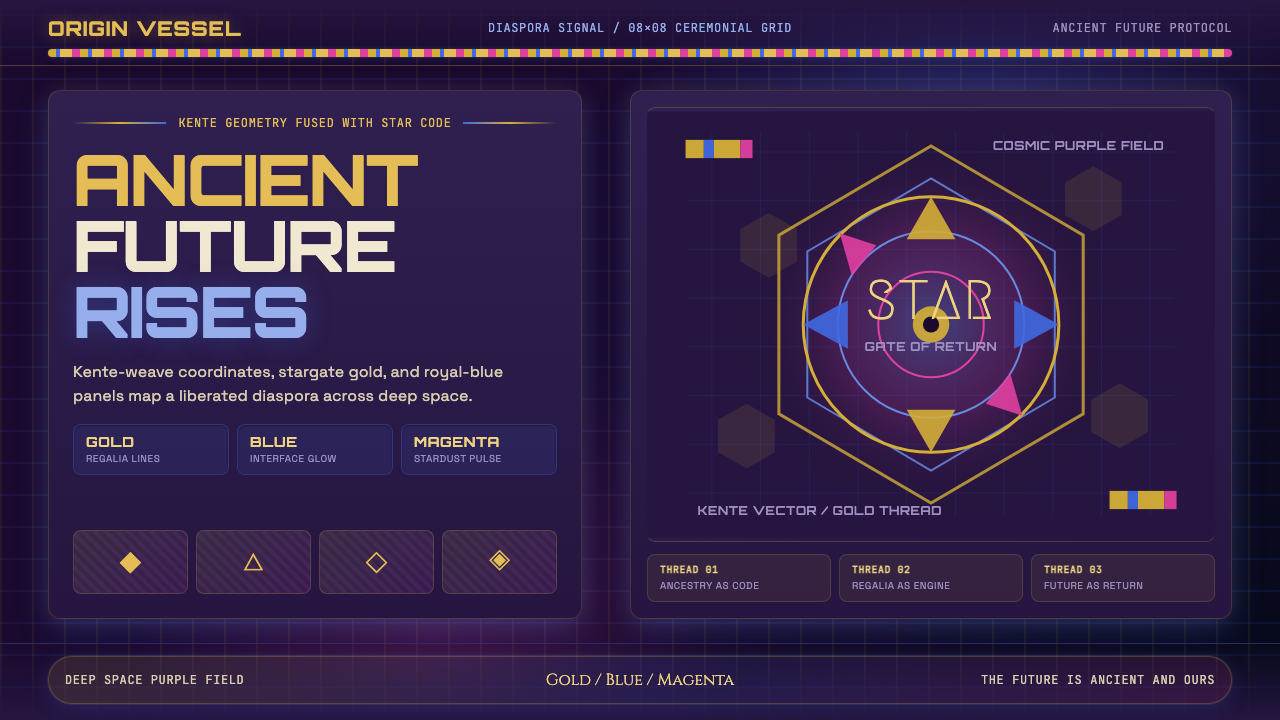 AfrofuturismAncient future, fully luminous. Gold kente grids cut through cosmic purple an…
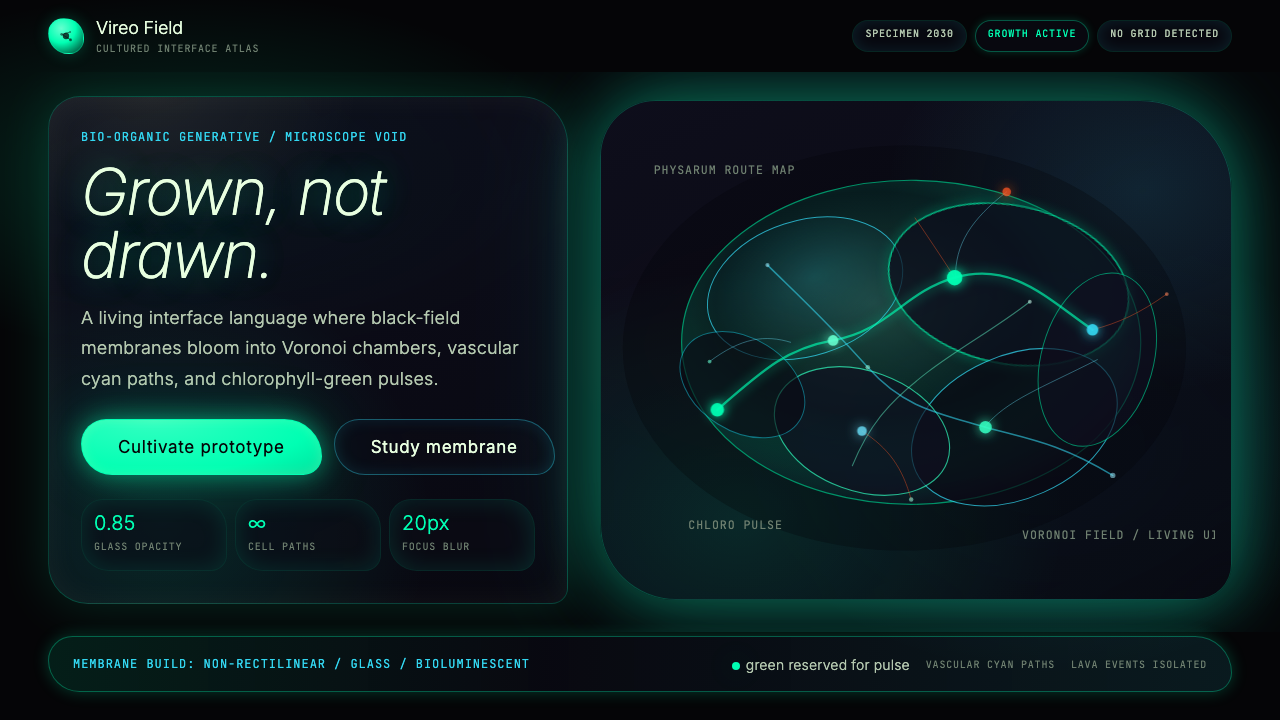 Bio-Organic GenerativeInterfaces feel cultured. Void black, Voronoi membranes, and neon chlorophyll…
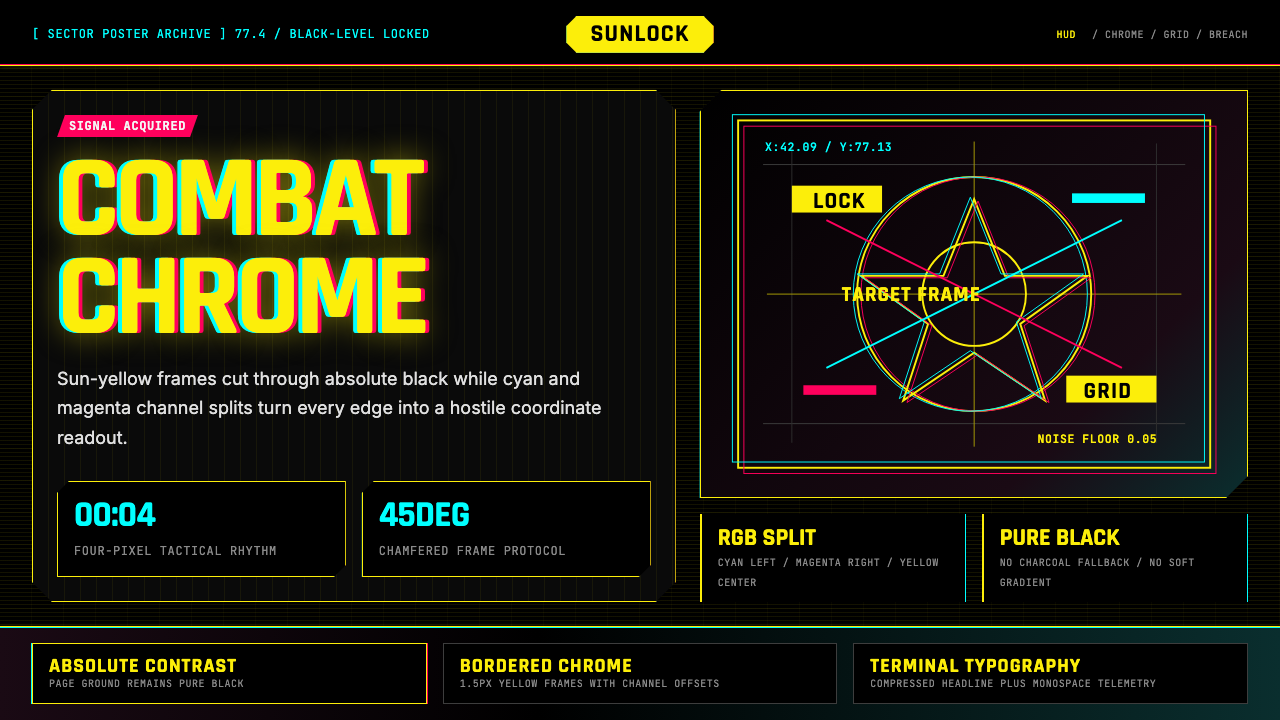 Cyberpunk 2077 Night City YellowCombat HUD on black. Sun-yellow chrome splits into magenta-cyan coordinate gr…
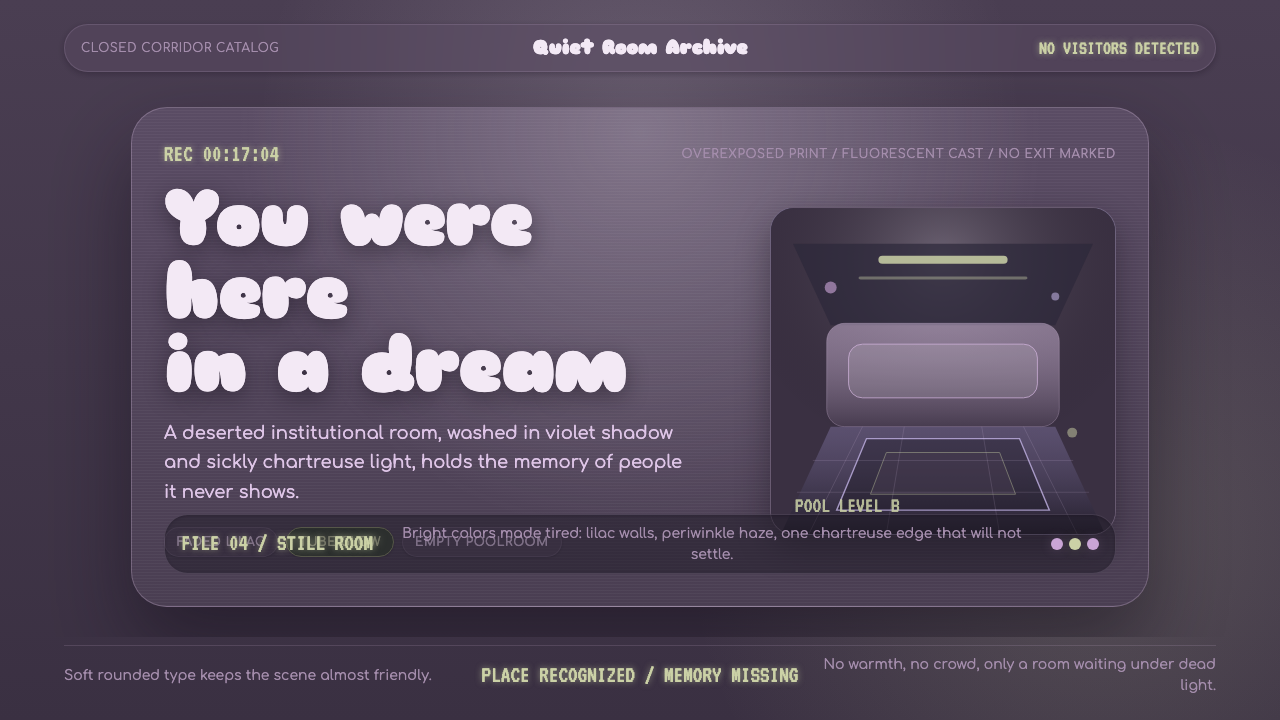 Dreamcore LiminalEmpty rooms feel remembered. Washed violet, Sniglet curves, and chartreuse tu…