What is Weirdcore Internet (2018)?
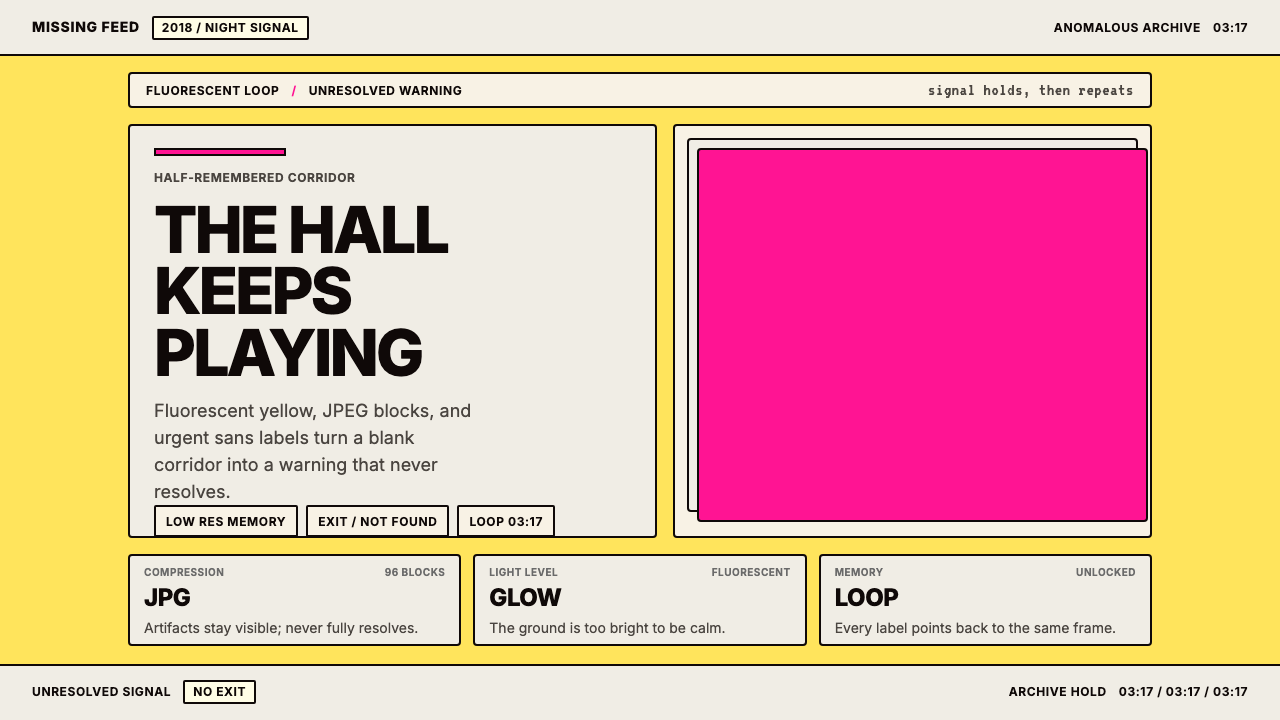
Weirdcore is the internet's native anxiety aesthetic — fluorescent-lit mundanity made genuinely unsettling through JPEG decay, wrong-era typography, and the specific dread of a familiar place at 3 AM.
Weirdcore Internet (2018) in brief
Weirdcore is an internet-native visual aesthetic defined by deliberate wrongness: colors that belong to institutional spaces rendered at sickly intensity, imagery degraded past the threshold of comfort, and typography that alternates between clinical urgency and childhood nostalgia. Where most design systems seek to resolve tension, Weirdcore engineers it — every choice is calibrated to produce a low-grade, persistent unease that viewers struggle to name or dismiss.
The aesthetic draws its power from the uncanny valley of the mundane. A school hallway, a fluorescent-lit bathroom, a playground photographed at dusk — these are spaces everyone has inhabited, yet Weirdcore renders them subtly wrong. The compression artifacts are a little too heavy, the colors a few degrees too saturated or too washed out, the text a little too urgent for its context. The result is not horror in any conventional sense but something closer to the feeling of a half-remembered dream that cannot be fully recalled.
Visually, the system works through controlled violation of design norms. Fluorescent yellow-green grounds replace neutral backgrounds. JPEG block patterns are allowed to remain or are deliberately reintroduced. Comic Sans appears not as irony but as a genuine psychological instrument — its associations with childhood and institutional messaging colliding against unsettling subject matter. Electric pink or acid green accents punctuate compositions the way a migraine aura interrupts ordinary vision: brief, sharp, and impossible to ignore.

Where does Weirdcore Internet (2018) come from?
Weirdcore as a named aesthetic emerged on Tumblr around 2018, though its constituent elements had been accumulating in internet culture for years before anyone applied a label. The early Tumblr community responsible for codifying it were largely anonymous archivists and image collectors drawn to a specific category of photograph: empty institutional spaces, overexposed playgrounds, school corridors at unusual hours, domestic rooms lit entirely by screens. These images circulated in communities that would later spawn the liminal space photography movement, and the two aesthetics share DNA — but Weirdcore adds typographic and compositional aggression that liminal space imagery typically withholds.
The aesthetic is inseparable from the technical conditions of early internet image culture. Images shared on forums and social platforms in the late 2000s and early 2010s were routinely compressed, resized, and re-uploaded until their original clarity was lost. JPEG artifacts — the blocky, ringing distortions that compression introduces — were not bugs to be corrected but textures that accumulated meaning. They signaled age, circulation, and a kind of democratic degradation: the image had traveled, been seen, been passed on. Weirdcore aestheticizes this degradation deliberately, treating it as a carrier of unease rather than a technical defect to be corrected.
The broader cultural context was the rising awareness, roughly from 2015 onward, that internet platforms were not neutral spaces but psychologically engineered environments — optimized for engagement, surveillance, and behavioral modification. Weirdcore images and edits function as a kind of dark mirror to this realization: they take the visual vocabulary of institutional trust — warning labels, safety signage, educational materials, fluorescent office environments — and destabilize it. The familiar becomes alien. The reassuring becomes threatening. This inversion carries genuine critical content about how designed environments shape perception.
Cross-platform spread accelerated after 2020, when TikTok and Reddit exposed the aesthetic to audiences far beyond Tumblr. Kane Pixels, a creator whose Backrooms-adjacent found-footage series drew on similar visual grammar, introduced many viewers to the aesthetics of uncanny institutional space through narrative rather than still imagery. The r/weirdcore and r/liminalspace communities on Reddit grew substantially during this period, developing shared visual conventions and vocabulary. By 2022 and 2023, the aesthetic had begun influencing commercial design — appearing in album covers, fashion editorials, and experimental brand campaigns willing to trade comfort for memorability.
What defines the Weirdcore Internet (2018) look?
Institutional Color Grounds
The backgrounds in Weirdcore work are drawn from the color vocabulary of institutional environments: the specific yellow-green of fluorescent overexposure, the pallid cream of government office walls, the sickly mint of school gymnasium paint. These colors are not abstract choices — they carry embodied memory of particular spaces and specific psychological states associated with being managed, evaluated, or contained. The ground color does most of the affective work before any other element is introduced.
JPEG Degradation as Texture
Compression artifacts — the blocky mosaic patterns and color bleeding that JPEG encoding introduces — are not corrected in Weirdcore but preserved or amplified. An image that has been compressed and recompressed accumulates a particular visual noise that signals age and transmission history. Weirdcore uses this degradation as an expressive texture: the artifact-heavy image feels like a recovered memory rather than a captured moment, distant and unreliable in a way that digital clarity is not.
Wrong-Register Typography
Typography in Weirdcore works through deliberate register mismatch. Comic Sans — culturally coded as childlike and non-serious — appears on urgent or disturbing content. Helvetica, the typeface of corporate and governmental authority, delivers messages that are half-formed, grammatically strange, or addressed to no clear reader. The choice of typeface carries social and institutional memory, and Weirdcore exploits the gap between a typeface's expected context and its actual deployment to generate cognitive dissonance.
Liminal Imagery
Source imagery favors spaces that exist between states: hallways leading nowhere apparent, waiting rooms without occupants, playgrounds photographed in the absence of children, swimming pools drained of water. These spaces are architecturally familiar but temporally wrong — they are designed for occupation and activity, but the images catch them vacant. This vacancy transforms the familiar into the uncanny: the designed-for-people space that has been vacated by people acquires a quality of expectation and latent threat.
Acid and Neon Accents
Against the sickly or washed-out grounds, Weirdcore deploys electric accents — hot pink, acid green, screaming orange — at full intensity. These colors do not harmonize with their surroundings; they conflict. The effect resembles a migraine aura: a sudden, sharp intrusion of extreme color against a subdued field. Used for text, borders, or overlaid shapes, these accents function as visual alarms — they demand attention in a way that cannot be filtered out, mimicking the involuntary response to danger signals in designed environments.
Text as Psychological Pressure
When text appears in Weirdcore compositions, it typically carries the form of instruction, warning, or address — but the content is either deliberately opaque, grammatically malformed, or addressed to a subject position that the viewer cannot cleanly occupy. Phrases like warning labels or institutional notices are deployed but made strange by context. The form of authority is retained while its semantic content is destabilized, producing an ambient sense of being spoken to in a language one almost but does not quite understand.
Controlled Overload
Unlike maximalist aesthetics that overwhelm through sheer density, Weirdcore achieves its effect through precise calibration of wrongness. A single element displaced from its expected context — a familiar typeface on unfamiliar content, a familiar space at an unfamiliar hour — is enough to activate unease. The most effective Weirdcore compositions are not cluttered but targeted: one or two deliberate violations of visual expectation, surrounded by enough normalcy to make the violation land.

Who shaped Weirdcore Internet (2018)?
The aesthetic was not launched by a single creator but by a loose collective of anonymous Tumblr users who began tagging and cross-posting images of empty institutional spaces, degraded photographs, and text-overlay edits under shared vocabulary. These archivists established the initial visual canon — what counted as weirdcore and what did not — through collective curation rather than individual authorship. Their anonymous, collaborative character is itself part of the aesthetic's identity: it emerged from the internet's distributed image culture rather than from any individual artistic vision.
Kane Pixels is a video creator whose Backrooms found-footage series, begun in 2022, brought the visual grammar of uncanny institutional spaces to a mainstream audience through short-form narrative video. Working with fluorescent-lit corridors, carpet patterns associated with public spaces, and the specific quality of surveillance or VHS footage, Kane Pixels developed a cinematic language adjacent to Weirdcore and helped establish shared visual references that influenced static image creators working in the aesthetic. The series demonstrated that the aesthetic's power was not format-specific — it worked as well in motion as in still image.
The Reddit community r/weirdcore, growing substantially from 2020 onward, became the primary platform for Weirdcore's post-Tumblr development. Community contributors posted original edits, debated aesthetic criteria, and developed shared vocabulary distinguishing Weirdcore from adjacent aesthetics like dreamcore, traumacore, and liminal space photography. This community-driven definitional work gave the aesthetic unusual conceptual clarity for an internet-native style: contributors could articulate not just what Weirdcore looks like but what psychological and cultural work it is doing.
The liminal space community developed partly in parallel and partly in dialogue with Weirdcore, focusing on the photography of transitional or empty spaces without Weirdcore's typographic and chromatic aggression. Liminal space imagery tends toward stillness and melancholy rather than dread; Weirdcore borrows the spatial vocabulary but injects visual urgency. The two communities influenced each other's development of shared criteria for what makes a space feel uncanny, and contributors to r/liminalspace frequently cross-posted or commented in Weirdcore contexts, making the boundary between the aesthetics porous and productive.
How do you use Weirdcore Internet (2018) today?
Weirdcore is a high-commitment aesthetic that rewards specificity. Using it well means understanding what it is communicating — disorientation, institutional unease, the specific dread of familiar spaces made strange — and ensuring that the product or content actually benefits from evoking those states. It is not an aesthetic of ambient moodiness; it has sharp psychological edges that should be pointed deliberately. The first question before applying it to any project is whether generating unease serves the audience and purpose.
For presentation slides, Weirdcore is most effective in contexts where the subject matter itself carries tension: security briefings, cultural commentary decks, exhibition materials for work exploring anxiety, digital identity, or institutional critique. A cover slide benefits from a fluorescent ground color, a single degraded or artifact-heavy image placed off-center, and a title set in a deliberately wrong typeface — not stylized wrongness but actually wrong, the wrong register for the content. Content slides should avoid conventional data visualization templates; data becomes more unsettling when presented in formats that mimic institutional signage or warning documentation rather than polished charts.
For web interfaces and digital products, Weirdcore is rare in commercial contexts for good reason — it is not a comfort-building aesthetic. Where it does appear commercially, it is typically in contexts where the brand wants to signal authenticity and edge rather than trustworthiness and efficiency. Landing pages for music releases, fashion editorials, and cultural institutions with experimental mandates can carry the aesthetic's fluorescent grounds, artifact-heavy imagery, and aggressive accent colors. Navigation should remain functional; the wrongness should be atmospheric rather than disruptive of basic usability. Avoid deploying the aesthetic on any interface where the user needs to complete a transaction or enter sensitive data — the aesthetic reads as untrustworthy in high-stakes UX contexts.
For editorial and marketing work, Weirdcore's strongest application is in contexts where memorability matters more than warmth — album artwork, poster campaigns for performances or exhibitions, zine covers, and editorial spreads for publications covering internet culture, mental health, gaming, or the aesthetics of digital life. The approach: establish the institutional ground color early and consistently, use imagery that is slightly temporally wrong (empty where occupied is expected, lit wrong for the time of day), and let the typographic choice do as much work as the image. A single Comic Sans headline above a JPEG-degraded photograph of an empty hallway does more than a complex composed layout.
A common mistake when working with Weirdcore is mistaking visual complexity for effectiveness. Because the aesthetic uses multiple wrong elements — unusual color, degraded imagery, strange typography, aggressive accents — practitioners sometimes pile all of these together simultaneously, producing visual noise rather than unease. The most effective Weirdcore compositions are disciplined: one or two deliberate violations of expectation set against a visually coherent background. Similarly, attempting to apply Weirdcore to conventionally positive or reassuring content — wellness, consumer product launches, family-oriented services — produces confused messages rather than interesting tension. The aesthetic requires subject matter that can sustain the psychological weight it applies.

Weirdcore Internet (2018) — FAQ
What distinguishes Weirdcore from liminal space photography?
Both aesthetics draw on images of empty, transitional, or institutionally coded spaces, but they diverge in register and intent. Liminal space photography tends to be melancholic and contemplative — the empty space is dreamlike, peaceful in its wrongness, an invitation to reflection. Weirdcore is more aggressive: it adds typographic intrusion, chromatic violence, and deliberate degradation that transforms the contemplative vacancy into something more actively threatening. Liminal space images ask you to pause; Weirdcore images make you want to leave.
Can Weirdcore be used in a light, non-threatening way — as an ironic reference rather than a committed aesthetic?
It can, but the results are usually weak. Weirdcore's effectiveness depends on commitment to its psychological logic — the wrongness has to feel sincere to land. When it is applied ironically or superficially — borrowing Comic Sans or JPEG artifacts as a knowing wink rather than as genuine instruments of unease — the result reads as nostalgia for early internet culture rather than as anything psychologically resonant. The aesthetic references are recognizable without the effect being achieved. If ironic nostalgia is the actual goal, a lighter approach to early internet visual culture will serve that goal more cleanly.
Why is Comic Sans so central to Weirdcore rather than just one option among many?
Comic Sans carries a very specific cultural charge: it is the typeface of good intentions deployed badly — institutional communications where someone tried to seem approachable and failed. It was widely used in educational settings, small-business signage, and early websites during the 1990s and early 2000s, giving it strong associations with a particular era of institutional amateurism. In Weirdcore, this loaded history is the point: the typeface activates cultural memory of spaces and contexts — schools, clinics, community centers — that the imagery is already evoking. The combination produces a specific and recognizable psychological flavor that a neutral or conventional typeface would not achieve.
How should color be balanced in Weirdcore — are all these intense colors meant to be used together?
No — and this is a common point of confusion. The palette has range, but its strength comes from contrast between the ground and the accent, not from using all available colors simultaneously. The institutional ground color — fluorescent yellow-green, pallid cream, washed-out mint — should dominate, typically covering the majority of the composition. The acid or neon accent appears at high intensity but in small, targeted areas: a border, a word, a shape. Deploying multiple neon accents simultaneously collapses the contrast that makes each one alarming. One ground, one accent, and perhaps a secondary neutral for typography is enough to achieve the aesthetic's full psychological effect.
Is Weirdcore appropriate for audiences outside internet-native culture — older users or non-digital contexts?
The aesthetic's references are most legible to audiences who grew up with early internet culture — the JPEG artifact has cultural meaning only for people who experienced it as a sign of image circulation and age. For audiences without that reference, the degraded imagery may read as simply low quality rather than as a deliberate choice, and Comic Sans may trigger its general association with poor taste rather than its specific institutional nostalgia. This does not make the aesthetic unusable across all contexts, but it means the communicative precision that Weirdcore achieves within its native audience is not guaranteed to transfer. In non-digital contexts — print, environmental installation, physical spaces — the institutional color and spatial vocabulary can carry the aesthetic's uncanny quality independently of digital-specific references.
Related design styles
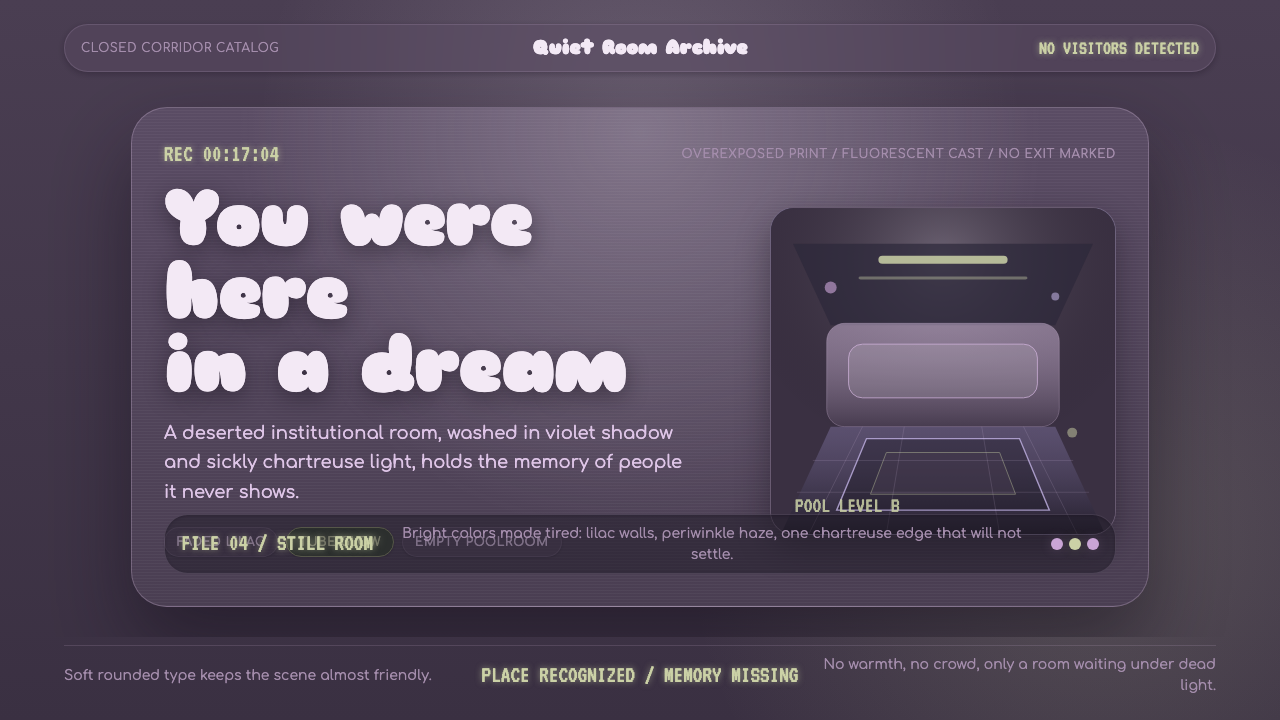 Dreamcore LiminalEmpty rooms feel remembered. Washed violet, Sniglet curves, and chartreuse tu…
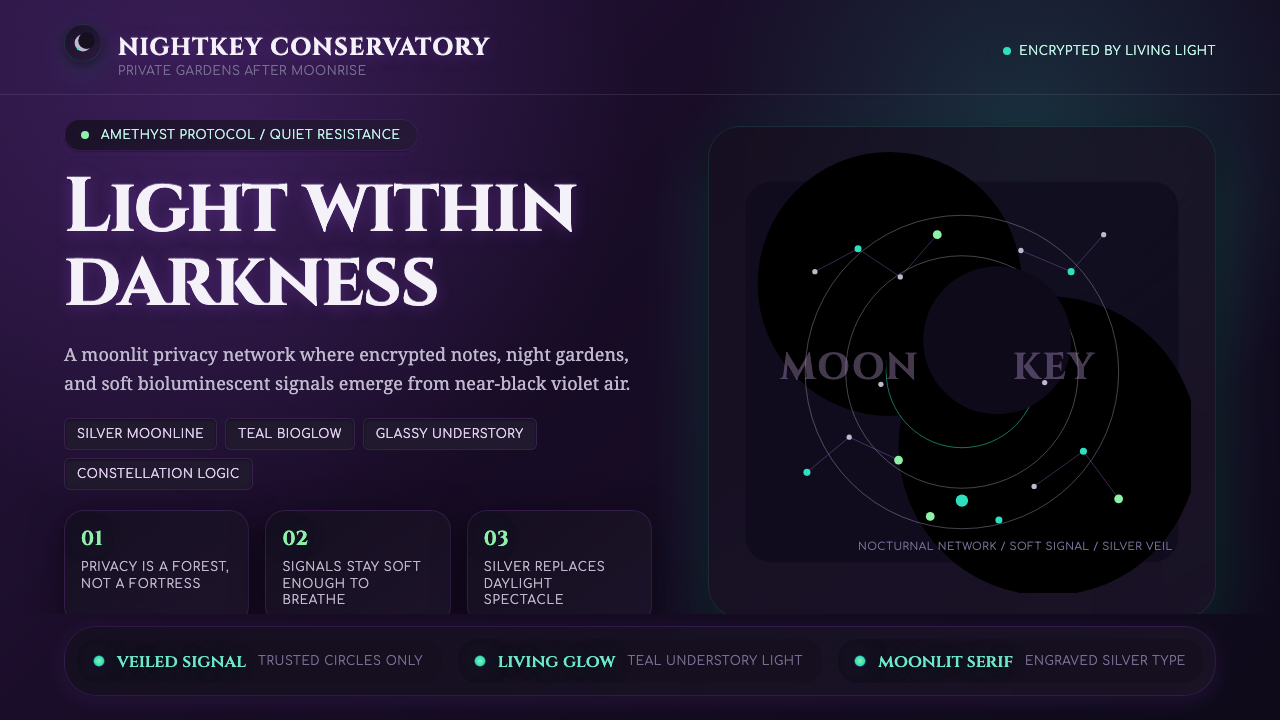 LunarpunkLight hides in darkness. Amethyst night, silver serif, and teal bioglow surfa…
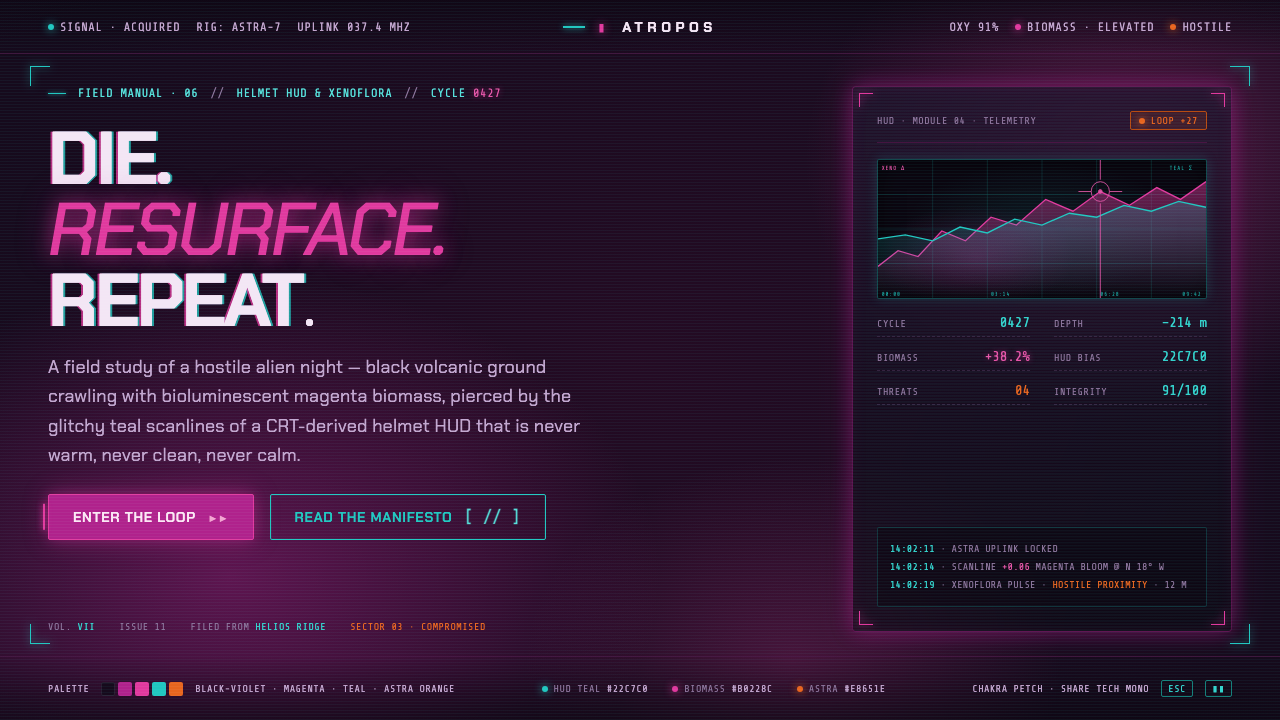 ReturnalNever warm, never clean, never calm. Magenta biomass on a violet night, pierc…
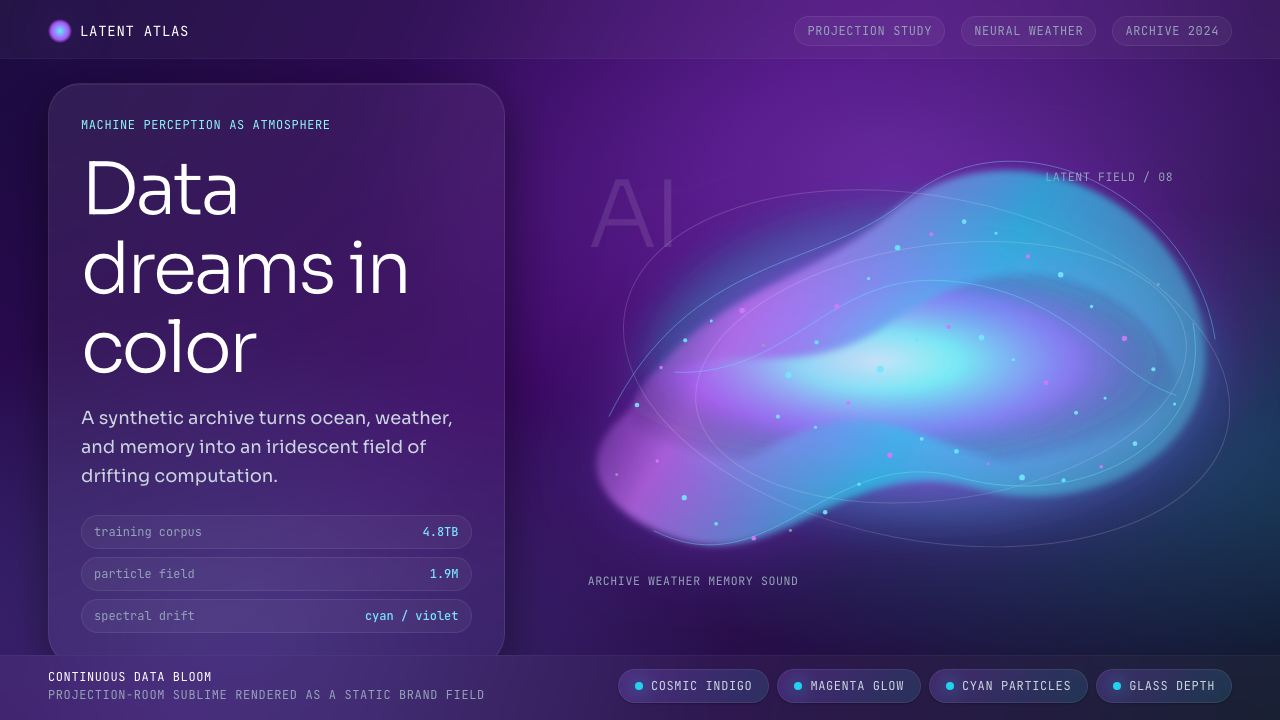 Generative AI Data Art (Refik Anadol era)Computational sublime. Indigo gradients and cyan-magenta particles make data…
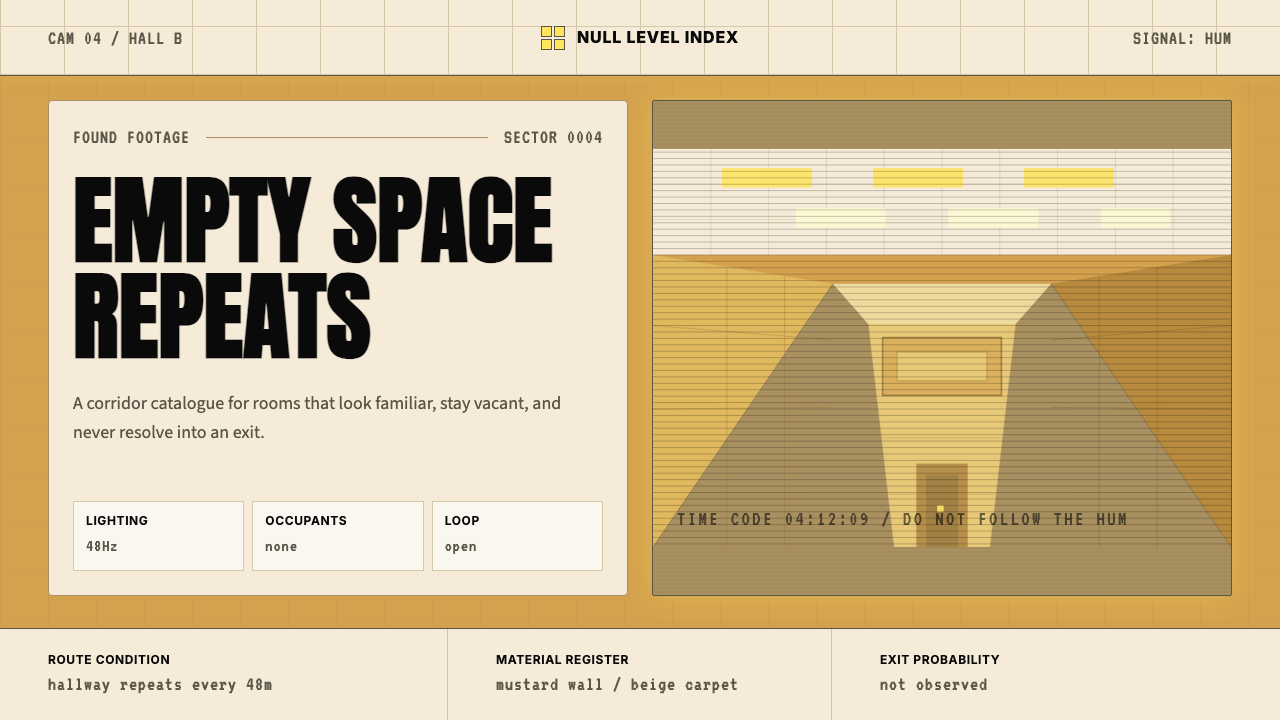 Liminal Space BackroomsUncanny vacancy. Mustard walls, fluorescent grids, and corporate sans trap th…
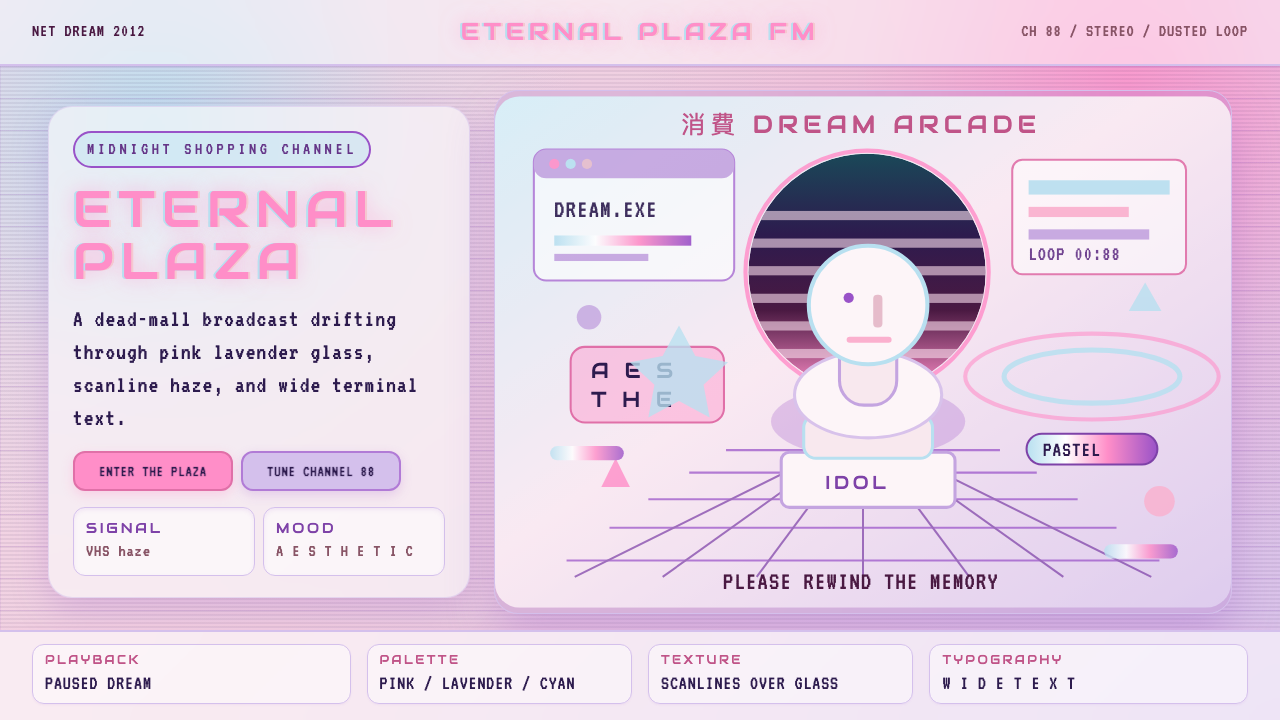 Vaporwave (Tumblr 2012)Dead-mall nostalgia glows. Pink-lavender glass, VHS scanlines, and wide retro…