What is Liminal Space Backrooms?
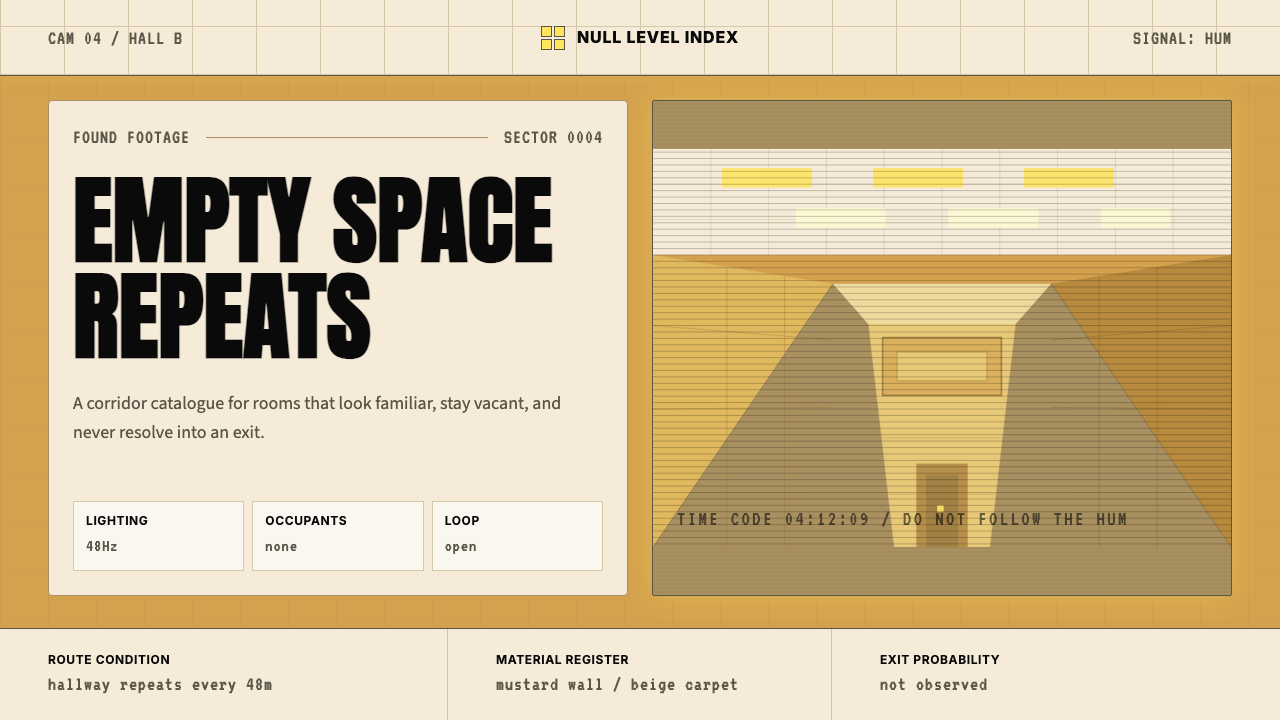
A single anonymous photograph of an empty fluorescent-lit hallway in 2019 spawned an entire internet mythology — and a design language built on wrongness, vacancy, and the uncanny weight of spaces that should not exist.
Liminal Space Backrooms in brief
Liminal Space Backrooms is a design aesthetic rooted in the internet subculture of liminal spaces — transitional zones like empty parking garages, vacant hotel corridors, and shuttered malls photographed at hours when no human presence should be expected. Within that broader culture, the Backrooms became the defining mythology: an infinite series of interconnected fluorescent-lit rooms clad in saturated mustard-yellow wallpaper, covered in institutional carpet, humming with the low electric note of overhead tube lights, and entirely devoid of people. The discomfort is architectural. Nothing is broken, nothing is threatening in any legible way — and yet everything feels profoundly wrong.
As a design system, Liminal Space Backrooms translates that uncanny institutional vocabulary into a coherent visual language. The palette centers on warm mustard yellows and carpet beiges — colors associated with mid-century corporate interiors, with the specific shade of optimism that aged poorly. Against those grounds, fluorescent white light bleeds in soft grids, casting the slightly washed-out tonal quality of a space lit entirely from above. Text and structural elements favor cold institutional sans-serif letterforms, echoing the signage of offices, schools, and public-sector buildings. The overall effect is not horror in a cinematic sense — it is the more specific discomfort of a familiar place made subtly alien by the removal of all human life.
What separates this aesthetic from simple nostalgia or retro pastiche is its relationship to wrongness as a deliberate design intention. A Backrooms-inflected composition does not merely evoke the 1970s or 1980s — it evokes a version of those decades that feels looped, recursive, stripped of narrative or exit. The eye looks for a door, a person, a reason, and finds none. Applied carefully, this produces design work with unusual psychological presence: layouts that command sustained attention precisely because something about them refuses to resolve.

Where does Liminal Space Backrooms come from?
The Backrooms mythology began on May 12, 2019, when an anonymous user posted a single photograph to the paranormal board of 4chan (/x/). The image showed an empty interior — yellow-tinted walls, commercial carpet, fluorescent ceiling grid, no windows, no exits visible — with the caption describing the sensation of having "noclipped" out of reality, like a glitch in a video game that drops a player into geometry that was never meant to be seen. The post's resonance was immediate and disproportionate. Within days it had circulated far beyond 4chan, accumulating thousands of replies and spawning the first attempts at fan-written lore.
The cultural context that made the image land so precisely was the broader liminal space aesthetic already developing on Tumblr and Reddit through the late 2010s. Accounts dedicated to photographs of empty malls, closed swimming pools, and deserted hotel corridors had accumulated large followings by 2018, tapping into a collective unease about late capitalism, pandemic-adjacent emptiness, and the specific loneliness of public spaces designed for crowds but photographed without them. The Backrooms gave this diffuse aesthetic a mythology — a name, a narrative framework, and crucially, an internal logic. It was not just an empty place; it was an infinite system of empty places, governed by its own rules of access and escape.
The mythology expanded rapidly through wiki documentation and fan fiction. The Backrooms Wikidot, later succeeded by the Backrooms Wiki on Fandom (significantly shaped by the contributor known as Hashland), codified the canonical levels — Level 0 being the original mustard-yellow office space, with subsequent levels introducing different institutional environments: swimming pools with humming pumps, endless parking structures, fluorescent-lit warehouses. Each level carried its own emotional texture, its own rules about entities and exits, its own relationship to dread. The wiki form itself became part of the aesthetic: dry, bureaucratic, written as if describing something mundanely real.
In 2022, Kane Parsons — known online as Kane Pixels — released a found-footage short film set in the Backrooms on YouTube. Produced with remarkable craft for a then-teenager, the film used practical effects and digital compositing to make the mythology feel three-dimensionally real. It accumulated tens of millions of views and established the Backrooms as a mainstream cultural reference, no longer contained to subcultural imageboards. Parsons subsequently developed the concept into an ongoing series. The visual vocabulary he established — handheld camera, underexposed fluorescent wash, the specific weight of institutional silence — became the definitive cinematic grammar of the aesthetic, and directly influenced how designers and digital artists began to apply the style deliberately rather than ironically.
What defines the Liminal Space Backrooms look?
Color: Mustard, Beige, and Fluorescent Wash
The defining palette is a narrow band of warm, slightly sickly yellows — the specific shade associated with 1970s interior design, institutional wallpaper, and the inside of public buildings that were last renovated before personal computers existed. Against these walls, floor tones are muted beiges and grays, the color of commercial carpet that has absorbed decades of use. Over everything, fluorescent lighting imposes a bleaching quality: whites are not crisp but slightly blown-out, shadows are shallow and directionless, and the overall tonal range is compressed toward the middle. There is no darkness in the Backrooms, which is its own form of wrongness.
Texture: Institutional Surfaces
Where most design aesthetics either embrace or reject texture, Backrooms aesthetics deploy a very specific subset: the textures of maintained-but-not-loved institutional spaces. Low-pile carpet with a repeating geometric pattern worn smooth in the high-traffic paths. Wallpaper with a subtle embossed grain, the kind that was chosen by committee for inoffensiveness. Acoustic ceiling tile with its regular grid of perforations. These textures are present but never prominent — they recede into the background as they do in real institutional spaces, creating environments that are technically detailed but experientially blank.
Light: Fluorescent Grid Logic
Lighting in the Backrooms aesthetic comes exclusively from above — a grid of fluorescent tubes or recessed panels that casts even, directionless illumination across every surface. There are no pools of warmth, no dramatic angles, no natural light intrusion. The light is comprehensive and evacuating: it removes shadow as a meaningful spatial element, flattening the environment into a sequence of equally-lit planes. In design applications, this translates to layouts where illumination effects, if used, are diffuse and overhead rather than directional, and where the overall tonal key sits in a compressed mid-register rather than spanning the full range from deep shadow to bright highlight.
Typography: Cold Institutional Sans
The letterforms that feel native to this aesthetic are the utilitarian sans-serifs of public institutions — the kind of type that appeared on exit signs, office directories, and government forms throughout the second half of the twentieth century. These are not the humanist sans-serifs of contemporary tech design, with their warmth and optical compensation; they are constructed, neutral, designed to communicate without personality. Weight is typically regular to medium — not bold enough to command, not light enough to whisper. Set at a size that is functional without being generous, they create the typographic equivalent of a corridor: directed, purposeful, offering nothing beyond navigation.
Spatial Logic: Infinite Repetition
The defining spatial quality of the Backrooms is the corridor or room that appears to extend infinitely — where the pattern of ceiling tiles, carpet, and wall panels repeats without variation into a distance that the eye cannot resolve. This is not emptiness in the minimalist sense; minimalism uses space expressively, with intention. Backrooms space is space that simply continues, without the relief of a focal point or an edge. In design, this translates to layouts that foreground repetition and rhythm: tiled patterns, repeated structural modules, grids that extend to all four edges of the composition without suggesting a boundary.
Wrongness as Aesthetic Signal
Perhaps the most distinctive and difficult-to-articulate quality of this aesthetic is what might be called deliberate wrongness: the introduction of a subtle, unresolvable element of unease into an otherwise coherent composition. A proportion that is almost right but not quite. A color relationship that is nearly familiar but slightly off. A spatial relationship that implies a room that could not physically exist. This is not random error or carelessness — it is a precise calibration. Too much wrongness and the work becomes horror; too little and it becomes simple retro nostalgia. The target register is the threshold between recognition and disorientation.
Absence of Human Presence
The Backrooms are defined by what is missing more than by what is present. In photographic source material, this means images shot to emphasize the void — no people, no objects left by people, no evidence that the space is used or awaiting use. In design, this translates to a careful restraint around warmth signals: no rounded corners implying approachability, no organic shapes suggesting hand-made care, no warm tonal adjustments softening the institutional palette. The space is complete in itself, not awaiting anyone. This creates a paradox useful for certain design contexts: the work commands attention while withholding the warmth that normally invites engagement.

Who shaped Liminal Space Backrooms?
The origin point of the Backrooms mythology is a single anonymous post — its author never identified — on the paranormal board of 4chan in May 2019. The post paired an image of an empty yellow-walled interior with a brief description of the noclipping sensation, and in doing so crystallized an aesthetic that had been diffusely developing across the internet into a specific, named mythology. The anonymity is integral to the cultural meaning: the Backrooms emerged without an author, which fits its logic of a place that exists outside human intention.
Kane Parsons, working under the name Kane Pixels, released a found-footage short film set in the Backrooms in 2022 that became the definitive cinematic interpretation of the aesthetic. Created while he was still a teenager, the film demonstrated an unusually developed sense of atmospheric composition — pacing, sound design, the specific visual grammar of institutional space under fluorescent light — that moved the Backrooms from text-and-image subcultural content to a genuinely cinematic form. His subsequent series established the visual conventions that now define how the aesthetic is understood: the particular quality of light, the sound of ventilation systems, the specific horror of corridors that do not end.
The expansion of the Backrooms from a single image into a richly detailed cosmology required systematization, and that work was done primarily through wiki communities. The contributor known as Hashland played a significant role in codifying the canonical level structure of the Backrooms on the Fandom wiki — establishing the rules that govern what each level looks, feels, and behaves like, and creating the bureaucratic-documentary writing style that became as much a part of the aesthetic as the visual elements. This wiki-as-worldbuilding approach, written in the dry register of an institutional manual, is itself a formal choice that reinforces the aesthetic's core logic.
Before the Backrooms had a name, a distributed community of photographers and image collectors had been developing the visual vocabulary of liminal space aesthetics across Tumblr, Reddit, and Twitter through the mid-to-late 2010s. Accounts dedicated to empty malls, deserted airports, and vacant hotel corridors accumulated substantial followings and established the compositional conventions — centered perspective, overhead fluorescence, the deliberate exclusion of people — that the Backrooms mythology then absorbed and systematized. This community represents the aesthetic's connection to documentary photography and to the broader cultural mood of late-2010s ambient unease.
A significant vector for the Backrooms aesthetic has been independent game development, where the style's spatial logic maps naturally onto interactive environments. Games set in liminal-space-adjacent interiors — whether explicitly Backrooms-themed or drawing on the same vocabulary of institutional corridors and fluorescent dread — have extended the aesthetic into three-dimensional interactive space and introduced its conventions to audiences who encountered it first through gameplay rather than photography or film. These games have also pushed the aesthetic toward specific interaction design patterns: the loop, the exit that leads back to the beginning, the map that cannot be trusted.
How do you use Liminal Space Backrooms today?
Liminal Space Backrooms is an unusual design choice: psychologically potent, visually distinctive, and genuinely difficult to apply well. Its power comes from dissonance — from the mismatch between familiar institutional forms and the specific unease they generate when stripped of human presence. Used without understanding, it reads as random retro. Used with precision, it creates work that occupies the reader's attention in an unusually sustained way. The starting point for any application is a clear answer to the question: what should this material make the viewer feel, and is institutional uncanniness actually the right register for that purpose?
For presentation slides, the style works most effectively in contexts where authority needs to be communicated alongside an edge of strangeness — speculative design, future-facing strategy work, design fiction, or presentations about topics that involve genuine institutional weight (infrastructure, systems, architecture, urban environments). A cover slide in this aesthetic uses a centered or slightly off-center perspective view of a tiled corridor or empty room as the full bleed background, with a title set in a cold institutional sans-serif at medium weight, positioned neither at the compositional center nor the conventional top-left. Content slides work best when they lean into the grid: text aligned to a strict invisible structure, pulled quotes formatted as institutional signage, data displayed in tables that recall ledger paper rather than contemporary dashboard design.
For web interfaces, the aesthetic is genuinely rare but has found traction in specific contexts: games and interactive fiction, speculative technology products, independent cultural institutions with a taste for the uncanny, and brands deliberately positioning themselves as inhabiting an alternative cultural space. Dashboard and informational layouts in this style use the fluorescent mid-yellow as a background rather than white, with text in a dark brown-black rather than pure black, creating a warmer-but-still-wrong tonal relationship. Navigation patterns should feel like wayfinding in an institutional building: functional labels, no decoration, corridors rather than rooms. Avoid any component that signals approachability — rounded cards, soft shadows, friendly iconography — unless the intent is specifically to create dissonance between the form and its institutional context.
For editorial and marketing applications, the style reads most successfully when the content itself justifies the uncanniness — writing about infrastructure, vacancy, late capitalism, the experience of anonymous public space, or anything that genuinely involves the themes the aesthetic embodies. An editorial spread in this style might use the full-bleed tiled background as a section break, with body text set in a narrow column at a size that feels slightly too small for comfort, pull quotes formatted as institutional notices. Marketing applications are the most treacherous territory: if the product or service has nothing to do with the aesthetic's emotional register, the style reads as cynical or hollow. The exception is deliberately ironic use — a brand that adopts the aesthetic with clear self-awareness — but this requires a very particular audience and product context to land.
The most common mistake in applying Backrooms aesthetics is reaching for the wrong kind of wrongness. The style's uncanniness is not grimy, not decayed, and not explicitly horrifying — it is maintained, clean, orderly, and nevertheless wrong. Designers who add physical decay, mold-like textures, explicit horror motifs, or darkened shadows are applying a different aesthetic entirely: haunted house rather than liminal space. The Backrooms are lit, swept, and humming with electricity. The wrongness is the absence of people in a place designed entirely for people. A second common mistake is overuse of the mustard yellow as a background at full saturation across all surfaces — in the source material, walls are never the only element; the carpet, the ceiling, the light all modulate the palette. A monochrome mustard application loses the spatial logic that makes the aesthetic work.

Liminal Space Backrooms — FAQ
Is Liminal Space Backrooms the same as vaporwave or retrowave?
They share a preoccupation with the built environment of the late twentieth century but are emotionally and formally distinct. Vaporwave is nostalgic and ironic — it processes the aesthetics of 1980s consumer capitalism through a lens of melancholy affection, using saturated purples and teals, smooth gradients, and classical statuary as recurring motifs. Retrowave is energetic and aspirational, borrowing the neon palette and grid-horizon compositions of 1980s science fiction. Liminal Space Backrooms is neither nostalgic nor aspirational — it is uncanny. Its relationship to the past is not affection or excitement but disorientation: these are spaces that should be familiar but are not. The palette is warmer and more muted than either vaporwave or retrowave, and the absence of human life is the whole point rather than a compositional choice.
Can Backrooms aesthetics work for a brand that wants to appear welcoming?
It is the wrong tool for that job. The entire aesthetic logic of the Backrooms depends on the removal of warmth and human presence as a source of tension. A brand that deploys this style while also trying to communicate warmth, approachability, or community will find that the two registers actively cancel each other out — neither the uncanny quality nor the warmth will register clearly. The exception is deliberate contrast: a brand could use the cold institutional visual language of the Backrooms as a foil — a before-state, an environment the product exists to escape — but this requires the escape to be visually represented too. As a primary, continuous identity system for a welcoming brand, it should not be used.
How does the Backrooms style handle photography and real imagery?
Photography is central to the aesthetic's origins and most powerful when used according to its source logic: images of real institutional spaces shot to emphasize vacancy, flatness, and overhead fluorescent quality. The most effective Backrooms photography uses a centered perspective that implies infinite continuation, eliminates all human presence (including any trace of human objects), and captures the specific tonal compression of fluorescent-only lighting. In design applications, photography should be color-graded toward the mustard-and-beige palette rather than corrected for naturalness, and should be cropped to suggest that the space continues beyond the frame. Photographs of people, organic objects, or natural light should not appear — their presence immediately dissolves the effect.
What makes Backrooms different from ordinary retro-institutional design?
Ordinary retro-institutional design borrows the surface markers of mid-century institutional aesthetics — the colors, the typefaces, the material textures — and deploys them with affection or irony, typically to signal authenticity, craft, or a kind of principled anti-trend stance. It is warm in its relationship to the past. Backrooms aesthetics uses the same surface markers but deliberately strips them of the warmth of the human activities they originally housed. The result is not retro charm but retro wrongness: a space that looks like the 1970s but feels like a loop, a glitch, an institutional environment running without its institutional purpose. The key diagnostic is presence and absence: retro-institutional design suggests a world of people; Backrooms design suggests a world from which all the people have been quietly removed.
Does this aesthetic work in dark mode?
Dark mode is formally incorrect for the Backrooms aesthetic in its canonical form. The defining horror of the Backrooms is that they are fully lit — fluorescent light eliminates shadow, removes darkness as a refuge, and makes the space feel exposed and inescapable rather than threatening through concealment. A dark-background variant loses precisely this quality and slides toward more conventional horror or gothic aesthetics. If a dark variant is necessary for product reasons, the more defensible approach is not to go to a near-black background but to shift to a dark desaturated brown or institutional gray — dark enough to imply a degraded or failing fluorescent environment, light enough to retain the sense of exposure rather than concealment. This preserves something of the source logic while accommodating the practical constraint.
Related design styles
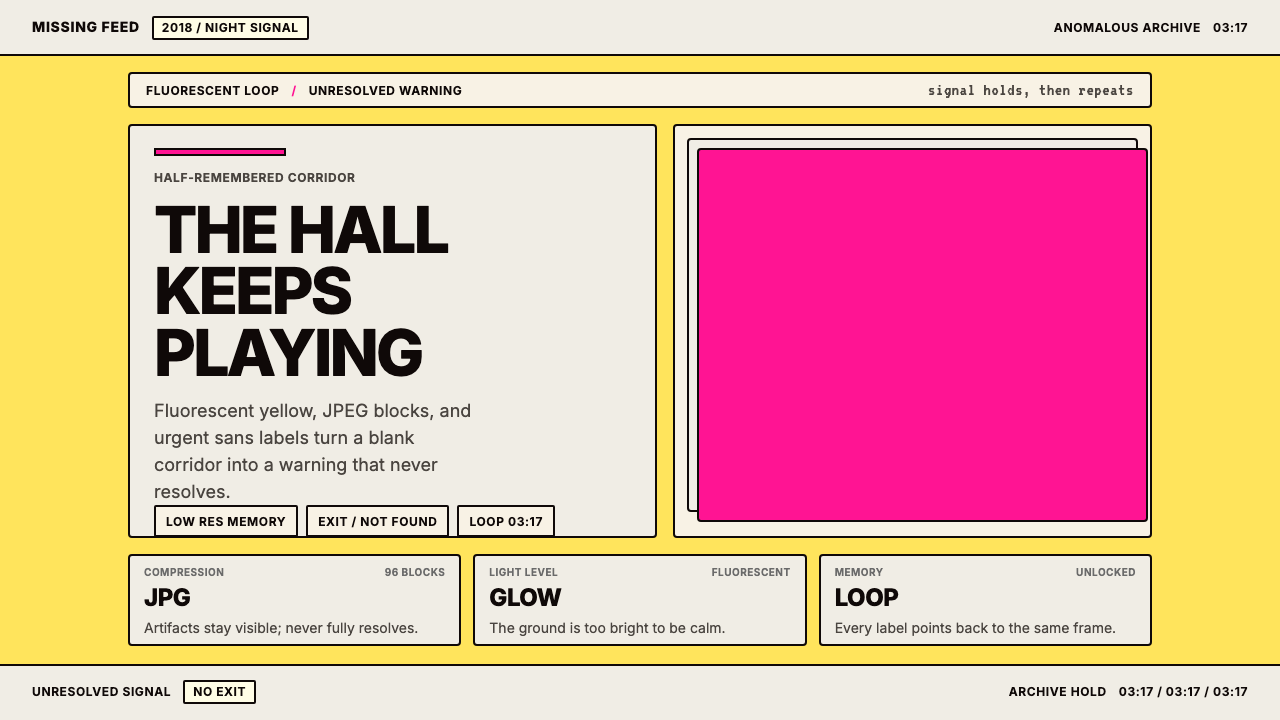 Weirdcore Internet (2018)Wrongness in fluorescent yellow. JPEG blocks and warning labels do the damage.
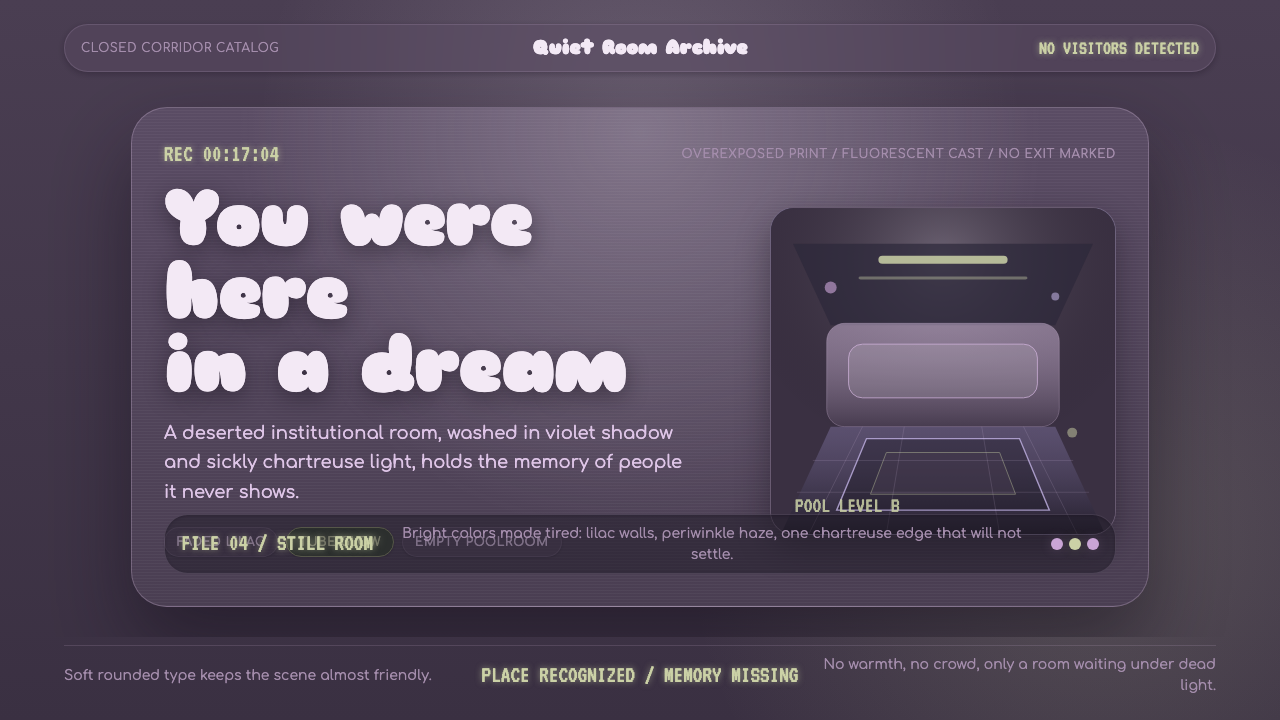 Dreamcore LiminalEmpty rooms feel remembered. Washed violet, Sniglet curves, and chartreuse tu…
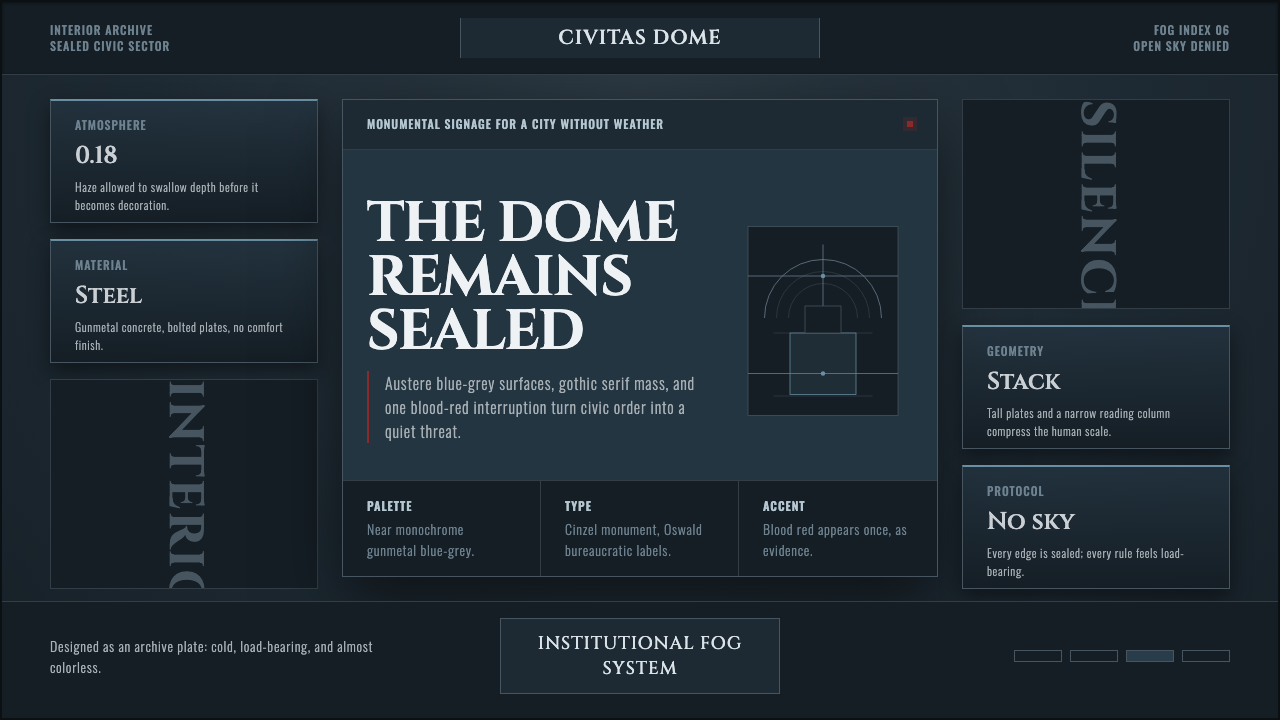 Ergo Proxy Romdo DomesCold order becomes dread. Gunmetal fog, gothic serif mass, one blood-red mark.
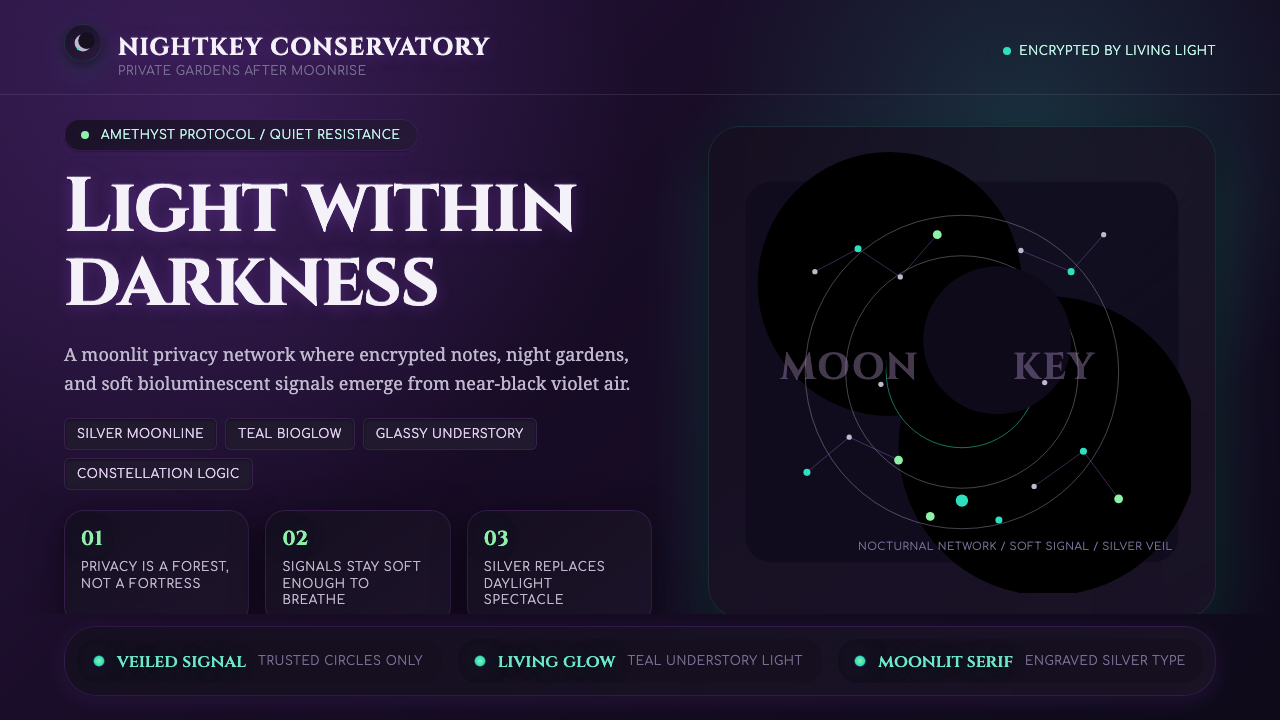 LunarpunkLight hides in darkness. Amethyst night, silver serif, and teal bioglow surfa…
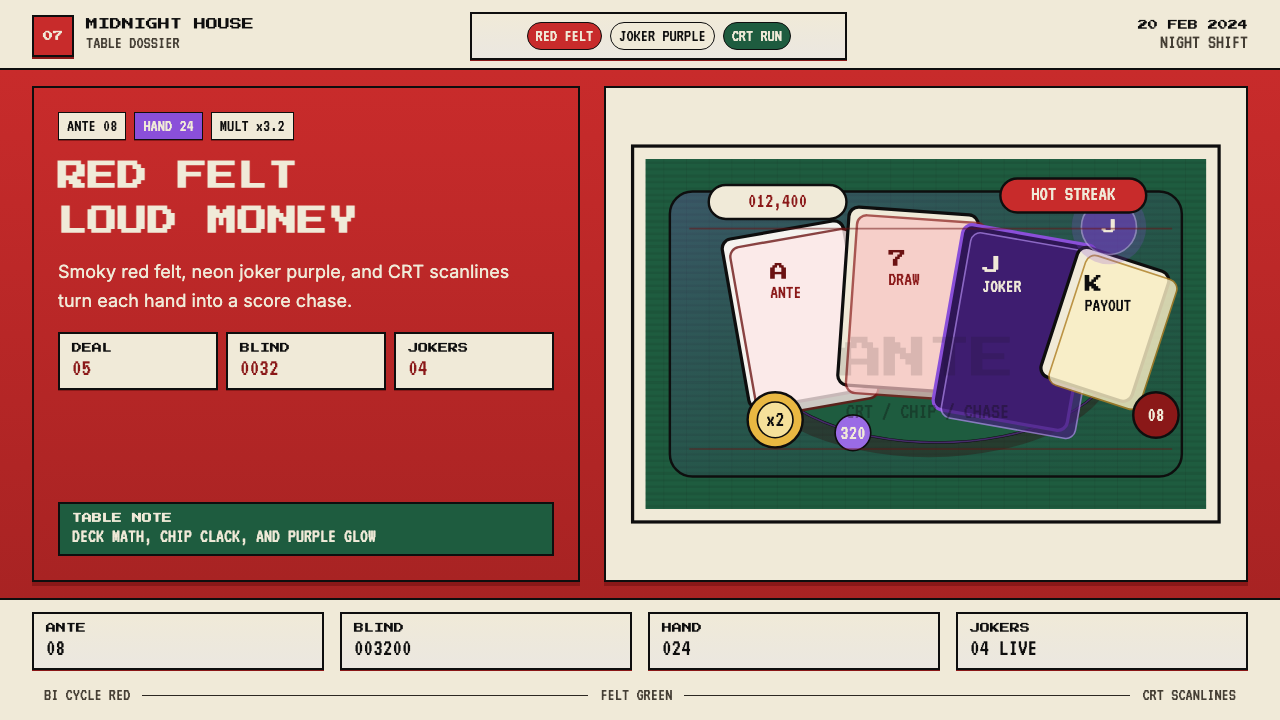 Balatro Poker RoguelikeLate-night poker math with a grin. Bicycle red, felt green, and CRT scanlines.
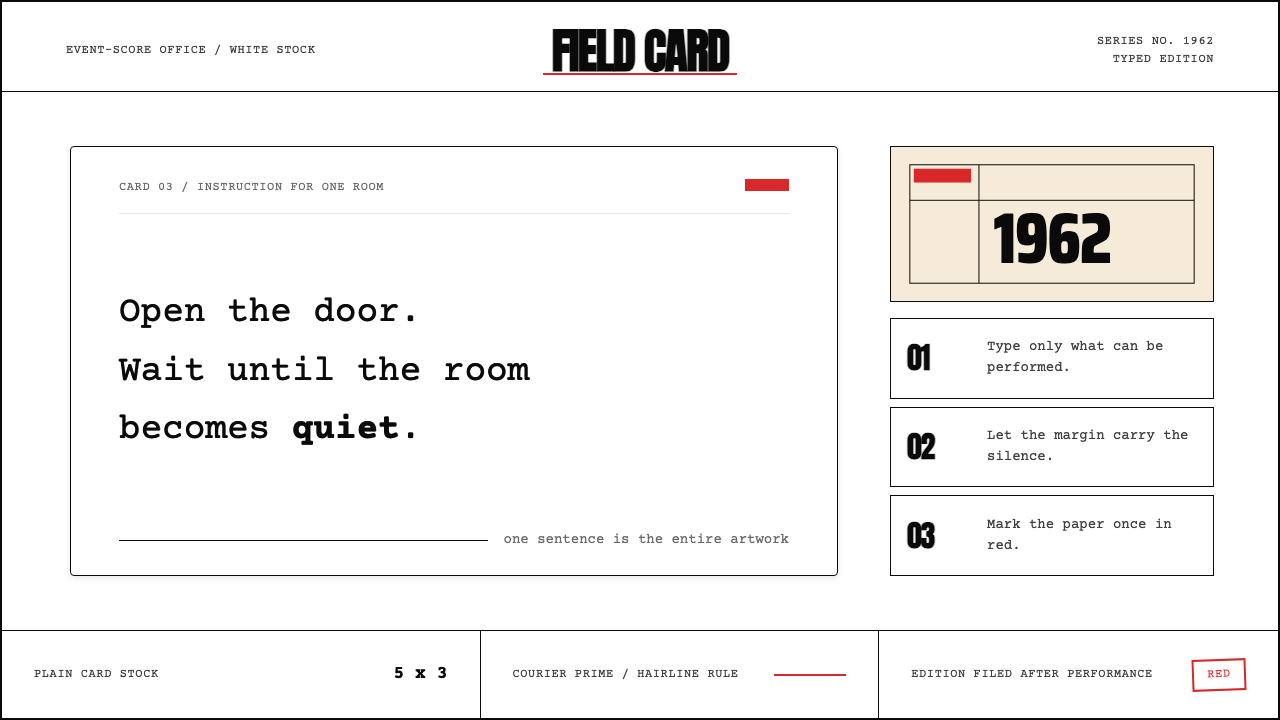 Fluxus Event Score (1962)Instruction becomes art. Courier on white card, hairline rules, one sharp red…